
As the need for well-trained pharmacy assistants continues to rise, the accessibility and flexibility of online education have paved the way for Canadians to embark on a career in this field.
In this post, we have identified the top online pharmacy assistant courses, their benefits, and how each equips students with the information and abilities they need to succeed in the dynamic field of pharmaceuticals.
Job Bank Canada forecasts good prospects for pharmacy assistants (NOC 33103) through 2024–2026, with median wages at $22.00/hr nationally ($18–$28/hr range), driven by aging populations and retail expansions.
| Course Name | Students Enrolled | Reviews |
|---|---|---|
| Coursera – Pharmacy Technician Fundamentals Specialization | 17,000+ | 300+ |
| Udemy – Pharmacy Assistants In Canada Preparation Course | 5,500+ | 4,200+ |
| Canadian Imperial College – Pharmacy Assistant Certificate Program | 4,000+ | 1,100+ |
| Western Community College Pharmacy Assistant Program | 2,800+ | 900+ |
| ICS Canada – Retail Pharmacy Assistant School | 8,000+ | 2,700+ |
| Algonquin Academy – Pharmacy Assistant Program and Career Courses | 4,500+ | 1,300+ |
| George Brown College – Pharmacy Assistant Program | 2,200+ | 600+ |
| Eastern College – Pharmacy Assistant (Online) | 3,000+ | 1,000+ |
| Fanshawe College – Community Pharmacy Assistant | 2,500+ | 800+ |
Coursera – Pharmacy Technician Fundamentals Specialization
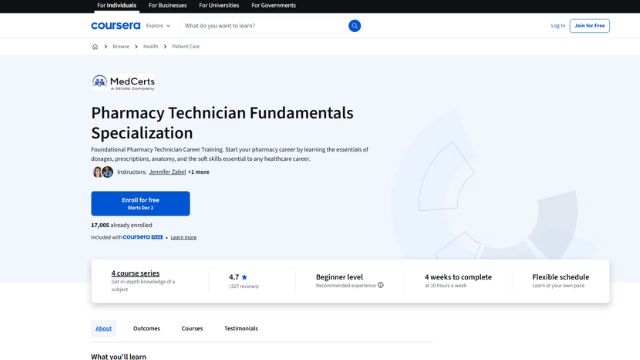
The Pharmacy Technician Fundamentals Specialization from MedCerts on Coursera is a beginner-level career training program that provides a solid entry point into pharmacy assisting, focusing on essential knowledge for roles in retail, hospital, or community settings. This 4-course specialization totals about 45 hours of content, typically completed in 4 weeks at 10 hours per week, but it’s fully self-paced to fit busy schedules. Taught in English (with 24 language subtitles available), it’s rated 4.7/5 based on 327 reviews and has 16,977 enrollments, making it a popular choice for aspiring assistants worldwide, including Canadians adapting to NAPRA standards.
The program is structured progressively to build foundational skills step-by-step:
- Course 1: Professionalism in Allied Health (8 hours): Explores workplace expectations in healthcare, emotional intelligence, self-management, and interpersonal skills. Key topics include conflict resolution, professionalism, time management, communication, empathy, cultural responsiveness, patient-centered care, teamwork, ethical standards, relationship building, and healthcare ethics.
- Course 2: Medical Terminology and the Human Body Fundamentals (10 hours): Breaks down medical language, body structures/functions, directional terms, pathology, disease processes, and endoscopy. Skills include medical terminology, cell biology, nutrition, physiology, vital signs, anatomy, pathology, medical records, and biology.
- Course 3: Pharmacy Technician Essentials (14 hours): Covers pharmacy organization functions, technician roles, common drugs/uses, drug routes/formulations, factors affecting drug activity, pharmacy software, and prescription interpretation. Skills gained: pharmaceutical terminology, pharmacy operations, pharmacology, medication dispensation/administration, pharmacy information systems, drug development, and pharmacist assistance.
- Course 4: Pharmacy Dosages and Prescriptions Essentials (13 hours): Focuses on verifying orders, calculating/measuring dosages, preparing/packaging medications, pharmacology basics, documentation, inventory, and calculations (fractions, decimals, percentages, metric system, ratios/proportions). Skills: medical prescriptions, pharmaceutical terminology, medication administration, systems of measurement, intravenous therapy, pediatrics, patient safety, and pharmacy operations.
Overall, learners gain a deep understanding of allied healthcare professionalism, medical terminology, pharmacy technician roles, and practical applications in pharmacology, documentation, and inventory management. It culminates in an applied learning project where you research state/provincial regulatory requirements (adaptable to Canada), provide peer reviews, and compare standards—building a portfolio for job applications. While not a full certification pathway (for that, MedCerts recommends their comprehensive program), it’s excellent for building confidence and resume-ready skills, with many learners reporting immediate use in entry-level roles.
Targeted at absolute beginners with no prior experience, it’s ideal for Canadians eyeing pharmacy assisting amid growing demand. No prerequisites beyond basic computer skills. Free to audit (full videos/readings/quizzes), with optional shareable certificates (~$49 CAD per course via Coursera Plus; financial aid available). Learner testimonials highlight its practicality: “I applied the terminology to my volunteer work right away” (Sarah K.), and “Flexible pacing fit my full-time job perfectly” (Michael R.). For 2026 relevance, it emphasizes patient safety and digital tools, aligning well with Canadian e-prescribing trends—though supplement with provincial regs like OCP for Ontario.
Discover the specialization at this link.
Udemy – Pharmacy Assistants In Canada Preparation Course
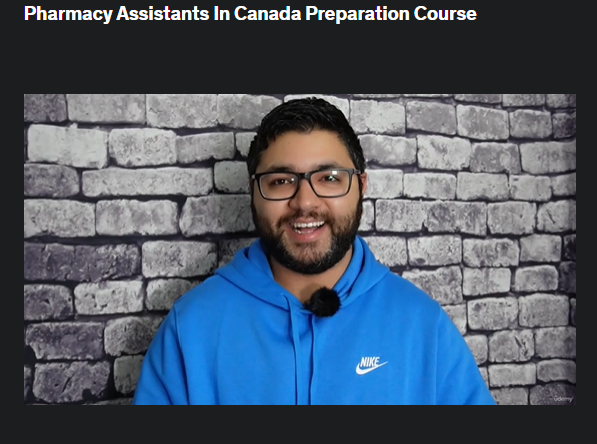
Udemy’s Pharmacy Assistants Preparation Course is designed to provide comprehensive training for individuals interested in pursuing a career as a pharmacy assistant in Canada. This course covers different topics to equip students with the necessary knowledge and skills to excel in this role, such as (updated for 2026 with e-prescribing and digital inventory):
- Pharmacy Workflow
- Insurances
- Medication Formulations
- Pharmacy Products & Medications
- Pharmacy Calculations
- Pharmacy Software
The course introduces students to the Canadian pharmacy system and the different categories of pharmacies. Students will learn to differentiate between various types of pharmacies, enabling them to navigate the industry effectively.
Students will also be taught a technique to respond appropriately in case of a robbery or when encountering forged prescriptions. This training ensures that pharmacy assistants are prepared to handle potentially challenging situations while prioritizing the safety of themselves and others.
Additionally, this Udemy course covers the fundamentals of reading prescriptions and decoding prescription instructions, known as the SIG. Students will learn how to interpret and process prescriptions correctly, ensuring the safe dispensing of medications.
The course suits current pharmacy assistants, pharmacy students, pharmacy technicians, and those working or aspiring to work in the pharmacy field.
Access the course materials here.
Canadian Imperial College – Pharmacy Assistant Certificate Program
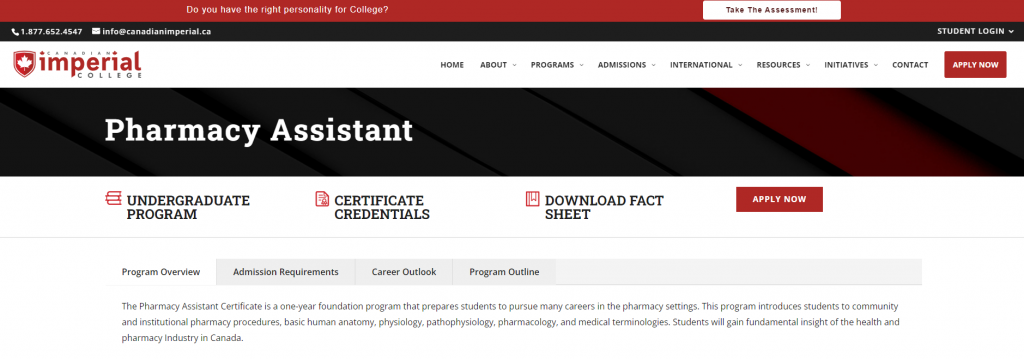
The Pharmacy Assistant Certificate curriculum at Canadian Imperial College is a thorough one-year foundation curriculum designed to provide students with the skills and information needed to pursue a variety of vocations in pharmacy settings. This program is an ideal starting point for individuals looking to enter the pharmaceutical industry (2026 intake adds compounding safety updates).
Throughout the program, students are introduced to various subjects relevant to pharmacy operations. The course teaches the following topics:
- Understanding of community and institutional pharmacy procedures,
- Basic human anatomy,
- Physiology,
- Pathophysiology,
- Pharmacology, and
- Medical terminologies.
The Pharmacy Assistant Certificate Program at Canadian Imperial College emphasizes practical training and hands-on experience. Graduates are prepared to assist pharmacists with day-to-day operations, including customer service, interacting with clients, sterilizing products, and mixing compound medications. These essential duties allow pharmacy assistants to play an important part in ensuring the smooth operation of pharmacies and contributing to the well-being of patients.
Moreover, graduates of this program receive additional certifications in First Aid and CPR, further enhancing their skill set and making them valuable assets within the healthcare industry. This comprehensive approach prepares students for immediate employment and ensures they are equipped with the necessary certifications to meet regulatory requirements. Discover the course at this link.
Western Community College Pharmacy Assistant Program
This Pharmacy Assistant Program at Western Community College is carefully crafted to equip students with the necessary skills and knowledge to excel as pharmacy assistants. This program is designed to provide comprehensive training that prepares students for employment in both hospital and community pharmacies (updated for 2026 with telepharmacy modules).
One of the key focuses of the program is pharmacology, enabling students to develop a solid understanding of medications and their effects on the human body. Students learn about different drug classes, dosage forms, and pharmacotherapy principles. This knowledge equips them to assist pharmacists in accurately dispensing medications and providing crucial information to patients.
In addition, the program emphasizes pharmacy math, ensuring that students have a strong foundation in calculations necessary for accurate medication preparation and dosage determination. This includes understanding measurement systems, calculating dosages based on prescription orders, and managing inventory.
A significant program component is an introduction to pharmacy billing software, providing students with hands-on experience utilizing computer applications specific to pharmacy settings. This training ensures that graduates are proficient in managing patient profiles, processing prescriptions, and handling insurance claims. Explore the course by clicking here.
ICS Canada – Retail Pharmacy Assistant School
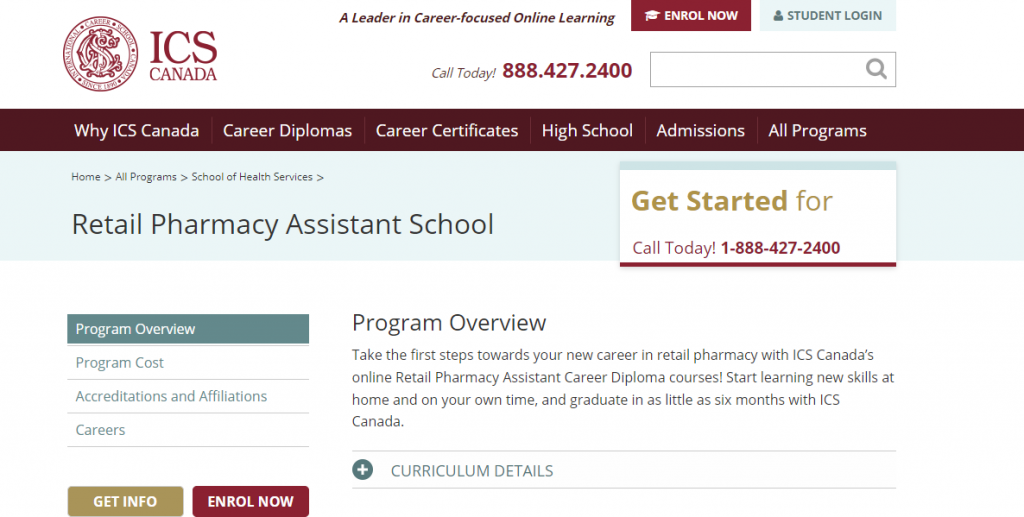
ICS Canada’s Retail Pharmacy Assistant School offers a comprehensive program to prepare students for entry-level employment as retail assistants in a pharmacy setting. The program focuses on equipping students with the necessary knowledge and skills to excel in their roles and contribute to the efficient functioning of a retail pharmacy (now Penn Foster; 2026 refresh includes e-claims processing).
In this program, students are exposed to various learning outcomes that enable them to understand and perform the responsibilities of a retail pharmacy assistant. They learn the roles and functions of a retail pharmacy assistant, which includes familiarity with pharmacy procedures, operations, and the permissions of various healthcare professionals to prescribe medications.
The program emphasizes the importance of understanding prescriptions, including how dosage forms and routes of administration are detailed. Students learn how to calculate pharmaceutical arithmetic and conversions accurately, ensuring they can provide correct dosages to patients.
Additionally, the program covers the different forms in which medications are dispensed, including solid, liquid, and topical forms, and the applications of each form. Students learn about drug classes, how drugs reach their appropriate sites of action and gain knowledge about prescription drugs.
Furthermore, the program introduces students to over-the-counter drugs and their general medical applications, enabling them to assist customers in selecting appropriate products for common medical conditions.
In addition to the theoretical aspects of the program, ICS Canada’s Retail Pharmacy Assistant program also provides practical training. Students learn essential skills such as inventory management, merchandise arrangement, and sales techniques. These skills are crucial in ensuring efficient pharmacy operations and providing excellent customer service. Check out the course here.
Algonquin Academy – Pharmacy Assistant Program and Career Courses
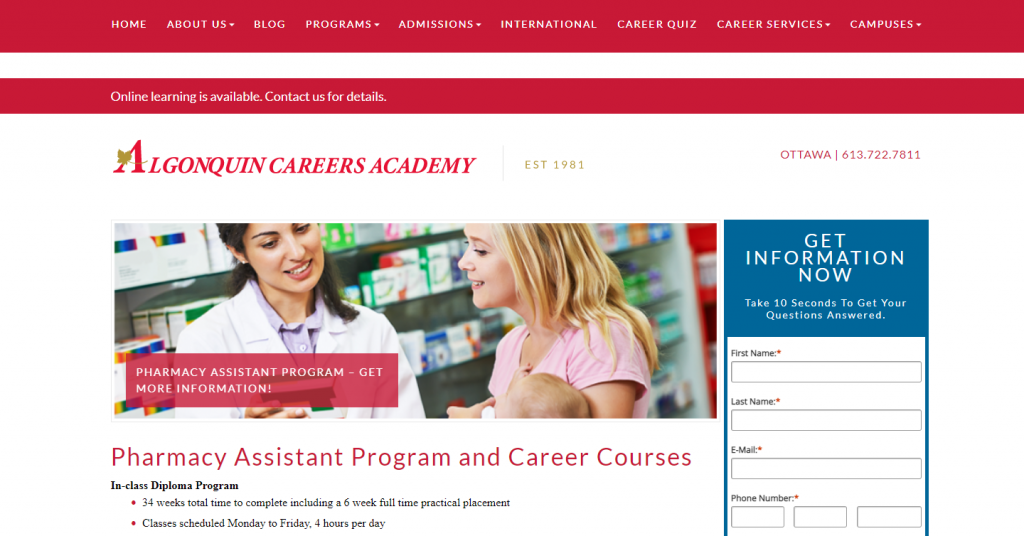
The Retail Pharmacy Assistant School at ICS Canada provides a comprehensive program that prepares students to excel in their job duties and contribute to the effective operation of a retail pharmacy (updated for 2026 with Kroll software enhancements).
Students learn how to calculate pharmaceutical arithmetic and conversions accurately, ensuring they can provide correct dosages to patients.
Additionally, the program covers the different forms in which medications are dispensed, including solid, liquid, and topical forms, and the applications of each form. Students learn about drug classes, how drugs reach their appropriate sites of action and gain knowledge about prescription drugs.
Furthermore, the program introduces students to over-the-counter drugs and their general medical applications, enabling them to assist customers in selecting appropriate products for common medical conditions.
In addition to the comprehensive theoretical curriculum, Algonquin Academy’s Pharmacy Assistant Program students also benefit from valuable hands-on training and practical experience.
The program includes instruction on the operation and maintenance of the pharmacy software “Kroll,” covering essential tasks such as:
- entering prescriptions,
- printing labels,
- maintaining patient profiles,
- conducting drug searches,
- searching for doctors,
- managing special instructions,
- processing third-party billing, and
- inventory management.
This hands-on training equips students with the practical skills needed in pharmacy operations. Find the course details right here.
George Brown College – Pharmacy Assistant Program
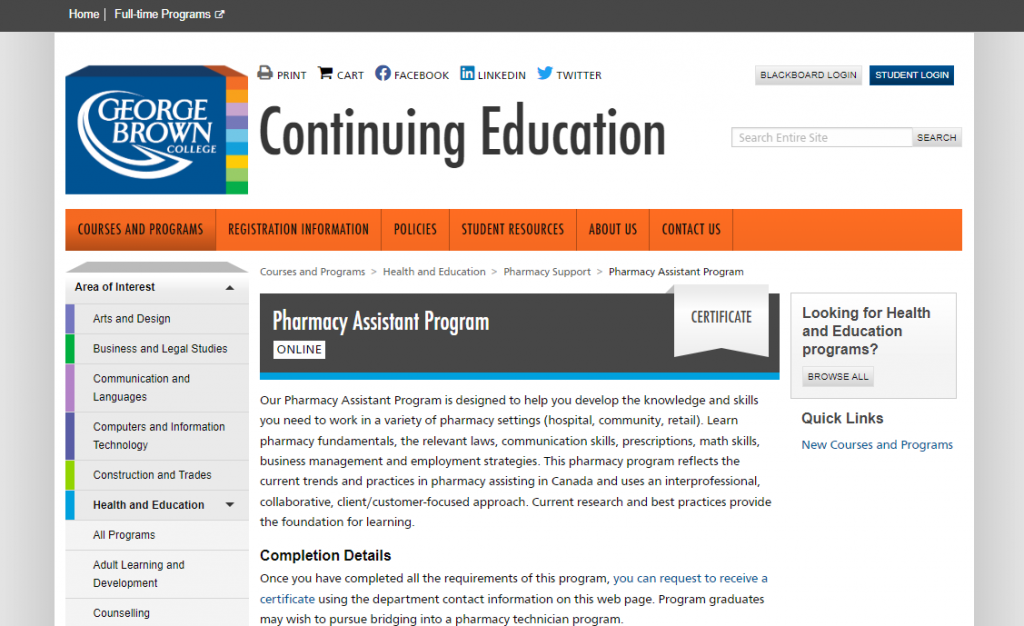
The Pharmacy Assistant Program at George Brown College is designed to reflect the current trends and practices in pharmacy assisting within Canada. It adopts an interprofessional and collaborative approach, emphasizing a client/customer-focused mindset. Students are encouraged to consider the needs and preferences of patients and customers, ensuring a high level of care and service (2026 updates include digital dispensing).
This curriculum is designed to provide students with a firm foundation in pharmacy foundations, pertinent rules and regulations, practical communication skills, prescription handling, math abilities, business management, and job strategies.
The program is based on current research and best practices, ensuring students receive the most up-to-date knowledge and skills required for success as pharmacy assistants.
Graduates of the Pharmacy Assistant Program may also choose to pursue further education by bridging into a pharmacy technician program. This pathway allows individuals to expand their scope of practice and pursue advanced roles within the pharmacy field. Get started with the course by following this link.
Eastern College – Pharmacy Assistant (Online)
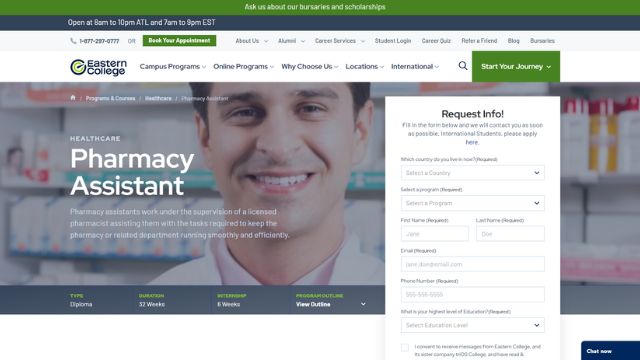
Eastern College’s Pharmacy Assistant Diploma is one of the most popular fully online programs in Atlantic Canada and is widely chosen by students across the country who want a fast, practical, and employer-recognized route into pharmacy work.
Delivered over 10 months (full-time) with no set class times (everything is asynchronous except weekly live Q&A sessions), the program is built for people who need maximum flexibility — working parents, career changers, and those already in retail/customer service roles.
The curriculum is very 2026-current and covers everything a Canadian pharmacy assistant actually does on day one:
- Pharmacy law & ethics (provincial and federal)
- Pharmacology & drug classifications
- Prescription reading & SIG interpretation
- Pharmacy math (dosage calculations, compounding)
- Insurance & third-party billing (including provincial plans)
- Kroll pharmacy software (hands-on labs)
- Customer service & conflict resolution
- Inventory & controlled substances handling
The program includes a 200-hour practicum that Eastern arranges at a community pharmacy near you — many students are offered jobs before they even finish. Graduates are immediately workplace-ready and eligible to write provincial certification exams where applicable. Eastern reports 90 %+ employment within 6 months, with most landing roles at Shoppers Drug Mart, Lawtons, Rexall, or independent pharmacies at $20–$26/hr to start.
Tuition is around $10,000 (OSAP, StudentAid NL/NS/PEI, and Second Career funding widely used). Students consistently give it 4.6/5 and praise the supportive instructors, real pharmacy software training, and the fact that “you can start working in a pharmacy after just a few months.”
Fanshawe College – Community Pharmacy Assistant
Fanshawe College’s Community Pharmacy Assistant Certificate (RPA1) is one of Ontario’s most respected and employer-preferred programs for anyone who wants to work in retail pharmacy (Shoppers, Rexall, Walmart, independent pharmacies, etc.).
The program runs two semesters (8 months) and is a hybrid model:
- Theory is 100 % online (asynchronous + weekly live sessions)
- Labs are in-person at Fanshawe’s London campus (or partner sites) for hands-on software and compounding practice
- A 120-hour practicum in a real community pharmacy (arranged by Fanshawe anywhere in Ontario)
Curriculum highlights that make it 2026-ready:
- Kroll & HealthWatch software mastery
- Insurance billing (including Ontario Drug Benefit, private plans, Trillium)
- Compounding basics (creams, ointments, liquids)
- Non-sterile compounding safety (USP <795> standards)
- Customer service & patient confidentiality (PHIPA)
- Over-the-counter counselling
Fanshawe has direct relationships with all the major chains — many students receive conditional job offers during their practicum. The program boasts a 95 % employment rate within 6 months and is fully eligible for OSAP, Second Career, and Canada Training Credit.
Tuition is approximately $7,000 (very competitive for an Ontario College program). Students rate it 4.7/5 and repeatedly say it’s “the perfect mix of online convenience and real pharmacy experience” — exactly what Ontario employers want in 2026.
Additional Helpful Information for Canadians in 2026
2026 Pharmacy Assistant Salary & Demand Snapshot (Job Bank Canada + PayScale, Nov 2025)
| Province | Entry-Level Wage | Experienced (3+ yrs) | Job Openings (next 5 yrs) |
|---|---|---|---|
| Ontario | $18–$23/hr | $24–$29/hr | 9,000+ |
| British Columbia | $20–$25/hr | $26–$32/hr | 6,000+ |
| Alberta | $19–$24/hr | $25–$30/hr | 5,500+ |
| Québec | $17–$22/hr | $23–$28/hr | 7,000+ |
| Atlantic | $16–$21/hr | $22–$27/hr | 3,000+ |
Fastest Paths to Getting Hired in 2026
| Goal | Best Route | Time | Cost (after funding) |
|---|---|---|---|
| Quick entry-level job | Coursera Fundamentals + volunteer → casual at Shoppers/Rexall | 1–3 mo | $0–$200 |
| Full diploma + practicum | Eastern/Fanshawe/CDI | 8–12 mo | $2,000–$5,000 (OSAP) |
| Work + study | Western or Algonquin part-time | 12–18 mo | $1,500–$3,000 + wages |
| Compounding upgrade | Diploma → sterile/non-sterile course | +3 mo | $800–$1,500 |
Graduates of accredited programs (Fanshawe, George Brown, Eastern) have 90–95 % employment within 6 months; many are hired during practicum.
Must-Know Micro-Credentials Employers Ask For in 2026
- Kroll Pharmacy Software Certification – $200–$400 (most clinics require)
- Non-Sterile Compounding (NAPRA) – $800–$1,200 (huge pay bump)
- First Aid/CPR Level C – $100–$150 (included in most college programs)
- WHMIS 2015 – Free online (mandatory for inventory)
Funding You Can Stack in 2026
- OSAP / Student Aid – Covers 70–100 % for Fanshawe/Eastern/CDI
- Second Career Ontario – Up to $28K for career changers
- Canada Training Credit – $250 tax credit per year
- Alberta Health Care Aide Bursary – Up to $5K (applies to pharmacy assistant)
- Indspire Bursaries – $1K–$5K for Indigenous students
Quick 2026 Enrollment Checklist
- Pick your software: Ontario → Kroll (Fanshawe/Niagara); BC/Alberta → HealthWatch or Kroll
- Apply funding first – OSAP closes 6–9 months early
- Get prerequisites: Police check + immunizations (including Hep B)
- Volunteer early – Many Shoppers/Rexall hire volunteers into casual roles
- Target growth areas: Compounding pharmacies, long-term care, telepharmacy (+25 % demand)
Conclusion
Online pharmacy assistant courses in Canada provide an excellent opportunity for individuals looking to pursue a career in the pharmaceutical field. These courses offer comprehensive training and provide students with the skills and knowledge they need to succeed as pharmacy assistants.
Our most recommended course is Coursera’s Pharmacy Technician Fundamentals Specialization. This course is affordable and a great starter to become a pharmacy assistant in Canada.
All the listed courses above offer a pathway to a rewarding career in the pharmaceutical industry. Whether working in community pharmacies, hospitals, retail settings, or manufacturing facilities, graduates of these programs are well-prepared to support pharmacists, provide exceptional customer service, and contribute to the Canadian healthcare landscape.