Key Takeaways
- The fastest realistic route is self-study: Python fundamentals in 2 to 6 weeks at $0 to $100, 3 to 5 GitHub portfolio projects over 4 to 8 weeks, then 1 to 3 months of applications, for a total of 3 to 6 months.
- No licence or registration is listed for Python work in Canada, so certificates act as optional signals; WorkBC reports many employers value portfolios, certifications, and skills over degrees.
- Test the field first with the Python for Everybody Specialization from the University of Michigan on Coursera, 2 months at 10 hours a week; the Specialization certificate proves basics and does not replace a portfolio or a college micro-credential.
- Job Bank puts the NOC 21232 median at $48.08 per hour, with provincial medians from $45.67 in Quebec to $52.40 in British Columbia.
- Fiona's verdict: worth it for analytical career changers who will finish projects, and skip the $8,600 to $9,000 UAlberta program unless an employer or program requires the credential.
Python programming is a versatile coding skill for building software, automating tasks, analyzing data, and creating AI applications, and it sits at the heart of NOC 21232, software developers and programmers. Canadian employers hire for it without a licence or a degree, which makes the entry path unusually flexible.
The shortest realistic route is a self-paced course plus a GitHub portfolio, a total of roughly 3 to 6 months including applications, with the fundamentals stage costing $0 to $100. My advice: test the field with a Coursera Specialization such as Python for Everybody before spending anything close to UAlberta's $8,600 to $9,000 program.

What Are The Ways To Learn Python In Canada?
The ways to learn Python in Canada run from free self-study to a $9,000 college program, and each route buys a different kind of proof. This table compares the four routes Canadians actually take, starting with the Coursera path I recommend for testing the field.
| Route | Time | Cost (CAD) | What You Get | Recognised By | Best For |
|---|---|---|---|---|---|
| Python for Everybody Specialization on Coursera | 2 months at 10 hours a week | Not listed | Specialization certificate | Not listed in our data | Testing the field before tuition |
| Self-paced bootcamp or book (The Complete Python Bootcamp: Go from Zero to Hero in Python 3) | 4 to 12 weeks | $0 to $500 | Certificate of completion or none | Employers via portfolio | Fast skill building on a small budget |
| College micro-credential or certificate | 3 to 12 months part-time | $600 to $9,000 | Certificate of Completion or Micro-Credential | Colleges and employers | Structured study with a credential |
| SAIT Python Programming Certificate | 1 year part-time | $0 to $625 per course | Certificate of Completion | SAIT | An Alberta college credential at a published price |
I recommend the Coursera route for anyone still testing the field, the SAIT certificate for Albertans who want a college credential at $0 to $625 per course, and the UAlberta program only for committed back end specialists with an employer helping pay.
What Is The Fastest Way To Learn Python In Canada?
The fastest way to learn Python in Canada is a self-paced course plus a public GitHub portfolio: fundamentals in 2 to 6 weeks at $0 to $100, projects over 4 to 8 weeks at $0, then applications for 1 to 3 months. Counting from your first lesson, plan on a total of 3 to 6 months including applications.
- Complete a self-paced Python fundamentals course or book, for example freeCodeCamp or Jose Portilla's 22-hour Complete Python Bootcamp on Udemy: 2 to 6 weeks, $0 to $100. A structured alternative for the same stage is Python for Everybody from the University of Michigan on Coursera, paced at 2 months at 10 hours a week.
- Build 3 to 5 portfolio projects on GitHub: 4 to 8 weeks, $0.
- Apply to junior developer roles or internships, the openings tracked under NOC 21232 on Job Bank: 1 to 3 months, $0.
- Treat 3 to 6 months as the total window including applications for the self-paced route, because drifting past it usually means the portfolio, not the coursework, stalled.
Do Employers In Canada Require A Python Certificate?
No legal licence or registration is listed for Python work in Canada; certificates are optional signals, and employers may value portfolios, certifications and skills over degrees, as WorkBC's career profile for NOC 21232, software developers and programmers, notes.
| Credential | Who Issues It | Legally Required? |
|---|---|---|
| Specialization or career certificate | University of Michigan, Penn, Madecraft, Logical Operations (via Coursera) | No, an optional portfolio supplement |
| Certificate of Completion | SAIT | No, a signal of structured study |
| Python Back End Web Development Certificate | University of Alberta | No, a credential for back end focus |
| PCAP career certificate | Logical Operations | No, an optional vendor credential |
What employers ask for instead is proof of skill. WorkBC states that self-taught or certificate routes are common and effective, and in practical terms a GitHub profile with 3 to 5 finished projects can strengthen applications alongside any certificate. I tell clients the projects, not the PDF, earn the interview.
Certificates still have a role. College credentials such as the SAIT Certificate of Completion, the UAlberta Python Back End certificate, and the Sheridan Python Web Developer micro-credential signal commitment and structure, and the PCAP Specialization from Logical Operations awards a career certificate for intermediate Python skills. The Coursera Specializations on this page sit in the same category: useful proof of basics, never a licence, because no licence or registration is listed for this occupation.
Which Python Courses Are Worth Taking In 2026?
Python courses worth taking in 2026 split into three lanes: university Specializations on Coursera, dense bootcamps on Udemy, and college micro-credentials like SAIT's. My default first pick is Python for Everybody from the University of Michigan, rated 4.8, and my commitment pick is Dr. Angela Yu's 52-hour 100 Days of Code on Udemy. All 9 options reviewed below earned their place.
Python for Everybody Specialization
Python for Everybody Specialization is a 2-months-at-10-hours-a-week online Specialization from the University of Michigan that teaches Python from a standing start and awards a Specialization certificate.
| Provider | University of Michigan |
|---|---|
| Length | 2 months at 10 hours a week |
| Rating | 4.8 |
| Credential | Specialization certificate |
| Format | online |
Fiona's take: This is the course I put in front of most clients. It carries a 4.8 rating, the highest on this page, the 2 months at 10 hours a week pace fits evenings, and a university name reads well on a profile. Treat the certificate as proof of basics; hiring managers then want your GitHub. Price was not listed in our data, so confirm the fee before enrolling.
Skip it if: Skip it if you already write loops and functions comfortably and need data science or back end depth instead.
Start On CourseraCertified Associate in Python Programming (PCAP) Specialization
Certified Associate in Python Programming (PCAP) Specialization is a 4-weeks-at-10-hours-a-week online Specialization from Logical Operations that develops intermediate Python skills and ends with a career certificate from Logical Operations.
| Provider | Logical Operations |
|---|---|
| Length | 4 weeks at 10 hours a week |
| Credential | career certificate from Logical Operations |
| Format | online |
Fiona's take: This one suits people who want a named provider certificate early. Four weeks at 10 hours a week is a tight sprint, and the content develops intermediate programming skills using Python. I suggest pairing it with the Michigan Specialization if you want both breadth and the certificate focus.
Skip it if: Skip it if your target postings never mention certification, because portfolios carry more weight in Canadian hiring.
Start On CourseraIntroduction to Programming with Python and Java Specialization
Introduction to Programming with Python and Java Specialization is a 2-months-at-10-hours-a-week online Specialization from the University of Pennsylvania, rated 4.5, that introduces two languages and awards a Specialization certificate.
| Provider | University of Pennsylvania |
|---|---|
| Length | 2 months at 10 hours a week |
| Rating | 4.5 |
| Credential | Specialization certificate |
| Format | online |
Fiona's take: The dual-language format is both the selling point and the trade-off. You finish with literacy in Python and Java, which helps if you are weighing college programs that assume both, but the Java half slows a Python-only job search. The Penn name adds credibility to the certificate.
Skip it if: Skip it if your goal is a Python job as fast as possible and Java appears nowhere in your target postings.
Start On CourseraPython Programming Fundamentals Specialization
Python Programming Fundamentals Specialization is a 4-weeks-at-10-hours-a-week online Specialization from Madecraft that covers core Python and awards a shareable certificate.
| Provider | Madecraft |
|---|---|
| Length | 4 weeks at 10 hours a week |
| Credential | Shareable certificate |
| Format | online |
Fiona's take: Four weeks at 10 hours a week makes this one of the two fastest structured Coursera options here, alongside the PCAP track, and no rating was listed in our data, so weigh it against Michigan's 4.8. I suggest it as a pre-college warm-up: finish it, then decide whether SAIT or UAlberta tuition is justified.
Skip it if: Skip it if you have already completed a full beginner course and are ready for projects.
Start On CourseraThe Complete Python Bootcamp: Go from Zero to Hero in Python 3
The Complete Python Bootcamp: Go from Zero to Hero in Python 3 is a 22-hour online course from Jose Portilla on Udemy, rated 4.6, that ends with a certificate of completion.
| Provider | Jose Portilla |
|---|---|
| Length | 22 hours |
| Rating | 4.6 |
| Credential | Certificate of completion |
| Format | online |
Fiona's take: Twenty-two hours of video in one purchase is a substantial block of content, and Portilla is a familiar name across the Udemy catalog. The pace is self-directed, so I tell clients to schedule it like a shift, not a scroll. Udemy fees were not listed in our data and change often, so check the live price.
Skip it if: Skip it if you need graded assignments or instructor feedback, and confirm the course's current features before enrolling.
View On Udemy100 Days of Code: The Complete Python Pro Bootcamp
100 Days of Code: The Complete Python Pro Bootcamp is a 52-hour online course from Dr. Angela Yu on Udemy, rated 4.7, that ends with a certificate of completion.
| Provider | Dr. Angela Yu |
|---|---|
| Length | 52 hours |
| Rating | 4.7 |
| Credential | Certificate of completion |
| Format | online |
Fiona's take: At 52 hours, this is the longest Udemy course listed here, structured as a daily streak, and its 4.7 rating trails only Michigan's 4.8. It suits career changers who need routine more than freedom. Push the projects to a public GitHub as you go, because that habit is what turns course hours into a portfolio.
Skip it if: Skip it if irregular shifts or family schedules make daily coding unrealistic.
View On UdemyPython for Data Science and Machine Learning Bootcamp
Python for Data Science and Machine Learning Bootcamp is a 25-hour online course from Jose Portilla on Udemy, rated 4.5, that ends with a certificate of completion.
| Provider | Jose Portilla |
|---|---|
| Length | 25 hours |
| Rating | 4.5 |
| Credential | Certificate of completion |
| Format | online |
Fiona's take: This is the on-ramp to the data science and machine learning lane. Separately, some data science and machine learning certificates that include Python may be subsidized through Upskill Canada to a reduced rate of $525 plus HST; confirm eligibility for any specific program. Python is primarily associated with NOC 21232 software developers and programmers, the category Job Bank tags a high opportunity occupation. Udemy fees were not listed in our data.
Skip it if: Skip it until your general Python basics are solid, because it assumes you can already write scripts.
View On UdemyPython Programming
Python Programming is an online continuing education course from George Brown College in Ontario; length, fees, and credential details were not listed in our data.
| Provider | George Brown College |
|---|---|
| Format | online, Ontario |
Fiona's take: George Brown gives Ontarians a local, online option with a college name attached, which matters if your target employers ask for formal coursework. Length, fees, credential and transcript details were not listed in our data, so confirm those with George Brown before comparing it with SAIT's published $0 to $625 per course.
Skip it if: Skip it if you need published prices before you can plan a budget.
See Program DetailsPython Training in Toronto
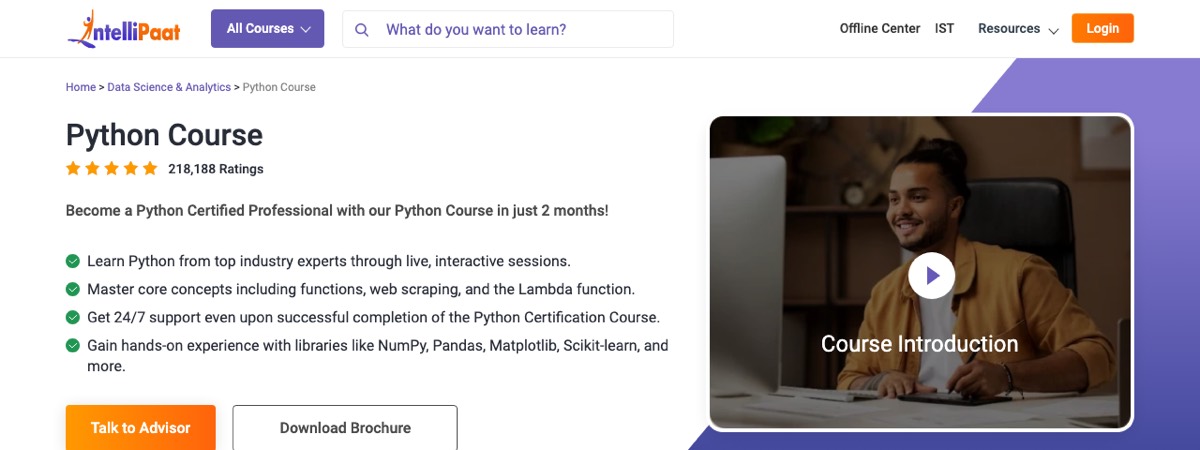
Python Training in Toronto is an online certification program from Intellipaat, a private provider marketing to the Ontario market; length, cost, and rating were not listed in our data.
| Provider | Intellipaat |
|---|---|
| Credential | Certification |
| Format | online, Ontario |
Fiona's take: Private bootcamps sell intensity, and Intellipaat targets Toronto learners online. With no published fee in our data, I cannot place it on a value scale. Hold it against SAIT at $0 to $625 per course, and demand a written price plus outcome details before paying anything.
Skip it if: Skip it if a college micro-credential or a Coursera Specialization already covers your goal at a known price.
See Program DetailsHow Much Do Python Classes Cost In Canada?
Python classes in Canada cost anywhere from $0 to $9,000, and the number you pay should track how certain you are about the field. The table below sets out the published figures from our data, including the two college programs with firm prices.
| Route | Cost (CAD) | What's Included |
|---|---|---|
| Coursera Specializations (Michigan, Penn, Madecraft, Logical Operations) | Not listed | Specialization or career certificate |
| Self-paced Udemy bootcamp or free book | $0 to $500 | Certificate of completion or none |
| SAIT Python Programming courses | $0 to $625 per course | Micro-credential courses |
| UAlberta Python Back End Web Development Certificate | $8,600 to $9,000 | 6 core courses plus electives, effective Fall 2025 |
The spread from $0 to $9,000 is the widest of any field I advise on, and it buys three different things. Self-paced options at $0 to $500 buy content. SAIT at $0 to $625 per course buys college structure. UAlberta at $8,600 to $9,000 effective Fall 2025 buys a full back end program of 6 core courses plus electives.
George Brown and Intellipaat publish no fees in our data, so treat those entries as enquiries, not decisions. My rule for clients: spend nothing beyond the self-paced lane until you have finished fundamentals and shipped one project, then escalate to a college credential only if a target employer or program requires one.
How Much Does A Python Programmer Earn In Canada?
A Python programmer in Canada earns a median of $48.08 per hour under Job Bank's NOC 21232, software developers and programmers. Here is how the provinces compare in our data.
| Region | Median Hourly Wage (NOC 21232) |
|---|---|
| Canada | $48.08 |
| British Columbia | $52.40 |
| Ontario | $48.08 |
| Alberta | $48.08 |
| Quebec | $45.67 |
Job Bank tags NOC 21232 a high opportunity occupation, the outlook flag I watch most closely with clients. The $48.08 median covers software developers and programmers overall, and Python is associated with NOC 21232 and is used for automation, data analysis and AI applications. The figures date from November 19, 2025, so they are current for 2026 planning.
Of the provinces listed in our data, British Columbia is highest at $52.40, Ontario and Alberta sit at the national figure of $48.08, and Quebec comes in at $45.67. Thousands of Canadian job ads mention Python, so the skill travels between provinces better than most credentials do.
Is Learning Python Worth It In 2026?
Learning Python is worth it in 2026 for most career changers, and the numbers back that. Job Bank tags NOC 21232 a high opportunity occupation, the median sits at $48.08 per hour, and no licence or registration is listed for the work. Few skills offer a $48.08 median with no credential gate, which is why I keep recommending this path to analytical clients.
The honest caveat: a certificate alone hires nobody. WorkBC's profile for software developers and programmers says many employers value portfolios, certifications, and skills over degrees, and that order matters. I tell clients the 3 to 5 GitHub projects do the persuading; the certificate of completion just gets the profile read.
The financial case is also asymmetric in your favour. The self-paced lane runs $0 to $100 for fundamentals, SAIT tops out at $625 per course, and only UAlberta's full back end program reaches $8,600 to $9,000. Testing the field with a Coursera Specialization first, then escalating only when you stall, keeps your downside small while the Job Bank outlook stays high opportunity.
Can You Get Funding For Python Training In Canada?
Funding for Python training in Canada comes through two channels: Upskill Canada, which subsidizes data science and machine learning certificates that include Python, and provincial job grants such as the Canada-Alberta Productivity Grant and the Ontario Job Grant.
- Upskill Canada. Upskill Canada has invested a second wave of funding, bringing the overall investment to $3.9M by 2026, in data science and machine learning certificates including Python. Eligible learners pay a reduced rate of $525 plus HST per certificate, which turns a four-figure program into a manageable line item.
- Provincial Job Grants. Provincial job grants may cover half or more of eligible training costs; the caps cited reach up to $10,000 per employee in Ontario and B.C., with examples including the Canada-Alberta Productivity Grant and the Ontario Job Grant. The grants are quoted per employee, so employed Canadians should raise them with their employer.
Python Classes Questions Canadians Ask
How Long Does It Take To Learn Python For A Job In Canada?
Learning Python for a job in Canada takes about 2 to 3 months of part-time study for the basics, and 3 to 6 months to reach job-ready with a portfolio through self-study or short courses. Build 3 to 5 GitHub projects inside that window, because employers screen the portfolio before any certificate.
Is Python In Demand For Jobs In Canada?
Python is in demand for jobs in Canada: Job Bank tags NOC 21232 software developers and programmers a high opportunity occupation, thousands of job ads mention Python, and the median wage sits at $48.08 per hour. Of the provinces listed in our data, British Columbia is highest at $52.40 per hour.
Do I Need A Degree To Get A Python Programming Job In Canada?
You do not necessarily need a degree for Python programming jobs in Canada. WorkBC's career profile for software developers and programmers says many employers value portfolios, certifications, and skills over degrees, and self-taught or certificate routes are common and effective. Your GitHub projects and a credential such as SAIT's do the persuading.
Are There Free Python Classes Available In Canada?
Free Python classes are available in Canada: freeCodeCamp and YouTube tutorials offer structured free learning, and the self-paced route prices out at $0 to $500 overall. On the college side, SAIT lists Python Programming micro-credential course fees starting at $0, so even the credentialed lane has a free entry point.
What Certificates Are Recognized For Python In Canada?
Certificates recognized for Python in Canada are college credentials: the SAIT Certificate of Completion, the UAlberta Python Back End certificate, and the Sheridan Python Web Developer micro-credential. No licence or registration is listed for Python work, so these certificates act as optional signals. Coursera Specialization certificates from Michigan or Penn supplement a portfolio but replace none of the college credentials.
Can I Get Funding For Python Training In Canada?
Funding for Python training in Canada is available: Upskill Canada subsidizes data science and machine learning certificates that include Python to a reduced rate of $525 plus HST per certificate, and provincial job grants such as the Ontario Job Grant may cover half or more of eligible training costs, with caps cited up to $10,000 per employee in Ontario and B.C.
What Is The Median Wage For Python Programmers In Canada?
The median wage for Python programmers in Canada is $48.08 per hour for NOC 21232 software developers and programmers, according to Job Bank. British Columbia posts $52.40, Ontario and Alberta match the national median at $48.08, and Quebec sits at $45.67.
What Is The Fastest Route To A Python Job In Canada?
The fastest route to a Python job in Canada is self-study: finish fundamentals in 4 to 6 weeks, build GitHub portfolio projects for 4 to 8 weeks at $0, then apply to junior roles for 1 to 3 months. The whole path takes 3 to 6 months and costs $0 to $100.
What's The Bottom Line On Python Classes In Canada?
- No licence or registration is listed for Python work in Canada, so a portfolio of 3 to 5 GitHub projects carries real weight with employers that value portfolios, certifications and skills.
- Start with Python for Everybody Specialization from the University of Michigan, 2 months at 10 hours a week, before you spend anything close to UAlberta's $8,600 to $9,000 program fee.
- The self-study route runs $0 to $100 for fundamentals and takes a total of 3 to 6 months including applications.
- Job Bank lists NOC 21232 as a high opportunity occupation with a $48.08 median hourly wage, and British Columbia at $52.40, the highest of the provinces in our data.
- Funding is real: Upskill Canada brings certificate costs down to $525 plus HST, and job grants may cover up to $10,000 per employee in Ontario and B.C.