Key Takeaways
- The fastest realistic route is a Transport Canada accredited online boating safety course and test: 3 to 5 hours, $30 to $70 CAD, a temporary card the same day, and the permanent card in 2 to 3 weeks.
- Proof of competency is mandatory for every power-driven pleasure craft operator in all provinces and territories except Nunavut and Northwest Territories, with Transport Canada as the regulator and accreditor, and the PCOC is the most common proof.
- Universitat de Barcelona's Oceanography course on Coursera, 3 weeks at 10 hours per week, is a way to test your interest before paying; it does not qualify you to operate a boat or issue a PCOC.
- The PCOC is valid for life with no renewal; the only later cost is a replacement card, where provider examples run $18 to $25.
- Fiona's verdict: boaters who just need to be legal should book an accredited provider such as BOATERexam.com or CanBoat now; save Coursera and Udemy for adding background knowledge in weather or oceanography after the card.
A Pleasure Craft Operator Card (PCOC) is the most common proof of competency required to operate a power-driven pleasure craft in Canada. Transport Canada accredits the course providers that issue it under one national standard, so an Ontario boating licence and a BC boating licence are the same card.
The realistic route is a single accredited online course and test: 3 to 5 hours, $30 to $70, a temporary card the same day. This page compares the nine online options I review with clients, Coursera and Udemy knowledge courses first, Transport Canada accredited PCOC providers second.

What Are The Ways To Get A Boating Licence In Canada?
A boating licence in Canada comes down to three Transport Canada routes to the Pleasure Craft Operator Card, plus one warm-up option to test your interest first. Only course providers accredited by Transport Canada can issue the card, whether you study online or in a classroom.
| Route | Time | Cost (CAD) | What You Get | Recognised By | Best For |
|---|---|---|---|---|---|
| Oceanography: a key to better understand our world marine science warm-up | 3 weeks at 10 hours per week | Not listed | Shareable Coursera certificate, no PCOC | Universitat de Barcelona, not Transport Canada | Testing interest before the $30 to $70 step |
| Online boating safety course and test | 3 to 5 hours | $30 to $70 | Pleasure Craft Operator Card (PCOC) | Transport Canada | Most boaters, including first-timers |
| In-person boating safety course and test | Varies | $30 to $70 | PCOC | Transport Canada | Learners who want a classroom and an instructor |
| Challenge the test in person, no course | Varies | Varies by provider | PCOC | Transport Canada | Experienced boaters who already know the material |
Fiona recommends the online course and test for anyone who simply needs to be legal on the water, and the Coursera route for people deciding whether boating deserves a bigger investment of study.
What Is The Fastest Way To Get A Boating Licence In Canada?
The fastest way to a boating licence is the accredited online course and test: 3 to 5 hours of study for $30 to $70, a temporary PCOC the same day, and the permanent card in 2 to 3 weeks.
- Register with a Transport Canada accredited online provider such as BOATERexam.com, Ace Boater or CanBoat: minutes, $0 to sign up.
- Finish the self-paced online boating safety course, a minimum of 3 hours of study, with typical completion at 3 to 5 hours and a cost of $30 to $70.
- Pass the Transport Canada boating safety test at 75% or higher; the test fee is included, and a failed attempt can carry an up to 24 hour wait before a rewrite.
- Collect the temporary PCOC immediately, since operators need proof of competency, most commonly the PCOC; the permanent card follows by mail in 2 to 3 weeks, included in what you already paid.
Do You Need A Boating Licence To Drive A Boat In Ontario?
A boating licence requirement is really a proof of competency requirement: everyone operating a power-driven pleasure craft must carry proof, and the most common proof is the Pleasure Craft Operator Card. That single national rule reaches Ontario cottagers and BC coastal boaters alike.
| Where Proof Of Competency Is Required | Required? | Regulator | What It Means |
|---|---|---|---|
| All provinces and territories except Nunavut and Northwest Territories | Yes, for any power-driven pleasure craft | Transport Canada | Operators need proof of competency; the PCOC is the most common proof |
Two edges matter. Non-powered craft sit outside the rule, but a sailboat fitted with an auxiliary motor needs proof of competency even while under sail. And a Coursera certificate, such as Universitat de Barcelona's oceanography course, does not meet this requirement anywhere in Canada; the PCOC comes only from providers Transport Canada has accredited.
Keep the Pleasure Craft Licence separate in your head. The PCOC proves operator competency; the Pleasure Craft Licence is a separate vessel licence for boats with motors of 10 hp or more. Owners of such boats may hold both documents.
Which Online Boat Courses Are Worth Taking In 2026?
Online boat courses worth taking divide into two camps: Transport Canada accredited PCOC providers that issue the card, and knowledge builders from Coursera and Udemy that never will. Here are the nine I compare with clients, in the order I raise them.
Oceanography: a key to better understand our world
Oceanography: a key to better understand our world is a 3 weeks at 10 hours per week online course from Universitat de Barcelona on Coursera that builds the marine science behind the water you boat on.
| Provider | Universitat de Barcelona |
|---|---|
| Length | 3 weeks at 10 hours/week |
| Rating | 288 reviews |
| Credential | Shareable certificate |
| Format | online |
Fiona's take: I send curious clients here before they pay $30 to $70 for the PCOC course, because 3 weeks at 10 hours per week answers whether ocean science genuinely interests them, and 288 reviews sit behind it. To be plain, this course does not qualify you to operate a boat, and Transport Canada does not accept it as proof of competency.
Skip it if: Skip it if the PCOC for this weekend is the only goal; go straight to an accredited provider.
Not a provincial licence, registration or certificate.
Start On CourseraStrategies for winning. Meteorology in a round the world regatta
Strategies for winning. Meteorology in a round the world regatta is a 2 weeks at 10 hours per week online course from Universitat de Barcelona on Coursera that teaches race level weather reading.
| Provider | Universitat de Barcelona |
|---|---|
| Length | 2 weeks at 10 hours/week |
| Rating | 145 reviews |
| Credential | Shareable certificate |
| Format | online |
Fiona's take: Weather judgment keeps boaters safe, and this course shows how round the world racers read it, with 145 reviews behind it. It will not produce a PCOC; I position it as continuing education for card holders who want to understand forecasts beyond the basics.
Skip it if: Skip it if you have never studied weather at all; start with a general weather course instead.
Not a provincial licence, registration or certificate.
Start On CourseraAce Your 104, Bareboat Cruising Written Sailing Exam
Ace Your 104, Bareboat Cruising Written Sailing Exam is an online course from Udemy that prepares candidates for a bareboat cruising written sailing exam.
| Provider | Udemy |
|---|---|
| Rating | 4.7 (407 ratings) |
| Credential | Certificate of completion |
| Format | online |
Fiona's take: It carries a 4.7 rating across 407 ratings, and it targets sailing exam content, not Canadian boating law. It does not issue a PCOC, so if the Transport Canada card is the goal, this is the wrong shelf.
Skip it if: Skip it unless a bareboat cruising written exam is actually on your calendar.
Not a provincial licence, registration or certificate.
View On UdemyWeather for Sailors and Boaters
Weather for Sailors and Boaters is a 2.5 hour online course from Udemy that covers practical weather reading for small craft.
| Provider | Udemy |
|---|---|
| Length | 2.5 hours |
| Rating | 4.7 (444 ratings) |
| Credential | Certificate of completion |
| Format | online |
Fiona's take: At 2.5 hours it is shorter than the PCOC course itself, and I suggest it as the companion buy: learn the law, then learn the sky, backed by 4.7 across 444 ratings. It has no standing with Transport Canada, which I state plainly to every client.
Skip it if: Skip it if you want only the minimum legal credential.
Not a provincial licence, registration or certificate.
View On UdemyPass Your Sailing Endorsement Exam
Pass Your Sailing Endorsement Exam is a 3 hour online course from Udemy aimed at a specific sailing endorsement exam.
| Provider | Udemy |
|---|---|
| Length | 3 hours |
| Rating | 4.6 (26 ratings) |
| Credential | Certificate of completion |
| Format | online |
Fiona's take: The rating is 4.6 across 26 ratings, a small sample, and the material is sailing exam content Canadian boaters do not need for the PCOC. It suits people stacking sailing credentials on top of the card.
Skip it if: Skip it if you do not have that endorsement exam booked.
Not a provincial licence, registration or certificate.
View On UdemyGet your Canadian Boat License (Online)
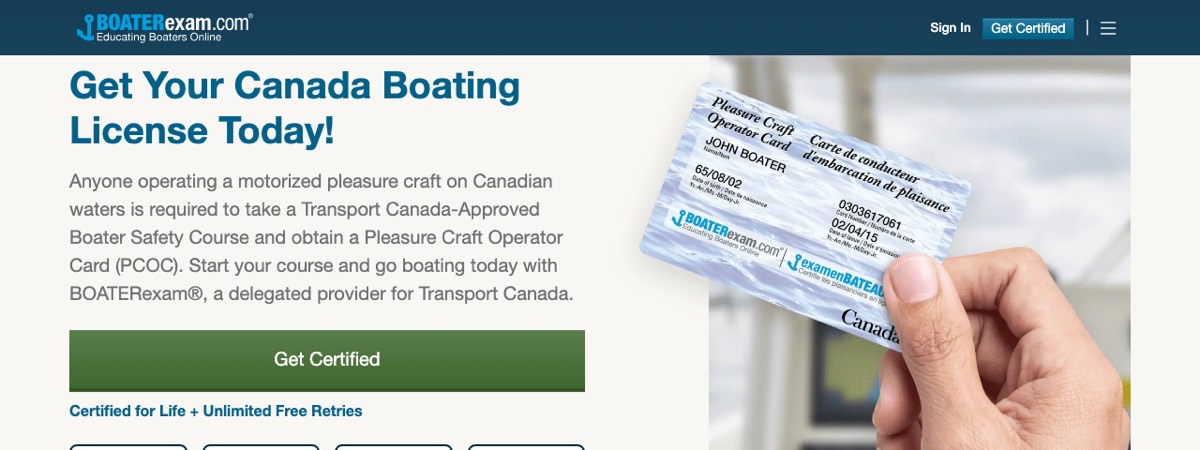
Get your Canadian Boat License (Online) is a minimum 3 hour online PCOC course from BOATERexam.com that ends with the Transport Canada boating safety test.
| Provider | BOATERexam.com |
|---|---|
| Length | minimum 3 hours |
| Credential | Pleasure Craft Operator Card (PCOC) |
| Format | online, Ontario |
Fiona's take: This is my default suggestion for Ontario clients who want the card fast: the minimum 3 hours of study is built in, delivery is online, and the provider is Transport Canada accredited. Provider fees typically run $30 to $70; confirm the current price.
Skip it if: Skip it if you learn better in a classroom or plan to challenge the test in person.
See Program DetailsOfficial Canadian Boating License Online
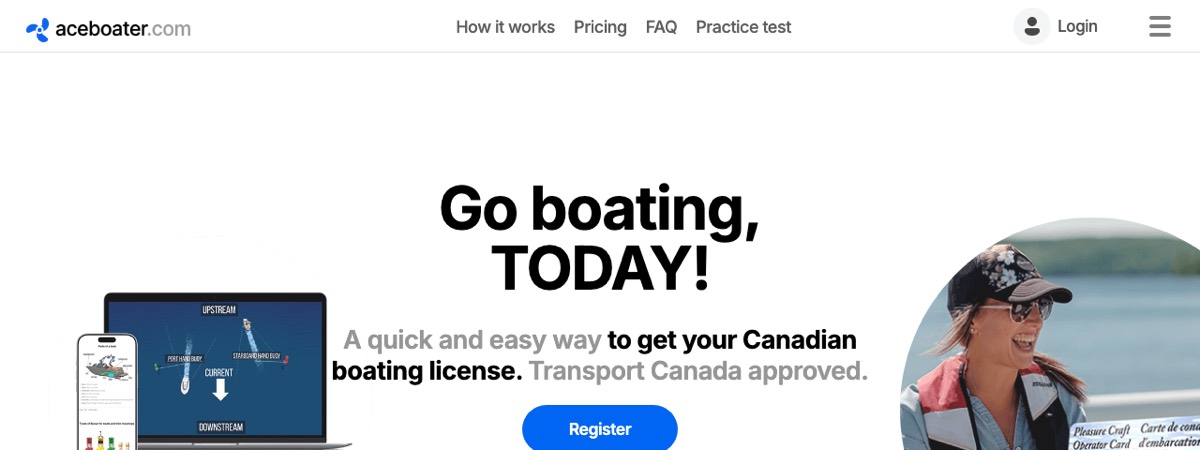
Official Canadian Boating License Online is an online PCOC course from Ace Boater, listed here as a Quebec option, that leads to the Transport Canada boating safety test and card.
| Provider | Ace Boater |
|---|---|
| Credential | Pleasure Craft Operator Card (PCOC) |
| Format | online, Quebec |
Fiona's take: Ace Boater covers the same Transport Canada test standard online as every other accredited provider. Because the federal government collects no fees and providers set their own, confirm the total price before you start rather than after.
Skip it if: Skip it if a fixed listed price matters to you; CanBoat publishes $49.95.
See Program DetailsPCOC Boating License
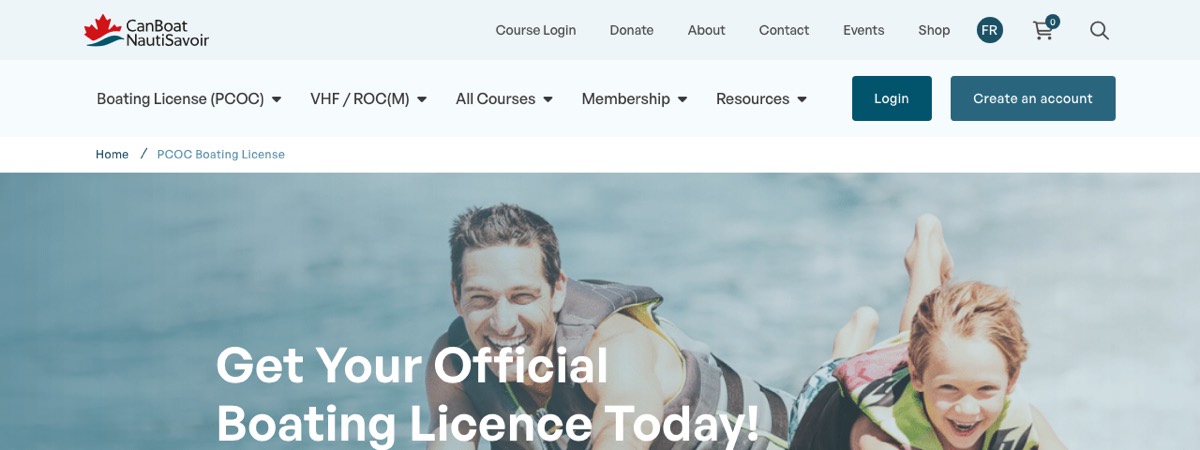
PCOC Boating License is an online PCOC course from CanBoat / NautiSavoir priced at $49.95 tax-free, including the Transport Canada test and card.
| Provider | CanBoat / NautiSavoir |
|---|---|
| Cost (CAD) | $49.95 (tax-free) |
| Credential | Pleasure Craft Operator Card (PCOC) |
| Format | online, Ontario |
Fiona's take: CanBoat is one of the providers here that publishes its price, $49.95 tax-free, sitting mid range in the $30 to $70 market. I recommend it for planners who want the full cost on paper before the first module.
Skip it if: Skip it if another accredited provider is priced lower and the card is your only need.
See Program DetailsBoating Licence (PCOC)
Boating Licence (PCOC) is an online PCOC option from Ohana Sailing Agency priced from $59 per person that leads to the same Transport Canada card.
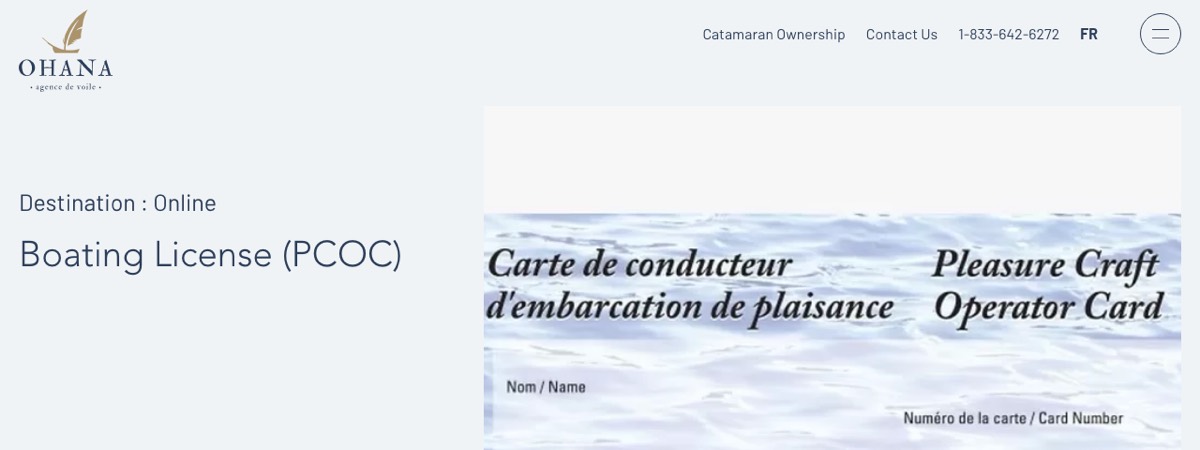
| Provider | Ohana Sailing Agency |
|---|---|
| Cost (CAD) | From $59 per person |
| Credential | Pleasure Craft Operator Card (PCOC) |
| Format | online, Quebec |
Fiona's take: From $59 per person sits near the top of the $30 to $70 range, so I would ask what is bundled before paying. The credential is the identical PCOC that every accredited provider issues.
Skip it if: Skip it if the PCOC is your only need and a lower priced accredited provider is available.
See Program DetailsHow Much Does A Boating Licence Cost In Canada?
A boating licence costs $30 to $70 CAD for the course, exam and card together, a fee set entirely by the accredited provider; the federal government collects nothing. That is the typical range listed, and fees may vary among course providers.
| Item | Cost (CAD) | Notes |
|---|---|---|
| Course, exam and PCOC issuance | $30 to $70 | Set by Transport Canada accredited providers; varies among them |
| CanBoat / NautiSavoir PCOC course | $49.95 tax-free | A fixed, published price |
| Ohana Sailing Agency PCOC | From $59 per person | Near the top of the provider range |
| Replacement PCOC | Varies, provider examples $18 to $25 | Charged by your provider if the card is lost |
Because Transport Canada leaves pricing to providers, the honest move is to compare two or three accredited providers before paying. The card never expires, so the $30 to $70 is a one time cost, and the only future fee is a replacement, where provider examples run $18 to $25.
Is A Boating Licence Worth It In 2026?
A boating licence is worth it for anyone who will operate a motor, because the law leaves no room to opt out: proof of competency is required in every province and territory except Nunavut and Northwest Territories. At $30 to $70 and 3 to 5 hours of study, the card is valid for life.
The value question gets interesting beyond the card. If boating is becoming a serious hobby, Universitat de Barcelona's Coursera courses add background knowledge in oceanography and weather: oceanography at 3 weeks and 10 hours per week, regatta meteorology at 2 weeks and 10 hours per week. Neither is proof of competency, so the accredited course remains the legal step.
One budget note: if your boat's motor is 10 hp or more, the Pleasure Craft Licence for the vessel is a separate licence document on top of your PCOC, so plan for two pieces of paperwork, not one. The card itself never expires, so the $30 to $70 course is the last time you pay unless you lose it.
Boating Licence Questions Canadians Ask
Who Needs A PCOC In Canada?
A PCOC is the most common proof of competency, and proof of competency is needed by everyone who operates a power-driven pleasure craft in Canadian waters, in all provinces and territories except Nunavut and Northwest Territories. Transport Canada's rule attaches to the operator, not the boat, so one person's proof does not cover a friend who takes the wheel. Non-powered craft and sailboats with no motor sit outside the requirement.
How Do I Get A PCOC?
Getting a PCOC means choosing one of three Transport Canada routes: an accredited online course and test (3 to 5 hours, $30 to $70), an accredited classroom course and test, or challenging the test in person without a course. You need 75% to pass. On the online route, a temporary card is issued immediately and the permanent PCOC arrives by mail in 2 to 3 weeks.
How Much Does A PCOC Cost?
A PCOC costs $30 to $70 CAD for the course, exam and card together, and every dollar goes to the accredited provider because the federal government collects no fees. Among listed prices, CanBoat charges $49.95 tax-free and Ohana Sailing Agency starts at $59 per person. A lost card later means a replacement fee, with provider examples in the $18 to $25 range.
Does The PCOC Expire Or Need Renewal?
The PCOC does not expire and needs no renewal: it is valid for life. Once you pass the Transport Canada boating safety test at 75% or higher and receive your card, you never pay again unless you lose it, and even then the replacement is a provider fee with examples in the $18 to $25 range.
Is The PCOC Required For Non-Powered Boats Or Sailboats Without Motors?
The PCOC is not required for non-powered craft, and that includes sailboats with no motor. The dividing line is the auxiliary engine: a sailboat fitted with a motor needs proof of competency even when you are under sail. If your sailboat carries any motor, plan to hold the card before you leave the dock.
Can I Challenge The PCOC Test Without Taking The Course?
You can challenge the PCOC test without a course, but only in person under the direct supervision of a Transport Canada accredited course provider; an online challenge is not allowed. Experienced boaters sometimes skip the 3 to 5 hours of study this way. The pass mark is 75% on every route, and the online course costs $30 to $70.
Is The PCOC The Same As A Pleasure Craft Licence?
The PCOC is not the same as a Pleasure Craft Licence. The PCOC is operator competency, proof about the person, while the PCL is a separate vessel licence, a document about the boat, required for motors of 10 hp or more. A boater can hold a PCOC without a PCL, and a boat with a PCL still needs an operator who carries proof of competency on board.
Are There Age Restrictions For Operating Boats With A PCOC?
Age restrictions apply even with a PCOC: operators under 12 are limited to a maximum of 10 hp unsupervised, operators aged 12 to 15 are limited to 40 hp unsupervised, and no one under 16 may operate a personal watercraft. The card does not lift these age and horsepower limits, so family boaters should match kids to the right boat.
What's The Bottom Line On The Boating Licence?
- The PCOC takes 3 to 5 hours online, costs $30 to $70 from a Transport Canada accredited provider, and is valid for life.
- Transport Canada requires proof of competency for every power-driven pleasure craft operator in all provinces and territories except Nunavut and Northwest Territories, and the PCOC is the most common proof.
- You need 75% to pass the test; on the online route a temporary card is issued immediately and the permanent card arrives by mail in 2 to 3 weeks.
- Start with Oceanography: a key to better understand our world only to test your interest in marine science; it does not issue the PCOC, so the accredited course is still the legal step.
- The PCOC covers the person, and the Pleasure Craft Licence is a separate vessel document for boats with motors of 10 hp or more; they are two different pieces of paperwork.






