
Financial literacy has emerged as an indispensable tool for individuals striving to secure their economic well-being and make informed decisions.
With the constantly evolving landscape of personal finance, there has never been a more critical time for you to arm yourself with the knowledge and skills needed to negotiate the complexity of money management.
Additionally, a career in the finance industry has emerged as a gateway to a world of possibilities for Canadians. As one of the pillars of economic growth and stability, the finance sector offers a diverse array of opportunities, each holding the potential to shape individual financial success and the broader economic landscape of the nation.
In 2026, online financial courses remain highly relevant as Canadians continue to face complex markets, rising living costs, and rapid growth in fintech and sustainable investing.
Online financial courses are innovative and accessible solutions that empower Canadians with the financial insight they need to thrive in an ever-changing economic environment.
In this article, we have listed some of the best online financial courses available to help you achieve financial success and pursue a career in the finance industry.
| Course Name | Students Enrolled | Reviews |
|---|---|---|
| Coursera – Financial Markets (Global) | 450,000+ | 85,000+ |
| Coursera – More Introduction to Financial Accounting | 55,500+ | 14,000+ |
| Coursera – Global Financial Markets and Instruments | 100,000+ | 20,000+ |
| Udemy – The Complete Financial Analyst Course | 400,000+ | 70,000+ |
| Udemy – The Complete Financial Analyst Training & Investing Course | 250,000+ | 30,000+ |
| Athabasca University – University Certificate in Finance | 30,000+ | 16,000+ |
| Centennial College – Financial Services | 40,500+ | 25,000+ |
| McGill Personal Finance | 12,000+ | 3,500+ |
Coursera – Financial Markets (Global)
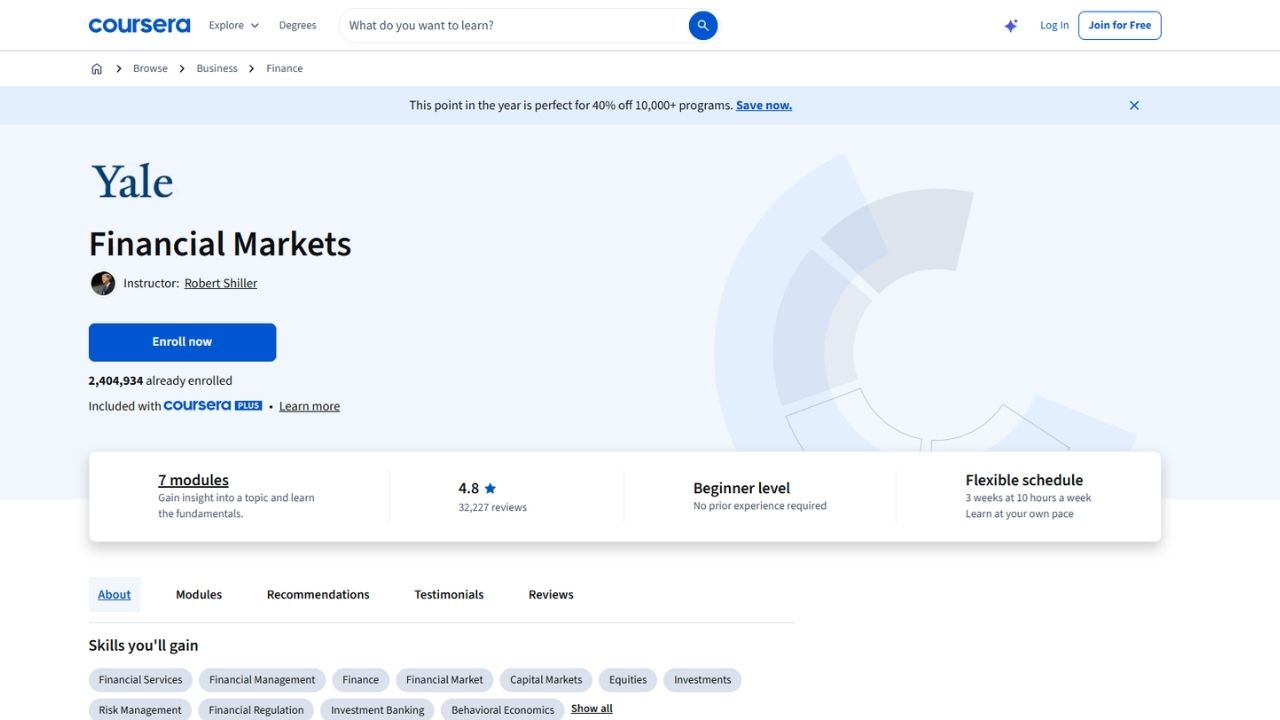
This highly popular Coursera course, originally developed by Yale University, provides a comprehensive introduction to financial markets and instruments from a global perspective. It covers how financial markets function, the role of different asset classes (stocks, bonds, derivatives, and more), valuation principles, and the impact of economic forces on markets. The course is widely respected for its clear explanations and real-world relevance, making it suitable for both beginners and those looking to strengthen their understanding of global finance. It remains one of the most enrolled finance courses on Coursera due to its strong academic foundation and practical insights.
Coursera – More Introduction to Financial Accounting
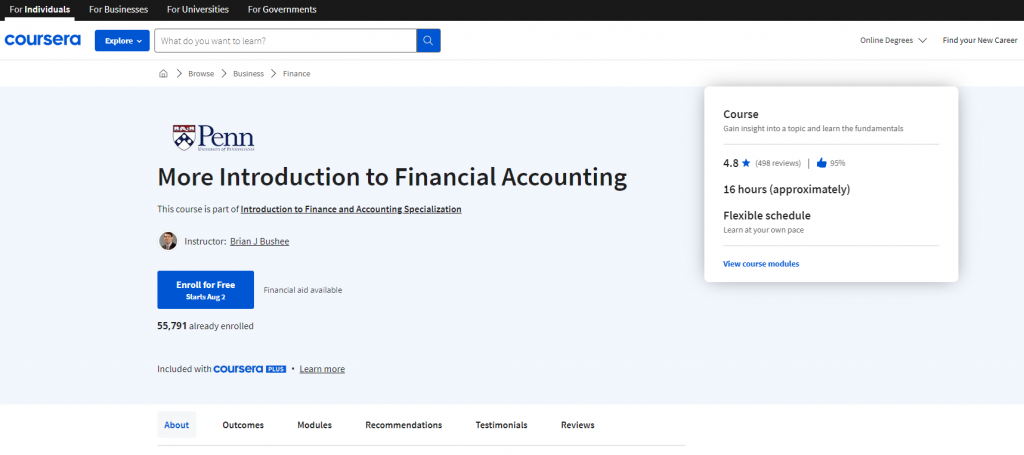
This course is part of the Specialization in Finance and Accounting. When you register for this course, you will also be registered for this Specialization. The program empowers learners to make informed decisions using comprehensive financial information. It covers various topics fundamental to financial analysis, including the following:
- Microsoft Excel
- Accounting
- Financial statements
- Ratios
- Debits and credits
- Profit and loss statements
- Balance sheets
- Essential liquidity
- Solvency
- Profitability
- Growth ratios
You will acquire a comprehensive understanding of business analysis, which unveils the driving forces behind companies, the significance of industry cycles, and vital drivers for startups, growing, mature, and declining companies, along with crucial industry-specific KPIs.
The entire program ensures that learners receive comprehensive training for each critical aspect of financial analysis, empowering them to approach their roles confidently.
This course is suitable for anyone who is interested in learning about financial accounting.
Get started with the course by following this link.
Coursera – Global Financial Markets and Instruments
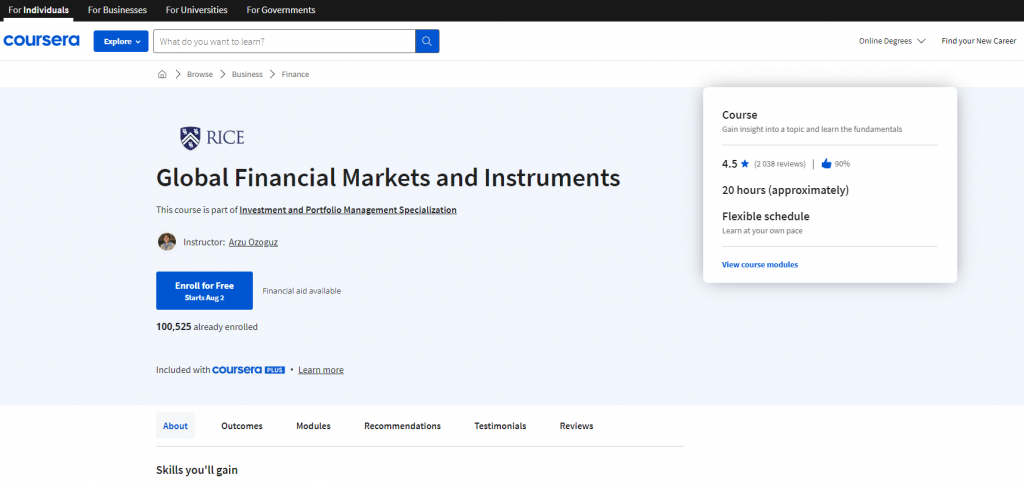
This course teaches financial markets and assets’ pivotal role in a well-functioning economy. You will learn the different financial instruments across major asset classes, gaining insights into their features and valuations.
You will also delve into the intricacies of securities trading, market types, algorithmic trading, dark pools, buying on margin, and short selling.
After finishing the course, you will be empowered with a range of essential skills which will enable you to:
- Identify and differentiate between various financial instruments available to investors.
- Conduct comprehensive comparisons of global financial markets, understanding their unique characteristics and attributes.
- Articulate the distinctive features of equity, debt, and derivative instruments, which are essential for making informed investment decisions.
- Define traditional and alternative asset classes, comprehending their significance in portfolio diversification.
- Engage in discussions surrounding different trading venues and the mechanics of securities trading, gaining a comprehensive understanding of market operations.
- Analyze current trends shaping today’s financial markets, enabling them to stay ahead of the ever-changing landscape.
This course makes money management accessible to everyone by offering an actionable basis for managing money confidently in a post-crisis society.
Discover the course at this link.
Udemy – The Complete Financial Analyst Course 2023
The Complete Financial Analyst Course 2023 stands out as the ultimate, comprehensive, and hands-on learning experience available online. The course covers many fundamental topics crucial for success in the world of finance, such as:
- Mastering Microsoft Excel
- Demystifying accounting principles and financial statements
- Understanding debits and credits
- Profit and loss statements
- Balance sheets
- Finance basics
- Interest rates
- Financial math calculations
- Loan assessments,
- Time value of money concepts
- Value of cash flows
What sets this course apart from others is its commitment to excellence. With high-quality production, HD video, and engaging animations, learning becomes an enjoyable experience rather than mundane.
This course emphasizes interactive learning, which includes extensive case studies that reinforce key concepts, ensuring learners grasp the material thoroughly.
It is designed for ambitious individuals seeking a successful finance career and those who yearn for practical financial analysis skills.
Check out the course here.
Udemy – The Complete Financial Analyst Training & Investing Course
This Udemy course unravels the art of portfolio management, honing the skills essential for financial analysts to thrive in the dynamic market. You will learn to become an Excel expert as you navigate financial modeling, creating detailed and comprehensive financial statements from scratch with the aid of templates.
You will also learn and gain a deeper understanding of risk management and technical analysis, enabling you to make informed decisions in any financial environment.
This course goes beyond the traditional realm of financial analysis. You will get to know the complexities of monetary and fiscal policy, comprehend the significance of interest rate changes, and grasp the dynamics of successful pitching to portfolio managers.
Additionally, you will explore venture capital investment ideas, mutual fund research processes, and hedge fund strategies, preparing you for various finance roles.
The course is ideal for aspiring financial analysts at all types of finance firms. Since this course offers a comprehensive overview of 14 finance roles, it will allow you to discover your passion and niche in the finance industry.
Find the course details right here.
Athabasca University – University Certificate in Finance
Athabasca University’s online University Certificate in Finance equips learners with a diverse skill set, preparing them to excel in various financial services associations.
The course tackles topics such as:
- Statistics
- Accounting
- Finance
- Economics
- Information systems
- Strategic management
As part of the curriculum, learners explore the intricacies of financial markets, financial instruments, and investment decision-making, preparing them to navigate the complexities of modern finance.
The program analyzes alternative methods to obtain, manage, and utilize capital effectively – a critical aspect of financial decision-making in a dynamic marketplace.
Furthermore, the University Certificate Course in Finance presents opportunities to fulfill substantial portions of the training required by professional financial services associations, positioning learners for a seamless transition into a career in finance.
This program from Athabasca University paves the way for aspiring professionals to acquire the knowledge, skills, and ethical principles essential for thriving in the finance industry.
Access the course materials here.
Centennial College – Financial Services
Centennial College’s two-year Financial Services diploma program is designed for individuals seeking a comprehensive and in-depth study of the financial industry, coupled with valuable industry certifications. This program offers a perfect blend of theoretical knowledge and hands-on experience.
You can gain certifications in the Canadian Securities Course (CSC), life insurance (LLQP), mutual funds (IFIC), and retirement planning (RPC), enhancing your marketability and standing out in the competitive financial services job market.
Throughout the program, you will benefit from the expertise of experienced faculty members who are industry professionals. These dedicated educators impart practical knowledge and insights beyond textbooks, providing students real-world perspectives on the financial landscape.
With small class sizes, students receive personalized attention and support from instructors, fostering an engaging and conducive learning environment.
Graduates of Centennial College’s Financial Services courses open up a world of fascinating job prospects. This degree prepares students for a variety of professions in the financial industry, from personal banking agents to analysts and investment advisors.
Explore the course by clicking here.
McGill Personal Finance
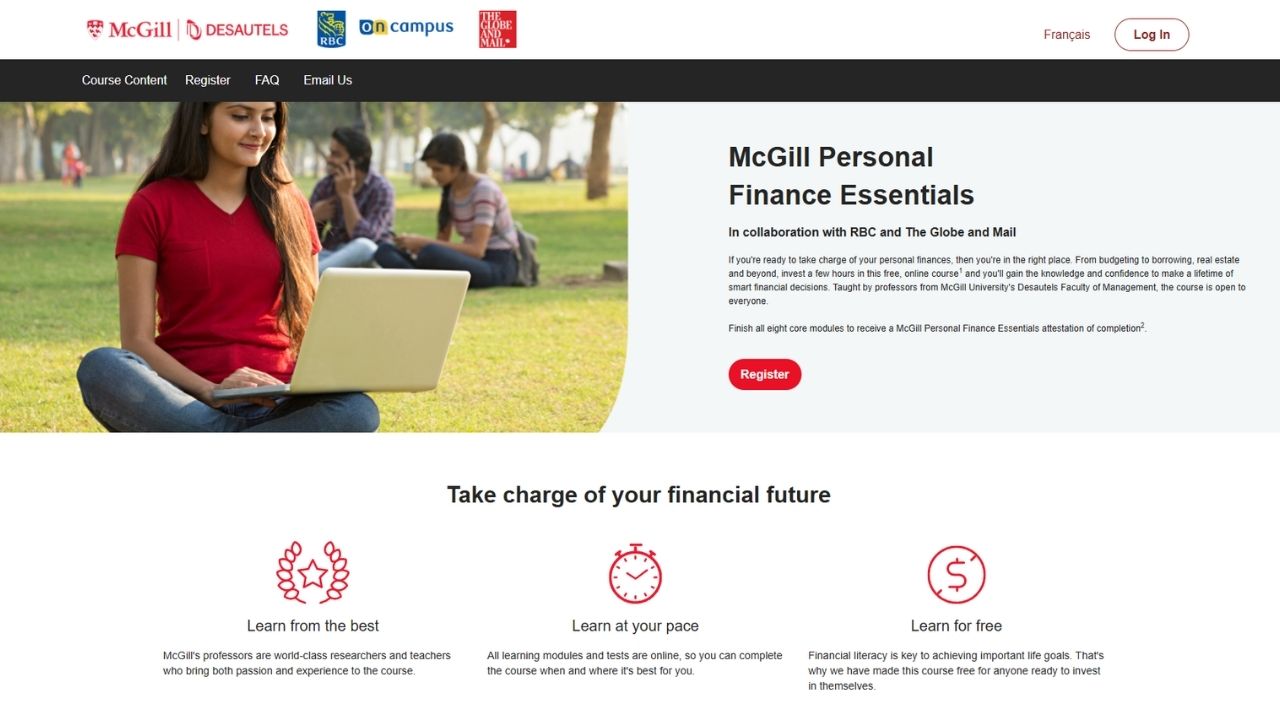
McGill Personal Finance is a practical, Canadian-focused personal finance education platform developed by McGill University. It offers accessible courses and resources designed to improve financial literacy, covering topics such as budgeting, investing, debt management, retirement planning, and responsible money management. The program is particularly valuable for individuals who want to build strong personal finance foundations or support others in improving their financial well-being. It combines academic credibility with practical, real-world applications tailored to the Canadian context.
Additional Helpful Information for Canadians in 2026
2026 Finance Career Snapshot (Canada)
| Role | Entry Level (0–2 years) | Mid-Level (3–5 years) | Senior / Specialized Roles | Notes |
|---|---|---|---|---|
| Financial Analyst | $58,000 – $72,000 | $80,000 – $100,000 | $110,000 – $140,000+ | Strong demand across industries |
| Wealth / Investment Advisor | $55,000 – $75,000 | $85,000 – $115,000 | $130,000 – $180,000+ | High earning potential with commissions |
| Personal Financial Planner | $52,000 – $68,000 | $78,000 – $105,000 | $120,000 – $160,000+ | Growing demand due to aging population |
| Fintech / Digital Finance Specialist | $65,000 – $82,000 | $95,000 – $125,000 | $140,000 – $175,000+ | Fastest growing area |
| ESG / Sustainable Finance Analyst | $62,000 – $78,000 | $88,000 – $115,000 | $125,000 – $160,000+ | Increasingly important |
| Credit / Risk Analyst | $58,000 – $74,000 | $82,000 – $105,000 | $115,000 – $145,000+ | Stable demand in banking |
| Freelance Financial Consultant | $60,000 – $85,000 | $95,000 – $130,000 | $150,000 – $200,000+ | Highest earning potential |
National Average (Mid-Level): $82,000 – $105,000 Highest earning potential: Roles in wealth management, investment advising, and fintech.
Career Paths After Taking These Courses
| Goal | Recommended Starting Course(s) | Time | Outcome |
|---|---|---|---|
| Improve personal financial literacy | McGill Personal Finance or Coursera Financial Markets | 1–3 months | Better money management skills |
| Start a career as a Financial Analyst | Coursera Financial Markets + Udemy Financial Analyst Course | 4–8 months | Strong foundation + practical skills |
| Work in banking or wealth management | Centennial College Financial Services program | 6–12 months | Industry certifications (CSC, LLQP, IFIC) |
| Pursue professional designations | Athabasca University Certificate in Finance | 8–18 months | Pathway toward CSC, CFA, or CFP |
| Understand global markets & investing | Coursera – Financial Markets (Global) | 2–4 months | Excellent for investment knowledge |
| Move into fintech or digital finance | Coursera Financial Markets + specialized fintech courses | 5–9 months | High-growth career path |
High-Demand Finance Skills in 2026
Employers in Canada are increasingly looking for professionals who combine traditional finance knowledge with modern capabilities:
- Financial modelling & Excel (still essential)
- ESG / Sustainable Investing knowledge
- Fintech & Digital Finance tools
- Data analytics (Python, Power BI, or Tableau)
- Risk management & compliance
- Wealth planning & retirement strategies
- Understanding of interest rates, inflation, and monetary policy
- Client relationship & advisory skills
Quick 2026 Decision Guide
| Your Goal | Recommended Course(s) |
|---|---|
| Want to improve your personal finances | McGill Personal Finance |
| Want a strong foundation in global markets | Coursera – Financial Markets (Global) |
| Want to become a Financial Analyst | Coursera Financial Markets + Udemy Financial Analyst Course |
| Want Canadian industry certifications | Centennial College – Financial Services |
| Want a flexible university-level credential | Athabasca University – University Certificate in Finance |
| Want practical, hands-on financial analysis | Udemy – The Complete Financial Analyst Course |
| Interested in investing and portfolio management | Coursera Financial Markets or Udemy Investing courses |
Practical Tips for Canadians in 2026
- Start with personal finance literacy if your main goal is managing your own money (McGill Personal Finance is excellent for this).
- Consider professional certifications — Many employers in banking, insurance, and wealth management value the Canadian Securities Course (CSC), LLQP, and IFIC certifications.
- Combine theory with practice — Coursera courses are great for concepts, while Udemy courses are better for hands-on Excel and financial modelling skills.
- ESG and sustainable finance are growing fast — If you’re interested in future-proofing your career, look for courses that cover responsible investing.
- Build a portfolio of projects — Even for finance roles, showing you can analyze real financial data or build financial models is highly valuable.
- Stay updated on interest rates and inflation — These topics remain very relevant in 2026 due to ongoing economic uncertainty.
Funding Options
- Canada Training Credit — Up to $250 per year tax credit.
- Employer sponsorship — Many banks, credit unions, and financial firms will pay for relevant finance training.
- Provincial workforce grants — Some provinces offer funding for career development in finance or fintech.
- Second Career (Ontario) — May fully fund eligible career changers entering the financial services sector.
Conclusion
All the online financial courses listed above will surely help you grow your knowledge about finance.
These programs will guide you as you start a career in the financial industry or improve your personal money management skills. Our top recommendation is Coursera’s Financial Markets (Global) for its strong academic foundation and global perspective on how markets work.
For those focused on personal finance literacy, McGill Personal Finance is an excellent Canadian option. For aspiring financial analysts, Udemy’s Complete Financial Analyst Course remains a practical and affordable choice. Both professional development and personal finance courses offer tremendous benefits.
Enrol in any of these courses now and pave your way to a brighter financial future.