Key Takeaways
- The fastest route is a general workplace online defensive driving course: 1-2 hours at $40-100, with eSafety First's version running 1 h 20 mins at $29.95 per person and issuing the certificate immediately after an 80% exam pass.
- No province in this guide makes the course mandatory. Alberta Transportation, Ontario's MTO and Quebec's CNESST all list it as non-mandatory, but employers must provide OHS training under provincial legislation when driving is part of job duties.
- Coursera try-first: Introduction to Self-Driving Cars from the University of Toronto explores automated vehicles. Its length is not listed, and it does not qualify you for a workplace defensive driving certificate or for demerit reduction.
- Certificate validity varies by provider: eSafety First certificates last 2 years at $29.95, On-Track Safety certificates last 36 months at $69.99 per seat, and Alberta's 3 demerit credit applies once every 2 years.
- Fiona's verdict: this suits anyone paid to drive who needs documented training fast. Skip the paid workplace courses if no employer or registry agent is asking to see one.
A defensive driving course is workplace safety training that teaches hazard recognition, safe driving techniques, vehicle maintenance and emergency response, built to reduce collisions for people who drive on the job. Most versions run online, take 1-2 hours and end in a certificate of completion.
The fastest route is a general workplace online course: eSafety First's version runs 1 h 20 mins, costs $29.95 per person and ends in a certificate valid 2 years. No province in this guide makes the course mandatory, but employers must provide OHS training when driving is part of your duties, and Alberta adds a 6-hour PDIC worth up to 3 demerit points.

What Are The Ways To Take Defensive Driving Training In Canada?
Defensive driving training in Canada comes in three routes: a Coursera course for exploring the field, a general workplace certificate for OHS compliance, and Alberta's government-approved demerit reduction course. Here is how they stack up.
| Route | Time | Cost (CAD) | What You Get | Recognized By | Best For |
|---|---|---|---|---|---|
| Introduction to Self-Driving Cars (try-first) | Not listed | Not listed | Coursera Course Certificate from the University of Toronto; not a workplace defensive driving certificate | Not listed as an OHS compliance certificate | Testing interest in driving and vehicle technology before paying for compliance training |
| General Workplace Defensive Driving Course (online) | 1-2 hours | $40-100 | Certificate of Completion, valid 2-3 years | Employers across Canada for OHS compliance | Employees who drive for work and need proof fast |
| Alberta DDC/PDIC Demerit Reduction Course | 6 hours | Approximately $100-115 plus GST (typical provider fees) | Notice of Driver Education Course Completion, up to 3 demerit points removed | Alberta registries, once every 2 years | Alberta drivers with demerits and commercial carriers |
Fiona's recommendation: if an employer is waiting on proof of training, take the general workplace route; if you are an Alberta driver carrying demerits, the PDIC is the route that changes your record; Coursera is for curiosity, not compliance.
What Is The Fastest Way To Get A Defensive Driving Certificate In Canada?
The fastest way to get a defensive driving certificate is a general workplace online course: eSafety First's version takes 1 h 20 mins, costs $29.95 per person, requires an 80% exam pass and issues the certificate immediately after. Here is the sequence I walk clients through.
- Confirm what you actually need: a workplace OHS certificate for your employer, or demerit reduction in Alberta. The first takes a couple of hours online; the second requires a 6-hour government-approved PDIC.
- Enroll in an online workplace course from a compliant provider. eSafety First's Defensive Driving Online Training starts immediately at $29.95 per person; On-Track Safety charges $69.99 per seat.
- Complete the modules and pass the exam. eSafety First requires an 80% pass mark, and the general workplace route runs 1-2 hours.
- Download and print your certificate of completion. It is issued immediately after you pass, at no extra cost.
- Alberta drivers: for demerits, book the 6-hour PDIC through a licensed driver training school at typical provider fees of approximately $100-115 plus GST, then submit the Notice of Driver Education Course Completion form to any Alberta registry agent for up to 3 demerit points removed, once every 2 years.
Do You Need A Defensive Driving Certificate In Canada?
A defensive driving certificate is not mandatory in any province listed in this guide. The duty sits with employers: provincial OHS legislation requires adequate training when driving is part of job duties, and no national mandate exists for workplace defensive driving certificates.
| Province | Certificate Mandatory? | Regulator Or Body | What It Means |
|---|---|---|---|
| Alberta | No | Alberta Transportation / Examinations and Licensing | PDIC completion earns a Notice of Driver Education Course Completion worth up to 3 demerit points removed, once every 2 years, filed at any Alberta registry agent |
| Ontario | No | Ministry of Transportation Ontario (MTO) | You may in some cases be required to take a driver improvement course (DIC) or defensive driving course (DDC) to avoid losing your driver's licence |
| Quebec | No | CNESST | Employers must provide safe working conditions, which extends to driving activities performed as part of job duties |
In practice, employer policy does the work a regulator would do elsewhere: the MTO notes that many driving schools offer DIC and DDC courses alongside government-approved beginner driver education, and CNESST frames driving for work as a health and safety obligation of the employer. For workplace courses, the certificate is generally used for employer OHS training records.
Provider recognition matters more than the regulator here. eSafety First states its certificate is accepted and recognized in Alberta, British Columbia, Manitoba, New Brunswick, Yukon, Nova Scotia, Ontario, Prince Edward Island, Quebec, Saskatchewan, the Northwest Territories, Nunavut, and Newfoundland and Labrador. A Coursera certificate, including the University of Toronto's self-driving course, is none of this: it clears no demerits and satisfies no OHS file. Alberta's demerit credit is the one thing in this system a government office actually processes.
Which Online Defensive Driving Courses Are Worth Taking?
Online defensive driving courses split into two camps: knowledge courses on Coursera and Udemy, and Canadian workplace courses from providers such as eSafety First, On-Track Safety and Gama Safety. The Canadian providers produce the certificates that employer safety files are built around; these five are the ones I compare for clients.
Introduction to Self-Driving Cars
Introduction to Self-Driving Cars is an online course from the University of Toronto that explores automated vehicle technology and awards a Coursera Course Certificate.
| Provider | University of Toronto |
|---|---|
| Credential | Course Certificate |
| Format | online |
Fiona's take: Start here if you are curious about where driving is heading, not about passing a safety check. It will not clear Alberta demerits and it will not satisfy an employer's OHS training requirement, because it was never built for either job. I recommend it as the thinking step before spending on compliance training, especially if automated vehicles could touch your line of work.
Skip it if: Skip it if you need a certificate an employer or an Alberta registry agent will actually accept.
Not a provincial licence, registration or certificate.
Start On CourseraDefensive Driving-Safe Driving
Defensive Driving-Safe Driving is a 44-minute online course from Steve Wilmes on Udemy that ends in a certificate of completion.
| Provider | Steve Wilmes |
|---|---|
| Length | 44m |
| Rating | 4.5 |
| Credential | Certificate of completion |
| Format | online |
Fiona's take: At 44 minutes, it is shorter than the workplace courses in this list with stated lengths, and it carries a 4.5 rating. Treat it as a personal refresher on safe-driving habits. Udemy certificates carry no weight with Alberta registries, and this course is not listed as OHS-compliant, so confirm with your employer before relying on it.
Skip it if: Skip it if your employer has named a specific provider.
Not a provincial licence, registration or certificate.
View On UdemyReal-World Defensive Driving
Real-World Defensive Driving is an online course from Luis Orozco on Udemy that teaches practical crash avoidance and ends in a certificate of completion; it holds a 5.0 rating.
| Provider | Luis Orozco |
|---|---|
| Rating | 5.0 |
| Credential | Certificate of completion |
| Format | online |
Fiona's take: It is the highest-rated course in this list at 5.0, and the course is framed around real-world defensive driving skills to stay focused, avoid crashes, and stay in control. Like every Udemy option here, it builds skill rather than standing: no demerit credit, no stated validity period, no OHS listing. I suggest it for newer drivers and commuters who want better habits without a compliance deadline.
Skip it if: Skip it if you need documented validity for a safety file.
Not a provincial licence, registration or certificate.
View On UdemyDefensive Driving Online Training
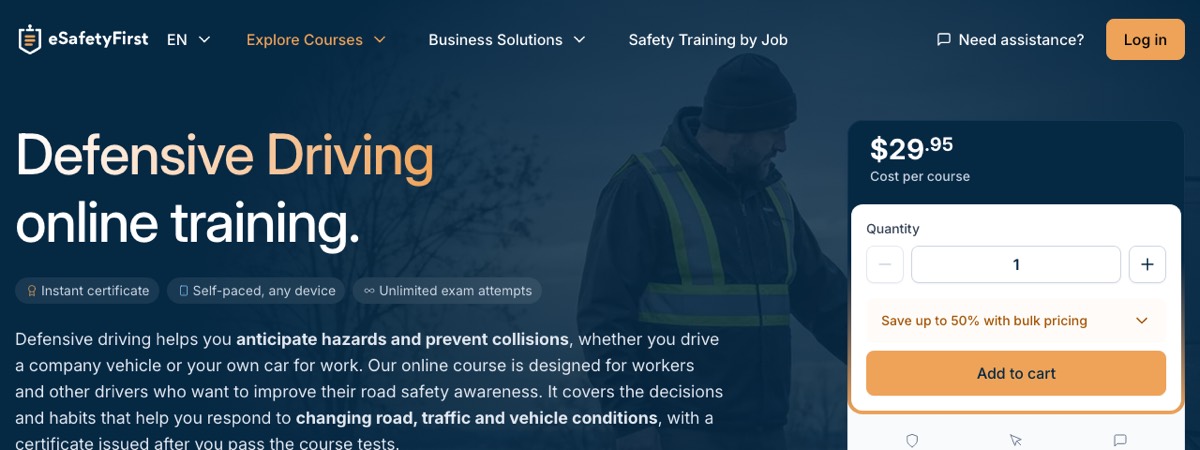
Defensive Driving Online Training is an online course from eSafety First Canada that runs 1 h 20 mins, costs $29.95 per person, requires an 80% exam pass and issues a certificate valid 2 years.
| Provider | eSafety First Canada |
|---|---|
| Length | 1 h 20 mins |
| Cost (CAD) | $29.95 (one-time, per person) |
| Rating | 4.5 |
| Credential | Certificate of Completion (valid 2 years) |
| Format | online |
Fiona's take: This is my default recommendation for workplace compliance. At $29.95 per person it is the lowest-priced Canadian option in this guide, the 80% pass mark gives the certificate some teeth, and eSafety First states it is accepted and recognized across the provinces and territories it names, from British Columbia to Newfoundland and Labrador. The trade-off is the 2-year validity, which brings renewals around quickly.
Skip it if: Skip it if you want one certificate to last three years.
See Program DetailsDefensive Driving
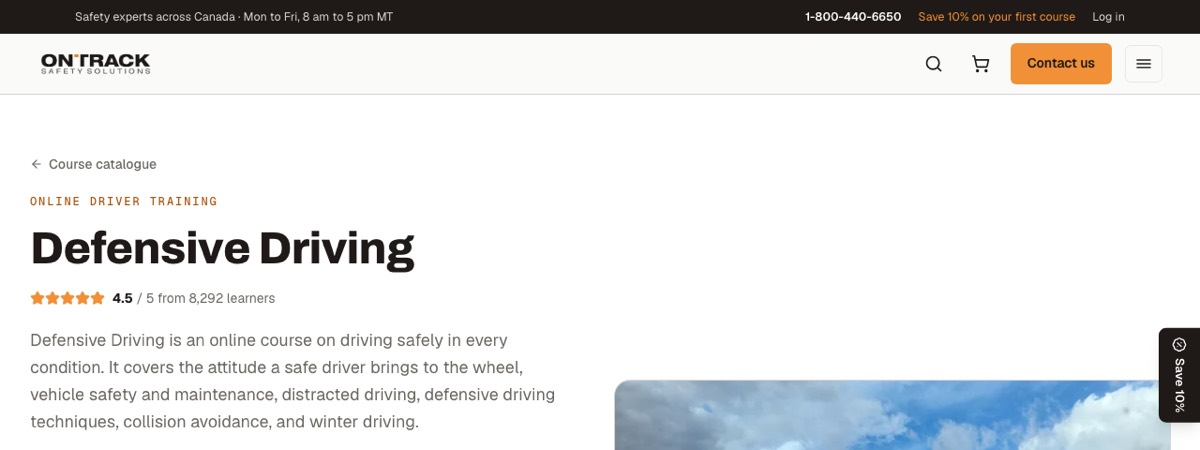
Defensive Driving is a 1h 30m online course from On-Track Safety that costs $69.99 per seat and issues a certificate valid 36 months.
| Provider | On-Track Safety |
|---|---|
| Length | 1h 30m |
| Cost (CAD) | $69.99 CAD per seat (certificate valid 36 months) |
| Rating | 4.5 |
| Credential | Certificate of completion |
| Format | online |
Fiona's take: On-Track charges more than eSafety First, but the certificate runs 36 months instead of 2 years, so you renew less often. Per-seat pricing and a fixed expiry also make fleet budgeting straightforward, and the course carries a 4.5 rating, same as eSafety First. For a driver who dislikes retraining cycles, the longer validity can justify the higher fee.
Skip it if: Skip it if a $29.95 certificate with 2-year validity already covers your requirement.
See Program DetailsHow Much Does A Defensive Driving Course Cost In Canada?
Defensive driving courses in this guide run from $29.95 at eSafety First to typical provider fees of approximately $100-115 plus GST for Alberta's PDIC, with typical workplace courses at $40-100. Named provider prices sit below the typical workplace range in most cases.
| Item | Cost (CAD) | Notes |
|---|---|---|
| Typical general workplace course | $40-100 | 1-2 hours, certificate valid 2-3 years |
| eSafety First Defensive Driving Online Training | $29.95 per person | 1 h 20 mins, certificate valid 2 years |
| Gama Safety Defensive Driving Course Online | CA$39.95 per person | 1 hour, one-time fee |
| On-Track Safety Defensive Driving | $69.99 per seat | 1h 30m, certificate valid 36 months |
| Alberta PDIC/DDC demerit course | Approximately $100-115 plus GST (typical provider fees) | 6 hours, through licensed driver training schools |
| Renewal | Same as the initial course fee | Typically every 2-3 years |
Price tracks validity more than content. Gama Safety charges CA$39.95 for 1 hour of training, eSafety First $29.95 for 1 h 20 mins, and On-Track Safety $69.99 per seat for 1h 30m. On-Track states 36-month validity, compared with eSafety First's 2 years; Gama Safety's validity is not listed. Renewal costs the same as the initial fee, typically every 2-3 years, so a shorter certificate means paying again sooner.
The Alberta PDIC sits apart at typical provider fees of approximately $100-115 plus GST for 6 hours; official Alberta pages direct you to schedule it through a licensed driver training school rather than listing a set fee. It is the one route in this guide that changes your driving record, so the premium buys a different product, not a longer video.
Is A Defensive Driving Course Worth It In 2026?
A defensive driving course is worth it in 2026 if driving is part of your pay. Employers must provide adequate training under provincial OHS legislation when driving is a job duty, and a current certificate is how you prove it. Job Bank lists a $26.42 median hourly wage for transport truck drivers (NOC 73300), so a $29.95 certificate is a small line against a year of earnings.
For Alberta drivers the case is concrete: a 6-hour PDIC at typical provider fees of approximately $100-115 plus GST removes up to 3 demerit points once every 2 years, and commercial carriers often require the course regardless. Ontario's MTO also keeps defensive driving in play, noting a DIC or DDC can be required to avoid losing your licence in some cases.
It is not worth paying for a workplace certificate nobody is asking to see. If you never drive for work, a 44-minute Udemy refresher or the Coursera route covers the learning at lower commitment. If no employer, registry agent, or licensing authority has required it, a personal driver may not need a workplace certificate.
Defensive Driving Questions Canadians Ask
Is A Defensive Driving Course Mandatory For Employees Who Drive For Work In Canada?
A defensive driving course is not mandatory under any national law in Canada. Employers must provide adequate training under provincial OHS legislation when driving is part of job duties, and in Quebec CNESST extends safe working conditions to driving performed for work. In practice, your employer chooses when training happens and which provider issues the certificate.
Which Provinces Approve Defensive Driving Courses For Demerit Point Reduction?
Alberta approves DDC and PDIC courses for demerit reduction through licensed driver training schools and certified employee driver training agencies. The course runs 6 hours, typically costs approximately $100-115 plus GST in provider fees, and finishing it earns a Notice of Driver Education Course Completion form you submit to any Alberta registry agent for up to 3 demerit points removed, once every 2 years.
How Long Is A Workplace Defensive Driving Certificate Valid?
A workplace defensive driving certificate is typically valid 2-3 years, depending on the provider and employer policy, with no single national expiry. eSafety First certificates last 2 years and On-Track Safety certificates last 36 months, so check the validity period before you pay. Alberta demerit reduction runs on its own clock: once every 2 years.
Can An Online Defensive Driving Course Be Used For Workplace Requirements Across Canada?
An online defensive driving course can meet workplace requirements across Canada when the provider is compliant. Many providers issue certificates recognized by employers in all provinces and territories for OHS compliance, and eSafety First states its acceptance from British Columbia to Newfoundland and Labrador. Confirm the provider with your employer first, because employer policy sets the certificate it honours.
What Is The Difference Between Workplace Defensive Driving And Alberta Demerit Reduction Courses?
Workplace defensive driving courses and Alberta demerit reduction courses answer different questions. Workplace versions focus on fleet safety and run short, 1-2 hours here, ending in a certificate for OHS compliance. Alberta DDC and PDIC courses run 6 hours and are government-approved for a 3 demerit credit once every 2 years.
How Much Does A Defensive Driving Course Cost In Canada?
A defensive driving course in Canada costs $40-100 for a typical online workplace version. Named prices in this guide run from $29.95 at eSafety First and CA$39.95 at Gama Safety to $69.99 per seat at On-Track Safety. Alberta PDIC demerit courses typically run approximately $100-115 plus GST in provider fees, and renewal costs the same as the initial course fee.
Do Employers Accept Online Defensive Driving Certificates?
Employers accept online defensive driving certificates from compliant providers across Canada for meeting OHS training needs, and eSafety First states recognition on its course page from Alberta to Newfoundland and Labrador. The catch is validity: employer policy typically honours a certificate for 2-3 years, so date your training and calendar the renewal before you need it again.
Where Can I Find Approved Defensive Driving Providers In Alberta?
Approved defensive driving providers in Alberta are the licensed driver training schools and certified employee driver training agencies listed on alberta.ca. The Notice of Driver Education Course Completion form that registry agents accept for the 3 demerit reduction comes from completing an approved PDIC, so confirm the school's approval before you pay.
What's The Bottom Line On Defensive Driving Courses?
- The fastest compliant route is a 1-2 hour online workplace course at $40-100, with eSafety First at $29.95 for a certificate valid 2 years.
- No province in this guide makes the course mandatory; the duty sits with employers under provincial OHS law, and Quebec's CNESST spells it out for driving duties.
- Alberta's 6-hour PDIC typically costs approximately $100-115 plus GST at provider rates and removes up to 3 demerit points once every 2 years, filed at any Alberta registry agent.
- Coursera pick: Introduction to Self-Driving Cars from the University of Toronto is for curiosity about driving's future, not for compliance.
- Certificates expire: 2 years at eSafety First, 36 months at On-Track Safety, and renewal typically costs the same as the first course.