Key Takeaways
- The fastest realistic route is the blended Heart & Stroke ACLS Provider course: about 10 hours in class plus online modules, $275 to $425, ending in a certificate valid for 2 years.
- ACLS is not a provincial legal mandate; the Heart & Stroke Foundation of Canada issues the card, and demand comes from employers, regulatory colleges and programs such as University of Toronto PGME residencies, where it is mandatory for certain programs.
- Test the theory first with Medical Emergencies: Airway, Breathing, and Circulation, a 5-module, roughly 12-hour University of Colorado course on Coursera; it does not qualify you for the Heart & Stroke ACLS Provider certificate.
- The Heart & Stroke ACLS Provider certificate is valid for two years to the day from issue; renewal takes 7-8 hours (1 day) and costs $225 to $325.
- Fiona's verdict: pay for ACLS if you are a resident (PGY1+ in a specific program), an advanced care paramedic, or hired into emergency, critical care or resuscitation roles; otherwise test your interest with Coursera first.
ACLS (Advanced Cardiovascular Life Support) is a Heart & Stroke Foundation certification course that trains healthcare providers to manage adult cardiac emergencies: cardiac arrest, dysrhythmias, stroke and acute coronary syndromes.
In Canada you earn it through a Heart & Stroke approved provider, in 14 classroom hours over 2 days or a blended format with about 10 hours in class, typically for $275 to $425. The certificate lasts 2 years. Here is how the routes, costs and prep options compare.
What Are The Ways To Get ACLS Certification In Canada?
Getting ACLS certification in Canada runs through the Heart & Stroke Foundation of Canada: every certifying path ends in the same ACLS Provider certificate, valid for 2 years. The Coursera row is preparation only and does not issue the card.
| Route | Time | Cost (CAD) | What You Get | Recognised By | Best For |
|---|---|---|---|---|---|
| Coursera prep: Medical Emergencies: Airway, Breathing, and Circulation | ~12 hours | Not listed | Shareable Coursera certificate, not the ACLS card | Shareable Coursera certificate; not recognised as the Heart & Stroke ACLS Provider certificate | Students testing the field before paying for ACLS |
| ACLS Provider, classroom | 14 hours (2 days) | $275-425 | Heart & Stroke ACLS Provider certificate | Heart & Stroke Foundation of Canada; hospitals; regulatory colleges | First-timers who want full in-person instruction |
| ACLS Provider, blended | ~10 hrs in class + online | $275-425 | Heart & Stroke ACLS Provider certificate | Heart & Stroke Foundation of Canada; hospitals; regulatory colleges | Working clinicians short on classroom time |
| ACLS Provider Renewal | 7-8 hours (1 day) | $225-325 | Heart & Stroke ACLS Provider certificate (renewal) | Heart & Stroke Foundation of Canada; hospitals; regulatory colleges | Holders whose card is expiring |
I recommend the blended Provider course for most first-timers, the 1-day renewal for anyone whose card is expiring, and the Coursera course for students who want the theory before paying for a seat.
What Is The Fastest Way To Get ACLS Certified In Canada?
The fastest way to get ACLS certified is the blended Heart & Stroke Provider course: self-paced modules first, then about 10 hours in the classroom, and you leave with a certificate valid for 2 years. Plan for the BLS prerequisite and short lead time for a seat.
- Hold a current Heart & Stroke BLS Provider certificate, issued within the past 12 months; it is a checked prerequisite.
- Pass the ACLS Precourse Self-Assessment with a 70% score; that takes 1-2 hours and costs $0 to $10.
- Register for a blended ACLS Provider course through the Heart & Stroke course finder; seats open same day or next available, $275 to $430.
- Complete the self-paced online modules before your classroom date.
- Attend the skills session and pass the exam and Megacode: 4-10 hours, cost included in your fee.
- Receive the Heart & Stroke ACLS Provider certificate, valid for 2 years from the date issued.
Is ACLS Certification Required In Canada?
ACLS certification is not a universal provincial legal mandate; employers, regulatory bodies and training programs drive the requirement. Heart & Stroke delivers the course in Canada under licence from the American Heart Association, using the same science and algorithms as AHA ACLS.
| Province | Required? | Regulator Or Registry | What It Means |
|---|---|---|---|
| Ontario | No provincial mandate | Heart & Stroke Foundation of Canada / university PGME programs | Mandatory for certain residency training programs; the University of Toronto Faculty of Medicine Postgraduate Office subsidizes it |
| Quebec | No provincial mandate | Heart & Stroke Foundation of Canada / various training centres | Courses run at the Institut de cardiologie de Montréal, CHUM and Université de Sherbrooke; the certification card is valid 2 years |
Who actually requires the card: many medical residents (PGY1+ in specific programs), paramedics, and healthcare providers in emergency, critical care or resuscitation roles. Employers and regulatory bodies commonly require it for advanced care paramedics and certain nursing and medical roles. It is not a universal provincial legal mandate, so your job posting, your college and your program set the rule.
Which ACLS Courses Are Worth Taking In Canada?
ACLS courses worth taking split into two groups: prep courses that build the theory, and Heart & Stroke courses that issue the actual card. Only the second group counts with hospitals and regulatory colleges; the first group gets you ready. Coursera options come first here because they are the way to test the field before you commit.
Medical Emergencies: Airway, Breathing, and Circulation
Medical Emergencies: Airway, Breathing, and Circulation is a 5-module online course from the University of Colorado, about 12 hours long, covering the airway, breathing and circulation emergencies named in its title.
| Provider | University of Colorado |
|---|---|
| Length | 5 modules, ~12 hours |
| Rating | 4.8 (812 reviews) |
| Credential | Shareable certificate |
| Format | online |
Fiona's take: This is a Coursera option related to airway, breathing, circulation and cardiovascular emergencies, rated 4.8 across 812 reviews, with a shareable certificate at the end. It does not qualify you for the Heart & Stroke ACLS Provider certificate or any clinical credential. I recommend it to nursing and paramedic students who want the theory before paying $275 or more for a seat.
Skip it if: Skip it if you need the actual ACLS card for a job posting this month.
Not a provincial licence, registration or certificate.
Start On CourseraMedical Emergencies: CPR, Toxicology, and Wilderness
Medical Emergencies: CPR, Toxicology, and Wilderness is a 4-module online course from the University of Colorado, about 13 hours long, covering CPR, toxicology and wilderness emergencies.
| Provider | University of Colorado |
|---|---|
| Length | 4 modules, ~13 hours |
| Rating | 4.8 (535 reviews) |
| Credential | Shareable certificate |
| Format | online |
Fiona's take: Rated 4.8 across 535 reviews, it goes wider than ACLS, which is the point: resuscitation plus toxicology and wilderness scenes in one package. It is preparation, not certification, and it does not qualify you for any provincial certificate.
Skip it if: Skip it if ACLS algorithms and Megacode practice are the only gap you need to close.
Not a provincial licence, registration or certificate.
Start On CourseraEvery Second Counts: Advanced and Emergency Clinical Skills
Every Second Counts: Advanced and Emergency Clinical Skills is a 4-module online course from Eli Lilly, about 4 hours long, focused on the advanced and emergency clinical skills in its title.
| Provider | Eli Lilly |
|---|---|
| Length | 4 modules, ~4 hours |
| Credential | Shareable certificate |
| Format | online |
Fiona's take: At roughly 4 hours it is the fastest taste of emergency thinking on this list, useful in the week before a Provider course. It does not qualify you for the Heart & Stroke ACLS certificate.
Skip it if: Skip it if you want depth; four hours stays at the overview level.
Not a provincial licence, registration or certificate.
Start On CourseraWilderness First Aid Specialization
Wilderness First Aid Specialization is a 4-course series from the University of Colorado, about 40 hours total, ending in a specialization certificate.
| Provider | University of Colorado |
|---|---|
| Length | 4 course series, ~40 hours |
| Rating | 4.8 (79 reviews) |
| Credential | Specialization certificate |
| Format | online |
Fiona's take: Rated 4.8 across 79 reviews, it suits people heading toward remote or camp work where help is far away. It is not ACLS and does not qualify you for any provincial certificate.
Skip it if: Skip it if your target is a hospital, emergency department or paramedic service that expects the Heart & Stroke card.
Not a provincial licence, registration or certificate.
Start On CourseraAdvanced Cardiac Life Support (ACLS)
Advanced Cardiac Life Support (ACLS) is a 2h 45m on-demand video course from Advanced Medical Certification on Udemy, free or by subscription, with a certificate of completion.
| Provider | Advanced Medical Certification |
|---|---|
| Length | 2h 45m on-demand video |
| Cost (CAD) | Free (or subscription) |
| Rating | 4.6 (1,824 ratings) |
| Credential | Certificate of completion |
| Format | online |
Fiona's take: Rated 4.6 across 1,824 ratings, it is the busiest ACLS-titled course on this list and a solid primer on rhythms and algorithms. If you can access it free, the main risk is your time; otherwise check the subscription cost. It does not confer the Heart & Stroke certificate.
Skip it if: Skip it if free video alone will not hold you to a study schedule.
Not a provincial licence, registration or certificate.
View On UdemyACLS & PALS
ACLS & PALS is a 4h 46m on-demand video course from Advanced Medical Certification on Udemy; price not shown, with subscription access from $13/month and a certificate of completion.
| Provider | Advanced Medical Certification |
|---|---|
| Length | 4h 46m total length |
| Cost (CAD) | not shown (subscription from $13/month) |
| Rating | 4.8 (747 ratings) |
| Credential | Certificate of completion |
| Format | online |
Fiona's take: Rated 4.8 across 747 ratings, it bundles adult and pediatric content, which suits paramedics or nurses who work across both populations. It is exam prep, not the official credential.
Skip it if: Skip it if you only need adult ACLS; the 2h 45m course covers that.
Not a provincial licence, registration or certificate.
View On UdemyACLS: Core ECG Rhythms and Interpretations
ACLS: Core ECG Rhythms and Interpretations is a 33-min on-demand video course from Advanced Medical Certification on Udemy, free, with a certificate of completion.
| Provider | Advanced Medical Certification |
|---|---|
| Length | 33 mins on-demand video |
| Cost (CAD) | Free |
| Rating | 4.4 (41 ratings) |
| Credential | Certificate of completion |
| Format | online |
Fiona's take: Rhythm recognition is where precourse work pays off, and this free 33 mins of video targets exactly that. Do this before the Precourse Self-Assessment, which requires a 70% pass.
Skip it if: Skip it if you already read ECGs fluently.
Not a provincial licence, registration or certificate.
View On UdemyHeart & Stroke - ACLS Course
Heart & Stroke ACLS Course at Saving Grace Medical Academy Ltd. is an in-person course in Edmonton, Alberta, listed at $200, ending in the Heart & Stroke ACLS Provider card.
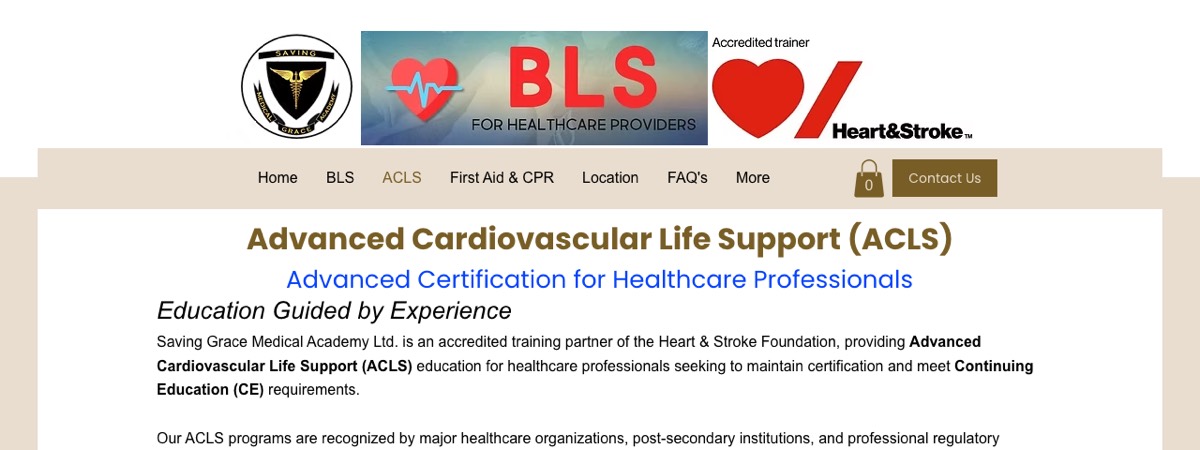
| Provider | Saving Grace Medical Academy Ltd. |
|---|---|
| Cost (CAD) | $200 CAD |
| Credential | Heart & Stroke ACLS Provider card |
| Format | in person, AB |
Fiona's take: At $200 this Edmonton listing sits below the typical $275 to $425 range for the same certificate. The in-person format suits first-timers who want an instructor in the room.
Skip it if: Skip it if Edmonton is out of reach.
See Program DetailsAdvanced Cardiac Life Support (ACLS) Course
Advanced Cardiac Life Support (ACLS) Course from VIVICPR is a blended Ontario option, about 6 hrs online plus in-class skills, ending in a 2-year ACLS Provider card; pricing is by contact.
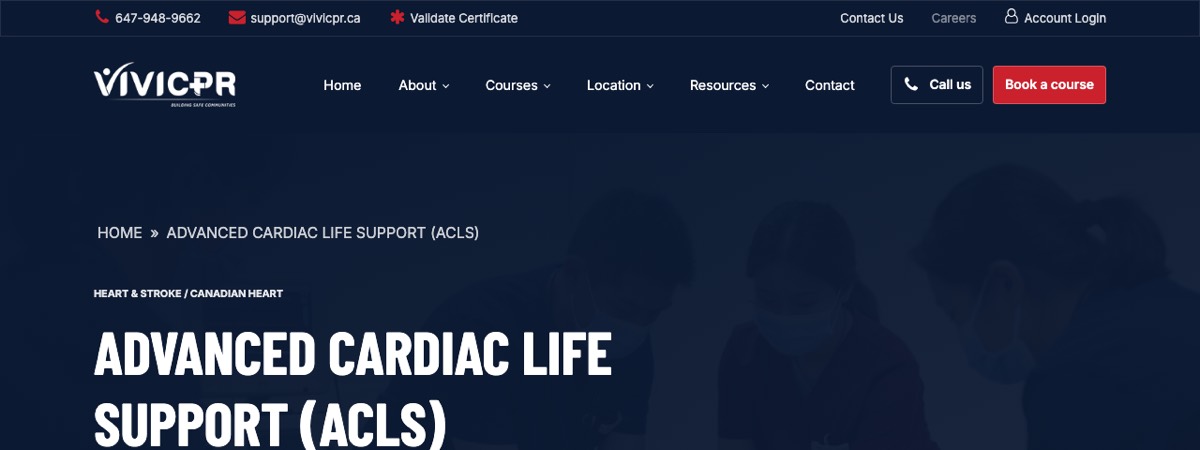
| Provider | VIVICPR |
|---|---|
| Length | ~6 hrs online + in-class skills |
| Cost (CAD) | Contact for pricing |
| Credential | 2-year ACLS Provider card |
| Format | blended, ON |
Fiona's take: The split format trims classroom time, which matters if you are working shifts. Contact VIVICPR for the fee, then compare it against the $275 Heart & Stroke listing before you book.
Skip it if: Skip it if you need a posted price up front.
See Program DetailsACLS Provider
ACLS Provider from Beats And Breaths Academy Ltd. is a blended or in-person course in Alberta, 1-2 days, $275 to $430, ending in Heart & Stroke ACLS certification.
| Provider | Beats And Breaths Academy Ltd. |
|---|---|
| Length | 1-2 days |
| Cost (CAD) | $275-430 CAD |
| Credential | Heart & Stroke ACLS |
| Format | blended/in person, AB |
Fiona's take: That range covers both formats, so confirm which price applies to your date before registering. Alberta readers get schedule flexibility here, from one blended day to two days in class.
Skip it if: Skip it if a $200 seat at Saving Grace in Edmonton fits your calendar.
See Program DetailsACLS PROVIDER
ACLS PROVIDER from SkillStat is an in-person course in Vancouver and BC; length and cost are not listed.
| Provider | SkillStat |
|---|---|
| Credential | ACLS Provider |
| Format | in person, BC |
Fiona's take: SkillStat is the BC option for metro Vancouver readers. Ask for dates and fees directly, then weigh them against the $275 Heart & Stroke listing.
Skip it if: Skip it if you live outside reach of Vancouver.
See Program DetailsACLS Certification Ottawa
ACLS Certification Ottawa from First Aid Plus is an in-person or blended course in Ottawa, Ontario, ending in a Heart & Stroke ACLS Provider card valid for two years.
| Provider | First Aid Plus |
|---|---|
| Credential | Heart & Stroke ACLS Provider card valid for two years |
| Format | in person/blended, ON |
Fiona's take: This is the provider behind our Ottawa pricing: $350 plus HST for the 2-day Provider course and $225 plus HST for the 1-day renewal. Renewal candidates land at the bottom of the $225 to $325 range here.
Skip it if: Skip it if Edmonton's $200 listing is within reach; otherwise it is a solid Eastern Ontario option.
See Program DetailsACLS Blended (1 day)
ACLS Blended (1 day) from Beats And Breaths Academy Ltd. is a one-day blended course in Alberta at $275, ending in Heart & Stroke ACLS certification.
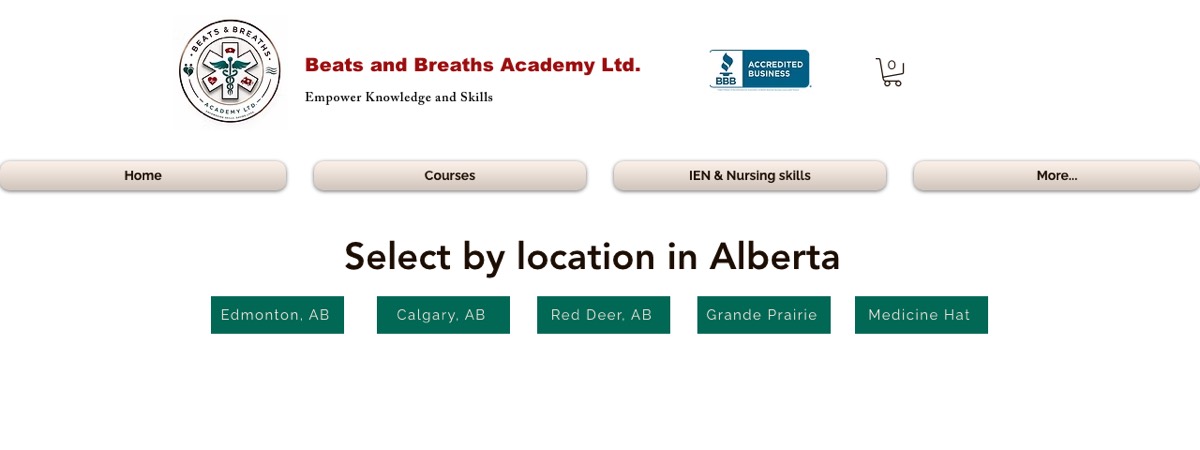
| Provider | Beats And Breaths Academy Ltd. |
|---|---|
| Length | 1 day |
| Cost (CAD) | $275 CAD |
| Credential | Heart & Stroke ACLS |
| Format | blended, AB |
Fiona's take: One day in class plus online modules is the fastest route to the card for working clinicians. At $275 it matches the Heart & Stroke listed price.
Skip it if: Skip it if you want zero screen time; the online portion is required.
See Program DetailsHow Much Does ACLS Certification Cost In Canada?
ACLS certification in Canada costs $275 to $425 for the full Provider course and $225 to $325 for renewal, before materials.
| Item | Cost (CAD) | Notes |
|---|---|---|
| ACLS Provider course, Heart & Stroke listing | $275 | Materials extra |
| ACLS Provider, First Aid Plus Ottawa (2 days) | $350 + HST | In person or blended |
| ACLS Provider Renewal | $225-325 | Ottawa renewal lists $225 + HST |
| ACLS Provider, Saving Grace Medical Academy, Edmonton | $200 | In person |
| Precourse Self-Assessment (70% pass) with current BLS | $0-10 | 1-2 hours |
Concrete examples include $200 in Edmonton, $275 on the Heart & Stroke listing, $350 + HST in Ottawa, and other provider prices up to about $425/$430. The provider and city you pick matter more than the credential itself. Materials are extra on top of tuition at the Heart & Stroke listing. Renewal is typically cheaper than the full Provider route: $225 to $325 versus $275 to $425.
Is ACLS Certification Worth It In 2026?
ACLS certification is worth it in 2026 when a program, employer or college asks for it by name. Many medical residents (PGY1+ in specific programs), paramedics, and providers in emergency, critical care or resuscitation roles need the card, and the University of Toronto makes it mandatory for certain residency programs with a subsidy attached. Without that pull, it is a $275 to $425 credential with no general workplace mandate.
The card buys two years of validity, and renewal at $225 to $325 costs less than the first course. Job Bank flags a strong risk of shortage nationally for paramedical occupations (NOC 32102) from 2024 to 2033, which strengthens the case for paramedics weighing the fee.
Can You Get Funding For ACLS Certification?
Funding for ACLS certification is thin; the concrete program sits inside a university.
- University of Toronto PGME ACLS subsidy. For certain residency programs where ACLS is mandatory, the University of Toronto Faculty of Medicine Postgraduate Office provides a one-time subsidy of up to $350 towards the course registration fee. If you are in a University of Toronto PGME program where ACLS is mandatory, ask your program coordinator before you pay out of pocket.
ACLS Certification Questions Canadians Ask
How Long Is ACLS Certification Valid In Canada?
ACLS certification in Canada is valid for two years. The Heart & Stroke ACLS Provider certificate runs to the day, exactly two years from the date it was issued, so calendar your renewal early: a 1-day renewal course at $225 to $325 keeps the card continuous.
Is Heart & Stroke ACLS The Same As AHA ACLS?
Heart & Stroke ACLS is the same program delivered in Canada: the Heart & Stroke Foundation of Canada runs ACLS under licence from the American Heart Association, using the same science and algorithms. The Heart & Stroke ACLS Provider certificate is the one Canadian hospitals and regulatory colleges recognize.
Do I Need BLS Before Taking ACLS?
BLS comes first: a current Heart & Stroke BLS Provider certificate, issued within the past 12 months, is a required prerequisite for ACLS. Pair it with the ACLS Precourse Self-Assessment, which you must pass at 70%; that takes 1-2 hours and costs $0 to $10.
Can I Take ACLS Online In Canada?
Taking ACLS online in Canada means blended, not fully virtual. Heart & Stroke approved providers pair self-paced online modules with an in-person skills session, and a fully online course with no skills session is not accepted for the official certificate. The blended format still puts about 10 hours in the classroom.
What Is The Cost Of An ACLS Course In Canada?
The cost of an ACLS course in Canada ranges from $275 to $425 for the Provider course and $225 to $325 for renewal, set by location and provider. Concrete listings: $275 from Heart & Stroke, $350 plus HST in Ottawa, and $200 at Saving Grace Medical Academy in Edmonton, with materials extra.
Is ACLS Mandatory For Paramedics Or Nurses In Canada?
ACLS is commonly required by employers and regulatory bodies for advanced care paramedics and certain nursing and medical roles, but it is not a universal provincial legal mandate. Before booking, check the job posting, your regulatory body and, for residents, your PGME program requirements.
Where Can I Find ACLS Courses Near Me In Canada?
ACLS courses near you start with the Heart & Stroke course finder, which lists dates and approved providers by province. Examples include SkillStat in Vancouver and BC, Saving Grace Medical Academy and Beats And Breaths Academy in Alberta, and VIVICPR and First Aid Plus in Ontario.
What's The Bottom Line On ACLS Certification In Canada?
- The Heart & Stroke ACLS Provider certificate is the credential Canadian hospitals and regulatory colleges ask for, and it is valid for 2 years.
- A full Provider course runs $275 to $425 over 14 classroom hours or a blended format with about 10 hours in class; renewal is $225 to $325 in one day.
- Blended registration plus a skills session is the fastest realistic path, and the BLS prerequisite and 70% Precourse Self-Assessment come first.
- Start with Medical Emergencies: Airway, Breathing, and Circulation if you want the theory before paying for a seat; that course does not issue the ACLS card.
- ACLS is not a universal provincial legal mandate; employers, regulatory bodies and programs such as University of Toronto PGME residencies are what require it.