Key Takeaways
- The fastest realistic route is a short college or industry heavy equipment operator course, taking weeks to months, followed by six or more months of paid on-the-job training; Keyano College charges $12,185.25 for its 8-week program and Great Plains College charges $9,995 for 6 weeks.
- Certification is compulsory only in Quebec for dozer, excavator and tractor-loader-backhoe operators, regulated by the Commission de la construction du Québec; it is voluntary in Newfoundland and Labrador, Nova Scotia, Prince Edward Island and Ontario.
- The Coursera try-first option, TBMs,Pile Rigs,Cranes & Hauling Vehicles, takes about 1 week at 10 hours a week, but it does not qualify you for any provincial certificate, registration or Red Seal endorsement.
- Heavy equipment operators, Job Bank NOC 73400, earn a median of $32.50 per hour in Canada, from $24.00 in Prince Edward Island to $43.73 in the Northwest Territories.
- Fiona's verdict: this path suits physically capable people who want paid training and a Red Seal-eligible trade, but skip it if you want a desk job or work that is uniform across every province.
A Heavy Equipment Operator operates the heavy equipment used to build and maintain roads, bridges, airports, pipelines, tunnels and buildings, and to work in surface mining, quarrying and material handling. In Canada the job sits under NOC 73400, and the realistic entry path is a short training course plus paid on-the-job training, not a four-year degree.
Certification is compulsory only in Quebec for dozer, excavator and tractor-loader-backhoe operators, and voluntary in Newfoundland and Labrador, Nova Scotia, Prince Edward Island and Ontario. The median wage is $32.50 per hour, and I recommend testing the field first with a short online course before you commit $12,185.25 to a college program such as Keyano's.
What Are The Ways To Become A Heavy Equipment Operator In Canada?
Two routes get you into the seat, plus a try-first online intro. The National Occupational Classification lists apprenticeship or college and industry courses combined with on-the-job training as the requirement.
| Route | Time | Cost (CAD) | What You Get | Recognised By | Best For |
|---|---|---|---|---|---|
| TBMs,Pile Rigs,Cranes & Hauling Vehicles (try first) | 1 week at 10 hours a week | Not listed | Shareable career certificate covering tunnel boring machines, pile rigs, cranes and hauling vehicles | Not a provincial licence, registration or certificate | Testing whether this trade suits you before paying for college |
| Apprenticeship | 1-2 years | Varies | Certificate of Qualification (provincial), Red Seal endorsement possible | Provincial apprenticeship authority / Red Seal | People who want the full credential and interprovincial mobility |
| College or industry course + on-the-job training | Varies (e.g. 6 weeks at Great Plains College, 8 weeks at Keyano College) | $9,995 (Great Plains College) or $12,185.25 (Keyano College) | Non-credit certificate or internal certification | Employer / provincial | People who want seat time fast and a direct line to employer training |
I recommend the apprenticeship route for anyone in Quebec or planning to move between provinces, and the college route plus employer training for everyone who wants to start earning within months.
What Is The Fastest Way To Become A Heavy Equipment Operator In Canada?
The fastest way in is a short industry or college course, then paid on-the-job training with an employer, then the voluntary certification where your province offers it.
- Complete a short industry or college heavy equipment operator course, which takes weeks to months; Great Plains College in Saskatchewan runs a 6-week program and Keyano College in Alberta runs an 8-week program.
- Start a Coursera course first if you are still deciding: TBMs,Pile Rigs,Cranes & Hauling Vehicles takes 1 week at 10 hours a week and gives you the vocabulary of cranes, pile rigs and hauling vehicles before you spend tuition money.
- Gain on-the-job training with an employer, which takes 6 or more months and costs you nothing because it is paid work.
- Obtain voluntary provincial certification where available and, if eligible, pursue the Red Seal endorsement by passing the interprovincial Red Seal examination.
- In Quebec, certification through the Commission de la construction du Québec is compulsory for dozer, excavator and tractor-loader-backhoe operators, so plan the apprenticeship route there from day one.
- In Ontario, Skilled Trades Ontario administers the voluntary trade, and the first-attempt Certificate of Qualification exam fee is $0 for post-January 1, 2025 completers.
Is Heavy Equipment Operator Certification Mandatory In Canada?
Heavy equipment operator certification is mandatory only in Quebec; everywhere else in the fact-checked provinces it exists as a voluntary credential, and the Red Seal endorsement sits on top of it for mobility.
| Province | Required? | Regulator Or Registry | What It Means |
|---|---|---|---|
| Quebec | Yes, compulsory for dozer, excavator, tractor-loader-backhoe | Commission de la construction du Québec | You cannot work in those machine classes without trade certification |
| Ontario | No, voluntary | Skilled Trades Ontario | Certification is available and helps with hiring, but is not required |
| Newfoundland and Labrador | No, voluntary | Apprenticeship and Trades Certification Division | Certification is available but optional |
| Nova Scotia | No, voluntary | Nova Scotia Apprenticeship Agency | Certification is available but optional |
| Prince Edward Island | No, voluntary | Apprenticeship Section | Certification is available but optional |
The Red Seal endorsement is available upon successful completion of the interprovincial Red Seal examination, and it is what makes your credential portable. If you train in Alberta and later want work covered by the Commission de la construction du Québec, the compulsory regime there is the one case where the credential is a hard legal requirement rather than a hiring advantage.
One caution I give every client: no online course from Coursera or Udemy gives you a provincial certificate, registration or licence. Those courses teach theory and machine knowledge only. Seat time and safety tickets may come through college or employer training; provincial certification comes through the relevant apprenticeship/trades authority, with Red Seal endorsement possible.
Which Heavy Equipment Operator Courses Are Worth Taking?
These eleven courses span the full range, from one-week online intros to a 4-year heavy equipment technician apprenticeship, and I rank them by what each actually gets you.
TBMs,Pile Rigs,Cranes & Hauling Vehicles
TBMs,Pile Rigs,Cranes & Hauling Vehicles is a 1-week online course at 10 hours per week from L&T EduTech covering tunnel boring machines, pile rigs, cranes and hauling vehicles.
| Provider | L&T EduTech |
|---|---|
| Length | 1 week at 10 hours a week |
| Credential | Shareable career certificate |
| Format | online |
Fiona's take: This is my try-first pick because it names the real machines, not generic concepts, and one week tells you whether the technical side of the trade grips you. I recommend it before you spend $9,995 or $12,185.25 on a college program. It ends with a shareable career certificate you can mention in an entry-level application.
Skip it if: Skip it if you are already working around heavy equipment or need actual seat time, because this course does not qualify you for any provincial certificate or licence.
Not a provincial licence, registration or certificate.
Start On CourseraConstruction Machinery for Concreting /Roads & Earth Moving
Construction Machinery for Concreting /Roads & Earth Moving is a 1-week online course at 10 hours per week from L&T EduTech on concreting, road building and earth-moving machinery.
| Provider | L&T EduTech |
|---|---|
| Length | 1 week at 10 hours a week |
| Credential | Shareable career certificate |
| Format | online |
Fiona's take: This one complements the hauling-vehicles course and points you toward the road-building segment of the trade under NOC 73400. Pair the two L&T EduTech courses if you want a two-week survey of the field before committing tuition.
Skip it if: Skip it if you already know which machine class you want, because it is a survey rather than machine-specific training.
Not a provincial licence, registration or certificate.
Start On CourseraConstruction Equipment Maintenance & Safety
Construction Equipment Maintenance & Safety is a 1-week online course at 10 hours per week from L&T EduTech on construction equipment maintenance and safety.
| Provider | L&T EduTech |
|---|---|
| Length | 1 week at 10 hours a week |
| Credential | Shareable career certificate |
| Format | online |
Fiona's take: Maintenance awareness is what separates operators whom foremen request by name from operators who idle machines with a fault light on. I tell clients this is the most underrated of the three Coursera options, because maintenance and safety knowledge can be useful when discussing workplace readiness.
Skip it if: Skip it if you plan to go the heavy equipment technician route at Red Deer Polytechnic or Olds College, where maintenance is the core of a 4-year apprenticeship.
Not a provincial licence, registration or certificate.
Start On CourseraHeavy Equipment Operator Certification
Heavy Equipment Operator Certification is a 1-hour-1-minute on-demand video course from Jaden Thompson on Udemy, rated 4.0 out of 5 from 28 ratings.
| Provider | Jaden Thompson |
|---|---|
| Length | 1h 1m total length |
| Rating | 4.0 out of 5 (28 ratings) |
| Credential | Certificate upon completion |
| Format | online |
Fiona's take: One hour cannot teach you to run an excavator, and despite the title this course does not confer any provincial certification. What it can do is give you the terminology of the trade in a single sitting, which is useful if you have an interview next week and a college program starting next month.
Skip it if: Skip it if you expect a credential, because the certificate of completion is not a provincial licence, registration or trade certificate.
Not a provincial licence, registration or certificate.
View On UdemyConstruction Equipment Safety: Operator, Worksite Awareness
Construction Equipment Safety: Operator, Worksite Awareness is a 5.5-hour on-demand video course from the Professional Training Institute (PTI) on Udemy covering operator and worksite safety awareness.
| Provider | Professional Training Institute (PTI) |
|---|---|
| Length | 5.5 hours on-demand video |
| Credential | Certificate of completion |
| Format | online |
Fiona's take: This is a 5.5-hour look at operator and worksite safety awareness, a short commitment by any measure. Great Plains includes safety tickets in its $9,995 fee, so compare any extra safety course against what your college program already includes.
Skip it if: Skip it if your college program already includes safety tickets, and check what this course covers against that program before enrolling.
Not a provincial licence, registration or certificate.
View On UdemyHeavy Equipment Operator Program
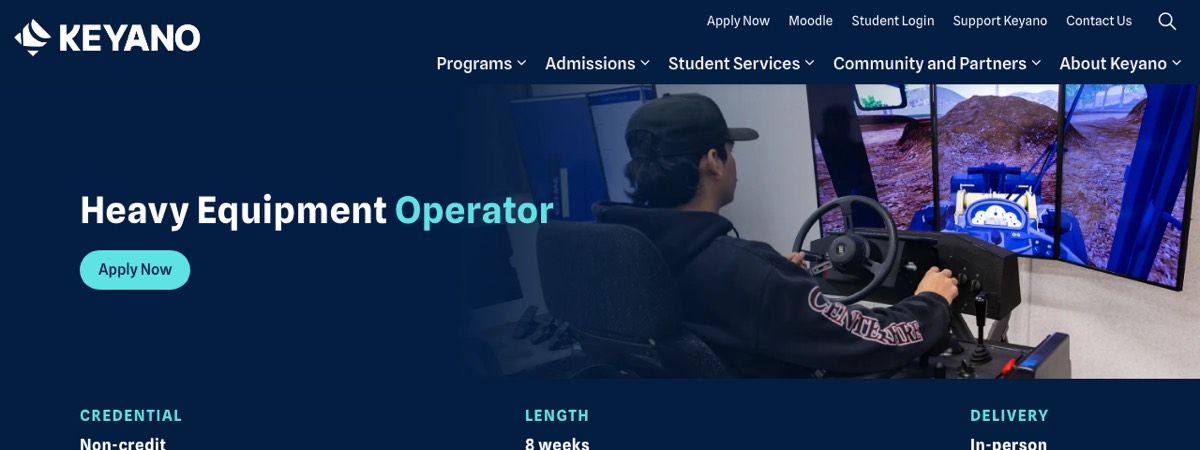
Heavy Equipment Operator Program is an 8-week in-person program at Keyano College in Alberta costing $12,185.25, including a $5 tech fee and $580.25 GST, and awards a non-credit certificate.
| Provider | Keyano College |
|---|---|
| Length | 8 weeks |
| Cost (CAD) | $11,600 + $5 (Tech) + $580.25 (GST) = $12,185.25 |
| Credential | Non-credit Certificate |
| Format | in person, AB |
Fiona's take: Keyano is an 8-week in-person program that prepares students for construction, mining and industrial operations in Alberta, where the median wage is $34.30 per hour. The credential it awards is a non-credit certificate, so pair it with employer training if you want a path toward certification. The full cost, $11,600 tuition plus fees and GST to $12,185.25, is the figure to budget against, not the sticker tuition.
Skip it if: Skip it if you want a credit credential or a Red Seal-eligible path, because this is a non-credit certificate and not an apprenticeship.
See Program DetailsHeavy Equipment Operator (HEO)
Heavy Equipment Operator (HEO) is a 6-week in-person program at Great Plains College in Saskatchewan costing $9,995 all-in, including books, application fee, student fee and all safety tickets, and awards Power Mobile Equipment Certification.
| Provider | Great Plains College |
|---|---|
| Length | 6 weeks |
| Cost (CAD) | $9,995 (Includes all costs, including books, application fee, student fee and all safety tickets) |
| Credential | Power Mobile Equipment Certification |
| Format | in person, SK |
Fiona's take: At 6 weeks and $9,995 with safety tickets included, this is the tightest package of the options here for someone who wants to be employable fast. The bundled safety tickets are the hidden value, since buying them separately adds up.
Skip it if: Skip it if you are not in Saskatchewan or willing to relocate, because the certification and ticket combination is delivered in person.
See Program DetailsHeavy Equipment Operator (HEO) Training
Heavy Equipment Operator (HEO) Training is a hybrid in-person program at Yukon University with individual courses of varying length, for example a 6-hour Common Core, mixing classroom, simulation and practical training.
| Provider | Yukon University |
|---|---|
| Length | varies (individual courses e.g. 6-Hour Common Core) |
| Credential | varies by course |
| Format | hybrid (classroom, simulation, practical), YT |
Fiona's take: The modular structure is the appeal here: you can take a 6-hour Common Core unit and decide whether to continue, rather than committing to a 6 or 8-week block. Yukon's median wage of $39.00 per hour is among the highest in the country, which changes the return-on-training math considerably.
Skip it if: Skip it if you need a fixed credential with a known price, because course length, cost and credential vary by course.
See Program DetailsHeavy Equipment Technician Apprenticeship
Heavy Equipment Technician Apprenticeship is a 4-year in-person apprenticeship at Red Deer Polytechnic in Alberta leading to a Journeyperson Certificate with Red Seal endorsement eligibility.

| Provider | Red Deer Polytechnic |
|---|---|
| Length | 4 Years |
| Credential | Journeyperson Certificate + Red Seal Endorsement eligibility |
| Format | in person, AB |
Fiona's take: This is the technician route, meaning you maintain and repair the machines rather than operate them, and I flag the distinction because clients confuse the two constantly. Four years is a serious commitment, but you finish with a Journeyperson Certificate and Red Seal eligibility, the most portable credentials in this field.
Skip it if: Skip it if you want to operate equipment rather than wrench on it, because this is the heavy equipment technician trade, not the operator trade.
See Program DetailsHeavy Equipment Technician Apprenticeship
Heavy Equipment Technician Apprenticeship is a 4-year in-person apprenticeship at Olds College in Alberta, delivered as eight weeks of training per year, leading to an Advanced Diploma and Alberta Journeyperson Certificate with Red Seal eligibility.

| Provider | Olds College |
|---|---|
| Length | Eight Weeks per year (4 years total) |
| Credential | Advanced Diploma + Alberta Journeyperson Certificate (Red Seal eligible) |
| Format | in person, AB |
Fiona's take: Olds structures the same technician trade as eight weeks per year over four years, which suits apprentices who need to work most of the year and train in blocks. The Advanced Diploma on top of the Alberta Journeyperson Certificate gives you a credential ladder if you later move into supervision.
Skip it if: Skip it if you are looking for operator seat time, because like Red Deer Polytechnic's program this trains heavy equipment technicians.
See Program DetailsHeavy Equipment Operator
Heavy Equipment Operator is the SkilledTradesBC Heavy Equipment Operator program, with 4 weeks of technical training over 1 year delivered in person by designated providers, leading to a Certificate of Qualification or Certificate of Apprenticeship.
| Provider | SkilledTradesBC |
|---|---|
| Length | Technical Training 4 weeks over 1 year |
| Credential | Certificate of Qualification / Certificate of Apprenticeship |
| Format | in person (technical training with designated providers), BC |
Fiona's take: For British Columbia this is the proper credential route, and BC's median wage of $35.75 per hour is above the national median of $32.50. The listed technical training is 4 weeks over 1 year. WorkBC projects 4,490 heavy equipment operator openings in BC from 2025 to 2035, so the demand backdrop is real.
Skip it if: Skip it if you are outside BC, because SkilledTradesBC credentials answer to the BC system, though the Red Seal examination adds interprovincial recognition.
See Program DetailsHow Much Does Heavy Equipment Operator Training Cost In Canada?
Heavy equipment operator training in Canada runs from free employer-delivered training to $12,185.25 for an 8-week college program, with the paid training being the cheap part.
| Item | Cost (CAD) | Notes |
|---|---|---|
| Keyano College Heavy Equipment Operator Program (8 weeks, AB) | $12,185.25 | $11,600 tuition plus $5 tech fee and $580.25 GST |
| Great Plains College HEO Program (6 weeks, SK) | $9,995 | Includes books, application fee, student fee and all safety tickets |
| On-the-job training with employer | 0 | Paid work, typically 6+ months |
| Ontario Certificate of Qualification exam (first attempt, post-January 1, 2025 completers) | $0 | Fee waived |
| SkilledTradesBC technical training (4 weeks over 1 year) | Not listed | Contact SkilledTradesBC and its designated providers |
| Coursera and Udemy online courses | Not listed | Confirm current pricing with Coursera and Udemy before enrolling |
The exam fee detail matters for Ontario: Skilled Trades Ontario waives the Certificate of Qualification exam fee, so the first-attempt C of Q exam fee is $0 for eligible post-January 1, 2025 completers. That removes one excuse for skipping the voluntary certification.
Compare program prices against what is bundled. Great Plains College at $9,995 includes all safety tickets; Keyano College at $12,185.25 includes tuition, a $5 tech fee and $580.25 GST. Weigh that difference against what safety tickets would cost you separately in Alberta before choosing on price alone.
How Much Does A Heavy Equipment Operator Earn In Canada?
A heavy equipment operator, classified under NOC 73400, earns a median of $32.50 per hour in Canada according to Job Bank, with the range running from $24.00 at the low end to $45.00 at the high end nationally.
| Region | Median Hourly Wage (Job Bank, NOC 73400) |
|---|---|
| Canada | $32.50 |
| Alberta | $34.30 |
| British Columbia | $35.75 |
| Manitoba | $28.92 |
| New Brunswick | $25.00 |
| Newfoundland and Labrador | $30.00 |
| Northwest Territories | $43.73 |
| Nova Scotia | $25.00 |
| Nunavut | $38.08 |
| Ontario | $32.00 |
| Prince Edward Island | $24.00 |
| Quebec | $36.00 |
| Saskatchewan | $30.00 |
| Yukon | $39.00 |
The geography tells the story: the Northwest Territories at $43.73 per hour, Yukon at $39.00 and Nunavut at $38.08 all out-earn every province, and Quebec at $36.00 leads the provinces. Prince Edward Island at $24.00 and New Brunswick and Nova Scotia at $25.00 sit at the bottom, which is why I tell Atlantic clients to weigh relocation seriously.
Outlook varies by province, and Job Bank rates it moderate in some Atlantic provinces. The concrete demand number I trust is WorkBC's projection of 4,490 heavy equipment operator openings in British Columbia from 2025 to 2035, a steady flow for a trade whose fastest college route costs $9,995 at Great Plains College.
Is Becoming A Heavy Equipment Operator Worth It In 2026?
Worth it comes down to two facts. First, the pay is solid and geographically wide: $32.50 per hour at the Canadian median under NOC 73400, and from $38.08 in Nunavut to $43.73 in the Northwest Territories. Second, the entry cost is low for a trade: $9,995 at Great Plains College or $12,185.25 at Keyano College, and the on-the-job phase is paid work rather than tuition.
The compulsory certification in Quebec is the one legal gate, enforced by the Commission de la construction du Québec for dozer, excavator and tractor-loader-backhoe operators, and the Red Seal endorsement is the answer for anyone who will move between provinces during a career. Voluntary certification in Ontario through Skilled Trades Ontario waives the exam fee for post-January 1, 2025 completers, so the first exam attempt costs $0.
The honest downside: certification is voluntary in Ontario, Newfoundland and Labrador, Nova Scotia and Prince Edward Island, so hiring often turns on seat time and safety tickets rather than paper. Keyano is an 8-week in-person program that prepares students for construction, mining and industrial operations. Whatever program you consider, ask exactly what training hours it includes before you pay.
Can You Get Funding For Heavy Equipment Operator Training?
Verified cost-reduction items in this guide are paid on-the-job training and the Ontario first-attempt C of Q exam fee waiver.
- Employer-delivered training. The on-the-job training phase, typically 6 or more months, is paid work at no cost to you.
- Ontario exam fee waiver. The first-attempt Certificate of Qualification exam fee is $0 for post-January 1, 2025 completers in Ontario, which removes the exam cost from the certification step.
Heavy Equipment Operator Questions Canadians Ask
How Do You Become A Heavy Equipment Operator In Canada?
Becoming a heavy equipment operator starts with completing secondary school, then a 1-2 year apprenticeship program or college and industry courses in heavy equipment operating combined with on-the-job training. Certification is compulsory in Quebec and voluntary in Newfoundland and Labrador, Nova Scotia, Prince Edward Island and Ontario, and the Red Seal endorsement is available for interprovincial mobility.
Is Heavy Equipment Operator Certification Mandatory In Canada?
Heavy equipment operator certification is compulsory only in Quebec, for dozer, excavator and tractor-loader-backhoe operators, under the Commission de la construction du Québec. It is voluntary in Newfoundland and Labrador, Nova Scotia, Prince Edward Island and Ontario. The Red Seal endorsement is available upon successful completion of the interprovincial Red Seal examination, where eligible.
What Is The Median Wage For Heavy Equipment Operators In Canada?
The median wage for heavy equipment operators is $32.50 per hour based on Job Bank data for NOC 73400, with the national range running from $24.00 to $45.00 per hour. Provincial medians range from $24.00 in Prince Edward Island to $36.00 in Quebec, and the territories pay more, led by the Northwest Territories at $43.73.
What NOC Code Are Heavy Equipment Operators?
Heavy equipment operators are classified under NOC 73400 in the 2021 version of the National Occupational Classification. This code covers operators of heavy equipment used in the construction and maintenance of roads, bridges, airports, pipelines, tunnels and buildings, plus surface mining, quarrying and material handling work.
Is There A Red Seal For Heavy Equipment Operators?
A Red Seal for heavy equipment operators exists, and it is granted upon successful completion of the interprovincial Red Seal examination. SkilledTradesBC lists the Red Seal-eligible path for BC operators, and Red Deer Polytechnic and Olds College offer Heavy Equipment Technician (not operator) apprenticeships that are also Red Seal eligible. It is the credential that moves with you across provinces.
How Long Does Heavy Equipment Operator Training Take?
Heavy equipment operator training takes a one- to two-year apprenticeship program, or equivalent college and industry courses combined with on-the-job training. Compressed college programs run 6 weeks at Great Plains College in Saskatchewan or 8 weeks at Keyano College in Alberta, followed by 6 or more months of paid on-the-job training with an employer.
What Are Job Prospects For Heavy Equipment Operators?
Job prospects for heavy equipment operators vary by province, and Job Bank rates the outlook moderate in some Atlantic provinces. In British Columbia, WorkBC projects 4,490 heavy equipment operator openings between 2025 and 2035, supported by a median wage of $35.75 per hour in that province.
Do Coursera Courses Count Toward Heavy Equipment Operator Certification?
Coursera courses such as TBMs,Pile Rigs,Cranes & Hauling Vehicles do not count toward any provincial certification, registration or licence for heavy equipment operators. What they do, in about 1 week at 10 hours per week, is teach you the machinery vocabulary so you can test your interest first, before paying $9,995 to $12,185.25 for a college program.
What's The Bottom Line On Heavy Equipment Operator Certification In Canada?
- Certification is compulsory only in Quebec, under the Commission de la construction du Québec, for dozer, excavator and tractor-loader-backhoe operators; it is voluntary in Ontario, Newfoundland and Labrador, Nova Scotia and Prince Edward Island.
- The realistic fast route is 6 to 8 weeks of college training, $9,995 at Great Plains College or $12,185.25 at Keyano College, followed by 6 or more months of paid on-the-job training.
- Heavy equipment operators under NOC 73400 earn a median of $32.50 per hour in Canada, and $43.73 in the Northwest Territories.
- Test the field first with TBMs,Pile Rigs,Cranes & Hauling Vehicles: 1 week at 10 hours a week, and it does not qualify you for any provincial certificate or licence.
- The Red Seal endorsement, earned by passing the interprovincial examination, is what makes this credential portable across provinces.






