Key Takeaways
- The fastest realistic route is the Canadian Red Cross Babysitting Course, which takes 7 to 8 hours, costs $70-95 plus GST or HST, and ends with a Babysitter Completion Certificate that never expires.
- No licence, registration or certificate is legally required to babysit casually in any Canadian province; Job Bank states this occupation is not regulated in Canada, though parents routinely ask for the Red Cross or St. John Ambulance certificate.
- The try-first option is Introduction to Early Childhood, a 10-hour online course from The State University of New York on Coursera; it does not give you the Red Cross Babysitter Completion Certificate that parents recognise.
- Babysitters fall under NOC 44100 Home child care providers, with a Canada-wide median wage of $19.00 per hour on Job Bank; Quebec pays a median of $21.00 and Alberta $20.00.
- Fiona's verdict: an 11-to-15-year-old starting out should take the Red Cross course first, then add the Coursera specialization only if they are considering child care as a longer-term path.
A babysitter in Canada provides short-term care for children in private homes, covering supervision, safety, basic first aid and child development support, and sits under NOC 44100 Home child care providers. The realistic start is one 7-to-8-hour course, usually the Canadian Red Cross Babysitting Course, which costs $70-95 and ends with a completion certificate with no expiry.
No province regulates casual babysitting, so the certificate is optional by law. I still tell every client aged 11 and up to get one, because it is what parents ask to see before they hand over their house keys.
What Are The Ways To Learn Babysitting In Canada?
Babysitting skills come from four routes: online university courses on Coursera, short video courses on Udemy, one-day Red Cross or St. John Ambulance courses, and in-person college-delivered Red Cross classes across the provinces.
| Route | Time | Cost (CAD) | What You Get | Recognised By | Best For |
|---|---|---|---|---|---|
| Home-Based Child Care Specialization | 4 weeks at 10 hours a week | Varies | Career certificate from The State University of New York | Coursera shareable certificate | Testing the field before paying for classroom training |
| Udemy video courses (The Complete Babysitting Certification Course) | 47 minutes | Varies | Certificate of completion | Udemy only | Quick confidence boost at home |
| Canadian Red Cross Babysitting Course | 7-8 hours | $70-95 + GST/HST | Babysitter Completion Certificate, no expiry | Canadian Red Cross | Most first-time sitters aged 11+; the credential parents recognise |
| St. John Ambulance Babysitting Basics | 8 hours | $75 | St. John Ambulance Babysitting Basics certificate | St. John Ambulance | Ages 11-15 wanting an equivalent one-day option |
| College-delivered Red Cross course (e.g., Conestoga College) | 8 hours | $75 per session | Canadian Red Cross Babysitter Completion Certificate | Canadian Red Cross | Learners who want a set classroom schedule with a local instructor |
I recommend the Red Cross course for almost everyone aged 11 and up, and the Coursera specialization for older teens and adults wondering whether child care should become a bigger part of their working life.
What Is The Fastest Way To Start Babysitting In Canada?
The fastest way to start babysitting is to finish the Canadian Red Cross Babysitting Course in a single day and then market yourself to families, with no waiting period or exam retake.
- Register for the Canadian Red Cross Babysitting Course; the minimum age is 11, or completion of Grade 5. It runs 7 to 8 hours, in person, hybrid or virtual, and costs $70-95 plus GST or HST including the manual and certificate.
- Complete the course day. You finish with a Babysitter Completion Certificate that has no expiry, so you never renew it.
- Start marketing to families immediately after the course at no cost, through parent networks, word of mouth and babysitting apps.
- Show your certificate when parents ask; most Canadian parents recognise the Red Cross name and the St. John Ambulance alternative.
- Optional next step: add first aid depth or the Coursera Home-Based Child Care Specialization if you want to move toward nannying or home daycare later, but neither is needed for casual babysitting work.
Do You Need A Licence Or Certificate To Babit Sit In Canada?
No licence, registration or certificate is legally required to babysit casually in any Canadian province or territory; Job Bank states plainly that this occupation is not regulated in Canada.
Casual babysitting in the child's own home sits outside the licensed childcare system in every province. The rules change only if you start operating a home daycare, which is a different occupation with provincial licensing. A babysitter looking after children in the family's private home needs no registration with any regulator or registry.
Practically, though, the certificate matters. When a parent in Ottawa, Calgary or Halifax screens a sitter, the two names that carry weight are the Canadian Red Cross and St. John Ambulance. A Babysitter Completion Certificate from either tells parents you have covered emergencies, basic first aid and safe caregiving, and it does not expire once issued.
Age is a parent's call, not the law's. There is no legal minimum age to babysit in Canada; the Red Cross course simply sets its own entry bar at age 11 or completion of Grade 5, and St. John Ambulance designs Babysitting Basics for ages 11 to 15.
Which Babysitting Courses Are Worth Taking?
The courses worth your money are the one-day certificates from the Canadian Red Cross and St. John Ambulance, delivered across the country and through colleges like Conestoga, Selkirk and Southeast; online options from Coursera and Udemy work as preparation or supplements.
Home-Based Child Care Specialization
Home-Based Child Care Specialization is a 3-course online series from The State University of New York on Coursera, taking 4 weeks at 10 hours a week, that covers running home-based child care professionally.
| Provider | The State University of New York |
|---|---|
| Length | 4 weeks at 10 hours a week (3 course series) |
| Credential | Career certificate from The State University of New York |
| Format | online |
Fiona's take: This is the course I recommend to anyone aged roughly 15 and up who suspects child care could become more than pocket money. It teaches the business and development side that one-day certificates skip entirely. It does not qualify you for the Red Cross Babysitter Completion Certificate, so pair it with the classroom course if you want the credential parents ask for.
Skip it if: Skip it if you only want evening and weekend babysitting gigs; the Red Cross day course alone is enough for that.
Start On CourseraIntroduction to Early Childhood
Introduction to Early Childhood is a 10-hour online course from The State University of New York on Coursera, rated 4.9 from 124 reviews, that introduces home-based child care fundamentals.
| Provider | The State University of New York |
|---|---|
| Length | 10 hours |
| Rating | 4.9 (124 reviews) |
| Credential | Shareable certificate |
| Format | online |
Fiona's take: Ten hours is a genuine low-risk test of whether you enjoy child development content, and the 4.9 rating from 124 reviews suggests learners find it delivers. It earns a shareable certificate. It does not replace the Red Cross certificate, but it tells you whether the field suits you before you commit to anything longer.
Skip it if: Skip it if you already know you like working with kids and just need the parent-facing certificate.
Start On CourseraChild Care as a Business
Child Care as a Business is a 12-hour online course from The State University of New York on Coursera that covers the operations side of paid child care.
| Provider | The State University of New York |
|---|---|
| Length | 12 hours |
| Credential | Shareable certificate |
| Format | online |
Fiona's take: This one sits at the far end of the babysitting path. It fits sitters who want to eventually run a home daycare or a nanny service, where rates, contracts and record keeping matter. As a single course inside the specialization, it also works alone if you only need the business pieces.
Skip it if: Skip it if you babysit a few evenings a month; invoicing is not your problem yet.
Start On CourseraThe Complete Babysitting Certification Course
The Complete Babysitting Certification Course is a 47-minute online video course from JNL Learning Solutions on Udemy that covers babysitting basics for teens and preteens.
| Provider | JNL Learning Solutions |
|---|---|
| Length | 47m total length |
| Credential | Certificate of completion |
| Format | online |
Fiona's take: Forty-seven minutes is a warm-up, not a qualification. I see it as a preview a nervous 11- or 12-year-old can watch at home before the classroom day, so the Red Cross material is not their first exposure. The certificate of completion means little to Canadian parents on its own.
Skip it if: Skip it if you are ready to book the Red Cross course; the real certificate makes this redundant.
View On UdemyNanny / Babysitter Training
Nanny / Babysitter Training is a 34-minute on-demand video course from Meme Boham on Udemy, rated 4.6 out of 5 from 72 ratings, that covers how to become a nanny or babysitter.
| Provider | Meme Boham |
|---|---|
| Length | 34 mins on-demand video |
| Rating | 4.6 out of 5 (72 ratings) |
| Credential | Certificate of completion |
| Format | online |
Fiona's take: At 4.6 from 72 ratings, learners rate it well for what it is: a short orientation to the role and to finding work. It is aimed slightly more at nannies than at casual sitters. Use it to decide whether the work appeals to you, then put your money toward the Red Cross course.
Skip it if: Skip it if you want any credential parents will recognise; this earns only a Udemy certificate of completion.
View On UdemyCanadian Red Cross Babysitting
Canadian Red Cross Babysitting at Conestoga College is an 8-hour in-person course in Ontario, at $75.00 per session, that ends in the Canadian Red Cross Babysitter Completion Certificate.

| Provider | Conestoga College |
|---|---|
| Length | 8 hours |
| Cost (CAD) | $75.00 (per session) |
| Credential | Canadian Red Cross Babysitter Completion Certificate |
| Format | in person, Ontario |
Fiona's take: This is the Red Cross course delivered on a college continuing-education schedule, which suits learners who want a fixed date, a real classroom and a local instructor in Ontario. At $75.00 per session it sits inside the national $70-95 range. The certificate is the same one Red Cross issues nationally and it never expires.
Skip it if: Skip it if Ontario is not your province; Selkirk College in British Columbia and Southeast College in Saskatchewan deliver the same Red Cross content closer to you.
See Program DetailsBabysitting Training Course (Canadian Red Cross)
Babysitting Training Course (Canadian Red Cross) at Southeast College is an in-person course in Saskatchewan that ends in a Canadian Red Cross certificate.
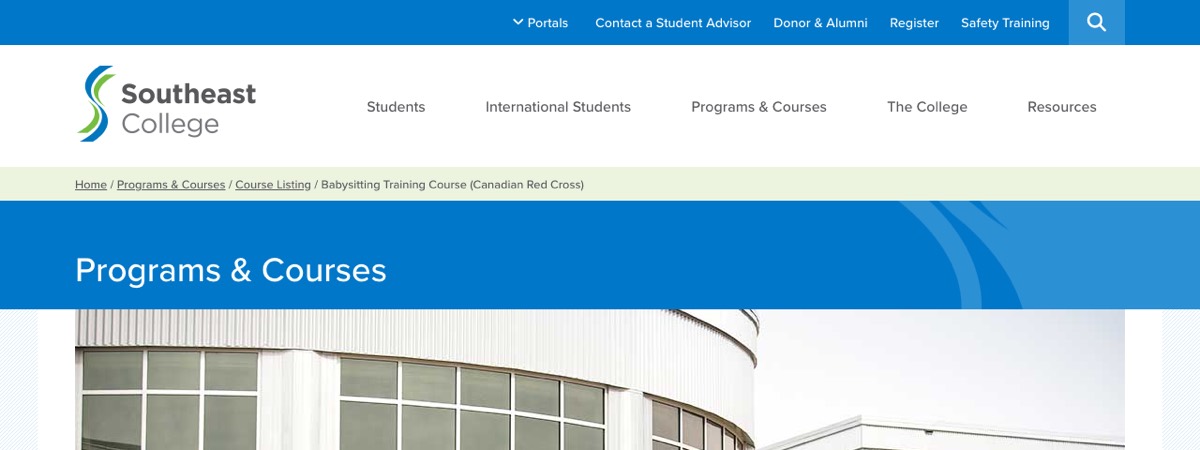
| Provider | Southeast College |
|---|---|
| Credential | Canadian Red Cross certificate |
| Format | in person, Saskatchewan |
Fiona's take: For sitters in Saskatchewan, Southeast College gives you the Red Cross certificate without travelling to a major centre. It is the same national curriculum, so parents anywhere in Canada recognise the credential. Fees are not listed, so confirm the price when you register.
Skip it if: Skip it if a Red Cross virtual delivery from Coast2Coast or Red Cross itself fits your schedule better.
See Program DetailsBabysitter Certificate: Red Cross
Babysitter Certificate: Red Cross at Selkirk College is an in-person course in British Columbia that ends in a Red Cross certificate.
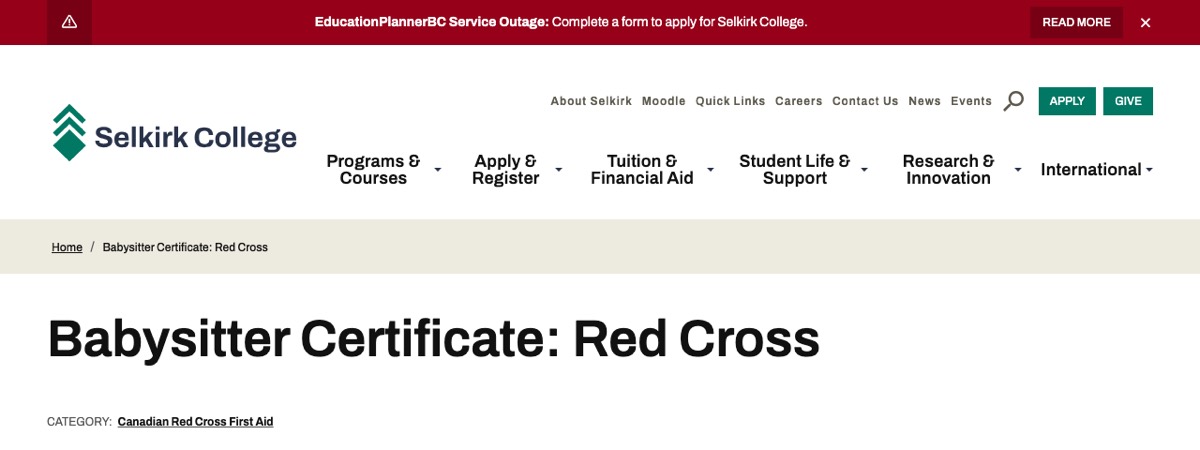
| Provider | Selkirk College |
|---|---|
| Credential | Red Cross certificate |
| Format | in person, British Columbia |
Fiona's take: Selkirk College serves British Columbia learners who want the recognized Red Cross certificate through a local institution rather than a private trainer. It covers the same 7-to-8-hour national curriculum. Confirm current fees and dates with the college before enrolling, since neither is published in the course listing.
Skip it if: Skip it if you are outside Selkirk's region; Mainland Safety offers the Red Cross course in BC as well.
See Program DetailsBabysitting Course - Canadian Red Cross
Babysitting Course - Canadian Red Cross is the national 7-to-8-hour course from the Canadian Red Cross, delivered in person, hybrid or virtual, that ends in the Babysitter Completion Certificate.
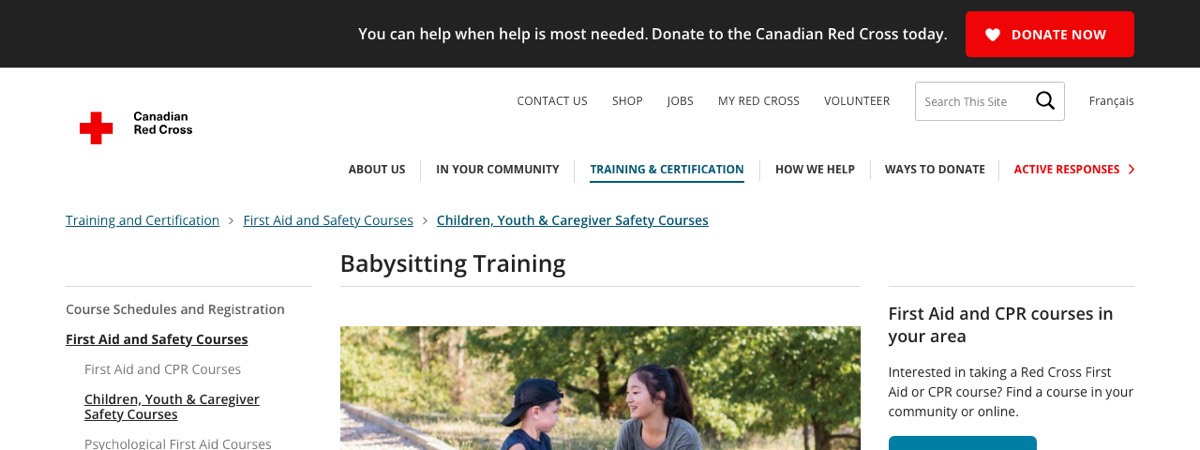
| Provider | Canadian Red Cross |
|---|---|
| Length | 7 to 8 hours |
| Credential | Babysitter Completion Certificate |
| Format | in person/hybrid/virtual, National (various) |
Fiona's take: This is my default recommendation for almost every new sitter. It is the name parents know, the certificate never expires, and the $70-95 fee including GST or HST covers the manual and certificate. Virtual, instructor-led delivery exists for teens who cannot reach a classroom. The minimum age is 11 or completion of Grade 5.
Skip it if: Skip it only if your family prefers the St. John Ambulance equivalent at $75 for the same one-day commitment.
See Program DetailsBabysitting Course BC (Canadian Red Cross)
Babysitting Course BC (Canadian Red Cross) from Mainland Safety is an in-person course in British Columbia that ends in a Canadian Red Cross certificate.

| Provider | Mainland Safety |
|---|---|
| Credential | Canadian Red Cross certificate |
| Format | in person, British Columbia |
Fiona's take: Mainland Safety is one of the Red Cross training partners delivering the certificate in BC, useful if the course dates at Selkirk College do not suit you. The content and credential are identical to the national program. Fees and length are not listed, so expect roughly the standard one-day format when you enquire.
Skip it if: Skip it if you are not in British Columbia; Red Cross itself lists national delivery options.
See Program DetailsBabysitting Training Course
Babysitting Training Course from Coast2Coast First Aid & Aquatics is a 7-to-8-hour course in Alberta, delivered virtually or in class, that ends in a Canadian Red Cross certificate.
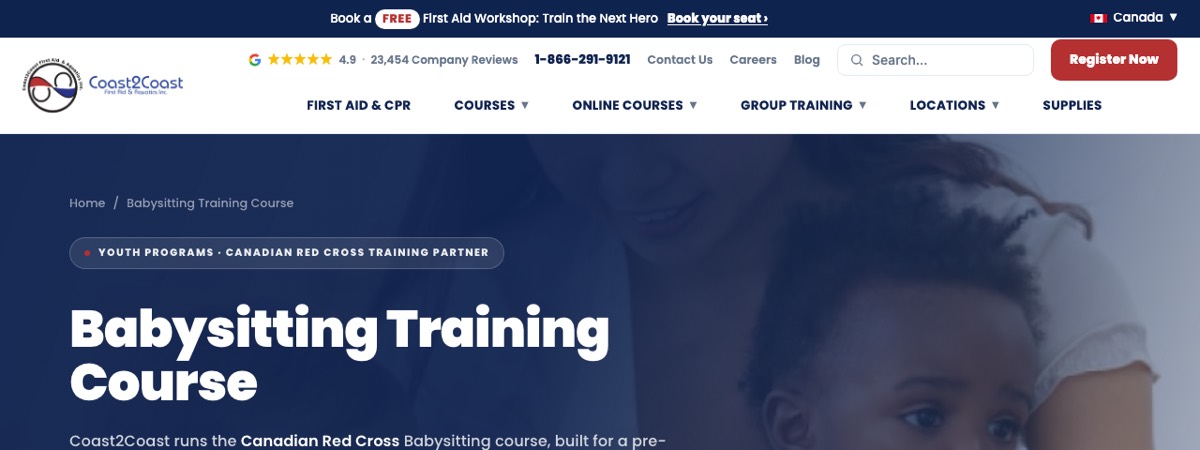
| Provider | Coast2Coast First Aid & Aquatics |
|---|---|
| Length | 7 to 8 hours |
| Credential | Canadian Red Cross certificate |
| Format | virtual/in-class, Alberta |
Fiona's take: Alberta learners get flexibility here: virtual or in-class delivery of the Red Cross curriculum, which matters for Edmonton and Calgary families juggling weekend schedules. The credential is the national Red Cross certificate with no expiry. Confirm the fee when you book, since it is not published.
Skip it if: Skip it if you are outside Alberta; the Red Cross national booking page lists providers in your area.
See Program DetailsHow Much Does A Babysitting Course Cost In Canada?
A babysitting course in Canada costs $70-95 for the Canadian Red Cross course including GST or HST, $75 for St. John Ambulance Babysitting Basics, and $75 per session for the Red Cross course delivered at Conestoga College.
| Course | Provider | Length | Cost (CAD) | Credential |
|---|---|---|---|---|
| Babysitting Course | Canadian Red Cross | 7-8 hours | $70-95 + GST/HST | Babysitter Completion Certificate, no expiry |
| Babysitting Basics | St. John Ambulance | 8 hours | $75 | St. John Ambulance certificate |
| Canadian Red Cross Babysitting | Conestoga College (Ontario) | 8 hours | $75 per session | Red Cross certificate |
| Home-Based Child Care Specialization | SUNY via Coursera | 4 weeks at 10 hours a week | Varies | Career certificate from SUNY |
| The Complete Babysitting Certification Course | JNL Learning Solutions via Udemy | 47 minutes | Varies | Udemy certificate of completion |
The Red Cross fee includes the manual and the certificate, so there is nothing to buy afterward, and the certificate never needs renewing. That makes the total cost of entry into babysitting roughly $75 in most cities, from Edmonton to Halifax.
The online options vary in price rather than being fixed, so compare the current fee at checkout. Their cost is usually far below a classroom day, which is exactly why I suggest them as a trial before you spend on the certificate parents actually ask for.
How Much Does A Babysitter Earn In Canada?
A babysitter in Canada earns a median of $19.00 per hour under NOC 44100 Home child care providers, according to Job Bank wage data.
| Region | Median Hourly Wage (CAD) |
|---|---|
| Canada (median) | 19.00 |
| Quebec | 21.00 |
| Alberta | 20.00 |
| New Brunswick | 19.19 |
| British Columbia | 19.00 |
| Nova Scotia | 19.00 |
| Ontario | 19.00 |
| Manitoba | 18.00 |
| Newfoundland and Labrador | 18.00 |
| Saskatchewan | 18.00 |
The spread is real but modest: $18.00 in Manitoba, Saskatchewan and Newfoundland and Labrador, and $21.00 in Quebec. A teen working two evening shifts a week at the $19.00 median earns more per hour than most entry-level retail jobs in the same cities, with no commute past the family's front door.
Job Bank rates the outlook as varying by province, so check the local report for your city before setting your rate. Experienced sitters with the Red Cross certificate, CPR confidence and good references consistently sit at or above their local median, because parents pay for reliability they can verify.
Is A Babysitting Course Worth It In 2026?
Yes, and the math is blunt. The Red Cross course costs $70-95 once, never expires, and the median babysitting wage is $19.00 an hour. Two evening jobs at that rate return the course fee with change, and every hour after that is upside. Few credentials in Canada pay for themselves inside a single shift.
The certificate also does something money cannot easily buy for a first-time sitter: it answers the parent's first question, which is whether you can handle an emergency. Job Bank confirms the occupation is not regulated, so the law does not force anyone to train, which is exactly why trained sitters stand out in a group chat full of untrained ones.
Where a course stops being worth it is when someone sells you repeated renewals or bundles. The Red Cross Babysitter Completion Certificate has no expiry, St. John Ambulance offers its equivalent for $75, and nothing in casual babysitting requires annual re-certification. Pay once, keep it forever, and spend future money on first aid or the Coursera specialization only if you are steering toward nannying or home daycare.
Babysitting Course Questions Canadians Ask
What Is The Minimum Age To Babysit In Canada?
The minimum age to babysit is not set by law anywhere in Canada; parents decide based on maturity, and the Red Cross course sets its own entry bar at 11 or completion of Grade 5. St. John Ambulance designs its Babysitting Basics course for ages 11 to 15. In practice, most parents hiring through networks expect sitters to be at least 12 or 13, and a certificate helps a younger candidate compete.
Is A Babysitting Course Required To Babysit In Canada?
A babysitting course is not required in any province; Job Bank states this occupation is not regulated in Canada. Courses are optional but strongly recommended, both for the emergency and first aid skills and for the parent confidence a Red Cross or St. John Ambulance certificate carries. I tell clients the $75 or so is the cheapest marketing they will ever buy.
How Much Does The Red Cross Babysitting Course Cost?
The Red Cross babysitting course typically costs $70-95 in Canadian dollars, including GST or HST, the manual and the certificate. Conestoga College in Ontario lists its Red Cross delivery at $75.00 per session, inside that range. The Babysitter Completion Certificate has no expiry, so this is a one-time cost rather than a recurring one.
What NOC Code Is Used For Babysitters On Job Bank?
Babysitters are classified under NOC 44100 Home child care providers on Job Bank and in Statistics Canada data. That code covers short-term and ongoing care for children in private homes. It matters when comparing wages, since Job Bank reports a Canada-wide median of $19.00 per hour for NOC 44100.
What Is The Median Hourly Wage For Babysitters In Canada?
The median hourly wage for babysitters under NOC 44100 is $19.00 per hour in Canada, based on current Job Bank figures. Quebec reports the highest provincial median at $21.00, followed by Alberta at $20.00, while Manitoba, Saskatchewan and Newfoundland and Labrador sit at $18.00. Rates in your neighbourhood may sit above or below these medians.
Does The Red Cross Babysitting Course Include First Aid?
The Red Cross babysitting course does include first aid skills, alongside emergency response and caregiving basics, all packed into the 7-to-8-hour day. St. John Ambulance Babysitting Basics covers the same territory for ages 11 to 15, including handling emergencies and performing basic first aid. Neither substitutes for a full workplace first aid certification, but both cover what a sitter is likely to face.
Are There St. John Ambulance Babysitting Courses Available?
St. John Ambulance babysitting courses are available across Canada under the name Babysitting Basics, an 8-hour course for ages 11 to 15 costing $75. It covers first aid, preparing healthy meals and handling emergencies, and ends in a St. John Ambulance certificate. It is a direct equivalent to the Red Cross course, so choose whichever provider has a class date near you.
Is Babysitting Regulated Like Licensed Childcare In Canada?
Babysitting is not regulated like licensed childcare for casual care in the child's home; Job Bank states the occupation is not regulated in Canada. Different rules apply only if you operate a home daycare, which is a separately licensed activity in each province. A casual sitter working in a family's house needs no licence, registry entry or renewal of any kind.
What's The Bottom Line On Babysitting Courses In Canada?
- One 7-to-8-hour day, $70-95 plus GST or HST, buys the Canadian Red Cross Babysitter Completion Certificate, which never expires; St. John Ambulance Babysitting Basics matches it at $75.
- No province regulates casual babysitting; the certificate is optional by law but is the credential parents in every Canadian city ask to see.
- At a median of $19.00 per hour under NOC 44100, the course fee is repaid inside two evening jobs.
- Start with Home-Based Child Care Specialization if you are unsure about child care work; 4 weeks at 10 hours a week tests the field, and the 10-hour Introduction to Early Childhood inside it is rated 4.9 from 124 reviews.
- Fiona's verdict: for ages 11 to 15, book the Red Cross course first; add Coursera only if babysitting is becoming a career question rather than pocket money.






