Key Takeaways
- The fastest realistic route is a blended Canadian Red Cross BLS course: 1-2 hours of online theory, a 2-3 hour in-person session at about $70, and a digital 1-year certificate within 48 hours.
- The credential is a provider certificate rather than a government registration: a current 1-year BLS card from the Canadian Red Cross or Heart & Stroke is recognised by healthcare employers, regulatory colleges and nursing and paramedic programs across Canada, and is required for many clinical placements and listed healthcare roles.
- Medical Emergencies: Airway, Breathing, and Circulation on Coursera, 1 week at 10 hours a week, does not qualify you for a BLS card; it is the try-before-you-commit option for future nurses and paramedics.
- A BLS certificate is valid for 1 year and renewal costs $50-80, against $65-85 for the initial course.
- Fiona's verdict: book the Red Cross or Heart & Stroke course the moment a placement or clinical job requires it; if you are still choosing a field, start with the free Udemy BLS theory or a Coursera course instead.
Basic Cardiac Life Support (BCLS) is the former name for Basic Life Support (BLS), the standard CPR certification for healthcare professionals, covering high-performance team-based resuscitation, airway management and AED use. BLS replaced the old CPR-HCP designation in 2019.
Getting certified is quick: a course from the Canadian Red Cross (4 hours) or Heart & Stroke (4-5 hours) costs $65-85, and the digital certificate arrives within 48 hours. This page compares the routes, the annual renewal math, and the online courses worth your time.
What Are The Ways To Get BCLS Certification In Canada?
BCLS certification routes in Canada come down to two certifying providers, plus an online theory option for people still deciding whether healthcare is their field.
| Route | Time | Cost (CAD) | What You Get | Recognised By | Best For |
|---|---|---|---|---|---|
| Coursera theory first: Medical Emergencies: Airway, Breathing, and Circulation | 1 week at 10 hours a week | Not listed | Shareable course certificate, not a BLS card | Not a healthcare certificate | Testing whether emergency care suits you |
| Canadian Red Cross BLS Provider Course (Action First Aid) | 4 hours, blended or in person | $70 | 1-year Canadian Red Cross BLS certificate | Healthcare employers, regulatory colleges, nursing and paramedic programs across Canada | Nursing and paramedic students heading to placements |
| Heart & Stroke BLS Course | 4-5 hours | $75 | 1-year Heart & Stroke BLS certificate | Hospitals, clinical settings, healthcare regulators nationwide | Hospital staff and regulated clinicians |
I recommend the Red Cross or Heart & Stroke route for anyone with a placement or job offer on the table, and the Coursera course only for people still choosing a field.
What Is The Fastest Way To Get BCLS Certified In Canada?
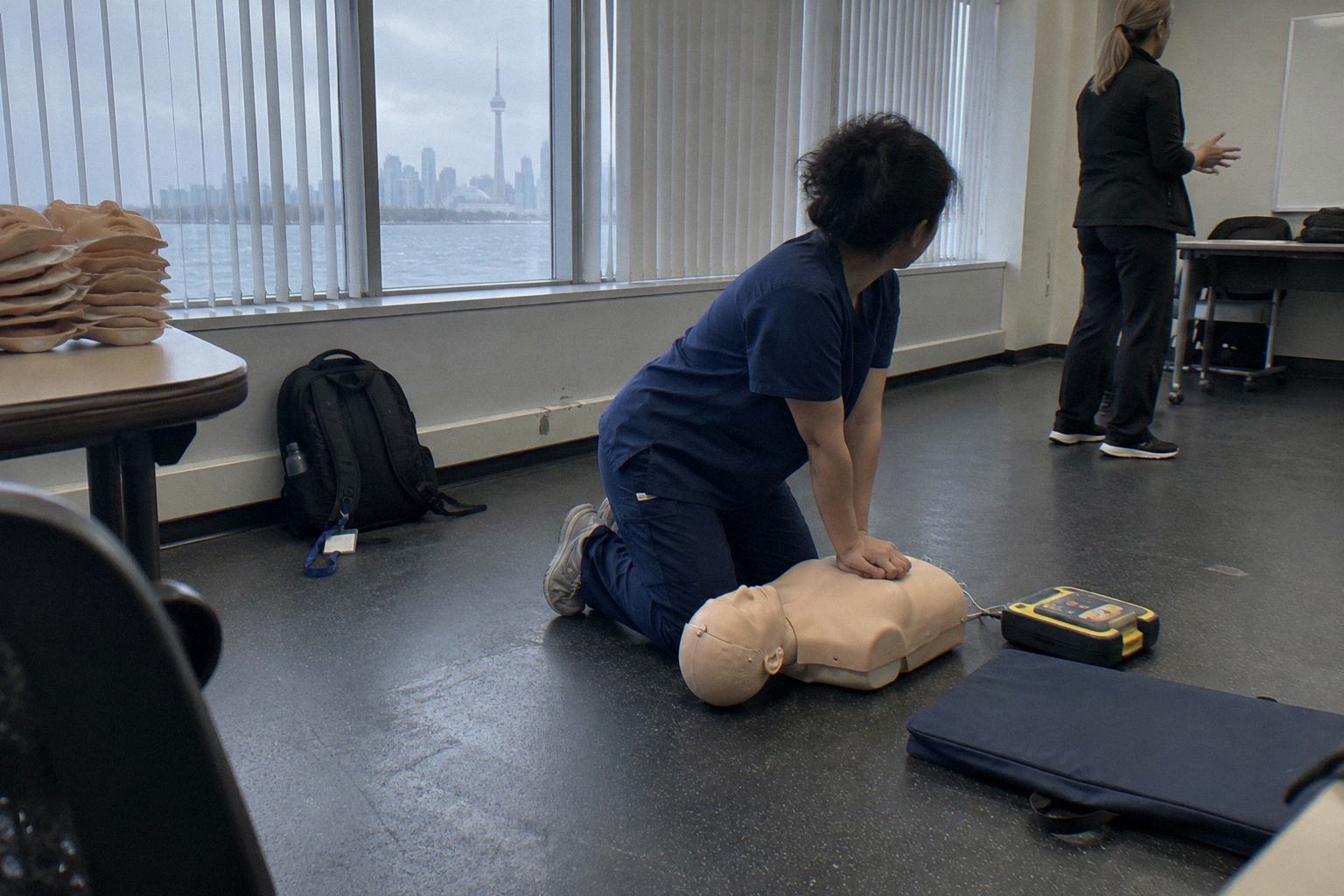
The fastest way to get BCLS certified is the blended format: online theory at home, a 2-3 hour in-person session, and a digital certificate within 48 hours, with the in-person session running about $70.
- Book a blended BLS course with providers such as Action First Aid, Coast2Coast and Red Cross partners in Toronto, or a Heart & Stroke provider in Ontario, Alberta or BC.
- Complete the online theory module first: 1-2 hours, $0 extra.
- Attend the in-person skills session and exam: 2-3 hours, about $70.
- Pass the exam and receive your digital certificate within 48 hours at no extra charge.
- Schedule renewal: the card is valid 1 year, and recertification costs $50-80 depending on provider.
Do You Need A BCLS Certificate To Work In Healthcare In Canada?
A BCLS certificate is not a government licence. The current 1-year BLS card from the Canadian Red Cross or the Heart & Stroke Foundation is recognised by healthcare employers, regulatory colleges and nursing and paramedic programs across Canada, and is required for many clinical placements and listed healthcare roles. Every card expires after 1 year.
| Who | Required? | Set By | What It Means |
|---|---|---|---|
| Nursing and paramedic students | Yes | Clinical placement programs | You present a current BLS card before placements begin |
| Nurses, doctors, paramedics, respiratory therapists, physiotherapists, dentists | Yes | Healthcare employers and regulatory colleges | A current card is part of working in clinical settings |
| Healthcare employers and hospitals | Yes | Hospitals, clinical settings, healthcare regulators nationwide | The 1-year card is checked at hiring and at annual renewal |
| Coursera or Udemy online theory | No | Not a certifying body | You finish with knowledge, not a BLS card |
The current standard is a 1-year BLS certificate, commonly through Canadian Red Cross or Heart & Stroke providers. Blended formats let you study theory online, but the hands-on skills session and exam happen in person, so a fully online course never produces a card. That is why I tell clients to treat Coursera and Udemy courses as preparation, never as certification.
One naming note: BLS replaced the CPR-HCP designation in 2019 as the healthcare standard. If your program checklist still says CPR-HCP or BCLS, both point to the same current 1-year BLS card.
Which BLS And BCLS Courses Are Worth Taking?
BLS and BCLS courses worth taking come in three tiers: online theory from Coursera and Udemy, a hospital course, and the certifying providers whose card employers actually want.
Medical Emergencies: Airway, Breathing, and Circulation
Medical Emergencies: Airway, Breathing, and Circulation is a 1 week at 10 hours a week online course from the University of Colorado System that covers the airway, breathing and circulation emergencies behind every resuscitation.
| Provider | University of Colorado System |
|---|---|
| Length | 1 week at 10 hours a week |
| Rating | 4.8 (820 reviews) |
| Credential | Shareable certificate |
| Format | online |
Fiona's take: This is the closest match to the BCLS skill set on Coursera, and airway management is core BLS content. It does not qualify you for a BLS card; treat it as the test run before you pay for a Canadian Red Cross or Heart & Stroke course. The 4.8 rating from 820 reviews suggests the teaching holds up.
Skip it if: Skip it if you already have a clinical placement date; you need the in-person card, not theory.
Not a provincial licence, registration or certificate.
Start On CourseraEvery Second Counts: Advanced and Emergency Clinical Skills
Every Second Counts: Advanced and Emergency Clinical Skills is an online course from Immersify that drills emergency clinical decision making.
| Provider | Immersify |
|---|---|
| Rating | 4.6 (111 reviews) |
| Credential | Shareable certificate |
| Format | online |
Fiona's take: Rated 4.6 from 111 reviews, it suits people weighing paramedicine or nursing who want scenario-based practice first. It does not qualify you for a BLS card, and it does not replace the in-person skills session employers check for.
Skip it if: Skip it if you want CPR mechanics specifically; the University of Colorado CPR course covers that directly.
Not a provincial licence, registration or certificate.
Start On CourseraBecome an EMT
Become an EMT is an online specialization from the University of Colorado System that builds emergency medical foundations toward a specialization certificate.
| Provider | University of Colorado System |
|---|---|
| Credential | Specialization certificate |
| Format | online |
Fiona's take: This is the right pick if you are testing a paramedic or emergency medical career, not just one certification. It does not qualify you for a BLS card or any Canadian credential; pair it later with a Red Cross or Heart & Stroke course if you proceed.
Skip it if: Skip it if you only need the 1-year BLS card for a placement.
Not a provincial licence, registration or certificate.
Start On CourseraMedical Emergencies: CPR, Toxicology, and Wilderness
Medical Emergencies: CPR, Toxicology, and Wilderness is a 13-hour online course from the University of Colorado System that covers CPR alongside toxicology and wilderness scenarios.
| Provider | University of Colorado System |
|---|---|
| Length | 13 hours |
| Credential | Shareable certificate |
| Format | online |
Fiona's take: Thirteen hours of CPR-flavoured theory for curious beginners, with a shareable certificate at the end. It does not qualify you for a BLS card; the Canadian Red Cross and Heart & Stroke cards require an in-person exam.
Skip it if: Skip the wilderness sections if your goal is a hospital placement card.
Not a provincial licence, registration or certificate.
Start On CourseraBasic Life Support (BLS)
Basic Life Support (BLS) is a 1h 6m free online course from Advanced Medical Certification on Udemy, rated 4.7 from 7,286 ratings.
| Provider | Advanced Medical Certification |
|---|---|
| Length | 1h 6m total length |
| Cost (CAD) | Free |
| Rating | 4.7 (7,286 ratings) |
| Credential | Certificate of completion |
| Format | online |
Fiona's take: One hour and six minutes of free BLS theory with a strong rating is the easiest possible preview of this field. The certificate of completion does not qualify you for a BLS card; treat it as a study aid before your paid Red Cross or Heart & Stroke course.
Skip it if: Skip it as a substitute: no in-person skills, no BLS card.
Not a provincial licence, registration or certificate.
View On UdemyFirst Aid & Basic Life Support (BLS)
First Aid & Basic Life Support (BLS) is an online course from Advanced Medical Certification on Udemy that bundles first aid basics with BLS content, rated 4.5 from 1,312 ratings.
| Provider | Advanced Medical Certification |
|---|---|
| Rating | 4.5 (1,312 ratings) |
| Credential | Certificate of completion |
| Format | online |
Fiona's take: Useful breadth if you want first aid and resuscitation together in one package. It does not qualify you for a BLS card, and healthcare employers will still ask for the 1-year Red Cross or Heart & Stroke certificate.
Skip it if: Skip it if your program asked specifically for BLS; you need the certified 4-hour course.
Not a provincial licence, registration or certificate.
View On UdemyResuscitation-Cardiac Arrest Management: RCUK 2025 Guideline
Resuscitation-Cardiac Arrest Management: RCUK 2025 Guideline is an online Udemy course from an unlisted instructor that teaches cardiac arrest management to the RCUK 2025 guideline.
| Provider | not shown |
|---|---|
| Credential | Certificate of completion |
| Format | online |
Fiona's take: Current guideline content for people who already hold a clinical role. It follows the RCUK 2025 guideline rather than the Canadian Red Cross or Heart & Stroke curriculum, and it does not qualify you for a BLS card in Canada.
Skip it if: Skip it if your employer asked for a Canadian provider card.
Not a provincial licence, registration or certificate.
View On UdemyBLS Provider Course
BLS Provider Course is a four-hour in-person course from Mackenzie Health in Ontario that grants BLS certification for $50 to staff and volunteers.
| Provider | Mackenzie Health |
|---|---|
| Length | four-hour course |
| Cost (CAD) | $50 (staff/volunteers) |
| Credential | BLS certification |
| Format | in person, Ontario |
Fiona's take: A hospital-taught course at $50 is one of the lowest listed prices on this page if you qualify: the $50 rate is listed for Mackenzie Health staff and volunteers.
Skip it if: Skip it if you have no Mackenzie Health affiliation; book a Red Cross or Heart & Stroke partner instead.
See Program DetailsBasic Life Support (BLS) Provider Course
Basic Life Support (BLS) Provider Course is the Heart & Stroke Foundation's certifying course, delivered in person or hybrid across Ontario, Alberta and BC for $50 to $84 depending on provider, with a certificate valid 1 year.
| Provider | Heart & Stroke Foundation |
|---|---|
| Cost (CAD) | CA$50.00 - CA$84.00 (varies by provider) |
| Credential | BLS certification (valid 1 year) |
| Format | in person/hybrid, Ontario/Alberta/BC |
Fiona's take: This is the card hospitals and clinical settings know nationwide. The price varies by provider within that range, so compare local options before booking. This is one of the two certificates that actually satisfies a BCLS requirement.
Skip it if: Skip it only if your employer names the Canadian Red Cross specifically.
See Program DetailsBLS Course BC
BLS Course BC is a 4-hour in-person course from Alert First Aid, a Canadian Red Cross partner in British Columbia, that issues the 1-year Red Cross BLS certificate.
| Provider | Alert First Aid (Canadian Red Cross) |
|---|---|
| Length | 4-hour |
| Rating | 4.9 (14,900+ Google Reviews) |
| Credential | Canadian Red Cross BLS (valid 1 year) |
| Format | in person, British Columbia |
Fiona's take: This is a BC Red Cross option, listed with a 4.9 rating from 14,900+ Google reviews. Four hours in person, then the card lasts the year.
Skip it if: Skip it if you are outside British Columbia; find a Red Cross partner closer to you.
See Program DetailsCPR & Resuscitation Training for Providers
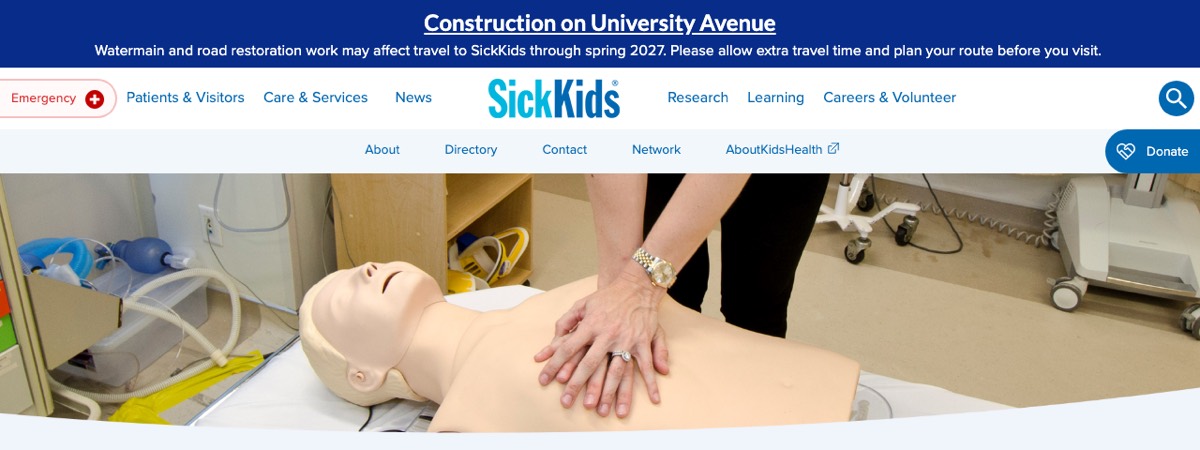
CPR & Resuscitation Training for Providers is an in-person BLS Provider Course from SickKids in Ontario.
| Provider | SickKids |
|---|---|
| Credential | BLS Provider Course |
| Format | in person, Ontario |
Fiona's take: SickKids is an Ontario in-person BLS Provider Course option; no price or length is listed, so ask before booking.
Skip it if: Skip it if you need a published price upfront; Heart & Stroke partners list theirs.
See Program DetailsHeart & Stroke BLS
Heart & Stroke BLS is an in-person course from LEC Inc in Alberta that issues the Heart & Stroke BLS 1-year certificate.
| Provider | LEC Inc. |
|---|---|
| Credential | BLS (1 Year Certificate) |
| Format | in person, Alberta |
Fiona's take: The Alberta option for the Heart & Stroke card, matching what hospitals and regulators recognise nationwide. No price is listed, so compare it with the $50 to $84 range other Heart & Stroke providers charge.
Skip it if: Skip it if you want a published price before you commit.
See Program DetailsHow Much Does BCLS Certification Cost In Canada?
BCLS certification costs $65-85 for the initial course, typically 4 hours for Red Cross or 4-5 hours for Heart & Stroke, and $50-80 to renew, and because every card expires after 1 year, renewal is an annual line item rather than a one-off payment.
| Item | Cost (CAD) | Notes |
|---|---|---|
| Initial BLS course (4 hours Red Cross, 4-5 hours Heart & Stroke) | $65-85 | Action First Aid lists $70 plus HST |
| Heart & Stroke full course (PACE First Aid) | $75 | Renewal at the same provider is $50 |
| Heart & Stroke BLS across providers | $50-84 | Varies by provider, per the Heart & Stroke course finder |
| Renewal or recertification | $50-80 | Required annually; cost varies by provider |
| Mackenzie Health BLS Provider Course | $50 | Staff and volunteers only, four hours, in person |
The digital certificate arrives within 48 hours of passing at no extra charge, so you are not paying for processing. The real recurring cost is renewal: most healthcare employers require it every year, and at $50-80 annually on top of a $65-85 start, plan for the card the way you plan for any recurring professional fee.
Is BCLS Certification Worth It In 2026?
BCLS certification is worth it in 2026 if a clinical role is in your future. Nursing students need it for placements; nurses, doctors, paramedics, respiratory therapists, physiotherapists and dentists need it for clinical settings. At $65-85 once and $50-80 a year, the cost is small against a healthcare career, and the card stays useful for as long as you stay clinical.
It is not worth paying for yet if you have no clinical target. A free 1h 6m Udemy BLS course or a Coursera module like Medical Emergencies: Airway, Breathing, and Circulation tells you whether the field grips you before you spend on the certified course. Start there, then book the Red Cross (4 hours) or Heart & Stroke (4-5 hours) course when a program or employer asks for the card.
Timing matters more than most people expect. Cards expire after 1 year, so taking the course the same month your placement or job starts wastes nothing, while certifying a year early means paying a $50-80 renewal before you have used the credential once.
BCLS Certification Questions Canadians Ask
What Is BCLS Certification?
BCLS certification is the older name for Basic Life Support (BLS), the standard 1-year CPR credential for healthcare professionals. It covers high-performance team-based resuscitation, 2-rescuer coordination, advanced airway management and AED use. Nurses, doctors, paramedics, respiratory therapists, physiotherapists, dentists and students on clinical placements all need it. The Canadian Red Cross and the Heart & Stroke Foundation issue the current cards.
Is BCLS The Same As BLS?
BCLS and BLS are the same certification; the Red Cross states they differ only in name. BCLS is the former term, and BLS from the Canadian Red Cross or Heart & Stroke is the current standard. If a job posting asks for BCLS, a current 1-year BLS certificate satisfies it.
How Long Is BCLS Valid In Canada?
BCLS validity is 1 year in Canada. Both the Canadian Red Cross and Heart & Stroke certificates expire after one year, and most healthcare employers require annual renewal, so book your recertification before the card lapses. Renewal costs $50-80 depending on provider, less than the $65-85 initial course.
Who Needs BCLS Certification?
Healthcare professionals and students need BCLS certification: nurses, physicians, paramedics, dental professionals, respiratory therapists and physiotherapists, plus nursing students heading into clinical placements. The 1-year card is recognised by hospitals, clinical settings, healthcare employers, regulatory colleges and nursing and paramedic programs, and many clinical placements and listed healthcare roles require it.
How Much Does BCLS Certification Cost?
BCLS certification costs $65-85 for the initial four-hour course. Action First Aid lists its Red Cross BLS at $70 plus HST, PACE First Aid charges $75 for the Heart & Stroke full course, and renewal runs $50-80. Mackenzie Health charges staff and volunteers $50. Budget for renewal every year.
Can I Take BCLS Online In Canada?
BCLS can be partly online: blended courses let you finish the theory at home in 1-2 hours, but the hands-on skills session and exam must happen in person, and the digital certificate follows within 48 hours. Fully online courses from Coursera or Udemy do not issue a BLS card.
Where Can I Get BCLS Certification In Toronto?
BCLS certification in Toronto is available from providers such as Action First Aid, Coast2Coast and Red Cross partners across Ontario. Ontario hospital options listed here include Mackenzie Health and SickKids, both in person. Outside Ontario, Alert First Aid runs Red Cross BLS in British Columbia and LEC Inc runs Heart & Stroke BLS in Alberta.
Does BCLS Replace CPR-HCP?
BCLS, now called BLS, did replace CPR-HCP: the CPR HCP designation was replaced by the Basic Life Support course in 2019 as the healthcare standard. If you hold an old CPR-HCP credential, the current standard is the 1-year BLS card from the Canadian Red Cross or the Heart & Stroke Foundation.
What's The Bottom Line On BCLS Certification?
- BCLS is BLS: a 1-year card from the Canadian Red Cross or Heart & Stroke is what employers mean by either name.
- The full certification typically takes 4 hours for Red Cross, or 4-5 hours for Heart & Stroke, costs $65-85, and the digital card lands within 48 hours of passing.
- Renewal is annual: budget $50-80 every year to keep the card active.
- Test the field first with Medical Emergencies: Airway, Breathing, and Circulation; it does not issue a BLS card, but it shows you whether emergency care fits before you pay.