Key Takeaways
- The fastest realistic route to an LLM in Canada is a 1-year research-based program, such as the University of Alberta Faculty of Law Master of Laws, with tuition of $5,570 for Canadian students and $9,250 for international students, plus $23,000 to $28,000 in estimated living expenses.
- An LLM is not a licence to practise law in Canada. Foreign lawyers need an assessment from the National Committee on Accreditation (NCA), and an LLM does not entitle the holder to practise law in Canada.
- Before committing a year and five figures, test the field with AI & Law from Lund University on Coursera, a 2-week online course at 10 hours a week. It awards a Course Certificate and does not qualify you for NCA assessment, law society admission, or any LLM program.
- Lawyers (NOC 41101) earn a median of $59.76 per hour in Canada, per Job Bank, ranging from $47.18 in Manitoba to $78.85 in Alberta.
- Fiona's verdict: the LLM suits lawyers and law graduates who want research depth or a specialty like law and technology. If your goal is to practise law in Canada, the JD route or NCA assessment is the real path, not the LLM.
A Master of Laws (LLM) is a one-year research degree program which enables law students, lawyers, and academics from related disciplines to hone legal expertise and conduct advanced research. In Canada it sits on top of a prior law degree, typically a JD or LLB.
If you already have that law degree, the realistic route is one year of tuition at $5,570 (Canadian) or $9,250 (international), plus $23,000 to $28,000 in living expenses, as estimated by the University of Alberta. What the LLM does not give you is a licence to practise: that still runs through NCA assessment for foreign lawyers or a JD and provincial law society admission.
What Are The Ways To Get A Masters Of Law Degree In Canada?
A masters of law degree in Canada comes in a few shapes: research-based, course-based, common-law, and specialty LLMs.
| Route | Time | Cost (CAD) | What You Get | Recognised By | Best For |
|---|---|---|---|---|---|
| AI & Law plus other Coursera law courses | 2 weeks at 10 hours a week | Cost not listed | Course Certificate | Coursera / Lund University | Testing interest in law and AI before applying to any LLM |
| Research-based LLM, University of Alberta Faculty of Law | 1 year | $5,570 (Canadian) or $9,250 (international) tuition | Master of Laws (LLM) degree | University of Alberta | Academic research and doctrinal depth |
| LLM - Master of Laws (Common Law) (LLMCL) | 1 year | Not listed | LLM | University of British Columbia | Foreign-trained lawyers wanting Canadian common law |
| Master of Laws (LLM) and Concentration Law and Technology | 12 to 16 months | Not listed | LLM | University of Ottawa | Law and technology specialists |
| Professional LLM in Canadian Common Law | Two years part-time | Not listed | LLM | Osgoode Professional Development (York University) | Working professionals studying part-time |
I recommend the University of Alberta research LLM for full-time Canadian students who want the credential in one year at a stated price, and the Osgoode part-time LLM for practising professionals in Ontario who cannot stop working.
What Is The Fastest Way To Get An LLM Degree In Canada?
The fastest realistic route to an LLM in Canada is a 1-year research-based program, and the University of Alberta Faculty of Law states its length and fees plainly.
- Complete a JD, LLB or equivalent law degree first. The fastest route starts with this prior credential, though the degree is also open to law students and academics from related disciplines; check each faculty's admission rules.
- Choose a 1-year program. The University of Alberta Master of Laws, the UBC LLM in Common Law, and the University of Toronto GPLLM all list one year full-time.
- Budget the tuition: $5,570 for Canadian students and $9,250 for international students at University of Alberta, plus $23,000 to $28,000 in estimated living expenses.
- Check the University of Alberta's current application requirements directly; the program is described as a one-year research degree.
- Complete the year. Some course-based options stretch longer: Dalhousie's LLM runs 16 months or longer, and Calgary's runs 12 to 16 months.
Does An LLM Degree Let You Practise Law In Canada?
An LLM does not entitle the holder to practise law in Canada. Practising requires admission to a provincial law society, and foreign-trained lawyers need an assessment from the National Committee on Accreditation (NCA).
The distinction trips up more of my clients than any other part of this decision. The LLM is a research degree, not a professional licence. If you trained abroad and want to be called to the bar here, your file goes to the NCA, which determines what further study or examinations you need. The LLM can run alongside that process, and some lawyers use it to absorb Canadian common law, but it does not replace the NCA assessment or law society admission.
Where the LLM does real work is specialisation. Programs like the University of Ottawa's LLM with a concentration in Law and Technology, and Osgoode's Professional LLM in Privacy and Cybersecurity Law, build depth in a field rather than a licence to appear in court. My advice: be honest about which of the two you are buying before you pay tuition.
Which LLM And Law Courses Are Worth Taking?
I group the options into three tiers: Coursera courses to test the water, Udemy courses for practical AI skills, and the actual LLM programs at Canadian universities.
AI & Law
AI & Law is a 2-week online course at 10 hours a week from Lund University on Coursera that awards a Course Certificate.
| Provider | Lund University |
|---|---|
| Length | 2 weeks at 10 hours a week |
| Credential | Course Certificate |
| Format | online |
Fiona's take: This is my try-first pick for anyone weighing an LLM with a technology angle. Two weeks tells you whether the subject pulls you before a $5,570 tuition bill does. The Coursera certificate carries no weight with law societies or the NCA, so treat it purely as a personal test.
Skip it if: Skip it if you already know you want a full LLM and have a law degree in hand; it will not advance your application.
Start On CourseraPrompt Engineering for Law
Prompt Engineering for Law is a 4-week online specialization at 10 hours a week from Vanderbilt University that awards a Specialization Certificate.
| Provider | Vanderbilt University |
|---|---|
| Length | 4 weeks at 10 hours a week |
| Credential | Specialization Certificate |
| Format | online |
Fiona's take: Four weeks at 10 hours a week is a bigger commitment than the Lund course, and the specialization is built on harnessing generative AI to transform legal research and practice. It awards a Specialization Certificate, not an LLM or any part of a licence. Treat it as skills-building, not a credential with regulatory weight.
Skip it if: Skip it if you want research or doctrine rather than hands-on tool skills.
Start On CourseraAI in Law: Research, Risk, and Legal Drafting
AI in Law: Research, Risk, and Legal Drafting is a 4-week online specialization at 10 hours a week from the University of Duisburg-Essen that awards a Specialization Certificate.
| Provider | University of Duisburg-Essen |
|---|---|
| Length | 4 weeks at 10 hours a week |
| Credential | Specialization Certificate |
| Format | online |
Fiona's take: The scope runs from research through risk to drafting across four weeks at 10 hours a week, a genuine but manageable commitment. I suggest it to LLM applicants weighing a law and technology focus who want a structured preview before applying. The Specialization Certificate carries no academic weight with any faculty.
Skip it if: Skip it if your LLM interest is elsewhere, such as tax or comparative common law.
Start On CourseraAI Governance and Compliance in Law
AI Governance and Compliance in Law is an online specialization from the University of Illinois College of Law that awards a Specialization Certificate.
| Provider | University of Illinois College of Law |
|---|---|
| Credential | Specialization Certificate |
| Format | online |
Fiona's take: The specialization covers governance and compliance in law, with the aim of gaining a legal edge in AI governance, and the University of Illinois College of Law name gives it credibility. I would pair this with the Ottawa Law and Technology LLM as a pre-application taste of the field. No duration is listed, so check the syllabus before you enrol.
Skip it if: Skip it if you need a stated schedule; no duration is listed for this one.
Start On CourseraGenerative AI & AI Agents for Legal Professionals
Generative AI & AI Agents for Legal Professionals is an online Udemy course rated 4.6 that awards a certificate of completion.
| Provider | Udemy |
|---|---|
| Rating | 4.6 |
| Credential | Certificate of completion |
| Format | online |
Fiona's take: A 4.6 rating across Udemy's law and AI shelf makes this the strongest of the three Udemy options on raw satisfaction. It suits practising lawyers more than applicants. A Udemy certificate of completion carries no academic or regulatory weight whatsoever.
Skip it if: Skip it if you want a university-backed name on the certificate for a CV.
View On UdemyAI in Law & Society
AI in Law & Society is an online Udemy course rated 4.3 that awards a certificate of completion.
| Provider | Udemy |
|---|---|
| Rating | 4.3 |
| Credential | Certificate of completion |
| Format | online |
Fiona's take: The society angle here, how law responds to AI rather than how lawyers use it, is closer to what an LLM thesis examines. At 4.3 it is a solid mid-tier pick for someone drafting a research proposal. Again, no credential weight.
Skip it if: Skip it if you want practitioner tooling rather than theory.
View On UdemyLAW & AI COURSE
LAW & AI COURSE is an online Udemy course rated 3.5 that awards a certificate of completion.
| Provider | Udemy |
|---|---|
| Rating | 3.5 |
| Credential | Certificate of completion |
| Format | online |
Fiona's take: At 3.5 this is the weakest-rated option in the set, and I rarely recommend a 3.5 over a 4.6 in the same subject. Only take it if the syllabus happens to cover exactly the niche you need. Certificate of completion, no academic standing.
Skip it if: Skip it; the two Udemy courses above cover similar ground with better ratings.
View On UdemyLLM - Master of Laws (Common Law) (LLMCL)
The LLM in Common Law (LLMCL) at the University of British Columbia is a 1-year in-person LLM degree.
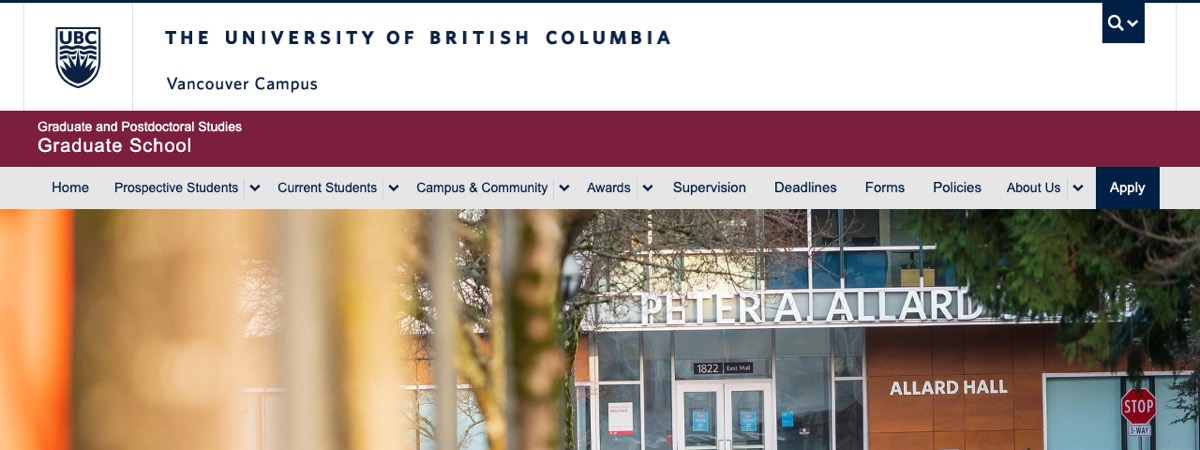
| Provider | University of British Columbia |
|---|---|
| Length | 1 year |
| Credential | LLM |
| Format | in person, British Columbia |
Fiona's take: This is my pick for foreign-trained law graduates who want a full LLM rather than a prep course. The program provides foundational training in the Canadian common law system for foreign-trained law graduates, but it does not replace NCA assessment or law society admission. One year, in person, in British Columbia; no tuition figure is listed, so ask the faculty directly.
Skip it if: Skip it if you cannot relocate to British Columbia or need a part-time format.
See Program DetailsGlobal Professional Master of Laws (GPLLM)
The Global Professional Master of Laws (GPLLM) at the University of Toronto is a one-year full-time, in-person professional degree.
| Provider | University of Toronto |
|---|---|
| Length | one year full-time |
| Credential | GPLLM |
| Format | in-person, Ontario |
Fiona's take: The GPLLM is a one-year full-time, in-person degree in Ontario, and the credential itself is a GPLLM, branded distinctly from a research LLM. No tuition figure is listed, so ask the faculty for current fees and build a full living-cost budget before you apply. If what you want is a thesis year, the University of Alberta research route is the better fit.
Skip it if: Skip it if your goal is a thesis and an academic route.
See Program DetailsMaster of Laws (LLM) and Concentration Law and Technology
The Master of Laws (LLM) with a concentration in Law and Technology at the University of Ottawa is a 12-to-16-month in-person LLM degree.
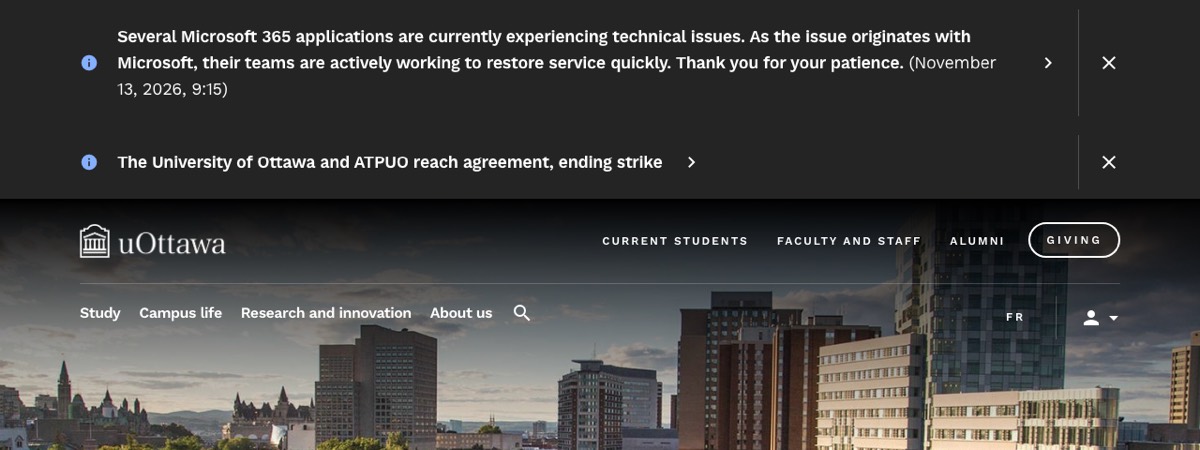
| Provider | University of Ottawa |
|---|---|
| Length | 12 to 16 months |
| Credential | LLM |
| Format | in person, Ontario |
Fiona's take: The concentration focuses on the impact of technology on law and the legal regulation of technology, which makes it the clear Canadian pick if that is your field. The 12-to-16-month range gives some schedule flexibility. Pair it with AI Governance and Compliance in Law if you want to test the subject before applying.
Skip it if: Skip it if you want a shorter, fixed one-year timeline.
See Program DetailsProfessional LLM in Canadian Common Law
The Professional LLM in Canadian Common Law at Osgoode Professional Development (York University) is a two-year part-time hybrid LLM degree.
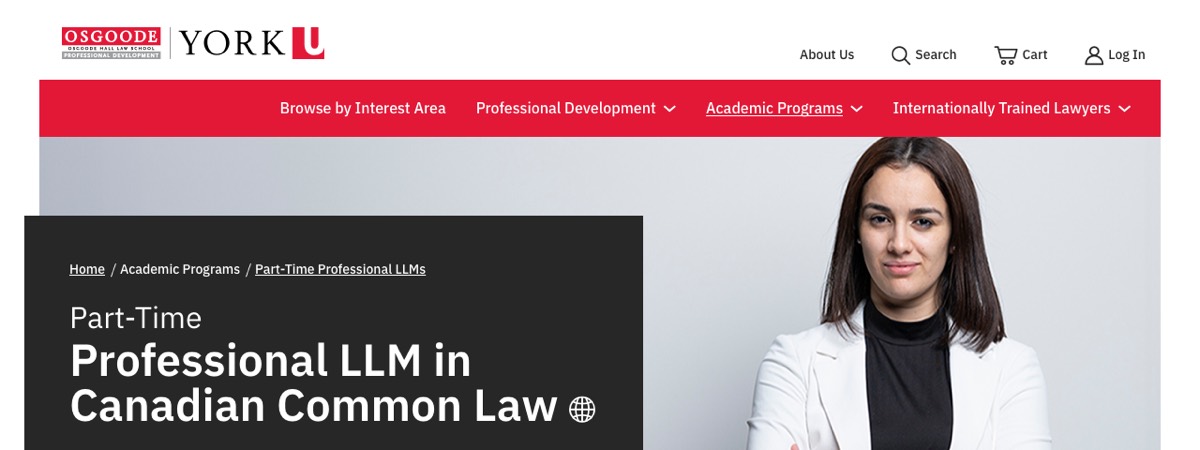
| Provider | Osgoode Professional Development (York University) |
|---|---|
| Length | two years part-time |
| Credential | LLM |
| Format | hybrid, Ontario |
Fiona's take: Two years part-time is the route I recommend to lawyers who are already working and cannot pause their practice. The hybrid delivery from Osgoode PD keeps the commute burden low in Ontario. It is a full LLM credential from York University.
Skip it if: Skip it if you want the credential fast; two years is double the University of Alberta timeline.
See Program DetailsLaw (LLM)
The Law (LLM) at Dalhousie University is a 16-month-or-longer in-person LLM degree in Nova Scotia.
| Provider | Dalhousie University |
|---|---|
| Length | 16 months or longer |
| Credential | LLM |
| Format | in-person, Nova Scotia |
Fiona's take: Dalhousie's Law (LLM) is an in-person Nova Scotia option that runs 16 months or longer, which suits students whose research needs more runway than one year. The program is designed to build advanced legal expertise. No tuition figure is listed, so confirm current fees directly with the faculty.
Skip it if: Skip it if you need a firm one-year exit date.
See Program DetailsLaw - LLM - Course
The Law - LLM (course-based) at the University of Calgary is a 12-to-16-month LLM degree in Alberta.
| Provider | University of Calgary |
|---|---|
| Length | 12-16 months |
| Credential | LLM |
| Format | Alberta |
Fiona's take: The course-based format suits students who prefer structured classes over a thesis, which is a real preference worth respecting. Calgary's 12-to-16-month window covers both speeds. No tuition or delivery details are listed, so verify both before applying.
Skip it if: Skip it if you want a thesis and a research relationship with a supervisor.
See Program DetailsMaster of Laws in Comparative Common Law (LL.M.)
The Master of Laws in Comparative Common Law (LL.M.) at Université de Montréal is a three-full-time-semester in-person LLM degree.
| Provider | Université de Montréal |
|---|---|
| Length | three full-time semesters |
| Credential | LL.M. |
| Format | in person, Quebec |
Fiona's take: Three full-time semesters lead to an LL.M. in Comparative Common Law at Université de Montréal, the one Quebec option in this comparison. The program is built around becoming a specialist in international private law with extensive knowledge, so read the full program description before applying.
Skip it if: Skip it if the longer timeline and relocation do not fit your plan.
See Program DetailsProfessional LLM in Privacy and Cybersecurity Law
The Professional LLM in Privacy and Cybersecurity Law at Osgoode Professional Development is a 2-year part-time online LLM degree.

| Provider | Osgoode Professional Development |
|---|---|
| Length | 2 years part-time |
| Credential | LLM |
| Format | online, Ontario |
Fiona's take: The fully online, part-time format means you can keep working while you specialise, and it is the only fully online LLM in this comparison, which matters for lawyers outside Ontario. Two years part-time is the trade-off. No tuition figure is listed, so ask Osgoode PD directly.
Skip it if: Skip it if you want a research thesis; this is a professional program.
See Program DetailsHow Much Does A Masters Of Law Degree Cost In Canada?
Tuition for the University of Alberta LLM is $5,570 for Canadian students and $9,250 for international students, with estimated living expenses of $23,000 to $28,000.
| Expense | Canadian Students | International Students |
|---|---|---|
| Tuition (University of Alberta LLM) | $5,570 | $9,250 |
| Estimated living expenses | $23,000 to $28,000 | $23,000 to $28,000 |
Those figures are University of Alberta numbers, not a national average. Most other faculties in this comparison, including Dalhousie, Calgary, and Montréal, list no tuition figures at all, which tells you to ask each graduate office directly before you build a budget. The living estimate is also the university's own, so scale it to the city you would actually study in rather than treating it as a fixed national number.
One honest note on the Coursera route: no certificate price is listed for AI & Law or the other specializations, so check the current enrolment page before comparing costs. Set whatever the certificate costs beside the $5,570 Canadian tuition at University of Alberta before you decide. I still tell clients to test the field first; I just tell them to confirm the price first too.
How Much Does A Lawyer Earn In Canada?
Lawyers (NOC 41101) earn a median of $59.76 per hour in Canada, according to Job Bank.
| Province | Median Hourly Wage |
|---|---|
| Alberta | $78.85 |
| Newfoundland and Labrador | $66.85 |
| Ontario | $65.21 |
| British Columbia | $65 |
| New Brunswick | $59.94 |
| Saskatchewan | $57.88 |
| Prince Edward Island | $57.69 |
| Nova Scotia | $56.15 |
| Quebec | $51.28 |
| Manitoba | $47.18 |
Two things matter when you read this table. First, these are wages for lawyers, NOC 41101, which requires admission to a law society, not for LLM holders as such. The LLM is an enhancement to this career, not the entry ticket. Second, the spread is wide: $47.18 in Manitoba against $78.85 in Alberta, a gap of over $30 an hour. Location matters as much as the credential.
The point I make to clients is more modest: these medians belong to lawyers already admitted to practise, so treat the LLM as a specialisation layered on top of that admission. Whether it moves your own rate depends on your practice and your employer, and no Job Bank median will answer that for you.
Is A Masters Of Law Degree Worth It In 2026?
For a practising Canadian lawyer, the arithmetic to weigh is simple: one year of tuition at $5,570 for Canadian students at University of Alberta, set against a median lawyer wage of $59.76 an hour in NOC 41101. What the degree buys is depth in a field: law and technology at Ottawa, privacy and cybersecurity at Osgoode, comparative common law at Montréal. Whether that depth converts into higher earnings is something no wage median can promise you.
For a foreign-trained lawyer, the honest answer is that the LLM is a research degree, not a licence. It does not entitle you to practise in Canada, and the NCA assessment is the gate that decides your professional future. UBC's LLM in Common Law provides foundational training in the Canadian common law system for foreign-trained law graduates, but it does not replace NCA assessment or law society admission. If your only question is 'can I practise law with this degree', the answer is no.
Where I counsel caution is with students treating the LLM as a way to delay a decision. A year, $5,570 in Canadian tuition, and $23,000 to $28,000 in living expenses is a lot to spend on avoidance. Test the field first with AI & Law, then apply with a thesis question you actually want to answer.
Can You Get Funding For An LLM Degree In Canada?
Yes, but less than the big scholarship headlines suggest, because the best-known award does not fund master's study at all.
- Vanier Canada Graduate Scholarships. The Vanier Canada Graduate Scholarships are worth CAD $50,000 per year, but Vanier eligibility requires that you be pursuing your first doctoral degree full-time. That rule rules out the LLM, which is a master's-level program. I list it here only so you do not build an LLM budget around it.
- University of Saskatchewan LLM funding. The University of Saskatchewan states that successful candidates will receive a minimum of $20,000 in funding for the 2027-2028 academic year, and its article headline references up to $25,000. That support goes to successful candidates rather than every applicant, so treat it as a strong reason to apply, not a guaranteed entitlement.
LLM Degree Questions Canadians Ask
Does An LLM Allow You To Practise Law In Canada?
No, an LLM does not entitle the holder to practise law in Canada. Practising requires admission to a provincial law society, and foreign-trained lawyers need an assessment from the National Committee on Accreditation (NCA) first. The LLM builds expertise and can support your NCA preparation, but it is a research degree, not a licence.
How Long Is An LLM In Canada?
An LLM in Canada is typically one year for research-based programs, as the University of Alberta Faculty of Law states. Some options run longer: Dalhousie's LLM is 16 months or longer, Calgary's is 12 to 16 months, and Osgoode's part-time Professional LLM in Canadian Common Law takes two years. Part-time and online formats stretch the timeline to fit work.
What Is The Cost Of An LLM In Canada?
LLM tuition examples include $5,570 for Canadian students and $9,250 for international students at the University of Alberta, with estimated living expenses of $23,000 to $28,000. Most other faculties in this comparison, including UBC, Ottawa, and Dalhousie, do not list tuition figures here, so request current fees from each graduate office directly.
Is There A 1-Year LLM Option In Canada?
Yes, many universities offer 1-year LLM programs. The University of Alberta research LLM, the UBC LLM in Common Law, and the University of Toronto GPLLM all list one year full-time. If you need part-time delivery, Osgoode's hybrid Professional LLM runs two years.
LLM Vs JD In Canada?
The LLM vs JD distinction is simple: the LLM is a graduate degree for those who already hold a prior law degree, while the JD is the professional degree that leads to admission to a law society. If you have never studied law, the JD is your route. If you are already a lawyer or law graduate, the LLM adds research depth or a specialisation.
Can International Students Get A PGWP After An LLM?
Yes, international students can get a Post-Graduation Work Permit of up to 3 years after an eligible LLM program. For applications after November 2024, PGWP eligibility is subject to language requirements set by IRCC. Check your specific program against IRCC's rules before you count on the permit.
What Are Median Lawyer Wages In Canada?
Median lawyer wages in Canada are $59.76 per hour for NOC 41101, per Job Bank. By province the range runs from $47.18 in Manitoba to $78.85 in Alberta, with Ontario at $65.21 and British Columbia at $65. Remember these figures apply to practising lawyers, not to LLM graduates as such.
What Is The Meaning Of LLM Degree?
The LLM degree means Master of Laws, and some faculties, including Université de Montréal, write it as LL.M. It is a one-year research degree that enables law students, lawyers, and academics from related disciplines to hone legal expertise and conduct advanced research. It is not the same as a JD, and it is not a licence to practise law in Canada.
What's The Bottom Line On The LLM Degree In Canada?
- A 1-year research LLM costs $5,570 in tuition for Canadian students at University of Alberta, $9,250 for international students, plus $23,000 to $28,000 in living expenses.
- An LLM does not entitle you to practise law in Canada. Foreign lawyers need NCA assessment; Canadian admission runs through a JD and a provincial law society.
- Test the field for two weeks with AI & Law from Lund University before you spend a year and five figures on the degree.
- LLM-specific funding exists at the University of Saskatchewan, which offers successful candidates a minimum of $20,000 in funding for 2027-2028; the Vanier Canada Graduate Scholarships, worth CAD $50,000 per year, fund doctoral study only, not the LLM.
- Lawyers (NOC 41101) earn a median $59.76 per hour in Canada, from $47.18 in Manitoba to $78.85 in Alberta.






