Key Takeaways
- The fastest realistic route among the programs compared in this guide is a 3 to 4 year undergraduate degree, the 11 month post-degree B.Ed. at UBC Okanagan, then a $245 BC Certificate of Qualification application that takes 1 to 3 months; tuition for the B.Ed. year is not listed.
- Teaching is provincially regulated in every province and territory, and certification is required to teach in K-12 public schools; the regulators named in this guide are the Ontario College of Teachers, Alberta Education, the BC Teacher Regulation Branch, Manitoba Education and Early Childhood Learning, and New Brunswick's Office of Teacher Certification, and BC requires its certificate for independent schools too.
- Uncommon Sense Teaching on Coursera, 2 weeks at 10 hours a week from Deep Teaching Solutions, is the try-first option; it does not qualify you for a teaching certificate in any province.
- Job Bank lists a median of $45.67 an hour for secondary school teachers (NOC 41220), from $41.03 in New Brunswick to $48.08 in Ontario among the provinces tracked.
- Fiona's verdict: the degree pays off for anyone committed to a classroom career, with Job Bank rating the outlook Good to Very Good in most provinces; start on Coursera if you are still testing the idea.
A Bachelor of Education (B.Ed.) is a professional degree that, combined with an undergraduate degree and provincial certification, qualifies graduates to teach in Canada's K-12 public schools. Teaching is provincially regulated in every province and territory, with certification required to teach in K-12 public schools; this guide's examples are Ontario, Alberta, BC, Manitoba and New Brunswick.
The realistic route is 4 to 6 years of study, or 11 months of teacher training if you already hold a degree and choose UBC Okanagan. I compare the main routes, selected fees and Job Bank wage figures below, starting with the quickest way to test the field.
What Are The Ways To Become A Teacher In Canada?
This page compares certification routes (consecutive, concurrent and accelerated B.Ed. programs) and non-certification taster and English-teaching options, from Coursera courses to the TESOL certificate.
| Route | Time | Cost (CAD) | What You Get | Recognised By | Best For |
|---|---|---|---|---|---|
| Coursera: Uncommon Sense Teaching and related series | 2 weeks at 10 hours a week | Not listed | Course Certificate | No provincial teaching certificate | Testing the field before a B.Ed. |
| Consecutive (after-degree) B.Ed. | 1 to 2 years after an undergraduate degree | $6,000 to $24,000 per year tuition | B.Ed. degree | Provincial regulators such as OCT, Alberta Education and the BC TRB | Degree holders changing careers |
| Concurrent or integrated B.Ed. | 4 to 5 years | $6,000 to $20,000 per year tuition | B.Ed. or combined degree | Provincial regulators | Students starting university now |
| Accelerated post-degree B.Ed. at UBC Okanagan | 11 months | Not listed | B.Ed. degree | BC Teacher Regulation Branch | Degree holders in BC wanting the fastest finish |
| TESOL certificate, Canadian College of Educators | 6 to 8 weeks or up to one year | $1,000 | TESOL Certificate | Not a provincial teaching certificate | Teaching English, not certified K-12 classrooms |
For most readers I recommend the Coursera row first to test fit, the 11 month UBC Okanagan or 12 month Nipissing program if you already hold a degree, and the concurrent route only if you are entering university now.
What Is The Fastest Way To Get A Teaching Certificate In Canada?
The fastest way to a teaching certificate in Canada, among the programs compared in this guide, is the accelerated post-degree B.Ed. at UBC Okanagan: 11 months of training after an undergraduate degree, then 1 to 3 months and $245 for the BC Certificate of Qualification. It only works if you arrive with a degree.
- Complete a recognized undergraduate degree, typically 3 to 4 years. Alberta Education sets the floor for that province: at minimum 4 years of university education, inclusive of a recognized degree and a pre-service teacher preparation program from an approved institution.
- Apply to the revamped post-degree B.Ed. at UBC Okanagan, which trains people who already hold an undergraduate degree in 11 months, down from 16 months.
- Finish the 11 month program. The UBC Okanagan tuition figure was not verified here; confirm current tuition with UBC.
- Apply to the BC Teacher Regulation Branch for a Certificate of Qualification: the application fee is $245 and processing takes 1 to 3 months.
- Plan on reapplying if you move. The certificate covers BC; Ontario classrooms mean the Ontario College of Teachers, Alberta means Alberta Education, each with its own application.
Does A Teaching Degree Lead To A Regulated Profession In Canada?
A teaching degree leads to a regulated profession: teaching is provincially regulated in every province and territory, and certification is required to teach in K-12 public schools on top of the B.Ed. Ontario, Alberta, British Columbia, Manitoba and New Brunswick are the five provinces detailed below; there is no national certificate.
| Province | Required? | Regulator Or Registry | What It Means |
|---|---|---|---|
| Ontario | Yes | Ontario College of Teachers (OCT) | Teacher certification in Ontario is regulated by the OCT |
| Alberta | Yes | Alberta Education (Minister of Education and Childcare) | Minimum 4 years of university education including a recognized degree and an approved pre-service program |
| British Columbia | Yes | Teacher Regulation Branch, Ministry of Education and Child Care | Public and independent school teaching requires a B.C. teaching certificate |
| Manitoba | Yes | Manitoba Education and Early Childhood Learning | Public school teaching requires a Permanent or Provisional Professional Teaching Certificate |
| New Brunswick | Yes | Office of Teacher Certification, Department of Education and Early Childhood Development | The department sets requirements for an initial Teacher's Certificate |
The certificate itself is provincial, not national. A B.C. teaching certificate opens BC public and independent schools, but Ontario means a separate application to the Ontario College of Teachers and Alberta means Alberta Education. Mobility agreements may ease the transfer, but each regulator still reviews your file and charges its own fee.
Where Coursera fits: nowhere in the certification chain. Uncommon Sense Teaching, the two specializations and the TESOL certificates on this page do not lead to a teaching certificate in any province. They build interest and theory. The credential regulators want is the B.Ed. from an approved institution, which is why the degree programs, not the short courses, sit in the certification lane of the routes table.
Which Teaching Courses And B.Ed. Programs Are Worth Taking?
The teaching courses worth taking fall into two groups: Coursera courses that test your interest, and university B.Ed. programs. These programs award a B.Ed.; after graduation, apply separately to the provincial regulator. I review every option below, Coursera first.
Uncommon Sense Teaching
Uncommon Sense Teaching is a 2-week online course at 10 hours a week from Deep Teaching Solutions and offers a Course Certificate.
| Provider | Deep Teaching Solutions |
|---|---|
| Length | 2 weeks at 10 hours a week |
| Credential | Course Certificate |
| Format | online |
Fiona's take: This is my try-first pick. Two weeks at 10 hours a week tells you whether the psychology of teaching grips you before you commit $6,000 to $24,000 a year to a consecutive B.Ed. You finish with a Course Certificate, not a teaching licence.
Skip it if: Skip it if you already hold a B.Ed. and need a regulator's application, not theory.
Start On CourseraSmart Teaching and Learning with AI
Smart Teaching and Learning with AI is a 3 course online series from Politecnico di Milano that ends in a Specialization Certificate.
| Provider | Politecnico di Milano |
|---|---|
| Length | 3 course series |
| Credential | Specialization Certificate |
| Format | online |
Fiona's take: I suggest this one to certified teachers and current B.Ed. students more than to newcomers, because AI in the classroom lands better once you have stood in front of a class. It carries no weight with any provincial regulator.
Skip it if: Skip it if your goal this year is a teaching certificate in Alberta or anywhere else in Canada.
Start On CourseraTeaching Impacts of Technology in K-12 Education
Teaching Impacts of Technology in K-12 Education is a 6 course online series from the University of California San Diego that awards a Specialization Certificate.
| Provider | University of California San Diego |
|---|---|
| Length | 6 course series |
| Credential | Specialization Certificate |
| Format | online |
Fiona's take: Six courses is the biggest Coursera commitment on this page, and the K-12 focus maps loosely onto Canadian classrooms. Use it to decide whether education technology interests you enough to specialise later in your career.
Skip it if: Skip it if you want a Canadian credential, because it is neither a B.Ed. nor a provincial certificate.
Start On CourseraEducation (Consecutive) Bachelor of Education
Education (Consecutive) Bachelor of Education from Nipissing University is a 12 month hybrid program over 3 terms in Ontario that awards a B.Ed.
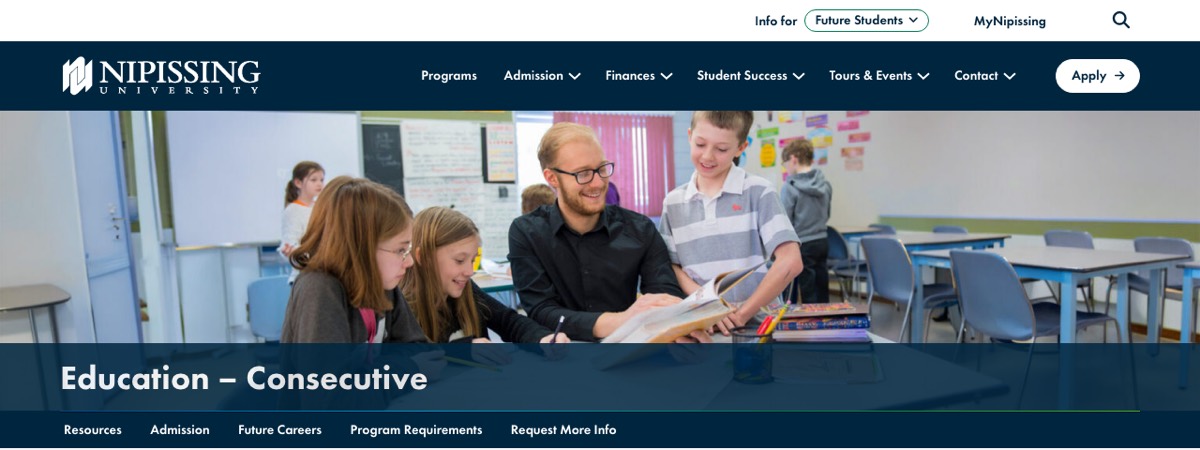
| Provider | Nipissing University |
|---|---|
| Length | 3 Terms | 12 Months |
| Credential | Bachelor of Education |
| Format | hybrid, Ontario |
Fiona's take: For degree holders in Ontario, 12 months is about as fast as a B.Ed. gets in the province. The program awards the degree; after graduation, apply separately to the Ontario College of Teachers. Hybrid delivery helps if you cannot be on campus five days a week.
Skip it if: Skip it if you do not yet hold an undergraduate degree.
See Program DetailsBachelor of Education – BEd Online
BEd Online from Crandall University is a 20 to 22 month hybrid Bachelor of Education program in New Brunswick.
| Provider | Crandall University |
|---|---|
| Length | 20-22 months |
| Credential | Bachelor of Education |
| Format | hybrid, New Brunswick |
Fiona's take: This is one of the shorter partly online B.Ed. options outside Ontario. The program awards a B.Ed.; after graduation, apply separately to the provincial regulator. You trade speed for flexibility: Nipissing finishes in 12 months, Crandall in 20 to 22.
Skip it if: Skip it if finishing fast matters more to you than online delivery.
See Program DetailsConsecutive Education BEd
Consecutive Education BEd from Queen's University is a 16 month in person Bachelor of Education program in Ontario.
| Provider | Queen's University |
|---|---|
| Length | 16 months |
| Credential | Bachelor of Education |
| Format | in person, Ontario |
Fiona's take: Sixteen months is longer than the faster Ontario options listed here. The program awards a B.Ed.; after graduation, apply separately to the Ontario College of Teachers. With UBC Okanagan at 11 months and both Nipissing and Tyndale at 12 in Ontario, that extra term has to earn its keep through program fit.
Skip it if: Skip it if your only criterion is speed.
See Program DetailsBachelor of Education
Bachelor of Education from Tyndale University is a 12 consecutive month in person program in Ontario that awards a B.Ed.
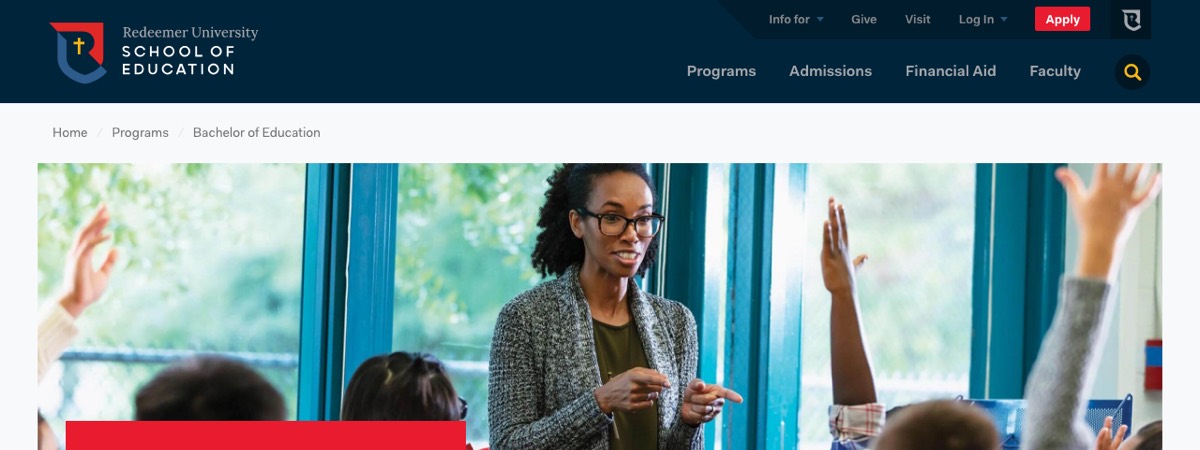
| Provider | Tyndale University |
|---|---|
| Length | 12 consecutive months |
| Credential | Bachelor of Education |
| Format | in person, Ontario |
Fiona's take: Tyndale also lists a 12-consecutive-month Ontario B.Ed.; confirm admission requirements. With Nipissing also at 12 months, I tell clients to compare the two on delivery format and campus fit rather than on length alone.
Skip it if: Skip it if you need an online or hybrid format.
See Program DetailsOnline Bachelor of Education After Degree (Elementary)
Online Bachelor of Education After Degree (Elementary) from the University of Regina is a two-year online program in Saskatchewan with admission offered for the Fall term only.
| Provider | University of Regina |
|---|---|
| Length | two-year |
| Credential | Bachelor of Education |
| Format | online, Saskatchewan |
Fiona's take: Fully online B.Ed. programs are rare in Canada, and Regina's after-degree in Elementary is the one to watch. Admission is offered for the Fall term only; the application deadline for Fall 2027 is February 15, 2027. Two years online is slower than UBC Okanagan's 11 months in person, but its online delivery may reduce relocation needs; confirm practicum and residency requirements.
Skip it if: Skip it if you want secondary rather than elementary, or if a Fall-only intake does not fit your timeline.
See Program DetailsBachelor of Education - Remote Delivery
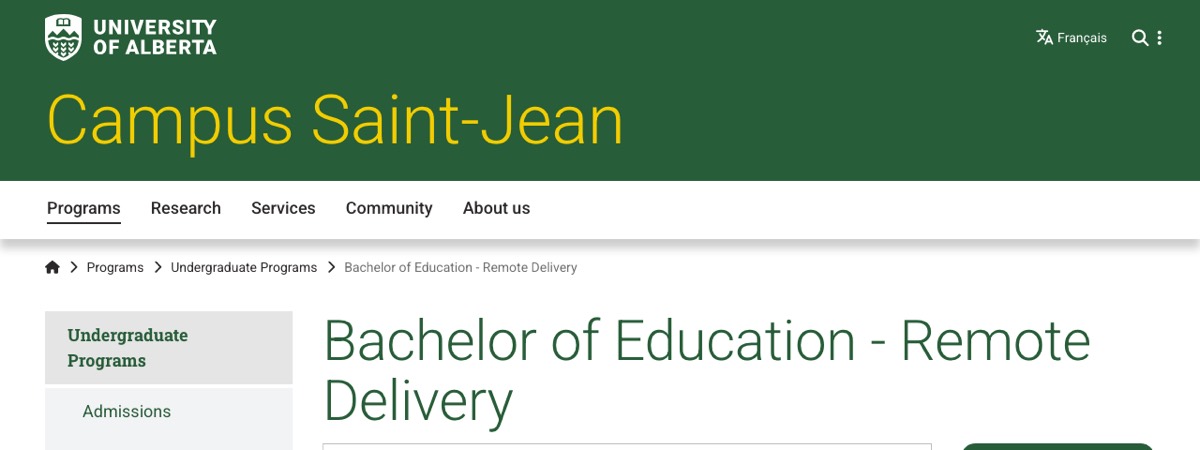
Bachelor of Education Remote Delivery from University of Alberta Campus Saint-Jean is a 2 year online after-degree program in Alberta.
| Provider | University of Alberta Campus Saint-Jean |
|---|---|
| Length | 2 years (After-Degree) |
| Credential | Bachelor of Education |
| Format | online, Alberta |
Fiona's take: For readers searching a teaching certificate in Alberta, this is the online option to examine: Campus Saint-Jean lists a 2-year online B.Ed. after-degree in Alberta; confirm certification eligibility with Alberta Education. The $200 Interim Professional Certification application fee applies when your teacher preparation was at an Alberta university.
Skip it if: Skip it if you lack the prior degree an after-degree requires.
See Program DetailsTeacher of English as a Second Language
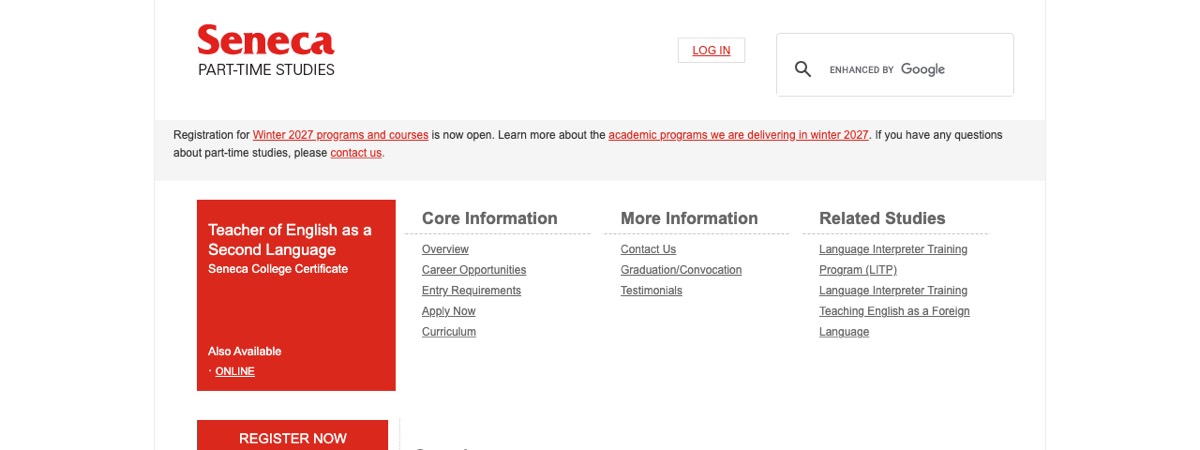
Teacher of English as a Second Language from Seneca Polytechnic is a part-time online program in Ontario ending in a Seneca College Certificate.
| Provider | Seneca Polytechnic |
|---|---|
| Length | part-time |
| Cost (CAD) | lowest tuition of all providers within the Greater Toronto Area |
| Credential | Seneca College Certificate |
| Format | online, Ontario |
Fiona's take: TESL is a real career lane, teaching English to adult ESL and EAP learners, but it is not the K-12 certificate. Seneca publishes no tuition figure, only a comparison with other Greater Toronto Area providers, so request the current number before enrolling.
Skip it if: Skip it if your goal is a Manitoba or BC public school classroom, which require provincial teaching certificates.
See Program DetailsCanadian TESOL Certificate Program with Practicum (120 hrs)
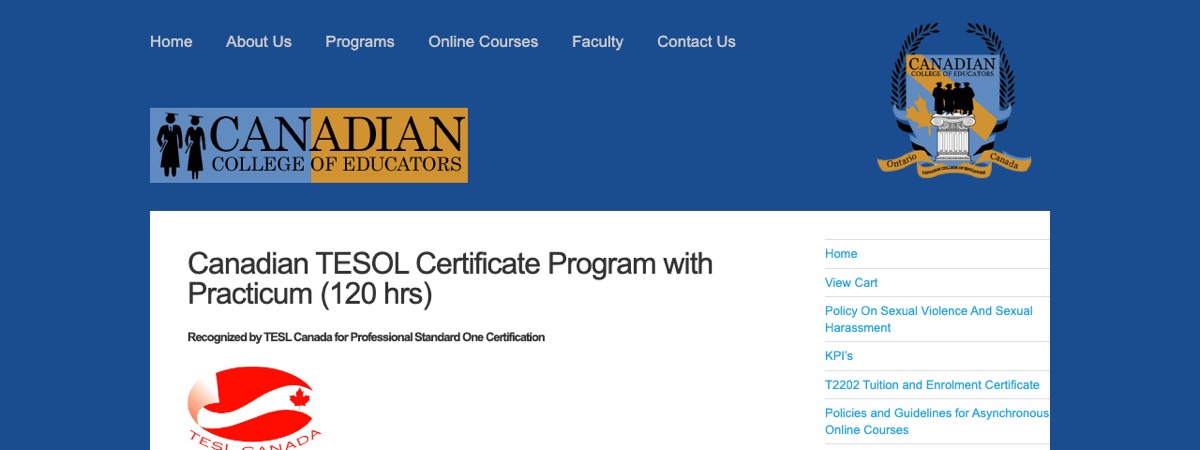
Canadian TESOL Certificate Program with Practicum (120 hrs) from the Canadian College of Educators is a 6 to 8 week online program, extendable up to one year, for $1,000.
| Provider | Canadian College of Educators |
|---|---|
| Length | 6 to 8 weeks or up to one year |
| Cost (CAD) | $1000 CND |
| Credential | TESOL Certificate |
| Format | online, Ontario |
Fiona's take: At $1,000 and 6 to 8 weeks, this is the shortest priced credential on the page, and the 120 hours include a practicum. It still does not certify you to teach in Canadian public schools; treat it as an English-teaching credential.
Skip it if: Skip it if you would rather put $1,000 toward B.Ed. tuition and application fees.
See Program DetailsHow Much Does A Teaching Certificate Cost In Canada?
The application fee examples in this guide are $200 in Alberta for applicants prepared at an Alberta university and $245 in BC, but the degree behind the certificate costs far more: $6,000 to $24,000 per year in tuition for a consecutive B.Ed. and $6,000 to $20,000 per year for a concurrent one. Budget for both layers.
| Item | Cost (CAD) | Notes |
|---|---|---|
| Consecutive B.Ed. tuition | $6,000 to $24,000 per year | 1 to 2 years after an undergraduate degree |
| Concurrent B.Ed. tuition | $6,000 to $20,000 per year | 4 to 5 years total |
| BC Certificate of Qualification application | $245 | Paid to the BC Teacher Regulation Branch |
| Alberta Interim Professional Certification application | $200 | Fee when your teacher preparation was at an Alberta university |
| BC annual renewal | $95 | Charged each year to keep the certificate current |
| Ontario College of Teachers registration and membership | Not listed | Registration plus annual membership fees apply |
| Canadian TESOL Certificate | $1,000 | Canadian College of Educators, 6 to 8 weeks |
Tuition dominates every other line. A consecutive B.Ed. at $6,000 to $24,000 per year for 1 to 2 years runs to multiples of the $245 BC application or the $200 Alberta application. Plan the program cost first and treat certification paperwork as the final, smallest expense.
Renewal is the fee people forget. British Columbia charges $95 a year to keep the certificate current, and the Ontario College of Teachers collects annual membership on top of registration. The Coursera courses and the $1,000 TESOL certificate carry no renewal obligations of this kind, one more sign they are testers rather than credentials.
How Much Does A Teacher Earn In Canada?
A teacher earns a median of $45.67 an hour in Canada, according to Job Bank figures for secondary school teachers (NOC 41220). The provincial medians run from $41.03 in New Brunswick to $48.08 in Ontario.
| Province | Median Hourly Wage (NOC 41220) |
|---|---|
| Canada, median | $45.67 |
| Ontario | $48.08 |
| Manitoba | $45.96 |
| Alberta | $44.92 |
| British Columbia | $44.89 |
| Nova Scotia | $41.35 |
| New Brunswick | $41.03 |
Job Bank rates the outlook for teachers Good to Very Good in most provinces per its occupation profiles, which is what you want to see against a multi-year degree investment. The $45.67 median is a national figure for NOC 41220; what you actually earn depends on the province you certify in and how far you climb the salary grid.
The provincial spread matters when you choose where to certify. Ontario at $48.08 and Manitoba at $45.96 sit above the national median, Alberta at $44.92 and BC at $44.89 sit just under it, and New Brunswick at $41.03 and Nova Scotia at $41.35 sit below. Since certification is provincial, moving later means reapplying, so weigh pay against where you intend to settle.
Is A Teaching Degree Worth It In 2026?
A teaching degree is worth it in 2026 if you want the classroom itself, because the economics hold up: a $45.67 median hourly wage for NOC 41220 and Job Bank outlooks of Good to Very Good in most provinces reward the years of study. Teaching is provincially regulated in every province and territory, and certification is required to teach in K-12 public schools, which shapes who can enter the field.
The cost side is manageable if you already hold a degree. A consecutive B.Ed. at $6,000 to $24,000 per year for 1 to 2 years is the main outlay, and fast formats such as UBC Okanagan's 11 months or Nipissing's 12 months shorten the stretch without income. Starting from high school changes the math: the concurrent route means 4 to 5 years at $6,000 to $20,000 per year.
My verdict: commit if a few weeks of serious exploration confirm the fit, and begin that exploration with Uncommon Sense Teaching before you spend tuition dollars. If what you actually want is teaching English, the $1,000 TESOL certificate from the Canadian College of Educators is a different and faster lane.
Teaching Certificate Questions Canadians Ask
How Long Does It Take To Become A Teacher In Canada?
Becoming a teacher in Canada typically takes 4 to 6 years of post-secondary study: a 3 to 4 year undergraduate degree plus a 1 to 2 year consecutive B.Ed., or a single 4 to 5 year concurrent program. Degree holders can finish the training stage in 11 months at UBC Okanagan, then add 1 to 3 months for the BC Certificate of Qualification.
Is There A 1-Year B.Ed. In Canada?
A 1-year B.Ed. does exist, though options are limited. UBC Okanagan runs an 11 month post-degree program, Nipissing University runs 3 terms in 12 months, Tyndale University runs 12 consecutive months, and some Ontario universities such as Redeemer also list 1-year programs. Post-degree and consecutive options require a prior undergraduate degree; confirm admission requirements for each school.
Do I Need A Degree To Teach In Canada?
A degree is required to teach in Canada. Alberta Education states that all teachers require at minimum 4 years of university education, inclusive of a recognized degree and a pre-service teacher preparation program from an approved institution. The Ontario College of Teachers likewise expects a completed four semester teacher education program on top of a degree.
Are There Online B.Ed. Programs In Canada?
Online B.Ed. programs exist but remain limited. The University of Regina offers an online after-degree B.Ed. in Elementary with Fall-term admission only, and its application deadline for Fall 2027 is February 15, 2027; University of Alberta Campus Saint-Jean offers a 2 year remote delivery after-degree, and Crandall University runs a 20 to 22 month hybrid. Fully online options are still the exception, so confirm delivery details before applying.
What Is The Difference Between A Diploma And A Degree For Teaching?
The difference between a diploma and a degree comes down to certification. A diploma may qualify you for some non-certified roles or early childhood education work, but certified K-12 teaching requires a B.Ed. degree plus provincial certification. Manitoba, for example, requires a Permanent or Provisional Professional Teaching Certificate for its public school system.
How Much Does Teacher Certification Cost?
Teacher certification costs depend on the province: $200 in Alberta for applicants prepared at an Alberta university, and $245 in BC for the Certificate of Qualification. Annual renewal fees also apply, $95 in BC. The Ontario College of Teachers charges registration plus annual membership fees; confirm the current amounts with the College before you apply.
Can I Teach In Multiple Provinces With One Certificate?
One certificate does not cover multiple provinces. Certification is provincial: the Ontario College of Teachers certifies Ontario, Alberta Education certifies Alberta, the BC Teacher Regulation Branch certifies BC. Mobility agreements may ease a transfer, but you still submit a separate application and pay each regulator's fee.
How Much Do Teachers Earn In Canada?
Teachers in Canada earn a median of $45.67 an hour, Job Bank reports for secondary school teachers (NOC 41220). Among the provinces listed, Ontario sits highest at $48.08 and New Brunswick lowest at $41.03, with Alberta at $44.92 and British Columbia at $44.89 close to the national median.
What's The Bottom Line On A Teaching Degree In Canada?
- The bottom line on a teaching degree: teaching is provincially regulated in every province and territory, certification is required for K-12 public school teaching and in BC for independent schools, and that certificate sits on top of a B.Ed., never replaces one.
- The fastest realistic path compared here is a 3 to 4 year undergraduate degree, the 11 month post-degree B.Ed. at UBC Okanagan, and a $245 BC Certificate of Qualification application taking 1 to 3 months.
- Tuition of $6,000 to $24,000 per year for a consecutive B.Ed. dwarfs the paperwork fees, so choose the program for fit, not for the $200 or $245 application.
- Test the field first with Uncommon Sense Teaching: 2 weeks at 10 hours a week, ending in a Course Certificate that is not a teaching licence.
- Job Bank's median of $45.67 an hour for NOC 41220 and a Good to Very Good outlook in most provinces make the years a sound bet for committed future teachers.






