Key Takeaways
- The fastest realistic route is a 4-year pre-professional bachelor's plus a 2-year CACB-accredited M.Arch with advanced standing, then 3,720 Internship in Architecture Program hours over 3 to 4 years and the ExAC: roughly 8 to 11 years in total, with M.Arch tuition varying by university.
- Registration is mandatory in every province and territory through regulators under ROAC, such as the Ontario Association of Architects (OAA) and the Architectural Institute of British Columbia (AIBC); only licensed architects may use the title.
- Software Design and Architecture from the University of Alberta runs 4 weeks at 10 hours a week and does not qualify you for CACB certification, M.Arch admission or any provincial register; it is a test of design thinking, not a step toward licensure.
- Architects (NOC 21200) earn a median of $38.94 per hour nationally, from $32.82 in Quebec to $45.69 in Alberta, with Job Bank outlooks rated Moderate in Ontario, Quebec and British Columbia and Good in Manitoba, Saskatchewan and Alberta.
- Fiona's verdict: the M.Arch suits the committed full-time student, the RAIC Syllabus, with annual re-enrolment at $376.23 plus studio fees, suits career changers already inside a firm, and Coursera suits anyone testing the field before betting a decade on it.
A Master of Architecture (M.Arch) from a CACB-accredited program is the professional degree that opens the path to licensed practice as an architect in Canada. There is no shorter credible route to the title: expect 8 to 11 years from first-year studio to provincial registration, because the degree is only the first third of the licence.
Below I compare the university M.Arch pathway, the RAIC Syllabus work-study route and a Coursera pick for testing the water, then costs, wages under NOC 21200 and the Dalhousie scholarship this guide actually lists.
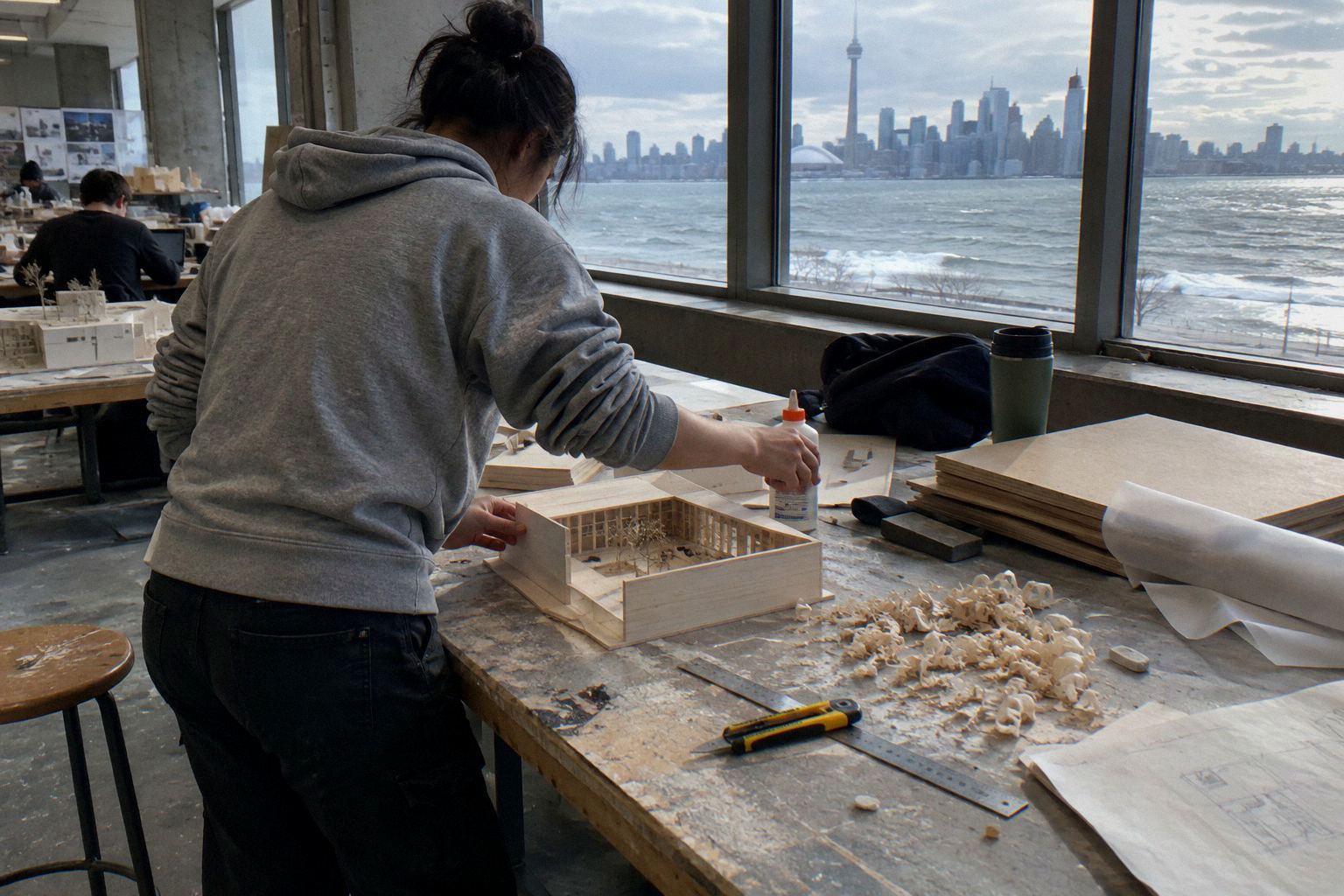
What Are The Ways To Become An Architect In Canada?
This guide compares the domestic CACB-accredited M.Arch pathway and the RAIC Syllabus work/study route, plus a college diploma that stops at technologist work. A Coursera series sits first in the table because I want you testing design thinking before paying for any of the longer routes.
| Route | Time | Cost (CAD) | What You Get | Recognised By | Best For |
|---|---|---|---|---|---|
| Software Design and Architecture (Coursera) | 4 weeks at 10 hours a week | Not listed | Shareable certificate in software design | No CACB or ROAC recognition | Testing design thinking or pivoting to tech |
| University pathway, CACB-accredited M.Arch | 6-7 years study + 3-4 years IAP | Varies by university; verify each program | M.Arch plus CACB certification | ROAC provincial regulators | The standard route to licensure |
| RAIC Syllabus Work/Study Program | 8-14 years, average 10-14 | $376.23 annual re-enrollment plus studio fees; total not verified | RAIC Professional Diploma in Architecture (Dipl. Arch.) plus CACB certification | ROAC provincial regulators after CACB assessment | Working while studying over a decade |
| Architectural Technology diploma (college) | Varies | Not listed | College diploma | Not recognised for architect licensure | Architectural technologist roles |
I recommend the CACB-accredited M.Arch for full-time students, the RAIC Syllabus, with annual re-enrolment at $376.23 plus studio fees, for people already working in firms, and the Coursera specialization for anyone still deciding whether design is the right instinct at all.
What Is The Fastest Way To Become An Architect In Canada?
The fastest way to become an architect in Canada is the university pathway taken straight through: a 4-year pre-professional bachelor's, a 2-year CACB-accredited M.Arch with advanced standing, 3,720 Internship in Architecture Program hours over 3 to 4 years, then the ExAC, roughly 8 to 11 years door to door.
- Complete a pre-professional bachelor's degree, for example a Bachelor of Architectural Studies (BAS), at a CACB-listed university: 4 years, tuition not listed here.
- Enter a CACB-accredited 2-year M.Arch with advanced standing, the route described in the University of Toronto's graduate calendar: 2 years, with tuition varying by university; verify each program.
- Log 3,720 hours of supervised experience in the Internship in Architecture Program (IAP): 3 to 4 years of part-time or full-time work tracked for your regulator.
- Pass the Examination for Architects in Canada (ExAC): sitting dates and fees are not listed here.
- Register with your provincial regulator, for example the Ontario Association of Architects (OAA) or the Architectural Institute of British Columbia (AIBC): registration fees not listed.
Do You Need A Licence To Practise Architecture In Canada?
A licence to practise architecture is mandatory in every province and territory, and only licensed architects may use the title. Each regulator under ROAC, such as the OAA in Ontario and the AIBC in British Columbia, sets its own admission standards: a CACB-certified professional degree, IAP hours and the ExAC.
| Jurisdiction | Licence Required? | Regulator | What It Means |
|---|---|---|---|
| All provinces and territories | Yes | Provincial and territorial regulators under ROAC | Legislation gives each regulator authority and responsibility for admission and competence standards |
| Ontario | Yes | Ontario Association of Architects (OAA) | You cannot practise or offer to practise architecture in Ontario without registration |
| British Columbia | Yes | Architectural Institute of British Columbia (AIBC) | Registration with AIBC is mandatory for architects practising or offering to practise in BC |
The M.Arch is the entry ticket, not the licence. It earns you CACB certification toward an application; the title arrives only when a provincial regulator registers you after the ExAC. I tell clients to treat the degree, the 3,720 IAP hours and the exam as three separate projects, each with its own fees and timelines.
No online course changes this. Software Design and Architecture from the University of Alberta is a shareable certificate in software design; it registers you with nobody, counts for no CACB credit and adds nothing to an OAA or AIBC file. Its job is to test your appetite for structured design work before you commit a decade.
Which Architecture Courses Are Worth Taking?
Architecture courses worth taking online are, I will be blunt, software and data architecture courses, because building architecture has no short online substitute that leads anywhere. None of the five below carries CACB credit, IAP hours or provincial recognition. They answer a different question: does structured design thinking suit you, and could tech architecture be a fallback?
Software Design and Architecture
Software Design and Architecture is a 4-course online specialization from the University of Alberta, 4 weeks at 10 hours a week, that teaches how to design and structure software systems.
| Provider | University of Alberta |
|---|---|
| Length | 4 weeks at 10 hours a week (4 course series) |
| Credential | Shareable certificate |
| Format | online |
Fiona's take: This is my Coursera pick: a Canadian university provider, a four-week commitment at 10 hours a week, and a clean test of whether formal design reasoning appeals to you. Architecture school rewards exactly that thinking, so a strong reaction either way is useful information. If it bores you, you learned that in four weeks instead of year two of an M.Arch.
Skip it if: Skip it if your goal is building design: it confers no CACB credit and no path to any provincial register.
Start On Coursera.NET 8 Microservices – DDD, CQRS & Clean Architecture
.NET 8 Microservices: DDD, CQRS and Clean Architecture is a 3-course online specialization from Packt, 4 weeks at 10 hours a week, that covers microservice design with domain-driven design, CQRS and clean architecture patterns.
| Provider | Packt |
|---|---|
| Length | 4 weeks at 10 hours a week (3 course series) |
| Credential | Shareable certificate from Packt |
| Format | online |
Fiona's take: Packt's series is for learners interested in .NET 8 microservices, DDD, CQRS and Clean Architecture, and it stays on that narrow goal. It has nothing to do with buildings: no drawing sets, no studio crits, no CACB credit.
Skip it if: Skip it if your goal is building design rather than software design.
Start On CourseraModern Data Architecture & Lakehouse Engineering
Modern Data Architecture & Lakehouse Engineering is a 13-course online specialization from Coursera, 4 weeks at 10 hours a week, that covers data platform and lakehouse engineering.
| Provider | Coursera |
|---|---|
| Length | 4 weeks at 10 hours a week (13 course series) |
| Credential | Shareable certificate from Coursera |
| Format | online |
Fiona's take: Data architecture is its own career, and this series is the deepest of the tech options here at 13 courses. I suggest it for architecture students hedging their bets before committing to a 2-year M.Arch. This is a tech and data course, not an architecture licensure route.
Skip it if: Skip it if you want to design anything physical.
Start On CourseraEnterprise Data Integration, Governance and Architecture
Enterprise Data Integration, Governance and Architecture is a 3-course online specialization from SkillUp, 4 weeks at 10 hours a week, that covers enterprise data integration and governance.
| Provider | SkillUp |
|---|---|
| Length | 4 weeks at 10 hours a week (3 course series) |
| Credential | Shareable certificate from SkillUp |
| Format | online |
Fiona's take: SkillUp's series is a 3-course, 4-week option with a shareable certificate. It suits analysts inside large organisations who need governance vocabulary more than drafting skill. Treat it as a career add-on, not a career change.
Skip it if: Skip it if you have no data background.
Start On Coursera.NET 8 Microservices: DDD, CQRS, Vertical/Clean Architecture
.NET 8 Microservices: DDD, CQRS, Vertical/Clean Architecture is an online course from Udemy, length not listed, covering microservice implementation with a certificate of completion.
| Provider | Udemy |
|---|---|
| Credential | Certificate of completion |
| Format | online |
Fiona's take: Udemy's version overlaps heavily with the Packt specialization on Coursera; pick one, not both. Neither has any bearing on architectural licensure in Canada, and neither belongs in a CACB file.
Skip it if: Skip it if you already took the Coursera series.
View On UdemyHow Much Does An Architecture Degree Cost In Canada?
An architecture degree in Canada carries tuition that varies by university, on top of four years of undergraduate tuition, exam and registration fees this guide cannot standardise, and, on the RAIC route, $376.23 per year for annual re-enrolment plus studio fees, with a total cost that is not verified.
| Item | Cost (CAD) | Notes |
|---|---|---|
| Pre-professional bachelor's, e.g. BAS | Not listed | 4 years of undergraduate tuition |
| CACB-accredited 2-year M.Arch, domestic | Varies by university; verify each program | Tuition is not standardised across programs |
| RAIC Syllabus annual re-enrollment | $376.23 | Paid December 15 to January 31, plus studio fees; total not verified |
| CACB certification, Intern Architect and registration fees, ExAC sittings | Not listed | Budget for all three separately |
Budget separately for CACB certification fees, provincial Intern Architect and registration fees, and ExAC sitting fees. I tell clients to ask the regulator, the OAA or the AIBC, for the current fee sheet before they start the IAP, so year three of the internship holds no surprises. The one firm number this guide lists on that leg is the RAIC re-enrollment charge of $376.23.
How Much Does An Architect Earn In Canada?
An architect in Canada earns a median of $38.94 per hour under NOC 21200, Job Bank reports, with a low of $26.44 and a high of $74.52. Provincial medians run from $32.82 in Quebec to $45.69 in Alberta.
| Region | Median Hourly Wage (CAD) |
|---|---|
| Canada | 38.94 |
| Ontario | 41.03 |
| British Columbia | 45.14 |
| Alberta | 45.69 |
| Quebec | 32.82 |
| Nova Scotia | 40.87 |
| Manitoba | 41.03 |
Job Bank rates the outlook moderate to good depending on province: moderate in Ontario, Quebec and British Columbia, good in Manitoba, Saskatchewan and Alberta. That spread matters when you choose where to log your 3,720 IAP hours, because the province you register in is usually the province where you build your practice. Alberta's $45.69 median with a good outlook is the strongest wage case in this guide.
Is An Architect Master Degree Worth It In 2026?
An architect master degree is worth it in 2026 if the title itself is the goal, because the title is legally protected: only licensed architects may practise architecture, in every province and territory, and the M.Arch is the door to that licence. No diploma, no online certificate and no technologist role substitutes for it.
It is not worth it for the money alone. Registration sits roughly 8 to 11 years away, and the payoff is a median of $38.94 per hour: above Quebec's $32.82, below British Columbia's $45.14 and Alberta's $45.69. The Coursera options on this page ask four weeks; the M.Arch asks a decade. Weigh that trade honestly before you enrol.
My split: studying full time, take the university pathway and apply for awards like Dalhousie's partial tuition scholarship, where a minimum 3.70 GPA or an A minus average makes M.Arch applicants eligible. Already working in a firm, take the RAIC Syllabus, with annual re-enrolment at $376.23 plus studio fees, and accept that it runs 8-14 years. Merely curious, start on Coursera.
Can You Get Funding For An Architecture Master Degree?
Funding for an architecture master degree in Canada, as covered here, comes down to university-specific graduate awards rather than a national scheme. The one concrete example is Dalhousie's Faculty of Architecture partial tuition scholarship for M.Arch applicants with a minimum 3.70 GPA, an A minus average.
- Dalhousie Faculty of Architecture partial tuition scholarship (MArch). MArch applicants at Dalhousie with an excellent academic record, a minimum 3.70 GPA or an A minus average, may be eligible for a partial tuition scholarship through the Faculty of Architecture. Ask each program you apply to about its own graduate awards; this guide lists this one only.
Architecture Degree Questions Canadians Ask
How Long Does It Take To Become An Architect In Canada?
It takes 8 to 11 years from the start of architecture school: 4 to 7 years of education, then 3 to 4 years of internship through the IAP's 3,720 hours, plus exam time for the ExAC. The RAIC Syllabus route stretches this to 8 to 14 years, averaging 10 to 14, because it is a work-study route.
Is There A 1-Year Architecture Degree Or Fast-Track To Licensure In Canada?
A 1-year fast-track does not exist in Canada. Professional M.Arch programs run 2 to 3 years minimum after pre-professional studies, and there are no 1-year options for a CACB-accredited professional degree. The quickest realistic sequence is a 4-year bachelor's plus a 2-year M.Arch with advanced standing, then 3,720 IAP hours and the ExAC.
Can I Become An Architect With A Diploma Instead Of A Degree?
An architect's licence is not reachable with a diploma. Diplomas such as Architectural Technology prepare you for architectural technologist roles. Licensure requires a CACB-certified professional degree or its equivalent through the RAIC Syllabus Professional Diploma in Architecture, followed by CACB certification, 3,720 IAP hours and the ExAC.
Are There Online Options For M.Arch Or Architecture Degrees Leading To Licensure?
Online options are limited because most CACB-accredited programs are in-person, built around studio work. The RAIC Syllabus offers some online and studio flexibility, but it is a work-study program that runs 8-14 years, not an online shortcut. Coursera certificates in software or data architecture never substitute for the accredited M.Arch.
What Is The Median Wage For Architects In Canada?
The median wage for architects, NOC 21200, is $38.94 per hour nationally, with a low of $26.44 and a high of $74.52, in Job Bank's latest figures. Provincial medians range from $32.82 in Quebec to $45.69 in Alberta; Ontario sits at $41.03, British Columbia at $45.14, Manitoba at $41.03 and Nova Scotia at $40.87.
Is Licensure Mandatory To Practise Architecture In Canada?
Licensure is mandatory in every province and territory: only licensed architects may use the title and practise architecture. Each regulator under ROAC, such as the Ontario Association of Architects or the Architectural Institute of British Columbia, holds the legal authority to set admission standards, so registration comes before you can offer any architectural service.
What Exams Are Required After The M.Arch Degree?
After the M.Arch degree the sequence is the Internship in Architecture Program, 3,720 logged hours of supervised experience, followed by the Examination for Architects in Canada (ExAC). Provincial registration comes last. Budget separately for CACB certification fees, provincial Intern Architect and registration fees, and ExAC sitting fees; no standard amounts are listed here.
What's The Bottom Line On The Architect Master Degree?
- The fastest route can be a 2-year CACB-accredited M.Arch with advanced standing after a 4-year pre-professional bachelor's, then 3,720 IAP hours over 3 to 4 years and the ExAC: roughly 8 to 11 years to the title.
- Licensure is mandatory in every province and territory through regulators like the OAA and AIBC under ROAC; no degree alone lets you practise.
- Test the design instinct first with Software Design and Architecture from the University of Alberta, 4 weeks at 10 hours a week, knowing it grants no CACB credit.
- Architects (NOC 21200) earn a median of $38.94 per hour, from $32.82 in Quebec to $45.69 in Alberta.
- The RAIC Syllabus charges $376.23 a year for re-enrolment, plus studio fees, and runs 8-14 years; choose it only if you are already working in a firm.






