Key Takeaways
- The fastest realistic route is the blended Intermediate First Aid course with CPR C and AED at St. John Ambulance: 16 hours split between online theory and one in-class day for $165, certificate issued on passing and valid 3 years.
- Workplace first aid is mandatory in Alberta under Alberta OHS (Part 11 of the OHS Code), Ontario under WSIB (Regulation 1101), British Columbia under WorkSafeBC and Quebec under CNESST.
- The Coursera Become an EMT Specialization from the University of Colorado System runs 2 months at 10 hours a week and does not qualify you for any provincial first aid certificate, registration or licence.
- First aid certificates are valid 3 years from issue, with CPR and AED refreshers often recommended annually; recertification costs $168 at Northwest College against $196 for the full course.
- Fiona's verdict: take the Coursera specialization to test emergency care as a career direction, and book the $165 St. John Ambulance blended course when a job needs the actual certificate.
First aid and CPR certification trains you in emergency response, CPR, AED use, injury care and choking response for workplace settings, meeting CSA Z1210 standards. In Canada the credential typically stays valid for 3 years.
The shortest realistic route to the actual credential is the blended Intermediate First Aid course with CPR C and AED at St. John Ambulance: 16 hours split between online theory and one in-class day, $165, and you hold the certificate the day you pass. Online options, including the Coursera pick below, let you test the field first, and the Coursera course itself does not give the provincial certificate.

What Are The Ways To Get First Aid And CPR Certification In Canada?
First aid and CPR certification in this comparison splits into three main options: test the field online, certify at the basic level in one day, or certify at the intermediate level over 16 hours.
| Route | Time | Cost (CAD) | What You Get | Recognised By | Best For |
|---|---|---|---|---|---|
| Become an EMT Specialization | 2 months at 10 hours a week | Not listed | Shareable Coursera certificate | Not listed | Testing emergency care before paying for in-class certification |
| St. John Ambulance Intermediate/Standard First Aid with CPR C + AED | 16 hours (2 days or blended) | $165-$240 | Certificate valid 3 years | Alberta OHS, WSIB, WorkSafeBC | Workplaces that require Intermediate (Standard) level training |
| Canadian Red Cross Basic/Emergency First Aid with CPR C + AED | 8 hours (1 day or blended) | $99-$130 | Certificate valid 3 years | WSIB, WorkSafeBC | Ontario workplaces with 1-5 workers per shift |
I recommend the Coursera specialization for anyone testing emergency care as a career, the Red Cross 8-hour Basic course for small Ontario workplaces, and the St. John Ambulance Intermediate course when an employer requires the full certificate.
What Is The Fastest Way To Get First Aid Certified In Canada?
The fastest way to get first aid certified is the blended St. John Ambulance Intermediate route: online theory, one in-class day, $165 all in, and the certificate lands immediately on passing.
- Run the workplace first aid assessment under your provincial rules, for example WorkSafeBC's hazard rating and ambulance access test: 1 day, $0.
- Register for the blended Intermediate First Aid course at St. John Ambulance, priced at $165.
- Complete the online theory, then attend the in-class day: 1-2 days plus online prep, $165 total.
- Pass and receive your certificate on the spot: immediate, $0 extra, valid 3 years.
Is First Aid Certification Mandatory In Canadian Workplaces?
First aid certification is mandatory in the four provinces in this comparison. Alberta OHS, Ontario's WSIB, WorkSafeBC and Quebec's CNESST all impose it, and in each case the duty sits with the employer.
| Province | Required? | Regulator Or Registry | What It Means |
|---|---|---|---|
| Alberta | Yes | Alberta OHS | First aiders, kits and equipment required under Part 11 of the OHS Code, scaled to hazard level, worker numbers and site distance |
| Ontario | Yes | WSIB | Businesses covered by the Workplace Safety Insurance Act must follow First Aid Requirements (Regulation 1101) |
| British Columbia | Yes | WorkSafeBC | Employers are responsible for first aid so injured workers get prompt treatment; requirements took effect November 1, 2024 |
| Quebec | Yes | CNESST | Employer must keep the required number of trained first aiders present at all times |
The detail that trips people up is that these are employer duties. WSIB, Alberta OHS, WorkSafeBC and CNESST each make the employer responsible for having trained first aiders on shift. WorkSafeBC rewrote its requirements effective November 1, 2024, scaling them to hazard rating, worker count and ambulance access time, and renaming the courses Basic, Intermediate and Advanced.
The Coursera course on this page, Become an EMT Specialization, does not give you the provincial certificate, registration or licence, and the Udemy guide carries the same limit. Every recognised route in this comparison includes an in-person or blended day, because that is where the hands-on skills get assessed.
Which Online CPR And First Aid Courses Are Worth Taking In 2026?
CPR and first aid courses for Canadians split into two camps: university-style theory that will not certify you, and provider courses that issue their own credentials. These are the eight worth comparing across online, blended and in-person delivery, with the certification routes included.
Become an EMT Specialization
Become an EMT Specialization is a 2-month online specialization at 10 hours a week from the University of Colorado System that ends in a shareable certificate.
| Provider | University of Colorado System |
|---|---|
| Length | 2 months at 10 hours a week |
| Credential | Shareable certificate |
| Format | online |
Fiona's take: I recommend this as the try-first option for career changers. Two months of emergency care theory tells you whether the field suits you before you pay for a hands-on or blended course, and the St. John Ambulance blended Intermediate option costs $165. This course does not qualify you for any provincial first aid certificate, registration or licence.
Skip it if: Skip it if your workplace needs a valid first aid certificate this month.
Not a provincial licence, registration or certificate.
Start On CourseraFirst Aid & CPR - An in Depth Guide to CPR, AED and Choking
First Aid & CPR - An in Depth Guide to CPR, AED and Choking is a 1h 56m online course from Uri Naor on Udemy that ends in a Udemy certificate.
| Provider | Uri Naor |
|---|---|
| Length | 1h 56m total length |
| Rating | 4.6 out of 5 (787 ratings) |
| Credential | Udemy certificate |
| Format | online |
Fiona's take: At under two hours this is a refresher rather than a certification route. It covers CPR, AED use and choking response, and 787 ratings give it 4.6 out of 5, but the Udemy certificate is not a provincial licence, registration or certificate.
Skip it if: Skip it if you have never had hands-on practice, since instructor feedback is what builds the skill.
Not a provincial licence, registration or certificate.
View On UdemyOnline First Aid Course Canada | CPR Course Canada
The Online First Aid Course Canada from Simple CPR is a fully online course that ends in a CPR certification.
| Provider | Simple CPR |
|---|---|
| Credential | CPR Certification |
| Format | online, Canada |
Fiona's take: Convenience is the whole pitch here: fully online delivery with a CPR certification at the end. My comparison lists no provincial OHS recognition for this course, while the routes WSIB and WorkSafeBC recognise run in person or blended. Confirm with your employer or regulator that the card counts before you rely on it.
Skip it if: Skip it if an employer asked for a certificate under WSIB Regulation 1101 or Part 11 of Alberta's OHS Code and you cannot confirm this card counts.
See Program DetailsAdult and Pediatric CPR, AED and First Aid
Adult and Pediatric CPR, AED and First Aid from eCPRcertification is a fully online course that ends in an eCPR Certification.
| Provider | eCPRcertification |
|---|---|
| Credential | eCPR Certification |
| Format | online |
Fiona's take: It includes adult and pediatric CPR, AED and first aid coverage, which is the draw if you want child content alongside adult CPR. My comparison lists no provincial OHS recognition for this course, and the credential is an eCPR Certification issued by the provider itself. Confirm recognition before you present the card to an employer.
Skip it if: Skip it if a job posting names a specific provider or first aid level.
See Program DetailsAdult CPR/AED Online
Adult CPR/AED Online from the American Red Cross is a work-at-your-own-pace online course costing $37.00 that ends in a completion certificate.
| Provider | American Red Cross |
|---|---|
| Length | Work at your own pace |
| Cost (CAD) | $37.00 |
| Credential | Completion certificate |
| Format | online |
Fiona's take: Note the distinction: this is the American Red Cross, a different organisation from the Canadian Red Cross, whose Basic/Emergency First Aid course is recognised by WSIB and WorkSafeBC in this comparison. The listed credential here is a completion certificate, and no provincial OHS recognition is listed for this course. I would use the $37.00 course as a theory warm-up before booking a Canadian blended course.
Skip it if: Skip it if you need a certificate listed as valid 3 years, since the credential here is a completion certificate.
See Program DetailsCanada - CPR and First Aid
Canada - CPR and First Aid from Hard Hat Training is a 1.5-2 hour online course costing C$49.00 that ends in a certificate and card.
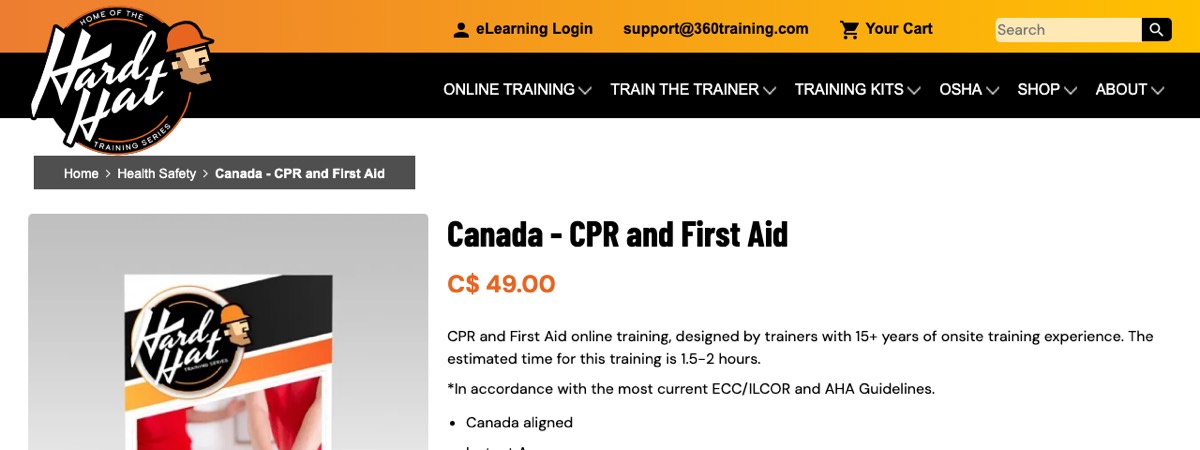
| Provider | Hard Hat Training |
|---|---|
| Length | 1.5-2 hours |
| Cost (CAD) | C$49.00 |
| Credential | Certificate and Card |
| Format | online, Canada |
Fiona's take: Hard Hat Training prices this in Canadian dollars, C$49.00, and lists it for Canada at 1.5 to 2 hours ending in a certificate and card. That is a fraction of the 8 hours the Canadian Red Cross Basic route runs in this comparison, and my comparison lists no provincial OHS recognition for this course. Confirm with your employer whether the card counts before booking.
Skip it if: Skip it if a supervisor asked for Standard or Intermediate First Aid by name.
See Program DetailsStandard First Aid & CPR (Blended)
Standard First Aid & CPR (Blended) from the Canadian Red Cross is a hybrid course that ends in a Standard First Aid & CPR credential.
| Provider | Canadian Red Cross |
|---|---|
| Credential | Standard First Aid & CPR |
| Format | hybrid, Canada |
Fiona's take: The recognised Red Cross route in my comparison is Basic/Emergency First Aid with CPR C + AED: 8 hours, $99 to $130, recognised by WSIB and WorkSafeBC, and it meets WSIB requirements for workplaces with 1 to 5 workers per shift. This Standard First Aid & CPR blended listing carries no length or price in my comparison, so ask the provider for both when you book.
Skip it if: Skip the blended format if you would rather spend the whole course in class, since in-person options exist.
See Program DetailsBLS Provider Course
The BLS Provider Course from Heart & Stroke is an in-person course that ends in a BLS Provider credential.
| Provider | Heart & Stroke |
|---|---|
| Credential | BLS Provider |
| Format | in person, Canada |
Fiona's take: BLS is its own credential in this comparison: where St. John Ambulance and the Canadian Red Cross issue CPR C inside first aid courses, Heart & Stroke issues BLS Provider separately and in person only. Choose it when the program or employer asking you for training names BLS, basic life saving certification, specifically.
Skip it if: Skip it for general workplace first aid, since BLS alone is not the Standard First Aid certificate.
See Program DetailsHow Much Does A First Aid And CPR Course Cost In Canada?
A first aid and CPR course on the recognised workplace routes in this comparison costs about $99 to $240: the Canadian Red Cross 8-hour Basic course starts at $99, the St. John Ambulance blended Intermediate sits at $165, Northwest College lists one Intermediate/Standard course at $196, and St. John Ambulance Intermediate typically ranges $165 to $240. The online-only listings sit below that band at $37.00 for the American Red Cross and C$49.00 for Hard Hat Training.
| Course | Format | Cost (CAD) | Notes |
|---|---|---|---|
| Canadian Red Cross Basic/Emergency First Aid with CPR C + AED | 1 day or blended | $99-$130 | Meets WSIB requirements for workplaces with 1-5 workers per shift |
| St. John Ambulance Basic First Aid (formerly OFA Level 1) | 1 day, in person | $120 plus PPE | Listed through Surrey Schools summer programs |
| St. John Ambulance Blended Intermediate First Aid | Blended, 2 days | $165 | Certificate valid 3 years |
| Northwest College Intermediate/Standard First Aid incl. CPR C AED | Not listed | $196 | Recertification $168; certificate valid 3 years |
| Become an EMT Specialization | Online, 2 months at 10 hours a week | Not listed | Shareable certificate, not a workplace first aid credential |
The price tracks the hours. Basic packages compress into 8 hours for $99 to $130, while Intermediate or Standard stretches to 16 hours and $165 to $240, with the St. John Ambulance blended version at $165 as the entry point. Watch the PPE add-on on the $120 Basic course listed through Surrey Schools. Northwest College lists the full course at $196, a $168 recertification and a 3-year certificate duration.
Is First Aid And CPR Certification Worth It In 2026?
First aid and CPR certification is worth it in 2026 for one plain reason: in the provinces covered here, Alberta, Ontario, BC and Quebec, the law pushes employers to have it. Alberta OHS, WSIB, WorkSafeBC and CNESST all make first aid a workplace requirement, and WorkSafeBC's November 1, 2024 update tied obligations to hazard rating, worker count and ambulance access time.
As a career add-on rather than a job requirement, the math is thinner. Job Bank puts first aid instructors (NOC 43109) at a median of $20.00 an hour across Canada, from $20.00 in Ontario to $26.67 in Saskatchewan, and lists the outlook as varying. Certification earns its keep as a requirement or a differentiator, not usually as a wage on its own.
Can You Get Funding For First Aid Training In Canada?
Funding for first aid training in this comparison comes from one provincial source: Quebec's CNESST subsidy program for First Aid in the Workplace.
- CNESST First Aid in the Workplace subsidies. CNESST regulates workplace first aid training in Quebec and provides subsidies under its program. Quebec workers and employers should ask CNESST about the subsidy before paying course fees out of pocket. In the other provinces in this comparison the duty sits with the employer under Alberta OHS, WSIB or WorkSafeBC, so ask your employer before paying yourself.
First Aid And CPR Questions Canadians Ask
How Long Is First Aid And CPR Certification Valid In Canada?
First aid and CPR certificates are valid for 3 years from the issue date, with CPR and AED practice often recommended annually in between. Northwest College lists recertification at $168 against $196 for the full Intermediate/Standard course with CPR C and AED, which carries a 3-year certificate duration, so put the expiry date in your calendar the day you get the card.
Which First Aid Level Do I Need For My Ontario Workplace?
Ontario workplaces follow WSIB Regulation 1101, and the count is per shift: 1 to 5 workers need Basic (Emergency) First Aid, and 6 or more need Intermediate (Standard) First Aid. The Canadian Red Cross Basic course covers the small-workplace tier in 8 hours for $99 to $130, while the St. John Ambulance Intermediate course runs 16 hours.
Is First Aid Training Mandatory In Alberta Workplaces?
First aid training is mandatory in Alberta workplaces. Part 11 of the OHS Code requires employers to provide first aiders, kits and equipment based on hazard level, worker numbers and site distance. Alberta OHS recognises the St. John Ambulance Intermediate/Standard course with CPR C and AED, which takes 16 hours as two days or a blended format.
What Are The New WorkSafeBC First Aid Requirements?
WorkSafeBC's new first aid requirements took effect on November 1, 2024, and they now scale obligations to hazard rating, worker count and ambulance access time. The courses were renamed at the same time to Basic, Intermediate and Advanced, which is why Basic First Aid now appears where the old OFA Level 1 label used to.
How Many First Aiders Are Required In Quebec Workplaces?
Quebec workplaces follow CNESST regulation: 1 first aider for 50 or fewer workers per shift, 2 for 51 to 150 workers, and 1 more for each additional 100. The employer must keep that number present at all times, and CNESST regulates the training and provides subsidies under its workplace program.
What Does A St. John Ambulance Intermediate First Aid Course Cost?
A St. John Ambulance Intermediate First Aid course typically costs $165 to $240 CAD depending on location and format. The blended version is listed at $165, runs 16 hours, and ends in a certificate valid 3 years. Northwest College charges $196 for the equivalent Intermediate/Standard course with CPR C and AED included.
Are St. John Ambulance Certificates Recognised Across Canada?
St. John Ambulance certificates are nationally recognized and meet provincial OHS and CSA standards. My comparison lists the SJA Intermediate/Standard route with CPR C and AED as recognised by Alberta OHS, WSIB and WorkSafeBC. What your workplace must hold still depends on the first aid assessment your employer runs under provincial OHS rules.
What's The Bottom Line On First Aid And CPR Courses?
- First aid certificates stay valid for 3 years: the Canadian Red Cross Basic course takes 8 hours and costs $99-$130, and the St. John Ambulance Intermediate takes 16 hours and costs $165-$240.
- The Coursera Become an EMT Specialization, Become an EMT Specialization, lets you test emergency care before paying for hands-on training, and it does not give you a provincial first aid certificate, registration or licence.
- WSIB Regulation 1101 in Ontario sets your level by headcount: Basic for 1 to 5 workers per shift, Intermediate for 6 or more.
- In Quebec, CNESST provides subsidies for workplace first aid training, so ask before you pay.






