Key Takeaways
- The fastest realistic route is to get hired first: Ontario recruits then complete the 12-week Basic Constable Training Program at the Ontario Police College, while BC recruits face $18,378 in 2025 JIBC Police Academy tuition and Blocks I to III.
- Prescribed training is mandatory in both provinces listed: the Ontario Police College under the Community Safety and Policing Act, 2019, and the JIBC Police Academy under BC's Police Act and BCPPS standards.
- Try the field first with Understanding and Managing the Stresses of Police Work, a 2-hour Coursera course from the University of Toronto; it does not qualify you for appointment as a police officer.
- Job Bank lists police officers under NOC 42100 at a median of $50.00 per hour in Canada: $50.55 in Ontario, $54.00 in British Columbia, $50.00 in Alberta and $45.08 in Quebec.
- Fiona's verdict: this path suits disciplined applicants who can pass fitness tests such as POPAT or PARE and months of screening, and who want public service pay with a moderate outlook through 2033.
A police officer in Canada maintains order, enforces laws, responds to emergencies, patrols communities and builds relationships, usually for a municipal, provincial or federal service under NOC 42100. In the Ontario and BC municipal routes covered here, the sequence runs backwards from most careers: a service hires you, and only then do you complete prescribed training.
In Ontario, that means the 12-week Basic Constable Training Program at the Ontario Police College after hiring. In British Columbia, it means the JIBC Police Academy Blocks I to III. Diplomas and online courses are optional preparation, never a shortcut to the badge.
What Are The Ways To Become A Police Officer In Canada?
The ways to become a police officer in Canada covered here share one pattern in Ontario and British Columbia: a police service hires you before prescribed training starts. Everything else, from college diplomas to short online courses, is preparation you choose to strengthen your file.
| Route | Time | Cost (CAD) | What You Get | Recognised By | Best For |
|---|---|---|---|---|---|
| Understanding and Managing the Stresses of Police Work as a try-first step | 2 hours | Not listed | Shareable certificate, not a police credential | No service or regulator | Testing your interest before a months-long application |
| Ontario hiring route: Basic Constable Training | 12 weeks after hiring, plus probation | Not listed | Basic Constable Training Program certificate | Ontario Police College / Ministry of the Solicitor General | Ontario applicants hired by a municipal or provincial service |
| British Columbia hiring route: JIBC recruit training | Block I 13-14 weeks, Block II 18-21 weeks in the field, Block III 8-9 weeks | $18,378 | Qualified Municipal Constable, then Certified Constable | JIBC Police Academy / BC Police Services | BC applicants hired by a municipal department |
| College diploma first, e.g. Police Foundations at Seneca Polytechnic | 16-24 months | Not listed | Ontario College Diploma | Credential: Ontario College Diploma from Seneca Polytechnic; police-regulator recognition: not listed | Building a competitive file before you apply |
I recommend the hiring routes for anyone who already meets the entry bar, the Seneca or JIBC diploma for applicants who want a stronger file, and the 2-hour Coursera course for anyone still deciding whether policing is for them.
What Is The Fastest Way To Become A Police Officer In Canada?
The fastest way to become a police officer in Canada on the routes covered here is hiring first in Ontario or British Columbia: prescribed training starts only after a service appoints you, so every week you save comes from applying early and applying broadly. Ontario recruits train 12 weeks at the Ontario Police College after hiring; BC recruits train at the JIBC Police Academy.
- Apply to a municipal police service that sponsors recruit training; application and screening take months, and no application cost is listed.
- Pass service testing, including fitness evaluations such as POPAT or PARE; some BC roles apply a 4:15 time standard.
- Accept an offer; your service then registers you in its prescribed recruit training.
- In Ontario, complete the 12-week Basic Constable Training Program at the Ontario Police College within 6 months of hiring, followed by field training and probation; tuition is not listed.
- In British Columbia, pay the $18,378 JIBC tuition in full before Block One, then complete Block I (13-14 weeks), Block II (18-21 weeks in the field) and Block III (8-9 weeks).
- In BC, reach Qualified Constable status within 18 months of appointment, then finish Block IV to reach Certified Constable within 36 months.
Do You Need A Licence Or Certificate To Become A Police Officer In Canada?
A licence or certificate is mandatory on every route covered here, though the timing splits: Ontario and British Columbia prescribe training a recruit completes after hiring on their municipal routes, while Quebec and the RCMP train before service. Policing is not a licence you buy or test into on the Ontario and BC municipal routes; the credential comes from prescribed training.
| Province | Required? | Regulator Or Registry | What It Means |
|---|---|---|---|
| Ontario | Yes | Ontario Police College, under the Community Safety and Policing Act, 2019 | The 12-week Basic Constable Training Program is the prescribed training for appointment as a police officer. |
| British Columbia | Yes | JIBC Police Academy, under the Police Act and BCPPS standards | Recruits complete Blocks I to III to reach Qualified Constable within 18 months of appointment, and Block IV to reach Certified Constable within 36 months. |
| Quebec | Yes | École nationale de police du Québec (ENPQ), under the Police Act (CQLR, chapter P-13.1, r. 4) | A distinct pre-hire path: candidates complete a DEC in Techniques policières, then the ENPQ's basic training; the School holds exclusive responsibility for the basic training that gives access to police patrolling functions. |
| Federal (RCMP) | Yes | RCMP Cadet Training Program at Depot | A pre-hire route: the 26-week Cadet Training Program charges no tuition, cadets receive a $1,000 weekly allowance, and the RCMP covers the cost of meals and accommodations. |
Here is the part people miss: a Police Foundations diploma from Seneca Polytechnic or Mohawk College is not the certificate. In Ontario, only the Ontario Police College delivers the Basic Constable Training Program prescribed for appointment, and you attend after a service hires you. The same logic holds in BC, where the JIBC Police Academy delivers the blocks that take a recruit to Qualified and then Certified Constable.
That employer-first pattern holds for the Ontario and BC municipal routes, not for Canada as a whole. Quebec runs a pre-hire sequence: a DEC in Techniques policières followed by basic training at the École nationale de police du Québec, which the Police Act (CQLR, chapter P-13.1, r. 4) gives exclusive responsibility for the basic training that leads to police patrolling functions. The RCMP also trains before service: its 26-week Cadet Training Program at Depot charges no tuition, pays a $1,000 weekly allowance, and covers meals and accommodations.
The Coursera and Udemy courses below do not register you, appoint you or count toward any of these programs. They are exploration and preparation, built for people who have not yet been hired. If you are applying outside Ontario and British Columbia, ask your target service directly what training it prescribes.
Which Police Officer Courses Are Worth Taking?
Courses worth taking for a policing career split into three groups: short online courses that test your interest, exam and criminology courses that sharpen a skill, and college certificates and diplomas that build a file over 10 months to 2 years. None of them appoints you as a police officer; for the Ontario and BC municipal routes covered here, appointment training runs through the Ontario Police College or the JIBC Police Academy.
Understanding and Managing the Stresses of Police Work
Understanding and Managing the Stresses of Police Work is a 2-hour online Coursera course from the University of Toronto that ends in a shareable certificate.
| Provider | University of Toronto |
|---|---|
| Length | 2 hours to complete |
| Credential | Shareable certificate |
| Format | online |
Fiona's take: This is my pick of the whole list because it covers the part of the job recruits underestimate: the stress load. Two hours buys an honest look at what officers absorb, from domestic violence and mental health issues to violent crime and the aftermath of horrible accidents, plus something concrete to say in an interview about why you still want the job. It does not qualify you for appointment or any police training.
Skip it if: Skip it if you already work in emergency services and know this material first hand.
Start On CourseraLeaders in Citizen Security and Justice Management
Leaders in Citizen Security and Justice Management is a 4-week online Coursera course from the Banco Interamericano de Desarrollo, at 10 hours a week.
| Provider | Banco Interamericano de Desarrollo |
|---|---|
| Length | 4 weeks to complete at 10 hours a week |
| Credential | Shareable certificate |
| Format | online |
Fiona's take: This one aims at people who want to manage justice programs, not patrol in them. Four weeks at 10 hours a week is a real commitment, so I would only point applicants here who are weighing policy or leadership paths alongside policing. It does not count toward any Canadian police training.
Skip it if: Skip it if your goal is a front-line constable job in the next year.
Start On CourseraCommunity Awareness: Police Brutality in the U.S.
Community Awareness: Police Brutality in the U.S. is a 2-week online Coursera teach-out at 10 hours a week from Teach-Out Experts.
| Provider | Teach-Out Experts |
|---|---|
| Length | 2 weeks to complete at 10 hours a week |
| Credential | Shareable certificate |
| Format | online |
Fiona's take: The subject matter is American, but the debate it covers, public trust and use of force, follows Canadian applicants into every interview. I treat it as context rather than preparation. It does not teach Canadian law and grants no police credential.
Skip it if: Skip it if you want Canadian standards and case material instead of the U.S. context.
Start On CourseraERPO: A Civil Approach to Gun Violence Prevention Teach-Out
ERPO: A Civil Approach to Gun Violence Prevention Teach-Out is a 6-module online Coursera course from Johns Hopkins University.
| Provider | Johns Hopkins University |
|---|---|
| Length | 6 modules |
| Credential | Shareable certificate |
| Format | online |
Fiona's take: This is a policy dive on extreme risk protection orders, a U.S. tool. It fits applicants eyeing policy, analyst or prevention roles later in a career, not someone packaging an application this year. It is not training for a Canadian service.
Skip it if: Skip it if extreme risk protection orders sit outside your lane.
Start On CourseraCertificate in Professional Criminology - Fully Accredited
Certificate in Professional Criminology - Fully Accredited is an online Udemy course from Dr. Ankita Kashyap rated 4.5 from 23 ratings.
| Provider | Dr. Ankita Kashyap |
|---|---|
| Rating | 4.5 (23 ratings) |
| Credential | Certificate of completion |
| Format | online |
Fiona's take: Treat the title with care: the provider markets the course as accredited, while the listed credential is a Udemy certificate of completion, not an Ontario College Diploma and nothing the Ontario Police College or JIBC asks for. The 4.5 rating from 23 ratings is a decent signal for a survey course. Use it to learn criminology vocabulary before a diploma or an interview.
Skip it if: Skip it if you want a credential a regulator or employer recognises.
View On UdemyHow to Pass the Entry-Level Police Exam - USA Edition
How To Pass The Entry-Level Police Exam - USA Edition is a 1h 51m online Udemy course from Richard Lang rated 4.4 from 3 ratings.
| Provider | Richard Lang |
|---|---|
| Length | 1h 51m total length |
| Rating | 4.4 (3 ratings) |
| Credential | Certificate of completion |
| Format | online |
Fiona's take: The USA Edition label matters: this course targets U.S. entry exams, and the rating rests on 3 ratings, which tells you little. At 1h 51m it works as light exposure to exam style. It is USA-focused and is not listed as POPAT or PARE preparation.
Skip it if: Skip it if you are applying only to Canadian services.
View On UdemyPolice Foundations: Investigations and Community Security Program
Police Foundations: Investigations and Community Security is a 2-year in-person program at Confederation College in Ontario leading to an Ontario College Diploma.
| Provider | Confederation College |
|---|---|
| Length | 2 years |
| Credential | Ontario College Diploma |
| Format | in person, Ontario |
Fiona's take: A diploma like this builds your knowledge of investigations and community security before you apply, which helps a thin file. It is not required by the Ontario Police College and does not replace the 12-week Basic Constable Training Program. Tuition is not listed, so request the current fee sheet before planning around it.
Skip it if: Skip it if you are already competitive in Ontario's hiring process.
See Program DetailsPolice Foundations
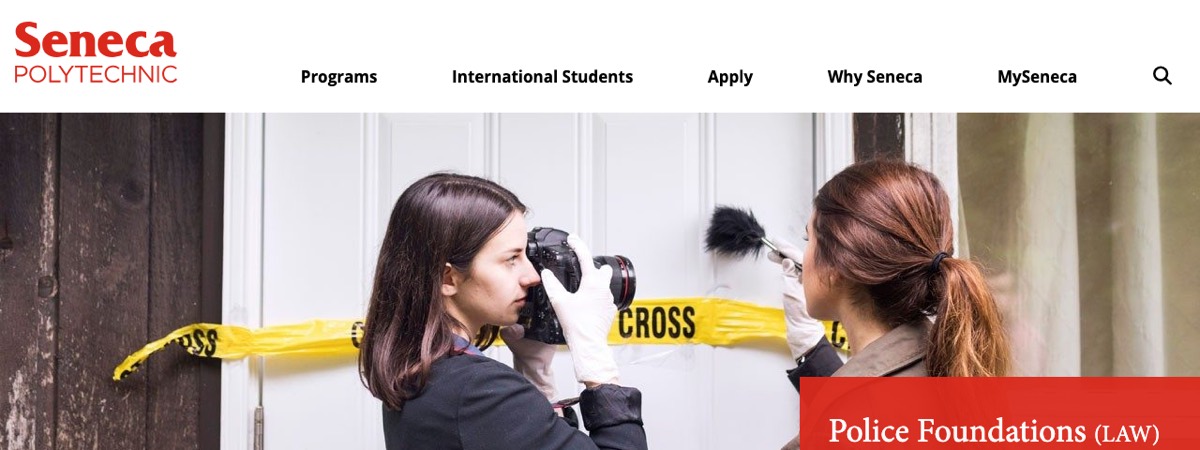
Police Foundations at Seneca Polytechnic is a hybrid 4-semester Ontario program leading to an Ontario College Diploma: 24 months from a Fall start, 16 months from a Winter start.
| Provider | Seneca Polytechnic |
|---|---|
| Length | 4 Semesters (Fall start - 24 months, Winter start - 16 months) |
| Credential | Ontario College Diploma |
| Format | hybrid, Ontario |
Fiona's take: The Winter start is the feature: you finish in 16 months instead of 24, the quickest Ontario College Diploma route on this page. Hybrid delivery suits people balancing paid work while they build a file. It remains preparation, not appointment.
Skip it if: Skip it if you cannot start in winter and two years is too long.
See Program DetailsJustice Studies Diploma
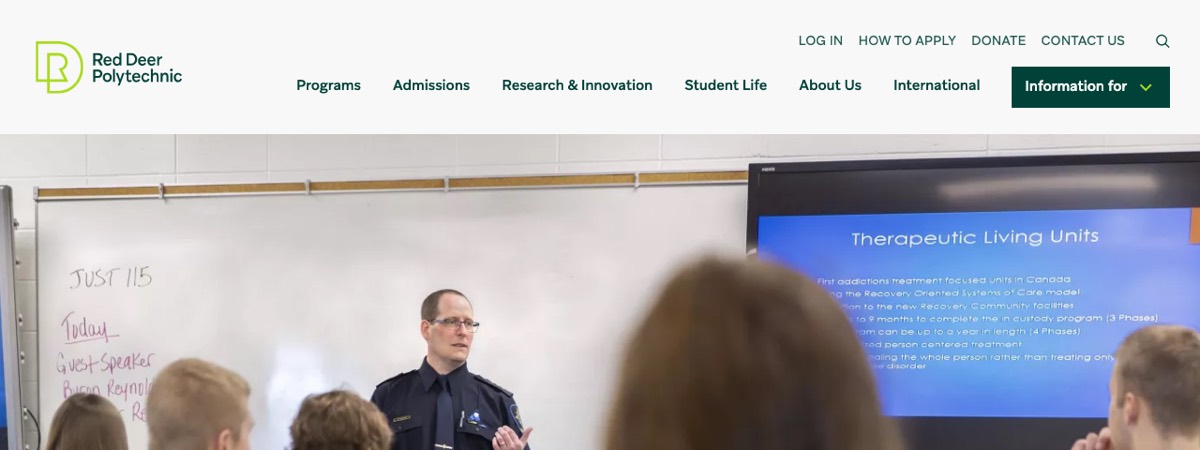
The Justice Studies Diploma at Red Deer Polytechnic is a 2-year in-person program in Alberta.
| Provider | Red Deer Polytechnic |
|---|---|
| Length | 2 years |
| Credential | Diploma |
| Format | in person, Alberta |
Fiona's take: For Alberta applicants this diploma covers the wider justice field rather than policing alone, which keeps related roles open as fallbacks. Two years is a serious time investment with no tuition listed, so ask the service you want whether a diploma strengthens your file before you enrol.
Skip it if: Skip it if you are set on policing and short on time.
See Program DetailsLaw Enforcement Program
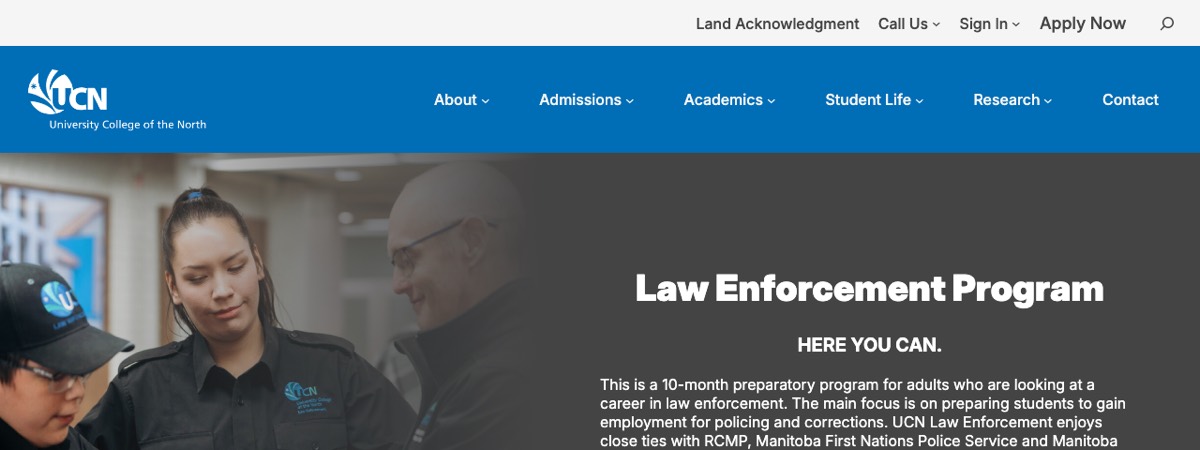
The Law Enforcement Program at University College of the North is a 10-month in-person certificate in Manitoba.
| Provider | University College of the North |
|---|---|
| Length | 10 Months |
| Credential | Certificate |
| Format | in person, Manitoba |
Fiona's take: Ten months makes this the shortest campus program on this page, and a sensible way for Manitoba applicants to test a law enforcement direction without committing two years. It is a certificate of preparation, not a constable appointment.
Skip it if: Skip it if you are applying in a different province and want local grounding where you will apply.
See Program DetailsLaw Enforcement Studies (LESD)
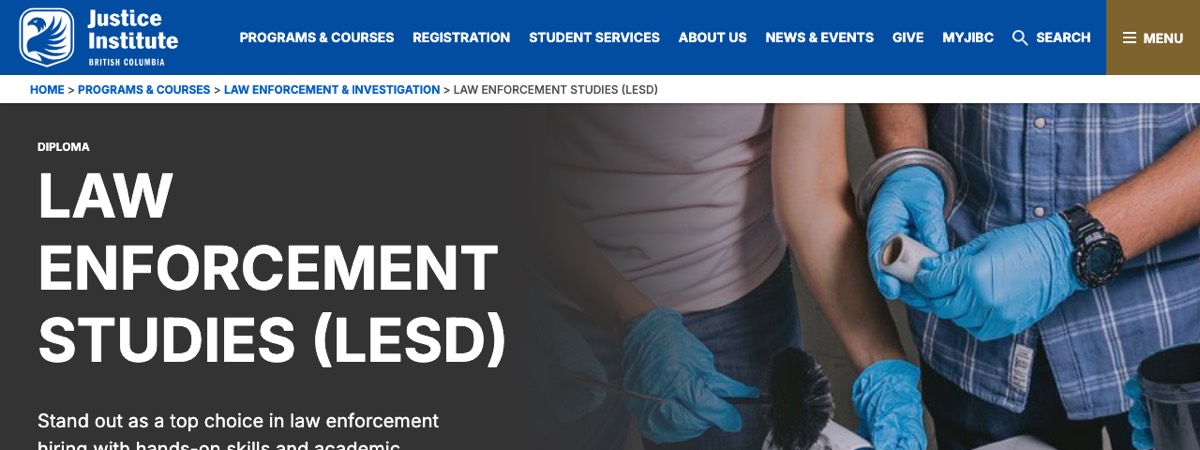
Law Enforcement Studies (LESD) at the Justice Institute of British Columbia is a 2-year hybrid diploma listed at $13,300.
| Provider | Justice Institute of British Columbia |
|---|---|
| Length | 2 years |
| Cost (CAD) | $13,300* |
| Credential | Diploma |
| Format | hybrid, British Columbia |
Fiona's take: This is the only diploma on this page from the institution that runs the Police Academy itself, so the content sits close to the working culture. The $13,300 fee is separate from, and no substitute for, the $18,378 recruit training a BC service will eventually send you to. A strong choice for committed BC applicants.
Skip it if: Skip it if you are only exploring; $13,300 is a lot for a taster.
See Program DetailsPolice and Justice Studies Diploma
The Police and Justice Studies Diploma at Thompson Rivers University is a 2-year in-person program in British Columbia.
| Provider | Thompson Rivers University |
|---|---|
| Length | 2 years |
| Credential | Diploma |
| Format | in person, British Columbia |
Fiona's take: TRU gives BC applicants a second diploma option beyond the JIBC route, in a conventional university setting. No tuition figure is listed, so budget for unknowns. Like every diploma here, it prepares you to apply; it does not appoint you.
Skip it if: Skip it if you want the polytechnic environment of JIBC.
See Program DetailsPolice Foundations
Police Foundations at Mohawk College is a 2-academic-year in-person Ontario program leading to an Ontario College Diploma.
| Provider | Mohawk College |
|---|---|
| Length | 2 academic years |
| Credential | Ontario College Diploma |
| Format | in person, Ontario |
Fiona's take: Mohawk's version is the classic Ontario formula: two academic years, in person, diploma at the end. It suits applicants who want structured time to mature a file, build fitness and gather experience before applying. Tuition is not listed.
Skip it if: Skip it if you need online or hybrid delivery.
See Program DetailsPolice Cadet Training
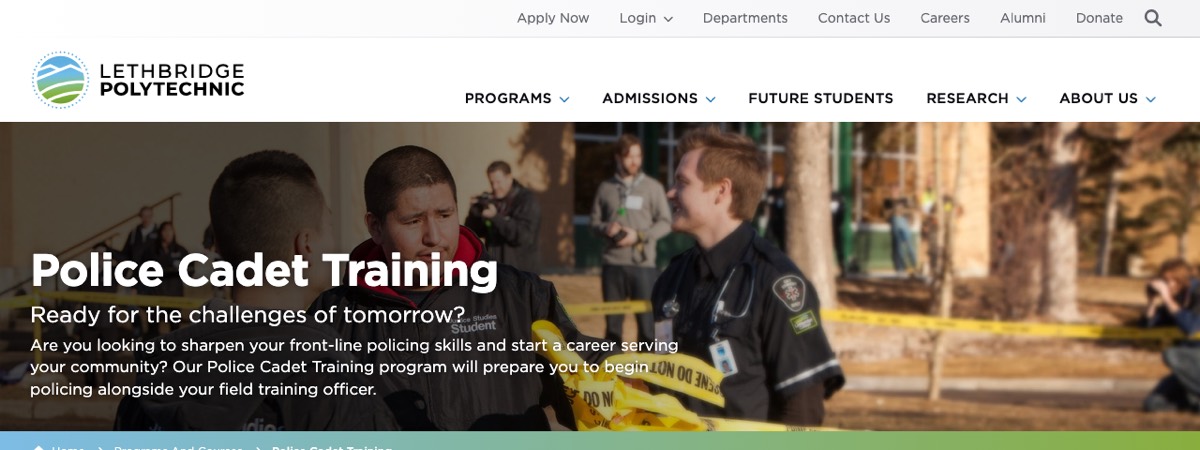
Police Cadet Training at Lethbridge Polytechnic is an in-person certificate program in Alberta with intakes in fall, winter or spring depending on agency requirements.
| Provider | Lethbridge Polytechnic |
|---|---|
| Length | Flexible – fall, winter or spring depending on agency requirements |
| Credential | Certificate |
| Format | in person, Alberta |
Fiona's take: The timing runs in fall, winter or spring depending on agency requirements, and the program was formed in collaboration with listed police services, which keeps it close to a service's working culture. It is the closest thing on this page to training linked directly to an agency, with a certificate at the end.
Skip it if: Skip it if you have no agency aligned with your timeline.
See Program DetailsHow Much Does Police Training Cost In Canada?
Police training costs in Canada come down to one published recruit figure on file: JIBC Police Academy tuition of $18,378 for 2025. Ontario eliminated the tuition fee for its Basic Constable Training Program retroactive to January 1, 2023, the RCMP Cadet Training Program charges no tuition, and most college diploma fees here are not listed; the JIBC Law Enforcement Studies diploma is listed at $13,300.
| Item | Cost (CAD) | Notes |
|---|---|---|
| JIBC Police Academy recruit tuition (2025) | $18,378 | Non-refundable, subject to change without notice, paid in full before Block One |
| JIBC Law Enforcement Studies diploma | $13,300 | Optional 2-year diploma, separate from recruit training |
| Ontario Police College Basic Constable Training Program | No tuition fee (eliminated, retroactive to January 1, 2023) | Prescribed 12-week training after hiring |
| RCMP Cadet Training Program at Depot | No tuition; $1,000 weekly cadet allowance | 26-week pre-hire training; meals and accommodations covered |
| College diplomas (Seneca, Mohawk, Confederation, Red Deer Polytechnic, TRU) | Not listed | Optional preparation, 16 months to 2 years |
| University College of the North Law Enforcement certificate | Not listed | Optional preparation, 10 months |
The BC number deserves respect before you celebrate an offer: the 2025 JIBC tuition rate is $18,378, subject to change without notice and non-refundable, due in full before Block One. Recruits often pay it themselves, though some hiring departments partially reimburse it, so ask that question during the offer call.
Ontario is clearer than it once was: the province eliminated the tuition fee for the Basic Constable Training Program at the Ontario Police College, retroactive to January 1, 2023, and removed the post-secondary education requirement for applicants in April 2023. The RCMP Cadet Training Program at Depot also charges no tuition and pays cadets a $1,000 weekly allowance, with meals and accommodations covered.
How Much Does A Police Officer Earn In Canada?
A police officer in Canada earns a median of $50.00 per hour under NOC 42100 on Job Bank's 2025 data, with listed provincial medians running from $45.08 in Quebec to $54.00 in British Columbia. The national range runs from $32.00 at the low end to $64.10 at the high end.
| Region | Low (CAD/Hour) | Median (CAD/Hour) | High (CAD/Hour) |
|---|---|---|---|
| Canada | 32.00 | 50.00 | 64.10 |
| Ontario | 32.21 | 50.55 | 64.00 |
| British Columbia | 35.00 | 54.00 | 70.67 |
| Alberta | Not listed | 50.00 | Not listed |
| Quebec | Not listed | 45.08 | Not listed |
British Columbia pays the most of the provinces listed, $54.00 at the median and $70.67 at the high end. Ontario sits close to the national picture at $50.55. The outlook is moderate nationally, with a moderate risk of shortage projected for 2024 to 2033, which in plain language means steady recruitment rather than a boom.
Is Becoming A Police Officer Worth It In 2026?
Becoming a police officer in 2026 is worth it for the right applicant: $50.00 per hour at the national median under NOC 42100, a defined training path and a moderate Job Bank outlook through 2033. The catch is that gatekeeping sits with employers, not schools, so your money and time go into applications, fitness and screening first.
Count the real timeline before you count the pay. Months of application, then 12 weeks at the Ontario Police College or roughly 40+ weeks of JIBC blocks in BC, then probation. The BC route can carry $18,378 in non-refundable tuition, while Ontario eliminated the tuition fee for Basic Constable Training retroactive to January 1, 2023, and the RCMP's Cadet Training Program at Depot charges none and pays a $1,000 weekly allowance.
If you are unsure, spend two hours first: the University of Toronto's stress course on Coursera is the shortest test of whether the daily reality of the job appeals to you before you commit anything.
Can You Get Funding For Police Training In Canada?
Funding for police training on the routes covered here comes in three forms: Ontario has eliminated tuition for Basic Constable Training retroactive to January 1, 2023, some BC departments partially reimburse JIBC recruit tuition, and the RCMP pays cadets during the Cadet Training Program. Quebec runs a pre-hire path, so budget differently there and confirm costs with the ENPQ.
- Ontario Basic Constable Training tuition elimination (effective 2023). Ontario eliminated the tuition fee for the Basic Constable Training program at the Ontario Police College, retroactive to January 1, 2023. In April 2023 the province also removed the post-secondary education requirement for becoming a police officer. Confirm the current details with your hiring service before you budget.
- BC department tuition reimbursement. JIBC recruit tuition of $18,378 is often paid by the recruit, but some hiring departments partially reimburse it. Ask during the hiring process what your service's policy is, and get it in writing if possible.
- RCMP Cadet Training Program allowance. The RCMP trains cadets before service at Depot: the Cadet Training Program charges no tuition, cadets receive a $1,000 weekly allowance while in the program, and the RCMP covers the cost of meals and accommodations. It is the one route on this page where training comes with income attached.
Police Officer Questions Canadians Ask
How Long Does It Take To Become A Police Officer In Ontario?
Becoming a police officer in Ontario starts with months of application and screening, then the clock begins: after hiring, you complete the 12-week Basic Constable Training Program at the Ontario Police College within 6 months, followed by field training and probation on top. The training itself is fixed; the hiring queue is what varies.
What Does Police Recruit Training Cost In BC?
Police recruit training in BC costs $18,378 at the JIBC Police Academy for 2025, non-refundable and due in full before Block One starts. Recruits often carry it themselves, though some hiring departments partially reimburse the tuition, so the out-of-pocket figure varies by service. Ask before you sign.
Do You Need Post-Secondary Education To Become A Cop In Ontario?
Post-secondary education is no longer required to become a police officer in Ontario: in April 2023 the province removed the requirement for becoming a police officer, alongside eliminating tuition for the Basic Constable Training program retroactive to January 1, 2023. Confirm the current standard with the service you are applying to before you plan around it.
What Physical Tests Do Canadian Police Services Use?
Physical tests used across Canadian services include POPAT and PARE, along with service-specific fitness evaluations; some BC roles apply a 4:15 time standard. I tell clients to ask their target service which test it uses and train for that exact course, because formats and standards differ from one service to the next.
What Is The Median Wage For Police Officers In Canada?
The median wage for police officers in Canada is $50.00 per hour under NOC 42100 on Job Bank's 2025 data. The listed provincial medians are $50.55 in Ontario, $54.00 in British Columbia, $50.00 in Alberta and $45.08 in Quebec, with a national high of $64.10 per hour.
How Do You Become A Police Officer In BC?
Becoming a police officer in BC means getting hired by a municipal department first, then completing JIBC Police Academy Blocks I to III, approximately 40+ weeks in total with field training, to reach Qualified Constable within 18 months of appointment. Block IV follows, leading to Certified Constable within 36 months.
Is Funding Available For Police Training In Canada?
Funding for police training exists in several verified forms. Ontario eliminated the tuition fee for Basic Constable Training, retroactive to January 1, 2023, and some BC hiring departments partially reimburse the $18,378 JIBC tuition. The RCMP Cadet Training Program at Depot charges no tuition and pays cadets a $1,000 weekly allowance. BC reimbursement is not automatic, so confirm the rules with the hiring service.
What Is The Job Outlook For Police Officers In Canada?
The job outlook for police officers in Canada is moderate nationally, with a moderate risk of shortage projected from 2024 to 2033 according to Job Bank and COPS data. In practical terms, expect steady recruitment rather than a hiring surge, which makes a clean application file matter more than timing the market.
What's The Bottom Line On Becoming A Police Officer In Canada?
- In the Ontario and BC routes covered here, you get hired first: the 12-week Basic Constable Training Program at the Ontario Police College and the JIBC Police Academy Blocks I to III in BC begin after a service appoints you.
- BC recruit tuition is $18,378 for 2025, non-refundable and due in full before Block One; some hiring departments partially reimburse it.
- Police officers under NOC 42100 earn a median of $50.00 per hour in Canada, $50.55 in Ontario and $54.00 in British Columbia.
- Test your interest first with Understanding and Managing the Stresses of Police Work, a 2-hour University of Toronto course on Coursera; it does not qualify you for appointment.
- Ontario removed the post-secondary education requirement for police applicants and eliminated tuition for Basic Constable Training retroactive to January 1, 2023, while the RCMP's Cadet Training Program at Depot charges no tuition and pays cadets a $1,000 weekly allowance.






