Key Takeaways
- The fastest realistic route is an Ontario pre-service college program, such as Seneca Polytechnic's 3-semester Firefighter, Pre-Service Education and Training, which takes 10 to 12 months, costs $10,000 to $15,000, and includes NFPA certification exams through the Office of the Fire Marshal.
- Certification is mandatory in Ontario, where the Office of the Fire Marshal (OFM) is the only authority having jurisdiction for issuing firefighting certification; in British Columbia, certification is voluntary, the Office of the Fire Commissioner sets structure firefighter training standards and departments set requirements based on those minimums, and in Alberta employers decide requirements.
- The try-first option is Fire and Life Safety Systems, a 4-week Coursera specialisation from L&T EduTech at 10 hours a week; it does not qualify you for OFM certification or any NFPA firefighter credential.
- Job Bank lists NOC 42101 firefighters at a Canada median of $45.79 an hour, with Ontario at $48.53, British Columbia at $50.00, Alberta at $48.43 and Quebec at $40.17 in the 2025 release.
- My verdict: this path suits applicants who can fund a year of full-time study, pass a physical, medical and interview, and ride out a 3 to 12 month hiring process.
A firefighter carries out firefighting and fire prevention activities and assists in other emergencies, working for municipal, provincial and federal governments or for large industrial employers with internal fire services. In Ontario the realistic route is a 10 to 12 month pre-service college program costing $10,000 to $15,000, followed by a 3 to 12 month hiring process.
Because that is real money and a year of your life, I tell clients to test the field first. A short online course such as Fire and Life Safety Systems shows whether fire and life safety material holds your interest before you commit tuition. It does not certify you; only the Office of the Fire Marshal (OFM) issues Ontario firefighting certification.
What Are The Ways To Become A Firefighter In Canada?
The ways to become a firefighter differ by province: in the provinces covered here, Ontario has mandatory certification, while British Columbia and Alberta set requirements at the department and employer level within their provincial frameworks. Here are the routes I compare with clients, starting with the lowest-commitment one.
| Route | Time | Cost (CAD) | What You Get | Recognised By | Best For |
|---|---|---|---|---|---|
| Fire and Life Safety Systems | 4 weeks at 10 hours a week | Not listed | Shareable certificate in fire and life safety theory | No regulator; does not lead to OFM or NFPA certification | Testing the field before college tuition |
| Pre-service college program (Ontario) | 10 to 12 months | $10,000 to $15,000 | Ontario College Certificate plus NFPA certification via OFM | OFM (Ontario) and fire departments | Ontario hiring |
| Lakeland College Firefighter Training | 12 or 17 weeks | Not listed | Certificate | Not listed; Alberta employers decide requirements | Alberta applicants checking employer requirements |
| JIBC Fire Fighting Technologies (British Columbia) | Not listed | About $10,568 domestic for the NFPA 1010 component | Certificate | BC departments working to OFC structure firefighter training standards | BC applicants wanting hybrid delivery |
| Volunteer firefighting | Not listed | Not listed | Hands-on experience Job Bank lists as an advantage in hiring | Municipal fire departments | Testing commitment while earning elsewhere |
I recommend the pre-service route for Ontario-bound clients, Lakeland or the Justice Institute of British Columbia for western applicants, and the Coursera specialisation for anyone still deciding whether the field fits.
What Is The Fastest Way To Become A Firefighter In Canada?
The fastest way to a paid firefighter job in Ontario is the pre-service college route: a 10 to 12 month program, then a 3 to 12 month hiring process. The OFM certification exams are built into the program, so there is no separate certification stage.
- Finish secondary school. Job Bank lists secondary school completion as the baseline for NOC 42101 firefighters, and the step itself costs $0.
- Complete a pre-service firefighter program at a recognized college. Typical Ontario pre-service programs run 10 to 12 months and cost about $10,000 to $15,000; examples include Seneca Polytechnic, Georgian College, Lambton College and Humber College, though lengths and listed costs vary by school.
- Sit the NFPA certification exams through the Office of the Fire Marshal. Time and cost are included in the program, and the OFM is the only authority having jurisdiction for issuing Ontario firefighting certification.
- Apply to municipal fire departments and pass the physical, medical and interview stages: 3 to 12 months, with $500 to $2,000 in applications and tests.
Do You Need A Licence Or Certification To Be A Firefighter In Canada?
Certification is mandatory in Ontario, where the Office of the Fire Marshal (OFM) is the only authority having jurisdiction for issuing Ontario firefighting certification. In British Columbia, certification is voluntary; the Office of the Fire Commissioner sets structure firefighter training standards, and departments set requirements based on those minimum standards. In Alberta, employers decide requirements. Here is what that means by province.
| Province | Required? | Regulator Or Registry | What It Means |
|---|---|---|---|
| Ontario | Yes, mandatory | Office of the Fire Marshal (OFM) | Municipalities must have firefighters certified to NFPA standards by the OFM for specific services, and the OFM is the only authority having jurisdiction for issuing Ontario firefighting certification. |
| British Columbia | No | Office of the Fire Commissioner (OFC) | The OFC holds the legislated mandate to set and issue structure firefighter training standards, and departments set their own standards based on OFC minimum training. |
| Alberta | No | Alberta Firefighter Certification Program (government administered IFSAC/Pro Board) | NFPA certification of fire service members is not required by the Alberta government; employers decide requirements. |
The Ontario rule is the one to plan around. Municipalities must have firefighters certified to NFPA standards by the OFM for the services they provide, which is why Ontario colleges build NFPA 1001 Level I and II plus NFPA 1072 hazardous materials awareness and operations into the pre-service curriculum. That program definition comes from the province's firefighter training and certification page.
None of the online courses below change your certification status. Coursera and Udemy certificates do not certify you with the OFM in Ontario, meet OFC structure firefighter training standards in British Columbia, or award an Alberta Firefighter Certification Program credential. I position them as theory and interview preparation; in British Columbia, departments set requirements based on OFC minimum training standards, and in Alberta, employers decide requirements.
Which Firefighter Courses Are Worth Taking In Canada?
Firefighter courses worth taking fall into three tiers: Coursera introductions to test interest, Udemy prep for exams and interviews, and college programs that lead to real credentials. I have ordered them the way I would spend my own money, theory first, then tuition.
Fire and Life Safety Systems
Fire and Life Safety Systems is a 4-week online specialisation from L&T EduTech, run at 10 hours a week, that covers fire and life safety systems and awards a shareable certificate.
| Provider | L&T EduTech |
|---|---|
| Length | 4 weeks at 10 hours a week |
| Credential | Shareable certificate |
| Format | online |
Fiona's take: This is the Coursera option I point Ontarians at first, because 4 weeks at 10 hours a week introduces fire and life safety systems and building safety concepts before you commit to a college application. Treat it as a screening tool for the pre-service decision. It does not qualify you for OFM certification or any NFPA firefighter credential.
Skip it if: Skip it if you already hold NFPA 1001 certification or only want interview coaching, since the Udemy oral board course below fits that job better.
Start On CourseraThe Effect of Fires on People, Property and the Environment
The Effect of Fires on People, Property and the Environment is a 1-week online course from the University of Maryland, College Park, run at 10 hours a week, that examines what fires do to people, property and the environment and awards a course certificate.
| Provider | University of Maryland, College Park |
|---|---|
| Length | 1 week at 10 hours a week |
| Credential | Course certificate |
| Format | online |
Fiona's take: This is the one Coursera course here with a university attached, and its fire-effects angle covers the part of the job civilians never see: why containment decisions weigh people, property and environment together. One week at 10 hours a week makes it a fast audition for the field.
Skip it if: Skip it if you want hands-on skills; nothing in a 1-week online course replaces a drill yard.
Start On CourseraFire Protection System
Fire Protection System is a 9-hour online course from L&T EduTech that covers fire protection systems and awards a course certificate.
| Provider | L&T EduTech |
|---|---|
| Length | 9 hours |
| Credential | Course certificate |
| Format | online |
Fiona's take: Nine hours is one focused weekend of study on how protection systems work and where they fail. I use it with clients who want a single concrete topic, not a specialisation, before deciding on a Seneca or Lambton application.
Skip it if: Skip it if you would rather commit once to the 4-week specialisation and study systems in that context.
Start On CourseraBasics of Fire Protection, Detection and Life Safety Systems
Basics of Fire Protection, Detection and Life Safety Systems is a 6-hour online course from L&T EduTech that introduces protection, detection and life safety basics and awards a course certificate.
| Provider | L&T EduTech |
|---|---|
| Length | 6 hours |
| Credential | Course certificate |
| Format | online |
Fiona's take: Six hours makes this the shortest serious taste of the field on Coursera. I recommend it to clients who want to finish something in a weekend and then decide whether to upgrade to the longer specialisation.
Skip it if: Skip it if you already work around fire systems; the material is introductory.
Start On CourseraCertified Fire Protection Specialist (CFPS) Exam Prep Course
Certified Fire Protection Specialist (CFPS) Exam Prep Course is a 52.5-hour on-demand video course from Udemy, priced at $199.99 and rated 4.7 from 2 ratings, that prepares candidates for the CFPS exam and awards a certificate of completion.
| Provider | Udemy |
|---|---|
| Length | 52.5 hours on-demand video |
| Cost (CAD) | $199.99 |
| Rating | 4.7 (2 ratings) |
| Credential | Certificate of completion |
| Format | online |
Fiona's take: This is exam prep for a fire protection specialist credential, not a firefighting certification, so I frame it for people aiming at inspection and fire protection roles rather than the attack line. The 4.7 rating rests on 2 ratings, a thin sample, and 52.5 hours of video is a serious commitment for a $199.99 purchase.
Skip it if: Skip it if your goal is municipal firefighting in Ontario, because OFM certification comes through the pre-service route, not this exam.
View On UdemyPerform Basic Fire Fighting & Apply Fire Fighting Techniques
Perform Basic Fire Fighting & Apply Fire Fighting Techniques is a 1-hour on-demand video course from Udemy, rated 4.3 from 18 ratings, that walks through basic firefighting techniques and awards a certificate of completion.
| Provider | Udemy |
|---|---|
| Length | 1 hour on-demand video |
| Rating | 4.3 (18 ratings) |
| Credential | Certificate of completion |
| Format | online |
Fiona's take: One hour of video will not make you a firefighter. It is not listed as OFM, OFC, Alberta Firefighter Certification Program, NFPA, IFSAC or Pro Board certification, and I treat it as basic awareness material only. The 4.3 rating from 18 ratings is a modest signal.
Skip it if: Skip it if you are enrolled anywhere already; any college program covers this ground properly.
View On UdemyFirefighter Code: Pass Your Firefighter Oral Board Interview
Firefighter Code: Pass Your Firefighter Oral Board Interview is a 6-hour on-demand video course from Udemy, rated 4.7 from 217 ratings, that coaches candidates through the oral board interview and awards a certificate of completion.
| Provider | Udemy |
|---|---|
| Length | 6 hours on-demand video |
| Rating | 4.7 (217 ratings) |
| Credential | Certificate of completion |
| Format | online |
Fiona's take: This is the one course on the page aimed squarely at the hiring stage, which in Ontario follows the pre-service program and runs 3 to 12 months. A 4.7 rating from 217 ratings is the strongest rating signal here. I tell clients to time it against actual interview invitations, not to buy it years ahead.
Skip it if: Skip it until your applications are in; interview coaching fades from memory.
View On UdemyFirefighter, Pre-Service Education and Training (FFP)
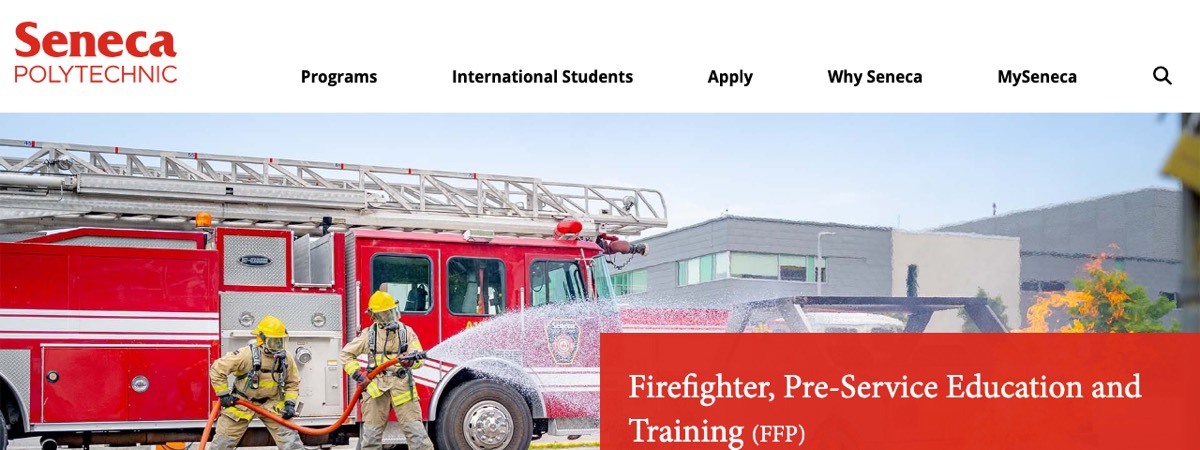
Firefighter, Pre-Service Education and Training (FFP) is a 3-semester, 12-month in-person program from Seneca Polytechnic that awards an Ontario College Certificate.
| Provider | Seneca Polytechnic |
|---|---|
| Length | 3 Semesters (12 Months) |
| Credential | Ontario College Certificate |
| Format | in person, Ontario |
Fiona's take: This is the Ontario benchmark. The program embeds the NFPA 1001 Level I and II and NFPA 1072 exams the OFM certifies, so certification is part of the year, not an afterthought. Domestic tuition and ancillary fees run $5,222.17 per semester across 3 semesters, with about $2,043 in books and supplies in first semester.
Skip it if: Skip it if you cannot study full time in person for 12 months; no online delivery is listed.
See Program DetailsFirefighter Training
Firefighter Training is a 12 or 17 week face-to-face and blended program from Lakeland College in Alberta that awards a certificate.
| Provider | Lakeland College |
|---|---|
| Length | 12 or 17 weeks |
| Credential | Certificate |
| Format | face-to-face, blended, Alberta |
Fiona's take: This is the fastest college-format route on the page, and it works in Alberta because the Alberta government does not require NFPA certification. Employers decide what they accept, so I tell Alberta-bound clients to check the posting before choosing between the 12 and 17 week versions.
Skip it if: Skip it if you are set on Ontario; the OFM track runs through an Ontario pre-service program, and this is not that.
See Program DetailsPre-Service Firefighter Education and Training
Pre-Service Firefighter Education and Training is a 1-year, 3-semester full-time program from Georgian College that awards an Ontario College Certificate.
| Provider | Georgian College |
|---|---|
| Length | 1 Year (3 Semesters) |
| Credential | Ontario College Certificate |
| Format | full-time, Ontario |
Fiona's take: Georgian runs the same Ontario pre-service structure the province defines, one year across 3 semesters leading to the OFM-track NFPA exams. With several Ontario colleges offering the credential, I tell clients to compare by published cost, commute and intake dates rather than by curriculum.
Skip it if: Skip it if you need a published price today; no Georgian tuition figure is listed here.
See Program DetailsPre-Service Firefighter Education & Training
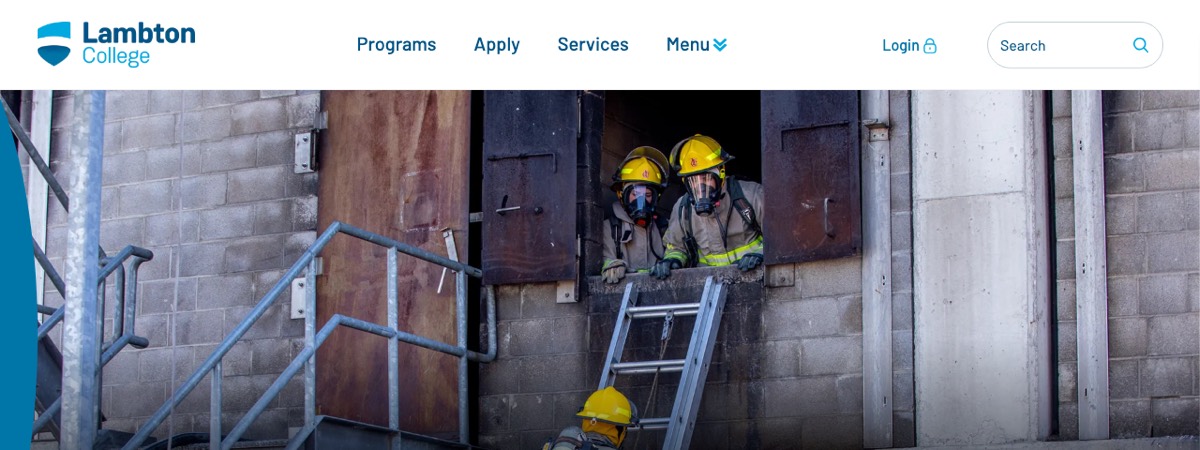
Pre-Service Firefighter Education & Training is a 10-month in-person program from Lambton College that awards an Ontario College Certificate.
| Provider | Lambton College |
|---|---|
| Length | One-Year (10 months) |
| Credential | Ontario College Certificate |
| Format | in-person, Ontario |
Fiona's take: Lambton is the college on this page with the clearest 2026-2027 numbers: Year 1 tuition of $11,373.04, plus PPE at $1,350.00 and a uniform at $165.00. Ten months is the short end of the 10 to 12 month pre-service range, which matters when every extra month is a month without earnings.
Skip it if: Skip it if the $1,350.00 PPE charge on top of tuition breaks your budget; settle the gear question with the college before applying.
See Program DetailsFire Fighting Technologies (FFTC)
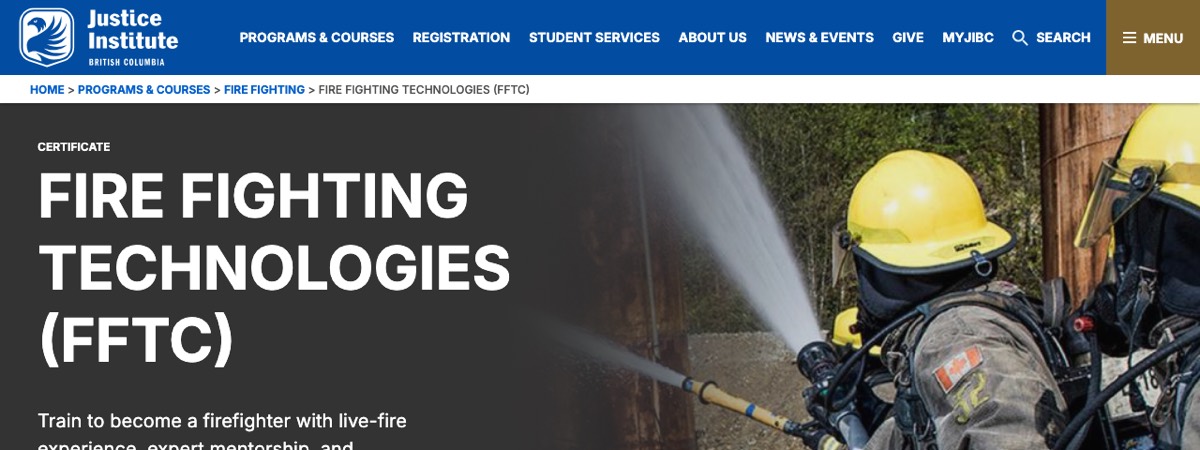
Fire Fighting Technologies (FFTC) is a hybrid online and on-campus certificate program from the Justice Institute of British Columbia, with domestic tuition of approximately $10,568 for the NFPA 1010 component.
| Provider | Justice Institute of British Columbia |
|---|---|
| Cost (CAD) | Domestic Tuition: approximately $10,568 (for NFPA 1010 component) |
| Credential | Certificate |
| Format | hybrid (online and on-campus), British Columbia |
Fiona's take: This is the BC route, built for the OFC environment where certification is voluntary, the OFC sets structure firefighter training standards, and departments set requirements based on those minimum standards. JIBC lists about $10,568 domestic for the NFPA 1010 component; compare full program costs before choosing.
Skip it if: Skip it if you are Ontario bound; the OFM certification track runs through an Ontario pre-service program, not a BC credential.
See Program DetailsPre-Service Firefighter Education and Training
Pre-Service Firefighter Education and Training is a 2-semester in-person program from Humber College that awards a certificate.
| Provider | Humber College |
|---|---|
| Length | 2 semesters |
| Credential | Certificate |
| Format | in person, Ontario |
Fiona's take: Humber lists 2 semesters where Seneca and Georgian list 3, so the calendar commitment differs within the same Ontario program family. I tell clients to put Humber, Seneca and Georgian side by side on schedule and total cost before choosing, because no Humber fee figure is listed here.
Skip it if: Skip it if you want published per-semester figures before deciding; Seneca and Lambton list them here.
See Program DetailsFire Safety Program (Certificate in Fire Safety Engineering)
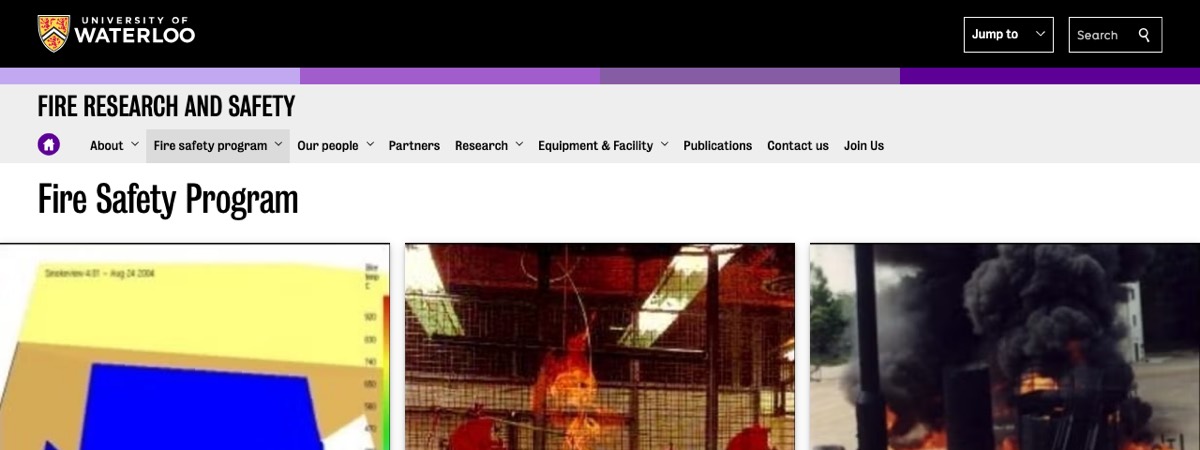
The Fire Safety Program is a certificate program in fire safety engineering from the University of Waterloo in Ontario.
| Provider | University of Waterloo |
|---|---|
| Credential | Certificate |
| Format | Ontario |
Fiona's take: This sits at the engineering end of fire safety, aimed at people who analyse and design fire protection rather than respond to calls. I raise it with clients who finish the Coursera specialisation, enjoy the systems side, and realise the operational role is not their target. No length or cost is listed.
Skip it if: Skip it if your goal is operational firefighting; an engineering certificate does not certify you to fight fires.
See Program DetailsHow Much Does Firefighter Training Cost In Canada?
Firefighter training in Ontario costs $10,000 to $15,000 in tuition and fees for the pre-service program, then $500 to $2,000 more for applications and tests during hiring. Western options price differently: the Justice Institute of British Columbia lists about $10,568 domestic for its NFPA 1010 component.
| Item | Cost (CAD) | Source |
|---|---|---|
| Pre-service program, tuition and fees (Ontario) | $10,000 to $15,000 | Route figure for the Ontario pre-service program |
| Seneca tuition and ancillary, per semester (domestic) | $5,222.17 | Seneca Polytechnic fee page |
| Seneca books and supplies, first semester | About $2,043 | Seneca Polytechnic fee page |
| Lambton Year 1 tuition (2026-2027) | $11,373.04 | Lambton College program page |
| Lambton PPE | $1,350.00 | Lambton College program page |
| Lambton uniform | $165.00 | Lambton College program page |
| JIBC NFPA 1010 component (domestic) | About $10,568 | Justice Institute of British Columbia |
| Hiring applications and tests | $500 to $2,000 | Job Bank requirements report |
| Udemy CFPS exam prep | $199.99 | Udemy |
Budget the extras, not just tuition. Lambton's published Year 1 adds $1,350.00 in PPE and $165.00 for a uniform on top of $11,373.04 in tuition, which pushes the real first-year number past the sticker figure. Seneca's per-semester fees of $5,222.17 repeat across 3 semesters, with about $2,043 in books and supplies landing in the first one.
The hiring stage costs money too. Applications and tests run $500 to $2,000, per the Job Bank requirements report, and they arrive while you are between program and paycheque. I tell clients to hold that amount aside before the program starts rather than borrow mid-process.
How Much Does A Firefighter Earn In Canada?
A firefighter in Canada earns a median of $45.79 an hour, according to Job Bank's 2025 release for NOC 42101. The provincial medians are $48.53 in Ontario, $50.00 in British Columbia, $48.43 in Alberta and $40.17 in Quebec.
| Region | Median Hourly Wage (Job Bank, NOC 42101, 2025 Release) |
|---|---|
| Canada | $45.79 |
| Ontario | $48.53 |
| British Columbia | $50.00 |
| Alberta | $48.43 |
| Quebec | $40.17 |
Job Bank rates the outlook for NOC 42101 as varying by province, so read the table as separate markets rather than one national picture. British Columbia's $50.00 median is the highest figure here and Quebec's $40.17 is the lowest, a wide spread between provinces under the same code.
Set that pay against the entry cost. A $10,000 to $15,000 pre-service year plus $500 to $2,000 in hiring costs is a real outlay, but $45.79 as the national median is a strong hourly rate for a credential earned in 10 to 12 months. Volunteer experience, which Job Bank lists as an advantage, can improve your position in the meantime.
Is Becoming A Firefighter Worth It In 2026?
Becoming a firefighter in 2026 is worth it for applicants who want the pay and the certainty of Ontario's mandatory certification: a $45.79 national median, $48.53 in Ontario, and an OFM credential tied to the NFPA standards municipalities must staff against. That is a strong return on a 10 to 12 month program at $10,000 to $15,000.
It is worth less as a gamble if you cannot fund the year or pass the physical. The hiring process alone runs 3 to 12 months with $500 to $2,000 in costs, and no wage arrives until it ends. In British Columbia and Alberta, where certification is not mandatory at the provincial level, I tell clients to confirm a target department's requirements before spending anything.
My honest test: run the Coursera step first. If the Fire and Life Safety Systems material bores you, you have learned that for the price of four weeks. If it hooks you, the Seneca or Lambton application is a far easier commitment to make.
Firefighter Questions Canadians Ask
How Long Does It Take To Become A Firefighter In Ontario?
Becoming a firefighter in Ontario typically takes 1 year for the pre-service program plus 3 to 12 months for the hiring process, including tests and applications. Seneca Polytechnic runs 3 semesters over 12 months, and Lambton College finishes in 10. The OFM certification exams are included in the program rather than added after.
Is Certification Mandatory For Firefighters In Ontario?
Certification in Ontario is mandatory: municipalities must have firefighters certified to NFPA standards by the Office of the Fire Marshal for specific services, and the OFM is the only authority having jurisdiction for issuing Ontario firefighting certification. The pre-service route builds those NFPA exams into the college year.
What Is The Median Wage For Firefighters In Canada?
The median wage for firefighters in Canada is $45.79 per hour, according to Job Bank 2025 data for NOC 42101. The provincial medians are $48.53 in Ontario, $50.00 in British Columbia, $48.43 in Alberta and $40.17 in Quebec. Job Bank rates the outlook as varying by province.
Do I Need A College Program To Become A Firefighter In BC?
BC does not have mandatory provincial firefighter certification; departments set their own requirements based on Office of the Fire Commissioner minimum training. BC applicants who want formal training look at the Justice Institute of British Columbia, which lists domestic tuition of about $10,568 for its NFPA 1010 component.
How Much Does Pre-Service Firefighter Training Cost In Ontario?
Pre-service firefighter training in Ontario costs approximately $10,000 to $15,000 in tuition and fees. At Seneca Polytechnic, tuition and ancillary fees run $5,222.17 per semester for domestic students across 3 semesters, with about $2,043 in books and supplies in first semester. Lambton College lists Year 1 tuition of $11,373.04 for 2026-2027.
Is Firefighter Certification Compulsory In Alberta?
Certification in Alberta is not compulsory: NFPA certification of fire service members is not required by the Alberta government, and employers decide requirements. The province administers the Alberta Firefighter Certification Program, an IFSAC and Pro Board option. Lakeland College offers a 12 or 17 week Firefighter Training program for Albertans who want a certificate.
What NOC Code Is Used For Firefighters On Job Bank?
NOC 42101 is the code Job Bank uses for firefighters, covering firefighting and fire prevention work for municipal, provincial and federal employers, industrial fire services and apprentices. The Job Bank wage report for NOC 42101 shows the Canada median of $45.79 per hour. Use that code when you search wages or postings.
Can Volunteer Experience Help Get Hired As A Firefighter?
Volunteer experience can help: Job Bank says experience as a volunteer firefighter may be an advantage in hiring. That note sits in the Job Bank requirements report for NOC 42101, the same occupation with a Canada median wage of $45.79 per hour. Since an Ontario pre-service program costs $10,000 to $15,000 over 10 to 12 months, weigh any hiring advantage before you apply.
What's The Bottom Line On Becoming A Firefighter In Canada?
- The bottom line on becoming a firefighter in Canada: Ontario's route is a 10 to 12 month pre-service program at $10,000 to $15,000 with OFM certification built in; in British Columbia, certification is voluntary, the OFC sets structure firefighter training standards and departments set requirements based on those minimums; in Alberta, employers decide requirements.
- Job Bank puts NOC 42101 median pay at $45.79 an hour Canada-wide, from $40.17 in Quebec to $50.00 in British Columbia.
- Start with Fire and Life Safety Systems on Coursera: 4 weeks at 10 hours a week to test the field, with no OFM or NFPA certification at the end.
- Lambton's 2026-2027 numbers, $11,373.04 tuition plus $1,350.00 PPE and $165.00 uniform, are the clearest published budget on the page.
- Budget $500 to $2,000 and 3 to 12 months for applications, tests and interviews after graduation.






