Key Takeaways
- One of the faster documented routes is the Alberta Class 1 Learning Pathway at a licensed school: 6-8 weeks covering 108 hours of Entry and Core Learning for a restricted licence, or 125+ hours for the unrestricted licence, costing $10,000-$12,000 for students enrolling on or after April 1, 2026.
- Mandatory entry-level training is required in five provinces: Alberta (Class 1 Learning Pathway, run by Alberta Transportation and Economic Corridors, since April 1, 2025), Ontario (MELT for Class A, set by the Ministry of Transportation Ontario), plus British Columbia, Saskatchewan and Manitoba.
- Before spending five figures, read a Coursera guide such as AI in Logistics: Transforming Transportation, Warehousing, and Freight Operations to test your interest; it does not qualify you for any Class 1 or Class A licence.
- Job Bank (2023-2024 reference period, revised November 19, 2025) lists the median wage for NOC 73300 Transport truck drivers at $26.42 per hour, with highs of $37.00 and provincial medians up to $30.77 in British Columbia.
- Fiona's verdict: this path suits disciplined career changers who can front the tuition or secure Alberta funding, where the Industry Advancement Grant and experience-based exemptions can cut the cost.
A truck driver in Canada operates tractor-trailers and heavy commercial freight vehicles, which requires a provincial Class 1 licence (Class A in Ontario) rather than a national credential. The realistic minimum is 6-8 weeks of mandatory training in Alberta or at least 103.5 hours in Ontario, plus provincial knowledge and road tests.
Before you enrol, know what the licence costs and who requires the training: five provinces, Alberta, Ontario, British Columbia, Saskatchewan and Manitoba, mandate entry-level training. Alberta's Class 1 Learning Pathway replaced MELT on April 1, 2025, and Ontario's Ministry of Transportation requires MELT for every Class A applicant. Here is how the routes, costs and funding compare.
What Are The Ways To Become A Truck Driver In Canada?
The ways to become a truck driver in Canada all end at a provincial commercial licence, and five provinces require mandatory entry-level training first: Alberta, Ontario, British Columbia, Saskatchewan and Manitoba. The online resources and mechanic programs in this table are related options, not licence routes.
| Route | Time | Cost (CAD) | What You Get | Recognised By | Best For |
|---|---|---|---|---|---|
| AI in Logistics: Transforming Transportation, Warehousing, and Freight Operations plus other Coursera articles and guides to test the field first | Not listed | Not listed | An understanding of freight, logistics and trucking careers, no licence | Not a licence or credential | Anyone unsure whether trucking suits them before paying tuition |
| Alberta Class 1 Learning Pathway at a licensed school (full) | 6-8 weeks (108 hours of Entry and Core for a restricted licence; 125+ hours total for unrestricted) | 10000-12000 | Unrestricted Alberta Class 1 licence | Alberta Transportation and Economic Corridors | Alberta residents who want the full pathway |
| Ontario MELT for Class A (e.g. AZ Truck Driver MELT (Mandatory Entry Level Training) Program at Confederation College) | 9 weeks approx. (at least 103.5 hours of instruction) | Not listed | Eligibility to take the Ontario Class A road test | Ministry of Transportation Ontario | Ontario residents and AZ aspirants |
| BC, Saskatchewan and Manitoba MELT | Not listed | Not listed | Eligibility to test for a Class 1 licence | Provincial regulators, including SGI in Saskatchewan | Drivers living in BC, Saskatchewan or Manitoba |
| Class 1 Learning Pathway at a college such as Class 1 Commercial Truck Driver Training at Northern Lakes College or Class 1 Truck Driver Training & Air Brakes Q Endorsement at Portage College | Entry 40 hours plus Core 67 hours | Entry $700; Core $9,500 at Portage College | Class 1 Learning Pathway completion | Alberta Transportation and Economic Corridors | Students who want staged, pay-as-you-go training |
| Experience-based exemption in Alberta | Not listed | Knowledge test $17 and road test $217 | Class 1 testing without full training, for drivers with 24+ months experience | Alberta Transportation and Economic Corridors | Licensed drivers with substantial commercial experience |
I recommend the Coursera reading first for anyone still deciding, then the full Alberta pathway for Alberta residents, and Ontario MELT for anyone living where a Class A is the target.
What Is The Fastest Way To Get A Class 1 Licence In Canada?
The fastest way to get a Class 1 licence as a new driver is a provincial entry-level training pathway; the Alberta Class 1 Learning Pathway is one of the faster documented routes at 6-8 weeks end to end, covering 108 hours of Entry and Core Learning for a restricted licence or 125+ hours for the unrestricted one. Timelines for British Columbia, Saskatchewan and Manitoba are not listed in the sources here, so compare locally before enrolling.
- Hold a valid Class 5 (or equivalent) non-probationary licence and pass the medical and vision exam: 1-4 weeks, $50-150 for the medical.
- Complete the Entry Program, 40 hours online or supported: 1-2 weeks, $250-700.
- Complete the Core Learning Program, 67 hours in-yard and in-cab: 4-6 weeks, $8,300-9,500.
- Pass the Class 1 knowledge test ($17) and road test ($217, permit): 1-2 weeks, $234 total for tests.
- Complete Competence Building for the unrestricted licence, optional but recommended: 1-2 weeks, $1,000-1,800.
- Drivers in Alberta with 24 or more months of qualifying experience may skip training entirely and test directly; 12-24 months allows testing or an equivalency program.
Is A Licence Or Mandatory Training Required To Drive A Truck In Canada?
A licence is the route for tractor-trailers and heavy commercial freight vehicles: typically a provincial Class 1 licence, or the equivalent Class A in Ontario. Five provinces mandate entry-level training before you can book a road test: Alberta, Ontario, British Columbia, Saskatchewan and Manitoba.
| Province | Mandatory Training? | Regulator | What It Means |
|---|---|---|---|
| Alberta | Yes, since April 1, 2025 | Alberta Transportation and Economic Corridors | The Class 1 Learning Pathway replaced the Class 1 Mandatory Entry-Level Training (MELT) program: Entry Program (40 hours) plus Core Learning (67 hours) plus Competence Building (10-18 hours); 108 hours of Entry and Core earn a licence with a provincial restriction, and 125+ hours the unrestricted licence |
| Ontario | Yes | Ministry of Transportation Ontario (MTO) | Class A applicants must complete MELT, at least 103.5 hours of instruction, before the road test |
| British Columbia | Yes | Not listed | Mandatory entry-level training is required before a Class 1 road test; hours and duration are not listed |
| Saskatchewan | Yes | SGI | Drivers seeking a Class 1 commercial licence must first complete Saskatchewan's mandatory entry-level training (MELT) |
| Manitoba | Yes | Not listed | Mandatory entry-level training requirements apply to Class 1 applicants; details are not listed |
A Coursera article or a Udemy prep course does not give you a Class 1 or Class A licence, and I want to be plain about that. Those resources teach theory and test preparation; the licence itself comes from the provincial regulator, such as Alberta Transportation and Economic Corridors or the Ministry of Transportation Ontario, after you pass their tests.
Both Alberta and Ontario require a valid medical report and vision test before training or testing, and the Alberta medical costs $50-150. Book it early because it is required before training or testing in both provinces.
Which Truck Driving Classes And Courses Are Worth Taking?
Only the truck-driving, MELT and Class 1 pathway programs lead toward a driving licence; the mechanic apprenticeships are related trades, and the Coursera articles and Udemy courses are for testing interest, not licence preparation.
A Quick Guide to APICS CLTD Certification
A Quick Guide to APICS CLTD Certification is an online guide from Coursera that explains the CLTD logistics and transportation certification.
| Provider | Coursera |
|---|---|
| Credential | CLTD certification prep |
| Format | online |
Fiona's take: This is aimed at the supply chain side of freight, not the driver's seat, but I recommend it to clients who want to see whether dispatch, planning or logistics management interests them more than driving does. It does not qualify you for any provincial truck licence.
Skip it if: Skip it if you only want the Class 1 or Class A licence and nothing else.
Not a provincial licence, registration or certificate.
Start On CourseraAI in Logistics: Transforming Transportation, Warehousing, and Freight Operations
AI in Logistics: Transforming Transportation, Warehousing, and Freight Operations is an online article from Coursera on how technology is changing freight work.
| Provider | Coursera |
|---|---|
| Credential | article/resource |
| Format | online |
Fiona's take: This is my first stop for clients weighing trucking against warehouse or logistics roles, because it shows where the industry is heading before tuition money is on the line. It does not qualify you for any licence, registration or certificate.
Skip it if: Skip it once you have committed to driver training, since it covers operations rather than driving skills.
Not a provincial licence, registration or certificate.
Start On CourseraWhat Is a Logistics Analyst? 2026 Career Guide
What Is a Logistics Analyst? 2026 Career Guide is an online career guide from Coursera covering the logistics analyst role.
| Provider | Coursera |
|---|---|
| Credential | article/resource |
| Format | online |
Fiona's take: I use this with career changers who like the freight industry but are not sure the cab suits them. It can redirect you before you spend $10,000 on Class 1 training. It does not qualify you for any licence.
Skip it if: Skip it if you are set on driving and have no interest in office or analyst roles.
Not a provincial licence, registration or certificate.
Start On CourseraIntroduction to Trucking
Introduction to Trucking is a 43-minute on-demand video course from Udemy, free, rated 4.7 from 23 ratings, with a certificate of completion.
| Provider | Udemy |
|---|---|
| Length | 43 mins on-demand video |
| Cost (CAD) | Free |
| Rating | 4.7 (23 ratings) |
| Credential | Certificate of completion |
| Format | online |
Fiona's take: Forty-three minutes of free video is a quick gut check on whether this career actually appeals to you. It does not qualify you for any provincial licence, but it is a sensible first evening before you commit to anything paid.
Skip it if: Skip it if you already work around trucks and know the basics.
Not a provincial licence, registration or certificate.
View On UdemyCDL Combination Vehicles Test Prep Training
CDL Combination Vehicles Test Prep Training is an online prep course from Udemy, rated 4.9 from 44 ratings, with a certificate of completion.
| Provider | Udemy |
|---|---|
| Rating | 4.9 (44 ratings) |
| Credential | Certificate of completion |
| Format | online |
Fiona's take: This is U.S. CDL and DMV-oriented prep and does not replace Alberta or Ontario official materials. It does not qualify you for any provincial licence in Canada. Read it only if you want extra combination-vehicle theory alongside the provincial handbooks.
Skip it if: Skip it if the official provincial materials alone are enough for your study style.
Not a provincial licence, registration or certificate.
View On UdemyHow to Get Your Class A CDL and Become a Truck Driver
How to Get Your Class A CDL and Become a Truck Driver is an online course from Udemy, rated 4.1 from 19 ratings, with a certificate of completion.
| Provider | Udemy |
|---|---|
| Rating | 4.1 (19 ratings) |
| Credential | Certificate of completion |
| Format | online |
Fiona's take: The CDL framing is American, so treat this as orientation on the licensing process and career path rather than Canadian exam prep. It does not qualify you for any provincial licence in Canada.
Skip it if: Skip it if you want strictly Canadian licence information, since Alberta and Ontario rules differ from the US CDL system.
Not a provincial licence, registration or certificate.
View On UdemyAZ Truck Driver MELT (Mandatory Entry Level Training) Program
The AZ Truck Driver MELT Program is an approximately 9-week in-person program at Confederation College in Ontario that leads to program completion.
| Provider | Confederation College |
|---|---|
| Length | 9 weeks (approx.) |
| Credential | Program completion |
| Format | In-Person, ON |
Fiona's take: Confederation College lists an approximately 9-week in-person AZ Truck Driver MELT program; confirm its current status with the Ministry of Transportation Ontario before enrolling. Cost is not listed, so request it directly and compare against private schools.
Skip it if: Skip it if you are in Alberta, where the Class 1 Learning Pathway is the relevant training.
See Program DetailsClass 1 Commercial Truck Driver Training
Class 1 Commercial Truck Driver Training at Northern Lakes College is a hybrid Alberta program covering the Entry Program (40 hours online) and Core (67 hours).
| Provider | Northern Lakes College |
|---|---|
| Length | Entry 40 hours (online); Core 67 hours |
| Credential | Class 1 Learning Pathway |
| Format | hybrid, AB |
Fiona's take: Northern Lakes College offers an Alberta Class 1 Learning Pathway program covering the Entry Program and Core Learning. Cost is not listed, so get a quote before enrolling.
Skip it if: Skip it if you need the Competence Building stage bundled in, and confirm the school's current offerings.
See Program DetailsClass 1 Truck Driver Training & Air Brakes Q Endorsement
Class 1 Truck Driver Training and Air Brakes Q Endorsement at Portage College is an in-person Alberta program covering Entry (40 hours, $700), Core (67 hours, $9,500) and Competence ($1,800).
| Provider | Portage College |
|---|---|
| Length | Entry 40h; Core 67h; Competence 17-25h |
| Cost (CAD) | Entry $700; Core $9,500; Competence $1,800 |
| Credential | Class 1 Learning Pathway completion |
| Format | In-Person, AB |
Fiona's take: This is the most transparent pricing in the pack, and the staged structure lets you pay as you progress through the Learning Pathway. Portage College is a real Alberta institution delivering the provincially required pathway.
Skip it if: Skip it if you live outside commuting range of Portage College, since the Core is in-person.
See Program DetailsClass 1 Learning Pathway
The Class 1 Learning Pathway page on Alberta.ca is the province's official resource describing Entry (40 hours) and Core (about 67 hours).
| Provider | Alberta.ca |
|---|---|
| Length | Entry 40 hours; Core ~67 hours |
| Credential | Provincial certification pathway |
| Format | hybrid, AB |
Fiona's take: Read this before signing anything anywhere. It is the authoritative description of what Alberta now requires, including the experience-based exemptions for drivers with 12 to 24 or more months behind the wheel.
Skip it if: Do not skip it if you are training in Alberta.
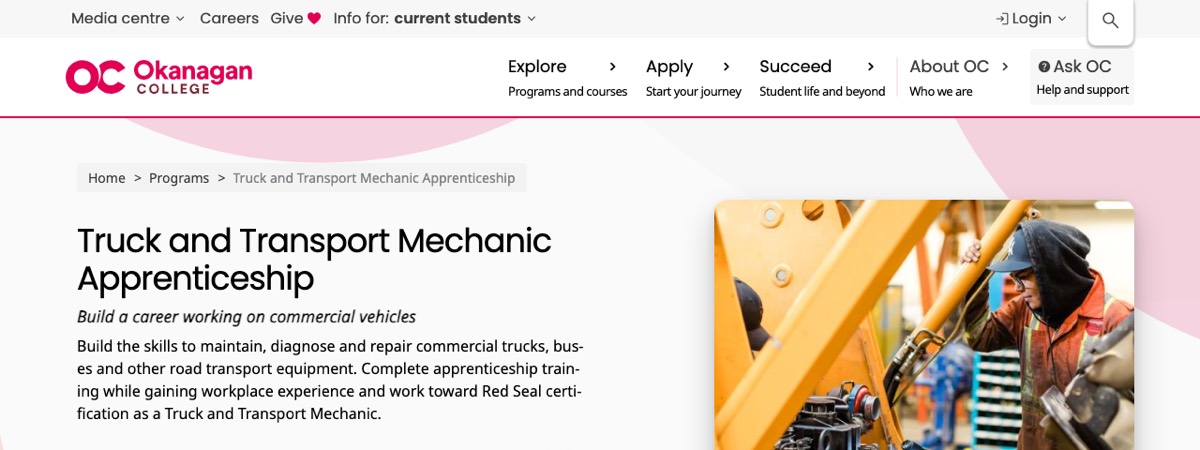
See Program DetailsTruck and Transport Mechanic Apprenticeship
Truck and Transport Mechanic Apprenticeship at Okanagan College is an in-person BC program, 5 weeks per level, at an estimated $815 per level for domestic students, and is Red Seal eligible.
| Provider | Okanagan College |
|---|---|
| Length | 5 weeks per level |
| Cost (CAD) | $815 estimated cost per level (domestic) |
| Credential | Apprenticeship (Red Seal eligible) |
| Format | In-Person, BC |
Fiona's take: This is the mechanic's route rather than the driver's, and I raise it with clients who like trucks but not trucking schedules. It is an apprenticeship, not a Class 1 licence.
Skip it if: Skip it if you want to drive rather than wrench.
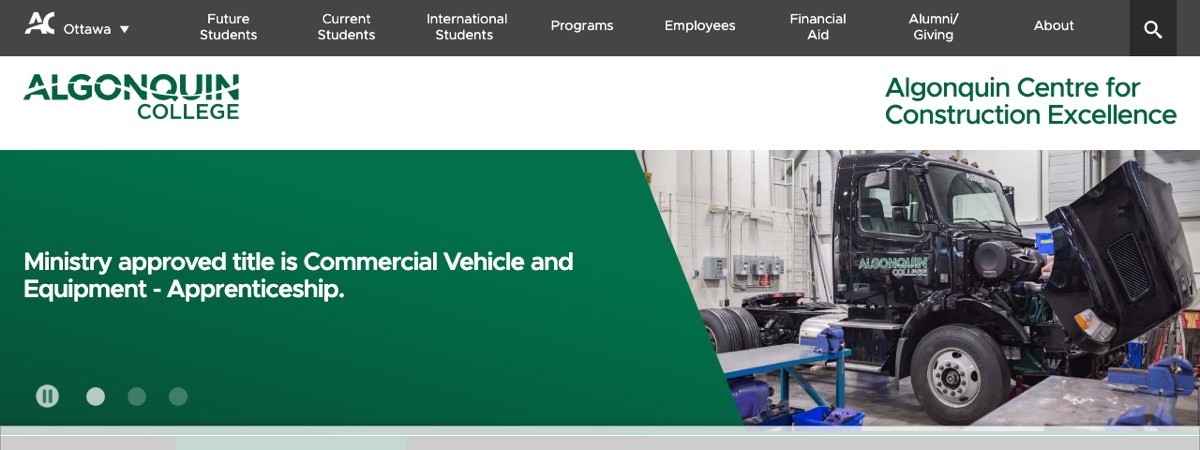
See Program DetailsCommercial Vehicle and Equipment (Core for 425A, 421A, 282E, 310T)
Commercial Vehicle and Equipment (Core for 425A, 421A, 282E, 310T) at Algonquin College is an 8-week in-person, non-credential apprenticeship program in Ontario.
| Provider | Algonquin College |
|---|---|
| Length | 8 Weeks |
| Credential | Non-Credential Program (Apprenticeship) |
| Format | In-Person, ON |
Fiona's take: This is technician training for commercial vehicles, useful if you want the shop side of the industry. It is not a truck driving class and confers no licence.
Skip it if: Skip it if your goal is a Class A licence rather than an apprenticeship pathway.
See Program DetailsTruck and Coach Technician
Truck and Coach Technician at Mohawk College is an in-person Ontario apprenticeship with 720 in-school hours plus 6,000 on-the-job hours.
| Provider | Mohawk College |
|---|---|
| Length | 720 hours in-school (plus 6,000 on-the-job) |
| Credential | Apprenticeship |
| Format | In-Person, ON |
Fiona's take: This is a long-haul commitment in the mechanic direction, a genuine apprenticeship rather than a quick credential. It suits people who want a Red Seal-adjacent trade, not a driving job.
Skip it if: Skip it if you want to be behind the wheel within two months.
See Program DetailsHow Much Do Truck Driving Classes Cost In Canada?
The headline number for Alberta is $10,000-$12,000 for the full Class 1 Learning Pathway through a licensed school, and that range is what students enrolling on or after April 1, 2026 pay.
| Item | Cost (CAD) |
|---|---|
| Medical and vision exam | 50-150 |
| Entry Program (40 hours) | 250-700 (range) or $700 at Portage College |
| Core Learning Program (67 hours) | 8,300-9,500 (range) or $9,500 at Portage College |
| Class 1 knowledge test | 17 |
| Class 1 road test permit | 217 |
| Competence Building (optional but recommended) | 1,000-1,800, or $1,800 at Portage College |
| Full Alberta Class 1 Learning Pathway at a licensed school | 10,000-12,000 |
Ontario MELT pricing is not listed, so ask providers for current tuition and compare at least two providers. Confederation College runs its AZ MELT program over roughly 9 weeks and does not list tuition.
The tests themselves are the smallest line item at $234 combined in Alberta. The tuition is the real cost, which is why funding, which I cover below, matters so much here.
How Much Does A Truck Driver Earn In Canada?
Job Bank lists the median hourly wage for NOC 73300 Transport truck drivers at $26.42 nationally, with a low of $19.45 and a high of $37.00, using a 2023-2024 reference period revised on November 19, 2025.
| Region | Median Hourly Wage (CAD) |
|---|---|
| Canada | 26.42 |
| Alberta | 30.00 |
| British Columbia | 30.77 |
| Saskatchewan | 27.00 |
| Ontario | 26.00 |
| Quebec | 25.20 |
| Manitoba | 24.00 |
British Columbia and Alberta pay the highest provincial medians in the pack at $30.77 and $30.00, which helps justify Alberta's higher tuition if you plan to work there. Job Bank's outlook shows a moderate risk of shortage nationally from 2024-2033, rated good in Newfoundland and Labrador, PEI, Nova Scotia, New Brunswick and Saskatchewan, and moderate in Ontario, Alberta and British Columbia.
A moderate shortage outlook is a reasonable sign for new entrants, though wages vary by region and by the type of freight you haul.
Is Truck Driving Training Worth It In 2026?
The arithmetic is straightforward: 6-8 weeks and $10,000-$12,000 in Alberta buys a credential with a national median of $26.42 per hour and province-level medians up to $30.77. Those figures let you estimate your own payback period, and the Job Bank outlook shows a moderate national shortage risk through 2033.
The catch is the upfront money. Ontario's MELT is at least 103.5 hours, Alberta's pathway is $10,000-$12,000 for post-April 2026 students, and five provinces (Alberta, Ontario, British Columbia, Saskatchewan and Manitoba) require mandatory training for new drivers; Alberta has experience-based alternatives for some drivers. Better Jobs Ontario has offered up to $28,000 for eligible applicants, but that funding stream has been paused since October 9, 2026, per industry reports, so confirm its status with an official Ontario source, while Alberta's Employment Pathway Grant reimburses eligible employers up to $10,000.
My verdict: worth it for a disciplined career changer who confirms the fit first. Read the Coursera logistics guides and the free Udemy Introduction to Trucking video before you pay tuition, so any change of heart happens before the money leaves your account.
Can You Get Funding For Truck Driving Classes?
Alberta's Industry Advancement Grant and Employment Pathway Grant currently support the Class 1 Learning Pathway. Better Jobs Ontario has offered up to $28,000 for eligible applicants, but that funding stream has been paused since October 9, 2026, per industry reports, so confirm current status with an official Ontario source before counting on it.
- Alberta Industry Advancement Grant / Employment Pathway Grant. Alberta is investing $54.1 million over three years in the Class 1 Learning Pathway grant program. The Employment Pathway Grant reimburses eligible employers for up to $10,000, so ask prospective Alberta employers whether they sponsor new hires through it.
- Better Jobs Ontario (Second Career). Better Jobs Ontario (Second Career) has offered eligible applicants up to $28,000 in funding for tuition, living expenses, books, supplies and transportation for truck and heavy equipment training. The stream affecting transportation students has been paused since October 9, 2026, per industry reports, so verify its status with an official Ontario source before you budget around it.
Truck Driving Classes Questions Canadians Ask
How Much Does Class 1 Training Cost In Alberta?
Class 1 training in Alberta costs between $10,000 and $12,000 for the full Learning Pathway at a licensed school, for students enrolling on or after April 1, 2026. That covers the Entry Program, Core Learning and Competence Building stages. The knowledge test adds $17 and the road test permit $217.
Is Mandatory Training Required For A Class 1 Or Class A Truck Licence?
Mandatory training is required in five provinces: Alberta (Class 1 Learning Pathway since April 1, 2025), Ontario (MELT of at least 103.5 hours for Class A), plus British Columbia, Saskatchewan and Manitoba. Alberta's pathway covers 108 hours of Entry and Core Learning for a restricted licence and 125+ hours for the unrestricted one.
How Long Does Class 1 Training Take In Alberta?
Class 1 training in Alberta takes 6-8 weeks: 108 hours of Entry and Core Learning earn a licence with a provincial restriction, and Competence Building of 10-18 hours brings the total to 125+ hours for the unrestricted licence, per the Alberta curriculum framework. New drivers should budget the full 6-8 weeks, while experienced drivers may test sooner.
Do I Need A Medical Exam For A Class 1 Licence?
A medical exam is required in Alberta and Ontario: a valid medical report and vision test must be done before training or testing. In Alberta the medical costs $50-150. Book it early, since neither province lets you begin training or book tests without it.
What Is The Median Wage For Truck Drivers In Canada?
The median wage for truck drivers in Canada is $26.42 per hour for NOC 73300 Transport truck drivers, from Job Bank data with a 2023-2024 reference period revised on November 19, 2025. The national range runs from $19.45 at the low end to $37.00 at the high end, with British Columbia's median at $30.77.
Can I Get A Class 1 Licence Without Full Training If I Have Experience?
Experienced drivers can get a Class 1 licence without full training in Alberta if they have 24 or more months of qualifying experience. Drivers with 12-24 months may qualify for testing or an equivalency program. Ontario and other provinces have their own rules, so check with the regulator.
Is There Government Funding For Truck Driver Training?
Government funding for truck driver training exists in Alberta; the Industry Advancement Grant and Employment Pathway Grant support the Class 1 Learning Pathway, with the Employment Pathway Grant reimbursing eligible employers up to $10,000. Better Jobs Ontario has offered up to $28,000 for tuition, books, supplies and transportation, but that stream has been paused since October 9, 2026, so confirm its status with an official Ontario source.
What NOC Code Is Used For Transport Truck Drivers?
The NOC code for transport truck drivers is 73300, and Job Bank publishes wage and outlook data under that code. Checking NOC 73300 shows the national median of $26.42 per hour, provincial medians such as $30.77 in British Columbia, and the outlook through 2033.
What's The Bottom Line On Truck Driving Classes In Canada?
- The Alberta Class 1 Learning Pathway is one of the faster documented routes: 6-8 weeks, 108 hours of Entry and Core Learning for a restricted licence and 125+ hours total for the unrestricted one, $10,000-$12,000 at a licensed school for students enrolling on or after April 1, 2026.
- Ontario requires MELT, at least 103.5 hours, before any Class A road test, under the Ministry of Transportation Ontario; British Columbia, Saskatchewan and Manitoba also require mandatory entry-level training.
- Test the field first: start with AI in Logistics: Transforming Transportation, Warehousing, and Freight Operations to see whether freight work suits you before paying tuition; no Coursera or Udemy item qualifies you for a licence.
- NOC 73300 Transport truck drivers earn a median of $26.42 per hour nationally, up to $30.77 in British Columbia, with a moderate shortage risk through 2033.
- Funding is firmest in Alberta, where the Employment Pathway Grant reimburses eligible employers up to $10,000; Better Jobs Ontario has offered up to $28,000, but that stream has been paused since October 9, 2026, so confirm with an official Ontario source.






