Key Takeaways
- The fastest realistic route is 2 years of university prerequisites plus the University of Toronto's accelerated 2-year BScN, then the NCLEX-RN; verified tuition amounts are not provided here, so confirm current tuition and registration fees directly with each school or regulator.
- Registration is mandatory: RNs register with the College of Nurses of Ontario, the British Columbia College of Nurses and Midwives (BCCNM), CRNA in Alberta, OIIQ in Quebec or the Nova Scotia College of Nursing, after passing the NCLEX-RN.
- The try-first option is Nursing Assistant Fundamentals, an online Coursera Specialization from MedCerts with length not listed; it does not qualify you for RN registration or any provincial licence.
- Registered nurses (NOC 31301) earn a national median of $43.27 an hour, Job Bank reports, ranging from $40.00 in Quebec to $47.58 in British Columbia.
- Fiona's verdict: the BScN suits anyone who wants RN scope and pay; a practical nursing diploma such as Vancouver Community College's 16-month, $17,434 program suits people who want bedside work sooner.
A Bachelor of Science in Nursing (BScN or BSN) is a university degree that prepares graduates for registered nurse (RN) practice and provincial registration eligibility. If your search ends at "nursing degree masters", start here: entry-to-practice for RNs requires a baccalaureate degree in nursing.
The standard route is a four-year BScN straight from high school, as at Memorial University. Applicants holding at least 2 years of university can compress the degree into 2 years through the University of Toronto's accelerated BScN, then pass the NCLEX-RN to register.
What Are The Ways To Become A Registered Nurse In Canada?
The ways to a nursing degree in Canada split by what you already hold: a high-school diploma, 2 years of university, or a practical nursing credential, plus an online taster to test the water first.
| Route | Time | Cost (CAD) | What You Get | Recognised By | Best For |
|---|---|---|---|---|---|
| Nursing Assistant Fundamentals | Not listed | Not listed | A Coursera Specialization in nursing assistant fundamentals | No provincial nursing regulator | Testing the field before committing to a degree |
| Standard four-year BScN from high school | 4 years | Not listed | Bachelor of Science in Nursing (BScN) | Provincial nursing regulator | High-school graduates |
| Accelerated, second-entry BScN (University of Toronto) | 2 years | Not listed | Bachelor of Science in Nursing (BScN) | Provincial nursing regulator | Career changers with 2 years or more of university |
| Compressed Time Frame BScN (Western University) | 19 to 22 months | Not listed | Bachelor of Science in Nursing (BScN) | College of Nurses of Ontario | RPNs and applicants with prior post-secondary education |
I recommend the standard four-year BScN for high-school graduates, U of T's accelerated BScN for career changers with two years of university behind them, and Western's CTF BScN for practising RPNs.
What Is The Fastest Way To Get A Nursing Degree In Canada?
The fastest way is the University of Toronto's accelerated BScN: 2 years in the program itself, reached after at least 2 years and 10.0 credits of university prerequisites, so about 4 years total if you are starting from zero.
- Complete at least 2 years (10.0 credits) of university prerequisites, including physiology, microbiology and statistics (2 years; confirm tuition directly with the university).
- Check your course record against U of T Bloomberg Nursing's BScN admissions checklist before you apply.
- Apply to and complete U of T's full-time accelerated 2-year BScN (2 years; confirm tuition directly with the university).
- Pass the NCLEX-RN exam after graduation (timing varies, weeks to months; registration and exam fees may apply, so confirm current amounts with the relevant provincial college).
- Register with your provincial college, such as the College of Nurses of Ontario, to practise as an RN.
Do You Need A Licence To Practise As A Registered Nurse In Canada?
A licence is mandatory in each province listed: the BScN makes you eligible, but you register with a provincial college before you may practise as an RN.
| Province | Required? | Regulator | Who Registers There |
|---|---|---|---|
| Ontario | Yes | College of Nurses of Ontario | RNs, nurse practitioners and registered practical nurses |
| British Columbia | Yes | British Columbia College of Nurses and Midwives (BCCNM) | RNs, nurse practitioners, licensed practical nurses and registered psychiatric nurses |
| Alberta | Yes | College of Registered Nurses of Alberta | RNs and nurse practitioners |
| Quebec | Yes | Ordre des infirmières et infirmiers du Québec | RNs and nurse practitioners |
| Nova Scotia | Yes | Nova Scotia College of Nursing | RNs, nurse practitioners and licensed practical nurses |
Passing the NCLEX-RN sits between your degree and your licence. Graduates must pass the NCLEX-RN for registration eligibility, and Job Bank records that graduates must pass the NCLEX and pay the required fees to be eligible for licensure with the College of Registered Nurses of Saskatchewan. Verified fee amounts are not provided here; confirm current registration fees directly with the regulator.
One more distinction I give clients early: the degree comes from a university such as Memorial or U of T, but the right to practise comes only from the college. A BScN without registration is a transcript, not a licence.
Which Nursing Courses Are Worth Taking In Canada?
Nursing courses worth taking split into three jobs: sampling the field online, prepping a competitive application, and earning a college credential for practical nurse practice. None of the online options grants a licence or a degree.
Nursing Assistant Fundamentals
Nursing Assistant Fundamentals is an online Specialization from MedCerts, delivered on Coursera, that covers the basics of nursing assistant practice.
| Provider | MedCerts |
|---|---|
| Credential | Specialization |
| Format | online |
Fiona's take: This is my try-first pick for anyone unsure about nursing. It does not qualify you for RN registration, any provincial licence, or BScN credit. What it does is show you what daily patient care involves before you spend four years on a degree. I tell hesitant clients to finish something like this before writing a single application.
Skip it if: Skip it if you already work in health care or have already decided on a BScN.
Start On CourseraCertified Nursing Assistant (CNA) Training Diploma
Certified Nursing Assistant (CNA) Training Diploma is a 4-hour-and-45-minute online course from Fadwa Baria on Udemy that trains nursing assistant fundamentals.
| Provider | Fadwa Baria |
|---|---|
| Length | 4h 45m total length |
| Credential | Certificate of completion |
| Format | online |
Fiona's take: The orientation content is useful, but this certificate of completion grants no Canadian credential. Treat it as background learning only; it is not a Canadian nursing qualification or a route to registration.
Skip it if: Skip it if you need a credential employers and colleges recognise, and go to a practical nursing diploma instead.
View On UdemyComplete Guide to Nursing School for Pre-Nursing Students
Complete Guide to Nursing School for Pre-Nursing Students is an online Udemy course that walks pre-nursing applicants through what nursing school demands.
| Provider | Udemy |
|---|---|
| Format | online |
Fiona's take: I like this one for the application stage rather than the practice stage: it addresses study habits and program structure, not clinical skills. It suits someone who wants an overview of nursing school lectures, labs, simulations and exams.
Skip it if: Skip it once you are admitted, because it has nothing further to teach you about practice itself.
View On UdemyPractical Nurse Diploma
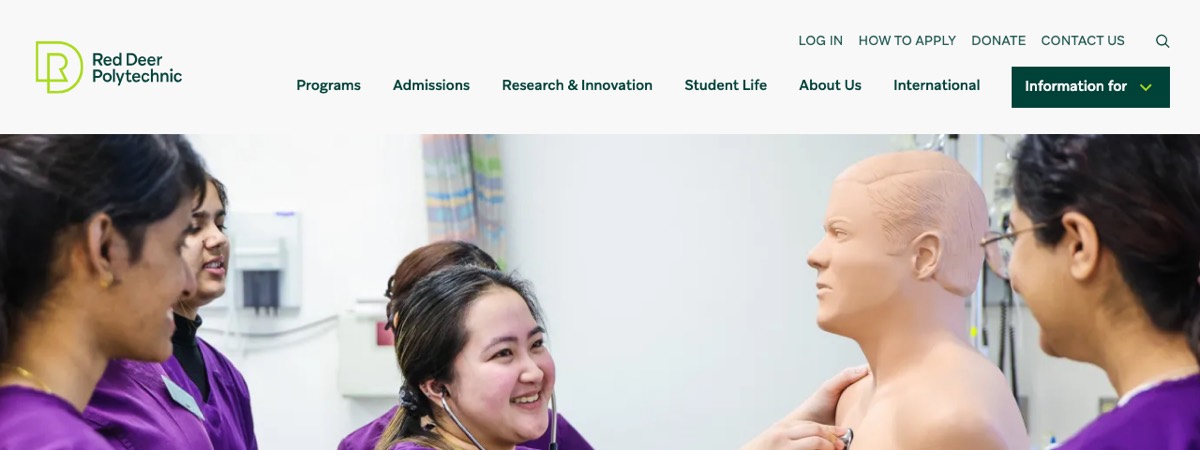
Practical Nurse Diploma is a 2-year or 3-year in-person or hybrid diploma from Red Deer Polytechnic in Alberta.
| Provider | Red Deer Polytechnic |
|---|---|
| Length | 2 Years OR 3 Years |
| Credential | Diploma |
| Format | in person/hybrid, AB |
Fiona's take: This is the diploma side of Canadian nursing: practical nurse practice, not RN registration, which requires the BScN. For Albertans who want paid bedside work sooner than a degree allows, it is a credible option with a flexible 2-year or 3-year pace.
Skip it if: Skip it if RN is your end goal and you already qualify for a BScN, because you would end up studying again later.
See Program DetailsBachelor of Science in Nursing (Honours) Pathway for Practical Nursing - Pembroke Campus
Bachelor of Science in Nursing (Honours) Pathway for Practical Nursing is a 2-year-and-4-month in-person degree at Algonquin College's Pembroke campus in Ontario.

| Provider | Algonquin College |
|---|---|
| Length | 2 years and 4 months |
| Credential | Bachelor of Science in Nursing (Honours) |
| Format | in person, ON |
Fiona's take: This is a degree bridge aimed at people who already hold practical nursing credentials. It delivers the BScN in 2 years and 4 months, which compares with Western's 19-to-22-month CTF format, and it is an in-person Pembroke Campus option for practical nurses seeking a BScN pathway.
Skip it if: Skip it if you have no practical nursing background, because the standard and accelerated BScNs are your routes.
See Program DetailsPractical Nursing Diploma
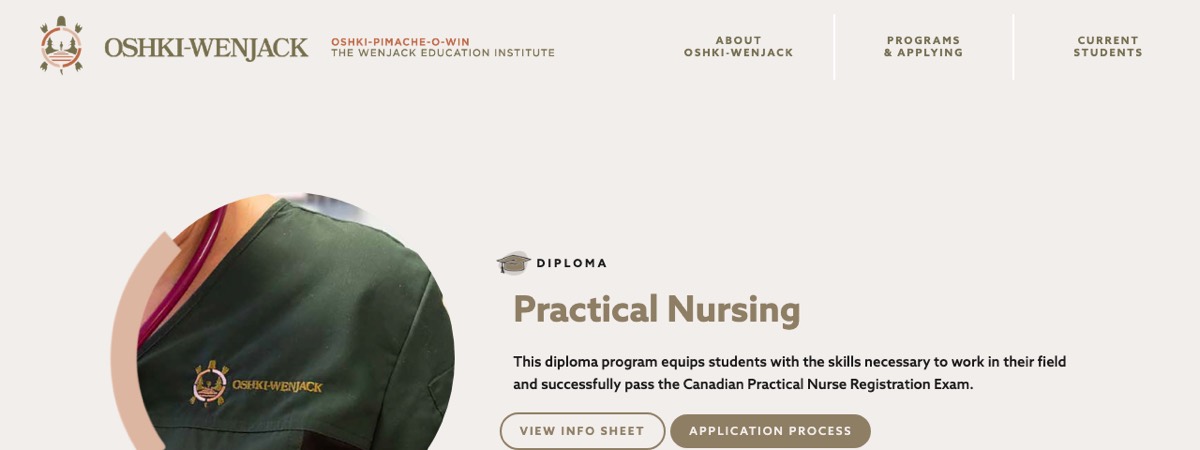
Practical Nursing is a 5-semester blended diploma from Oshki-Pimache-O-Win: The Wenjack Education Institute in Ontario.
| Provider | Oshki-Pimache-O-Win: The Wenjack Education Institute |
|---|---|
| Length | 5 Semesters |
| Credential | Diploma |
| Format | blended, ON |
Fiona's take: This is a five-semester blended program for students who need flexibility in how they study. The diploma is positioned for practical nursing rather than RN registration, which still requires a baccalaureate.
Skip it if: Skip it if your goal is RN scope and NOC 31301 pay, because the BScN remains the only door there.
See Program DetailsPractical Nursing Program (PN) S121
Practical Nursing Program (PN) S121 is a 2-year, 4-semester full-time Ontario College Diploma from George Brown College.
| Provider | George Brown College |
|---|---|
| Length | 2 years (4 semesters) |
| Credential | Ontario College Diploma |
| Format | full-time, ON |
Fiona's take: The S121 program is a conventional college route into practical nursing in Ontario; after successful completion, George Brown says students are eligible to write the RPN registration examinations required by the College of Nurses of Ontario. It suits students who want a structured, full-time, four-semester path without the length of a degree.
Skip it if: Skip it if you specifically want registered nurse practice, because a diploma alone will not get you there.
See Program DetailsPractical Nursing
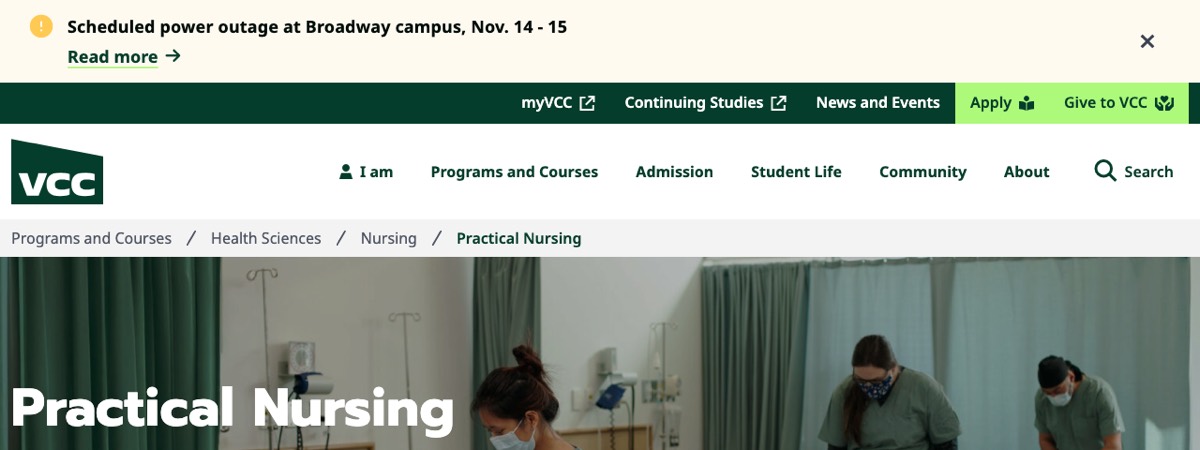
Practical Nursing is a 16-month, class-based diploma from Vancouver Community College in British Columbia costing $17,434.
| Provider | Vancouver Community College |
|---|---|
| Length | 16 months |
| Cost (CAD) | $17434 |
| Credential | Diploma |
| Format | class-based, BC |
Fiona's take: This is the only program on this page with a published price, $17,434, and at 16 months it is the fastest college credential on this list. It is a practical nursing diploma, and RN registration requires the bachelor's degree, the BScN. For BC students weighing cost against time, it is the clearest comparison point on this list.
Skip it if: Skip it if you are set on the RN path, because the BScN is the only route to that registration.
See Program DetailsHow Much Does A Nursing Degree Cost In Canada?
BScN tuition has no verified amounts here; confirm current tuition and registration fees directly with each school or regulator. One college program does publish a number, and it is a diploma rather than the degree.
| Item | Cost (CAD) | Notes |
|---|---|---|
| Standard four-year BScN (Memorial University option) | Not listed | Confirm tuition with the university |
| Accelerated 2-year BScN (University of Toronto) | Not listed | Prerequisites add 2 years of prior study |
| Compressed Time Frame BScN (Western University) | Not listed | 19 to 22 months; for RPNs or applicants with prior post-secondary |
| Practical Nursing diploma (Vancouver Community College) | $17,434 | 16-month BC diploma, a different credential from the BScN |
| NCLEX-RN exam and initial registration | Not listed | Fees may apply; confirm current amounts with the relevant provincial college |
Do not budget from this page alone. Verified tuition amounts are not provided here for Memorial, U of T or Western, so confirm current tuition and registration fees directly with each school or regulator. The one hard number, Vancouver Community College's $17,434, buys a practical nursing diploma, not the degree, so resist comparing it directly against a four-year BScN.
Add the exam layer on top. Job Bank notes that graduates must pass the NCLEX and pay the required fees to be eligible for licensure with the College of Registered Nurses of Saskatchewan. Registration and exam fees may apply; confirm current amounts with the relevant provincial college.
How Much Does A Registered Nurse Earn In Canada?
Registered nurses earn a national median of $43.27 per hour, Job Bank's NOC 31301 figures show, with provincial medians running from $40.00 in Quebec to $47.58 in British Columbia.
| Province | Median Hourly Wage (NOC 31301) |
|---|---|
| Canada | $43.27 |
| Newfoundland and Labrador | $44.00 |
| Prince Edward Island | $42.00 |
| Nova Scotia | $41.50 |
| New Brunswick | $44.77 |
| Quebec | $40.00 |
| Ontario | $42.00 |
| Manitoba | $45.00 |
| Saskatchewan | $47.13 |
| Alberta | $47.50 |
| British Columbia | $47.58 |
The spread matters as much as the median. British Columbia ($47.58), Alberta ($47.50) and Saskatchewan ($47.13) post the highest provincial medians, while Quebec sits at $40.00 and Nova Scotia at $41.50. A new RN weighing offers should hold these figures against living costs in each market rather than chasing the top line alone.
The outlook is the stronger story. Job Bank projects a strong risk of a national labour shortage for RNs from 2024 to 2033 and rates prospects very good or good in most provinces. That is the demand backdrop that makes the four-year investment defensible.
Is A Nursing Degree Worth It In 2026?
A nursing degree is worth it in 2026 on the numbers alone. NOC 31301 medians sit at or above $40.00 an hour in every province Job Bank lists, the national median is $43.27, and a projected shortage through 2033 supports steady hiring demand for graduates who register.
The trade is time and cost. Four years standard from high school, or U of T's 2-year accelerated format on top of prerequisite study, with verified tuition amounts not provided here and registration and exam fees that may apply on top. Anyone choosing this path should confirm current tuition and fees directly with each school or regulator, then weigh it against the faster practical nursing diplomas described above.
If RN scope is the goal, the degree is not optional, it is the entry credential, full stop. If you want bedside work sooner, a diploma such as Oshki's 5-semester program or Vancouver Community College's 16-month program is a legitimate destination, and Algonquin's Pembroke pathway exists to bridge practical nurses toward the BScN later.
Can You Get Funding For A Nursing Degree In Canada?
The one named funding item here is Ontario's Learn & Stay Grant for Western's CTF BScN, pending renewal.
- Ontario Learn & Stay Grant. Western University lists its Compressed Time Frame BScN as eligible for the Ontario government's Learn & Stay Grant, pending renewal of the grant program. Verify the grant's status in the year you apply before counting it in your budget, and check whether other BScN programs you are considering carry the same eligibility.
Nursing Degree Questions Canadians Ask
Is A Bachelor's Degree Required To Become An RN In Canada?
A bachelor's degree is required for RN practice: entry-to-practice for registered nurses means a baccalaureate in nursing such as the BScN. Practical nurse and licensed practical nurse roles sit on the diploma side. So the RN decision is really a degree decision, and the routes above are the ways to get there.
What Is The Fastest Way To Get A Nursing Degree In Canada?
The fastest way is an accelerated BScN for applicants with at least 2 years of prior university education, such as the 2-year program at the University of Toronto. Count the prerequisite years and the realistic total is about 4 years. From high school, the standard BScN also takes 4 years, so prior study is what buys the shorter program.
Are There Fully Online Nursing Degree Programs In Canada?
Fully online BSN programs are not available in Canada, because the required clinical placements and labs must be done in person. Online study can still serve you for prerequisites or for testing interest, like the Coursera Nursing Assistant Fundamentals Specialization, but the degree itself demands campus and placement time in every case.
Diploma Or Degree For Nursing In Canada?
A diploma prepares you for licensed practical nurse and practical nurse roles; registered nurse registration requires the bachelor's degree, the BScN or BSN. Vancouver Community College's 16-month diploma and George Brown's 2-year S121 program are diploma examples. Choose the diploma for faster entry, the degree for RN scope and NOC 31301 pay.
How Long Is A Typical Nursing Degree Program?
A typical nursing degree runs 4 years in the standard BScN format, such as Memorial University's four-year option. Accelerated options compress the degree to 19 to 22 months for qualified applicants, like Western's CTF BScN, though entry requires prior post-secondary education or an RPN credential. Budget the NCLEX-RN and registration on top.
Do You Need A Masters Degree To Become A Nurse In Canada?
A masters degree is not the entry credential. Entry-to-practice for registered nurses is the baccalaureate: a BScN or BSN, followed by the NCLEX-RN and college registration. The decision in front of you now is which bachelor route, standard or accelerated, fits your starting point.
Do I Need To Pass An Exam After Graduating Nursing School?
An exam stands between graduation and practice: graduates must pass the NCLEX-RN for registration eligibility, then register with the provincial college. Timing varies from weeks to months after convocation. Registration and exam fees may apply; confirm current amounts with the relevant provincial college. Plan the gap so your job start date matches your registration date.
Can I Work As A Nurse In Canada With A Foreign Degree?
A foreign degree can get you there, but internationally educated nurses must have credentials assessed and meet provincial registration requirements, including exams. NNAS sets out the nursing role types. Your provincial college, such as the College of Nurses of Ontario or the British Columbia College of Nurses and Midwives (BCCNM), makes the final registration decision.
What's The Bottom Line On A Nursing Degree In Canada?
- Registered nurse practice in Canada requires a BScN plus registration with a provincial college such as the CNO, the British Columbia College of Nurses and Midwives (BCCNM) or CRNA, sealed by a pass on the NCLEX-RN.
- The fastest realistic path is 2 years of prerequisites plus U of T's 2-year accelerated BScN; from high school the standard route is 4 years at a school like Memorial.
- Job Bank's NOC 31301 median is $43.27 an hour, from $40.00 in Quebec to $47.58 in British Columbia, against a projected national shortage through 2033.
- No full BSN exists online in Canada; clinical placements keep the degree in person.
- Test the field first with Nursing Assistant Fundamentals: it grants no licence or registration, but it is an online way to sample nursing-assistant topics before committing to a BScN path.