Key Takeaways
- The fastest real credential is a CWB Welder Qualification: 1 to 4 weeks of preparation, then one day of testing per position at $175 to $300 per plate, renewed with a $175 check test every 2 years.
- Trade certification for welders is compulsory only in Alberta under Alberta Apprenticeship and Industry Training (Tradesecrets); Ontario (Skilled Trades Ontario) and British Columbia (SkilledTradesBC) keep it voluntary, but structural steel under the National Building Code of Canada must be welded by CWB Certified companies in every province.
- Welding Processes in Heavy Manufacturing & Quality Controls from L&T EduTech on Coursera takes about 8 hours and does not qualify you for any provincial certificate, CWB test or apprenticeship credit; it is the try-before-you-commit step.
- The median wage for welders (NOC 72106) is $30.00 per hour (Job Bank, November 19, 2025), ranging $22.00 to $47.00, with Alberta at $38.00 and Newfoundland and Labrador at $38.41.
- Fiona's verdict: test the field with the 8-hour Coursera course, buy a CWB test if structural work is the goal, and commit to the 3-year, 5400-to-6000-hour Red Seal apprenticeship only once you know the trade fits.
A welder permanently joins pieces of metal or manufactured parts using metal filler and heat or pressure, and builds and repairs structures to specification, in the words of Skilled Trades Ontario's trade profile. In Canada this trade has two very different doors.
The quick door is a CWB Welder Qualification, earned in days to weeks for $175 to $600 in test fees. The full door is a Red Seal apprenticeship of 3 years and 5400 to 6000 hours. This page maps both, province by province, starting with the shortest way to test your interest: an 8-hour Coursera course.
What Are The Ways To Become A Welder In Canada?
The ways to become a welder in Canada come down to two verified credential routes, the CWB Welder Qualification and the Red Seal Welder Apprenticeship; this page adds the courses and college programs worth knowing alongside them.
| Route | Time | Cost (CAD) | What You Get | Recognised By | Best For |
|---|---|---|---|---|---|
| Welding Processes in Heavy Manufacturing & Quality Controls (Coursera) | 8 hours | Not listed | Shareable certificate in welding processes and quality controls; no trade status | Not provincial trade certification, a CWB qualification or apprenticeship credit | Testing whether the trade fits before paying tuition anywhere |
| CWB Welder Qualification | Days to weeks | $175-600 per test set | CWB Welder Qualification Record, process and position specific, valid 2 years | CWB Group and employers hiring for structural work | Structural steel work under the National Building Code of Canada |
| Red Seal Welder Apprenticeship | 3 years / 5400-6000 hours | Not listed | Certificate of Apprenticeship plus Red Seal endorsement | Provincial apprenticeship authorities plus Red Seal | Full journeyperson status and work across provinces |
| Certificate in Welding Foundation (Kwantlen Polytechnic University) | 28 weeks | Not listed | Certificate | Certificate from Kwantlen Polytechnic University; provincial or apprenticeship recognition not verified in our research | BC beginners who want a foundation program before an apprenticeship |
Fiona recommends the Coursera course for anyone still deciding, the CWB qualification for people who already weld and need a ticket fast, and the Red Seal apprenticeship for those committing to the trade long term, especially in Alberta.
What Is The Fastest Way To Get Certified As A Welder In Canada?
The fastest way to get certified as a welder in Canada is the CWB Welder Qualification: 1 to 4 weeks of practice, then a single day of testing per position at $175 to $300, with no apprenticeship required.
- Register at an accredited CWB test centre, such as the one at Portage College, and prepare for the exact process and position you need; plan 1 to 4 weeks.
- Complete the practical bend tests, one day per test, at $175 to $300 per plate or position.
- Receive your CWB Welder Qualification Record immediately upon passing.
- Renew every 2 years with the $175 check test to keep the record current.
- If you later want full trade status, register with your provincial authority; the Red Seal route runs 3 years and 5400 to 6000 hours.
Do You Need Trade Certification To Weld In Canada?
Trade certification is compulsory only in Alberta; everywhere else the trade is voluntary, but structural steel under the National Building Code of Canada must be welded by CWB Certified companies.
| Province | Required? | Regulator Or Registry | What It Means |
|---|---|---|---|
| Alberta | Yes, compulsory | Alberta Apprenticeship and Industry Training (Tradesecrets) | Welder is listed among the compulsory certification trades. |
| Ontario | No, voluntary | Skilled Trades Ontario | You can work without the certificate, and because the trade is non-compulsory the certificate does not have to be renewed. |
| British Columbia | No, voluntary | SkilledTradesBC | Welders are considered apprentices until they complete Level B (Red Seal) certification. |
| All provinces, structural steel | Yes for structural work | CWB Group | Buildings and structures under the National Building Code of Canada must be welded by CWB Certified companies. |
Canada runs two parallel systems. Provincial trade certification through Skilled Trades Ontario, SkilledTradesBC and Alberta Apprenticeship and Industry Training governs your status as a tradesperson. CWB qualification through CWB Group is a process and position specific record, valid 2 years and renewed via the $175 check test, recognised by employers for structural work, so budget for that on a two-year cycle.
No online course grants trade certification or a CWB qualification. The Coursera and Udemy certificates below are completion records that no apprenticeship authority or CWB test centre treats as a qualification. A CWB ticket comes from practical testing, and the Red Seal endorsement comes through apprenticeship completion and the Red Seal exam.
Which Welding Courses Are Worth Taking In Canada?
The welding courses worth taking in Canada depend on where you sit in the decision: online theory first if you are still testing the idea, a CWB test centre if you need a ticket now, and a college apprenticeship stream if you are committed.
Welding Processes in Heavy Manufacturing & Quality Controls
Welding Processes in Heavy Manufacturing & Quality Controls is an 8-hour online course from L&T EduTech on Coursera that covers welding processes and the quality controls used around them in heavy manufacturing.
| Provider | L&T EduTech |
|---|---|
| Length | 8 hours to complete |
| Rating | 4.3 (31 reviews) |
| Credential | Shareable certificate |
| Format | online |
Fiona's take: This course does not qualify you for any provincial certificate, CWB test or apprenticeship credit, and I say that to every client before they enrol. What it does is put the fundamental principles behind producing high-quality welded components in front of you for one working day, at 4.3 from 31 reviews. If you are choosing between welding and another trade, spend these 8 hours first.
Skip it if: Skip it if you already weld commercially or hold a CWB qualification.
Not a provincial licence, registration or certificate.
Start On CourseraHeavy Manufacturing
Heavy Manufacturing is a 4-week online specialization from L&T EduTech on Coursera, at about 10 hours a week, that covers heavy manufacturing from processes to production systems and ends in a career certificate.
| Provider | L&T EduTech |
|---|---|
| Length | 4 weeks at 10 hours a week |
| Rating | from 58 reviews of courses in this program |
| Credential | Career certificate from L&T EduTech |
| Format | online |
Fiona's take: It is broader than welding, and that is the point: heavy plants hire people who understand the whole line, and the courses in this program carry 58 reviews between them. Pair it with the welding processes course when you want trade-specific depth.
Skip it if: Skip it if your goal is a CWB ticket this month; nothing here touches a test bench.
Not a provincial licence, registration or certificate.
Start On CourseraFoundations in Heavy Industry Production
Foundations in Heavy Industry Production is a 7-hour online course from L&T EduTech on Coursera that introduces how production in heavy industry is organised.
| Provider | L&T EduTech |
|---|---|
| Length | 7 hours |
| Credential | Shareable certificate |
| Format | online |
Fiona's take: Seven hours is a fair screening dose of the sector before any money or time moves. It suits people weighing welding against neighbouring roles such as fabrication and machine operation. It leads to no trade credential of any kind.
Skip it if: Skip it if you have already settled on welding and want process-level detail.
Not a provincial licence, registration or certificate.
Start On CourseraHeavy Manufacturing Process and System
Heavy Manufacturing Process and System is an 8-hour online course from L&T EduTech on Coursera that examines manufacturing processes and the systems that control them.
| Provider | L&T EduTech |
|---|---|
| Length | 8 hours |
| Credential | Shareable certificate |
| Format | online |
Fiona's take: This one sits closest to the codes-and-quality side of the trade, though it grants no qualification. I suggest it for first-level apprentices who want the theory to stick between class blocks.
Skip it if: Skip it if what you need is hands-on practice time.
Not a provincial licence, registration or certificate.
Start On CourseraIntroduction to Welding Technologies and Processes
Introduction to Welding Technologies and Processes is a 2.5-hour online course on Udemy from Ray Harkins and Garry Pace of The Manufacturing Academy that surveys the main welding technologies and processes.
| Provider | Ray Harkins, The Manufacturing Academy, Garry Pace |
|---|---|
| Length | 2.5 hours |
| Cost (CAD) | not shown (often ~$14.99-$69.99 USD) |
| Rating | 4.7 (651 ratings) |
| Credential | Certificate of completion |
| Format | online |
Fiona's take: At 4.7 from 651 ratings it is the most-reviewed course on this page, and the listing does not show the price. It works as a clean primer on process families before you pick a college stream. It qualifies you for nothing in Canada.
Skip it if: Skip it if you already know MIG from TIG and want bench hours instead.
Not a provincial licence, registration or certificate.
View On UdemyUnderstanding Welding Codes and Procedures
Understanding Welding Codes and Procedures is a 4.5-hour online course on Udemy from Ray Harkins and Garry Pace of The Manufacturing Academy that explains welding codes and procedure documents.
| Provider | Ray Harkins, The Manufacturing Academy, Garry Pace |
|---|---|
| Length | 4.5 hours |
| Cost (CAD) | not shown (often ~$14.99-$69.99 USD) |
| Rating | 4.6 (483 ratings) |
| Credential | Certificate of completion |
| Format | online |
Fiona's take: Codes are where new welders stumble, and this course, at 4.6 from 483 ratings, walks through the paperwork that governs real work. It sits well beside CWB preparation, but it is not CWB preparation: the qualification still comes from a bend test at a certified centre.
Skip it if: Skip it if you only weld as a hobby with no code work in view.
Not a provincial licence, registration or certificate.
View On UdemyBeginner MIG Welding
Beginner MIG Welding is a 1-hour online course on Udemy from Josh Maynard that covers MIG welding basics.
| Provider | Josh Maynard |
|---|---|
| Length | 1 hour |
| Cost (CAD) | not shown (~$19.99 USD) |
| Rating | 4.2 (201 ratings) |
| Credential | Certificate of completion |
| Format | online |
Fiona's take: One hour, rated 4.2 from 201 ratings: it introduces MIG welding and how to weld each joint type, and it will not teach your hands. Use it the week before your first in-person class so the vocabulary is not new.
Skip it if: Skip it if you have already run a bead.
Not a provincial licence, registration or certificate.
View On UdemyMetal/Welding Trades Apprenticeships
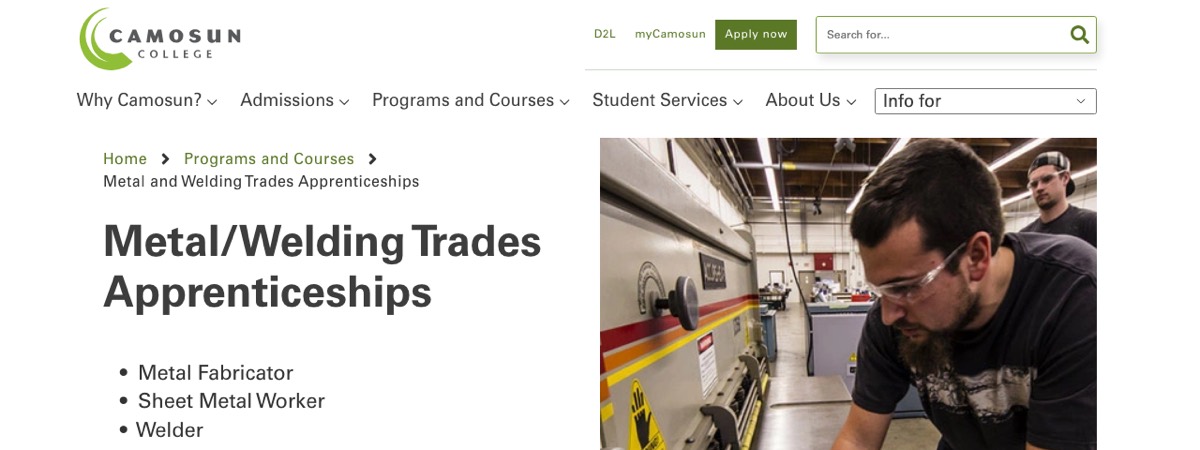
Metal/Welding Trades Apprenticeships at Camosun College is an in-person apprenticeship technical training program in British Columbia running 6 to 10 weeks, with tuition of $926.00 for Level 1, $926.00 for Level 2 and $1,273.25 for Level 3, effective September 2026 to August 2027.
| Provider | Camosun College |
|---|---|
| Length | 6 - 10 weeks |
| Cost (CAD) | Welder Apprenticeship: $926.00 Level 1, $926.00 Level 2, $1,273.25 Level 3 (tuition, effective Sept 2026-Aug 2027) |
| Credential | Technical Training Certification |
| Format | in person, BC |
Fiona's take: This is the in-class portion of a BC welding apprenticeship, priced level by level. British Columbia counts welders as apprentices until they complete Level B (Red Seal) certification, which is the context for these three levels of technical training. The published tuition makes the three levels predictable in a way most trades listings are not.
Skip it if: Skip it if you are outside British Columbia; your own province's apprenticeship authority sets its technical training.
See Program DetailsCertificate in Welding Foundation
The Certificate in Welding Foundation at Kwantlen Polytechnic University is a 28-week in-person program in British Columbia that ends in a certificate.

| Provider | Kwantlen Polytechnic University |
|---|---|
| Length | 28 weeks |
| Credential | Certificate |
| Format | in person, BC |
Fiona's take: The 28-week in-person foundation program is intended to help you develop the skills employers are looking for. Tuition is not provided in our research, so request a fee sheet from the program office before you apply.
Skip it if: Skip it if you already have welding experience and want to move straight into apprenticeship levels.
See Program DetailsWelder Apprenticeship
The Welder Apprenticeship at Red Deer Polytechnic is a 3-year in-person program in Alberta that ends in a Journeyperson Certificate with a Red Seal endorsement option.
| Provider | Red Deer Polytechnic |
|---|---|
| Length | 3 Years |
| Credential | Journeyperson Certificate with Red Seal Endorsement option |
| Format | in person, AB |
Fiona's take: In the one province where certification is compulsory, this is one Alberta apprenticeship option for the compulsory welder trade. Its 3-year length matches the 5400 to 6000 hours the Red Seal program describes for the trade.
Skip it if: Skip it if you only need structural tickets; a CWB test is faster.
See Program DetailsWelding Apprenticeship Program
The Welding Apprenticeship Program at Confederation College is an in-person Ontario program lasting 2 to 5 years depending on the trade, leading to a Certificate of Qualification with a Red Seal endorsement.
| Provider | Confederation College |
|---|---|
| Length | 2–5 years (varies by trade) |
| Credential | Certificate of Qualification with a Red Seal endorsement |
| Format | in person, ON |
Fiona's take: Ontario keeps welding non-compulsory, so this program is about employability and mobility rather than permission to work. The Red Seal endorsement it targets is the national trade credential, recognised by provincial apprenticeship authorities.
Skip it if: Skip it if you need a qualification record sooner; the CWB route can produce a process and position specific record in weeks if you pass.
See Program DetailsWelder Apprenticeship
The Welder Apprenticeship at Olds College is an in-person Alberta program of eight weeks per year for three years, ending in a diploma and the Alberta Journeyperson Certificate, which is Red Seal eligible.
| Provider | Olds College |
|---|---|
| Length | Eight Weeks (per year for 3 years) |
| Credential | Diploma and Alberta Journeyperson Certificate (Red Seal eligible) |
| Format | in person, AB |
Fiona's take: The eight-weeks-per-year schedule spreads the training over three years, ending in a diploma and the Alberta Journeyperson Certificate, which is Red Seal eligible. In the province where welder certification is compulsory, the Alberta Journeyperson Certificate is the credential to hold.
Skip it if: Skip it if you are outside Alberta and your employer only asks for CWB tickets.
See Program DetailsWelding – Apprenticeship Level 1 - 3
Welding Apprenticeship Level 1 to 3 at Selkirk College is an in-person British Columbia program of 8 weeks for Level 1, 8 weeks for Level 2 and 10 weeks for Level 3, granting credit toward the Welder apprenticeship on the Red Seal path.
| Provider | Selkirk College |
|---|---|
| Length | Level 1 - 8 weeks, Level 2 - 8 weeks, Level 3 - 10 weeks |
| Credential | Credit for Welder Apprenticeship (Red Seal path) |
| Format | in person, BC |
Fiona's take: The level structure mirrors how BC treats the trade: you are considered an apprentice until you complete Level B (Red Seal) certification. The Level 3 block runs two weeks longer than the others, so plan the time away from work.
Skip it if: Skip it if you only need a CWB qualification record rather than the full apprenticeship path.
See Program DetailsHow Much Does Welding Certification Cost In Canada?
Welding certification costs in Canada start at $175, the price of a single CWB plate test at Portage College's test centre, and climb with apprenticeship tuition once you commit to the full trade.
| Item | Cost (CAD) | Notes |
|---|---|---|
| CWB 1 plate test | $175 | Portage College test centre price |
| CWB 2 plate test | $300 | Portage College test centre price |
| CWB check test (renewal) | $175 | Needed every 2 years to keep the qualification record current |
| Full CWB test set | $175-600 | Depending on how many processes and positions you test |
| Camosun College Level 1 tuition | $926.00 | Effective September 2026 to August 2027 |
| Camosun College Level 2 tuition | $926.00 | Effective September 2026 to August 2027 |
| Camosun College Level 3 tuition | $1,273.25 | Effective September 2026 to August 2027 |
| Coursera and Udemy course fees | Not listed | Check each listing; the fact sheets show no CAD price |
A CWB qualification costs $175 to $600 to earn ($175 to $300 per plate test) and $175 every two years to keep, which makes its long-run cost predictable in a way apprenticeship tuition often is not. Our research does not provide tuition for Kwantlen Polytechnic University, Red Deer Polytechnic, Olds College or Selkirk College, so request a fee sheet from each program office before you apply.
How Much Does A Welder Earn In Canada?
A welder in Canada earns a median of $30.00 per hour under NOC 72106 (Job Bank, November 19, 2025), with a low of $22.00 and a high of $47.00.
| Region | Median Hourly (CAD) |
|---|---|
| Canada | $30.00 |
| Alberta | $38.00 |
| British Columbia | $35.00 |
| Newfoundland and Labrador | $38.41 |
| Ontario | $28.00 |
| Quebec | $28.00 |
The provincial spread rewards mobility: Alberta's $38.00 median and Newfoundland and Labrador's $38.41 sit about ten dollars above the $28.00 medians in both Ontario and Quebec. A CWB report flags a moderate risk of labour shortage for welders from 2024 to 2033. My read for clients: earn the ticket, then follow the structural work.
Is Welding Worth It In 2026?
Welding is worth it in 2026 for people who want a trade with a short entry path and structural demand. The moderate risk of labour shortage from 2024 to 2033 in the CWB report and Job Bank's $30.00 median under NOC 72106 give the base case, and the CWB route can produce a process and position specific qualification record in weeks if you pass.
It is not worth it for certification collectors. A CWB ticket is process and position specific and must be renewed every 2 years via the $175 check test. The durable asset is the Red Seal route, 3 years and 5400 to 6000 hours, and in Alberta that route is not optional.
My honest advice: spend 8 hours on the Coursera welding processes course first. If the theory bores you, the shop will too, and you will have saved yourself an application cycle and a semester of tuition.
Can You Get Funding For Welding Training In Canada?
You can get funding for welding training in Canada through one federal program aimed squarely at apprentices: the Canada Apprentice Loan.
- Canada Apprentice Loan. A federal program offering interest-free loans of up to $4,000 per period of technical training. It is a loan, so it must be repaid. Eligible apprentices may be able to use it for those training periods; confirm eligibility before relying on it.
Welding Certification Questions Canadians Ask
What Does AWS Certification Mean In Canada?
AWS certification is a question this page cannot settle from its research. The verified routes here are Canadian: Red Seal, the national trade credential from a completed apprenticeship, and CWB qualification, a practical record tied to one process and position, valid 2 years, at $175 to $300 per plate. This page does not verify AWS recognition in Canada.
Is Welding Certification Mandatory In Canada?
Welding certification is mandatory in Canada only in Alberta, where Alberta Apprenticeship and Industry Training lists Welder among its compulsory certification trades. In Ontario and British Columbia the trade is voluntary. One rule applies everywhere: structural steel under the National Building Code of Canada must be welded by CWB Certified companies.
What Is The Difference Between Red Seal And CWB Certification?
The difference between Red Seal and CWB certification is scope. Red Seal is the national trade credential earned by finishing a provincial apprenticeship, typically 3 years and 5400 to 6000 hours, and passing the interprovincial exam. CWB is a practical qualification tied to one process and position, valid 2 years, recognised by CWB Group and employers for structural work.
How Long Does A Welding Apprenticeship Take In Canada?
A welding apprenticeship takes typically 3 years, or 5400 to 6000 hours, combining on-the-job time with technical training. College schedules reflect that length: Red Deer Polytechnic runs 3 years, and Olds College runs eight weeks of class per year for three years while you work the rest of the time.
What Is The Median Wage For Welders In Canada?
The median wage for welders in Canada is $30.00 per hour under NOC 72106 (Job Bank, November 19, 2025). The range runs $22.00 to $47.00, and province matters: Alberta reports $38.00 and Newfoundland and Labrador $38.41, against $28.00 in both Ontario and Quebec.
Do I Need CWB Certification To Weld In Canada?
You need CWB certification to weld in Canada mainly through your employer: for structural steel work under the National Building Code of Canada, buildings and structures must be welded by CWB Certified companies. Individual CWB welder qualifications are process and position specific and commonly required for that work. Outside Alberta's compulsory certification, and away from structural work, no CWB ticket is required.
How Much Does A CWB Welding Test Cost?
A CWB welding test costs $175 for a single plate test or check test at Portage College's test centre, $300 for a two-plate test, and up to $600 for a full test set depending on how many processes and positions you certify. Renewal is the $175 check test every 2 years.
Where Can I Find Welding Classes Near Me?
Welding classes near you depend on province. In British Columbia, Camosun College, Kwantlen Polytechnic University and Selkirk College run them; in Alberta, Red Deer Polytechnic and Olds College; in Ontario, Confederation College. For the practical qualification alone, CWB test centres such as the one at Portage College serve candidates directly.
What's The Bottom Line On Welding Certification In Canada?
- A CWB Welder Qualification is the fastest real credential in Canadian welding: 1 to 4 weeks of prep, one day of testing per position, $175 to $300 per plate.
- Only Alberta makes welder certification compulsory; structural steel under the National Building Code of Canada requires CWB Certified companies in every province.
- The Red Seal endorsement, earned through a 3-year, 5400-to-6000-hour apprenticeship, is the credential that travels between provinces.
- Start with Welding Processes in Heavy Manufacturing & Quality Controls from L&T EduTech: 8 hours to learn whether the trade suits you before any tuition leaves your account.
- Job Bank's median for NOC 72106 is $30.00 per hour, and the CWB report sees a moderate risk of labour shortage through 2033.






