Key Takeaways
- The fastest realistic route to TDG training is a short online course: Yukon University's TDG 001 takes 4 hours at $39 plus GST online, and On-Track Safety's 3-hour course costs $34.99 CAD but covers ground transportation only, excluding classes 1, 6.2 and 7, so use it only if it matches your duties and your employer accepts it as training evidence.
- A TDG training certificate is mandatory in every province and territory under the Transportation of Dangerous Goods Regulations administered by Transport Canada; anyone who handles, offers for transport or transports dangerous goods must hold one or work under direct supervision of a certified person.
- Coursera options let you test the field first: Hazardous Waste Management from L&T EduTech is a 9-hour online course, but it does not qualify you for a TDG training certificate; only your employer (or you, if self-employed) can issue that after adequate training.
- A TDG certificate expires after 24 months for air transport and 36 months for road, railway or vessel transport, and transport truck drivers (NOC 73300) earn a median of $26.42 per hour in Canada according to Job Bank.
- Fiona's verdict: this suits truck drivers, warehouse handlers and dock workers whose employer moves regulated goods; match the course to your duties, since On-Track's $34.99 option covers ground transport only and excludes classes 1, 6.2 and 7.
A Transportation of Dangerous Goods (TDG) training certificate is a document issued by an employer, or by a self-employed person, confirming that someone who handles, offers for transport or transports dangerous goods is adequately trained under the Transportation of Dangerous Goods Regulations. Transport Canada requires it in every province and territory.
The realistic route is short: an online course measured in hours, then the signed certificate from your employer. Yukon University's TDG 001 costs $39 plus GST over 4 hours; On-Track Safety's 3-hour course is $34.99 CAD, ground transport only, excluding classes 1, 6.2 and 7. Coursera courses test the field first; they do not replace the certificate.
What Are The Ways To Get A TDG Certificate In Canada?
There is only one official credential, but several ways to complete the training behind it.
| Route | Time | Cost (CAD) | What You Get | Recognised By | Best For |
|---|---|---|---|---|---|
| Hazardous Waste Management plus employer training | 9 hours plus employer training | Varies | Theory on hazardous waste handling; not a TDG certificate | Transport Canada requires the certificate to come from your employer (or you, if self-employed) | Testing the field before committing |
| Employer-issued certificate after online provider training | Varies; On-Track 3h and WSPS 10.5h where listed | $34.95 to $169.00 where listed | TDG training certificate | Transport Canada TDG Directorate, all provinces and territories | Drivers and handlers who need the credential now |
| College course, e.g. Yukon University TDG 001 | 4 hours | $39 +GST online; $95.00 + tax in person | Transportation of Dangerous Goods Certificate valid for 3 years | Transport Canada TDG Directorate | Learners who want a college-issued record |
| Instructor-led training, e.g. SafetyCo Training | Varies; Not listed | $249 per person; private from $1,999 | TDG training certificate | Transport Canada TDG Directorate | Teams and employers training crews together |
For individuals who need the certificate quickly, I recommend the online provider route; for employers training several workers, SafetyCo's private sessions starting from $1,999 make more sense.
What Is The Fastest Way To Get A TDG Certificate In Canada?
The fastest path runs from a short online course to a signed certificate from your employer, or from you if self-employed.
- Complete training covering the topics in section 6.2 of the TDG Regulations: classification, shipping names, documentation, marks, safety standards, ERAP, reporting, safe handling, equipment use, mode-specific requirements and emergency measures. On-Track Safety's 3-hour course is $34.99 CAD but covers ground transportation only, excluding classes 1, 6.2 and 7; Danatec lists its course at $34.95 CAD with no stated length.
- Have your employer (or yourself, if self-employed) confirm you are adequately trained for the duties involved.
- Your employer (or you, if self-employed) issues a signed training certificate with an expiry date, immediately upon confirming adequate training.
- Hold a valid training certificate when doing TDG work, or perform those activities in the presence and under the direct supervision of a certified person; the certificate expires 24 months after issuance for air transport and 36 months for road, rail or vessel transport.
- Keep records: employers must keep training records until two years after the certificate expires.
Is A TDG Certificate Legally Required In Canada?
A TDG training certificate is mandatory in every province and territory under the Transportation of Dangerous Goods Regulations, which Transport Canada's TDG Directorate administers.
The regulation is blunt: a person who handles, offers for transport or transports dangerous goods must be adequately trained and hold a training certificate, or perform those activities in the presence and under the direct supervision of someone who is trained and certified. There is no provincial opt-out; the TDG Regulations have been adopted by all provinces and territories.
One point trips up clients constantly: the official certificate comes from your employer, not from the training provider. A provider such as WSPS or On-Track Safety supplies evidence of training, but under section 6.3 it is the employer who has reasonable grounds to believe an employee is adequately trained and who must issue the certificate. If you are self-employed, you issue your own.
The certificate must list what your training covers and when it expires. Because it expires after 24 months for air transport and 36 months for road, rail or vessel work, I tell clients to put the expiry date in their calendar the day it is issued. Employers must keep the training records until two years after expiry.
Which TDG Courses Are Worth Taking?
I separate these into two groups: provider courses that lead toward a TDG training certificate, and Coursera or Udemy courses that build background knowledge without certifying you.
Hazardous Waste Management
Hazardous Waste Management is a 9-hour online course from L&T EduTech that covers the handling and management of hazardous waste.
| Provider | L&T EduTech |
|---|---|
| Length | 9 hours to complete |
| Credential | Shareable certificate |
| Format | online |
Fiona's take: This is my pick for testing the field. Nine hours is a single weekend, and it gives you working vocabulary on hazardous materials before you spend anything on formal TDG training. You finish with a shareable certificate you can mention in a job application conversation.
Skip it if: Skip it if you need a legal TDG training certificate this week, because it does not qualify you for one.
Not a provincial licence, registration or certificate.
Start On CourseraChemical Hazards and Process Safety
Chemical Hazards and Process Safety is a 4-course online specialization from the University of California, Davis, totalling approximately 39 hours.
| Provider | University of California, Davis |
|---|---|
| Length | 4 courses, approx 39 hours |
| Credential | Career certificate |
| Format | online |
Fiona's take: This is the deep-dive option for people working around chemicals, not just moving them: a 4-course online specialization from the University of California, Davis, approximately 39 hours. That is a real time commitment next to a 3-hour TDG course, so I point clients here only when the role itself involves process safety.
Skip it if: Skip it if you only drive or handle goods; the TDG regulations do not require this level of chemistry background.
Not a provincial licence, registration or certificate.
Start On CourseraSolid Waste Collection, Storage and Transportation
Solid Waste Collection, Storage and Transportation is a 1-week online course from L&T EduTech, at about 10 hours a week.
| Provider | L&T EduTech |
|---|---|
| Length | 1 week to complete at 10 hours a week |
| Credential | Shareable certificate |
| Format | online |
Fiona's take: This one fits workers on the collection side of the industry, where waste streams can include regulated materials. It is a reasonable middle ground between the 9-hour hazardous waste course and the 39-hour Davis specialization.
Skip it if: Skip it if your work is specifically dangerous goods transport rather than solid waste.
Not a provincial licence, registration or certificate.
Start On CourseraDangerous Goods Transport: Road, Sea and Air Compared
Dangerous Goods Transport: Road, Sea and Air Compared is a 5h 46m online course from Ganesh Ravikumar on Udemy.
| Provider | Ganesh Ravikumar |
|---|---|
| Length | 5h 46m total length |
| Credential | Certificate of completion |
| Format | online |
Fiona's take: This is background learning comparing ADR by road, IMDG by sea, IATA by air and 49 CFR in the US. At under six hours it is a quick tour of how international regimes differ. Nothing here shows it prepares you for a Canadian TDG certificate or exam, so treat it as context, not compliance.
Skip it if: Skip it if you transport by road only and want to put every hour toward Canadian road-mode requirements.
Not a provincial licence, registration or certificate.
View On UdemyCertified Hazardous Materials Management Professional(CHMMP)
Certified Hazardous Materials Management Professional (CHMMP) is an online course from ACCREVIA International on Udemy, rated 4.6 out of 5 from 32 ratings.
| Provider | ACCREVIA International |
|---|---|
| Rating | 4.6 out of 5 (32 ratings) |
| Credential | Certificate |
| Format | online |
Fiona's take: This is a professional-development credential aimed at people managing hazardous materials programs, not at drivers. The 4.6 rating from 32 ratings is a small sample, so weigh it accordingly.
Skip it if: Skip it if you are an individual handler; the CHMMP title is not required under the TDG Regulations.
Not a provincial licence, registration or certificate.
View On UdemyAirports : Convey Dangerous Goods by Road, Airside & Ramp
Airports: Convey Dangerous Goods by Road, Airside and Ramp is an online course from Shahed Mahomed Haniff on Udemy.
| Provider | Shahed Mahomed Haniff |
|---|---|
| Credential | Certificate of completion |
| Format | online |
Fiona's take: This is niche and useful if you work airside or on the ramp, where road, airside and ramp rules intersect. Air transport certificates expire fastest, after 24 months, so ramp workers retrain more often and this course helps between renewals.
Skip it if: Skip it entirely if you never work near an airport operation.
Not a provincial licence, registration or certificate.
View On UdemyTDG 001 - Transportation of Dangerous Goods
TDG 001 - Transportation of Dangerous Goods is a 4-hour course from Yukon University, available online self-paced or in person, for $39 plus GST online or $95.00 plus tax in person.
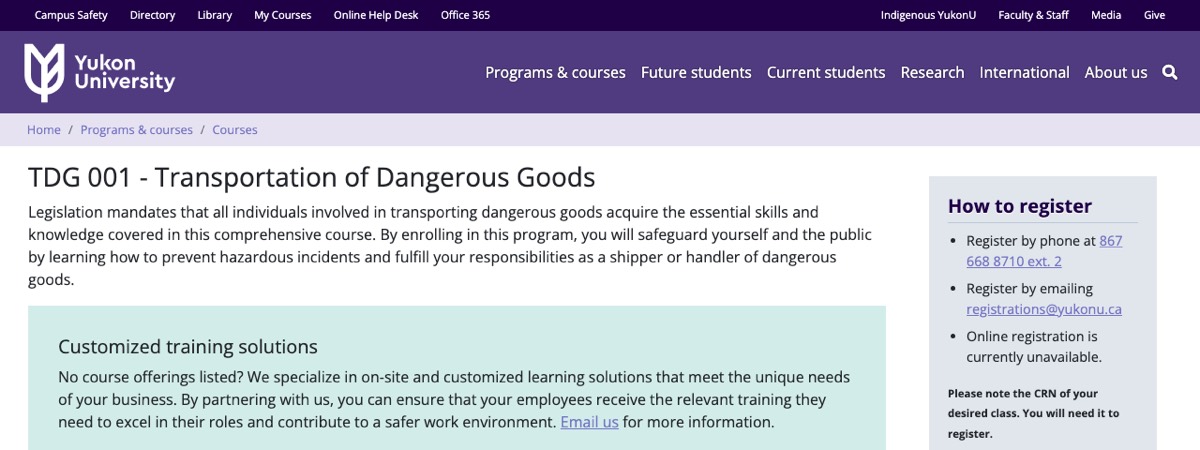
| Provider | Yukon University |
|---|---|
| Length | 4 hours |
| Cost (CAD) | $39 +GST (online self-paced); $95.00 + tax (in-person) |
| Credential | Transportation of Dangerous Goods Certificate valid for 3-years |
| Format | online/in person, YT |
Fiona's take: This is the strongest structured option I reviewed. A university-run course that fits in half a shift, costs $39 plus GST online, and grants a Transportation of Dangerous Goods Certificate valid for 3 years. For career changers who want a college name on their training record, this is it.
Skip it if: Skip it if a $34.99 provider course from On-Track Safety serves the same purpose for slightly less.
See Program DetailsTransportation of Dangerous Goods eCourse
Transportation of Dangerous Goods eCourse is a 10.5-hour online course from the Ontario-based provider WSPS for $169.00.
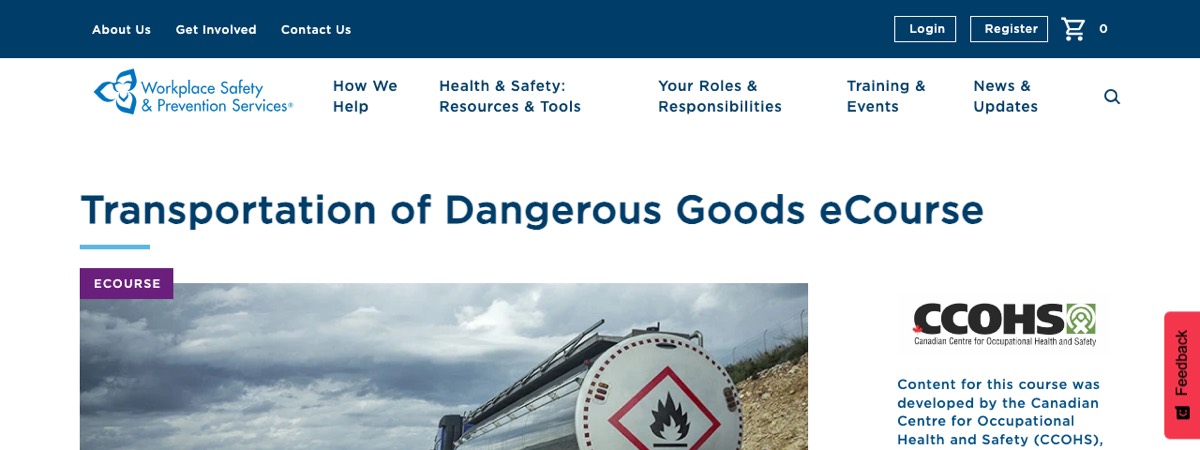
| Provider | WSPS |
|---|---|
| Length | 10.5 Hours |
| Cost (CAD) | $169.00 |
| Credential | TDG Certificate of Training |
| Format | online, ON |
Fiona's take: WSPS is an Ontario-based provider with a 10.5-hour online TDG eCourse for $169.00, the longest listed online TDG option in this set. It costs several times more than Danatec or On-Track, so I recommend it when an employer wants a longer training record rather than a short one. The certificate itself still comes from the employer.
Skip it if: Skip it if you are paying yourself and only want a shorter listed course.
See Program DetailsTDG Online Training
TDG Online Training is an online course from Danatec, through whmis.ca, for $34.95 CAD.

| Provider | Danatec (whmis.ca) |
|---|---|
| Cost (CAD) | $34.95 CAD |
| Credential | TDG training certificate |
| Format | online |
Fiona's take: Danatec has the lowest listed TDG provider price among the offers I reviewed, at $34.95 CAD. The length is not listed, so ask how long the material takes before you enroll. The listed credential is a TDG training certificate, and the official document still comes from your employer.
Skip it if: Skip it if you want a college-issued record; Yukon University's TDG 001 fills that role.
See Program DetailsTransportation of Dangerous Goods - TDG
Transportation of Dangerous Goods - TDG is an instructor-led course from SafetyCo Training in Ontario, at $249 per person publicly or private sessions starting from $1,999.
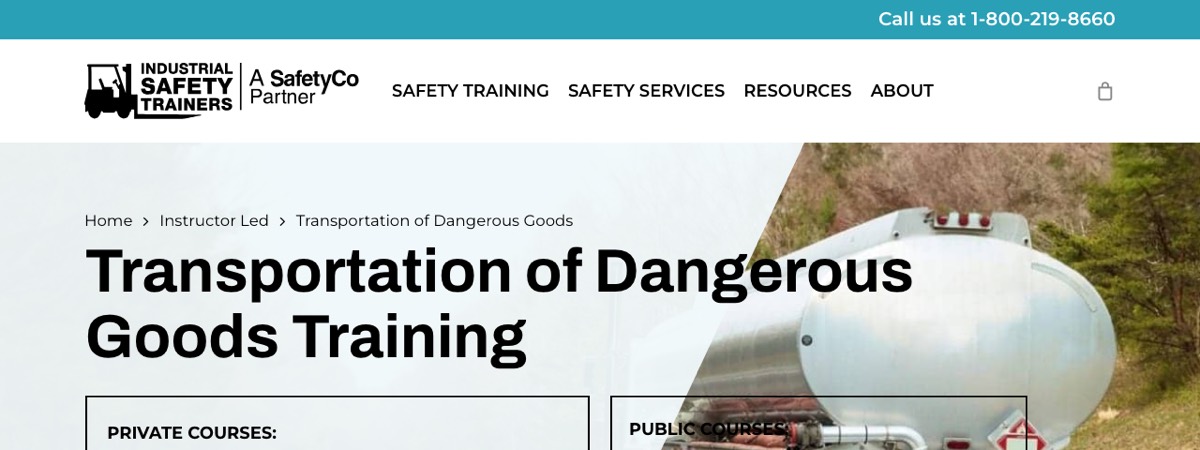
| Provider | SafetyCo Training |
|---|---|
| Cost (CAD) | $249 / Person (public); Starting From $1,999 (private) |
| Credential | TDG training certificate |
| Format | in person, ON |
Fiona's take: Instructor-led training suits teams and employers who want discussion around real workplace scenarios. At $249 per person it is the premium public option, and the private rate starting from $1,999 makes sense once an employer is training a crew.
Skip it if: Skip it if an online option already covers the classes and duties your employer needs; online and instructor-led courses may differ in scope.
See Program DetailsTransportation of Dangerous Goods Training – TDG
Transportation of Dangerous Goods Training - TDG is an in-person course from the Maritime Environmental Training Institute (METI) in Nova Scotia, with pricing not listed.
| Provider | Maritime Environmental Training Institute (METI) |
|---|---|
| Credential | TDG Ticket/Certificate |
| Format | in person, NS |
Fiona's take: METI gives Atlantic Canadian workers an in-person option without flying west, which matters for hands-on learners. The pricing is not listed, so contact METI before budgeting.
Skip it if: Skip it if you are outside the Maritimes and comfortable learning online.
See Program DetailsTransportation of Dangerous Goods - TDG - Online Course
Transportation of Dangerous Goods - TDG - Online Course is a 3-hour online course from On-Track Safety for $34.99 CAD, rated 4.5 out of 5 from 1,639 learners.

| Provider | On-Track Safety |
|---|---|
| Length | 3h |
| Cost (CAD) | $34.99 CAD |
| Rating | 4.5 / 5 from 1,639 learners |
| Credential | Certificate, valid 36 month(s) |
| Format | online |
Fiona's take: On-Track is a 3-hour, $34.99 CAD ground-transportation option covering all dangerous goods classes except 1, 6.2 and 7, with a 4.5 rating from 1,639 learners and a certificate valid 36 months. Use it only if it matches your duties and your employer accepts it as training evidence; if your work involves explosives, infectious substances or radioactive materials, look elsewhere.
Skip it if: Skip it if your duties involve classes 1, 6.2 or 7, or if your employer mandates a different provider.
See Program DetailsHow Much Does A TDG Certificate Cost In Canada?
Among the reviewed options with listed individual prices, TDG training ranges from $34.95 to $249 per person; SafetyCo private sessions start at $1,999, METI's pricing is not listed, and the regulations themselves set no fee.
| Provider | Format | Length | Cost (CAD) |
|---|---|---|---|
| Danatec (whmis.ca) | Online | Not listed | $34.95 |
| On-Track Safety | Online | 3h | $34.99 |
| Yukon University TDG 001 | Online self-paced | 4 hours | $39 +GST |
| Yukon University TDG 001 | In person | 4 hours | $95.00 + tax |
| WSPS eCourse | Online | 10.5 hours | $169.00 |
| SafetyCo Training | In person | Not listed | $249 per person; private from $1,999 |
The Transportation of Dangerous Goods Regulations specify no government fee for training or certificate issuance, so your only cost is the training itself. Among the options reviewed with listed individual prices, the range runs from Danatec's $34.95 online course to SafetyCo's $249 instructor-led session; SafetyCo private sessions start at $1,999, and METI's pricing is not listed.
Coursera and Udemy courses sit outside this comparison because they do not lead to a TDG training certificate at all; treat them as background learning, not compliance spending. One hidden cost to plan for: the certificate expires after 36 months for road transport, so budget for repeat training roughly every three years, or every 24 months if you work air transport.
Is A TDG Certificate Worth It In 2026?
For anyone whose work touches dangerous goods, the question answers itself: it is legally required in every province and territory, and without it you must work under the direct supervision of a certified person. For transport truck drivers, the credential is close to standard equipment. Job Bank puts the median wage for transport truck drivers (NOC 73300) at $26.42 per hour in Canada, from $23.00 in New Brunswick to $30.77 in British Columbia.
The value calculation is really about course length and scope, not the credential. A $34.99 online course from On-Track Safety and a $249 instructor-led session from SafetyCo both end in the same employer-issued certificate. WSPS is 10.5 hours; On-Track is 3 hours. What differs is time on task and which classes the course covers, so check the scope against your duties before paying.
Where the certificate is weakest is portability across roles. It proves you were trained for specific duties as of the issue date, and it expires. I tell clients to treat it as a maintenance credential, like a driver's abstract: renew on schedule, keep the record, and do not expect it to carry weight beyond dangerous goods work.
TDG Certificate Questions Canadians Ask
Who Needs A TDG Training Certificate?
Any person who handles, offers for transport or transports dangerous goods needs a TDG training certificate in Canada. The alternative under section 6.1 of the TDG Regulations is working in the presence and under the direct supervision of someone who is trained and certified. Outside that supervision option, the regulations give no other route.
How Long Is A TDG Certificate Valid?
A TDG training certificate expires 24 months after issuance for air transport and 36 months after issuance for road vehicle, railway vehicle or vessel transport. If you transport by more than one mode, the shorter clock applies. Yukon University's TDG 001 certificate and On-Track Safety's online certificate both state the 3-year validity for road work, matching the 36-month rule.
Who Issues The TDG Training Certificate?
The employer issues the official TDG training certificate, or the self-employed person issues their own, after determining the person is adequately trained. Training providers such as Danatec, WSPS or Yukon University supply evidence of training, but the legally meaningful certificate under section 6.3 is the employer-issued document. This is the single most misunderstood part of the process.
What Are The Nine Classes Of Dangerous Goods?
The nine classes are Class 1 Explosives; Class 2 Gases; Class 3 Flammable Liquids; Class 4 Flammable Solids etc.; Class 5 Oxidizing Substances; Class 6 Toxic Substances; Class 7 Radioactive Materials; Class 8 Corrosives; and Class 9 Miscellaneous. Your training must cover classification because shipping names, documentation and marks all flow from the class of goods you carry.
Is TDG Training Mandatory In Canada?
Yes, TDG training is mandatory in every province and territory. The Transportation of Dangerous Goods Regulations, adopted by all provinces and territories and administered by Transport Canada's TDG Directorate, require adequate training and a certificate for anyone handling, offering for transport or transporting dangerous goods.
What Does Your TDG Certificate Prove?
Your TDG certificate proves that your employer had reasonable grounds to believe you are adequately trained for the duties listed on it, as of the issue date. It also shows the expiry date, which is 24 months for air transport and 36 months for road, rail or vessel. It does not prove skill or experience; it proves training under the regulations.
When Are You Issued A TDG Certificate?
You are issued a TDG training certificate immediately once your employer confirms you are adequately trained, which typically follows completion of a course such as Yukon University's 4-hour TDG 001. The employer must include the expiry date on the certificate. There is no government processing step or wait, because the certificate is employer-issued, not Transport Canada-issued.
How Long Must TDG Training Records Be Kept?
Employers must keep TDG training records from the date of issuance until two years after the certificate expires. That means for a 36-month road certificate, the record lives for roughly five years. I advise workers to keep their own copy too, since inspections do not wait for the payroll office.
What's The Bottom Line On The TDG Certificate In Canada?
- A TDG training certificate is legally required in every province and territory for anyone who handles, offers for transport or transports dangerous goods, under the Transportation of Dangerous Goods Regulations.
- Your employer issues the certificate, not the training provider; providers like Danatec at $34.95 CAD and On-Track Safety at $34.99 CAD supply the training evidence.
- The certificate expires after 24 months for air transport and 36 months for road, rail or vessel, and employers must keep records two years past expiry.
- Hazardous Waste Management from L&T EduTech is a 9-hour way to test the field, but it does not qualify you for a TDG training certificate.
- On-Track Safety's listed price is $34.99 CAD, covering ground transportation and excluding classes 1, 6.2 and 7; Job Bank's median wage for transport truck drivers (NOC 73300) is $26.42 per hour in Canada.






