Key Takeaways
- The fastest realistic route is a CDAC-accredited college program at 8 to 12 months, followed by the NDAEB Theory Exam, which costs $100 for the application plus $630 for the examination.
- Registration with a provincial regulator is mandatory in BC through the BC College of Oral Health Professionals, in Alberta through the College of Alberta Dental Assistants, and in Saskatchewan, Manitoba, New Brunswick, Nova Scotia, Prince Edward Island and Newfoundland and Labrador; dental assisting is not regulated in Ontario or Quebec.
- The Coursera option Introduction to Dental Terminology from the University of Pittsburgh runs 8 modules in about 1 week at 10 hours a week, but it does not qualify you for provincial registration or for the NDAEB exam; it is a way to test the field before you commit to a college program.
- Dental assistants earn a median of $27.00 per hour in Canada (NOC 33100), with British Columbia at $31.00 and Ontario and Quebec at $26.00 per Job Bank.
- Fiona's verdict: this path suits anyone who wants registered health-care work, with 8 to 12 months of college plus the NDAEB Theory Exam and registration time where required, since the Coursera and Udemy courses alone will not get you registered.
A dental assistant (NOC 33100) assists dentists, dental hygienists and dental therapists during examination and treatment of patients, and handles clerical functions in the office. It is a health-care job you can train for quickly in Canada, but registration requirements change by province.
The realistic path is an 8 to 12 month CDAC-accredited college program, then the NDAEB Theory Exam, then registration with your provincial regulator if your province requires it. Below I compare the courses, the exam fees, the registration rules and the pay, so you can decide whether this field is worth your money before you spend any of it.
What Are The Ways To Become A Dental Assistant In Canada?
Online courses can test your interest, but the recognized route in this pack is the CDAC-accredited college program, which is recognized by the NDAEB and provincial regulators. In most jurisdictions, dental assistants are required to complete an 8-month or one-year educational program.
| Route | Time | Cost (CAD) | What You Get | Recognised By | Best For |
|---|---|---|---|---|---|
| Introduction to Dental Terminology (Coursera) | 8 modules, 1 week at 10 hours a week | Not listed | Course Certificate | No provincial regulator; interest testing only | Testing whether dental assisting suits you |
| Udemy masterclass route, e.g. Dental Assisting Masterclass: Clinical Skills, Procedures & | 3.5 hours on-demand video | $11.99 | Certificate of completion | No regulator accepts it for registration | Building familiarity with clinical vocabulary |
| CDAC-accredited college program | 8-12 months | Varies by college, from $5,477 at Okanagan College | Certificate or diploma | NDAEB and provincial regulators | Working as a registered dental assistant |
I recommend the Coursera route for anyone still deciding, and the CDAC-accredited college program for anyone ready to work in the field, since the CDAC-accredited route is the route in this pack recognized by the NDAEB and provincial regulators.
How Long Does It Take To Become A Dental Assistant In Canada?
Becoming a registered dental assistant takes about 8 to 12 months of college training plus exam and registration time. Here is the sequence I walk clients through.
- Test the field with Introduction to Dental Terminology from the University of Pittsburgh, 8 modules you can finish in about 1 week at 10 hours a week. Cost not listed.
- Enrol in a CDAC-accredited dental assisting program, which takes 8 to 12 months. Tuition varies by college, from $5,477 at Okanagan College to $11,540 at Vancouver Community College.
- Pass the NDAEB Theory Exam. The application fee is $100 and the examination fee is $630, per the NDAEB fee schedule.
- Apply for provincial registration or licensure where your province requires it, such as with the BC College of Oral Health Professionals in BC or the College of Alberta Dental Assistants in Alberta. Fees and processing times are not listed.
- If you plan intra-oral duties in Ontario, plan for the NDAEB exam as well, since Ontario requires it for intra-oral work even though the occupation itself is not regulated there.
Do You Need A Licence To Work As A Dental Assistant In Canada?
Licensing for dental assistants depends entirely on the province. Most provinces make registration with a regulatory college mandatory, while Ontario and Quebec do not regulate dental assisting at all.
| Province | Required? | Regulator Or Registry | What It Means |
|---|---|---|---|
| British Columbia | Yes | BC College of Oral Health Professionals (BCCOHP) | You must register before working as a dental assistant |
| Alberta | Yes | College of Alberta Dental Assistants (CADA) | Registration with CADA is mandatory |
| Saskatchewan | Yes | College of Dental Assistants of Saskatchewan | Registration required |
| Manitoba | Yes | Manitoba Dental Association | Registration required |
| Ontario | No | Not regulated (RCDSO regulates dentists; ODAA is voluntary) | No registration needed, but the NDAEB exam is required for intra-oral duties |
| Quebec | No | Not regulated (Ordre des Dentistes du Quebec) | No dental assistant registration requirement |
| New Brunswick | Yes | New Brunswick Dental Society | Registration required |
| Nova Scotia | Yes | Nova Scotia Regulator of Dentistry and Dental Assisting | Registration required |
| Prince Edward Island | Yes | Prince Edward Island Dental College | Registration required |
| Newfoundland and Labrador | Yes | Newfoundland and Labrador Dental Board | Registration required |
The NDAEB Theory Exam is required for registration in all provinces except Quebec, and it is required for intra-oral duties in Ontario. That single exam, $100 to apply plus $630 to write, sits on almost every path into this career.
Chairside, or Level I, work is possible without certification in some cases, but intra-oral, or Level II, duties require the NDAEB credential in regulated provinces. I tell clients to plan for Level II from the start, because that is where the registration requirement sits.
Which Dental Assistant Courses Are Worth Taking?
The courses worth your time split into two groups: non-credit online courses that build vocabulary and interest, and CDAC-accredited college certificates that lead to the NDAEB exam. Here is my read on each option in the pack.
Introduction to Dental Terminology
Introduction to Dental Terminology is an 8-module online course from the University of Pittsburgh on Coursera that you can finish in 1 week at 10 hours a week.
| Provider | University of Pittsburgh |
|---|---|
| Length | 8 modules, 1 week to complete at 10 hours a week |
| Rating | 4.9 (14 reviews) |
| Credential | Course Certificate |
| Format | online |
Fiona's take: This is the course I recommend to every client who is curious about dental assisting but has never set foot in a treatment room. Learning tooth surfaces, instrument names and clinical terms is half the battle in a first college semester. It carries a 4.9 rating from 14 reviews. It does not qualify you for any provincial registration or the NDAEB exam, so pair it with a college program if you intend to work.
Skip it if: Skip it if you already have chairside experience and know the terminology cold.
Start On CourseraIntroduction to Dental Medicine
Introduction to Dental Medicine is a 7-module online course from the University of Pennsylvania on Coursera with a flexible schedule.
| Provider | University of Pennsylvania |
|---|---|
| Length | 7 modules, flexible schedule |
| Rating | 4.8 (1,518 reviews) |
| Credential | Course Certificate |
| Format | online |
Fiona's take: This one goes broader than terminology and introduces how dentists actually diagnose and treat, which is useful context for an assistant. It carries a 4.8 rating from 1,518 reviews, which is a lot of feedback. It offers a Course Certificate, but not a provincial registration credential or NDAEB qualification.
Skip it if: Skip it if you only want assistant-level basics and would rather spend the hours on the terminology course.
Start On CourseraThe Integration of Art and Science in Modern Dental Medicine
The Integration of Art and Science in Modern Dental Medicine is a 3 to 6 month online specialization from the University of Pennsylvania on Coursera.
| Provider | University of Pennsylvania |
|---|---|
| Length | 3 - 6 Months |
| Rating | 4.9 (2.3K reviews) |
| Credential | Specialization Certificate |
| Format | online |
Fiona's take: A specialization is a bigger commitment. At 3 to 6 months it is shorter than the typical 8 to 12 month CDAC-accredited route, but it does not lead to NDAEB or provincial registration. Its 4.9 rating across 2.3K reviews is impressive. My honest view: if employment is the goal, a career changer is better served by an accredited program that leads to registration.
Skip it if: Skip it if your goal is employment, since the accredited college route is the one regulators recognize.
Start On CourseraDental Assisting Masterclass: Clinical Skills, Procedures &
Dental Assisting Masterclass: Clinical Skills, Procedures is a 3.5-hour on-demand video course from Dave King on Udemy, currently $11.99.
| Provider | Dave King |
|---|---|
| Length | 3.5 hours on-demand video |
| Cost (CAD) | $11.99 (current price) |
| Rating | 4.7 (123 ratings) |
| Credential | Certificate of completion |
| Format | online |
Fiona's take: For $11.99 you get a walk-through of clinical procedures at a fraction of any tuition, and the 4.7 rating from 123 ratings suggests it delivers. Watch it before college to make lectures feel familiar. It grants only a Udemy certificate of completion, which no provincial regulator accepts for registration.
Skip it if: Skip it if you dislike video-only learning and want instructor feedback instead.
View On UdemyDiploma in Clinical Dental Assisting Technology
Diploma in Clinical Dental Assisting Technology is an 8.5-hour online course from HeartbeatsZ Academy, UK, on Udemy, currently $12.99.
| Provider | HeartbeatsZ Academy, UK |
|---|---|
| Length | 8.5 hours |
| Cost (CAD) | $12.99 (current price) |
| Rating | 4.5 (68 ratings) |
| Credential | Certificate of completion |
| Format | online |
Fiona's take: The word diploma here means a Udemy completion certificate, not a Canadian diploma, and I make that distinction explicitly with clients. Still, 8.5 hours of structured content for $12.99 is a fair preview of the field. It does not satisfy any provincial registration requirement.
Skip it if: Skip it if the UK framing or the 4.5 rating from 68 ratings gives you pause, and take the masterclass instead.
View On UdemyMaster Dental Radiography: Clinical Guide to X-Ray Skills
Master Dental Radiography: Clinical Guide to X-Ray Skills is an on-demand video course on Udemy, currently $11.99.
| Provider | Various (Udemy) |
|---|---|
| Length | not shown (on-demand) |
| Cost (CAD) | $11.99 (current price) |
| Rating | 4.4 (43 ratings) |
| Credential | Certificate of completion |
| Format | online |
Fiona's take: Radiography is a Level II skill, so a preview of x-ray concepts before college is genuinely useful, and at $11.99 the downside is small. It carries a 4.4 rating from 43 ratings. Note that intra-oral Level II duties require the NDAEB credential in regulated provinces, which this course does not provide.
Skip it if: Skip it if you are still deciding on the career and want general material first.
View On UdemyCertified Dental Assistant, Certificate
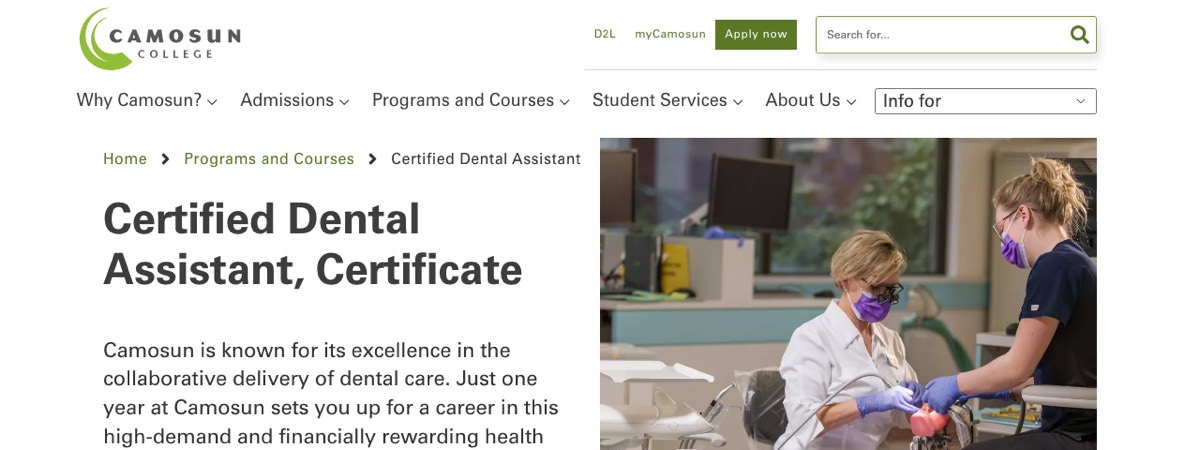
The Certified Dental Assistant Certificate at Camosun College is a 10-month full-time, in-person program in BC costing $9,479 for domestic students for the entire program.
| Provider | Camosun College |
|---|---|
| Length | 10 months |
| Cost (CAD) | $9,479 (domestic) for entire program |
| Credential | Certificate |
| Format | Full-time, in-person, BC |
Fiona's take: This is a real route to registration in a province where registration is mandatory through the BC College of Oral Health Professionals. Ten months is within the CDAC norm of 8 to 12 months. The price is listed, which many colleges do not publish, and that transparency helps you plan.
Skip it if: Skip it if you cannot attend a full-time, in-person BC program.
See Program DetailsDental Assisting | Vancouver Community College
Vancouver Community College's Dental Assisting program is a 10-month (41-week) full-time class-based certificate in BC with tuition of $11,540.
| Provider | Vancouver Community College |
|---|---|
| Length | 10 months (41 weeks) |
| Cost (CAD) | $11,540 tuition |
| Credential | Certificate |
| Format | Class-based, full-time, BC |
Fiona's take: VCC is an urban campus choice, and the 41-week structure is explicit, which I like for planning around work or family. Tuition of $11,540 is at the higher end among the BC options here. Graduates move toward registration with the BC College of Oral Health Professionals.
Skip it if: Skip it if $11,540 tuition is above your ceiling and Okanagan College at $5,477 fits better.
See Program DetailsDental Assisting (Levels I And II)
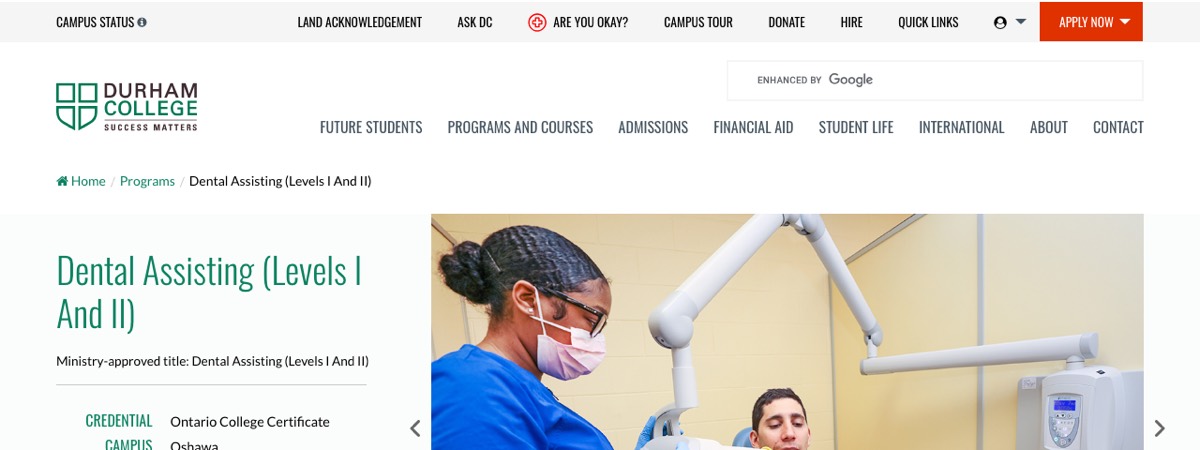
Dental Assisting (Levels I And II) at Durham College is a two-semester, in-person Ontario College Certificate.
| Provider | Durham College |
|---|---|
| Length | Two semesters |
| Credential | Ontario College Certificate |
| Format | In-person, ON |
Fiona's take: Ontario does not regulate dental assisting, so this program is about employability rather than mandatory registration. Level II intra-oral duties require the NDAEB exam in Ontario, so ask Durham and the NDAEB how this program aligns with Ontario intra-oral duties. Tuition is not listed, so ask the registrar directly.
Skip it if: Skip it if you are outside commuting distance of Durham College, since it is an in-person program.
See Program DetailsDental Assisting Certificate
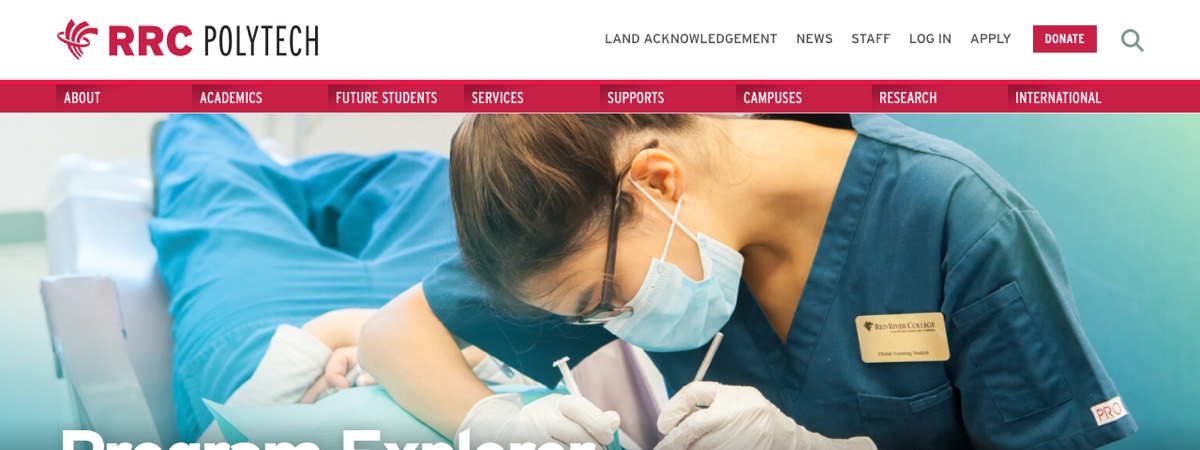
The Dental Assisting Certificate at RRC Polytech is a 1-year, in-person hybrid program in Manitoba costing $6,000 to $6,700.
| Provider | RRC Polytech |
|---|---|
| Length | 1 year |
| Cost (CAD) | $6,000 – $6,700 |
| Credential | Certificate |
| Format | In-person hybrid, MB |
Fiona's take: The hybrid delivery means part of the program comes to you, and the tuition range of $6,000 to $6,700 sits below both BC colleges listed here. In Manitoba, registration is with the Manitoba Dental Association, which I confirm with clients before they enrol anywhere.
Skip it if: Skip it if Manitoba is not where you intend to work and another province's program is closer.
See Program DetailsCertified Dental Assistant Certificate
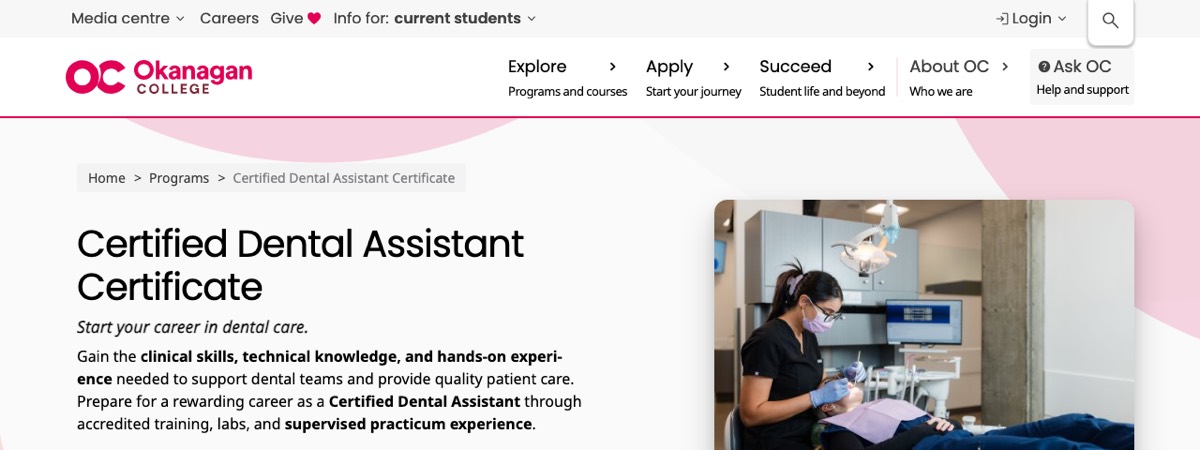
The Certified Dental Assistant Certificate at Okanagan College is a full-time, in-person program in BC with 2025-26 tuition of $5,477.
| Provider | Okanagan College |
|---|---|
| Length | not shown (full-time) |
| Cost (CAD) | $2025-26: $5,477 |
| Credential | Certificate |
| Format | Full-Time, in-person, BC |
Fiona's take: This is the lowest published tuition among the college programs with prices listed here, which matters if you are funding this yourself. The program length is not listed, so confirm the month count with the college before you plan around it. It feeds into BC registration through the BC College of Oral Health Professionals.
Skip it if: Skip it if you need a published program length before committing.
See Program DetailsDental Assisting
Dental Assisting at Georgian College is a 3-semester (1-year) full-time Ontario College Certificate.
| Provider | Georgian College |
|---|---|
| Length | 3 Semesters / 1 Year |
| Credential | Ontario College Certificate |
| Format | Full-time, ON |
Fiona's take: Three semesters in one year is a slightly longer shape than the two-semester Durham College format, which can mean a placement or a break term, so ask. It leads to an Ontario College Certificate in a province where the NDAEB exam matters for intra-oral duties. Tuition is not listed.
Skip it if: Skip it if you want a published tuition figure before applying.
See Program DetailsHow Much Does A Dental Assistant Course Cost In Canada?
A dental assistant course in Canada costs between $11.99 for a Udemy video course and $11,540 in tuition for a full Vancouver Community College certificate, plus NDAEB fees of $730 for the Theory Exam. Here is the breakdown.
| Item | Cost (CAD) | Notes |
|---|---|---|
| NDAEB Theory Exam | $100 application (non-refundable) + $630 examination | Required for registration outside Quebec and for intra-oral duties in Ontario |
| NDAEB CPE | $100 application + $1,685 evaluation | Confirm when this applies with the NDAEB |
| Okanagan College, Certified Dental Assistant Certificate (BC) | $5,477 for 2025-26 | Full-time, in-person; length not listed |
| RRC Polytech, Dental Assisting Certificate (MB) | $6,000 to $6,700 | 1 year, in-person hybrid |
| Camosun College, Certified Dental Assistant Certificate (BC) | $9,479 domestic, entire program | 10 months, full-time |
| Vancouver Community College, Dental Assisting (BC) | $11,540 tuition | 10 months, 41 weeks |
| Udemy courses | $11.99 to $12.99 each | Not accepted for any registration |
Two patterns stand out to me. BC programs here run $5,477 to $11,540 in tuition, so shopping within one province can save thousands. And the NDAEB Theory Exam at $730 total is a fixed cost for registration in regulated provinces, and for intra-oral duties in Ontario; Quebec is not regulated.
The NDAEB CPE fee, $100 plus $1,685, is listed on the NDAEB fee schedule; confirm when this applies with the NDAEB. Provincial registration fees are not listed, so budget a buffer and confirm with your regulator, whether that is the College of Alberta Dental Assistants or the Nova Scotia Regulator of Dentistry and Dental Assisting.
How Much Does A Dental Assistant Earn In Canada?
Dental assistants (NOC 33100) earn a national median of $27.00 per hour per Job Bank, in a range from $21.00 at the low end to $35.00 at the high end. Province matters, as the table shows.
| Jurisdiction | Median Hourly (CAD) | Source |
|---|---|---|
| Canada | $27.00 | Job Bank, NOC 33100 |
| British Columbia | $31.00 | Job Bank |
| Ontario | $26.00 | Job Bank |
| Quebec | $26.00 | Job Bank |
| Other provinces | Medians vary between 22 and 27 | Job Bank |
British Columbia pays the highest median among the provinces listed, at $31.00, and WorkBC flags high opportunity for dental assistants in that province. Alberta figures were not verified, so check Job Bank directly if Edmonton or Calgary is your market.
Job Bank lists a national range of $21.00 to $35.00 per hour for NOC 33100, with medians in other provinces varying between 22 and 27. Confirm the current figure for your province before you plan a budget around this wage.
Is A Dental Assistant Course Worth It In 2026?
On the numbers, the case is strong. An 8 to 12 month program, tuition of $5,477 to $11,540 at the colleges listed here, and a national median wage of $27.00 per hour in a field where WorkBC reports high opportunity. Those are the figures I put in front of clients who are deciding whether to enrol.
The catch is the patchwork of regulation. In eight provinces you finish a CDAC-accredited program and register with a regulator such as the College of Dental Assistants of Saskatchewan. In Ontario and Quebec the occupation is not regulated, which lowers the barrier but can also mean weaker credential signalling to employers, so the NDAEB credential is worth having for jobs at the top of the $21.00 to $35.00 range.
My verdict for 2026: worth it if you complete an accredited program and the NDAEB Theory Exam. What is not worth it is paying college tuition without knowing the field suits you, which is exactly the gap a $11.99 Udemy course or the University of Pittsburgh terminology course on Coursera closes first.
Dental Assistant Course Questions Canadians Ask
How Long Does It Take To Become A Dental Assistant In Canada?
Becoming a dental assistant takes 8 to 12 months for a CDAC-accredited college program, since in most jurisdictions dental assistants are required to complete an 8-month or one-year educational program. Add the NDAEB Theory Exam, at $100 to apply and $630 to write, plus provincial registration time where it is required.
Is The NDAEB Exam Required In Every Province?
The NDAEB exam is required for registration in all provinces except Quebec, and it is required for intra-oral duties in Ontario even though dental assisting is not regulated there. Quebec has no dental assistant registration requirement at all. Check your provincial regulator, such as the College of Alberta Dental Assistants, before you book.
What Is The Median Wage For Dental Assistants In Canada?
The median wage is $27.00 per hour nationally, within a range of $21.00 to $35.00 per hour, per Job Bank for NOC 33100. British Columbia sits higher at $31.00, while Ontario and Quebec both sit at $26.00. Other provincial medians vary between 22 and 27.
Do I Need To Register With A Regulatory Body To Work As A Dental Assistant?
Registration is required in most provinces: BC through the BC College of Oral Health Professionals, Alberta through CADA, plus Saskatchewan, Manitoba, New Brunswick, Nova Scotia, Prince Edward Island and Newfoundland and Labrador each with their own body. Ontario and Quebec are the exceptions, as dental assisting is not regulated in either province.
What Programs Are Accredited For Dental Assisting?
CDAC-accredited programs are the ones regulators recognize, and they are listed on cdac-cadc.ca. Programs like the Certified Dental Assistant Certificate at Okanagan College at $5,477 for 2025-26, or Camosun College at $9,479 domestic for the entire 10-month program, are examples of the college route. Always confirm the accreditation status on the CDAC site before you pay a deposit.
How Much Does The NDAEB Exam Cost?
The NDAEB Theory Exam costs $630 for the examination plus a $100 non-refundable application fee, for $730 total per the NDAEB fee schedule. The CPE costs more, at $1,685 for the evaluation plus the same $100 application fee. These sit on top of your tuition.
Can I Work As A Dental Assistant Without Certification?
Working as a dental assistant without the full credential is possible in some chairside, or Level I, cases, but intra-oral, or Level II, duties require the NDAEB credential in regulated provinces. Since eight provinces regulate the occupation, most clients I advise pursue the full path. The Coursera and Udemy courses on this page do not substitute for it.
What Is The Job Outlook For Dental Assistants?
The outlook for dental assistants varies by province, with WorkBC reporting high opportunity for dental assistants and dental laboratory assistants in British Columbia, which also posts the highest median wage listed here at $31.00 per hour. Alberta figures were not verified. Nationally, Job Bank places the median at $27.00 for NOC 33100.
What's The Bottom Line On Dental Assistant Courses In Canada?
- A CDAC-accredited program takes 8 to 12 months and, at the colleges listed here, tuition of $5,477 to $11,540, plus the NDAEB Theory Exam at $730 total.
- Registration is mandatory in eight provinces, from the BC College of Oral Health Professionals to the Newfoundland and Labrador Dental Board; Ontario and Quebec do not regulate dental assisting.
- Test the field first with Introduction to Dental Terminology or Dental Assisting Masterclass: Clinical Skills, Procedures & at $11.99, but neither qualifies you for registration or the NDAEB exam.
- Dental assistants earn a median of $27.00 per hour in Canada, with a range of $21.00 to $35.00 and BC at $31.00, per Job Bank NOC 33100.
- Fiona's verdict: a good fit for anyone who wants registered health-care work, with 8 to 12 months of college plus the NDAEB Theory Exam and registration time where required, not just the online intro courses.