Key Takeaways
- The credential route to mechanical engineer roles is the 4-year bachelor's degree, a BEng or BASc, at $40,000-$80,000; the 1-year fast-track diploma at $17,000 is the shortest verified diploma option.
- A licence from a provincial regulator, such as Professional Engineers Ontario (PEO), APEGA in Alberta or EGBC in British Columbia, is required to practise as a Professional Engineer (P.Eng.) and to approve engineering drawings and reports in every province and territory.
- Introduction to Engineering Mechanics from Georgia Tech (Introduction to Engineering Mechanics) is a 1-3 month online course rated 4.8 that tests your fit for the field; it does not count toward a CEAB degree and does not qualify you as an engineer.
- Job Bank lists the median wage for NOC 21301 mechanical engineers at $45.67 per hour across Canada, with a national low of $30.00 and high of $72.49; among the provinces included here, Alberta has the highest median at $52.88.
- Fiona's verdict: take the degree if the P.Eng. is the goal, the 1-year fast-track diploma if you want the shortest diploma option, and the diploma-plus-bridge route if you want a college start at $30,000-55,000 total.
A mechanical engineer researches, designs and develops machinery and systems for heating, ventilating and air conditioning, power generation, transportation, processing and manufacturing. Canada files the role under NOC 21301, and the entry credential is a 4-year bachelor's degree, a BEng or BASc.
If you typed car mechanical engineering courses, the honest answer is that cars are one application inside the wider degree, which runs $40,000-80,000. Below: that degree, the $15,000-30,000 college diploma, the bridge that joins them, the 1-year fast-track at $17,000, and the Coursera course I use to test fit before any of it.
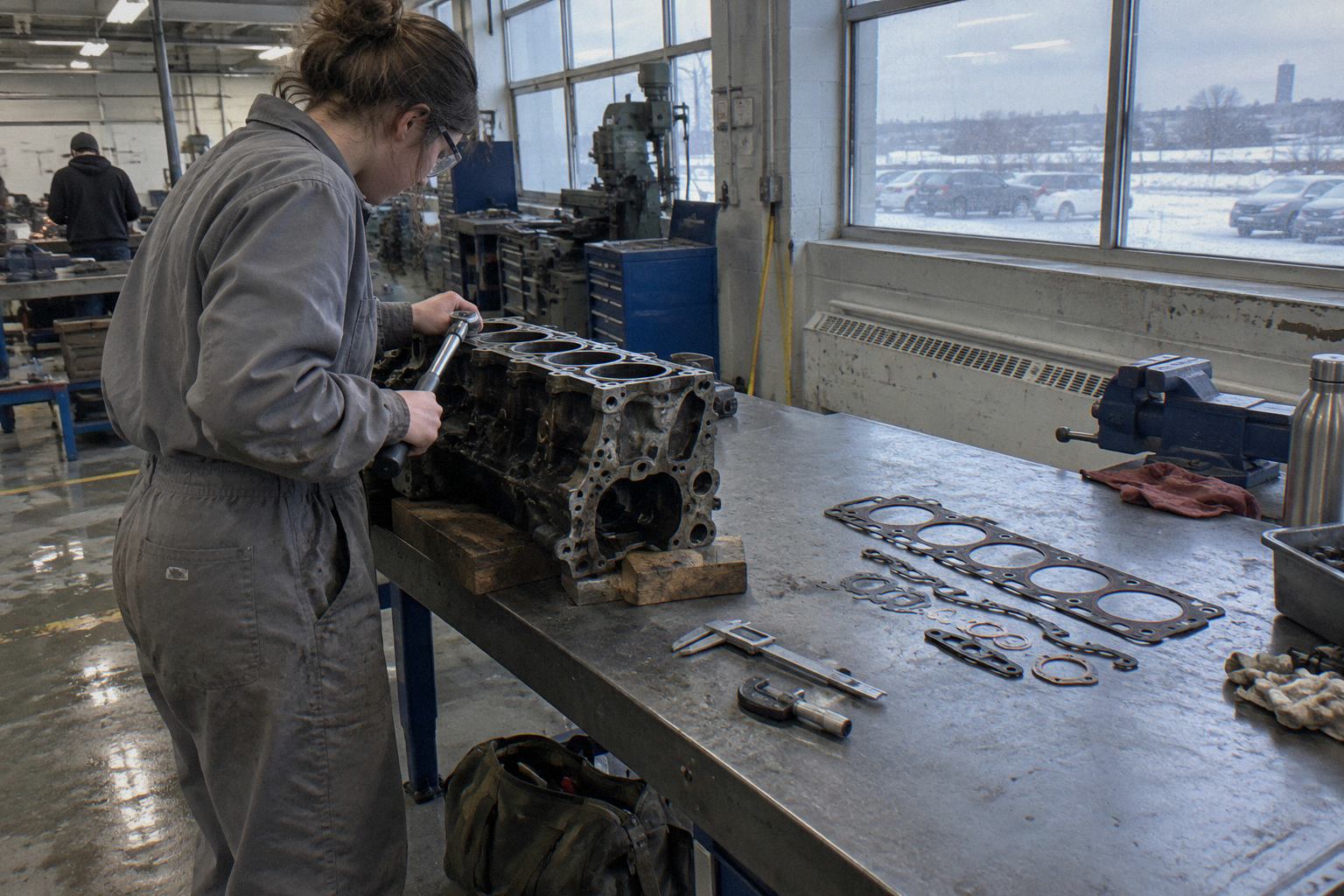
What Are The Ways To Become A Mechanical Engineer In Canada?
Credential routes are the bachelor's degree, college diploma, diploma-plus-bridge and fast-track diploma; online courses can test fit or add skills but are not a route to becoming a mechanical engineer. NOC 21301 requires a bachelor's degree for engineer roles, so the credential you choose decides which doors open.
| Route | Time | Cost (CAD) | What You Get | Recognised By | Best For |
|---|---|---|---|---|---|
| Introduction to Engineering Mechanics plus other Coursera starters (test fit, not a credential route) | 1-3 Months | Not listed | Course | Not listed | Testing the field before you apply |
| University Bachelor's Degree | 4 years | $40,000-$80,000 | BEng or BASc | CEAB | The P.Eng. path, fastest to the degree |
| College Diploma (Mechanical Engineering Technology) | 2-3 years | $15,000-$30,000 | Ontario College Diploma or Advanced Diploma | CTAB for some bridges | Technologist and technician roles |
| Diploma + Bridge to Degree | 3-5 years total | $30,000-$55,000 | Diploma plus BEng | CEAB via bridge | College start, degree finish |
| Fast-track Diploma | 1 year | $17,000 | College Diploma | The issuing college | The shortest verified diploma option |
For most clients I recommend the Coursera test while applications are pending, the direct degree for anyone set on the P.Eng., and the fast-track diploma for anyone who wants the shortest diploma option.
What Is The Fastest Way To Become A Mechanical Engineer In Canada?
The fastest way to the credential is the direct 4-year bachelor's degree, a BEng or BASc, at $40,000-80,000, because the college sequence below totals about 5 years. That college sequence is still the one I recommend when you want smaller steps: diploma first, then a bridge, then the same CEAB-recognised degree. The 1-year fast-track diploma at $17,000 is the shortest verified diploma option.
- Test the field first: Introduction to Engineering Mechanics from Georgia Tech runs 1-3 months online and shows you whether engineering mechanics suits you before you commit tuition anywhere.
- Complete a 2-3 year Mechanical Engineering Technology Diploma at a college such as Red Deer Polytechnic ($6,510 for Year 1 domestic) or Okanagan College, roughly $15,000-$25,000 in total.
- Complete an 8-month Engineering Bridge program at $4,500-$6,300; Camosun College's bridges lead into UBC and UVic.
- Enter the 3rd year of a BEng through a bridge such as Queen's Smith Engineering and finish the remaining 2 years, $20,000-$40,000.
- Apply to the regulator where you will work: PEO's application fee is $360.00 plus $46.80 HST, with the NPPE exam part of the process.
Do You Need A P.Eng. Licence To Practise As A Mechanical Engineer In Canada?
A P.Eng. licence is required to approve engineering drawings and reports and to practise as a Professional Engineer, and every province and territory has its own regulator, such as PEO in Ontario, APEGA in Alberta and EGBC in British Columbia. The licence sits on top of the degree; NOC 21301 makes the bachelor's the entry requirement.
| Province | Regulator | Required For |
|---|---|---|
| Ontario | Professional Engineers Ontario (PEO) | Practising as a P.Eng., approving engineering drawings and reports |
| Alberta | APEGA | Practising as a P.Eng., approving engineering drawings and reports |
| British Columbia | EGBC | Practising as a P.Eng., approving engineering drawings and reports |
| All provinces and territories | Provincial and territorial associations of professional engineers | Licensing is required to approve drawings and reports and to practise as a P.Eng. |
For NOC 21301 mechanical engineer roles, the pack states that a bachelor's degree in mechanical engineering or a related discipline is required; P.Eng. practice also requires provincial and territorial licensing. The university route carries CEAB recognition, and the bridge route reaches that recognition through the bridging program. Licensing is what lets you take responsibility for work after graduation: approving drawings and reports, and practising as a P.Eng.
One point that matters to internationally trained engineers: the 2026 P.Eng. guidance is clear that no regulator requires a fixed period of Canadian work for a new first-time application. The fees are modest by comparison with tuition. PEO charges an application fee of $360.00 plus $46.80 HST, with the NPPE exam part of the package.
Which Mechanical Engineering Courses Are Worth Taking In Canada?
The mechanical engineering courses worth taking depend on your goal: Coursera and Udemy for testing the field and adding skills, college diplomas for employable credentials, and one online graduate option for engineers already working. If you searched car mechanical engineering courses, start with the fundamentals, since automotive work is an application of the same mechanics core that NOC 21301 spans across transportation, manufacturing and power generation.
Introduction to Engineering Mechanics
Introduction to Engineering Mechanics is a 1-3 month online course from the Georgia Institute of Technology, rated 4.8, that covers introductory engineering mechanics topics such as engineering analysis, mechanics and calculations.
| Provider | Georgia Institute of Technology |
|---|---|
| Length | 1 - 3 Months |
| Rating | 4.8 |
| Credential | Course |
| Format | online |
Fiona's take: This is where I send clients before they write a single application. Learning over 1-3 months whether this material suits you beats finding out mid-degree with $40,000 committed. It is a Course, not credit: it does not count toward a CEAB-accredited BEng and does not qualify you as an engineer.
Skip it if: Skip it if you have already passed a statics or mechanics course, because it will repeat what you know.
Start On CourseraAI for Mechanical Engineers
AI for Mechanical Engineers is a 1-3 month online Specialization from the University of Michigan, rated 4.5, that pairs machine learning with mechanical engineering practice.
| Provider | University of Michigan |
|---|---|
| Length | 1 - 3 Months |
| Rating | 4.5 |
| Credential | Specialization |
| Format | online |
Fiona's take: This one serves working technologists and students past first year who want a second skill layered on the mechanics base. Employers hiring under NOC 21301 still screen for the degree and the P.Eng. path, so treat it as an add-on rather than an entry point.
Skip it if: Skip it as your first course, since the mechanics fundamentals need to come before it.
Start On CourseraTransmission Line Engineering: Civil, Mechanical and Cables
Transmission Line Engineering: Civil, Mechanical and Cables is an online Specialization from L&T EduTech running 3 months at 10 hours a week, ending in a career certificate.
| Provider | L&T EduTech |
|---|---|
| Length | 3 months at 10 hours a week |
| Credential | Specialization with career certificate |
| Format | online |
Fiona's take: The scope is power infrastructure, one of the sectors named in the NOC 21301 definition alongside transportation and manufacturing. It suits someone eyeing the power generation side of mechanical work. It is a Coursera career certificate, not a BEng or BASc and not a P.Eng. licence.
Skip it if: Skip it if your interest is automotive, since transmission lines here are electrical infrastructure, not gearboxes.
Start On CourseraTransmission Line Design: Mechanical and Civil Foundations
Transmission Line Design: Mechanical and Civil Foundations is an 8-hour online course from L&T EduTech with a course certificate.
| Provider | L&T EduTech |
|---|---|
| Length | 8 hours to complete |
| Credential | Course certificate |
| Format | online |
Fiona's take: Eight hours makes this the smallest commitment on the page, a genuine one-evening test of whether structural mechanics problems hold your attention. It is a sampler of the power sector, not a step toward a BEng.
Skip it if: Skip it if you already know the field suits you and want breadth instead.
Start On CourseraMechanical design and Product development process
Mechanical design and Product development process is a 9.5-hour online course on Udemy, rated 4.4, that walks through how a designed product reaches production.
| Provider | Udemy |
|---|---|
| Length | 9.5 total hours |
| Rating | 4.4 |
| Credential | Course certificate |
| Format | online |
Fiona's take: This fits the college diploma crowd: Mechanical Engineering Technology students and working technologists who want the design-to-manufacture workflow spelled out plainly. It will not advance P.Eng. academic requirements, and it is not credit toward a BEng.
Skip it if: Skip it if you need academic credit, since Udemy certificates carry none here.
View On UdemyBasics of Sheet metal design for Mechanical design engineers
Basics of Sheet metal design for Mechanical design engineers is a 7-hour online course on Udemy, rated 4.5, covering sheet metal design fundamentals.
| Provider | Udemy |
|---|---|
| Length | 7 total hours |
| Rating | 4.5 |
| Credential | Course certificate |
| Format | online |
Fiona's take: Sheet metal is processing and manufacturing work, two sectors named in the NOC 21301 definition, and this course speaks directly to that shop-floor side of the trade. Pair it with a diploma rather than expecting it to stand alone on a resume.
Skip it if: Skip it if your target is theory-heavy design roles in power or HVAC systems.
View On UdemyMechanical Engineering Technology Diploma
The Mechanical Engineering Technology Diploma at Red Deer Polytechnic is a 2-year in-person diploma in Alberta with published Year 1 domestic tuition of $6,510.
| Provider | Red Deer Polytechnic |
|---|---|
| Length | 2 Years |
| Credential | Diploma |
| Format | in person, Alberta |
Fiona's take: Alberta students get a concrete, published number here: $6,510 for Year 1 domestic. The credential leads to technologist work, and diploma graduates can aim at bridge programs that finish with a BEng, including the 8-month Engineering Bridge at $4,500-$6,300.
Skip it if: Skip it if the P.Eng. is the goal and you can enter a 4-year degree directly.
See Program DetailsMechanical Engineering Technology Diploma
The Mechanical Engineering Technology Diploma at Okanagan College is a 2-year in-person diploma in British Columbia with an estimated domestic first-year cost of $7,252.
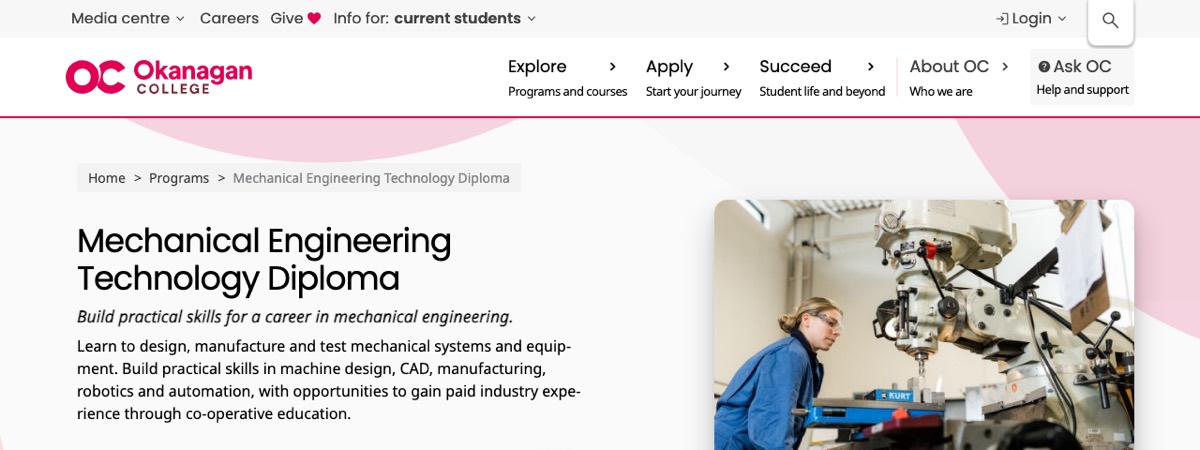
| Provider | Okanagan College |
|---|---|
| Length | 2 years |
| Cost (CAD) | Domestic students estimated first-year cost $7,252 |
| Credential | Diploma |
| Format | in person, British Columbia |
Fiona's take: For BC students this pairs with a clear next step: Camosun College's 8-month Engineering Bridge, $4,500-$6,300, leads into UBC and UVic. That is the college-to-degree path laid out in one region, and it is the route I sketch for budget-conscious clients in the province.
Skip it if: Skip it if you would rather start at university and skip the bridge step.
See Program DetailsGraduate Diploma in Engineering Management (online)
The Graduate Diploma in Engineering Management at the University of Ottawa is a 1-year part-time online graduate diploma in Ontario.
| Provider | University of Ottawa |
|---|---|
| Length | 1 year, part time |
| Credential | Graduate Diploma |
| Format | online, Ontario |
Fiona's take: This is a 1-year, part-time online graduate diploma in engineering management; it is not presented here as a route to a BEng. It suits readers who want a management-focused credential on top of an existing engineering background without leaving work.
Skip it if: Skip it if you are looking for an entry route into mechanical engineering, since it does not lead to a BEng.
See Program DetailsEngineering Certificate
The Engineering Certificate at Capilano University is a 1-year in-person first-year university transfer program in engineering in British Columbia.
| Provider | Capilano University |
|---|---|
| Length | 1 year(s) |
| Credential | Certificate |
| Format | in person, British Columbia |
Fiona's take: One year of first-year university transfer engineering is a way to sample the material before a full degree in BC. The certificate alone does not meet the NOC 21301 bachelor's requirement, so treat it as a starting block, not a finish line.
Skip it if: Skip it if you already qualify for a full diploma or degree program.
See Program DetailsHow Much Does A Mechanical Engineering Degree Cost In Canada?
A mechanical engineering degree costs $40,000-$80,000 over its 4 years, against $15,000-$30,000 for a 2-3 year college diploma and $30,000-$55,000 for the combined diploma-plus-bridge route. Those are program totals; the per-year examples and the regulator fees below show where the numbers come from.
| Item | Cost (CAD) | Notes |
|---|---|---|
| University bachelor's degree, 4 years | $40,000-$80,000 | BEng or BASc |
| College diploma, 2-3 years | $15,000-$30,000 | Mechanical Engineering Technology |
| Diploma plus bridge to degree, 3-5 years total | $30,000-$55,000 | Diploma plus BEng |
| Fast-track diploma, 1 year | $17,000 | Two semesters |
| Engineering Bridge program, 8 months | $4,500-$6,300 | Camosun College bridges to UBC and UVic |
| Red Deer Polytechnic Year 1 tuition, domestic | $6,510 | Published college fee |
| Okanagan College first year, domestic | $7,252 | Estimated first-year cost |
| PEO P.Eng. application | $360.00 plus $46.80 HST | Ontario regulator fee, NPPE exam separate item in the process |
The college math is concrete. Red Deer Polytechnic charges $6,510 for Year 1 domestic and Okanagan College estimates $7,252, which is how 2-3 year diplomas land at $15,000-$30,000 in total. The 8-month Engineering Bridge at Camosun adds $4,500-$6,300 on top, and the final 2 university years run $20,000-$40,000.
The degree route runs $40,000-$80,000 over 4 years. Combining diploma and bridge reaches a CEAB-recognised finish at $30,000-$55,000, which is why the pack notes Mohawk describes the Queen's bridge as faster and more affordable than completing a standalone degree after college.
Licensing sits on top of every route that ends in a degree. PEO's application alone is $360.00 plus $46.80 HST, with the NPPE exam part of the process. Budget it, but do not let it drive your route choice; tuition differences dwarf it.
How Much Does A Mechanical Engineer Earn In Canada?
A mechanical engineer in Canada earns a median of $45.67 per hour under NOC 21301, Job Bank reports, with a national low of $30.00 and high of $72.49. Among the provinces included here, Alberta has the highest median at $52.88 per hour.
| Region | Median Hourly Wage (CAD) |
|---|---|
| Canada | $45.67 |
| Ontario | $46.42 |
| Alberta | $52.88 |
| British Columbia | $43.27 |
| Quebec | $44.00 |
Job Bank reports a national low, median and high of $30.00, $45.67 and $72.49 per hour for NOC 21301. Among the provinces included here, Alberta sits highest at $52.88, followed by Ontario at $46.42, Quebec at $44.00 and British Columbia at $43.27. The spread between the low and high figures signals a wide range of pay within the occupation.
Two cautions from me. These figures cover mechanical engineers, not technologist or technician titles, so diploma-route pay is a different question. Set the $45.67 median against the $40,000-$80,000 degree cost and the $15,000-$30,000 diploma cost when you weigh routes, and read the low and high as Job Bank's reported range rather than a guarantee of where you will land.
Is A Mechanical Engineering Degree Worth It In 2026?
A mechanical engineering degree is worth it in 2026 if the P.Eng. is the goal. For NOC 21301 mechanical engineer roles, the pack states that a bachelor's degree in mechanical engineering or a related discipline is required, and P.Eng. practice also requires provincial and territorial licensing to approve drawings and reports. If you want the engineer title and the responsibility that comes with it, the degree is the credential the role asks for.
The money case is defensible: Job Bank reports a national low, median and high of $30.00, $45.67 and $72.49 per hour, against $40,000-$80,000 for the direct degree or $30,000-$55,000 through diploma-plus-bridge. The bridge keeps the CEAB-recognised finish at the lower total over about 5 years, which is why I raise it with every budget-focused client who still wants the P.Eng. path.
If you are unsure, do not buy uncertainty at degree prices. The Georgia Tech mechanics course costs you 1-3 months, not 4 years, and the fast-track diploma is a 1-year college diploma option at $17,000; separate diploma-plus-bridge routes are listed at 3-5 years total.
Mechanical Engineering Questions Canadians Ask
Do I Need A Degree Or Is A Diploma Enough For Mechanical Engineering Jobs In Canada?
A degree is what NOC 21301 asks for: a bachelor's in mechanical engineering or a related discipline is required for mechanical engineer roles. A diploma qualifies you for technologist and technician positions, or as the first half of a bridge to the BEng. Plan the diploma only if technologist work, or a later bridge, fits your timeline.
What Is The Fastest Way To Become A Mechanical Engineer In Canada?
The fastest way to the credential is the direct 4-year bachelor's degree. The college sequence, a 2-3 year diploma, an 8-month bridge, then 2 years of university, totals about 5 years. The 1-year fast-track diploma at $17,000 is the shortest verified diploma option if a diploma rather than the engineer credential fits your plans.
Are There 1-Year Options For Mechanical Engineering In Canada?
One-year options exist at the diploma and certificate level. Centennial College's Mechanical Engineering Technician, Design fast-track delivers a diploma in 1 year for qualified applicants at about $17,000, and Capilano University offers a 1-year Engineering Certificate. No 1-year bachelor's degree in mechanical engineering is verified, so the P.Eng. path still runs through 4 years of university.
Is Mechanical Engineering Regulated And Do I Need A P.Eng.?
Mechanical engineering is regulated: licensing by a provincial or territorial association of professional engineers is required to approve engineering drawings and reports and to practise as a Professional Engineer. PEO covers Ontario, APEGA covers Alberta, EGBC covers British Columbia. No regulator requires a fixed period of Canadian work for a new first-time P.Eng. application.
What Are Typical Wages For Mechanical Engineers In Canada?
Job Bank reports a national low, median and high of $30.00, $45.67 and $72.49 per hour under NOC 21301. Among the provinces included here, Alberta is highest at $52.88, followed by Ontario at $46.42, Quebec at $44.00 and British Columbia at $43.27. Those are mechanical engineer figures, not technologist titles.
Are Online Mechanical Engineering Degrees Available In Canada?
Full online bachelor's degrees in mechanical engineering are limited in Canada. Some bridge programs include online preparatory courses, as Queen's Smith Engineering does, and the University of Ottawa runs a fully online Graduate Diploma in Engineering Management over 1 year part time. For the degree itself, expect an in-person or mostly in-person program.
Diploma Or Degree For A Mechanical Engineering Career?
Diploma or degree comes down to title and licence. The degree is the P.Eng. path and the mechanical engineer title under NOC 21301; the diploma leads to technologist roles or entry into bridges such as Camosun's 8-month Engineering Bridge into UBC and UVic at $4,500-$6,300. Degree for engineer, diploma for technologist is the short version.
How Much Does A Mechanical Engineering Diploma Cost In Canada?
A mechanical engineering diploma typically costs $15,000-$30,000 across 2-3 years. Published examples: Red Deer Polytechnic lists Year 1 domestic tuition at $6,510, and Okanagan College estimates first-year domestic cost at $7,252. The 1-year fast-track version at Centennial College is about $17,000, and an 8-month bridge afterward adds $4,500-$6,300.
What's The Bottom Line On Mechanical Engineering Degrees In Canada?
- The bottom line on mechanical engineering in Canada: the 4-year bachelor's degree at $40,000-$80,000 is the credential behind NOC 21301 and the P.Eng. path.
- A licence from PEO, APEGA, EGBC or your provincial regulator is required to practise as a Professional Engineer and to approve engineering drawings and reports.
- The diploma-plus-bridge route finishes with the same CEAB-recognised degree for $30,000-$55,000 over about 5 years, and Centennial College's fast-track delivers a technician diploma in 1 year at $17,000.
- Test the field first with Introduction to Engineering Mechanics from Georgia Tech, rated 4.8; it will not count toward the degree, but it will tell you whether you belong in it.
- Job Bank median pay for NOC 21301 is $45.67 per hour nationally, with a low of $30.00 and a high of $72.49, and Alberta at $52.88 among the provinces included here.






