Key Takeaways
- The realistic route to practising is a 2-year recognized diploma of about 2,200 hours, then exams costing $1,639.11 in Ontario (CMTO) or $1,970 per attempt in BC (CCHPBC).
- Registration is mandatory in five provinces: British Columbia (CCHPBC), Ontario (CMTO), New Brunswick, Newfoundland and Labrador and Prince Edward Island; other provinces and territories rely on voluntary associations.
- Science of Exercise on Coursera, 1 week at 10 hours a week from the University of Colorado Boulder, lets you test the field first; it does not qualify you for RMT registration.
- Job Bank's 2025 wage data puts the median for NOC 32201 at $32,867 a year; among the provinces listed, Alberta is $32,867 and British Columbia is $43,600.
- Fiona's verdict: this career suits people ready for two years of in-person study and fees like the $915 CMTO renewal; start with a Coursera week before committing.
A massage therapist assesses the soft tissues and joints of the body to treat and prevent dysfunction, injury, pain and physical disorders. In Canada the work splits in two: five provinces regulate it through colleges, the rest leave it open. Classes for massage therapy therefore range from one-week online courses to 2,200-hour diplomas.
The fastest honest route to practising is a 2-year in-person diploma, then exams and registration. But before anyone pays tuition, I point them at a Coursera week to test the science. Here is the full 2026 map: routes, fees, wages and the seven courses worth knowing.

What Are The Ways To Train As A Massage Therapist In Canada?
The ways to train as a massage therapist in Canada fall into three routes: a one-week online test, the full diploma-plus-exams path, and interprovincial mobility for existing RMTs. Online courses do not lead to registration; both the diploma route and CFTA mobility route can lead to regulator registration, depending on your status.
| Route | Time | Cost (CAD) | What You Get | Recognised By | Best For |
|---|---|---|---|---|---|
| Science of Exercise as a try-first week | 1 week at 10 hours a week | Not listed | Shareable certificate | No regulator; no registration | Testing the field before a diploma application |
| Recognized diploma program + provincial exams + registration | 2 years (approx. 2,200 hours) | Tuition not listed; ON exams $1,639.11 | Diploma in Massage Therapy + RMT registration | CMTO (ON), CCHPBC (BC) | Practising in regulated provinces |
| Inter-jurisdictional mobility (CFTA) | Varies (exams often waived) | Varies; Ontario jurisprudence is free, and our data lists a $225 initial application (proposed reduction) | RMT registration in new province | Destination regulator | Registered RMTs relocating |
I recommend the Coursera week to anyone still testing the idea, the diploma route to anyone set on British Columbia, Ontario, New Brunswick, Newfoundland and Labrador or PEI, and the CFTA route to RMTs who are moving.
What Is The Fastest Way To Become A Massage Therapist In Canada?
The fastest way to become a massage therapist in Canada is still the full in-person route, and regulators do not accept shortcuts: recognized diplomas run roughly 2,200 hours. Here is the sequence in a regulated province, with Ontario and BC figures.
- Complete a recognized 2-year Massage Therapy diploma of about 2,200 hours. Humber is listed as a 6-semester Ontario advanced diploma and Academy Canada as an 88-week in-person NL diploma; confirm regulator recognition before enrolling.
- Pass the provincial exams. Ontario's CMTO charges $1,639.11 total ($681.11 MCQ plus $958 OSCE); BC candidates sit the CKT, PBA and LEP, with the CCHPBC full licence examination at $1,970 per attempt.
- Complete the jurisprudence and ethics program. Ontario's CMTO version takes 4 hours and is free.
- Apply for initial registration with the regulator, plus insurance and a police check. The application is $225 in BC and $225 in Ontario under a proposed reduction.
Do You Need A Licence To Practise Massage Therapy In Canada?
A licence, in the form of registration with a regulatory college, is mandatory in five provinces as of 2026: British Columbia, Ontario, New Brunswick, Newfoundland and Labrador, and Prince Edward Island. Everywhere else in Canada there is no regulator and association membership is voluntary.
| Province | Required? | Regulator Or Registry | What It Means |
|---|---|---|---|
| British Columbia | Yes | CCHPBC | Register before practising; full licence exam $1,970 per attempt, practising application $225 |
| Ontario | Yes | CMTO | Recognized diploma plus the MCQ and OSCE exams before registration |
| New Brunswick | Yes | Regulatory college (not named in our data) | A regulatory college is established as of 2026 |
| Newfoundland and Labrador | Yes | Regulatory college (not named in our data) | A regulatory college is established as of 2026 |
| Prince Edward Island | Yes | Regulatory college (not named in our data) | A regulatory college is established as of 2026 |
| Other provinces and territories | No | None, or voluntary associations | No registration with a regulator is required to practise |
Two points matter for course shoppers. First, the CMTO requires candidates to complete two mandatory certification exams before registration in Ontario, and the CCHPBC runs a $1,970 full licence examination in BC. Second, no online course qualifies you for any of it: registration requires an in-person recognized diploma with supervised clinical hours. A Coursera or Udemy certificate builds knowledge, not a licence.
Moving later is simpler than starting twice. Under the Canadian Free Trade Agreement, in Ontario registered therapists from provinces or territories that regulate massage therapy can register by completing the jurisprudence program and registration; our data notes exams are often waived under CFTA, but requirements vary. Fees still apply, including the $225 application.
Which Massage Therapy Classes Are Worth Taking?
Massage therapy classes worth taking fall into three tiers in my view: a Coursera week to test the science, a focused Udemy add-on, and the in-person diploma programs you must verify with the relevant regulator. I reviewed all seven options below, Coursera first.
Science of Exercise
Science of Exercise is a 1 week at 10 hours a week online course from the University of Colorado Boulder that teaches how the body responds to exercise.
| Provider | University of Colorado Boulder |
|---|---|
| Length | 1 week at 10 hours a week |
| Rating | 97% (4,783 reviews) |
| Credential | Shareable certificate |
| Format | online |
Fiona's take: This is the course I tell uncertain clients to start with. It gives a short introduction to exercise physiology before you commit to a diploma, and the 97% rating across 4,783 reviews signals dependable content. Be clear about what it is: a screen test, not a credential. It does not qualify you for registration with the CMTO or the CCHPBC.
Skip it if: Skip it if you already hold a kinesiology or human kinetics degree.
Start On CourseraIntroduction to Integrative Nursing
Introduction to Integrative Nursing is a 2 weeks at 10 hours a week online course from the University of Minnesota that introduces integrative approaches to patient care.
| Provider | University of Minnesota |
|---|---|
| Length | 2 weeks at 10 hours a week |
| Rating | 98% (98 reviews) |
| Credential | Shareable certificate |
| Format | online |
Fiona's take: This one may interest learners curious about integrative approaches to patient care. It is rated 98% from 98 reviews, a much smaller sample than the Colorado course. It grants no registration anywhere; use it to decide whether a health-care environment suits you before you commit to a diploma.
Skip it if: Skip it if you want hands-on technique rather than care models.
Start On CourseraCuranderismo: Traditional Healing of the Body
Curanderismo: Traditional Healing of the Body is a 1 week at 10 hours a week online course from the University of New Mexico that surveys Hispanic/Latino traditional healing of the body.
| Provider | University of New Mexico |
|---|---|
| Length | 1 week at 10 hours a week |
| Rating | 110 reviews |
| Credential | Shareable certificate |
| Format | online |
Fiona's take: This is cultural literacy around bodywork rather than exam preparation, and with 110 reviews logged it is a niche pick. I suggest it as a one-week detour for context on how healing traditions frame touch, pain and recovery. Like every course in this tier, it does not lead to registration in any regulated province.
Skip it if: Skip it if your next step is the CMTO MCQ or OSCE.
Start On CourseraCupping Therapy Massage Certificate Course | 4 CEU
Cupping Therapy Massage Certificate Course | 4 CEU is a 3h 43m online course from Mark Perren-Jones on Udemy that teaches cupping technique for pain work.
| Provider | Mark Perren-Jones |
|---|---|
| Length | 3h 43m total length |
| Rating | 4.7 out of 5 (3,398 ratings) |
| Credential | Certificate |
| Format | online |
Fiona's take: At 3 hours 43 minutes it fits between diploma semesters, and it is rated 4.7 out of 5 across 3,398 ratings. I see it as an add-on for someone already in a program or in practice, since cupping sits outside what regulators examine. The certificate comes from Udemy: it adds nothing toward CMTO or CCHPBC registration.
Skip it if: Skip it if you have no hands-on foundation yet.
View On UdemyMassage Therapy
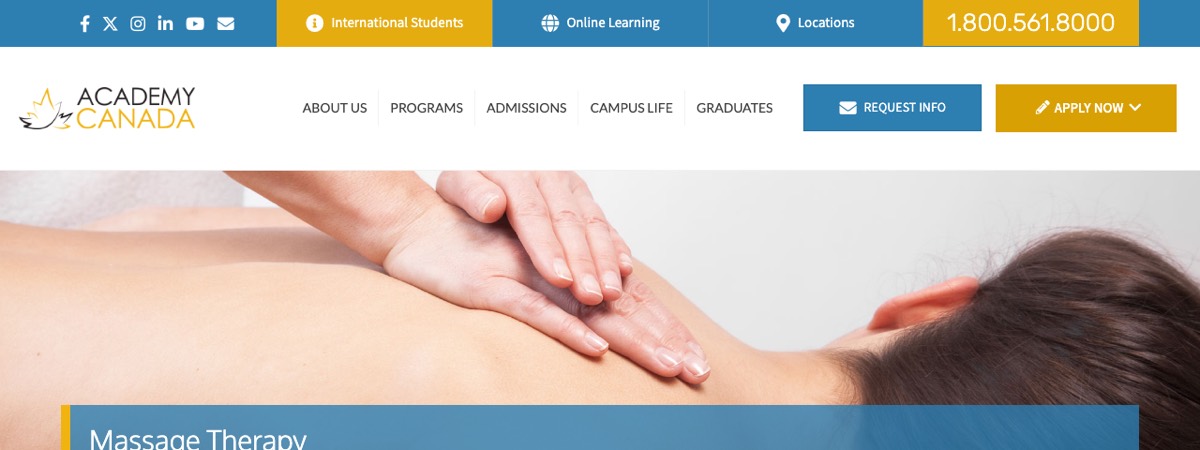
Massage Therapy at Academy Canada Career College is an 88 week in person program in Newfoundland and Labrador that awards a Diploma of Health and Human Sciences.
| Provider | Academy Canada Career College |
|---|---|
| Length | 88 weeks |
| Credential | Diploma of Health and Human Sciences |
| Format | in person, NL |
Fiona's take: Newfoundland and Labrador is listed as a regulated province; confirm with the provincial college that this specific Academy Canada diploma meets registration requirements before paying tuition. Tuition is not listed in our data. At 88 weeks it is close to the standard 2-year length.
Skip it if: Skip it if you live outside Atlantic Canada; this is in-person training.
See Program DetailsMassage Therapy
Massage Therapy at Humber Polytechnic is a 6 semester in person advanced diploma program in Ontario.
| Provider | Humber Polytechnic |
|---|---|
| Length | 6 semesters |
| Credential | Advanced Diploma |
| Format | in person, ON |
Fiona's take: This is the model Ontario route: a college diploma, then the CMTO's MCQ and OSCE. Ontario diploma programs in massage therapy run through colleges of applied arts and technology and career colleges approved by the Ontario Ministry of Colleges and Universities. Tuition is not listed in our data, so request the current fee sheet directly from Humber.
Skip it if: Skip it if six semesters in Toronto does not fit your life.
See Program DetailsRaynor Online Massage Courses in Canada
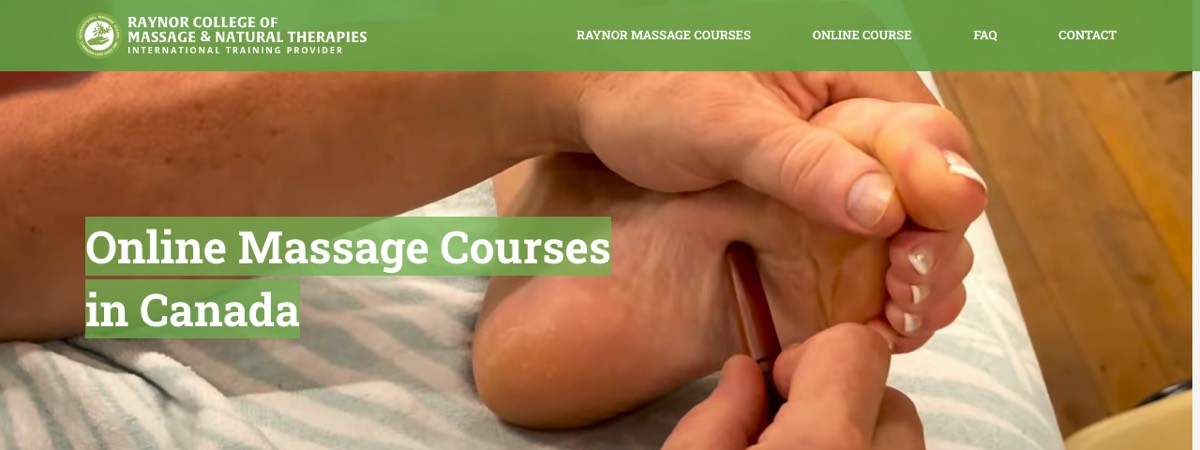
Raynor Online Massage Courses in Canada is an online offering from Raynor Massage Canada with no listed length, cost or credential.
| Provider | Raynor Massage Canada |
|---|---|
| Format | online |
Fiona's take: Raynor teaches a distinct style of bodywork, but our data lists no hours, price or credential for this course. As an online offering it cannot meet the in-person supervised clinical-hour requirements regulators such as the CMTO set. Ask for length, cost and recognition details in writing before you pay anything.
Skip it if: Skip it if RMT registration is your goal.
See Program DetailsHow Much Does Massage Therapy Training Cost In Canada?
Massage therapy training costs divide into tuition, which neither Humber nor Academy Canada lists in our data, and regulator fees, which are published. Here are the regulator fees listed in our data.
| Fee Item | Cost (CAD) | Who Charges It |
|---|---|---|
| MCQ exam fee | $681.11 | CMTO (Ontario) |
| OSCE exam fee | $958 | CMTO (Ontario) |
| Initial application (proposed reduction) | $225 | CMTO (Ontario) |
| General Certificate renewal (2026) | $915 | CMTO (Ontario) |
| Full licence examination (each attempt) | $1,970 | CCHPBC (British Columbia) |
| Practising licence application | $225 | CCHPBC (British Columbia) |
| Annual renewal (practising, stage one) | $890 | CCHPBC (British Columbia) |
| Diploma tuition | Not listed | Humber, Academy Canada |
Ontario's MCQ and OSCE fees total $1,639.11. In BC, the CCHPBC fee is listed per attempt, at $1,970 for the full licence examination. Add insurance and a police check, which the regulators require but do not price in our data.
Fees continue after registration. Ontario's General Certificate renewal is $915 for 2026, and BC's practising renewal at stage one is $890 a year. Weigh that against the median wage before you commit, which I cover next.
How Much Does A Massage Therapist Earn In Canada?
A massage therapist in Canada earns a median of $32,867 a year under NOC 32201, according to Job Bank's 2025 wage data. The spread between provinces is wide.
| Province | Median Annual Wage (CAD) |
|---|---|
| Canada | $32,867 |
| British Columbia | $43,600 |
| Prince Edward Island | $40,800 |
| Ontario | $38,308 |
| Newfoundland and Labrador | $36,400 |
| Nova Scotia | $36,193 |
| Quebec | $34,137 |
| New Brunswick | $34,016 |
| Alberta | $32,867 |
Among the provinces listed, British Columbia reports $43,600, with PEI at $40,800 and Ontario at $38,308 behind it. Alberta's $32,867 matches the national median exactly. These are medians for NOC 32201, so half of practitioners earn less.
Job Bank rates the outlook Good in most provinces and Moderate in British Columbia and Manitoba. Read that pairing honestly: BC pays the most on paper among the provinces listed while its outlook is rated Moderate. For planners, Ontario combines a $38,308 median with the CMTO's clear registration path.
Is Massage Therapy Worth It In 2026?
Massage therapy in 2026 is worth it for two kinds of people. The first wants a regulated credential: in British Columbia, Ontario, New Brunswick, Newfoundland and Labrador or PEI, registration defines the profession and the path is clear, roughly 2,200 hours plus exams. The second wants flexibility in a province with no regulator, where no registration gates entry.
Run the numbers before enrolling. A $32,867 national median sits against two years of full-time study, plus tuition and regulator fees: $1,639.11 in Ontario exams and $915 in annual CMTO renewal. BC's $43,600 median softens the case in the west, and PEI's $40,800 does the same in the Maritimes.
My honest test: spend one week on Science of Exercise first. If the physiology holds your attention for 10 hours a week, a 2,200-hour diploma is a reasonable bet. If it does not, you have learned that in one week instead of two years.
Massage Therapy Questions Canadians Ask
How Long Does It Take To Become A Massage Therapist In Canada?
Becoming a massage therapist in Canada takes about 2 years of full-time diploma study, roughly 2,200 hours, plus exams and registration processing. Ontario's jurisprudence module adds just 4 hours and is free. Exams run multiple times a year, so your timeline depends partly on sitting dates with the CMTO or CCHPBC.
Is Massage Therapy Regulated In All Canadian Provinces?
Massage therapy regulation stops at five provinces. As of 2026, British Columbia, Ontario, New Brunswick, Newfoundland and Labrador and Prince Edward Island have regulatory colleges; BC registrants answer to the CCHPBC and Ontario registrants to the CMTO. In the remaining provinces and territories, no registration is mandatory and associations are voluntary.
What Exams Are Required To Become An RMT In Ontario?
Ontario requires two CMTO certification exams, both administered by Prometric: the written MCQ at $681.11 and the practical OSCE at $958, totalling $1,639.11. British Columbia takes a different route with the CKT, PBA and LEP, and the CCHPBC full licence examination costs $1,970 per attempt.
What Is The Median Wage For Massage Therapists In Canada?
The median wage for massage therapists in Canada is $32,867 a year under NOC 32201, based on Job Bank's 2025 wage data. Provinces vary widely: British Columbia reports $43,600, PEI $40,800 and Ontario $38,308, while Alberta matches the national median at $32,867.
Do I Need A Diploma To Practise Massage Therapy?
A diploma is required in the five regulated provinces: British Columbia, Ontario, New Brunswick, Newfoundland and Labrador and PEI. Recognized programs typically run 2,200 hours or more over about 2 years, delivered in person with supervised clinical hours. Online certificates from Coursera or Udemy do not satisfy the registration requirements in regulated provinces.
Can I Transfer My RMT Registration Between Provinces?
Transfers between provinces work under the Canadian Free Trade Agreement. In Ontario, registered therapists from provinces or territories that regulate massage therapy can register by completing the jurisprudence program and registration; our data notes exams are often waived under CFTA, but requirements vary. Fees still apply, including the $225 application.
What Are The Renewal Fees For RMTs In Ontario And BC?
Renewal fees for RMTs differ by province. Ontario's CMTO charges $915 for General Certificate renewal in 2026. British Columbia's CCHPBC charges $890 for the annual practising renewal at stage one. Neither figure includes insurance or continuing education, so budget those separately.
Is Online Massage Therapy Training Sufficient For RMT Registration?
Online massage therapy training is not sufficient for RMT registration. Regulators require in-person programs with supervised clinical hours from recognized institutions; confirm any specific Humber or Academy Canada program with the relevant regulator before enrolling. Coursera courses build useful background knowledge, but no regulatory college accepts them toward registration.
What's The Bottom Line On Massage Therapy Classes In Canada?
- Massage therapy is regulated in five provinces as of 2026, British Columbia, Ontario, New Brunswick, Newfoundland and Labrador and PEI; everywhere else, no registration is required.
- The credential route is a 2-year diploma of roughly 2,200 hours plus exams: $1,639.11 in Ontario, $1,970 per attempt in BC.
- Science of Exercise is a 1-week University of Colorado Boulder course that tests your interest in the science before you commit; it grants no registration.
- Job Bank's median for NOC 32201 is $32,867; among the provinces listed, Alberta is $32,867 and British Columbia is $43,600.
- Online classes never replace the in-person diploma where regulation applies; they tell you whether to enrol.