
Key Takeaways
- The fastest realistic route is a registered apprenticeship: 4 to 5 years, roughly $1,000 to $6,000 in total school fees, and you are paid on the job the whole way.
- A licence is compulsory in Ontario through Skilled Trades Ontario (trade 309A), in British Columbia through SkilledTradesBC, in Alberta through Apprenticeship and Industry Training, and in Quebec through the CCQ.
- Coursera's Electrical Power Distribution from L&T EduTech runs 1 week at 10 hours a week and is a quick way to test the field, but it does not qualify you for provincial certification, apprenticeship hours, or Red Seal exam eligibility.
- Electricians (NOC 72200) earn a median of $35.00 an hour in Canada, from $20.00 at the low end to $48.00 at the high end.
- Fiona's verdict: the apprenticeship suits anyone ready to commit 4 to 5 years for strong pay and low debt, while a college certificate such as George Brown's T167 at $5,313 suits applicants who cannot yet get a sponsor to sign.
An electrician in Canada is a skilled tradesperson who installs, maintains, and repairs electrical systems in buildings and structures, classified as NOC 72200 and licensed through a provincial apprenticeship, a Certificate of Qualification, and an optional Red Seal endorsement.
The realistic route is a 4 to 5 year registered apprenticeship with roughly $1,000 to $6,000 in total school fees, paid the whole way. Online courses still have a real role: not as licence shortcuts, but as a quick way to test the trade before you commit.
What Are The Ways To Become An Electrician In Canada?
The ways to become an electrician in Canada come down to four: an online theory course to test the field, a registered apprenticeship, a college pre-apprenticeship program, and the trade qualifier challenge for experienced workers.
| Route | Time | Cost (CAD) | What You Get | Recognised By | Best For |
|---|---|---|---|---|---|
| Electrical Power Distribution (online theory) | 1 week | Not listed | Coursera certificate of completion | No regulator; not a trade credential | Testing the field before committing |
| Registered apprenticeship | 4-5 years | ~$1,000-$6,000 school fees | Certificate of Qualification + Red Seal | All provinces via Red Seal | Fastest route once you have a sponsor |
| College pre-apprenticeship, e.g. Electrical Techniques | 1 year | $5,000-$15,000 | Certificate or diploma | Helps secure an apprenticeship sponsor | Applicants without an employer contact |
| Trade qualifier / challenge | Varies; typically 1.5x apprenticeship hours | $100-$450 application + exam | Certificate of Qualification | Provincial regulator | Experienced but uncertified workers |
I recommend the registered apprenticeship for anyone who can get an employer or union to sign, and a college Electrical Techniques certificate first for anyone who cannot yet get that signature.
What Is The Fastest Way To Become An Electrician In Canada?
The fastest way to become a certified electrician in Canada is the registered apprenticeship, and there is no way around its 4 to 5 year length. What makes it fastest is the money: you are paid on the job and total school fees run roughly $1,000 to $6,000.
- Finish high school with math and science and pick up safety tickets such as WHMIS and Working at Heights. Timing varies, often during or after high school, and costs run low to $500.
- Find an employer or union sponsor and register the training agreement with your provincial authority, for example Skilled Trades Ontario. Allow 1 to 6 months and $0 to $100 to register.
- Log the hours and the classroom levels: Ontario's 309A requires 8,160 on-the-job hours plus 840 to 1,050 in-school hours over 4 to 5 years, with school fees only, roughly $1,000 to $6,000 total.
- Book and pass the Certificate of Qualification or Red Seal exam after your levels. Skilled Trades Ontario charges $150 plus HST.
- Already experienced but uncertified? The trade qualifier path asks for typically 1.5 times the apprenticeship hours, and challenge applications and exams run $100 to $450. In Ontario, Skilled Trades Ontario's Trade Equivalency Assessment adds $235 plus HST.
Do You Need A Licence To Work As An Electrician In Canada?
A licence is required to work as an electrician in the four provinces clients ask me about most: the trade is compulsory in Ontario, British Columbia, Alberta, and Quebec, each under its own regulator.
| Province | Required? | Regulator Or Registry | What It Means |
|---|---|---|---|
| Ontario | Yes, compulsory | Skilled Trades Ontario (STO) | Electrician Construction and Maintenance (309A) requires a registered training agreement, a provisional certificate, or a Certificate of Qualification |
| British Columbia | Yes, compulsory | SkilledTradesBC | Compulsory since the December 2022 Skilled Trades Certification rules |
| Alberta | Yes, compulsory | Alberta Apprenticeship and Industry Training (AIT) | A Certificate of Qualification or registered apprentice status is required |
| Quebec | Yes, compulsory | Commission de la construction du Québec (CCQ) | Compulsory, through the CCQ or an electricity certificate |
No online course on this page grants that licence. Electrical Power Distribution does not qualify you for provincial electrician certification, apprenticeship hours, or Red Seal exam eligibility. The licence comes from the regulator, after a registered training agreement, completed hours, in-school levels, and a passed exam.
The Certificate of Qualification is the provincial credential, and the Red Seal endorsement on top of it is recognised in all provinces. In-school training at a deliverer such as Lambton College is a component of the apprenticeship, not a separate licence, and the Ontario exam fee is $150 plus HST.
Which Electrician Courses Are Worth Taking In Canada?
The electrician courses worth taking in Canada depend on your stage: Coursera for a first look at the field, Udemy for short primers, college programs for a sponsor-ready certificate, and exam prep once you are eligible to challenge.
Electrical Power Distribution
Electrical Power Distribution is a 1 week online course at 10 hours a week from L&T EduTech on Coursera that covers how power distribution works, rated 4.5 from 157 reviews.
| Provider | Coursera |
|---|---|
| Length | 1 week at 10 hours a week |
| Rating | 4.5 (157 reviews) |
| Credential | Coursera certificate of completion |
| Format | online |
Fiona's take: Fiona's take: this is the fastest decision filter I know for this trade. One week tells you whether the theory grips you before you spend $5,313 on a college certificate or commit to 8,160 on-the-job hours. Be clear eyed about the limit: you finish with a Coursera certificate of completion, not a licence.
Skip it if: Skip it if you already hold a registered training agreement, because you now need hours and in-school levels, not another completion certificate.
Theory only; apprenticeship hours and the Certificate of Qualification are still required.
Start On CourseraLinear Circuits 1: DC Analysis
Linear Circuits 1: DC Analysis is a 2 month online course at 10 hours a week from the Georgia Institute of Technology on Coursera that teaches direct-current circuit analysis, rated 4.5 from 1,493 reviews.
| Provider | Georgia Institute of Technology on Coursera |
|---|---|
| Length | 2 months at 10 hours a week |
| Rating | 4.5 (1,493 reviews) |
| Credential | Coursera certificate of completion |
| Format | online |
Fiona's take: This is university-grade circuit theory, and it maps to the classroom side of your in-school levels. I suggest it to clients who want first-level technical training to feel familiar rather than alien. It builds analysis skills, not apprenticeship hours.
Skip it if: Skip it if your goal is the licence rather than deep theory, since Georgia Tech grades circuits, not 309A competencies.
Start On CourseraElectrical Course 101
Electrical Course 101 is a 15 hour 1 minute video course from Udemy that covers entry-level electrical concepts, rated 4.4 from 728 ratings.
| Provider | Udemy |
|---|---|
| Length | 15h 1m of video |
| Rating | 4.4 (728 ratings) |
| Credential | Udemy certificate |
| Format | online |
Fiona's take: Fifteen hours of video at 4.4 from 728 ratings is a fair primer. I would use it in the month before a pre-apprenticeship program, so the basic concepts arrive familiar rather than foreign. It carries no weight with any provincial regulator.
Skip it if: Skip it if you want a credential an employer recognises, because a Udemy certificate counts with none of them.
View On UdemyElectrical Wiring Course II
Electrical Wiring Course II is a 3 hour video course from Udemy that covers practical wiring methods, rated 4.7 from 1,692 ratings.
| Provider | Udemy |
|---|---|
| Length | 3 hours |
| Rating | 4.7 (1,692 ratings) |
| Credential | Udemy certificate |
| Format | online |
Fiona's take: Three hours, 4.7 stars from 1,692 ratings: the strongest rated item on this page. It works as a preview before a college program or a refresher for a helper role. Nothing here counts toward a Certificate of Qualification.
Skip it if: Skip it if you are already a registered apprentice, since your in-school levels cover wiring with certified instructors.
View On UdemyElectrical Techniques (T167)
Electrical Techniques (T167) is a 2 semester in-person program from George Brown Polytechnic in Ontario that costs $5,313 in domestic tuition and awards an Ontario College Certificate.
| Provider | George Brown Polytechnic |
|---|---|
| Length | 2 semesters |
| Cost (CAD) | $5,313 domestic tuition |
| Credential | Ontario College Certificate |
| Format | in person, ON |
Fiona's take: This certificate gives applicants something concrete to show employers when asking for a training agreement signature, and $5,313 sits at the low end of the $5,000 to $15,000 college range. I recommend it for Ontarians with no industry contacts. It does not shorten the apprenticeship itself.
Skip it if: Skip it if a sponsor has already signed, because a training agreement starts your 8,160 paid hours immediately.
See Program DetailsElectrical Techniques
Electrical Techniques is a 2 semester in-person program from Humber Polytechnic in Ontario that costs $7,044.68 domestic for two semesters and awards an Ontario College Certificate.

| Provider | Humber Polytechnic |
|---|---|
| Length | 2 semesters |
| Cost (CAD) | $7,044.68 domestic for two semesters |
| Credential | Ontario College Certificate |
| Format | in person, ON |
Fiona's take: Humber awards the same Ontario College Certificate as George Brown, at $7,044.68 against $5,313, so choose on campus, schedule, and employer connections rather than brand. Both run in person over 2 semesters. Neither replaces the 8,160 on-the-job hours.
Skip it if: Skip it if tuition is the deciding factor and George Brown's $5,313 option is open to you.
See Program DetailsElectrical Foundation
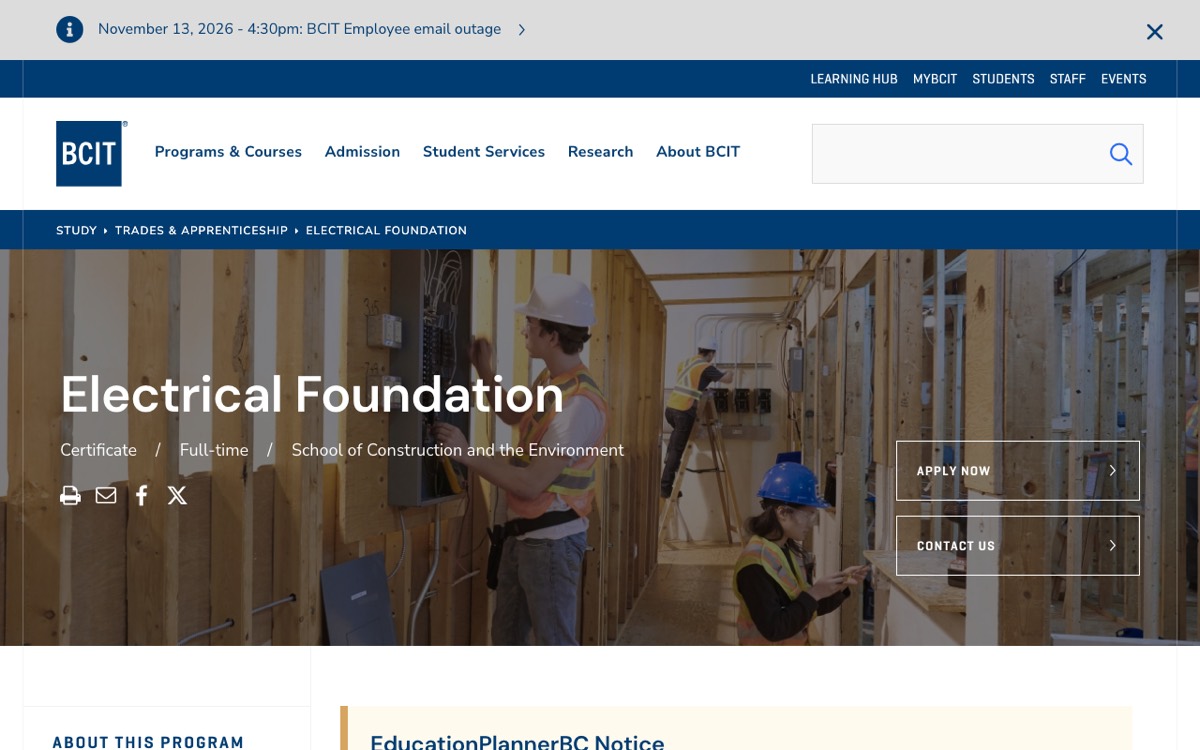
Electrical Foundation is a full-time in-person certificate program from BCIT in British Columbia that prepares students to enter an electrical apprenticeship; length and fees are not listed.
| Provider | BCIT |
|---|---|
| Length | 24 weeks, full-time |
| Credential | Certificate |
| Format | in person, BC |
Fiona's take: For British Columbians, a foundation program can help secure an apprenticeship sponsor before SkilledTradesBC registration, which has been compulsory since December 2022. BCIT's name carries weight with BC employers. Confirm length and fees directly with BCIT before applying.
Skip it if: Skip it if you cannot attend in person in British Columbia.
See Program DetailsConstruction/Industrial Electrician
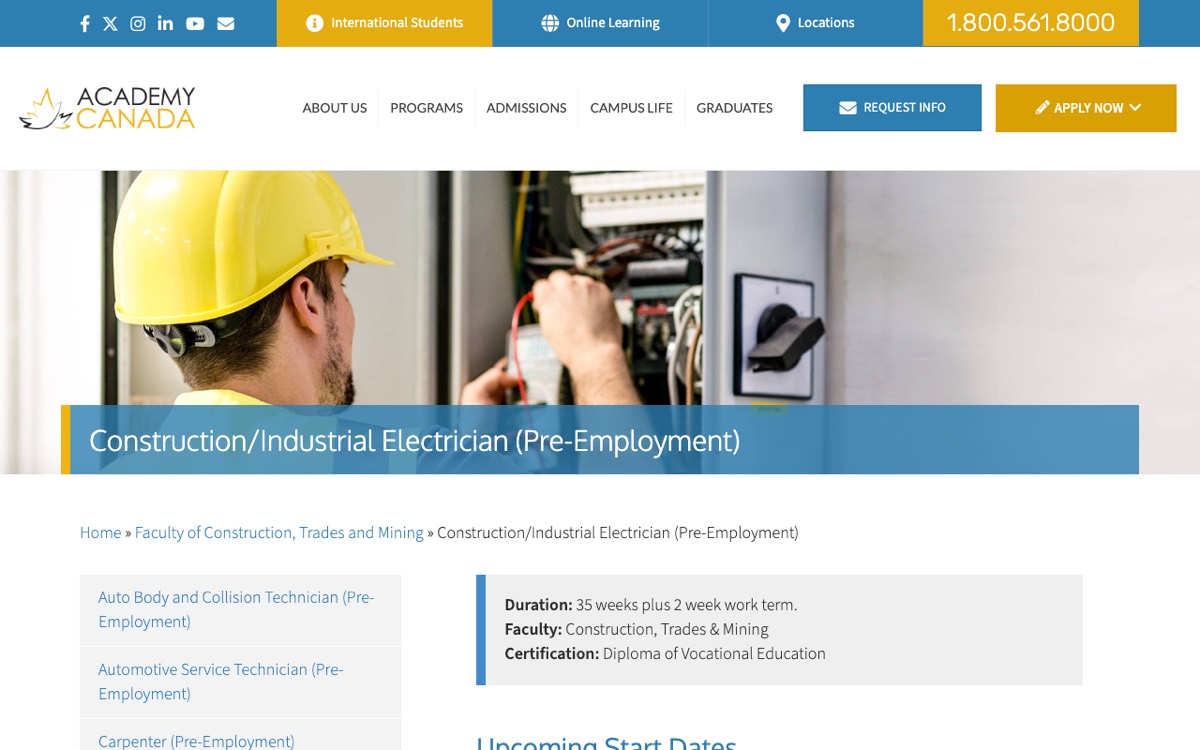
Construction/Industrial Electrician is a 35 week in-person diploma program from Academy Canada in Newfoundland and Labrador that includes a 2 week work term.
| Provider | Academy Canada |
|---|---|
| Length | 35 weeks plus a 2-week work term |
| Credential | Diploma |
| Format | in person, NL |
Fiona's take: The 2 week work term is the valuable part: it puts you in front of an employer who might sponsor the next stage. At 35 weeks plus the work term, this is the Newfoundland and Labrador route, not a national one.
Skip it if: Skip it if you are in Ontario, where the 309A apprenticeship through Skilled Trades Ontario is the direct route to the Certificate of Qualification.
See Program DetailsElectrician Distance Learning Course
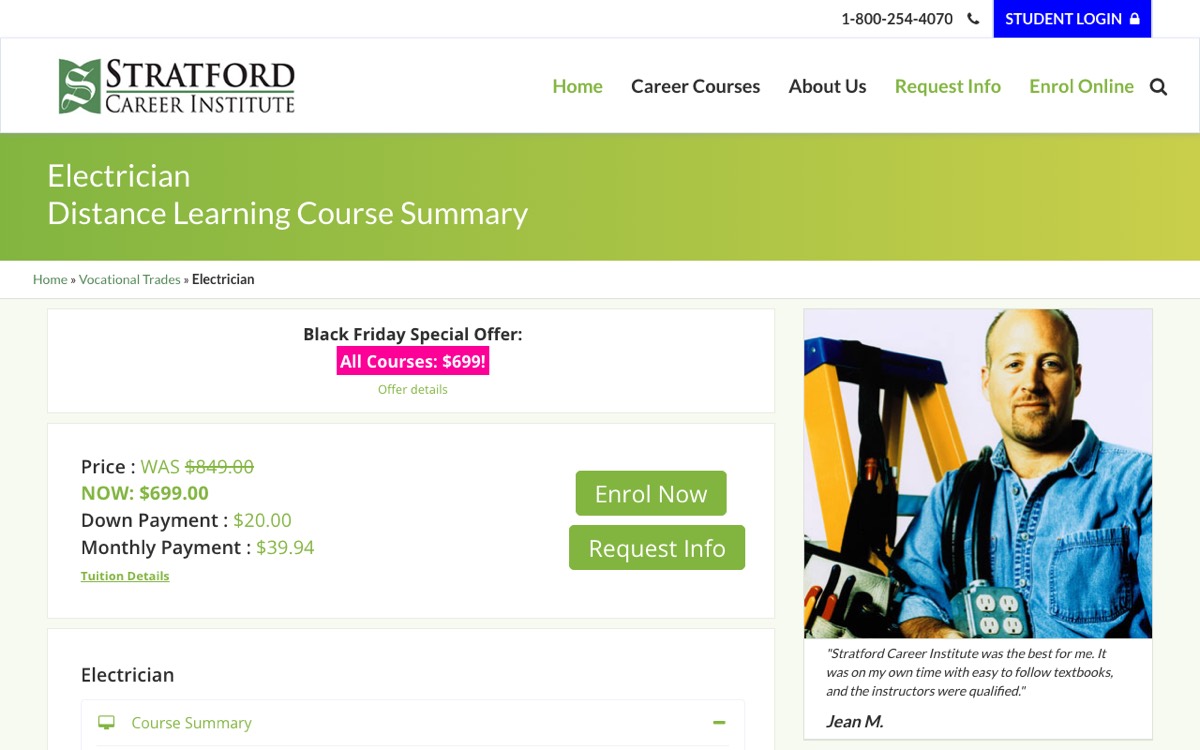
The Electrician Distance Learning Course is an online course from Stratford Career Institute that costs $849 at list price and awards a course diploma, not a trade certificate.
| Provider | Stratford Career Institute |
|---|---|
| Cost (CAD) | $849 list price |
| Credential | Course diploma (not a trade certificate) |
| Format | online |
Fiona's take: The credential here is a course diploma, not a trade certificate. At $849 it costs more than Canny College's $800 exam prep, which at least points at a real Certificate of Qualification exam. Treat it as vocabulary building for hobbyists and the curious.
Skip it if: Skip it if certification is your goal, because the $849 buys knowledge, not a licence.
See Program DetailsElectrician Construction & Maintenance 309A Red Seal Exam Prep
Electrician Construction & Maintenance 309A Red Seal Exam Prep is an online exam preparation course from Canny College in Ontario that costs $800.

| Provider | Canny College |
|---|---|
| Cost (CAD) | $800 |
| Credential | Exam prep |
| Format | online, ON |
Fiona's take: This is the right course at the right stage: after the 9,000 hours, before the exam. Add Skilled Trades Ontario's $150 plus HST exam fee to the $800 when you budget. Prep cannot substitute for required hours, so confirm eligibility first.
Skip it if: Skip it until you are exam-eligible, because prep without the hours leads nowhere.
See Program DetailsHow Much Does Electrician Training Cost In Canada?
Electrician training in Canada spans from roughly $1,000 to $6,000 in total apprenticeship school fees to $7,044.68 for two semesters at Humber Polytechnic, with the college route listed at $5,000 to $15,000 overall.
| Item | Cost (CAD) | Notes |
|---|---|---|
| Registered apprenticeship, total in-school fees | ~$1,000-$6,000 | Fees only; the job pays you |
| Lambton College 309A in-school blocks | ~$10/day, some levels waived | Part of the Ontario apprenticeship |
| George Brown Electrical Techniques (T167) | $5,313 | Domestic tuition, 2 semesters |
| Humber Electrical Techniques | $7,044.68 | Domestic, two semesters |
| Academy Canada Construction/Industrial Electrician | Not listed | 35 weeks plus a 2 week work term |
| BCIT Electrical Foundation | Not listed | Confirm current figures with BCIT |
| Stratford distance course | $849 | List price; diploma is not a trade certificate |
| Canny College 309A exam prep | $800 | Online, Ontario |
| Skilled Trades Ontario C of Q / Red Seal exam | $150 + HST | Written after your training levels |
| Skilled Trades Ontario Trade Equivalency Assessment | $235 + HST | For trade qualifiers |
| Trade qualifier application + exam | $100-$450 | Varies by regulator |
| Coursera Electrical Power Distribution | Not listed | 1 week theory course |
The spread between routes is the whole story. An apprentice pays roughly $1,000 to $6,000 in total school fees across 4 to 5 years, while a pre-apprenticeship college certificate runs $5,000 to $15,000 before you have earned a single paid hour. George Brown charges $5,313 and Humber $7,044.68 for the same two semester Ontario College Certificate, so price-shop before enrolling.
Ontario's regulator fees are modest once you arrive: $150 plus HST for the Certificate of Qualification exam, and $235 plus HST if you enter through the Trade Equivalency Assessment. Online extras, from Stratford's $849 diploma to Canny's $800 prep, are optional, and none replace the regulator's fees.
How Much Does An Electrician Earn In Canada?
An electrician earns a median of $35.00 an hour in Canada under NOC 72200, with a low of $20.00 and a high of $48.00.
| Region | Hourly Wage (CAD) |
|---|---|
| Canada | $20.00 low / $35.00 median / $48.00 high |
| Alberta | $37.32-$38.00 |
| British Columbia | $34.00-$35.44 |
| Ontario | $34.00 |
| Quebec | $41.15-$41.30 |
| Saskatchewan | $37.00-$37.50 |
| Manitoba | $35.00-$36.15 |
The Job Bank outlook for NOC 72200 is positive, with job openings in construction and maintenance. Quebec posts the strongest rates at $41.15 to $41.30, Alberta follows at $37.32 to $38.00, and Saskatchewan at $37.00 to $37.50. Ontario's $34.00 sits below the national median of $35.00, which surprises many of my Ontario clients.
Because the trade is compulsory in Ontario, BC, Alberta, and Quebec, working legally requires registration or certification, and the Red Seal endorsement lets the Certificate of Qualification travel. That portability matters when Quebec pays $41.15 and Ontario pays $34.00 for the same NOC 72200 work.
Is Becoming An Electrician Worth It In 2026?
Becoming an electrician in 2026 is worth it for anyone who can commit the years. The Job Bank outlook for NOC 72200 is positive, median pay is $35.00 with a high of $48.00, and compulsory status in Ontario, BC, Alberta, and Quebec keeps unqualified workers out of the legal market. Few careers pay this well for $1,000 to $6,000 in training fees.
The honest catch is time. Ontario's 309A asks for 9,000 total hours, 8,160 on-the-job plus 840 to 1,050 in-school, and Lambton College describes the program as typically five years. Anyone selling you a faster online route to a licence is selling something Skilled Trades Ontario does not recognise.
Start with the quick test. Electrical Power Distribution takes one week at 10 hours a week and shows you the theory before the commitment. If power distribution bores you at 10 hours a week, the apprenticeship will bore you at 8,160 hours, and that is worth knowing for the price of a week.
Can You Get Funding For Electrician Training In Canada?
Yes, funding for electrician training in Canada exists at the federal level, and these two programs are the ones I raise with apprentice clients first.
- Canada Apprentice Loan. Up to $4,000 in interest-free loans per period of technical training, with a lifetime maximum of $20,000. This is a loan and it must be repaid. Against total school fees of roughly $1,000 to $6,000, it can carry an apprentice through the in-school blocks.
- Canadian Apprenticeship Strategy. Grants and program funding flow through the Canadian Apprenticeship Strategy. This is project funding rather than money paid directly to individual apprentices, so check the current funding streams before each school block.
Electrician Course Questions Canadians Ask
How Many Hours Is The 309A Electrician Apprenticeship In Ontario?
The 309A electrician apprenticeship in Ontario totals 9,000 hours: 8,160 on-the-job plus 840 to 1,050 in-school. Lambton College, one in-school deliverer, notes the program typically takes five years to complete, consisting of 8,160 hours of on-the-job training and 840 hours of in-school training.
Is Electrician A Compulsory Trade In BC?
Electrician is compulsory in BC, and has been since the December 2022 Skilled Trades Certification rules made it so. SkilledTradesBC is the regulator, which means you must be registered or certified to work legally in the province. Anyone selling a licence-free shortcut in British Columbia is selling something the province does not recognise.
Can I Become An Electrician In Canada With An Online Course?
An online course alone cannot make you a licensed electrician in Canada. Coursera's Electrical Power Distribution, for example, does not qualify you for provincial certification, apprenticeship hours, or Red Seal exam eligibility. The trade is compulsory in Ontario, British Columbia, Alberta, and Quebec, so the path still runs through a registered apprenticeship with a regulator such as Skilled Trades Ontario or SkilledTradesBC.
What Does The Red Seal Exam Cost In Ontario?
The Red Seal or Certificate of Qualification exam in Ontario costs $150 plus HST through Skilled Trades Ontario. If you arrive as a trade qualifier rather than a registered apprentice, add the $235 plus HST Trade Equivalency Assessment first. Budget exam prep separately if you want it, such as Canny College's $800 online 309A course.
How Much Do Electricians Make In Canada?
Electricians in Canada earn a median of $35.00 an hour under NOC 72200, with a low of $20.00 and a high of $48.00. Quebec posts the strongest rates at $41.15 to $41.30, while Ontario lists $34.00. The Job Bank outlook is positive, with openings in construction and maintenance.
Can I Challenge The Electrician Exam Without An Apprenticeship?
Challenging the exam without a completed apprenticeship is possible through the trade qualifier route, but regulators want substantial proof: typically 1.5 times the apprenticeship hours. Skilled Trades Ontario runs a Trade Equivalency Assessment at $235 plus HST, and challenge applications and exams run $100 to $450. The credential at the end is the same Certificate of Qualification.
Does The Government Help Pay For Apprenticeship Training?
The government does help pay for apprenticeship training. The Canada Apprentice Loan offers up to $4,000 in interest-free loans per period of technical training, with a lifetime maximum of $20,000, and it must be repaid. The Canadian Apprenticeship Strategy provides grants and project funding rather than money paid directly to individual apprentices. School fees run roughly $1,000 to $6,000.
What's The Bottom Line On Electrician Courses In Canada?
- Online electrician courses teach theory and vocabulary; only a registered apprenticeship or the trade qualifier route, through a regulator such as Skilled Trades Ontario, SkilledTradesBC, AIT, or the CCQ, produces a licence.
- The cheapest credible path is the apprenticeship itself: 4 to 5 years, roughly $1,000 to $6,000 in school fees, paid on the job.
- Test the trade first with Electrical Power Distribution: 1 week at 10 hours a week, rated 4.5 from 157 reviews, and honest about granting no certification.
- Electricians (NOC 72200) earn a median of $35.00 an hour in Canada, and Quebec pays $41.15 to $41.30.
- If no sponsor will sign you yet, George Brown's T167 at $5,313 or Humber at $7,044.68 buys an Ontario College Certificate that opens employer doors.