Key Takeaways
- The fastest realistic route is the CPTG-aligned 30-hour certificate program at about 3 weeks for roughly $1,500, then CPTG membership at $129 and the CPT exam at $339 as a member, and you can be applying to NOC 33101 phlebotomist jobs.
- Phlebotomy work is not regulated nationally, so no licence is required. Phlebotomy is a controlled act in Ontario but can be performed by unregulated workers in licensed labs, and the CPTG CPT credential is voluntary. The BC MLA route is different: WorkBC states MLAs in BC must be certified by BCSLS.
- Try the field first with Phlebotomy Basics, a 6-hour online Coursera course from MedCerts. It does not qualify you for the CPTG CPT credential or for any job on its own.
- Job Bank reports a median wage of $27.00 per hour for NOC 33101 across Canada, ranging from $19.18 at the low end to $36.11 at the high end, with a strong national risk of labour shortage through 2033.
- Fiona's verdict: phlebotomy suits people who want patient-facing healthcare work in weeks rather than years, especially in Quebec ($29.02 median) or Alberta ($28.62 median), provided they can handle hands-on training and an in-person exam.
A phlebotomist is a healthcare professional who obtains blood specimens from patients, performing venipuncture, micro-collection and specimen processing while protecting patient safety and confidentiality. In Canada you do not legally need a licence to do this work, and the shortest credible route is a 30-hour CPTG-aligned certificate at about $1,500, followed by the CPTG CPT exam.
Most employers prefer certified candidates, so a hands-on program plus CPTG certification may strengthen your applications. Before spending that money, I tell clients to test the field with a few hours of online theory so they know the vocabulary and the day-to-day realities first.
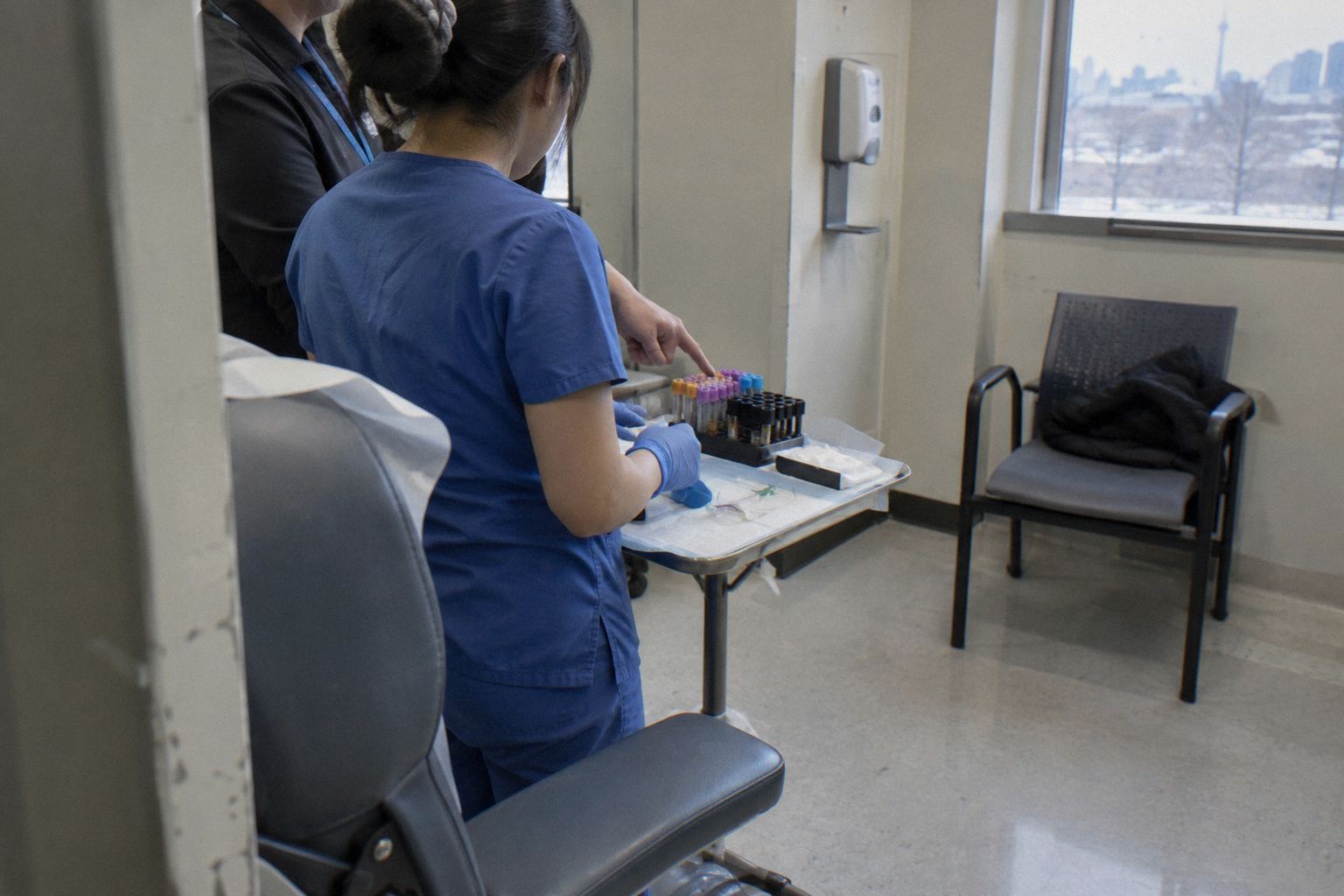
What Are The Ways To Become A Phlebotomist In Canada?
There are two main routes to the work: a short CPTG-aligned certificate route and a fuller Medical Laboratory Assistant certificate route. Workshops can be useful tasters or refreshers.
| Route | Time | Cost (CAD) | What You Get | Recognised By | Best For |
|---|---|---|---|---|---|
| Phlebotomy Fundamentals plus a hands-on program later | 12 weeks at 2 hours a week | Not listed | A career certificate from MedCerts and a real sense of the field before you spend more | Coursera and MedCerts (no Canadian certification) | Anyone unsure whether phlebotomy suits them |
| CPTG-aligned short phlebotomy certificate plus CPT exam (Medical Training Center) | 3 weeks / 30 hours | $1,500 | MTC Micro-Credential and preparation for the CPTG CPT exam | Canadian Phlebotomy Technicians Group Inc. (CPTG) | Career changers who want the fastest job-ready path |
| Medical Laboratory Assistant certificate program, e.g. Edison College Canada in Victoria, BC | 36 weeks including practicum | Varies (college tuition) | MLA certificate and eligibility to apply to register with BCSLS | BC Society of Laboratory Science (BCSLS); employers | People who want a broader lab career, not just blood collection |
I recommend the Coursera fundamentals course first for anyone who has never worked in healthcare, the Medical Training Center route for career changers who want speed, and the Edison College MLA program for students in BC who want a wider lab scope.
What Is The Fastest Way To Become A Phlebotomist In Canada?
The fastest realistic route runs about 3 weeks of training plus one exam sitting, and it stacks three fees: $1,500 for the program, $129 for CPTG membership and $339 for the CPT exam as a member.
- Complete the 30-hour CPTG-aligned phlebotomy certificate program through the Medical Training Center, online classes plus two full days of hands-on lab training, about 3 weeks at $1,500.
- Become a CPTG member, which is immediate upon application, for $129.
- Pass the CPT exam, a theory plus practical OSCE format, at the next available sitting such as November 2026 or March 2027, for $339 as a member.
- Apply for phlebotomist jobs under NOC 33101, which costs nothing beyond your time.
- Optional for newcomers: if you already hold a foreign degree, diploma or work experience as a phlebotomist, CPTG will assess your credentials and experience for exam eligibility instead of requiring the full course.
Do You Need A Licence Or Certification To Work As A Phlebotomist In Canada?
Phlebotomy work is not regulated nationally, so no province requires phlebotomists to be licensed or registered with a regulator. The BC MLA route is different: WorkBC states MLAs in BC must be certified by BCSLS. Most employers prefer candidates with CPTG or equivalent certification, so treat the voluntary credential as highly recommended.
| Province | Required? | Regulator Or Registry | What It Means |
|---|---|---|---|
| Ontario | No | CMLTO covers Medical Laboratory Technologists; phlebotomy is a controlled act under the RHPA | Phlebotomy is a controlled act in Ontario, but it can be performed by unregulated workers employed by a licensed laboratory or specimen collection centre |
| British Columbia | No, voluntary for MLAs | BC Society of Laboratory Science (BCSLS) | WorkBC states medical laboratory assistants in BC must be certified by BCSLS, so in practice BC employers expect it |
| Canada generally | No | None; voluntary CPTG certification | Laboratory technicians and assistants are not regulated in Canada, so no registration with a provincial or territorial regulatory authority is required |
The phrase to remember is voluntary but highly recommended. The Canadian Phlebotomy Technicians Group (CPTG) awards the Certified Phlebotomy Technician (CPT) title after you pass both the theory and practical components of its exam, and that credential is the primary voluntary national certification employers look for.
In BC, the Medical Laboratory Assistant path is different: WorkBC states MLAs in BC must be certified by BCSLS, and graduates of programs like the Edison College MLA certificate can apply to register with BCSLS. If you plan to work in BC specifically, compare the MLA route with the shorter CPTG route before enrolling.
Which Phlebotomy Courses In Canada Are Worth Taking?
I group the worthwhile options into three tiers: quick online theory to test the field, short hands-on programs that prepare you for the CPTG exam, and full MLA programs for a broader lab career. MedLabTech Academy in Mississauga also runs a blended CPD route with 28 to 32 hours of online theory plus 6 hours hands-on.
Phlebotomy Fundamentals
Phlebotomy Fundamentals is a 12-week online specialization from MedCerts, at 2 hours a week, that ends with a career certificate.
| Provider | MedCerts |
|---|---|
| Length | 12 weeks at 2 hours a week |
| Credential | career certificate from MedCerts |
| Format | online |
Fiona's take: This is the most structured way to learn the theory before committing to a longer hands-on program such as the $1,500 MTC certificate. The 12-week pacing suits people balancing a job. It does not qualify you for the CPTG CPT credential or for employment as a phlebotomist, so treat it as a test run.
Skip it if: Skip it if you already work in healthcare and just need the hands-on venipuncture hours.
Start On CourseraPhlebotomy Basics
Phlebotomy Basics is a 6-hour online course from MedCerts on Coursera that awards a shareable career certificate.
| Provider | MedCerts |
|---|---|
| Length | 6 hours to complete |
| Credential | shareable career certificate |
| Format | online |
Fiona's take: Six hours is a short commitment that still teaches you what the work involves. I recommend it to every client who is phlebotomy-curious but has never drawn blood or worked around patients. It does not qualify you for the CPTG CPT credential or any job on its own.
Skip it if: Skip it if you have already decided on the career and can enrol directly in a hands-on program.
Start On CourseraProfessionalism in Phlebotomy
Professionalism in Phlebotomy is a 5-hour online course from MedCerts covering the patient-facing side of the job.
| Provider | MedCerts |
|---|---|
| Length | 5 hours |
| Credential | shareable career certificate |
| Format | online |
Fiona's take: Drawing blood is half technique, half people skills, and this course covers the half most short programs rush. It works well as a companion to one of the MedCerts theory courses. It does not lead to any Canadian certification.
Skip it if: Skip it if patient interaction is already second nature to you from another healthcare role.
Start On CourseraMedical Terminology and Anatomy for Phlebotomy
Medical Terminology and Anatomy for Phlebotomy is a 5-hour online course from MedCerts that covers the vocabulary of the job.
| Provider | MedCerts |
|---|---|
| Length | 5 hours |
| Credential | shareable career certificate |
| Format | online |
Fiona's take: Phlebotomy exams and employer interviews lean heavily on terminology, so this is the single most transferable hour-for-hour investment on the theory side. It also helps if you later move toward the MLA route, where terminology matters even more.
Skip it if: Skip it if you already hold a healthcare credential and know the terminology.
Start On CourseraIntroduction to Phlebotomy (Knowledge Based)
Introduction to Phlebotomy (Knowledge Based) is a 57-minute online course from Global Edulink on Udemy, rated 4.5 from 149 ratings, that awards a certificate of completion.
| Provider | Global Edulink |
|---|---|
| Length | 57m total length |
| Rating | 4.5 (149 ratings) |
| Credential | Certificate of completion |
| Format | online |
Fiona's take: Under an hour is the smallest time commitment that still walks you through what the job involves. At 4.5 from 149 ratings it is well received for what it is. Like all the online theory options, it does not prepare you for the CPTG practical OSCE.
Skip it if: Skip it if you would rather have the MedCerts certificate on your record.
View On UdemyDiploma in Phlebotomy Training including Venepuncture
Diploma in Phlebotomy Training including Venepuncture is a 9 hour 25 minute online course on Udemy, rated 4.6 from 135 ratings, that awards a certificate of completion.
| Provider | Various |
|---|---|
| Length | 9h 25m total length |
| Rating | 4.6 (135 ratings) |
| Credential | Certificate of completion |
| Format | online |
Fiona's take: This is a longer Udemy theory option at 9 hours 25 minutes, and at 4.6 from 135 ratings it holds up. The word Diploma in the title does not mean it is a Canadian credential, and it does not replace in-person lab training.
Skip it if: Skip it if you plan to take a structured program like the Medical Training Center certificate, which covers the same theory.
View On UdemyPhlebotomy Essentials: Venipuncture for Healthcare Pros
Phlebotomy Essentials: Venipuncture for Healthcare Pros is a 1-hour on-demand video course from Nisrein Alfar on Udemy, rated 4.5 from 16 ratings.
| Provider | Nisrein Alfar |
|---|---|
| Length | 1 hour on-demand video |
| Rating | 4.5 (16 ratings) |
| Credential | Certificate of completion |
| Format | online |
Fiona's take: A quick refresher aimed at people who already work in healthcare, useful for nurses or paramedics adding blood collection to their skill set. With only 16 ratings, take the score with caution. It confers no Canadian certification.
Skip it if: Skip it if you are starting from zero, the fundamentals course suits beginners better.
View On UdemyMedical Laboratory Assistant Certificate
Medical Laboratory Assistant Certificate is a 36-week program from Edison College Canada in Victoria, BC, 30 weeks theory plus a 6-week practicum, delivered in-class or hybrid.
| Provider | Edison College Canada |
|---|---|
| Length | 36 weeks (30 weeks theory + 6 weeks practicum) |
| Credential | Certificate; BCSLS approved |
| Format | in-class or hybrid, BC |
Fiona's take: This is the thorough route: BCSLS approved, with a real practicum, and graduates can apply to register with BCSLS. It takes 36 weeks versus 3 weeks for the short CPTG route, so it is a different career decision, not just a different course.
Skip it if: Skip it if you only want blood collection, since the short certificate gets you to NOC 33101 jobs far sooner.
See Program DetailsPhlebotomy
Phlebotomy is a 2-day in-person training course from Northern College in Ontario, delivered with a training certificate for $298.26 including HST.
| Provider | Northern College |
|---|---|
| Length | 2 Days |
| Cost (CAD) | $298.26 (includes HST) |
| Credential | Training Certificate |
| Format | in-person, ON |
Fiona's take: Two days and $298.26 makes this one of the lower-cost hands-on options with published pricing, and it includes real needle practice. Confirm the current schedule with the college before planning around it.
Skip it if: Skip it if you need a program that explicitly prepares you for the CPTG CPT exam.
See Program DetailsPhlebotomy for Health Care (RN/RPN) and Non-Health Care Workers
Phlebotomy for Health Care (RN/RPN) and Non-Health Care Workers is a 6-week, 24-hour hybrid micro-credential from Humber College in Ontario.
| Provider | Humber College |
|---|---|
| Length | 6 Weeks, 24 Hours |
| Credential | Micro-credential |
| Format | hybrid, ON |
Fiona's take: Humber splits the difference between a workshop and a full program: 24 hours over 6 weeks in a hybrid format. It suits Ontarians near Toronto who want a college-branded micro-credential on their resume.
Skip it if: Skip it if the 3-week Medical Training Center route with direct CPTG exam preparation fits your timeline better.
See Program DetailsPhlebotomy Certificate Program
Phlebotomy Certificate Program is a 30-hour, roughly 3-week hybrid program from the Medical Training Center, $1,500 in Oshawa and up to $2,300 for tuition at other locations, available in ON, BC, AB, MB, NL, NB and PEI.
| Provider | Medical Training Center |
|---|---|
| Length | 30 hrs over ~3 weeks |
| Cost (CAD) | $1,500 (Oshawa, ON) to $2,300 (other locations; tuition) |
| Credential | MTC Micro-Credential; prepares for CPTG CPT exam |
| Format | hybrid (online + in-person lab), ON/BC/AB/MB/NL/NB/PEI |
Fiona's take: This is the fastest job-ready route I recommend to career changers, with instructor-led online classes plus two full days of hands-on lab training. It awards an MTC Micro-Credential and prepares you for the CPTG CPT exam. It is listed in ON, BC, AB, MB, NL, NB and PEI.
Skip it if: Skip it if you want the broader MLA scope and can invest 36 weeks.
See Program DetailsPhlebotomy One-Day Workshop
Phlebotomy One-Day Workshop is a 1-day in-person workshop from the Medical Training Center, $275 starting price in Oshawa up to $450 in Vancouver, offered in ON, NL, MB, BC and PEI, with a CPTG-recognized workshop certificate.
| Provider | Medical Training Center |
|---|---|
| Length | 1 day |
| Cost (CAD) | $275+ (Oshawa) to $450 (Vancouver); starting price |
| Credential | Workshop Certificate; CPTG-recognized |
| Format | in-person, ON/NL/MB/BC/PEI |
Fiona's take: One day, $275 to $450, and a CPTG-recognized certificate. I recommend this as a taster that still includes hands-on practice, stronger than pure theory but far short of the 30-hour program.
Skip it if: Skip it if you have already decided on the career, the 30-hour program is the better buy.
See Program DetailsPhlebotomy Workshop
Phlebotomy Workshop is a one-day, 5-hour in-person workshop from the Canadian College of Healthcare and Pharmaceutics in Ontario, fees not shown, with a workshop certificate.
| Provider | Canadian College of Healthcare and Pharmaceutics |
|---|---|
| Length | one-day (5 hour) workshop |
| Cost (CAD) | not shown (email for fees) |
| Credential | workshop certificate |
| Format | in-person, ON |
Fiona's take: A 5-hour workshop day in Ontario with a certificate at the end. The fee is not published, so you need to email for pricing before comparing it against the Medical Training Center workshop at $275 to $450.
Skip it if: Skip it if you want published pricing before you commit to attending.
See Program DetailsHow Much Does Phlebotomy Training Cost In Canada?
Counting every required line, the certification route stacks three fees before tax: $1,500 for the program, $129 for CPTG membership and $339 for the CPT exam as a member.
| Item | Cost (CAD) | Notes |
|---|---|---|
| MTC Phlebotomy Certificate program | $1,500 | 30 hours, about 3 weeks, Oshawa; $2,300 tuition at other locations |
| CPTG membership (annual) | $129 | Plus tax; immediate upon application |
| CPTG CPT exam (member) | $339 | Plus tax; theory and practical components |
| CPTG exam rewrite (both components, member) | $339 | Charged if you fail and rewrite both components |
| Northern College Phlebotomy (2 days, ON) | $298.26 | Includes HST |
| MTC One-Day Workshop | $275 to $450 | Starting price; Oshawa to Vancouver |
The exam rewrite fee deserves a line of its own: failing both components of the CPT exam costs another $339, so take the practical OSCE seriously and use every lab hour in your program.
Workshop prices are starting prices, and tuition at Medical Training Center locations outside Oshawa runs to $2,300. Edison College does not publish MLA tuition in its listing, so contact Edison College for current MLA tuition. MedLabTech Academy in Mississauga also leaves its fee unpublished, so email before comparing.
How Much Does A Phlebotomist Earn In Canada?
Job Bank reports a median of $27.00 per hour for NOC 33101 nationally, with wages from $19.18 at the low end to $36.11 at the high end.
| Province | Median Hourly (CAD) |
|---|---|
| Alberta | 28.62 |
| British Columbia | 28.00 |
| Manitoba | 26.00 |
| New Brunswick | 25.20 |
| Newfoundland and Labrador | 26.50 |
| Nova Scotia | 25.00 |
| Ontario | 26.25 |
| Prince Edward Island | 28.00 |
| Quebec | 29.02 |
| Saskatchewan | 25.75 |
Quebec at $29.02 and Alberta at $28.62 sit at the top of the provincial table, while Nova Scotia at $25.00 sits at the bottom. The spread between provinces is real but modest, roughly $4 per hour between highest and lowest.
The outlook matters more than the current wage. Job Bank rates prospects as varying from moderate to good by province, and projects a strong risk of labour shortage for NOC 33101 at the national level over 2024 to 2033. That is a genuinely favourable backdrop for a 3-week training investment.
Is A Phlebotomy Course Worth It In 2026?
On pure arithmetic, yes. A $1,500 program, a $129 CPTG membership and a $339 exam fee buy access to a field with a strong national risk of labour shortage through 2033. The relatively short training time and $27.00 median hourly wage can make the route attractive.
The honest caveats are two. First, certification is voluntary, so you are competing against other certified candidates, not protected by a licence. Second, the work is physical and patient-facing: needles, anxious patients, and repetitive collections. That is exactly why I recommend Phlebotomy Basics before any enrolment, because 6 hours tells you whether the day-to-day work appeals to you.
For the right person, phlebotomy is also a gateway rather than a ceiling. The MLA route at Edison College builds on the same skills and leads toward BCSLS registration and a broader laboratory career, so starting with a short program does not close doors.
Can You Get Funding For Phlebotomy Training In Canada?
Yes, three programs in the pack can reduce or eliminate your costs, though two are aimed at MLA students rather than short phlebotomy certificates.
- MLPAO Bursaries (Ontario). Two $1,000 bursaries are awarded to students pursuing post-secondary education in an Ontario Medical Laboratory Assistant/Technician program. This fits the MLA route, not the 3-week certificate.
- Student Recruitment and Retention Bursary (BC). This BC program pays $2,000 per recipient per program year for eligible health programs including Medical Lab Assistant, which directly supports the Edison College MLA route.
- BYAP Funding (GTA). The Black Youth Apprenticeship Program funds 100% of specialized micro-credential training in high-demand areas such as phlebotomy for Black youth in the Greater Toronto Area, making it the one item here that can cover a short phlebotomy certificate entirely.
Phlebotomy Questions Canadians Ask
Do You Need Certification To Be A Phlebotomist In Canada?
How Long Does Phlebotomy Training Take In Canada?
What Is The Median Wage For Phlebotomists In Canada?
Is Phlebotomy Regulated In Ontario?
What Certification Is Recognized For Phlebotomists In Canada?
Are There Funding Options For Phlebotomy Or MLA Training?
What Is The Job Outlook For Phlebotomists In Canada?
Can Internationally Educated Professionals Become Certified Phlebotomists In Canada?
What's The Bottom Line On Phlebotomy Courses In Canada?
- Phlebotomy is unregulated in Canada, so no licence is required, but the CPTG CPT credential at $339 for members, after a $129 membership, is what employers actually look for.
- The fastest job-ready route is the Medical Training Center's 30-hour certificate: about 3 weeks at $1,500 in Oshawa, and you can be applying to NOC 33101 jobs after one exam sitting.
- Job Bank shows a $27.00 median hourly wage nationally, with Quebec at $29.02 and Alberta at $28.62, plus a strong risk of national labour shortage through 2033.
- Start with Phlebotomy Basics if you have never drawn blood: 6 hours online, and it does not qualify you for the CPTG credential or any job, it just tells you whether the field fits before you spend $1,500.
- For a broader career, the 36-week Medical Laboratory Assistant program at Edison College in Victoria, BC lets graduates apply to register with BCSLS, and BC's $2,000 health bursary can offset it.






