Key Takeaways
- The fastest career route is a Commercial Pilot Licence with Multi-IFR ratings, which takes 12 to 24 months full-time and costs $65,500 to $113,000 CAD in 2026; a Private Pilot Licence alone takes 3 to 12 months and costs $15,000 to $27,000.
- A Transport Canada pilot licence is mandatory for all flight crew in every province; training is regulated federally under the Canadian Aviation Regulations, Standard 421, not by provincial bodies.
- Fundamentals of Flight mechanics from ISAE-SUPAERO is a 4-week, 10-hour-a-week online introduction; it does not qualify you for any Transport Canada licence but lets you test the theory before spending $15,000 or more on flight training.
- Job Bank puts the median wage for air pilots, flight engineers and flying instructors (NOC 72600) at $52.00 an hour, with Ontario at $63.00 and British Columbia at $57.69.
- Fiona's verdict: pilot training suits someone with a valid Category 1 medical certificate, tolerance for five-figure training bills and a clear plan to build the hours toward an ATPL, which takes 4 to 6 years.
A pilot in Canada holds a Transport Canada-issued permit or licence to operate aircraft as flight crew. All flight crew members must hold a permit or licence issued by Transport Canada, so flying classes alone are never the finish line: training through a Flight Training Unit leads to a licence.
The realistic route to a flying career is a Private Pilot Licence ($15,000 to $27,000, 3 to 12 months) followed by a Commercial Pilot Licence with Multi-IFR ratings, which brings total career-ready cost to $65,500 to $113,000 and 12 to 24 months of full-time study. Here is how I advise clients to plan it, and where a short online course can save you a costly mistake.
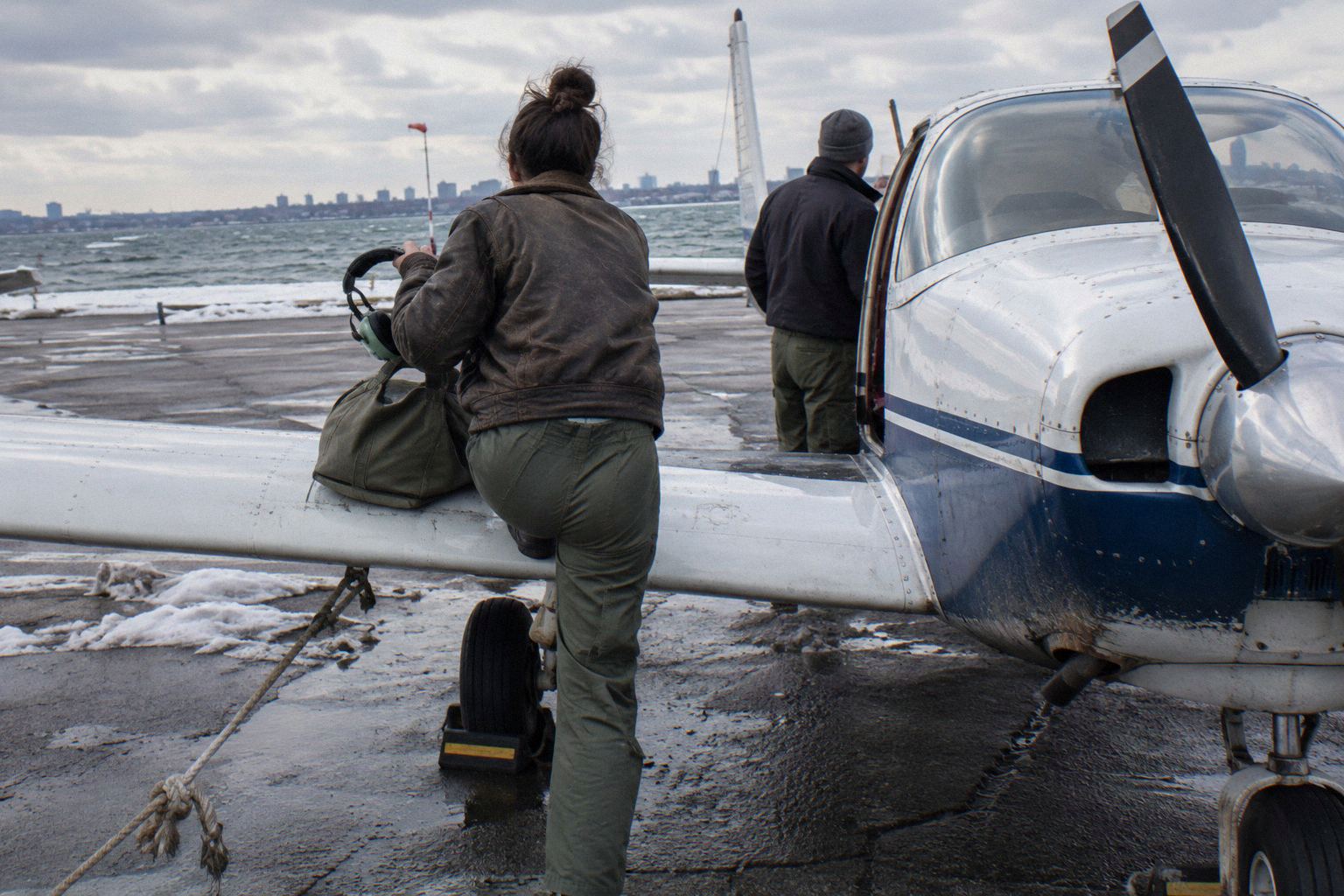
What Are The Ways To Become A Pilot In Canada?
Three Transport Canada licence levels define the path, and some college programs combine flight training with a college credential.
| Route | Time | Cost (CAD) | What You Get | Recognised By | Best For |
|---|---|---|---|---|---|
| Fundamentals of Flight mechanics plus ground study | 4 weeks at 10 hours a week | Not listed | Shareable certificate in flight mechanics theory; no flight hours, no licence | Coursera / ISAE-SUPAERO | Testing whether aviation theory suits you before paying for flight training |
| Private Pilot Licence (PPL) - Aeroplane | 3-12 months | 15000-27000 | Private Pilot Licence; fly privately, no pay, 45 hrs total, PPAER written exam plus flight test | Transport Canada | Hobbyists and the first step of every career path |
| Commercial Pilot Licence (CPL) with Multi-IFR ratings | 12-24 months | 65500-113000 | CPL, Multi-Engine and Instrument Ratings; paid flying jobs | Transport Canada | Career changers aiming at operator and charter jobs |
| Airline Transport Pilot Licence (ATPL) | 4-6 years including experience building | 80000-130000+ | ATPL, the licence airlines require of captains | Transport Canada | Pilots committed to a long airline track |
| College aviation program (for example BCIT or Seneca) | Varies by program; examples include 64 weeks, 2 years, 60 credits, or an undergraduate degree | Varies by program; Red Deer Polytechnic estimates $45,714 per year domestic tuition and fees | Diploma or graduate diploma bundled with flight training | Transport Canada plus the college credential | Students who want a degree-like structure and financing options |
For hobby flyers I recommend the straight PPL through a Transport Canada Flight Training Unit; for career clients I recommend a college-attached CPL program such as Seneca Polytechnic's Aviation Flight Training when they want structure, and the independent FTU route when they want speed.
What Is The Fastest Way To Become A Pilot In Canada?
The fastest path from zero to a paid flying job is straight through a Flight Training Unit with no detours, roughly 12 to 24 months to a career-ready CPL.
- Obtain a Category 1 Medical Certificate from a Transport Canada authorized medical examiner: 1-4 weeks, $150 to $500. You must apply for a medical certificate to confirm you meet the standards for a pilot licence.
- Get a Student Pilot Permit through an Authorized Person at any Flight Training Unit: 1-2 weeks, $0 to $200.
- Complete PPL training and pass the PPAER written exam plus the flight test: 3-6 months, $15,000 to $27,000 including ground school.
- Complete the Commercial Pilot Licence with Multi-Engine and Instrument Ratings: 6-12 months, $50,000 to $86,000 at this stage.
- Pay the $80 CPL issuance fee to Transport Canada and start building hours toward the ATPL, which airlines expect after 4 to 6 years including experience building.
Is A Pilot Licence Required To Fly In Canada?
A Transport Canada-issued permit or licence is mandatory for all flight crew in every province; the federal Canadian Aviation Regulations, Standard 421, govern the whole system, so the rules do not shift between Ontario and Alberta.
| Credential | Required? | Regulator | What It Means |
|---|---|---|---|
| Pilot permit or licence | Yes, for all flight crew members | Transport Canada | You cannot act as flight crew in Canada without one, in any province |
| Category 1 Medical Certificate | Yes for CPL and career flying | Transport Canada medical standards | Confirms you meet the medical standards required to hold a pilot licence |
| Student Pilot Permit | Yes before solo flight | Transport Canada via an Authorized Person at an FTU | Issued before you can fly solo as a student |
Which Flying Classes And Pilot Courses Are Worth Taking?
I group the options into theory primers you can take before committing money, and licensed college programs that bundle flight training with a credential.
Fundamentals of Flight mechanics
Fundamentals of Flight mechanics is a 4-week, 10-hour-a-week online specialization from ISAE-SUPAERO covering flight mechanics theory.
| Provider | ISAE-SUPAERO |
|---|---|
| Length | 4 weeks at 10 hours a week |
| Credential | Shareable certificate |
| Format | online |
Fiona's take: This is the course I suggest first when a client is unsure whether professional aviation suits them. It is a structured way to study flight mechanics before you commit to a $15,000 PPL. It does not qualify you for any Transport Canada licence or flight hours; treat it as a filter, not a shortcut, before you sign a training contract.
Skip it if: Skip it if you have already committed to a flight school and would rather put every hour into your FTU's own ground school.
Start On CourseraFlight mechanics - The basis
Flight mechanics - The basis is a 7-hour online course from ISAE-SUPAERO that is part of the Fundamentals specialization.
| Provider | ISAE-SUPAERO |
|---|---|
| Length | 7 hours |
| Credential | Shareable certificate |
| Format | online |
Fiona's take: At 7 hours this is a focused single-course introduction to flight mechanics, useful for a weekend test of your interest in the subject. It does not count toward any licence. I recommend it for teenagers weighing aviation against other careers before parents commit to flight school fees.
Skip it if: Skip it if you want the fuller specialization, which includes this material and goes further.
Start On CourseraFlight Mechanics - Anemobarometry
Flight Mechanics - Anemobarometry is a 6-hour online course from ISAE-SUPAERO that is part of the Fundamentals specialization.
| Provider | ISAE-SUPAERO |
|---|---|
| Length | 6 hours |
| Credential | Shareable certificate |
| Format | online |
Fiona's take: Anemobarometry is a six-hour deep dive into one slice of the flight mechanics specialization, so it works as a follow-on to the basis course rather than a starting point. It does not qualify you for any licence or permit.
Skip it if: Skip it if that topic already makes sense to you or your FTU ground school covers it.
Start On CourseraFull pilots licence course {Flight School}
Full pilots licence course {Flight School} is a 13-hour on-demand video course from Baron Flying Club rated 4.4 from 73 ratings.
| Provider | Baron Flying Club |
|---|---|
| Length | 13 hours on-demand video |
| Rating | 4.4 (73 ratings) |
| Credential | Certificate of completion |
| Format | online |
Fiona's take: Thirteen hours of video walks through private licence material, including training on the PA-28 Warrior, which many FTUs actually fly. I tell clients to use it as ground-school support while flying weekly, not as a replacement for Transport Canada's written exam prep. The certificate of completion carries no licensing weight.
Skip it if: Skip it if you have not yet decided whether to pursue a PPL at all; start with a Coursera theory primer instead.
View On UdemyA Brief Introduction to Aviation
A Brief Introduction to Aviation is a 40-minute on-demand video course from Udemy rated 4.6 from 493 ratings.
| Provider | Udemy |
|---|---|
| Length | 40m total length |
| Rating | 4.6 (493 ratings) |
| Credential | Certificate of completion |
| Format | online |
Fiona's take: Forty minutes is barely a lecture, but it is an honest first sip of aviation vocabulary. I recommend it to clients who want something to watch before deciding whether to spend an hour planning a flight school visit. It grants no licence credit.
Skip it if: Skip it if you already know you want to train; go straight to the PPL route.
View On UdemyAviation Certificate
Aviation Certificate is a 2-year full-time blended program at Red Deer Polytechnic in Alberta estimated at $45,714 per year in domestic tuition and fees.
| Provider | Red Deer Polytechnic |
|---|---|
| Length | 2 Years |
| Cost (CAD) | Domestic: $45,714 per year (estimate of tuition and fees) |
| Credential | Certificate + Commercial Pilot License |
| Format | Full-Time Blended, AB |
Fiona's take: This program bundles a certificate with a Commercial Pilot License, which is a real advantage for students who want campus structure and Alberta weather experience. The pack lists an estimated domestic tuition-and-fees amount of $45,714 per year; confirm the full cost with the polytechnic before budgeting. It does not replace Transport Canada licensing; the licence comes through the same federal system.
Skip it if: Skip it if you live outside Alberta and can access a local FTU without relocating for two years.
See Program DetailsAviation Flight Training (CSFT)
Aviation Flight Training (CSFT) is a 6-semester, 2-year hybrid program delivered by Seneca Polytechnic with Confederation College in Ontario.
| Provider | Seneca Polytechnic / Confederation College |
|---|---|
| Length | 6 Semesters (2 Years) |
| Credential | Professional License (CPL + Multi-IFR) |
| Format | Hybrid, ON |
Fiona's take: The CSFT partnership leads to a professional licence covering CPL plus Multi-IFR, the exact package career changers need for a first paid flying job. Ontario clients often ask me about pilot licences in Ontario specifically; this is one of the structured routes in the province. Confirm current flight training fees directly, because the pack lists none.
Skip it if: Skip it if you need the fastest possible timeline; a direct FTU route can be shorter than a 2-year fixed program.
See Program DetailsCommercial Aviation Diploma - Aeroplane
Commercial Aviation Diploma - Aeroplane is a 60-credit program at Okanagan College in British Columbia with flight training through an approved provider.
| Provider | Okanagan College |
|---|---|
| Length | 60-credit program |
| Credential | Diploma |
| Format | in person / hybrid (flight with approved provider), BC |
Fiona's take: This diploma suits clients who want a BC-based path with hybrid delivery. The program integrates business education with professional flight training through an approved provider. Fees are not listed in my materials, so budget carefully and ask the college for current totals.
Skip it if: Skip it if you already hold a PPL and only need the CPL and ratings added on.
See Program DetailsAirline and Flight Operations Commercial Pilot (Fixed-Wing) Graduate Diploma
Airline and Flight Operations Commercial Pilot (Fixed-Wing) Graduate Diploma is a 64-week blended program at the British Columbia Institute of Technology (BCIT).
| Provider | British Columbia Institute of Technology (BCIT) |
|---|---|
| Length | 64 weeks |
| Credential | Graduate Diploma |
| Format | Blended, BC |
Fiona's take: Sixty-four weeks is a tight schedule for a graduate diploma that takes you to a fixed-wing commercial licence, and the program is described as one of the fastest ways in Canada to qualify for a commercial pilot's licence. I recommend it to clients who want a fast, structured route and are ready for an intensive year. Costs are not listed in my materials, so ask BCIT for the current total including flight hours.
Skip it if: Skip it if a 64-week full-time commitment does not fit your life; a flexible FTU schedule may suit you better.
See Program DetailsAviation
Aviation is an undergraduate degree program with flight training at Mount Allison University in New Brunswick, leading to a BA, BComm or BSc plus a CPL and ratings.
| Provider | Mount Allison University |
|---|---|
| Length | undergraduate degree with flight training |
| Credential | BA/BComm/BSc + CPL + ratings |
| Format | in person, NB |
Fiona's take: This is the route for clients who want both a university degree and a commercial licence, at the cost of a longer timeline than a direct FTU path. No university degree is required for any Transport Canada licence, so choose this only if the degree itself matters to you.
Skip it if: Skip it if your goal is purely the fastest route to paid flying; the degree adds years.
See Program DetailsCommercial Flight Operations Diploma
Commercial Flight Operations Diploma is an in-person Ontario program delivered by Conestoga College with Spectrum Airways, leading to an Ontario College Diploma plus a CPL and ratings.
| Provider | Conestoga College / Spectrum Airways |
|---|---|
| Credential | Ontario College Diploma + CPL + ratings |
| Format | in person, ON |
Fiona's take: The Conestoga and Spectrum Airways pairing gives Ontario students a college diploma alongside the licence package. Length and cost are not listed in my materials, so request both before comparing against the CSFT route.
Skip it if: Skip it if you are not able to attend the in-person Ontario delivery.
See Program DetailsHow Much Does Pilot Training Cost In Canada?
Pilot training costs run from $15,000 for a basic private licence to $113,000 for a career-ready commercial licence with Multi-IFR ratings in 2026, plus small Transport Canada issuance fees.
| Item | Cost (CAD) |
|---|---|
| Private Pilot Licence training (45 hrs total, PPAER written exam plus flight test) | 15000-27000 |
| CPL with Multi-Engine and Instrument Ratings (career-ready total) | 65500-113000 |
| ATPL track including experience building | 80000-130000+ |
| Transport Canada PPL issuance fee | 55 |
| Transport Canada CPL issuance fee | 80 |
| Transport Canada ATPL issuance fee | 100 |
| Category 1 Medical Certificate | 150-500 |
| Student Pilot Permit via an FTU | 0-200 |
How Much Does A Pilot Earn In Canada?
Pilots in Canada earn a Job Bank median of $52.00 an hour for NOC 72600, air pilots, flight engineers and flying instructors, with strong provincial spread.
| Region | Median Hourly Wage (Job Bank) |
|---|---|
| Canada overall (NOC 72600) | $52.00 |
| Ontario | $63.00 |
| British Columbia | $57.69 |
| New Brunswick | $55.29 |
| Alberta | $54.11 |
| Quebec | $50.56 |
| Saskatchewan | $50.00 |
| Manitoba | $45.11 |
| Nova Scotia | $44.00 |
| Newfoundland and Labrador | $41.87 |
Is Becoming A Pilot Worth It In 2026?
Becoming a pilot in Canada is worth it for the right person, and the numbers are clear enough to test. A career-ready CPL with Multi-IFR costs $65,500 to $113,000 and takes 12 to 24 months, against a Job Bank median wage of $52.00 an hour under NOC 72600. No university degree is required for any Transport Canada licence, so the credential costs less time than most degree paths even before the ATPL years.
The honest risks: the Category 1 medical, at $150 to $500, can end the plan before it starts. Canada Student Financial Assistance includes loans and grants for eligible post-secondary students; check the program's financial aid office to see whether your training route qualifies, and remember the loan portion must be repaid. I tell clients the test is simple: pass the medical, watch the Fundamentals of Flight mechanics specialization, then decide whether $65,500 is a bet you want to place.
Can You Get Funding For Pilot Training In Canada?
Flight training itself is mostly self-funded, but student aid may be available depending on your program.
- Canada Student Financial Assistance (loans and grants). The Government of Canada has extended temporary increases to the Canada Student Financial Assistance grants and loans for the 2026-27 academic year. Canada Student Financial Assistance includes loans and grants for eligible post-secondary students; check the program's financial aid office to confirm whether your aviation program qualifies. Grants reduce your cost; the loan portion must be repaid.
Pilot Training Questions Canadians Ask
How Long Does It Take To Become A Pilot In Canada?
From zero to a career-ready CPL with Multi-IFR ratings typically takes 12 to 24 months full-time. Reaching the ATPL and an airline job takes 4 to 6 years or more including experience building. A Private Pilot Licence on its own takes 3 to 12 months.
How Much Does A Pilot Licence Cost In Canada?
Pilot licence costs run from $15,000 to $27,000 for a PPL to $65,500 to $113,000 CAD in 2026 for a career-ready CPL with Multi-IFR. Transport Canada's issuance fees are small by comparison: $55 for the PPL, $80 for the CPL and $100 for the ATPL.
Do I Need A University Degree To Become A Pilot In Canada?
No university degree is required for any Transport Canada pilot licence. That said, degree-attached routes exist, such as Mount Allison University's Aviation program leading to a BA, BComm or BSc plus a CPL and ratings, if the credential itself matters to you.
What Medical Certificate Is Needed For Commercial Pilots?
Commercial pilots need a Category 1 medical certificate for the CPL and career flying. You must apply to confirm you meet the medical standards required to hold a pilot licence; budget $150 to $500 and 1 to 4 weeks for this step, and do it before paying for any flight training.
Is Pilot Training Regulated Federally Or By Province?
Pilot training is regulated federally by Transport Canada under the Canadian Aviation Regulations, Standard 421. The rules are the same in Ontario, Alberta and every other province, so a licence earned in one part of Canada is valid nationwide.
What Is The Minimum Age For A Commercial Pilot Licence?
The minimum age for a Commercial Pilot Licence is 18 years for the CPL-Aeroplane under Standard 421.30 of the Canadian Aviation Regulations. You can start flight training and the Student Pilot Permit well before that, which many clients do not realize.
Where Can I Find Approved Flight Training In Canada?
Use Transport Canada's Flight Training Units Search tool on tc.canada.ca. Only train through an authorized FTU if your goal is a licence, because online courses like the Coursera flight mechanics options build knowledge but count for zero flight hours.
What Is The Median Wage For Pilots In Canada?
The median wage for pilots in Canada is $52.00 per hour for Job Bank's NOC 72600, air pilots, flight engineers and flying instructors. Ontario leads the pack I track at $63.00, with British Columbia at $57.69 and Newfoundland and Labrador at $41.87.
What's The Bottom Line On Becoming A Pilot In Canada?
- A Transport Canada licence is mandatory for all flight crew in every province, regulated federally under the Canadian Aviation Regulations Standard 421; no university degree is required for any of them.
- A career-ready CPL with Multi-IFR costs $65,500 to $113,000 in 2026 and takes 12 to 24 months; the PPL step alone is $15,000 to $27,000 over 3 to 12 months.
- Test the field first with Fundamentals of Flight mechanics, a 4-week, 10-hour-a-week theory specialization that qualifies you for no Transport Canada licence but lets you try the subject before committing.
- Pilots earn a Job Bank median of $52.00 an hour under NOC 72600, with Ontario at $63.00, but the ATPL track runs 4 to 6 years including experience building.
- Get your Category 1 medical certificate ($150 to $500) before you pay for any flight hours; if the medical fails, the plan ends at that price instead of after $15,000 or more of training.






