Key Takeaways
- The fastest realistic route to practising law in Canada is a 2 to 3 year undergrad plus a 3 year JD plus 10 to 12 months of articling and bar exams, roughly 7 to 8 years total, with domestic JD tuition varying by school, from UBC Allard's $14,517.44 to Osgoode's $24,802.26 per year.
- Yes, a licence is required: you must graduate from an FLSC approved common law program and be called to the bar by a provincial law society such as the Law Society of Ontario; Quebec uses the civil law LL.B. or LL.L. under the Barreau du Québec.
- Coursera's An Introduction to American Law from the University of Pennsylvania runs 1 to 3 months online and is a low-commitment way to test your interest in law, but it does not qualify you for any law society's licensing process.
- Lawyers (NOC 41101) earn a median of $59.76 per hour in Canada, from $47.18 in Manitoba to $78.85 in Alberta, per Job Bank.
- Fiona's verdict: the JD suits students with strong grades, three years of tuition and a genuine appetite for legal reading, and Coursera lets you test that appetite before applying anywhere.
A Juris Doctor (JD) is a second-entry professional degree in common law, and it is the degree you need to become a lawyer in every Canadian province except Quebec, where the civil law LL.B. or LL.L. is the primary credential. Canadian JD programs run three full-time academic years or 90 course credits under the Federation of Law Societies of Canada National Requirement.
Before you commit seven or eight years and tuition that runs from UBC Allard's $14,517.44 to Osgoode's $24,802.26 per year domestic, I recommend testing the field. A short Coursera course is the low-commitment way to do that, so this page starts there and then walks through the real routes, costs and licensing steps.
What Are The Ways To Get A JD Degree In Canada?
A JD degree in Canada comes through three main routes, and the first move I recommend is a Coursera course that tells you whether law school is for you at all.
| Route | Time | Cost (CAD) | What You Get | Recognised By | Best For |
|---|---|---|---|---|---|
| Prep and interest test: An Introduction to American Law plus What Is a Juris Doctor (JD) Degree? | 1 - 3 Months | Not listed | An intro to American law and a plain explainer on the JD | Coursera and the University of Pennsylvania | Anyone testing interest before committing to a 3 year degree |
| Standard JD after undergrad | 3 years full-time | Varies by school: UBC $14,517.44, Osgoode $24,802.26 per year domestic | JD degree | FLSC approved programs; provincial law societies | Most aspiring lawyers in common law provinces |
| Accelerated combined program (e.g., Political Science and JD at uOttawa) | 6 years total | Varies | JD plus another degree | FLSC and universities | Students seeking a combined political science and JD pathway |
| NCA pathway for internationally trained lawyers | Varies | Lower than a full JD | Certificate of Qualification | NCA / FLSC | Lawyers trained abroad |
I recommend the Coursera prep option first for anyone undecided, the standard 3 year JD for most Canadian students, the uOttawa six year pathway for students seeking the combined political science and JD program, and the NCA pathway for lawyers already trained outside Canada.
What Is The Fastest Way To Become A Lawyer With A JD In Canada?
The fastest complete path from high school to a Canadian law licence runs about 7 to 8 years, and no shortcut skips any of its three stages.
- Complete at least 2 years of undergrad, though most Canadian law faculties prefer a 4 year degree, roughly 3 to 4 years at about $7,000 to $15,000 per year domestic.
- Write the LSAT, which most English common law programs require for admission.
- Complete an FLSC approved 3 year full-time JD program; domestic tuition varies by school, from UBC Allard's $14,517.44 per year to Osgoode's $24,802.26, and the University of Alberta estimates a $19,792.00 first-year total for Canadian students.
- Complete 10 to 12 months of articling, or an equivalent such as the Law Practice Program in Ontario, plus bar exams; the Law Society of Ontario schedule runs to several thousand dollars, including a $160 application fee, $865 for each licensing exam and $2,800 for the articling program or Law Practice Program.
Is A JD Degree Required To Practise Law In Canada?
Yes, a licence is required everywhere in Canada, and the JD is the degree that opens it in the common law provinces.
| Province | Degree Required? | Regulator Or Body | What It Means |
|---|---|---|---|
| All common law provinces | Yes, JD or LL.B. | Federation of Law Societies of Canada; National Committee on Accreditation for equivalency | The FLSC approves common law programs meeting the National Requirement of 3 full-time academic years or 90 course credits |
| Ontario | Yes | Law Society of Ontario | Candidates must graduate from a common law program approved by Convocation, then article and pass bar exams |
| Quebec | Yes, civil law LL.B. or LL.L. primary | Barreau du Québec | The JD exists for common law, such as McGill's BCL/JD, but Québec practice runs on the civil law degree |
I tell clients the provincial law society is the body that actually licences you. The JD is the entry ticket; the Law Society of Ontario or its counterparts in other provinces then runs the licensing process, articling and the bar exams.
Quebec is the one place where the standard route differs. There, the Bachelor of Laws or the Licentiate of Law is the necessary degree, and a JD is the common law alternative rather than the default.
Which JD And Law School Courses Are Worth Taking?
Worthwhile prep ranges from short Coursera introductions to the JD programs themselves at schools like Dalhousie and the University of Toronto, and I would start with the Coursera options before applying anywhere.
An Introduction to American Law
An Introduction to American Law is a 1 to 3 month online course from the University of Pennsylvania on American law, with listed skills including Civil Procedures and Civil Law.
| Provider | University of Pennsylvania |
|---|---|
| Length | 1 - 3 Months |
| Rating | 4.8 (5.3K reviews) |
| Credential | Course |
| Format | online |
Fiona's take: Rated 4.8 across 5.3K reviews, it is the course I recommend first to clients testing their interest in law before applying anywhere. The content is American law rather than Canadian, so treat it as a trial run of legal study rather than preparation for a Canadian JD. It does not count toward any licensing requirement.
Skip it if: Skip it if you want Canadian law content, since the course covers American law.
Start On CourseraWhat Is a Juris Doctor (JD) Degree?
What Is a Juris Doctor (JD) Degree? is an online Coursera article from Coursera explaining what a JD is and what careers it opens.
| Provider | Coursera |
|---|---|
| Credential | Article |
| Format | online |
Fiona's take: This is a ten minute read, not a course, and I use it with clients who conflate the JD with a doctorate. It clarifies that the JD is a second-entry professional degree in common law, which matters when family asks what you are studying.
Skip it if: Skip it if you already know the JD is a 3 year professional degree and not a PhD.
Start On CourseraIndigenous Canada
Indigenous Canada is a 12 module online course from the University of Alberta.
| Provider | University of Alberta |
|---|---|
| Length | 12 modules |
| Credential | Course |
| Format | online |
Fiona's take: This 12 module course is useful background, but it is not LSAT prep and not a licensing credential. I suggest it to clients who want context on Indigenous Canada before starting a JD. It will not move an application forward on its own.
Skip it if: Skip it if your only goal is LSAT strategy, since it is not a test prep course.
Start On CourseraHow to become a Lawyer in Canada
How to become a Lawyer in Canada is a 6h 41m online Udemy course on the accreditation and licensing route for lawyers in Canada.
| Provider | Udemy |
|---|---|
| Length | 6h 41m |
| Cost (CAD) | not shown (from $11.99) |
| Rating | 4.7 (7 ratings) |
| Credential | Course |
| Format | online |
Fiona's take: At 4.7 from 7 ratings it has a thin review base, so I treat it as a map rather than a credential. It is useful for internationally trained lawyers trying to understand the NCA before paying for any equivalency assessment. It does not qualify you for licensing anywhere.
Skip it if: Skip it if you are a Canadian law student, since your faculty and law society lay out the same steps for free.
View On UdemyExecutive Juris Doctor
Executive Juris Doctor is a 9h 52m online Udemy course marketed at business professionals.
| Provider | Udemy |
|---|---|
| Length | 9h 52m |
| Cost (CAD) | not shown (from $11.99) |
| Rating | 4.6 (125 ratings) |
| Credential | Course |
| Format | online |
Fiona's take: Despite the name, this is not a JD and no Canadian law society will recognise it for licensing. The 4.6 rating across 125 ratings reflects business audiences, not aspiring lawyers. I would only point a client at it for general legal literacy in a corporate role.
Skip it if: Skip it entirely if your goal is a licence to practise law in Canada.
View On UdemyJuris Doctor (JD)
Juris Doctor (JD) at the Schulich School of Law, Dalhousie University is a 3 year full-time in person program in Nova Scotia, with part-time options up to 7 years.
| Provider | Schulich School of Law, Dalhousie University |
|---|---|
| Length | 3 years full-time (part-time max 7 years) |
| Credential | JD |
| Format | in person (part-time/hybrid options noted), Nova Scotia |
Fiona's take: The JD runs 3 years full-time with a part-time option up to 7 years, delivered in person with part-time and hybrid options noted. Graduates then move into the provincial law society licensing process. I flag the flexible delivery to career changer clients who cannot do three straight full-time years.
Skip it if: Skip it if you cannot study in Nova Scotia, since the program is delivered in person.
See Program DetailsProgramme de droit canadien
Programme de droit canadien at the University of Ottawa Faculty of Law is a 3 year in person program in Ontario granting both a JD and an LLL.
| Provider | University of Ottawa Faculty of Law |
|---|---|
| Length | 3 years |
| Credential | JD and LLL |
| Format | in person, Ontario |
Fiona's take: The dual credential is the standout: graduates leave with both the common law JD and the Quebec civil law Licentiate. I recommend it to bilingual clients who want mobility across the Quebec and Ontario bars. It is 3 years in person in Ottawa.
Skip it if: Skip it if you are not comfortable studying in French, since half the credential is Quebec civil law.
See Program DetailsJuris Doctor (JD) Program
Juris Doctor (JD) Program at the Jackman Law School, University of Toronto is a 3 year full-time in person program in Ontario.
| Provider | Jackman Law School, University of Toronto |
|---|---|
| Length | 3 years full-time |
| Credential | JD |
| Format | in person, Ontario |
Fiona's take: The JD Program at the Jackman Law School is three years, full-time and in person, and UofT is listed as a higher tuition example among Canadian law schools. It feeds into the provincial licensing process. I raise it with Ontario clients comparing the province's law schools on price and delivery.
Skip it if: Skip it if cost is your main constraint, since UofT sits at the higher end of domestic tuition.
See Program DetailsBora Laskin Faculty of Law JD (1L Online Intensive)
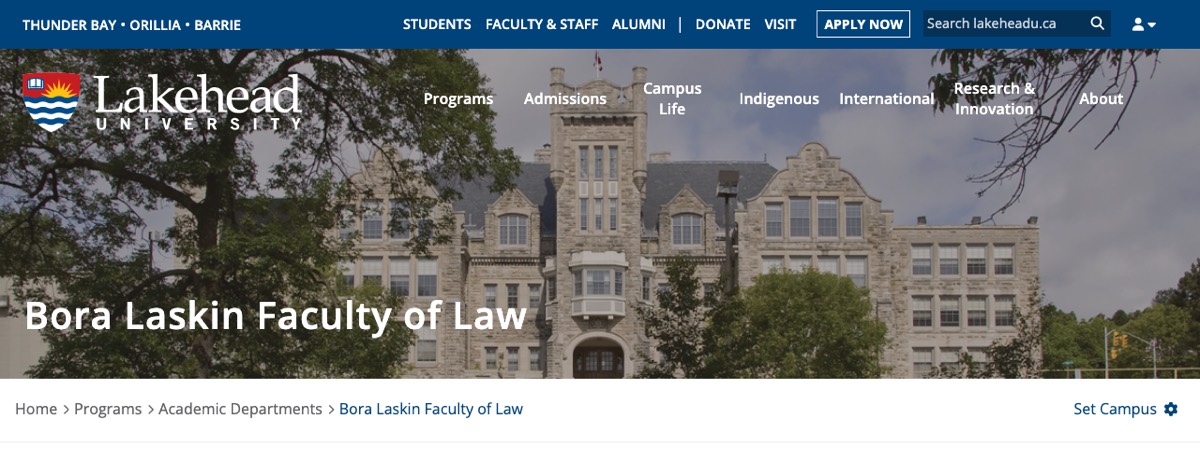
Bora Laskin Faculty of Law JD (1L Online Intensive) at Lakehead University is a 3 year hybrid program in Ontario, with a first year online intensive plus 2 years in person.
| Provider | Lakehead University |
|---|---|
| Length | 3 years (1L hybrid/online intensive + 2 years in person) |
| Credential | JD |
| Format | hybrid, Ontario |
Fiona's take: This is the closest thing to an online start on a Canadian JD, and it matters for clients in Northwestern Ontario. The full degree is still 3 years, and no Canadian law school offers a purely online JD. The 1L intensive is the flexible piece.
Skip it if: Skip it if you want the standard full-time Toronto or Ottawa experience, since this is a regional program.
See Program DetailsProfessional LLM in Canadian Common Law (Full-Time)
Professional LLM in Canadian Common Law (Full-Time) at OsgoodePD, York University is a 1 year in person program of 3 terms in Ontario, at $7,753.61 per term for domestic Ontario students.
| Provider | OsgoodePD, York University |
|---|---|
| Length | 1 year (3 terms) |
| Cost (CAD) | $7,753.61 per term (domestic Ontario) |
| Credential | Professional LLM |
| Format | in person, Ontario |
Fiona's take: I recommend this to internationally trained lawyers who need Canadian common law grounding before NCA assessment or licensing. At roughly $7,753.61 per term for Ontario residents, it costs a fraction of a 3 year JD. It is an LLM, not a JD, and it is aimed at qualified lawyers rather than first degree seekers.
Skip it if: Skip it if you have never studied law before, since the entry point for new lawyers is the JD, not this LLM.
See Program DetailsHow Much Does A JD Degree Cost In Canada?
A JD degree in Canada has no single domestic tuition rate: UBC Allard lists $14,517.44 for first-year domestic tuition in 2026/27, Osgoode lists $24,802.26, and the University of Alberta estimates a $19,792.00 first-year total including fees and books.
| Cost Item | Amount (CAD) | Notes |
|---|---|---|
| UBC Allard JD tuition, 1st year domestic | $14,517.44 | 2026/27 rate at the Peter A. Allard School of Law |
| University of Alberta JD, estimated first-year total (2024) | $19,792.00 | Tuition $16,097.40 plus about $1,700 in books and $1,994.60 in non-instructional fees for Canadian JD students |
| University of Alberta JD, 2026-27 program fee | $6,234.28 for two terms | Program fee only, charged in addition to course tuition |
| Osgoode Hall JD tuition, domestic | $24,802.26 per year | Published 2025-26 rate; international rate $44,431.60 |
| Mandatory student fees | About $1,400 per year | Allard example |
| Books, first year | About $1,800 | Allard example |
| Undergrad before JD | About $7,000 - $15,000 per year domestic | Minimum 2 years, preferred 4 |
| Licensing after JD, Law Society of Ontario schedule | Several thousand dollars | $160 application, $865 per licensing exam, $2,800 articling program or Law Practice Program, $165 administrative licensure, $250 ceremonial call |
I tell clients to budget books and fees, not just tuition, because the roughly $1,400 in mandatory fees and $1,800 in first year books at Allard are real money on top of tuition. International students pay roughly 2 to 3 times domestic rates, as Osgoode's $44,431.60 international tuition shows.
Tuition varies by school and province, so compare each school's current fee schedule before you apply. The University of Alberta's 2026-27 program fee is $6,234.28 for two terms, and that fee is charged in addition to course tuition; the faculty's estimated first-year total for Canadian JD students is $19,792.00, including $16,097.40 in tuition. Osgoode Hall's published domestic rate sits at $24,802.26, a difference worth pricing against your own budget.
How Much Does A Lawyer Earn In Canada With A JD?
Lawyers, NOC 41101, earn a median of $59.76 per hour across Canada, per Job Bank.
| Region | Median Hourly Wage (CAD) |
|---|---|
| Canada | $59.76 |
| Alberta | $78.85 |
| Ontario | $65.21 |
| British Columbia | $65.00 |
| Quebec | $51.28 |
| Manitoba | $47.18 |
The spread is wide: Alberta's $78.85 median is nearly double Manitoba's $47.18, so where you article and settle matters as much as which school you attend. Ontario sits at $65.21 and British Columbia at $65.00, both above the national median.
Job Bank rates the outlook for NOC 41101 as moderate to good across 2025 to 2027, varying by province. The wage and outlook figures are national medians and averages, and individual return on the degree depends on tuition, debt and career path.
Is A JD Degree Worth It In Canada In 2026?
Three years of tuition, $14,517.44 per year at UBC Allard or $24,802.26 at Osgoode, buys entry to a licensed profession with a $59.76 national median hourly wage and a moderate to good Job Bank outlook through 2027. But those figures are averages, and individual return on the degree depends on tuition, debt and career path.
The real risk is fit, not money. That is exactly why I push the Coursera test first: 1 to 3 months with An Introduction to American Law answers the fit question before you sink a year of tuition into it.
The JD does not suit everyone who likes arguing. It suits readers with stamina, and people comfortable being licensed, examined and regulated by a body like the Law Society of Ontario. If that describes you and the wage table holds appeal, the degree is worth it in 2026.
Can You Get Funding For A JD Degree In Canada?
Yes, JD students in Canada can draw on provincial student aid such as OSAP in Ontario, plus university specific scholarships and bursaries.
- Provincial student aid (OSAP and counterparts). Ontario students apply to OSAP, and comparable provincial aid programs exist in other provinces. Provincial student aid may include loans and/or grants depending on the program; check the province's current rules.
- University scholarships and bursaries. Law schools such as UBC's Peter A. Allard School of Law publish tuition, fees and funding details, and UBC offers an Undergraduate Programs and Admissions Calculator for financial planning. Ask each faculty you apply to about entrance awards, since these vary by school.
JD Degree Questions Canadians Ask
Is There A 1-Year JD In Canada?
No, there is no 1-year JD in Canada. The standard JD is 3 years full-time after undergrad, per the FLSC National Requirement of 3 full-time academic years or 90 course credits. One year law programs in Canada are typically LLMs, and an LLM does not directly qualify you for a Canadian lawyer's licence.
Are There Online JD Programs In Canada?
Online JD programs in Canada do not exist in pure form: no Canadian law school currently offers a fully online JD or LL.B. curriculum. Programs are primarily in person, though Lakehead's Bora Laskin Faculty of Law offers a 1L online intensive followed by 2 years in person. Expect the degree itself to be earned on campus.
JD Or Diploma Or Certificate For Law In Canada?
A JD or accepted LL.B./LL.L., or an NCA Certificate of Qualification for internationally trained lawyers, is the academic route to bar admission in Canada; diplomas and certificates alone do not qualify. The Federation accepts successful completion of an LL.B. or JD degree as the academic requirement. A short course can be useful background, but it will not get you called to the bar.
Which JD Programs In Canada Cost The Least?
Lower tuition JD programs in Canada include the University of Alberta, which estimates a first-year total of $19,792.00 for Canadian JD students, tuition of $16,097.40, plus a separate program fee of $6,234.28 for two terms in 2026-27. UBC Allard lists $14,517.44 in first-year domestic tuition. Rates vary by province and residency, so compare each school's current fee schedule.
How Long After A JD Until You Are A Lawyer In Canada?
After the JD, expect 10 to 12 months of articling plus bar exams before licensing by your provincial law society. Counting a 4 year undergrad and a 3 year JD, the full path from high school to call runs about 7 to 8 years. Ontario's Law Practice Program is one articling equivalent that can shift the format but not the timeline.
Does Quebec Use The JD Degree?
Quebec primarily uses the civil law Bachelor of Laws or Licentiate of Law, regulated through the Barreau du Québec, for practice in its civil law system. The JD exists in Quebec for common law, most prominently McGill's BCL/JD. A JD alone is not the standard route to the Quebec bar.
Is The LSAT Required For A Canadian JD?
Yes, most English common law JD programs in Canada require the LSAT as part of admission. It is one component alongside your undergrad record. Check each faculty's requirements, since requirements sit with the individual law school rather than with the FLSC.
Can International Students Do A JD In Canada And Stay To Practise?
International students can complete a Canadian JD and enter the licensing process. They may be able to pursue work-permit or PR pathways if they meet current IRCC rules; the JD does not guarantee a work permit or PR. International tuition runs 2 to 3 times domestic rates, such as $44,431.60 a year at Osgoode, so plan the budget before applying.
What's The Bottom Line On A JD Degree In Canada?
- The JD is a 3 year second-entry degree in common law, and it is the required credential for bar admission in every province except Quebec, where the civil law LL.B. or LL.L. is the primary degree.
- Domestic tuition varies by school, from UBC Allard's $14,517.44 to Osgoode's $24,802.26 per year, plus about $1,400 in fees and $1,800 in first year books at Allard, over 3 years.
- Lawyers (NOC 41101) earn a median $59.76 per hour, from $47.18 in Manitoba to $78.85 in Alberta, per Job Bank.
- Test the field first with An Introduction to American Law from the University of Pennsylvania, 1 to 3 months online, rated 4.8 by 5.3K reviewers.
- Total time from high school to licence is about 7 to 8 years, so only commit if the reading genuinely holds you.