Key Takeaways
- An integrated CPL program is the fastest realistic route: 12 to 18 months full-time at $90,000 to $120,000, plus a $250 Category 1 medical, exam and test fees, and the $80 licence issuance from Transport Canada.
- A licence is mandatory: Transport Canada issues every pilot licence in Canada under the Canadian Aviation Regulations, and all pilots operating a Canadian registered aircraft must hold one.
- Fundamentals of Flight mechanics from ISAE-SUPAERO is a 4-week online theory series you can take before committing to flight school; it does not qualify you for a Transport Canada licence or any flight hours.
- Job Bank puts the median wage for pilots, NOC 72600, at $52.00 per hour in Canada, ranging from $24.04 to $106.00; Ontario's median is $63.00 and Newfoundland and Labrador's is $41.87.
- Fiona's verdict: worth it if you pass a Category 1 medical first and line up funding; the $48,000 to $65,000 modular path suits self-funders, integrated suits full-time airline-bound students.
A Commercial Pilot Licence (CPL) is the Transport Canada credential that lets you fly aircraft for compensation or hire anywhere in Canada. Searching flight classes near me is the right first instinct, because the licence is national but the training is local and expensive.
The shortest realistic route is an integrated CPL program: 12 to 18 months and $90,000 to $120,000, finishing with the CPAER exam, a flight test and an $80 licence issuance. The modular route costs less, $48,000 to $65,000, over 12 to 24 months. Here is how I tell clients to choose.
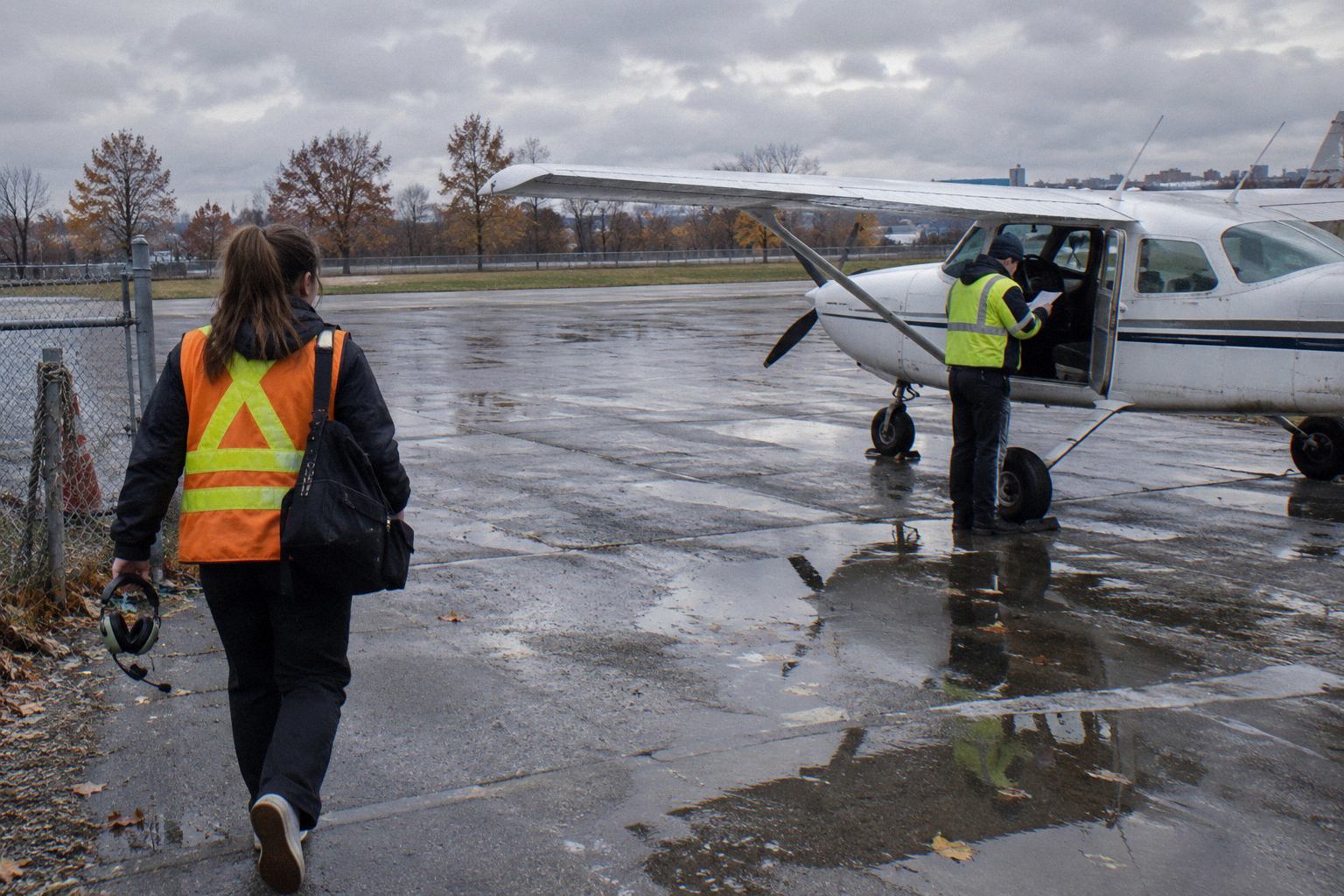
What Are The Ways To Become A Commercial Pilot In Canada?
Becoming a commercial pilot in Canada comes down to two flight-school routes, the modular path at a local school or a full-time integrated program, and both end at the same Transport Canada licence. Before committing to either, an online theory series lets you test whether aviation study suits you.
| Route | Time | Cost (CAD) | What You Get | Recognised By | Best For |
|---|---|---|---|---|---|
| Fundamentals of Flight mechanics (Coursera theory series) | 4 weeks | Not listed | Shareable career certificate in flight theory; no flight hours | Not a Transport Canada credential | Testing whether aviation theory suits you before paying for flight school |
| Modular / traditional flight school | 12-24 months | $48,000-65,000 | CPL-A | Transport Canada | Self-funders and students training part-time near home |
| Integrated CPL course | 9-18 months | $90,000-120,000 | CPL-A plus multi-engine and instrument ratings | Transport Canada | Full-time students aiming at airline cockpits fastest |
I recommend the Coursera series for anyone still deciding, the modular route for clients funding themselves stage by stage, and the integrated route for those with financing in place who want the airline path in one push.
What Is The Fastest Way To Become A Commercial Pilot In Canada?
The fastest way to become a commercial pilot in Canada is a full-time integrated program, advertised at 12 to 18 months and compressible toward 10 to 14 months only at a full-time pace. MFC, for example, runs a 16-month integrated program.
- Confirm you can hold the licence at all: book a Category 1 medical with a Transport Canada medical examiner, 1 to 2 weeks, about $250.
- Enrol in an integrated CPL program: 12 to 18 months full-time at $90,000 to $120,000; MFC quotes $103,547 tuition for its 16-month program.
- Log the hours: 200 hours of total flight time, or 150 hours on the integrated path, plus 80 hours of ground school.
- Pass the CPAER exam and the flight test within 24 months of your application; the written exam is 100 questions with a 60% pass mark and costs $131.54 per sitting, and flight test examiners charge $500 to $700.
- Apply to Transport Canada for CPL issuance: $80, processed in 40 working days.
Do You Need A Licence To Work As A Commercial Pilot In Canada?
A licence is required without exception: all pilots must hold a permit, certificate or licence issued by Transport Canada if they are operating a Canadian registered aircraft, and the CPL is the licence that lets you fly for compensation or hire. The rule is national, set under the Canadian Aviation Regulations.
| Province | Required? | Regulator Or Registry | What It Means |
|---|---|---|---|
| Canada (national) | Yes | Transport Canada | Licensing is federal under the Canadian Aviation Regulations; one CPL lets you fly for compensation or hire on Canadian registered aircraft |
To earn the CPL you need age 18, a Category 1 medical, 200 hours of total flight time or 150 hours on the integrated path, 80 hours of ground school, a pass on the CPAER, the CPL written exam, and a successful flight test. The CPAER is 100 questions with a 60% pass mark.
Online courses change none of this. Fundamentals of Flight mechanics and the two Udemy courses below teach theory and career planning; none of them counts toward the flight hours, the ground school requirement or the licence itself. Training is completed through a flight school, the flight test is conducted by an examiner, and Transport Canada issues the CPL after requirements are met and the $80 issuance fee is paid.
Which Flight Training Courses In Canada Are Worth Taking?
Flight training courses in Canada split into three tiers: online theory, integrated programs at flight schools, and college diplomas that can carry provincial student aid. I list them in the order I would tell a client to try them.
Fundamentals of Flight mechanics
Fundamentals of Flight mechanics is a 4-week online course series from ISAE-SUPAERO that teaches the theory of how aircraft fly, delivered as four courses with a shareable career certificate.
| Provider | ISAE-SUPAERO |
|---|---|
| Length | 4 weeks to complete (4 course series) |
| Credential | Shareable certificate / Career certificate from ISAE-SUPAERO |
| Format | online |
Fiona's take: This is my try-first pick for anyone typing flight classes near me at midnight. Four weeks tells you whether the theory side of aviation actually holds your interest before a school takes a deposit. It does not qualify you for a Transport Canada licence or any flight hours, and no price is listed in our data, so confirm the current fee before enrolling.
Skip it if: Skip it if you already feel confident in basic flight-mechanics theory.
Start On CourseraHow to become a commercial pilot
How to become a commercial pilot is an online Udemy course from Adeeb Ahmad that walks through the path to a professional flying career.
| Provider | Adeeb Ahmad |
|---|---|
| Rating | 4.5 (61 ratings) |
| Format | online |
Fiona's take: Rated 4.5 from 61 ratings, it introduces FAA and India commercial-pilot requirements. Do not treat it as a Canadian licensing guide; the Transport Canada requirements are the ones listed above. No length or price is listed in our data, so weigh it against the free checkride course first.
Skip it if: Skip it once you have chosen a school and a route, because it adds little after that decision.
View On UdemyCommercial Pilot Course Part I: How To Pass The Checkride
Commercial Pilot Course Part I: How To Pass The Checkride is a free online Udemy course from Michael Carlini focused on passing the commercial flight test.
| Provider | Michael Carlini |
|---|---|
| Cost (CAD) | Free |
| Rating | 4.5 (20 ratings) |
| Format | online |
Fiona's take: The price is right, free, and it is rated 4.5 from 20 ratings. The course covers the commercial pilot checkride, the oral, and the FAA written knowledge test, so use it only as a general U.S.-focused checkride overview, not as Transport Canada flight-test preparation.
Skip it if: Skip it unless you want a general overview of how a U.S. commercial checkride works.
View On UdemyAviation Flight Training (CSFT)
Aviation Flight Training (CSFT) is a 2-year, six-semester hybrid program from Seneca Polytechnic in partnership with Confederation College that leads to a professional licence.
| Provider | Seneca Polytechnic (partnership with Confederation College) |
|---|---|
| Length | 6 Semesters (2 Years) |
| Credential | Professional License |
| Format | hybrid, ON |
Fiona's take: Seneca Polytechnic coursework pairs with Confederation College flight training toward a professional licence. Because this is a Seneca and Confederation partnership, ask the schools directly whether this specific route is eligible for provincial student aid. Tuition is not listed in our data.
Skip it if: Skip it if you live outside Ontario, since the flight training happens in person.
See Program DetailsAviation Certificate
Aviation Certificate is a 2-year blended certificate from Red Deer Polytechnic in Alberta.
| Provider | Red Deer Polytechnic |
|---|---|
| Length | 2 Years |
| Credential | Certificate |
| Format | blended, AB |
Fiona's take: Red Deer Polytechnic gives Alberta students a two-year aviation option with blended delivery, shorter than the Ontario advanced diplomas. Alberta Student Aid is the provincial program to ask about, but our data only confirms loan eligibility for Confederation, Sault, BCIT, Sask Polytech and MRU. Tuition is not listed in our data.
Skip it if: Skip it if you want a diploma credential, since this awards a certificate.
See Program DetailsCommercial Flight Operations Diploma
Commercial Flight Operations Diploma is an in-person Ontario College Diploma from Conestoga College delivered through Spectrum Airways.
| Provider | Conestoga College (via Spectrum Airways) |
|---|---|
| Credential | Ontario College Diploma |
| Format | in person, ON |
Fiona's take: Conestoga pairs its diploma with Spectrum Airways, a working flight school, so the classroom and the flying arrive under one registration. Confirm OSAP eligibility for this specific program before budgeting around it. Length and tuition are not listed in our data.
Skip it if: Skip it if you need a published schedule and price before you can plan financing.
See Program DetailsCommercial Aviation Diploma - Aeroplane
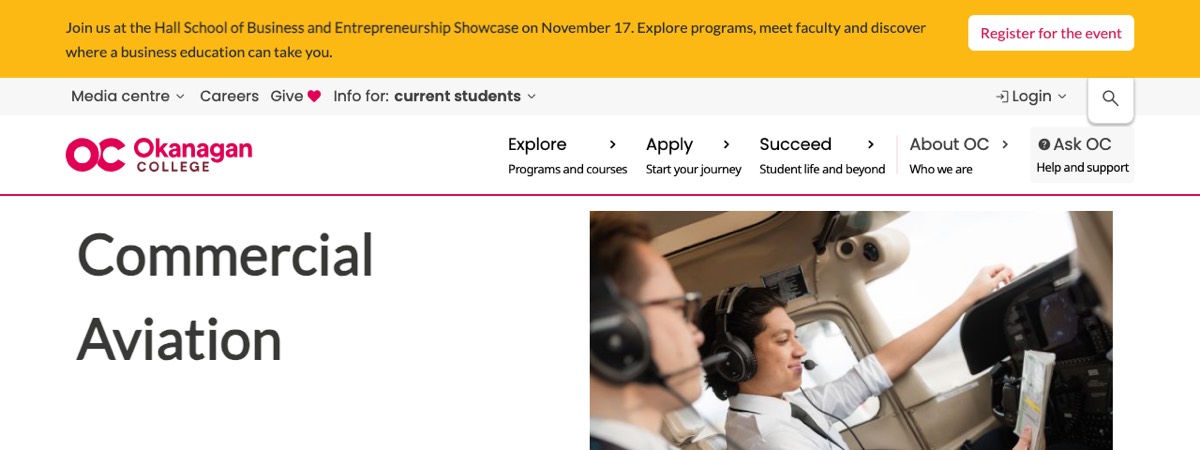
Commercial Aviation Diploma - Aeroplane is an in-person, 60-credit diploma from Okanagan College in British Columbia.
| Provider | Okanagan College |
|---|---|
| Length | 60-credit program |
| Credential | Diploma |
| Format | in person, BC |
Fiona's take: Okanagan College frames the program as 60 credits with flight training delivered in person in BC. BCIT is the British Columbia program our data flags as loan-eligible, so ask Okanagan directly about StudentAid BC rather than assuming. Tuition is not listed in our data.
Skip it if: Skip it if the Okanagan is out of reach geographically, because the whole program is in person.
See Program DetailsCommercial Flight and Aviation Leadership
Commercial Flight and Aviation Leadership is a 90-week in-person program from Fanshawe College leading to an Ontario College Advanced Diploma.
| Provider | Fanshawe College |
|---|---|
| Length | 90 weeks |
| Credential | Ontario College Advanced Diploma |
| Format | in person, ON |
Fiona's take: Fanshawe stretches training across 90 weeks and layers leadership coursework on top of the flying, which suits students who want airline management doors open later. Confirm OSAP eligibility for this specific program with the college before you budget around it. Tuition is not listed in our data.
Skip it if: Skip it if speed is the priority, because 90 weeks runs longer than an integrated course.
See Program DetailsAviation - Flight Management
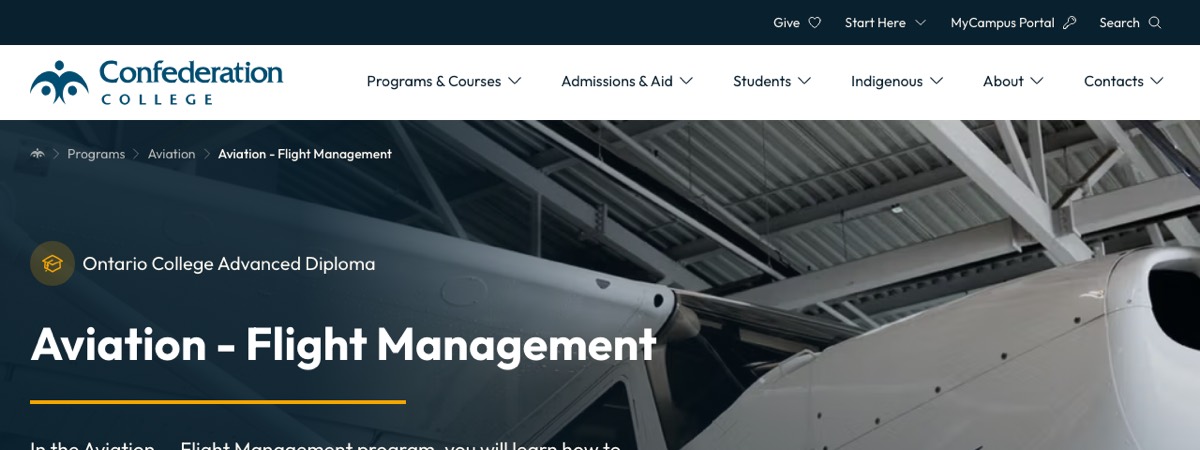
Aviation - Flight Management is a 2.5-year in-person program from Confederation College leading to an Ontario College Advanced Diploma.
| Provider | Confederation College |
|---|---|
| Length | 2.5 years |
| Credential | Ontario College Advanced Diploma |
| Format | in person, ON |
Fiona's take: Confederation College is one of the public programs our data confirms as loan-eligible, alongside Sault, BCIT, Sask Polytech and MRU. That makes this 2.5-year advanced diploma the safest funding bet on the page, if not the fastest. Seneca's CSFT partnership draws on the same school.
Skip it if: Skip it if you want the licence inside 18 months, because the diploma takes 2.5 years.
See Program DetailsCommercial Pilot Aviation Diploma
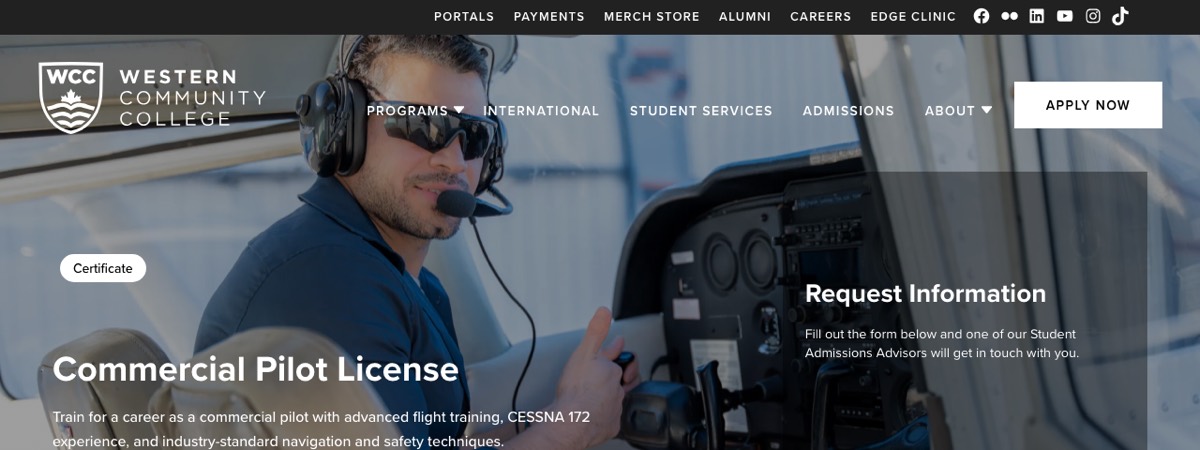
Commercial Pilot Aviation Diploma is a 1.5-year in-person diploma from Western Community College in British Columbia.
| Provider | Western Community College |
|---|---|
| Length | 1.5 YEARS |
| Credential | Diploma |
| Format | in person, BC |
Fiona's take: At 1.5 years, it is one of the shorter listed programs with a stated duration. Our data does not list it among the loan-eligible programs, so treat funding as unconfirmed and ask the college directly before you build a budget around it.
Skip it if: Skip it if student aid is essential to your plan until you confirm eligibility in writing.
See Program DetailsHow Much Does Commercial Pilot Training Cost In Canada?
Commercial pilot training costs $48,000 to $65,000 from zero to CPL on the modular route and $90,000 to $120,000 integrated. The government fees on top are small; the flight hours are what you are really paying for.
| Item | Cost (CAD) | Notes |
|---|---|---|
| Integrated CPL program | $90,000-120,000 | MFC quotes a 16-month program at $103,547 tuition |
| Modular zero-to-CPL | $48,000-65,000 | Itemised estimate, paid stage by stage |
| Category 1 medical | $250 | Required to hold the CPL; best completed before major training spending |
| CPAER written exam | $131.54 | Per sitting; 100 questions, 60% pass mark |
| Flight test examiner fee | $500-700 | Charged by the flight test examiner |
| CPL licence issuance | $80 | Transport Canada processing takes 40 working days |
The $80 issuance fee and the $131.54 exam fee are trivial next to the training bill, which is why I tell clients never to shop on government fees. The decision that matters is modular at $48,000 to $65,000 versus integrated at $90,000 to $120,000; the difference buys bundled multi-engine and instrument ratings and a faster timeline.
Loans shrink the cash problem only if the program qualifies. Canada Student Loans and provincial programs apply when your training is an eligible program at a designated educational institution, and a loan is a loan: it must be repaid. The private pilot licence stage is often not covered.
How Much Does A Commercial Pilot Earn In Canada?
A commercial pilot earns a median of $52.00 per hour in Canada, Job Bank reports for NOC 72600, with the range running from $24.04 to $106.00 in the 2023-2024 Labour Force Survey. Where you fly changes the number.
| Province | Median Hourly Wage (CAD) |
|---|---|
| Canada | 52.00 |
| Ontario | 63.00 |
| British Columbia | 57.69 |
| New Brunswick | 55.29 |
| Alberta | 54.11 |
| Quebec | 50.56 |
| Nova Scotia | 44.00 |
| Newfoundland and Labrador | 41.87 |
Entry wages for fresh CPL holders are not listed in our data, so use the $24.04 to $106.00 Job Bank range cautiously. Job Bank lists NOC 72600 pilots as employed by airline and air freight companies and flying schools, and the job examples tied to a new CPL are flight instructor, charter, bush pilot and regional airline first officer.
Ontario's $63.00 median is the highest of the provinces Job Bank lists, and Newfoundland and Labrador's $41.87 is the lowest. Job Bank lists the outlook for NOC 72600 as varying, so treat wage growth as regional rather than guaranteed.
Is Commercial Pilot Training Worth It In 2026?
Commercial pilot training is worth it in 2026 for one specific reader: someone who has passed a Category 1 medical, has a realistic funding plan, and wants an airline cockpit badly enough to spend $90,000 to $120,000 integrated or grind out $48,000 to $65,000 modular. For that person the CPL is the only door.
The math improves with the integrated route's bundled ratings. Airline and IFR operations often require multi-engine and instrument ratings, and integrated programs include them, which is part of why they cost more. A modular graduate can add the same ratings later, just in separate payments.
If any piece of that is missing, the medical, the money or the motivation, spend 4 weeks on Fundamentals of Flight mechanics first. The theory either hooks you or it does not, and both answers are worth having before the first flight-school invoice arrives.
Can You Get Funding For Commercial Pilot Training In Canada?
Funding for commercial pilot training exists, but it attaches to the program, not the licence. Government aid may apply only when the training is an eligible program at a designated educational institution, and some public college aviation programs are confirmed loan-eligible examples.
- Canada Student Loans and Grants. Federal loans and grants can fund flight training, but only if your training is an eligible program at a designated educational institution. A loan must be repaid; confirm the designation before you enrol anywhere.
- Provincial Student Aid (OSAP, StudentAid BC, AB Student Aid). Provincial programs mirror the federal rule. Public college programs such as Confederation, Sault, BCIT, Sask Polytech and MRU are loan-eligible examples; confirm the specific program's current eligibility, which is why I steer aid-dependent clients toward college aviation diplomas rather than standalone flight schools.
Commercial Pilot Questions Canadians Ask
How Long Does It Take To Become A Commercial Pilot In Canada?
Becoming a commercial pilot in Canada takes 12 to 18 months full-time through an integrated course, or 18 to 24 months on the modular path. Integrated schools advertise 12 to 18 months, and only at a full-time pace can the timeline compress toward 10 to 14 months. Plan your finances around the longer end.
What Are The Commercial Pilot Licence Requirements In Canada?
The commercial pilot licence requirements in Canada are age 18, a Category 1 medical, 200 hours of total flight time or 150 hours on the integrated path, 80 hours of ground school, a pass on the CPAER written exam and a successful flight test. Transport Canada sets all of it under CAR 421.30.
How Much Does Commercial Pilot Training Cost In Canada?
Commercial pilot training in Canada costs $48,000 to $65,000 from zero to CPL modular, or $90,000 to $120,000 integrated. Add the $131.54 CPAER exam fee, the $500 to $700 flight test examiner fee, the $250 medical and the $80 licence issuance. One integrated provider, MFC, quotes $103,547 tuition.
What Is The Median Wage For Pilots In Canada?
The median wage for pilots in Canada is $52.00 per hour under NOC 72600, Job Bank reports, with the range from $24.04 to $106.00. Ontario posts the highest listed provincial median at $63.00 and Newfoundland and Labrador the lowest at $41.87. Figures come from the 2023-2024 Labour Force Survey.
Can I Get Student Loans For Pilot Training In Canada?
Student loans for pilot training in Canada are possible when your course is an eligible program at a designated educational institution. Public college programs such as Confederation, Sault, BCIT, Sask Polytech and MRU are loan-eligible examples; confirm the specific program's current eligibility. The private pilot licence stage is often not covered, and a loan must be repaid.
Is Transport Canada The Regulator For Commercial Pilots?
Transport Canada is the regulator for commercial pilots. Every pilot licence, permit and certificate in the country is issued by Transport Canada under the Canadian Aviation Regulations, and the rule covers anyone operating a Canadian registered aircraft. There is no provincial licensing body to shop between.
What Jobs Can You Get With A CPL In Canada?
Jobs you can get with a CPL in Canada include flight instructor, charter pilot, bush pilot and regional airline first officer, the copilot seat. Job Bank lists NOC 72600 pilots as employed by airline and air freight companies and flying schools. Those are the common CPL job examples; none is guaranteed as a first step.
Do I Need An Instrument Rating For Commercial Pilot Jobs?
An instrument rating is highly recommended and often required for airline or IFR operations. Many integrated programs include the multi-engine and instrument ratings alongside the CPL-A, which is part of their higher price. On the modular route you can add both ratings after the licence, as separate steps.
What's The Bottom Line On Becoming A Commercial Pilot In Canada?
- Becoming a commercial pilot in Canada runs through one regulator: Transport Canada issues the CPL under the Canadian Aviation Regulations, and it asks for age 18, a Category 1 medical, 200 hours of flight time or 150 integrated, 80 hours of ground school, the CPAER exam and a flight test.
- Budget $48,000 to $65,000 modular or $90,000 to $120,000 integrated, plus the $131.54 exam, the $500 to $700 examiner fee and the $80 issuance.
- Job Bank's median for NOC 72600 is $52.00 an hour, from $24.04 to $106.00, with job examples in instructing, charter, bush flying and regional first officer seats.
- Government aid follows the program: only eligible programs at designated institutions qualify for loans, and public college programs such as Confederation, Sault, BCIT, Sask Polytech and MRU are loan-eligible examples; confirm the specific program's current eligibility.
- Before any deposit, spend 4 weeks on Fundamentals of Flight mechanics; it will not qualify you for a licence, but it will tell you whether the theory is for you.






