Key Takeaways
- The fastest realistic route is a 12-month CCAPP-accredited diploma ($14,000 to $18,000), then the PEBC Qualifying Exams (about $1,800) and provincial registration steps ($300 to $500).
- Registration is mandatory in nine provinces, from the Alberta College of Pharmacy and the Ontario College of Pharmacists to the College of Pharmacists of BC; Quebec does not regulate the title yet.
- Pharmacy Technician Fundamentals from MedCerts on Coursera is a 4-week series at 10 hours a week that tests your interest; it does not lead to PEBC certification or registration with any provincial college.
- Job Bank's median wage for NOC 32124 is $24.83 an hour in Canada, running from $20.00 in Quebec to $31.00 in British Columbia.
- Fiona's verdict: this path suits anyone who wants a regulated health career after 1 to 2 years of training, or about 12 months in a compressed example, and the unsure should start with the four-week Coursera test first.
A pharmacy technician is a regulated health professional who plays a critical role in the preparation and dispensing of medications. In the nine provinces that regulate the title, you need a CCAPP-accredited diploma, the PEBC Qualifying Exams, and registration with that province's regulator; Quebec's framework is still underway.
The realistic route runs 1 to 2 years and $8,000 to $20,000 in tuition, plus about $1,800 in exams. Before any of that, I tell clients to spend four weeks testing the field on Coursera.
What Are The Ways To Become A Pharmacy Technician In Canada?
This guide separates a try-first online option from the main regulated route: a CCAPP-accredited program followed by PEBC certification and provincial registration. Only the regulated route leads to the title.
| Route | Time | Cost (CAD) | What You Get | Recognised By | Best For |
|---|---|---|---|---|---|
| Pharmacy Technician Fundamentals (MedCerts series) | 4 weeks at 10 hours a week | Not listed | Shareable career certificate from MedCerts | No provincial college or PEBC | Testing the field before paying diploma tuition |
| CCAPP-accredited Pharmacy Technician Diploma or Certificate | 1 to 2 years | $8,000 to $20,000 | Diploma or certificate | PEBC, provincial regulators | The required training step in regulated provinces |
| PEBC Certification + Provincial Registration | 3 to 12 months after the program | $2,000 to $4,000 | PEBC Certificate of Qualification and provincial registration | Provincial pharmacy regulators | Diploma graduates who need to register |
For readers still deciding, I recommend the MedCerts series first; for readers set on the career, the CCAPP diploma followed by PEBC certification and registration is the route that ends in a regulated title.
What Is The Fastest Way To Become A Pharmacy Technician In Canada?
The fastest way to become a pharmacy technician in Canada is a 12-month CCAPP-accredited diploma, followed by the PEBC Qualifying Exams and provincial registration. Here is each stage with its clock and its cost.
- Finish a 12-month CCAPP-accredited diploma, such as the pharmacy technician diploma at Vancouver Community College, for $14,000 to $18,000.
- Sit the PEBC Qualifying Exam Part I (MCQ) and Part II (OSPE) for about $1,800 together, $585 for Part I and $1,240 for Part II under 2027 fees, within 3 to 6 months.
- Complete your province's jurisprudence requirements, any required practical training, and registration with the regulator over 1 to 3 months for $300 to $500.
- Start job hunting with Job Bank's median of $24.83 an hour (NOC 32124) as your benchmark.
Is Registration Mandatory For Pharmacy Technicians In Canada?
Registration is mandatory for pharmacy technicians in nine provinces, each through its own regulator: the Alberta College of Pharmacy, the College of Pharmacists of BC, the Ontario College of Pharmacists and their counterparts elsewhere. Quebec is the exception, with a framework still underway.
| Province | Required? | Regulator Or Registry | What It Means |
|---|---|---|---|
| Alberta | Yes | Alberta College of Pharmacy (ACP) | Complete ACP's requirements to enter the pharmacy technician register |
| British Columbia | Yes | College of Pharmacists of BC | You must be registered with the college to work |
| Manitoba | Yes | College of Pharmacists of Manitoba | Register with the college before working |
| New Brunswick | Yes | New Brunswick Pharmaceutical Society | Register with the society before working |
| Newfoundland and Labrador | Yes | Newfoundland and Labrador Pharmacy Board | Register with the board before working |
| Nova Scotia | Yes | Nova Scotia College of Pharmacists | Register with the college before working |
| Ontario | Yes | Ontario College of Pharmacists | Registration is required for pharmacy technicians |
| Prince Edward Island | Yes | Prince Edward Island Pharmacy Board | Register with the board before working |
| Saskatchewan | Yes | College of Pharmacy Professionals | Register with the college before working |
| Quebec | Not yet | Ordre des pharmaciens du Québec | A framework is underway but not in force |
Registration is what turns a graduate into a practising technician. In Alberta, the Alberta College of Pharmacy lists the requirements you must complete to enter the pharmacy technician register, and the Ontario College of Pharmacists requires registration before you can use the title there. Your PEBC Certificate of Qualification, provincial jurisprudence and any required practical training all feed that application.
NAPRA counts nine regulating provinces: Alberta, British Columbia, Manitoba, New Brunswick, Newfoundland and Labrador, Nova Scotia, Ontario, Prince Edward Island and Saskatchewan, and notes that steps are underway to implement a framework in Quebec under the Ordre des pharmaciens du Québec. If you plan to work in Quebec, check with the Ordre before choosing a program, and in any other province check that regulator's current requirements before you apply.
Which Pharmacy Technician Courses Are Worth Taking?
The pharmacy technician courses worth taking split into two groups: short online courses that test your interest, and college diplomas that are the real gateway to the regulated title. I list the try-first options first, then the college programs. Prices for the online options are not listed, so check the platform pages.
Pharmacy Technician Fundamentals
Pharmacy Technician Fundamentals is a 4-week, 10-hours-a-week online course series (4 courses) from MedCerts on Coursera that ends with a shareable career certificate.
| Provider | MedCerts |
|---|---|
| Length | 4 weeks at 10 hours a week (4 course series) |
| Rating | 4.7 (1,411 reviews across courses) |
| Credential | Shareable career certificate from MedCerts |
| Format | online |
Fiona's take: This is the try-first course I put in front of clients. It carries a 4.7 rating across 1,411 reviews, one of the largest samples on this list, and it introduces the fundamentals of a pharmacy career. Be clear about what it is not: no MedCerts certificate from Coursera counts toward CCAPP accreditation, PEBC certification, or registration with any provincial college. It is a test drive, not a shortcut.
Skip it if: Skip it if you have already been accepted into a diploma program, because the material will repeat.
Start On CourseraPharmacy Technician Intermediate
Pharmacy Technician Intermediate is a 4-week, 10-hours-a-week online course series (3 courses) from MedCerts on Coursera, rated 4.9 across 79 reviews.
| Provider | MedCerts |
|---|---|
| Length | 4 weeks at 10 hours a week (3 course series) |
| Rating | 4.9 (79 reviews across courses) |
| Credential | Shareable career certificate from MedCerts |
| Format | online |
Fiona's take: The 4.9 rating is the highest score here, but it rests on 79 reviews, so read it as a strong signal from a small crowd rather than a settled verdict. I suggest it as a follow-up to Fundamentals for people who finished the first series still curious about the work. Like the rest of the MedCerts line, it does not qualify you for provincial registration.
Skip it if: Skip it if the Fundamentals series already told you this field is not for you.
Start On CourseraPharmacy Technician Essentials
Pharmacy Technician Essentials is a 15-hour online course from MedCerts on Coursera with a shareable certificate at the end.
| Provider | MedCerts |
|---|---|
| Length | 15 hours |
| Credential | Shareable certificate |
| Format | online |
Fiona's take: Fifteen hours is shorter than the 4-week Coursera specializations, but not the shortest option listed: the Udemy courses run 5 and 8 hours. It is still a realistic way to rule the field in or out before any tuition. No rating is listed for it. The same limit applies: it is background knowledge, not a credential any regulator recognises.
Skip it if: Skip it if your schedule can absorb the fuller 4-week Fundamentals series instead.
Start On CourseraBecome a Pharmacy Technician
Become a Pharmacy Technician is a 5-hour online course from Steven Pettit, Pharm. D. on Udemy, rated 4.7 across 3,322 reviews.
| Provider | Steven Pettit, Pharm. D. |
|---|---|
| Length | 5 total hours |
| Rating | 4.7 (3,322 reviews) |
| Credential | Certificate of completion |
| Format | online |
Fiona's take: 3,322 reviews is the biggest feedback pool in this roundup, and the 4.7 score holds up. Five hours of content suits someone who wants the gist of the role in one sitting before deciding on anything longer. The certificate of completion is a Udemy credential, not a step toward PEBC exams or provincial registration.
Skip it if: Skip it if you want graded assignments and a structured series, because this is a single video course.
View On UdemyPharmacy Technician Bootcamp From Meded101
Pharmacy Technician Bootcamp From Meded101 is an 8-hour online course from Eric Christianson on Udemy, rated 4.7 across 108 ratings.
| Provider | Eric Christianson |
|---|---|
| Length | 8 hours |
| Rating | 4.7 (108 ratings) |
| Credential | Certificate of completion |
| Format | online |
Fiona's take: The bootcamp format suits revision: eight hours that pull the role's core ideas into one place, useful in the month before a diploma program starts. The 4.7 score comes from 108 ratings, a modest sample compared with the 3,322 behind the Pettit course. A certificate of completion is all it confers.
Skip it if: Skip it if you are starting from zero, because a bootcamp moves faster than a first introduction should.
View On UdemyPharmacy Technician
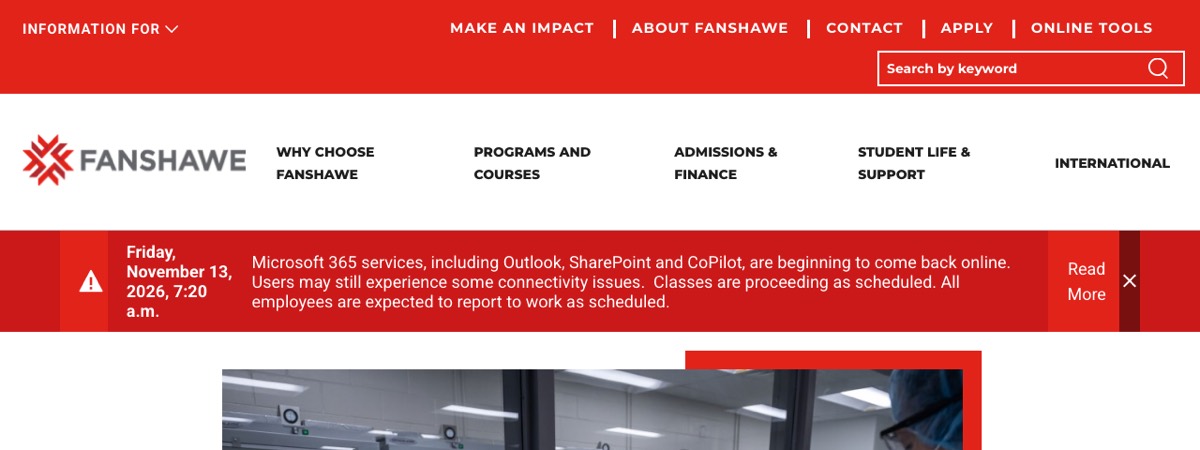
Pharmacy Technician at Fanshawe College is a 60-week, in-person program in Ontario that ends in an Ontario College Diploma.
| Provider | Fanshawe College |
|---|---|
| Length | 60 weeks |
| Credential | Ontario College Diploma |
| Format | in person, Ontario |
Fiona's take: Sixty weeks sits inside the 1 to 2 year range for accredited programs and moves you through the diploma stage without the longer four-semester format. One check before you apply: confirm the program's current standing on CCAPP's accredited program list, because that accreditation is what keeps the PEBC door open. Tuition is not listed, so ask the registrar directly.
Skip it if: Skip it if you cannot attend in person in Ontario.
See Program DetailsPharmacy Technician
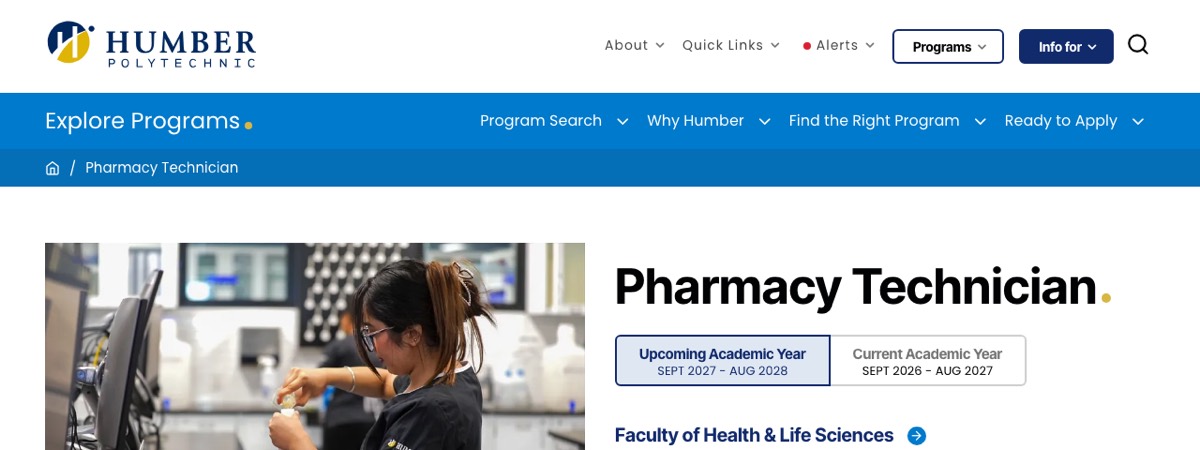
Pharmacy Technician at Humber College is a 4-semester, in-person diploma program in Ontario.
| Provider | Humber College |
|---|---|
| Length | 4 semesters |
| Credential | Diploma |
| Format | in person, Ontario |
Fiona's take: Four semesters fits within the typical 1-to-2-year route, a steadier pace than a 12-month sprint if you are working alongside study. As with every college on this page, verify its listing on the CCAPP accredited program directory before you pay a deposit, and ask the registrar about tuition, which is not listed here.
Skip it if: Skip it if you want the shortest possible timeline, because compressed 12-month options exist.
See Program DetailsHow Much Does A Pharmacy Technician Course Cost In Canada?
A pharmacy technician course costs $8,000 to $20,000 in tuition at a CCAPP-accredited college in Canada, and about $2,000 to $4,000 more for exams and registration once the program ends. Here is the full stack.
| Item | Cost (CAD) | Notes |
|---|---|---|
| CCAPP-accredited diploma or certificate tuition | $8,000 to $20,000 | Typical range for 1 to 2 year programs |
| 12-month compressed diploma | $14,000 to $18,000 | The fastest-route example, sourced to VCC's program page |
| PEBC Qualifying Exam Part I (MCQ) | $585 | 2027 fees |
| PEBC Qualifying Exam Part II (OSPE) | $1,240 | 2027 fees |
| Jurisprudence, practical training and registration steps | $300 to $500 | Takes 1 to 3 months after exams |
| Provincial registration, annual renewal | $250 to $450 | Paid every year you stay registered |
| PEBC certification and registration combined | $2,000 to $4,000 | The full post-program stage |
Tuition is the line that swings. The 12-month compressed diploma runs $14,000 to $18,000, while the wider accredited market spans $8,000 to $20,000. Fanshawe and Humber tuition is not listed, so ask their registrars before comparing offers.
The post-program stage is predictable: $585 for PEBC Part I and $1,240 for Part II under 2027 fees, $300 to $500 for jurisprudence and registration steps, then $250 to $450 a year to stay registered. Prices for the online try-first courses are not listed, so treat the platform pages as the source of truth.
How Much Does A Pharmacy Technician Earn In Canada?
A pharmacy technician earns a median of $24.83 an hour in Canada under NOC 32124, Job Bank figures show. British Columbia is the highest provincial median at $31.00 and Quebec the lowest at $20.00.
| Province | Median Hourly Wage (NOC 32124) |
|---|---|
| Canada | $24.83 |
| Alberta | $26.75 |
| British Columbia | $31.00 |
| Manitoba | $28.00 |
| New Brunswick | $26.94 |
| Newfoundland and Labrador | $26.94 |
| Nova Scotia | $25.00 |
| Ontario | $26.45 |
| Prince Edward Island | $21.00 |
| Quebec | $20.00 |
| Saskatchewan | $25.00 |
British Columbia pays the highest median at $31.00 an hour and WorkBC flags high opportunity in the province, which is why I steer wage-sensitive clients toward BC programs such as those at Vancouver Community College, Okanagan College and Selkirk College. Alberta's median sits at $26.75 and Ontario's at $26.45, and the outlook reads as high opportunity in BC and good in Ontario.
The lower end belongs to Quebec at $20.00 and Prince Edward Island at $21.00, and Quebec is also the province where the title is not yet regulated. Set expectations against the national median of $24.83 rather than the BC figure, because the two describe different labour markets.
Is A Pharmacy Technician Course Worth It In 2026?
A pharmacy technician course is worth it in 2026 if you want a regulated health title without a degree-length program. The diploma stage runs 1 to 2 years, the post-program PEBC certification and provincial registration stage typically adds 3 to 12 months, and the payoff is a median of $24.83 an hour nationally, with BC at $31.00 where WorkBC also sees high opportunity.
The investment side is honest and countable: $8,000 to $20,000 in tuition, about $1,800 in PEBC fees, and $250 to $450 a year to stay registered. Against that, registration in nine provinces gives the title legal standing, and renewal is a known, budgetable cost rather than a surprise.
Where I hesitate is with clients who want the wage without the structure. If $8,000 to $20,000 and both exam sittings feel heavy, the MedCerts series on Coursera answers the interest question in four weeks, and you can walk away before paying any diploma tuition.
Can You Get Funding For A Pharmacy Technician Program?
Funding for a pharmacy technician program is available through the standard student aid stack: Canada Student Loans and Grants federally, plus provincial programs such as BC StudentAid.
- Canada Student Loans and Grants. The federal program provides financial assistance which may help eligible post-secondary students in eligible programs. A loan is a loan: the borrowed portion must be repaid after you finish.
- Provincial student aid (for example, BC StudentAid). Provincial systems run alongside the federal one. Check the relevant provincial or territorial student-aid rules; BC StudentAid is the application point for BC student aid.
Pharmacy Technician Questions Canadians Ask
How Long Does It Take To Become A Pharmacy Technician In Canada?
Becoming a pharmacy technician in Canada typically takes 1 to 2 years for an accredited program, plus exams and registration afterward. The compressed route is a 12-month diploma, then 3 to 6 months to pass the PEBC Qualifying Exams, then 1 to 3 months for jurisprudence and registration with your provincial college.
What Is The Cost Of Pharmacy Technician Training In Canada?
Pharmacy technician training in Canada ranges from $8,000 to $20,000 in tuition at CCAPP-accredited colleges, with the 12-month compressed diploma between $14,000 and $18,000. Exams add about $1,800, with Part I at $585 and Part II at $1,240 under 2027 fees, and provincial registration costs $300 to $500 to set up plus $250 to $450 a year to renew.
Do I Need To Pass Exams To Become A Registered Pharmacy Technician?
Exams are required: the PEBC Qualifying Exam Part I, a multiple-choice exam, and Part II, the OSPE, are both needed in regulated provinces before a college will register you. Together they cost about $1,800 under 2027 fees. A Coursera or Udemy certificate does not stand in for either exam, or for the diploma behind them.
Is Registration Mandatory For Pharmacy Technicians In Canada?
Registration is mandatory in nine provinces: Alberta, British Columbia, Manitoba, New Brunswick, Newfoundland and Labrador, Nova Scotia, Ontario, Prince Edward Island and Saskatchewan, each through its own college or board. Quebec does not yet regulate the title, though steps toward a framework are underway with the Ordre des pharmaciens du Québec. In the nine regulated provinces you cannot work as a pharmacy technician without registering.
What Is The Median Salary For Pharmacy Technicians In Canada?
The median salary for pharmacy technicians in Canada is $24.83 an hour in Job Bank data for NOC 32124. Provincially the medians run from $20.00 in Quebec and $21.00 on Prince Edward Island up to $31.00 in British Columbia, with Manitoba at $28.00 and Alberta at $26.75 in between.
Are There CCAPP Accredited Programs In BC?
CCAPP-accredited programs in BC exist: Vancouver Community College, Okanagan College and Selkirk College all hold accreditation for pharmacy technician training. BC is also the strongest wage market, with a median of $31.00 an hour and high opportunity flagged by WorkBC, so the province pairs solid training options with the highest provincial median in the Job Bank table.
Can International Graduates Become Pharmacy Technicians In Canada?
International graduates can become pharmacy technicians in Canada through PEBC's evaluation of international qualifications, followed by provincial requirements. The route runs through the same regulators, from the Ontario College of Pharmacists to the College of Pharmacists of BC, and the same exam structure where the college requires it. International graduates should check PEBC's international evaluation route and the regulator requirements in the province where they plan to register.
What Is The Job Outlook For Pharmacy Technicians?
The job outlook for pharmacy technicians is listed as high opportunity in British Columbia and good in Ontario. Combined with a national median wage of $24.83 an hour and registration that limits the title to qualified applicants in nine provinces, the demand picture supports the training investment.
What's The Bottom Line On Pharmacy Technician Courses?
- A CCAPP-accredited diploma ($8,000 to $20,000) plus PEBC exams (about $1,800) and registration steps ($300 to $500) is the route to the regulated title in nine provinces.
- Pharmacy Technician Fundamentals is a 4-week, 10-hours-a-week MedCerts series that lets you test the field first, but it does not lead to registration.
- Job Bank's median wage for NOC 32124 is $24.83 an hour, from $20.00 in Quebec to $31.00 in BC, where WorkBC sees high opportunity.
- Quebec is the one province listed without mandatory registration; a framework is underway with the Ordre des pharmaciens du Québec.
- This path suits you if you want a regulated health career after 1 to 2 years of training, or about 12 months in a compressed example; hold off on the diploma until a 15-hour or 4-week taste confirms the interest.