Key Takeaways
- The fastest structured start is a single continuing education course: Conestoga College's ASL 101 costs $312.54 and runs 42 hours over one semester, while George Brown's full C144 certificate takes 1 year and costs $4,314 in domestic tuition.
- No licence or registration is required to learn or use ASL in Canada, but ASL does not satisfy IRCC citizenship language proof, which requires English or French tests such as CELPIP or IELTS.
- The Coursera try-first option is American Deaf Culture from the University of Houston, a 5-hour online course. It is a Deaf culture course with a shareable certificate, not a college certificate, and it does not teach signing fluency.
- CHHA-Edmonton charges $195 per beginner conversational ASL course, and free online lessons exist through resources like SignSchool, but most structured adult classes are paid.
- Fiona's verdict: budget learners should start with a short paid course or Coursera to test commitment; learners who need a recognised credential should target George Brown's C144 at $4,314 or NSCC's one-year certificate at $3,800 in 2026-27 domestic tuition.
American Sign Language (ASL) is a complete visual-gestural language with its own grammar, syntax and vocabulary, used primarily by Deaf communities in Canada and the United States. It is not English on the hands, and it is not universal.
The shortest realistic route in Canada is a single continuing education course: Conestoga College's ASL 101, which costs $312.54 and runs 42 hours over one semester. If you need a credential, George Brown Polytechnic's online C144 certificate takes 1 year and costs $4,314 in domestic tuition. I recommend testing your commitment with a short course first.
What Are The Ways To Learn American Sign Language In Canada?
American Sign Language classes in Canada split into three routes: short continuing education courses, full college certificates, and community providers such as Canadian Hearing Services.
| Route | Time | Cost (CAD) | What You Get | Recognised By | Best For |
|---|---|---|---|---|---|
| American Deaf Culture (Coursera, University of Houston) | 5 hours | Not listed | Shareable certificate in Deaf culture, not signing fluency | Coursera | Testing interest before paying tuition |
| Continuing education courses (e.g. Conestoga ASL 101, CHHA-Edmonton) | 42 hours per course | $312.54 at Conestoga; $195 at CHHA-Edmonton | Course credit or completion | Conestoga College; CHHA-Edmonton | Beginners and casual learners |
| College certificates (George Brown C144, VCC, NSCC) | 8 months to 1 year | $3,800 to $6,729 | Ontario College Certificate or college Certificate | George Brown Polytechnic, Vancouver Community College, NSCC | Career changers who need a credential |
I recommend the Conestoga or CHHA route for hobbyists, and the George Brown C144 online certificate for anyone who wants a structured credential without moving.
What Is The Fastest Way To Start ASL Sign Language Classes?
The fastest way to start ASL classes in Canada is a single beginner course, which you can register for immediately at several providers.
- Enrol in a beginner online ASL course, such as Canadian Hearing Services ASL 101. Registration is immediate and each level runs 10 weeks; course fees are not listed by CHS.
- If you want a fixed published price, enrol in Conestoga College ASL 101 for $312.54, which runs 42 hours over one semester.
- Progress to ASL 102 and higher levels, adding 10 to 20 weeks per level at Canadian Hearing Services.
- Apply to a full certificate program such as George Brown's C144 for a structured credential: 1 year full-time at $4,314 domestic tuition.
- In Edmonton, CHHA-Edmonton offers beginner conversational ASL at $195 per course.
Can You Use ASL For IRCC Citizenship Language Proof In Canada?
ASL does not satisfy IRCC citizenship language proof requirements. IRCC requires proof of English or French proficiency through specific tests such as CELPIP or IELTS, and ASL does not fulfil that citizenship requirement.
| Requirement | Does ASL Count? | What IRCC Accepts | What It Means |
|---|---|---|---|
| Citizenship language proof | No | English or French tests such as CELPIP or IELTS | Deaf applicants can request accommodations such as interpreters, but ASL itself does not satisfy this requirement |
| Licence or registration to learn or use ASL | Not required | No regulator exists | Anyone can enrol in classes or use ASL freely |
ASL is unregulated as a subject: no provincial body licenses learners, and no registration is required to study it or use it in daily life. The regulation question only matters if your goal is citizenship language proof, and there the answer is firm: IRCC wants English or French.
Where Deaf applicants do get support is in accommodations. IRCC allows arrangements such as interpreters for Deaf applicants during the citizenship process, so the barrier is the test requirement itself, not access to the process.
Which ASL Courses And Certificate Programs Are Worth Taking?
The ASL courses worth taking depend on your goal: culture and commitment testing, vocabulary volume, or a recognised college certificate.
American Deaf Culture
American Deaf Culture is a 5-hour online course from the University of Houston with a shareable certificate.
| Provider | University of Houston |
|---|---|
| Length | 5 hours to complete |
| Rating | 4.5 (395 reviews) |
| Credential | Shareable certificate |
| Format | online |
Fiona's take: This is the lowest-stakes way I know to find out whether Deaf studies is actually for you. At 5 hours total, you finish in a weekend, and the 4.5 rating across 395 reviews suggests it holds attention. I tell clients to pair it with a free resource such as SignSchool before paying tuition anywhere.
Skip it if: Skip it if you already know you want to sign; it teaches culture, not hands.
Start On CourseraASL | First 500+ Basic Signs | American Sign Language
ASL | First 500+ Basic Signs | American Sign Language is a 22h 46m on-demand video course from Able Lingo ASL with a certificate of completion.
| Provider | Able Lingo ASL |
|---|---|
| Length | 22h 46m total length |
| Rating | 4.8 (1,542 ratings) |
| Credential | Certificate of completion |
| Format | online |
Fiona's take: The volume here is the selling point: over 22 hours of video covering more than 500 signs, rated 4.8 across 1,542 ratings. It suits self-motivated learners who want vocabulary fast and will drill on their own. It is not a substitute for live practice with fluent signers.
Skip it if: Skip it if you learn best in a live classroom with feedback on your handshapes.
View On UdemyAmerican Sign Language Level 1
American Sign Language Level 1 is a 2.5-hour on-demand video course from Intellezy Trainers with a certificate of completion.
| Provider | Intellezy Trainers |
|---|---|
| Length | 2.5 hours on-demand video |
| Rating | 4.6 (4,218 ratings) |
| Credential | Certificate of completion |
| Format | online |
Fiona's take: At 2.5 hours, this is a quick taste rather than a program, rated 4.6 across 4,218 ratings. I see it as a screening tool: if you finish it and want more, a paid course or certificate is a safer bet. On its own it will not build conversational ability.
Skip it if: Skip it if you already have any ASL background; it starts from zero.
View On UdemyAmerican Sign Language and Deaf Studies Program C144
American Sign Language and Deaf Studies Program C144 is a 2-semester online program from George Brown Polytechnic costing $4,314 in domestic tuition and awarding an Ontario College Certificate.
| Provider | George Brown Polytechnic |
|---|---|
| Length | 2 semesters |
| Cost (CAD) | $4,314.00 (domestic tuition) |
| Credential | Ontario College Certificate |
| Format | online, ON |
Fiona's take: This is the credential I recommend most often, because it is fully online, one year, and carries an Ontario College Certificate. It has lower listed domestic tuition than VCC at $4,314, and the online delivery means location is not a barrier for most Canadians.
Skip it if: Skip it if you only want casual conversation; $4,314 is a real commitment for a hobby.
See Program DetailsASL and Deaf Studies Certificate
ASL and Deaf Studies Certificate is an 8-month class-based program at Vancouver Community College costing $6,729 in domestic tuition.
| Provider | Vancouver Community College |
|---|---|
| Length | 8 months |
| Cost (CAD) | $6,729 (domestic tuition) |
| Credential | Certificate |
| Format | class-based, BC |
Fiona's take: VCC delivers the credential in 8 months full-time, four months faster than George Brown, but tuition is $6,729 and delivery is class-based in BC. For BC residents who want speed and in-person immersion, it is a strong option. For everyone else, George Brown undercuts it on both price and location.
Skip it if: Skip it if you are outside Metro Vancouver or want the lower tuition of an online program.
See Program DetailsCertificate in American Sign Language
Certificate in American Sign Language is a 1-2 year face-to-face program at University of Victoria Continuing Studies with estimated fees of $4,580.24.
| Provider | University of Victoria Continuing Studies |
|---|---|
| Length | 1-2 years |
| Cost (CAD) | $4,580.24 CAD (estimated fees) |
| Credential | Certificate |
| Format | face to face, BC |
Fiona's take: UVic's certificate runs face to face over 1 to 2 years at an estimated $4,580.24, close to George Brown's price but slower. Its value is the in-person format on Vancouver Island, which matters for signing, since immediate feedback on handshape is hard to get online.
Skip it if: Skip it if you need a fixed timeline; the 1-2 year span suggests part-time pacing.
See Program DetailsAmerican Sign Language (ASL) Studies
American Sign Language (ASL) Studies is a 1-year in-person certificate at NSCC costing $3,800 in 2026-27 domestic tuition.
| Provider | NSCC |
|---|---|
| Length | 1 Year |
| Cost (CAD) | $3,620 (domestic tuition) |
| Credential | Certificate |
| Format | in person, NS |
Fiona's take: NSCC is the cheapest full certificate in this comparison at $3,800 for one year in person in Nova Scotia, using the 2026-27 domestic tuition figure. For Atlantic Canadians this is the obvious first choice on price alone. The in-person delivery is a genuine advantage for a visual language.
Skip it if: Skip it if you are outside Nova Scotia and cannot relocate for a year.
See Program DetailsAmerican Sign Language - Basic Skills
American Sign Language - Basic Skills is a part-time joint certificate program at Conestoga College with length and cost not listed.
| Provider | Conestoga College |
|---|---|
| Credential | joint certificate |
| Format | part-time, ON |
Fiona's take: This is the pathway the $312.54 ASL 101 course feeds into, awarding a joint certificate part-time. I like it as a pay-as-you-go route: start with one $312.54 course and only continue if the first one sticks. Confirm current fees with Conestoga before enrolling, since the program page does not list them.
Skip it if: Skip it if you need a full-time credential with a published total price.
See Program DetailsAmerican Sign Language courses
American Sign Language courses at Seneca Polytechnic are online, in-person or hybrid courses awarding a Certificate of Completion after three levels.
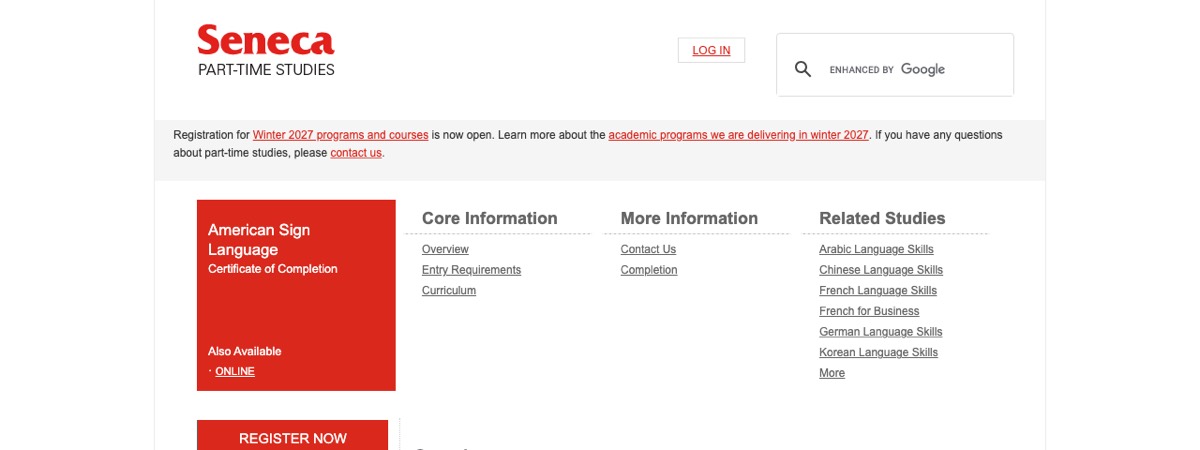
| Provider | Seneca Polytechnic |
|---|---|
| Credential | Certificate of Completion (after three levels) |
| Format | online/in-person/hybrid, ON |
Fiona's take: Seneca gives Ontario learners format flexibility: online, in person or hybrid, with a completion certificate after three levels. That suits people in the GTA juggling work schedules. Note it is a Certificate of Completion rather than the Ontario College Certificate listed for George Brown.
Skip it if: Skip it if an employer or further program requires a formal college credential.
See Program DetailsHow Much Do American Sign Language Classes Cost In Canada?
American Sign Language class prices in Canada run from single community courses to full certificates: CHHA-Edmonton offers beginner conversational ASL for $195 per course, while a full certificate at Vancouver Community College costs $6,729.
| Provider | Program Or Course | Cost (CAD) | Notes |
|---|---|---|---|
| CHHA-Edmonton | Beginner conversational ASL | $195 per course | Community provider, varying fees elsewhere in the city |
| Conestoga College | ASL 101 (continuing education) | $312.54 | 42 hours, one semester |
| Vanier College | ASL Level 1 | $435 | $375 tuition plus a $60 materials fee |
| NSCC | ASL Studies certificate | $3,800 | 1 year, 2026-27 domestic tuition, in person |
| George Brown Polytechnic | ASL and Deaf Studies C144 | $4,314 | 1 year, online, Ontario College Certificate |
| University of Victoria | Certificate in ASL | $4,580.24 | Estimated fees, 1-2 years, face to face |
| Vancouver Community College | ASL and Deaf Studies | $6,729 | 8 months, domestic tuition |
| Canadian Hearing Services | ASL 101 and other levels | Not listed | 10 weeks per level, virtual classes |
The pattern in these numbers is clear: single courses sit in the low hundreds, and full certificates sit between $3,800 and $6,729. NSCC at $3,800 for the 2026-27 year is the cheapest full certificate in this comparison, and VCC at $6,729 is the most expensive, though VCC is also the fastest at 8 months.
Canadian Hearing Services fees are not listed here; confirm current pricing before enrolling. What CHS does publish is structure: 10 weeks per level, taught by qualified Deaf instructors using the Signing Naturally curriculum.
Is Learning ASL Worth It In 2026?
ASL is worth learning in 2026 if your reason matches the route. Hobbyists and family members of Deaf people get real value from a $195 CHHA-Edmonton course or Conestoga's $312.54 ASL 101; those prices are close to what a month of casual spending looks like, and basic conversational skill is the realistic outcome of one 10-week or 42-hour course.
The certificate route is for people who want a structured ASL and Deaf Studies credential. At $4,314, George Brown's online C144 is the credential I steer career changers toward, because it removes relocation from the equation entirely. NSCC at $3,800 in 2026-27 domestic tuition is the better deal if you can study in Nova Scotia.
One caution I give every client: ASL will not help with IRCC citizenship language proof, which requires English or French tests like CELPIP or IELTS. If your goal is citizenship language proof rather than communication, spend the money on test preparation instead.
Can You Get Funding For ASL Classes In Canada?
One listed funding-related option is LINC American Sign Language at NorQuest College, and it is restricted to LINC-eligible newcomers.
- LINC American Sign Language (ASL) at NorQuest College. NorQuest College teaches ASL within the Language Instruction for Newcomers to Canada (LINC) framework, but the class is restricted to LINC-eligible newcomers. If you qualify for LINC, ask NorQuest about the ASL section.
American Sign Language Classes Questions Canadians Ask
Are There Free ASL Classes In Canada?
Free ASL classes exist in limited forms: apps and resources like SignSchool offer free online lessons, and certain high school students in BC can access free online ASL courses. Most structured adult classes are paid, though. SignSchool offers free lessons; the cost of Coursera's American Deaf Culture course is not listed here.
What Is The Cost Of ASL Classes In Edmonton?
ASL class prices in Edmonton vary by provider: CHHA-Edmonton offers beginner conversational ASL for $195 per course. Other Edmonton providers, such as the Alberta Cultural Society of the Deaf and Metro Continuing Education, set their own varying fees, so compare syllabi and hours, not just price, before registering with any of them.
Can I Use ASL For IRCC Citizenship Language Requirements?
ASL cannot be used for IRCC citizenship language requirements. IRCC requires proof of English or French proficiency through designated tests like CELPIP or IELTS. Accommodations such as interpreters are available for Deaf applicants during the process, but ASL itself does not satisfy the language proof rule.
How Long Does It Take To Learn Basic ASL?
Basic ASL takes one introductory course by the standard timelines in Canada: ASL 101 courses typically run 10 weeks, such as at Canadian Hearing Services, or 42 hours over one semester at Conestoga College. That gets you basic conversational skills, not fluency, which takes continued levels or a certificate program.
Are There Online ASL Courses In Canada?
Online ASL courses in Canada are well established. George Brown's C144 certificate runs fully online for one year, and Canadian Hearing Services teaches virtual classes at every level using the Signing Naturally curriculum with qualified Deaf instructors. Online is a viable route to a real credential here.
What Credential Do ASL Certificate Programs Award?
ASL certificate programs award different credentials depending on the school. George Brown awards an Ontario College Certificate after 2 semesters, and Vancouver Community College awards a Certificate after 8 months. Seneca Polytechnic awards a Certificate of Completion after three levels, which is not a college certificate.
Is ASL Offered At Colleges In Alberta?
ASL college offerings in Alberta are thin right now. Lakeland College's ASL and Deaf Culture Studies certificate is not offered for 2026-2027. For classes in the province, check NorQuest's LINC ASL if you are an eligible newcomer, or community providers such as CHHA-Edmonton at $195 per course.
Do ASL Courses Include Deaf Culture?
Deaf culture is built into most serious ASL programs. VCC and George Brown curricula integrate Deaf culture, community, linguistics and social issues alongside language skills, and Coursera's American Deaf Culture course covers the cultural side alone. Treat culture as core content, not an optional extra.
What's The Bottom Line On American Sign Language Classes In Canada?
- A single beginner course is the honest starting point: Conestoga ASL 101 costs $312.54 for 42 hours, and CHHA-Edmonton charges $195 per course.
- The cheapest full certificate is NSCC's one-year in-person program at $3,800 in 2026-27 domestic tuition; the cheapest online certificate is George Brown's C144 at $4,314 for domestic tuition.
- ASL does not satisfy IRCC citizenship language proof, which requires English or French tests such as CELPIP or IELTS.
- NorQuest's LINC ASL class is restricted to LINC-eligible newcomers.
- Test your commitment first with American Deaf Culture, a 5-hour Coursera course from the University of Houston, before paying tuition anywhere.






