Key Takeaways
- The fastest realistic route is an accredited diagnostic medical sonography diploma at 2 years (22-27 months; listed program lengths vary), followed by Sonography Canada entry-to-practice exams; Humber College is the only compared offer with a tuition amount listed here, $5,242.56 for two semesters as a domestic student.
- Registration with a regulator is mandatory in Ontario (CMRITO), Quebec (OTIMROEPMQ), Saskatchewan (CMRIPS), Nova Scotia (NSRMIRT) and Alberta (ACMDTT) from July 6, 2026; British Columbia and other provinces leave hiring to employer discretion.
- Human Anatomy and Medical Terminology Fundamentals, a 3-6 month online Coursera Specialization from MedCerts rated 4.7, is the try-first pick; it does not qualify you for Sonography Canada exams or CMRITO registration.
- Medical sonographers earn a median of $42.00 per hour under NOC 32122 in Job Bank's wage report, with a national range of $34.90 to $51.00.
- Fiona's verdict: this path suits disciplined students who want hospital imaging work after two years of school and can handle competitive entry, national exams, and $694.95 in annual CMRITO fees if they practise in Ontario.
A diagnostic medical sonographer uses high-frequency sound waves (ultrasound) to produce and record images of the body, helping physicians monitor pregnancies and diagnose cardiac, ophthalmic, vascular and other medical disorders. The shortest realistic route in Canada is an accredited diploma, typically about 2 years (22-27 months), though listed program lengths vary, then Sonography Canada's entry-to-practice exams, then registration with your provincial regulator where it is required.
Before you spend two years and tuition on that path, test the field. A Coursera Specialization such as MedCerts' Human Anatomy and Medical Terminology Fundamentals shows you the material first, without pretending to be a licence.
What Are The Ways To Become A Sonographer In Canada?
The ways to become a sonographer in Canada are two accredited study routes, plus the Coursera starting point I recommend for anyone still testing the field. The standard path is a 2-year diploma (22-27 months); the alternate is a related allied health diploma followed by a one-year post-diploma program, 3-4 years total.
| Route | Time | Cost (CAD) | What You Get | Recognised By | Best For |
|---|---|---|---|---|---|
| Coursera first: Human Anatomy and Medical Terminology Fundamentals | 3-6 Months | Not listed | Online Specialization in human anatomy and medical terminology | No regulator; does not create eligibility for Sonography Canada exams | Testing the field before applying to a diploma |
| Accredited Canadian diploma program (generalist or specialty) | 2 years (22-27 months) | Not listed | Ontario College Advanced Diploma or equivalent; eligibility for Sonography Canada exams | Sonography Canada; provincial regulators such as CMRITO | New entrants who want the standard route |
| Related allied health diploma + post-diploma sonography | 3-4 years total | Not listed | Allied health diploma plus a one-year post-diploma program in DMS | Sonography Canada | Career changers who already hold a related allied health credential |
For readers still deciding, I recommend the Coursera Specialization first; for committed applicants, the accredited 2-year diploma; and the post-diploma route only for those who already hold a related allied health diploma.
What Is The Fastest Way To Become A Sonographer In Canada?
The fastest way to become a sonographer in Canada is the direct diploma route: typically about 2 years (22-27 months) in an accredited program, though listed program lengths vary, then the Sonography Canada exams in the months after graduation, then registration with a regulator that takes weeks. Short online courses prepare you for that sequence; they do not replace any part of it.
- Finish your OSSD or equivalent with the required sciences, English, Math and Physics or Biology, before you apply; competitive programs screen on these grades.
- Complete an accredited DMS diploma; Camosun and Conestoga list 2 years and BCIT lists 27 months, all inside the 22-27 month range for this route.
- Sit the Sonography Canada entry-to-practice exams, the Core/Generalist paper or a specialty, in the months after graduation.
- Register with the provincial regulator where it is required; CMRITO in Ontario charges a $141.25 application fee and a $694.95 annual registration fee, and this step takes weeks.
- If Alberta is your target, plan around July 6, 2026, when every DMS practitioner in any specialty must hold an ACMDTT registration and a valid practice permit.
Is A Licence Required To Work As A Sonographer In Canada?
A licence, in the form of registration with a provincial regulator, is required in Ontario, Quebec, Saskatchewan, Nova Scotia and, from July 6, 2026, Alberta. British Columbia and the remaining provinces and territories leave sonography unregulated, so employers set the hiring bar, and most request a Sonography Canada credential.
| Province | Required? | Regulator | What It Means |
|---|---|---|---|
| Ontario | Yes | CMRITO | Registration requires the certifying examination(s) of Sonography Canada for DMS. |
| Quebec | Yes | OTIMROEPMQ | Registration with OTIMROEPMQ is required to work in Quebec. |
| Saskatchewan | Yes | CMRIPS | Registration with CMRIPS is required to work in Saskatchewan. |
| Nova Scotia | Yes | NSRMIRT | Registration with NSRMIRT is required to work in Nova Scotia. |
| Alberta | Yes, from July 6, 2026 | ACMDTT | All individuals practising DMS in any specialty must be registered and hold a valid practice permit. |
| British Columbia | No | None; employer discretion | Most employers request applicants have Sonography Canada credential(s). |
| Other provinces and territories | No | None; employer discretion | Employers determine hiring requirements; most request Sonography Canada credentials. |
The exam layer matters as much as the registration layer. CMRITO's registration requirements for diagnostic medical sonography name the certifying examination(s) of Sonography Canada, so in Ontario the national credential is the doorway to the provincial one. Alberta is moving the same direction: from July 6, 2026, all individuals practising as a DMS in any specialty must be registered with the College and hold a valid practice permit.
I tell clients to plan for the Sonography Canada credential in every scenario, regulated or not. It is the exam requirement in provinces that register sonographers, and it is what most employers request in provinces that do not. Ontario applicants should also budget the regulator's fees: $141.25 to apply and $694.95 each year.
Which Sonography Courses Are Worth Taking In Canada?
Sonography courses worth taking split into three tiers: short online courses that test and support the coursework, exam drills, and college diplomas, which can lead to Sonography Canada exam eligibility when the program holds current accreditation. Read the Coursera and Udemy picks below as preparation, and verify current EQual status and Sonography Canada exam eligibility with each college before you enrol.
Human Anatomy and Medical Terminology Fundamentals
Human Anatomy and Medical Terminology Fundamentals is a 3-6 month online Specialization from MedCerts that builds the anatomy base and vocabulary sonography diplomas assume on day one.
| Provider | MedCerts |
|---|---|
| Length | 3-6 Months |
| Rating | 4.7 |
| Credential | Specialization |
| Format | online |
Fiona's take: This is my Coursera pick, and it is where I tell undecided clients to start. A 4.7 rating and a focused curriculum make it a low-risk way to test whether medical coursework holds your interest before you compete for a seat at Conestoga or BCIT. To be plain: completing it does not qualify you for Sonography Canada exams or CMRITO registration. It is preparation, not a credential.
Skip it if: Skip it if you already hold a health sciences diploma, because you would be repeating familiar ground.
Start On CourseraIntroduction to Human Physiology
Introduction to Human Physiology is a 1-3 month online course from Duke University that explains how organ systems work, the science underneath every ultrasound image.
| Provider | Duke University |
|---|---|
| Length | 1-3 Months |
| Rating | 4.8 |
| Credential | Course |
| Format | online |
Fiona's take: It is a 1-3 month online course from Duke University with a 4.8 rating. I recommend it for applicants whose Physics or Biology preparation is dated, since admissions screen on those sciences. It will not replace program prerequisites, but it sharpens them.
Skip it if: Skip it if you have recently completed college-level physiology, because it covers foundational ground.
Start On CourseraUltrasound Physics - Advanced
Ultrasound Physics - Advanced is a 2.5-hour online course from Paul Mushinsky that drills the physics theory behind every scan.
| Provider | Paul Mushinsky |
|---|---|
| Length | 2.5 hours |
| Rating | 4.5 |
| Credential | Course |
| Format | online |
Fiona's take: At 2.5 hours it is a supplement, not a program. The 4.5 rating helps, and physics is the module I would shore up before any exam sitting. Pair it with a diploma program's classroom term, not instead of one.
Skip it if: Skip it if you want hands-on scanning practice, because a lecture course cannot replace lab hours.
View On UdemyDiagnostic Medical Sonographer (RDMS) Practice Tests
Diagnostic Medical Sonographer (RDMS) Practice Tests is a self-paced online set of practice tests from Edu Viking that drills exam-style multiple-choice questions.
| Provider | Edu Viking |
|---|---|
| Length | Self-paced |
| Credential | Practice Tests |
| Format | online |
Fiona's take: Question banks have a place late in preparation. Note the target: the RDMS letters in the title are not Sonography Canada's certification, and CMRITO requires Sonography Canada's certifying examinations for DMS. Use these for extra drilling once you know exactly which exam you are sitting.
Skip it if: Skip it if you have not yet enrolled in a diploma, because the questions will not mean much without the coursework.
View On UdemyDiploma in Ultrasonography (UK) - Part 1/2
Diploma in Ultrasonography (UK) - Part 1/2 is a 7-hour online course from London HeartbeatsZ Academy, UK that introduces ultrasonography concepts at survey level.
| Provider | London HeartbeatsZ Academy, UK |
|---|---|
| Length | 7 hours |
| Rating | 4.2 |
| Credential | Diploma |
| Format | online |
Fiona's take: The word Diploma oversells a 7-hour course. The 4.2 rating is the lowest among the online picks here, and the UK framing means it follows another country's system. Treat it as an evening-length preview of the field, not a step toward CMRITO registration.
Skip it if: Skip it if your goal is Ontario registration, because it creates no eligibility for Sonography Canada examinations.
View On UdemyDiagnostic Medical Sonography
Diagnostic Medical Sonography at the Canadian National Institute of Health (CNIH) is a hybrid Ontario program, listed at 19 months in the offer data while the provider describes a 20-month (5-term) program, leading to an Ontario College Advanced Diploma.
| Provider | Canadian National Institute of Health (CNIH) |
|---|---|
| Length | 19 Months |
| Credential | Ontario College Advanced Diploma |
| Format | hybrid, Ontario |
Fiona's take: The listing says 19 months and the provider quote says 20 months (5 terms), so confirm the schedule with the college; either figure makes this the shortest Ontario program in this comparison, and hybrid delivery helps if you are balancing work. Before enrolling, confirm the program's current standing against Sonography Canada's accreditation expectations and CMRITO's registration requirements, because exam eligibility is what turns the diploma into a career.
Skip it if: Skip it if practicum hours are your priority and you cannot confirm placement details with the college.
See Program DetailsDiagnostic Medical Sonographer Diploma
The Diagnostic Medical Sonographer Diploma at Anderson College is a 2-year in-person Ontario program that includes two 16-week practicums.
| Provider | Anderson College |
|---|---|
| Length | 2 Years + Two 16-Week Practicums |
| Credential | Diploma |
| Format | in person, Ontario |
Fiona's take: Those two 16-week practicums are the standout, because scanning hours are what employers value. Anderson College appears among Ontario's program examples, with the standing advice to check its current EQual status before you apply. Confirm the full schedule with the college, since the two practicums extend the commitment beyond classroom time.
Skip it if: Skip it if you cannot commit to two years plus two 16-week practicums in person.
See Program DetailsUltrasonography - Medical Radiation Sciences
Ultrasonography - Medical Radiation Sciences at Mohawk College is a 2 academic year, 6-semester hybrid program leading to an Ontario College Advanced Diploma.
| Provider | Mohawk College |
|---|---|
| Length | 2 academic years (6 semesters) |
| Credential | Ontario College Advanced Diploma |
| Format | hybrid, Ontario |
Fiona's take: Mohawk College/McMaster appears among Ontario's program examples, and the medical radiation sciences framing sits sonography inside the wider imaging world. Six semesters across 2 academic years is the standard compression for this credential. Hybrid delivery plus an Ontario Advanced Diploma makes it a strong shortlist entry for sonography courses in Ontario.
Skip it if: Skip it if you want the shortest possible Ontario timeline, because a shorter listed length exists in this comparison.
See Program DetailsMedical Diagnostic Sonography
Medical Diagnostic Sonography at Humber College is a 7-semester in-person Advanced Diploma program in Ontario priced at $5,242.56 for two semesters for domestic students.
| Provider | Humber College |
|---|---|
| Length | 7 semesters |
| Cost (CAD) | domestic: $5,242.56 for two semesters |
| Credential | Advanced Diploma |
| Format | in person, Ontario |
Fiona's take: Humber is the only offer in this comparison with a tuition amount listed here, and I appreciate that, because it makes planning easier. Use the $5,242.56 for two semesters as your anchor, and ask the registrar for the full 7-semester total before you apply.
Skip it if: Skip it if you need hybrid or online delivery, because this program runs in person.
See Program DetailsDiagnostic Medical Sonography
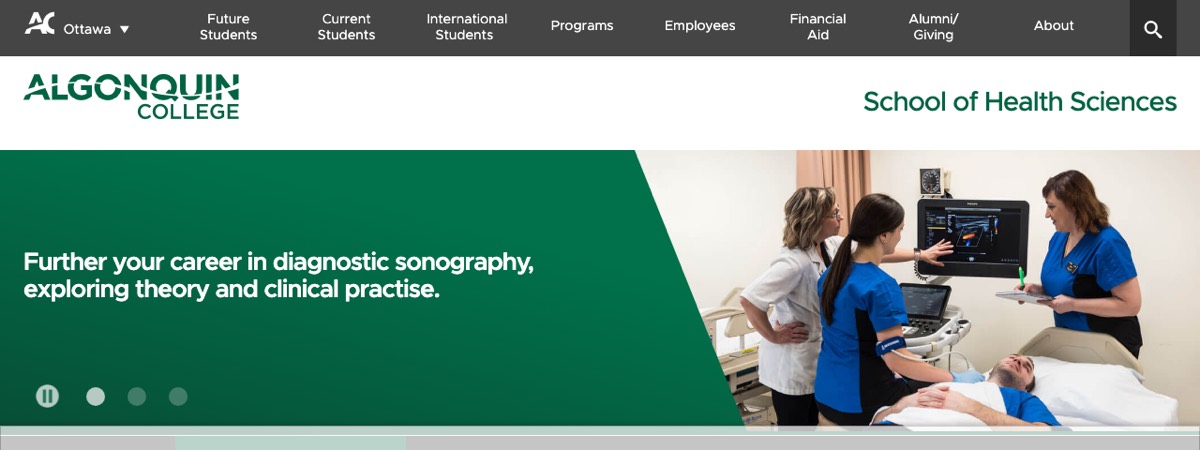
Diagnostic Medical Sonography at Algonquin College is a 2-year in-person program in Ontario leading to an Ontario College Graduate Certificate.
| Provider | Algonquin College |
|---|---|
| Length | 2 Years |
| Credential | Ontario College Graduate Certificate |
| Format | in person, Ontario |
Fiona's take: A Graduate Certificate is a different credential from the Advanced Diploma, so confirm entry requirements directly with Algonquin before applying. Algonquin gives the Ottawa region a local, in-person option on this list. Ask admissions how the credential maps to Sonography Canada exam eligibility before committing.
Skip it if: Skip it only if Algonquin's confirmed entry requirements do not match your academic background.
See Program DetailsDiagnostic Medical Sonography
Diagnostic Medical Sonography at MCG Career College is an 80-week in-person diploma program in Alberta.
| Provider | MCG Career College |
|---|---|
| Length | 80 weeks |
| Credential | Diploma in Diagnostic Medical Sonography |
| Format | in person, Alberta |
Fiona's take: Alberta is worth watching: from July 6, 2026, every DMS practitioner there must register with ACMDTT and hold a valid practice permit. If you are targeting Alberta, ask MCG directly how the 80-week diploma positions you for that registration. The in-person format may suit students who prefer campus-based training.
Skip it if: Skip it if you plan to practise in Ontario, because 80 weeks in person in Alberta is a detour before an Ontario registration.
See Program DetailsDiagnostic Medical Sonography (General and Cardiac)
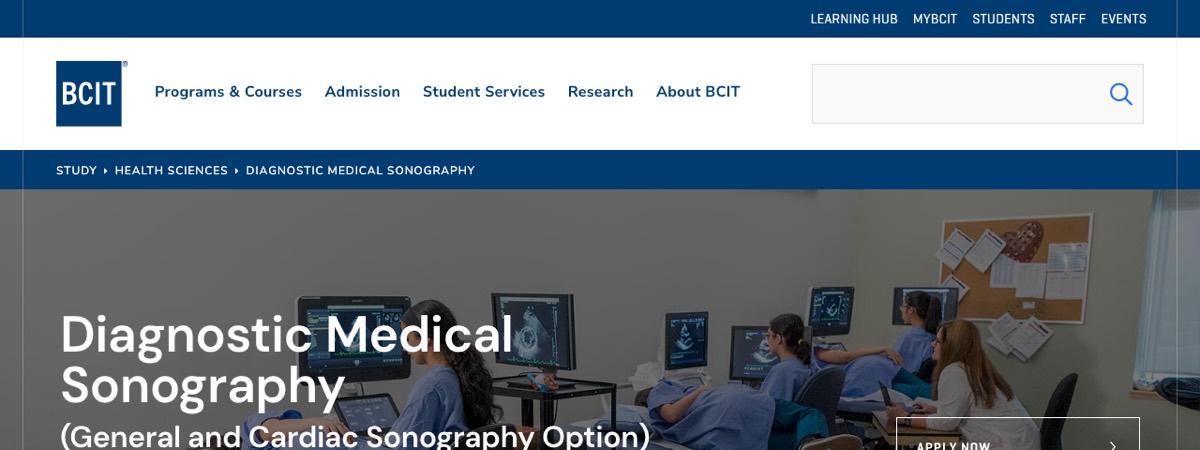
Diagnostic Medical Sonography (General and Cardiac) at BCIT is a 27-month in-person diploma program in British Columbia.
| Provider | British Columbia Institute of Technology (BCIT) |
|---|---|
| Length | 27 months |
| Credential | Diploma |
| Format | in person, British Columbia |
Fiona's take: The 27-month length sits at the top of the 22-27 month range for Canadian diplomas, and the General and Cardiac option lines up with specialty examinations. Remember that BC is unregulated: employers there set hiring requirements and most request Sonography Canada credentials, so plan for certification anyway.
Skip it if: Skip it if you are rooted in Ontario, because this program runs in person in British Columbia.
See Program DetailsHow Much Does Sonography Training Cost In Canada?
Sonography training costs split into tuition, which is listed for only one of the programs compared here, and registration fees, which are fixed where listed. Humber College is the only compared offer with a tuition amount, $5,242.56 for two semesters domestic. CMRITO fees add $141.25 at application and $694.95 per year in Ontario.
| Item | Amount (CAD) | Notes |
|---|---|---|
| Humber College tuition (domestic) | $5,242.56 for two semesters | Medical Diagnostic Sonography, 7 semesters, in person |
| Diploma tuition at other compared programs | Not listed | CNIH, MCG, Anderson, Mohawk, Algonquin and BCIT have no cost listed in this comparison; ask the registrar |
| CMRITO application fee | $141.25 ($125 + HST) | Ontario registration, one time |
| CMRITO annual registration fee | $694.95 ($615 + HST) | Ontario registration, each year |
| Online short courses (Coursera, Udemy) | Not listed | Specializations and short courses; check current prices on the platform |
Tuition is the biggest line and the least transparent. One listed number is not much to plan a 22-27 month program on, so my advice is direct: request full program totals, including practicum costs, from every registrar you shortlist, and get them in writing. The months you spend in a diploma are also earnings you set aside, so weigh both sides.
Regulator fees are small next to tuition but recurring: $141.25 once and $694.95 every year you stay registered in Ontario. Sonography Canada's exam fees are not in our figures, so ask the certifying body directly before you build a budget. I would not sign a program contract without that number.
How Much Does A Sonographer Earn In Canada?
A sonographer in Canada earns a median of $42.00 per hour under NOC 32122, according to Job Bank's wage report. The national range runs from $34.90 to $51.00. Among the provincial medians listed in this guide, the spread runs from $37.23 in New Brunswick to $46.00 in Alberta, and Ontario sits at $41.00, just below the national median.
| Region | Median Hourly Wage (CAD) |
|---|---|
| Canada | 42.00 |
| Alberta | 46.00 |
| British Columbia | 44.41 |
| Saskatchewan | 44.07 |
| Newfoundland and Labrador | 42.70 |
| Manitoba | 41.70 |
| Ontario | 41.00 |
| Nova Scotia | 39.01 |
| Quebec | 38.50 |
| New Brunswick | 37.23 |
Job Bank's wage report for NOC 32122 shows the spread clearly: $34.90 at the low end, $51.00 at the high end, $42.00 in the middle. Among the provincial medians listed in this guide, Alberta's $46.00 is the highest, British Columbia follows at $44.41, and Ontario's $41.00 lands just under the national line. For Ontario applicants, that difference is real but modest against the cost of relocating.
On outlook, WorkBC points to high opportunity for medical sonographers in British Columbia, which pairs with the $44.41 provincial median and the employer preference for Sonography Canada credentials in an unregulated province. Wage data cannot promise you a job; it shows what the work pays once you clear the exams and register.
Is Sonography Worth It In 2026?
Sonography is worth it in 2026 for applicants who want a hospital imaging career on a 2-year plan. The 22-27 month diploma is the fast lane to a $42.00 median hourly wage under NOC 32122, and Alberta's requirement that every DMS practitioner register with ACMDTT from July 6, 2026 is now part of the planning picture there.
Weigh that against the friction honestly. Admission is competitive and screens on English, Math and Physics or Biology. The Sonography Canada exams come after graduation, in the months before your first full paycheque, and Ontario registration adds $141.25 plus $694.95 a year. None of this is a dealbreaker; all of it is planning.
My verdict: this path suits detail-oriented people who want patient contact without a nursing or medicine timeline and who can commit to in-person scan labs. Start with Human Anatomy and Medical Terminology Fundamentals on Coursera to test your stamina for the material, then apply to the accredited diploma that fits your province.
Can You Get Funding For Sonography Training In Canada?
Funding for sonography training that we can confirm here is one program: Conestoga College lists its Diagnostic Medical Sonography program as OSAP eligible. Confirm aid directly for any other program you are comparing, because eligibility elsewhere is not established on this page.
- OSAP (Ontario Student Assistance Program). Conestoga College lists its Diagnostic Medical Sonography program as OSAP eligible. If Conestoga is on your shortlist for sonography courses in Ontario, file the OSAP application alongside your program application and confirm your aid with Conestoga's financial aid office. Treat any loan component as money you must repay, and confirm eligibility for any other program directly with that college.
Sonography Questions Canadians Ask
How Long Does It Take To Become A Sonographer In Canada?
Becoming a sonographer in Canada typically takes about 2 years through an accredited diploma program (22-27 months), though listed program lengths vary. After graduation you add the Sonography Canada entry-to-practice exams in the months that follow, then provincial registration, which takes weeks where required. The related allied health route stretches the timeline to 3-4 years total.
Is Sonography Regulated In Every Province?
Sonography regulation is not national; five provinces require registration. Ontario registers through CMRITO, Quebec through OTIMROEPMQ, Saskatchewan through CMRIPS and Nova Scotia through NSRMIRT, while Alberta's ACMDTT requirement takes effect July 6, 2026. In British Columbia and other unregulated jurisdictions, employers set hiring requirements, and most request a Sonography Canada credential.
What Is The Median Wage For Medical Sonographers In Canada?
The median wage for medical sonographers in Canada is $42.00 per hour under NOC 32122, according to Job Bank's wage report. The national range runs $34.90 at the low end to $51.00 at the high end. Among the provincial medians listed in this guide, Alberta posts the highest at $46.00, New Brunswick sits lowest at $37.23, and Ontario lands at $41.00.
Do I Need Sonography Canada Certification To Work?
Sonography Canada certification is usually required or preferred. Regulated provinces make it the exam gateway: CMRITO in Ontario, for example, requires the certifying examination(s) of Sonography Canada for DMS. In unregulated provinces such as British Columbia, most employers still request the credential, so treat it as the national hiring baseline.
What Programs Are Accredited In Ontario?
Ontario's accredited examples named in our research are Conestoga College, Mohawk College/McMaster and Anderson College, and you should still check current EQual status before you apply. Other Ontario programs listed on this page include Humber College's 7-semester Advanced Diploma, Algonquin College's Graduate Certificate and the Canadian National Institute of Health's 20-month (5-term) program; verify their current accreditation and Sonography Canada exam eligibility directly.
What Are The Admission Requirements For DMS Programs?
Admission to DMS programs starts with an OSSD or equivalent, including English, Math, and Physics or Biology at specific grades. Entry is competitive, so those science grades carry real weight. Camosun's diploma, for one, lists these subjects among its requirements; short courses like Duke's physiology course on Coursera can fill knowledge gaps but will not replace the OSSD credits.
Can Internationally Educated Sonographers Work In Canada?
Internationally educated sonographers can work in Canada, through assessment, examinations and provincial registration where required. CMRITO's applicant requirements are the Ontario reference point for internationally trained practitioners. Quebec registers through OTIMROEPMQ and Saskatchewan through CMRIPS, so the sequence depends on where you plan to practise and which regulator governs it.
What's The Bottom Line On Sonography In Canada?
- The accredited 2-year diploma (22-27 months), plus Sonography Canada entry-to-practice exams, then registration with the provincial regulator where required, is the fastest route to working as a sonographer in Canada.
- Registration is mandatory in Ontario, Quebec, Saskatchewan, Nova Scotia and Alberta from July 6, 2026; CMRITO registration requires Sonography Canada's certifying examinations and costs $141.25 to apply plus $694.95 per year.
- Job Bank's NOC 32122 median is $42.00 per hour, spanning $34.90 to $51.00, with Alberta's $46.00 the highest among the provincial medians listed in this guide.
- Test the field first with Human Anatomy and Medical Terminology Fundamentals, a 3-6 month Coursera Specialization that builds your base and does not qualify you for CMRITO registration.
- If Ontario is your target, shortlist Conestoga, Mohawk/McMaster, Humber, Algonquin and Anderson, and verify Anderson's current EQual status before applying.






