Key Takeaways
- The fastest realistic route is 2 to 3 years of postsecondary prerequisites, which vary by school, a 3-year MD at McMaster, Calgary or SFU, then a 2-year family medicine residency; the CMA counts the full journey at typically 10+ years from high school. MD tuition is not listed; the MCAT costs $360 USD, or $145 USD for approved Canadians.
- A licence is mandatory in all provinces and territories: you register with the provincial or territorial medical regulatory authority, such as the College of Physicians and Surgeons of your province, and every regulator requires verifiable education, training and certification credentials.
- Try the field first with the University of Michigan Anatomy Specialization on Coursera, 2 months at 10 hours a week. It does not qualify you for licensure, and the pack does not show it counting toward any MD program.
- Job Bank lists annual pay for NOC 31102 at $232,227 median, from a low of $90,826 to a high of $435,240; hourly medians by province are not reported for this occupation.
- Fiona's verdict: the MD suits applicants with finished postsecondary prerequisites, which vary by school, and a decade of runway. If you have never tested the material at university level, start with a Coursera Specialization before you spend anything on applications.
A Doctor of Medicine (MD) is the professional degree Canadian medical schools award. The standard MD is often four years; some Canadian MD programs are three years, and all prepare students to begin residency training. Canadians often ask whether it counts as a doctorate: the MD is considered a bachelor's degree-level qualification.
The shortest route worth comparing is a 3-year MD at McMaster or the University of Calgary after 2 to 3 years of postsecondary prerequisites, which vary by school, then a 2-year family medicine residency. Tuition is not a single national figure; the MCAT exam fee of $360 USD is the one firm cost at the application stage.

What Are The Ways To Get A Doctor Of Medicine Degree In Canada?
There are two MD routes in the pack: standard MD programs and accelerated 3-year MD programs. Coursera can be used only as optional preparation. Canada has 19 MD-granting medical schools, and every one awards the same credential.
| Route | Time | Cost (CAD) | What You Get | Recognised By | Best For |
|---|---|---|---|---|---|
| Anatomy (Coursera, University of Michigan) | 2 months at 10 hours a week | Not listed | Specialization certificate; the pack does not show it qualifies for MD credit or licensure | No medical regulator; not valid for licensure | Testing whether medicine holds your interest |
| Standard MD, e.g., Toronto Metropolitan University School of Medicine | 4 years after 2-4 years undergrad | Not listed | MD degree | CACMS accredited faculties | Most applicants with prerequisites in progress |
| Accelerated 3-year MD (McMaster, Calgary, SFU) | 3 years | Not listed | MD degree | CACMS | Applicants who already hold prerequisites |
I recommend the standard MD at a CACMS-accredited faculty for most clients, and the Coursera route for anyone who has never studied university-level science and wants proof the material fits before applying.
What Is The Fastest Way To Get An MD Degree In Canada?
The fastest verified path stacks three stages: 2 to 3 years of prerequisites, a 3-year MD, then the 2-year family medicine residency. From high school, the CMA counts the full journey at typically 10+ years.
- Complete 2 to 3 years of postsecondary study first: the AFMC's admission requirements report says most provinces require at least two years of postsecondary education, and prerequisites vary by school.
- Schedule the MCAT exam or check whether a school skips it: the AAMC exam runs about 7 hours across 4 sections and costs $360 USD, or $145 USD for Canadian examinees approved before registration under the AFMC and AAMC Fee Assistance Program. Some schools do not require the MCAT; verify each school's current admissions requirements.
- Apply to the 3-year MDs: McMaster requires CASPer, and McMaster, Calgary and SFU run 3-year programs.
- Finish the shortest residency: family medicine runs two years, per the CMA.
- Register with your provincial or territorial medical regulatory authority, for example the College of Physicians and Surgeons of your province, which requires verifiable education, training and certification credentials.
Is A Licence Required To Practise Medicine In Canada?
A licence is required in every province and territory, and the MD degree alone does not grant it. Registration sits with the provincial or territorial medical regulatory authority, such as the College of Physicians and Surgeons of your province.
| Province | Required? | Regulator Or Registry | What It Means |
|---|---|---|---|
| All provinces and territories | Yes | Provincial/territorial medical regulatory authority (e.g., College of Physicians and Surgeons of your province) | Verifiable evidence of medical knowledge and skills through education, training and certification credentials |
The FMRAC Common Standards say it plainly: all medical regulatory authorities require verifiable evidence of medical knowledge and skills in the form of education, training, and certification credentials. In practice that means the MD, residency training such as the 2-year family medicine program, and certification credentials before any college registers you.
The pack does not show any Coursera or Udemy course as a medical licensure credential. The Anatomy Specialization from the University of Michigan is study prep; I recommend it only to test the material, not for registration in any province or territory.
Which Courses Are Worth Taking Before Medical School?
Courses worth taking before medical school do two jobs: they test your appetite for the content, and they build context. These offers are online courses and certificates in the pack; the pack does not show that they qualify for MD credit or licensure, so choose for learning, not for credentials.
Anatomy
Anatomy is a 2-month online Specialization from the University of Michigan that covers the structure of the human body.
| Provider | University of Michigan |
|---|---|
| Length | 2 months at 10 hours a week |
| Credential | Specialization |
| Format | online |
Fiona's take: This is my pick to test the field. Anatomy is core MD content, and 10 hours a week for 2 months is a realistic taste alongside a job or degree. The pack does not show it counting toward MD credit or licensure at any medical school.
Skip it if: Skip it if you have already completed university-level anatomy or pure memorisation of structure sounds like a slog.
Start On CourseraMedical School Anatomy and Physiology I Professional Certificate
Medical School Anatomy and Physiology I Professional Certificate is a 2-month online Professional Certificate from Lecturio that covers anatomy and physiology aimed at medical school preparation.
| Provider | Lecturio |
|---|---|
| Length | 2 months at 10 hours a week |
| Credential | Professional Certificate |
| Format | online |
Fiona's take: The Professional Certificate framing gives this a slightly stronger shape than a single course, though the pack does not show it carrying credit at any of Canada's 19 MD-granting schools. I suggest it for applicants who want physiology alongside anatomy before paying $360 USD for the MCAT.
Skip it if: Skip it if the University of Michigan Anatomy Specialization already covers what you need.
Start On CourseraCancer Biology
Cancer Biology is a 3 to 6 month online Specialization from Johns Hopkins University whose listed skills include oncology, molecular biology and cell biology.
| Provider | Johns Hopkins University |
|---|---|
| Length | 3 - 6 Months |
| Credential | Specialization |
| Format | online |
Fiona's take: This one is for focus, not breadth: if oncology or research draws you, it is a deep single-topic dive from Johns Hopkins University. The pack does not show it shortening any MD program or counting toward licensure.
Skip it if: Skip it if you want general pre-med coverage rather than one disease area.
Start On CourseraIntroductory Human Physiology
Introductory Human Physiology is a 1 to 3 month online course from Duke University that covers how the body's systems function.
| Provider | Duke University |
|---|---|
| Length | 1 - 3 Months |
| Credential | Course |
| Format | online |
Fiona's take: Duke's course is listed at 1 to 3 months, the gentlest entry point among the dated options here. Pair it with the Michigan Anatomy Specialization and you have built yourself a pre-med foundation. The pack does not show it conferring credit toward the MD.
Skip it if: Skip it if you have already finished undergraduate physiology.
Start On CourseraPractical Medicine for Everyday Life
Practical Medicine for Everyday Life is an online course from Dr KHALEELURAHIMAN AM, rated 4.7, that covers practical medical knowledge for daily life.
| Provider | Dr KHALEELURAHIMAN AM |
|---|---|
| Rating | 4.7 |
| Credential | Course Certificate |
| Format | online |
Fiona's take: This is health literacy for households, not pre-med prep. I would never position it as part of an MD application. Take it for yourself and the people around you.
Skip it if: Skip it if your goal is medical school rather than personal knowledge.
View On UdemySucceed in a Value-Driven Healthcare World
Succeed in a Value-Driven Healthcare World is an online course from R Robinson, MD, rated 4.6, that covers the business side of healthcare.
| Provider | R Robinson, MD |
|---|---|
| Rating | 4.6 |
| Credential | Course Certificate |
| Format | online |
Fiona's take: The business of medicine is real, and this course introduces it without requiring a decade of training first. It suits applicants building a parallel story about system thinking, and it suits practising clinicians even more.
Skip it if: Skip it if you want science content; this is healthcare business.
View On UdemyMD Program
MD Program is a 4-year, in-person MD degree program from Toronto Metropolitan University School of Medicine in Ontario that prepares students to begin residency training.
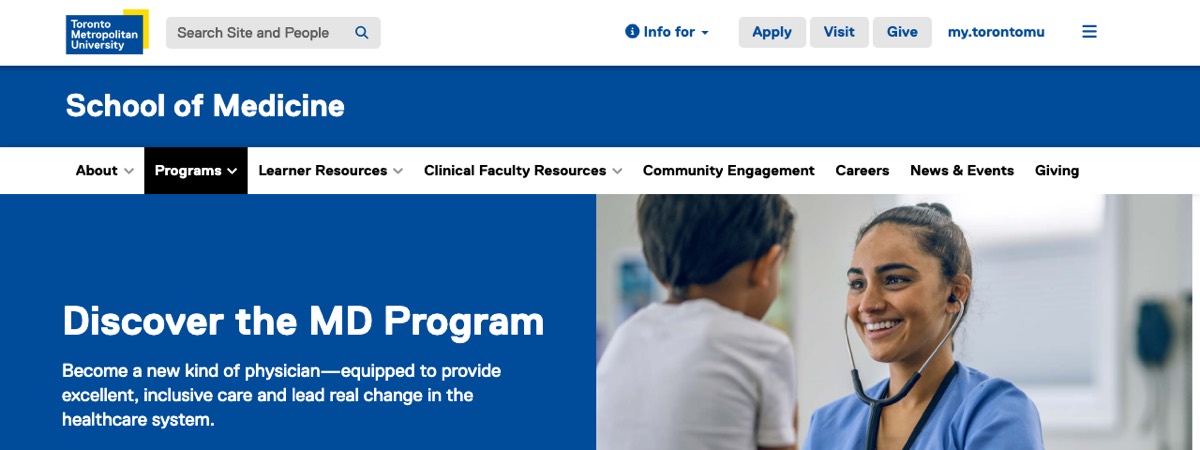
| Provider | Toronto Metropolitan University School of Medicine |
|---|---|
| Length | 4 years |
| Credential | MD degree |
| Format | in person, Ontario |
Fiona's take: This is the credential itself, not prep: 4 years, in person, in Ontario. Compare it against the 3-year MDs at McMaster, Calgary and SFU before applying. A 3-year MD is one year shorter than a 4-year format; compare each school's current fees.
Skip it if: Skip it if you are set on the accelerated 3-year timeline at McMaster or Calgary.
See Program DetailsCanadian Medical Education Statistics 2025
Canadian Medical Education Statistics 2025 is an online report from the Association of Faculties of Medicine of Canada (AFMC) that compiles data on medical education across the country.
| Provider | Association of Faculties of Medicine of Canada (AFMC) |
|---|---|
| Credential | Report |
| Format | online, National |
Fiona's take: Read it before choosing where to apply; it is the closest thing to a scoreboard for Canada's 19 MD-granting schools. Its price is not listed, but the value is in comparing faculties on data rather than reputation.
Skip it if: Skip it if you want course content rather than admissions and enrolment data.
See Program DetailsHow Much Does An MD Degree Cost In Canada?
MD degree costs come down to one firm figure: the MCAT at $360 USD, or $145 USD with fee assistance. Tuition at Canada's 19 medical faculties is not listed as a single number, so get each school's current fee schedule directly before you budget a decade around it.
| Item | Cost | Notes |
|---|---|---|
| MCAT exam (AAMC) | $360 USD | Runs about 7 hours across 4 sections |
| MCAT with fee assistance | $145 USD | Canadian examinees approved before registration under the AFMC and AAMC Fee Assistance Program |
| MD tuition, e.g., Toronto Metropolitan University School of Medicine | Not listed | Varies by faculty; verify directly with each school |
| Residency years | Not listed | Family medicine, the shortest, runs 2 years |
| Coursera prep, e.g., the Anatomy Specialization | Not listed | 2 months at 10 hours a week |
The pack lists one verified reduced fee: $145 USD for Canadian examinees approved before registration under the AFMC and AAMC Fee Assistance Program. Sort the approval before you schedule the MCAT exam. Beyond that, the pack does not list tuition, living costs or residency costs; each faculty's own fee schedule is the only source.
How Much Does A Doctor Earn In Canada?
Doctors in Canada earn, on Job Bank's annual figures for NOC 31102, a median of $232,227 per year, with a low of $90,826 and a high of $435,240. Job Bank reports annual medians only for this occupation, so no provincial hourly breakdown appears here.
| Pay Level | Annual Pay (CAD) |
|---|---|
| Low | $90,826 |
| Median | $232,227 |
| High | $435,240 |
The trade is stark on paper: a $232,227 median for NOC 31102 against a training runway the CMA measures at 10+ years from high school. Job Bank reports annual medians only for this occupation, so I compare yearly totals rather than hourly rates when I walk clients through these numbers.
Weigh that trade honestly before you apply. The pay arrives only after 2 to 3 years of prerequisites, a 3 or 4 year MD, and at least a 2-year family medicine residency, plus registration with the College of Physicians and Surgeons or equivalent regulator in your province.
Is An MD Degree Worth It In 2026?
The MD degree in 2026 is worth it for one reader: someone set on practising medicine who accepts the CMA's 10+ year timeline from high school. The payoff side is real, a Job Bank median of $232,227 for NOC 31102, and there is no side door; the AFMC confirms the qualification for medicine is the MD degree itself.
It is not a doctorate, whatever the name suggests. The MD is considered a bachelor's degree-level qualification, which is why I tell clients to stop framing it as a research degree and start framing it as licensure training: the MD, then residency, then a college of physicians and surgeons.
If you are merely curious, run the test first: the University of Michigan's Anatomy Specialization on Coursera, 2 months at 10 hours a week. A bad fit discovered in month one online beats a bad fit discovered in year two of an MD.
Doctor Of Medicine Degree Questions Canadians Ask
What Is An MD Degree?
An MD degree is the first professional degree in medicine, awarded by Canadian medical schools. Memorial describes it as a four-year program that prepares students to begin residency training. Canada has 19 MD-granting schools, and there is no diploma alternative: the AFMC lists the MD degree itself as the qualification for medicine.
How Long Does It Take To Become A Doctor In Canada?
Becoming a doctor in Canada typically takes 10+ years from high school, by the CMA's count, once undergraduate study, the MD and residency are all included. The compressed version stacks 2 to 3 years of prerequisites, a 3-year MD at McMaster or Calgary, and a 2-year family medicine residency.
Is The MD A Doctorate Degree?
The MD degree is considered a bachelor's degree-level qualification, not a research doctorate, even though its name says doctor. For licensing purposes the label does not matter: regulators require verifiable education, training and certification credentials, and the MD is the degree that starts that pathway.
Do All Canadian Medical Schools Require The MCAT?
No, some Canadian medical schools do not require the MCAT; verify each school's current admissions requirements before you apply. Where the MCAT does apply, the AAMC exam runs about 7 hours across 4 sections and costs $360 USD, or $145 USD for Canadian examinees approved before registration under the AFMC and AAMC Fee Assistance Program.
What Is The Shortest MD Program In Canada?
The shortest MD programs in Canada run 3 years, at McMaster University and the University of Calgary, with SFU also listed among 3-year options. McMaster's is described as the shortest MD in Canada. A 3-year MD is one year shorter than a 4-year format; compare each school's current fees.
Is There A Diploma Instead Of The MD Degree For Medicine?
No diploma replaces the MD for medicine in Canada. The AFMC is direct that the qualification is the MD degree, and no college certificate or online course, including Coursera Specializations, substitutes for it. Medical regulatory authorities require verifiable education, training and certification credentials, and the pack does not show any online course meeting them.
How Many Medical Schools Are In Canada?
Canada has 19 MD-granting medical schools, and the count matters for planning because formats differ. The standard format runs four years, while McMaster, Calgary and SFU run 3-year programs. Toronto Metropolitan University School of Medicine in Ontario is one example of the 4-year, in-person format.
What's The Bottom Line On The MD Degree In Canada?
- The bottom line on the MD degree in Canada: it is a 3 or 4 year professional degree plus residency, at least 2 years in family medicine, and typically 10+ years total from high school.
- A licence is mandatory in all provinces and territories through the provincial or territorial medical regulatory authority; the pack does not show any online course counting toward it.
- Median pay for NOC 31102 is $232,227 per year on Job Bank figures, from a low of $90,826 to a high of $435,240.
- The MCAT costs $360 USD, or $145 USD for Canadian examinees approved under the AFMC and AAMC Fee Assistance Program; MD tuition must be confirmed faculty by faculty.
- Start with Anatomy from the University of Michigan: 2 months at 10 hours a week to test the material before the decade-long commitment.






