Key Takeaways
- The fastest realistic route to an MS degree in Canada is a 1-year course-based MSc at a public university, such as the McMaster one-year MSc in Physics and Astronomy, the uOttawa MSc in Management or the Lakehead MSc in Computer Science, and Lakehead lists international tuition at $25,500 for the first year.
- An MS degree is not a licence. It is an academic credential from a university, and if you want a Post-Graduation Work Permit after it, IRCC requires CLB 7 in all four language skills for master's graduates.
- You can test the field first with Coursera's online Master of Science in Computer Science from University of Colorado Boulder, or spend $22.99 on a Udemy course such as Machine Learning A-Z, and neither of those steps commits you to a thesis-based program.
- A Computer Science MSc can lead to work as a software engineer and designer under NOC 21231, which has a median hourly wage of $56.49 in Canada according to Job Bank.
- Fiona's verdict: the MS degree suits students who want a university master's credential and the degree-level exemption from the PGWP field-of-study requirement, while the Coursera master's suits working professionals who need the credential online.
A Master of Science (MS or MSc) is a postgraduate academic degree awarded by universities for advanced study in scientific, technical or quantitative fields after a bachelor's degree. In Canada it typically takes 1 to 2 years: course-based programs often run 12 months, while thesis-based programs run about 2 years.
The shortest realistic route is a 1-year course-based MSc at a Canadian public university, with average international graduate tuition of $24,693 per year for 2026/27 according to Statistics Canada. Before you commit that money, Machine Learning A-Z on Udemy at $22.99 on sale can tell you whether the field suits you at all. I lay out both paths below.

What Are The Ways To Get An MS Degree In Canada?
The table compares Canadian MSc routes plus one non-Canadian online MSc option. They differ mainly in length, delivery and whether you write a thesis.
| Route | Time | Cost (CAD) | What You Get | Recognised By | Best For |
|---|---|---|---|---|---|
| Master of Science in Computer Science online first | Not listed | Not listed | Master of Science in Computer Science from University of Colorado Boulder, online | The awarding university, not a Canadian institution | Testing graduate study before relocating |
| Thesis-based MSc at a Canadian university | 2 years | Not listed | Master of Science degree | Canadian universities | Students who want a 2-year research thesis format |
| Course-based MSc at a Canadian university | 1-2 years | Not listed | Master of Science degree | Canadian universities; eligible master's graduates may qualify for PGWP if IRCC conditions are met | Students who want the fastest Canadian MSc |
| Online MSc from Athabasca University (Master of Science – Computing and Information Systems) | 2.5-5 years | Not listed | Master of Science in Computing and Information Systems | Athabasca University, Alberta | Working professionals who study part-time |
I recommend the Athabasca online MSc for working professionals, the 1-year course-based MSc for students who want the fastest Canadian degree, and the Coursera master's for anyone still deciding whether graduate study fits their life.
What Is The Fastest Way To Get An MS Degree In Canada?
The fastest documented route is the 1-year course-based MSc, and McMaster Physics, uOttawa and Guelph all run programs on that model.
- Apply to a 1-year course-based MSc at a public university, for example McMaster's one-year MSc in Physics and Astronomy, uOttawa's MSc in Management or Guelph's MCTI. Application takes 3-6 months.
- Complete the 12-month program. Lakehead's course-option MSc in Computer Science in Ontario is listed at 1 year.
- Apply for a 3-year Post-Graduation Work Permit within 180 days of finishing. A master's graduate needs CLB 7 in all four skills.
- Budget around $24,693 per year in international graduate tuition, the Statistics Canada average for 2026/27. Among one-year master's programs, Lakehead lists $25,500 gross for the first year, Mount Saint Vincent lists $11,717 and Western lists $28,028 per year, and the latter two credentials are not Master of Science degrees.
Does An MS Degree Require A Licence Or Lead To A Regulated Profession?
An MS degree is an academic credential, not a licence, and the degree itself does not register you with any professional body.
| Requirement | Applies To | Set By | What It Means |
|---|---|---|---|
| CLB 7 in all four skills | PGWP applicants with a master's degree | IRCC | Language proof needed for the 3-year work permit |
| No field-of-study restriction | Bachelor's, master's and doctoral graduates | IRCC | Your MSc field does not limit PGWP eligibility |
| No licence for the degree itself | All MSc graduates | N/A | The degree is an academic credential |
The credential you receive is a Master of Science from a university, recognised by Canadian universities and by IRCC for the Post-Graduation Work Permit. Unlike a trade certificate or a health licence, there is no regulator you apply to in order to hold the degree itself.
Where regulation enters is the work permit stage. IRCC requires master's graduates to show CLB 7 in all four language skills for the PGWP, and the degree exemption from field-of-study restrictions is exactly why the MSc route is attractive: a bachelor's, master's or doctoral graduate does not need to meet the field of study requirement for the PGWP.
Whether a specific job afterwards is regulated depends on the occupation and the province, not on the degree. NOC 21231, software engineers and designers, appears in the verified data only as a wage example, not as a licensing statement.
Which MS Degree Programs And Prep Courses Are Worth Considering?
One Coursera route, two short Udemy courses and four Canadian master's programs give you a spread of price points from $16.99 to full graduate tuition.
Master of Science in Computer Science
Master of Science in Computer Science is an online master's degree from University of Colorado Boulder delivered through Coursera.
| Provider | University of Colorado Boulder |
|---|---|
| Credential | Master of Science |
| Format | online |
Fiona's take: I recommend this to clients who want to know whether they can actually sustain graduate coursework before paying Canadian international tuition. It is a genuine MSc credential, and because it is online it fits around a job. Coursera does not list the length or the price, so verify both before committing.
Skip it if: Skip this if you need a Canadian degree specifically for the PGWP, since this degree is American.
Start On CourseraMachine Learning A-Z [2026]: ML, DL, AI with AWS, Python & R
Machine Learning A-Z [2026]: ML, DL, AI with AWS, Python & R is a 49.2-hour online course from the SuperDataScience Team on Udemy, priced at $22.99 on sale, rated 4.5, and issuing a Certificate of Completion.
| Provider | SuperDataScience Team |
|---|---|
| Length | 49.2h |
| Cost (CAD) | $22.99 (on sale) |
| Rating | 4.5 |
| Credential | Certificate of Completion |
| Format | online |
Fiona's take: At $22.99 on sale this is a low-cost way to test whether machine learning work suits you before applying to any MSc. It is a non-credit certificate of completion, not a degree, and I frame it purely as a decision tool.
Skip it if: Skip this if you already work in machine learning and need graduate-level credentialing.
View On UdemyData Science A-Z: Hands-On Exercises & ChatGPT Prize [2026]
Data Science A-Z: Hands-On Exercises & ChatGPT Prize [2026] is an online course from the SuperDataScience Team on Udemy, priced at $16.99 on sale and rated 4.7, issuing a Certificate of Completion.
| Provider | SuperDataScience Team |
|---|---|
| Cost (CAD) | $16.99 (on sale) |
| Rating | 4.7 |
| Credential | Certificate of Completion |
| Format | online |
Fiona's take: Pair this with the Machine Learning course if you are weighing a data-focused MSc. At $16.99 it costs less than an application fee, and the hands-on exercises tell you quickly whether daily data work appeals to you.
Skip it if: Skip this if a thesis-based research path, rather than applied data work, is your goal.
View On UdemyMaster of Science – Computing and Information Systems
Master of Science in Computing and Information Systems is an online Canadian MSc from Athabasca University running 30 or 39 credits over 2.5 to 5 years.
| Provider | Athabasca University |
|---|---|
| Length | 30 or 39 credits; as little as 2.5 years full-time, up to 5 years |
| Credential | Master of Science |
| Format | online, Alberta |
Fiona's take: This is the route I suggest to working professionals in Canada who cannot relocate. It is a Canadian MS degree from an Alberta university, and the 5-year window means you can pace it around employment. Cost is not listed, so request current fees from Athabasca directly.
Skip it if: Skip this if you need the credential within 12 months, because even full-time the shortest listed path is 2.5 years.
See Program DetailsMaster of Science in Computer Science (MSc) - Course option
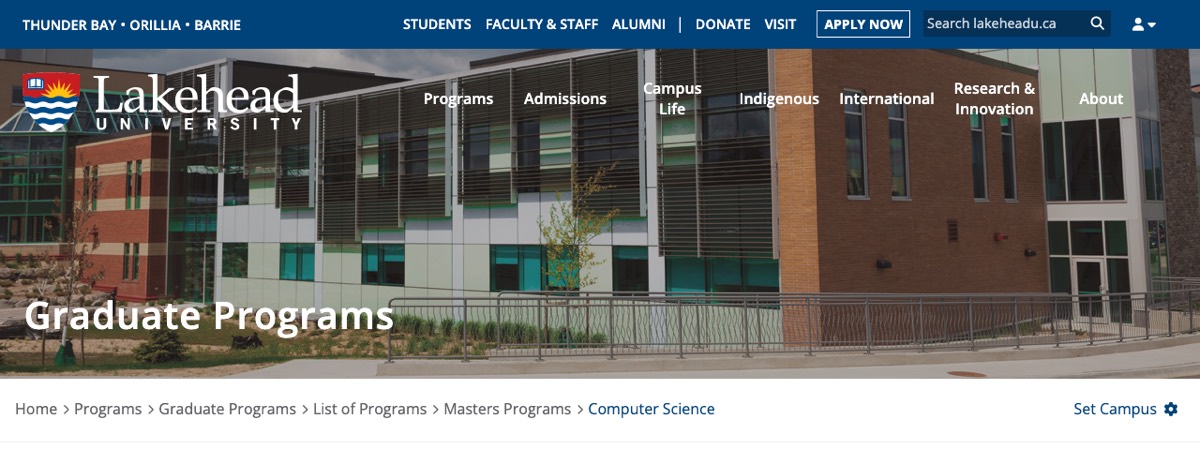
Master of Science in Computer Science (MSc) Course option is a 1-year in-person program at Lakehead University in Ontario with international tuition listed at $25,500 for the first year.
| Provider | Lakehead University |
|---|---|
| Length | 1 year |
| Cost (CAD) | $25,500 gross tuition first year (international example) |
| Credential | Master of Science |
| Format | in person, Ontario |
Fiona's take: Lakehead's course option is the model of the fast Canadian MSc: one year, in person, and a full Master of Science credential. It is a 1-year in-person Master of Science in Ontario; PGWP applicants still need to meet IRCC eligibility rules, including the CLB 7 requirement. The gross first-year tuition of $25,500 is listed, so you can plan against the $24,693 national average.
Skip it if: Skip this if you cannot study in person in Thunder Bay or need online delivery.
See Program DetailsMaster of Applied Human Nutrition
Master of Applied Human Nutrition is a 1-year in-person master's at Mount Saint Vincent University in Nova Scotia with gross tuition of C$11,717.
| Provider | Mount Saint Vincent University |
|---|---|
| Length | 1 year |
| Cost (CAD) | C$11,717 gross tuition |
| Credential | Master's degree |
| Format | in person, Nova Scotia |
Fiona's take: The listed gross tuition is C$11,717, lower than the Lakehead and Western figures in this article. The program runs one year in person in Nova Scotia, and its credential is a master's degree rather than a Master of Science, so I use it here as a price comparison rather than an MSc example.
Skip it if: Skip this if your field is computer science or engineering rather than nutrition.
See Program DetailsHealth Equity and Sustainability (MHSc)
Health Equity and Sustainability (MHSc) is a 1-year online master's from Western University in Ontario at $28,028 per year.
| Provider | Western University - Canada |
|---|---|
| Length | 1 year |
| Cost (CAD) | $28,028 /yr |
| Credential | Master of Health Science |
| Format | online, Ontario |
Fiona's take: Western's MHSc pairs the 1-year timeline with online delivery. The tuition is above the international graduate average, so I tell clients to weigh the online convenience against lower-listed options such as Mount Saint Vincent. The credential is a Master of Health Science rather than a Master of Science, so treat it as a comparison point for format and cost.
Skip it if: Skip this if you want a title that says Master of Science specifically, since the credential is Master of Health Science.
See Program DetailsHow Much Does An MS Degree Cost In Canada?
Tuition varies widely by institution, and the one verified benchmark is the Statistics Canada international graduate average of $24,693 per year for 2026/27.
| Item | Cost (CAD) | Notes |
|---|---|---|
| International graduate tuition average | $24,693 per year | Statistics Canada, 2026/27 average |
| Lakehead MSc Computer Science (international) | $25,500 gross first year | 1-year in-person program, Ontario |
| Mount Saint Vincent Master of Applied Human Nutrition | $11,717 gross tuition | 1-year master's; credential is a master's degree, not an MSc |
| Western MHSc Health Equity and Sustainability | $28,028 per year | 1-year online program; credential is Master of Health Science, not an MSc |
| Coursera MSc Computer Science | Not listed | Confirm fees on the offer page |
| Athabasca MSc Computing and Information Systems | Not listed | Request current fees from Athabasca |
How Much Does An MS Graduate Earn In Canada?
Job Bank lists a median hourly wage of $56.49 for NOC 21231, software engineers and designers, the occupation an MSc in Computer Science commonly leads to.
| Occupation | NOC Code | Median Hourly Wage (Canada) |
|---|---|---|
| Software engineers and designers | 21231 | $56.49 |
The median of $56.49 per hour is a national figure for NOC 21231, software engineers and designers. The verified data covers only that national median wage, not provincial wages or outlook, so check Job Bank for figures in your province before you build a budget around this number.
Wages vary by province and employer, and a median is not a promise. The degree provides a Master of Science credential; for the PGWP, master's graduates still need CLB 7 in all four skills, though a degree means you do not need to meet the field-of-study requirement.
Is An MS Degree Worth It In 2026?
The MS degree earns its keep on two fronts. Academically, thesis-based MSc programs are typically about 2 years, and some programs are course-based or project-based instead. Practically, a master's degree means you do not need to meet the field-of-study requirement for the PGWP, which matters if you are an international student planning a work permit; IRCC conditions such as CLB 7 still apply.
On cost, the verified numbers are plain: average international graduate tuition of $24,693 per year for 2026/27, and a national median wage of $56.49 per hour for NOC 21231, software engineers and designers. Those two figures alone do not give you a repayment timeline. A $22.99 Udemy course cannot deliver a graduate credential, but it can show you whether the day-to-day work appeals before you commit graduate tuition to the field.
The degree is not for everyone. If you can reach your target occupation with a PG diploma or a bachelor's, the MSc may be unnecessary expense, though diploma graduates may face field-of-study restrictions for the PGWP that degree graduates do not. Where the MSc has a clear, verified edge is that degree-level PGWP treatment and the university credential itself.
MS Degree Questions Canadians Ask
How Long Is A Master's Degree In Canada?
A master's degree in Canada typically takes 1 to 2 years. Course-based programs often finish in 12 months, such as Lakehead's course-option MSc in Computer Science, while thesis-based programs run about 2 years because of the research component.
Does A 1-Year Master's Give A 3-Year PGWP?
Yes, eligible master's graduates of programs at least 8 months long receive a 3-year Post-Graduation Work Permit. You must apply within 180 days and meet the CLB 7 language requirement that IRCC sets for master's graduates.
What Is The Difference Between An MSc And A PG Diploma?
The MSc is a university degree while the PG diploma is typically from colleges. For the PGWP, diplomas may face field-of-study restrictions while bachelor's, master's and doctoral graduates do not need to meet the field of study requirement at all.
What Language Test Is Needed For The PGWP After A Master's?
CLB 7 in all four skills is what IRCC requires for university master's graduates applying for the Post-Graduation Work Permit. Plan your test date so results arrive before your 180-day application window closes.
Do I Need A Thesis For An MSc In Canada?
Not always. McMaster lists a one-year course-based MSc in Physics and Astronomy, uOttawa's MSc in Management is project-based, and Lakehead's Computer Science MSc has a course option. Thesis, project and course-only formats all exist.
What Is The Average International Tuition For Graduate Programs?
International graduate tuition averages $24,693 per year for 2026/27 according to Statistics Canada. Listed master's programs range from $11,717 at Mount Saint Vincent University to $28,028 per year at Western, so the average is a midpoint rather than a rule.
Can I Do An MS Degree Online From Canada?
Yes. Athabasca University offers the MSc in Computing and Information Systems fully online, Western's MHSc in Health Equity and Sustainability is online, and University of Colorado Boulder delivers its MSc in Computer Science through Coursera. Confirm each program's fees directly, since several do not publish them.
What's The Bottom Line On An MS Degree In Canada?
- A Canadian MS degree takes 1 to 2 years, with 12-month course-based programs at schools like McMaster, uOttawa and Lakehead being the fastest route.
- International graduate tuition averages $24,693 per year for 2026/27; among listed master's programs, Mount Saint Vincent's Master of Applied Human Nutrition lists $11,717, Lakehead's MSc lists $25,500 gross for year one and Western's MHSc lists $28,028 per year.
- Master's graduates need CLB 7 in all four skills for the PGWP, and a degree means you do not need to meet the field-of-study requirement.
- A computer science MSc can lead to NOC 21231, software engineers and designers, with a median wage of $56.49 per hour according to Job Bank.
- Test the field for $22.99 with Machine Learning A-Z [2026]: ML, DL, AI with AWS, Python & R or start the online degree route with Master of Science in Computer Science before paying graduate tuition anywhere.






