Key Takeaways
- The fastest realistic route to registered dietitian status is an accredited bachelor's in nutrition or dietetics, recognized by provincial regulators and EQual (Accreditation Canada), a 10-12 month supervised practicum and, in all provinces except Quebec, the CDRE at $750 beginning with the November 2026 sitting: 4-5 years total, with tuition not listed in the available offer data.
- Registration with a provincial dietetic regulator is mandatory for the dietitian title in every province; the nutritionist title is protected only in Alberta, Quebec, Nova Scotia and Prince Edward Island.
- Nutrition Education for the Consumer Specialization on Coursera, from the National Academy of Sports Medicine, runs 4 weeks at 10 hours a week and does not qualify you for dietitian registration or any protected title.
- Job Bank's November 2025 update puts dietitians and nutritionists, NOC 31121, at a median of $41.63 per hour, ranging from $22.53 to $50.00.
- Fiona's verdict: take the Coursera route first if you are curious, and commit to the degree only if you want the protected title, because no short course reaches it.
A dietitian or nutritionist (NOC 31121) assesses nutrition-related issues, develops nutrition care plans to prevent and manage disease, and manages food and nutrition service systems. The two titles are not equal in law: dietitian is protected across Canada, nutritionist is protected in only four provinces.
The shortest honest route to the regulated title is still long: an accredited bachelor's, a 10-12 month practicum and, outside Quebec, the CDRE, about 4-5 years in total. If you are unsure, a Coursera specialization from the National Academy of Sports Medicine tests the field in 4 weeks before you commit years to it.

What Are The Ways To Study Nutrition In Canada?
The listed options fall into three groups: short online certificates, one-year college credentials in food and nutrition management, and the accredited degree path that ends in dietitian registration. Each group answers a different goal.
| Route | Time | Cost (CAD) | What You Get | Recognised By | Best For |
|---|---|---|---|---|---|
| Nutrition Education for the Consumer Specialization on Coursera | 4 weeks at 10 hours a week | Not listed | Coursera Specialization certificate | No regulator; not a licence | Testing the field before a degree |
| Internationally Accredited Certificate in Nutrition or Diet And Nutrition Coach Certification: Beginner To Advanced on Udemy | 5 total hours each | Not listed | Certificates of completion | No regulator; not a licence | Coaching basics |
| Nutrition and Food Service Management Diploma at Langara College | 1 year, full-time | Not listed | Diploma | Not listed | Food service management in British Columbia |
| Food and Nutrition Management Ontario College Graduate Certificate at Algonquin College | 1 year, full-time | Not listed | Ontario College Graduate Certificate | Not listed | Food and nutrition management in Ontario |
| Honours Bachelor of Science in Nutrition and Dietetics or Major in Dietetics | 4 years at uOttawa; three and a half years at McGill excluding the freshman year | Not listed | Honours BSc or BSc (NutrSc) | Feeds the dietitian route | The degree half of the dietitian path |
| Accredited bachelor's plus practicum plus CDRE | 4-5 years | CDRE $750 from November 2026; $185 Ontario application; tuition not listed | Eligibility for dietitian registration | Provincial regulators; EQual (Accreditation Canada) | Becoming a registered dietitian |
I recommend the Coursera row for anyone still deciding, and the full degree-plus-practicum row for anyone set on the protected dietitian title, because no short course reaches it.
What Is The Fastest Way To Become A Dietitian In Canada?
The fastest way to become a dietitian in Canada still runs through the full sequence, roughly 4-5 years end to end. Here is the order, with the costs listed in the available data.
- Finish an accredited bachelor's in dietetics, nutrition or a related field such as food and nutritional science, recognized by provincial regulators and EQual (Accreditation Canada): 4 years at the University of Ottawa, three and a half years at McGill excluding the freshman year. Tuition is not listed in the available offer data.
- Complete the supervised practicum, integrated into the degree or taken after it, typically 10-12 months.
- Pass the Canadian Dietetic Registration Examination (CDRE), offered twice yearly and required in all provinces except Quebec: $750 beginning with the November 2026 sitting.
- Register with your provincial regulator; the College of Dietitians of Ontario charges a $185 application fee, mandatory for all applicant types and non-refundable.
- Keep the registration current: annual renewal in Ontario costs $667, a figure in effect since November 1, 2024.
Do You Need A Licence To Call Yourself A Nutritionist In Canada?
A licence, in the form of registration with a provincial dietetic regulator, is mandatory for the dietitian title in every province. For nutritionist the answer splits by province: protected in four, open in six. The CDRE sits in front of registration everywhere except Quebec.
| Where | What Is Protected | Regulator Or Registry | What It Means |
|---|---|---|---|
| All provinces | Dietitian, protected by law | Provincial dietetic regulatory bodies | You cannot call yourself a dietitian without registration, anywhere in Canada |
| Alberta, Quebec, Nova Scotia, Prince Edward Island | Nutritionist, also protected | Provincial regulators, for example the College of Dietitians of Alberta | You must register before using the word nutritionist in these four provinces |
| Ontario, British Columbia, Saskatchewan, Manitoba, New Brunswick, Newfoundland and Labrador | Nutritionist, not protected | None | Anyone may use the word nutritionist in these six provinces |
The Coursera and Udemy certificates on this page grant none of this. They teach content; they do not register you with any college, they do not permit the dietitian title anywhere, and they do not permit the nutritionist title in Alberta, Quebec, Nova Scotia or Prince Edward Island. On the regulated path, the accredited degree, the practicum and, outside Quebec, the CDRE lead to registration.
In Ontario, British Columbia, Saskatchewan, Manitoba, New Brunswick and Newfoundland and Labrador, anyone may use the word nutritionist, but these certificates have no regulator backing. That is the honest trade-off: no college stands behind the credential, and the word itself carries no protected meaning in those provinces.
Which Nutrition Courses Are Worth Taking?
Nutrition courses worth taking split cleanly by goal: test the field with Coursera, build coaching basics with Udemy, or commit to Langara, Algonquin, uOttawa or McGill for their college and university credentials. Here is my read on nine of them.
Nutrition Education for the Consumer Specialization
Nutrition Education for the Consumer Specialization is a 4-week online specialization at 10 hours per week from the National Academy of Sports Medicine that ends in a Coursera Specialization certificate.
| Provider | National Academy of Sports Medicine |
|---|---|
| Length | 4 weeks at 10 hours a week |
| Rating | 4.7 (137 reviews) |
| Credential | Specialization certificate |
| Format | online |
Fiona's take: This is my try-first pick. It is the shortest Coursera option listed and it holds a 4.7 rating from 137 reviews. Be clear about what it is not: it registers you with no college and moves you no closer to the dietitian title.
Skip it if: Skip it if you already know you want dietitian registration, because only the accredited degree route gets you there.
Start On CourseraPathway to Wellness: Mind, Movement & Nutrition Specialization
Pathway to Wellness: Mind, Movement & Nutrition Specialization is an 8-week online specialization at 2 hours per week from the American Council on Exercise that ends in a Coursera Specialization certificate.
| Provider | American Council on Exercise |
|---|---|
| Length | 8 weeks at 2 hours a week |
| Rating | from 70 reviews of courses in this program |
| Credential | Specialization certificate |
| Format | online |
Fiona's take: ACE treats nutrition as one third of wellness beside mind and movement, which suits readers eyeing health coaching rather than clinical dietetics. At 2 hours per week it fits around a full-time job. Coursera counts ratings from 70 reviews of the courses inside this program. The certificate carries no standing with dietetic regulators.
Skip it if: Skip it if you want depth in food science alone; this one spreads across three subjects.
Start On CourseraDairy Nutrition for Udder Success Specialization
Dairy Nutrition for Udder Success Specialization is a 2-month online specialization at 10 hours per week from the University of Illinois Urbana-Champaign that ends in a Coursera Specialization certificate.
| Provider | University of Illinois Urbana-Champaign |
|---|---|
| Length | 2 months at 10 hours a week |
| Rating | from 37 reviews of courses in this program |
| Credential | Specialization certificate |
| Format | online |
Fiona's take: This is animal nutrition, built for dairy production and farm advisory work, with ratings counted from 37 reviews across the program's courses. For someone in Canadian agriculture it is a university-led option. It has nothing to do with NOC 31121 or dietetic registration.
Skip it if: Skip it if your interest is human nutrition; it will not help with any credential on this page.
Start On CourseraInternationally Accredited Certificate in Nutrition
Internationally Accredited Certificate in Nutrition is a 5-hour online course from Akash Sehrawat of Fabulous Body on Udemy that issues an internationally accredited certificate.
| Provider | Akash Sehrawat, Fabulous Body |
|---|---|
| Length | 5 total hours |
| Rating | 4.7 (13,187 ratings) |
| Credential | Internationally Accredited Certificate |
| Format | online |
Fiona's take: The review base is the draw: 4.7 across 13,187 ratings, the largest on this page. Five total hours will not replicate a degree semester, but it maps the vocabulary of nutrition quickly. Treat the certificate as a coaching credential, not a dietetic one.
Skip it if: Skip it if your goal is registration, which requires the accredited degree route.
View On UdemyDiet And Nutrition Coach Certification: Beginner To Advanced
Diet And Nutrition Coach Certification: Beginner To Advanced is a 5-hour online course from Felix Harder on Udemy that issues a completion certificate.
| Provider | Felix Harder |
|---|---|
| Length | 5 total hours |
| Rating | 4.7 (10,322 reviews) |
| Credential | Certificate |
| Format | online |
Fiona's take: Harder structures this as a coaching course as much as a nutrition one, and it holds 4.7 across 10,322 reviews. In Ontario, British Columbia, Saskatchewan, Manitoba, New Brunswick and Newfoundland and Labrador anyone may use the word nutritionist, but this certificate has no regulator backing. In Alberta, Quebec, Nova Scotia and Prince Edward Island the title is protected and requires registration.
Skip it if: Skip it if you want a college or university credential instead; the options below cover those.
View On UdemyNutrition and Food Service Management Diploma
Nutrition and Food Service Management Diploma is a 1-year full-time diploma from Langara College in British Columbia.
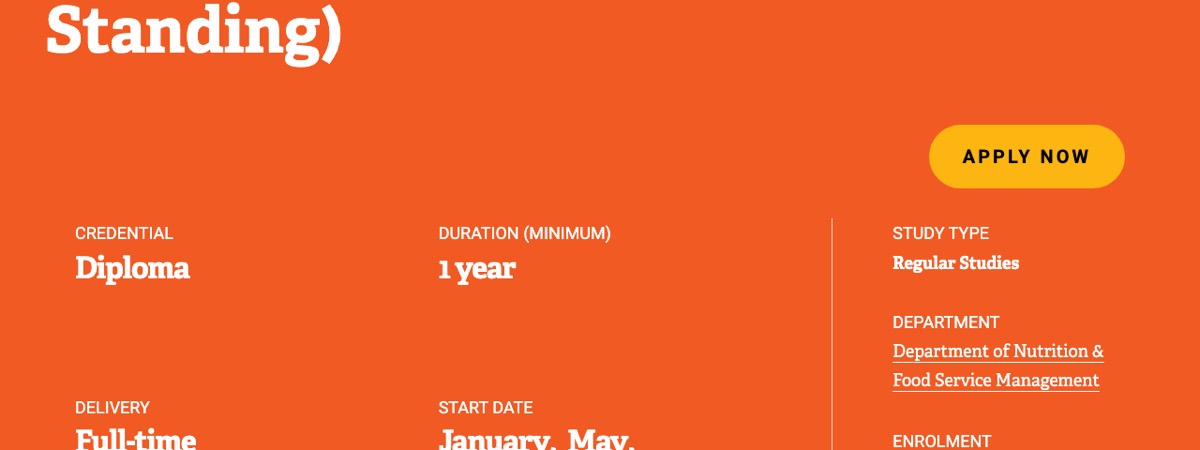
| Provider | Langara College |
|---|---|
| Length | 1 year |
| Credential | Diploma |
| Format | Full-time, British Columbia |
Fiona's take: Langara sits between the short certificates and the degree: a one-year college diploma aimed at food and nutrition service management rather than clinical dietetics. It does not lead to the CDRE or the dietitian title. For BC residents who want a one-year credential without a 4-year degree, this is the middle path.
Skip it if: Skip it if the dietitian title is your actual goal; you would still need the full degree route.
See Program DetailsFood and Nutrition Management Ontario College Graduate Certificate
Food and Nutrition Management Ontario College Graduate Certificate is a 1-year full-time graduate certificate from Algonquin College in Ontario.
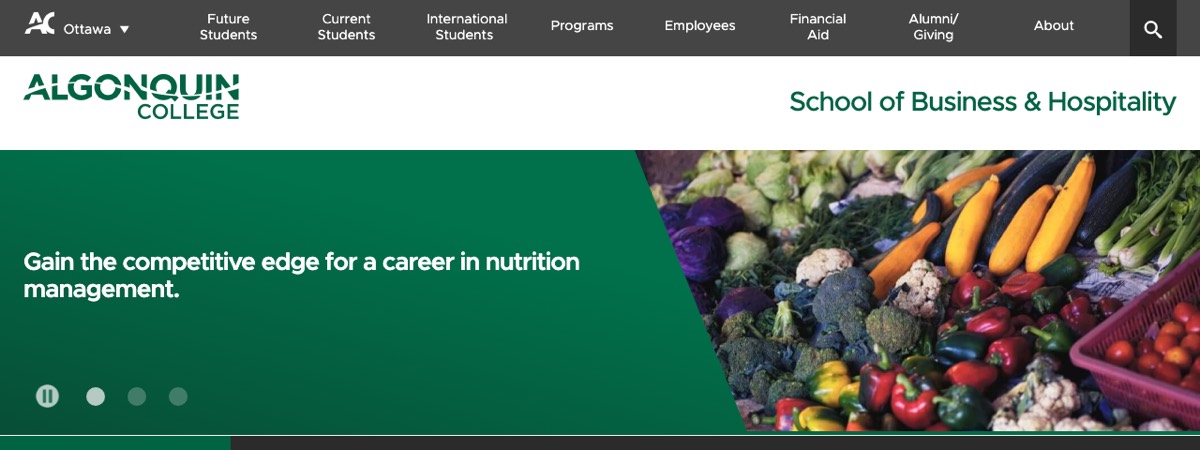
| Provider | Algonquin College |
|---|---|
| Length | 1 Year |
| Credential | Ontario College Graduate Certificate |
| Format | Full-time, Ontario |
Fiona's take: Algonquin's certificate is the Ontario counterpart to Langara's diploma: one year, full-time, management oriented. It is not a dietetic qualification; no CDRE, no registration. Pick it if you are in Ontario and want the same food and nutrition management direction.
Skip it if: Skip it if your goal is clinical dietetics; this is a management credential.
See Program DetailsHonours Bachelor of Science in Nutrition and Dietetics
Honours Bachelor of Science in Nutrition and Dietetics is a 4-year on-campus degree from the University of Ottawa totalling 129 units.
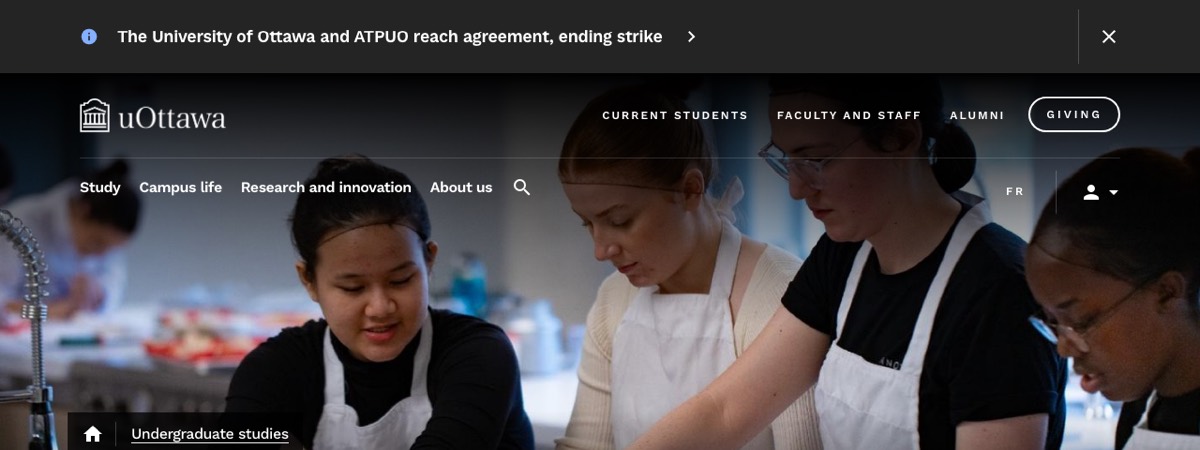
| Provider | University of Ottawa |
|---|---|
| Length | 4 years — 129 units |
| Credential | Honours Bachelor of Science |
| Format | On campus, Ontario |
Fiona's take: This is the degree half of the dietitian route in Ontario. Confirm the program's accreditation status before you apply, because registration depends on an accredited program plus a practicum. The supervised practicum, integrated into the degree or taken after it, typically runs 10-12 months; then come the $750 CDRE from the November 2026 sitting and the $185 Ontario application.
Skip it if: Skip it if you cannot study full-time on campus in Ottawa; no online version is listed.
See Program DetailsMajor in Dietetics
Major in Dietetics is a three-and-a-half-year on-campus program at McGill University, excluding the freshman year, leading to a BSc (NutrSc).
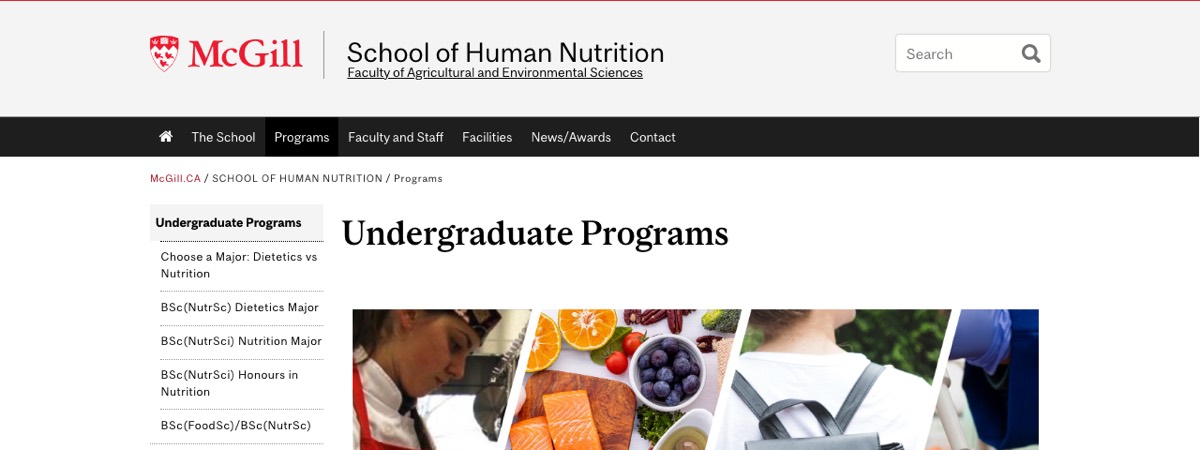
| Provider | McGill University |
|---|---|
| Length | Three and a Half Year Program (excluding freshman year) |
| Credential | BSc (NutrSc) |
| Format | On campus, Quebec |
Fiona's take: McGill is the Quebec route to the same profession, and Quebec is the one province that skips the CDRE. The three and a half years exclude the freshman year, so read the total as longer if you need that entry year. Registration still runs through the provincial regulator.
Skip it if: Skip it if you are set on studying and practising in Ontario; uOttawa fits that goal more directly.
See Program DetailsHow Much Does A Nutrition Qualification Cost In Canada?
Confirmed dietitian-route regulator costs include the $750 CDRE beginning with the November 2026 sitting and, in Ontario, a $185 application fee, before any tuition. Tuition for Langara, Algonquin, uOttawa and McGill is not listed in the available offer data, so the table separates confirmed fees from the rest.
| Item | Cost (CAD) | Detail |
|---|---|---|
| Canadian Dietetic Registration Examination (CDRE) | $750 | Beginning with the November 2026 sitting; the exam runs twice yearly |
| College of Dietitians of Ontario application | $185 | Mandatory for all applicant types, non-refundable |
| College of Dietitians of Ontario annual renewal | $667 | In effect beginning November 1, 2024 |
| Tuition: Langara, Algonquin, uOttawa, McGill | Not listed | Contact the institution directly |
| Coursera and Udemy courses | Not listed | Costs are not listed in the available offer data |
The certain costs are regulator costs, not school costs: the available data confirms exam and registration fees but lists no tuition. The CDRE runs twice yearly, so your timeline can slip by months if you miss a sitting. Ontario adds $667 per year to stay registered once you are in.
For the short courses, costs are not listed in the available offer data. Check the linked course pages before you compare them against the college options.
How Much Does A Nutritionist Earn In Canada?
A nutritionist or dietitian in Canada earns a median of $41.63 per hour, with the low end at $22.53 and the high end at $50.00, in Job Bank's November 2025 figures for NOC 31121. Provincial medians run from $34.36 in Manitoba to $46.24 in Alberta.
| Province | Median Hourly Wage (CAD) |
|---|---|
| Canada | 41.63 |
| Alberta | 46.24 |
| British Columbia | 44.00 |
| Saskatchewan | 42.00 |
| Ontario | 42.00 |
| Nova Scotia | 41.94 |
| Prince Edward Island | 40.38 |
| New Brunswick | 40.00 |
| Newfoundland and Labrador | 40.00 |
| Quebec | 40.00 |
| Manitoba | 34.36 |
The spread matters more than the median. Alberta's $46.24 and British Columbia's $44.00 sit clearly above the national line, while Manitoba's $34.36 sits well below it; where you practise moves this paycheque as much as anything else you control.
COPS projections flag a strong risk of a national shortage for this occupation across 2026-2035, though the outlook varies by province. The wage figures above are for NOC 31121, dietitians and nutritionists as Job Bank reports the group.
Is A Nutrition Course Worth It In 2026?
A nutrition course is worth it in 2026 when the format matches the goal. If the goal is the protected dietitian title, the accredited degree, the 10-12 month practicum and, in all provinces except Quebec, the CDRE are the requirements, and the payoff is a median of $41.63 per hour in an occupation COPS flags for shortage risk through 2035. Nothing shorter substitutes.
If the goal is coaching or personal interest, the calculus flips. The NASM specialization on Coursera answers whether this field suits you in 4 weeks at 10 hours a week, and in Ontario, British Columbia, Saskatchewan, Manitoba, New Brunswick and Newfoundland and Labrador anyone may use the word nutritionist.
My verdict: pay for the degree only if you want the regulated title. For everyone else, the Coursera test first, then decide. Spending 4-5 years to learn you wanted coaching rather than clinical care plans is the mistake I help clients avoid.
Nutrition Questions Canadians Ask
Is The Title Nutritionist Protected In Canada?
Nutritionist is protected in four provinces: Alberta, Quebec, Nova Scotia and Prince Edward Island, where provincial regulators control who may use it. In Ontario, British Columbia, Saskatchewan, Manitoba, New Brunswick and Newfoundland and Labrador, anyone may use the word. Dietitian, by contrast, is protected by law across Canada.
What Education Is Needed To Become A Dietitian In Canada?
Education for the dietitian title means an accredited bachelor's degree in dietetics, nutrition or a related field such as food and nutritional science, recognized by provincial regulators and EQual (Accreditation Canada), then supervised practical training, then the CDRE in all provinces except Quebec, then registration with the provincial regulator.
How Much Does The CDRE Cost?
The CDRE fee is $750 beginning with the November 2026 sitting. The exam runs twice yearly and is required in all provinces except Quebec. You pay it on top of tuition, which is not listed in the available offer data, and on top of the $185 application fee if you register with the College of Dietitians of Ontario.
What Is The Median Wage For Dietitians And Nutritionists In Canada?
The median wage for NOC 31121 is $41.63 per hour, with a low of $22.53 and a high of $50.00, in Job Bank's November 2025 update. Provincial medians range from $34.36 in Manitoba to $46.24 in Alberta, so geography moves this pay as much as seniority does.
How Long Does It Take To Become A Registered Dietitian?
Registered dietitian status typically takes 4-5 years including degree and practicum. Budget 4 years for the University of Ottawa's Honours BSc or three and a half years at McGill excluding the freshman year; the supervised practicum, integrated into the degree or taken after it, typically runs 10-12 months, then the CDRE follows outside Quebec, along with provincial registration.
Can A Coursera Certificate Make Me A Nutritionist?
A Coursera certificate cannot make you a nutritionist in the four provinces where the title is protected: Alberta, Quebec, Nova Scotia and PEI require registration with a regulator. In the six unregulated provinces anyone may use the word, but the certificate still carries no regulator backing. It is a learning credential, not a licence.
Is There A National Exam For Dietitians?
There is one national exam: the Canadian Dietetic Registration Examination. It is required in all provinces except Quebec, it runs twice yearly, and it costs $750 beginning with the November 2026 sitting. Passing it is the last gate before you register with a provincial regulator and use the protected dietitian title.
What's The Bottom Line On Nutrition Courses In Canada?
- The bottom line: the protected dietitian title takes an accredited degree, a 10-12 month practicum and, outside Quebec, the CDRE at $750 from the November 2026 sitting, 4-5 years in total.
- Dietitian is protected by law across Canada; nutritionist is protected in Alberta, Quebec, Nova Scotia and PEI, and open to anyone in Ontario, BC, Saskatchewan, Manitoba, New Brunswick and Newfoundland and Labrador.
- Nutrition Education for the Consumer Specialization is the try-first pick: 4 weeks at 10 hours a week from the National Academy of Sports Medicine, with a certificate and no licence attached.
- Job Bank puts NOC 31121 at a median of $41.63 per hour (November 2025), and COPS projects a strong national shortage risk for 2026-2035.






