Key Takeaways
- The fastest realistic route is a two-year Primary Care Paramedic college program at $15,000 to $20,000, then the $650 plus tax COPR PCP exam and provincial registration; faster formats exist at JIBC (12 months), Oulton College (15 months) and Oxford College (16 months).
- Registration is mandatory in all ten provinces: provincial regulators, the COPR members, hold the legislated authority to grant registration, licensure or certification, and Ontario graduates must also pass the A-EMCA provincial certification exam.
- Coursera's Become an EMT Specialization from the University of Colorado System (2 months at 10 hours a week, 6 courses, free to audit) tests your interest in emergency medicine but qualifies you for no Canadian paramedic registration.
- Job Bank lists NOC 32102 at a Canada median of $38.00 per hour (November 2025), from $27.31 in PEI to $42.17 in Ontario.
- Fiona's verdict: this path suits anyone ready for two years of study, exams and shift work; audit the Coursera specialization first if you are still unsure the field fits.
A paramedic administers pre-hospital emergency care to patients with injuries or medical illnesses and transports them to hospital for further treatment. In Canada the job is regulated in all ten provinces, so a course only counts if it ends in registration with a provincial regulator.
The realistic route: a two-year Primary Care Paramedic (PCP) college program at $15,000 to $20,000, the $650 plus tax COPR PCP exam, then registration. If you are not sure yet, a free-to-audit Coursera specialization will tell you whether the work suits you before you spend anything.
What Are The Ways To Become A Paramedic In Canada?
Becoming a paramedic in Canada means one of four routes: an online taster, the standard two-year PCP diploma, an accelerated 12-to-16-month program, or an advanced or degree path on top of PCP.
| Route | Time | Cost (CAD) | What You Get | Recognised By | Best For |
|---|---|---|---|---|---|
| Become an EMT Specialization | 2 months at 10 hours a week | Free to audit; subscription price not shown | Career certificate (6-course series, US EMT content) | Not recognised for registration in Canada | Testing the field before paying tuition |
| Primary Care Paramedic (PCP) diploma | 2 years | $15,000 to $20,000 | Ontario College Diploma or equivalent | Provincial regulators and COPR | The standard entry route to paid paramedic work |
| Accelerated PCP programs (JIBC, Saskatchewan Polytechnic) | 12 months to 1 year | Not listed | Certificate or diploma | Not listed; confirm with your provincial regulator | Students who want the shortest college route |
| Advanced Care Paramedic (ACP) | 1 additional year after PCP | Not listed | Post-diploma certificate | Provincial regulators and COPR | Working PCPs who want advanced scope |
| Bachelor of Applied Health Science, Paramedic (Medicine Hat College) | 4 years, with embedded 2-year PCP diploma | Not listed | Bachelor's degree with PCP diploma option | Not listed | Alberta students who want a degree plus the PCP credential |
I recommend the Coursera route for anyone still testing the idea, and the two-year PCP diploma, with JIBC's 12-month option for British Columbians in a hurry, for anyone ready to commit.
What Is The Fastest Way To Become A Paramedic In Canada?
The fastest way is still a college credential: accelerated programs run 12 to 16 months. Most provinces use COPR exams; Ontario requires A-EMCA. All routes still require provincial registration before practice.
- Complete high school with biology and the other science prerequisites: 4 years, $0, and most applicants already have this done.
- Enrol in and complete an accredited two-year PCP college program: 2 years, $15,000 to $20,000. Faster formats exist at named schools: the Justice Institute of British Columbia lists a 12-month PCP certificate/diploma, and Saskatchewan Polytechnic a one-year certificate.
- Pass the COPR PCP exam: $650 plus applicable tax per attempt, scheduling time varies.
- Register with your provincial regulator: timing and fees vary, and the registration fee is not listed on COPR's start page, so ask your regulator directly.
- In Ontario, also pass the A-EMCA provincial certification exam after your program; Oxford College's 16-month diploma is one program that lists eligibility for AEMCA certification.
Do You Need A Licence To Work As A Paramedic In Canada?
A licence is mandatory: paramedicine is regulated in all ten provinces, and you cannot practise without registration from your provincial regulator.
| Province | Required? | Regulator Or Registry | What It Means |
|---|---|---|---|
| All ten provinces | Yes | Provincial regulators (COPR members) | They hold the legislated authority to grant registration, licensure or certification to practise as an EMR or paramedic |
| Ontario | Yes | Provincial regulator (COPR member) | Graduates must also pass the A-EMCA provincial certification exam after the two-year program |
COPR administers the entry-to-practice examinations for EMR, PCP and ACP used by most provinces, and each PCP or ACP attempt costs $650 plus applicable tax. Ontario runs its own process instead: graduates must pass the A-EMCA provincial certification exam after the two-year program. Oxford College's diploma lists eligibility for AEMCA certification, which tells you its graduates sit that exam.
Online certificates do not register you anywhere. The University of Colorado System's EMT courses on Coursera, the Udemy tactical prep course and the London HeartbeatsZ Academy diploma all end in provider certificates, and none of them is registration with a provincial regulator. Use them to decide and to prepare, never to practise.
Internationally trained paramedics follow a separate track: COPR's PEAS assessment, or direct contact with the provincial regulator where you plan to work. Do that before paying for any bridging course.
Which Paramedic Courses Are Worth Taking In Canada?
Paramedic courses worth your money fall into three groups: free-to-audit online theory courses, college PCP programs and provider diplomas. I reviewed every option below, Coursera first, and I say plainly where each one stops.
Become an EMT Specialization
Become an EMT Specialization is a 2-month, 6-course online series from the University of Colorado System, taken at 10 hours a week, ending in a career certificate.
| Provider | University of Colorado System |
|---|---|
| Length | 2 months at 10 hours a week (6 course series) |
| Cost (CAD) | not shown (subscription or free to audit) |
| Credential | Career certificate |
| Format | online |
Fiona's take: This is the try-before-you-buy option. It is free to audit, the subscription price is not shown, and it is EMT content from the University of Colorado System; it is not a Canadian paramedic registration credential. It does not qualify you for registration with any Canadian provincial regulator, and you would still complete an accredited PCP program afterwards. I recommend it to clients deciding whether emergency care suits them.
Skip it if: Skip it if you already know you want this career; it adds no Canadian credential.
Start On CourseraEMT Foundations
EMT Foundations is a 14-hour online course from the University of Colorado System ending in a course certificate.
| Provider | University of Colorado System |
|---|---|
| Length | 14 hours |
| Credential | Course certificate |
| Format | online |
Fiona's take: Fourteen hours is a weekend-sized sample of emergency response theory, which is exactly the point. Check Coursera's current audit or pricing options before paying, because it answers the basic question of whether this material holds your attention. It does not register you as a paramedic in any province.
Skip it if: Skip it if you already have a healthcare or first-response background.
Start On CourseraTrauma Emergencies and Care
Trauma Emergencies and Care is a 12-hour online course from the University of Colorado System ending in a course certificate.
| Provider | University of Colorado System |
|---|---|
| Length | 12 hours |
| Credential | Course certificate |
| Format | online |
Fiona's take: Trauma calls are core paramedic work, and this is the module of the specialization I would sample first if the blood-and-splints side of the job is your real question. It is EMT content from the University of Colorado System, not a Canadian paramedic registration credential, so treat it as interest testing rather than Canadian scope of practice. It grants no registration here.
Skip it if: Skip it if you want Canadian-specific scope of practice.
Start On CourseraPrepare for the EMT Certification Test
Prepare for the EMT Certification Test is an 11-hour online course from the University of Colorado System built as exam preparation, ending in a course certificate.
| Provider | University of Colorado System |
|---|---|
| Length | 11 hours |
| Credential | Course certificate |
| Format | online |
Fiona's take: It is EMT content from the University of Colorado System built as exam preparation, so it targets an EMT certification test, not the COPR PCP exam, which costs $650 plus tax per attempt in Canada, and not Ontario's A-EMCA. Disciplined question practice still builds exam habits that transfer to any multiple-choice test. Position it as a warm-up, never as your COPR prep.
Skip it if: Skip it if your goal is specifically the COPR PCP or A-EMCA exam and you want exam-specific prep.
Start On CourseraTactical Paramedic Certification (TP-C)
Tactical Paramedic Certification (TP-C) is a self-paced online course from Udemy instructor Rohit k built around 160 practice questions, ending in a certificate of completion.
| Provider | Rohit k |
|---|---|
| Length | not shown (self-paced with 160 practice questions) |
| Cost (CAD) | not shown (typically subscription-based) |
| Credential | Certificate of completion |
| Format | online |
Fiona's take: Tactical medicine is a niche, and this is practice-question drilling rather than an accredited program. It grants no registration with a Canadian provincial regulator, and the cost is not shown, with Udemy typically pricing it on subscription. It only makes sense well after you are registered and exploring a speciality.
Skip it if: Skip it unless you are already a registered paramedic curious about tactical roles.
View On UdemyDiploma in Paramedical Science
Diploma in Paramedical Science is a 14.5-hour online course from London HeartbeatsZ Academy in the UK, rated 4.2, ending in a Udemy diploma certificate.
| Provider | London HeartbeatsZ Academy, UK |
|---|---|
| Length | 14.5 total hours |
| Rating | 4.2 |
| Credential | Diploma certificate |
| Format | online |
Fiona's take: The word diploma misleads here. This is not an Ontario College Diploma or any Canadian PCP credential, and it will not admit you to the COPR PCP exam. As a low-commitment survey of paramedic science from a UK perspective it is watchable, and the 4.2 rating suggests learners get something from it.
Skip it if: Skip it if you need a credential; nothing on Udemy registers you in Canada.
View On UdemyBachelor of Applied Health Science - Paramedic
Bachelor of Applied Health Science - Paramedic is a 4-year, in person or hybrid degree from Medicine Hat College in Alberta with an embedded 2-year PCP diploma option.
| Provider | Medicine Hat College |
|---|---|
| Length | 4 years (embedded 2-year PCP Diploma) |
| Credential | Bachelor of Applied Health Science - Paramedic (with PCP Diploma option) |
| Format | in person/hybrid, Alberta |
Fiona's take: The four-year degree includes an embedded 2-year PCP Diploma option. Tuition is not listed, so ask the registrar directly. Four years is double the standard PCP timeline, and you should choose it deliberately, not by default.
Skip it if: Skip it if your goal is to be on an ambulance as fast as possible.
See Program DetailsPrimary Care Paramedic
Primary Care Paramedic is a 2-year blended diploma from University College of the North in Manitoba costing $11,634.81 in Year 1 and $7,193.17 in Year 2.
| Provider | University College of the North |
|---|---|
| Length | 2 Years |
| Cost (CAD) | Year 1: $11,634.81; Year 2: $7,193.17 |
| Credential | Diploma |
| Format | blended, Manitoba |
Fiona's take: This is one of the programs on the page with a published cost; Oxford also lists a full-program price, so you can budget without a phone call: Year 1 at $11,634.81 and Year 2 at $7,193.17. Blended delivery suits students across northern and rural Manitoba. Confirm seat availability and clinical placement details with the college before planning your timeline.
Skip it if: Skip it if you live outside Manitoba and want placements near home.
See Program DetailsPrimary Care Paramedic Diploma
Primary Care Paramedic Diploma is a 2-year, 5-term hybrid diploma from Keyano College in Alberta.
| Provider | Keyano College |
|---|---|
| Length | 2 years (5 terms) |
| Credential | Diploma |
| Format | hybrid, Alberta |
Fiona's take: Five terms across two years with hybrid delivery gives Alberta students some schedule flexibility. Tuition is not listed, so budget from the $15,000 to $20,000 range typical of PCP programs and get the real number from the registrar in writing before you apply.
Skip it if: Skip it if you need published tuition before applying.
See Program DetailsPrimary Care Paramedicine (PCP)
Primary Care Paramedicine (PCP) is a 12-month blended certificate/diploma from the Justice Institute of British Columbia.
| Provider | Justice Institute of British Columbia |
|---|---|
| Length | 12-month |
| Credential | Certificate/Diploma |
| Format | blended, British Columbia |
Fiona's take: At 12 months, it is one of the quickest college-format programs listed, alongside Saskatchewan Polytechnic's one-year certificate. Tuition is not listed, so ask JIBC directly. Blended delivery means online coursework paired with in-person skills sessions, and you still sit the COPR PCP exam at $650 plus tax and register with your regulator afterwards.
Skip it if: Skip it if you cannot attend in-person sessions in British Columbia.
See Program DetailsPrimary Care Paramedic
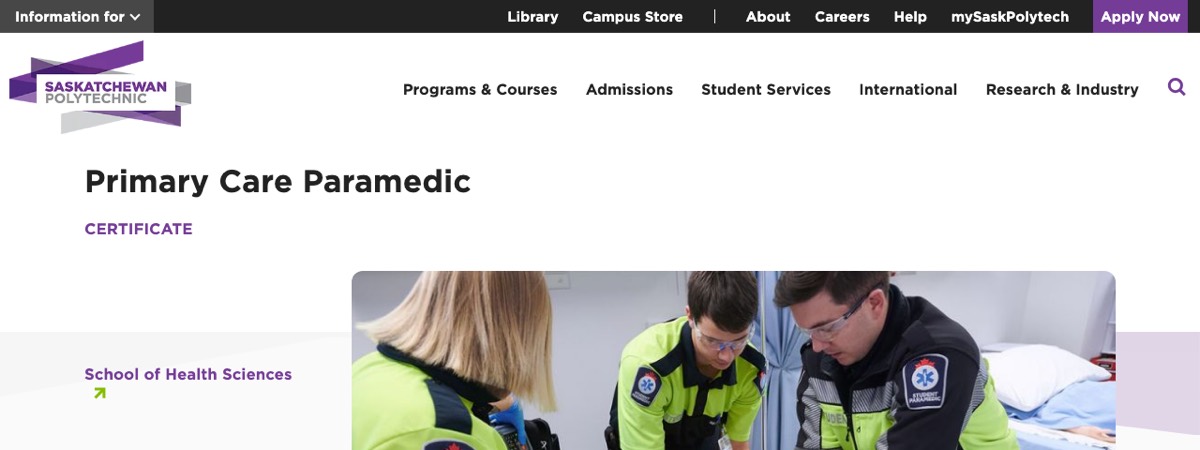
Primary Care Paramedic is a 1-year certificate from Saskatchewan Polytechnic, delivered in person or hybrid.
| Provider | Saskatchewan Polytechnic |
|---|---|
| Length | one-year certificate |
| Credential | Certificate |
| Format | in person/hybrid, Saskatchewan |
Fiona's take: One year is the shortest duration of any Saskatchewan option here, and in person or hybrid delivery fits students in Regina, Saskatoon and points between. Tuition is not listed. Ask Saskatchewan Polytechnic how the certificate articulates if you later want the two-year diploma or ACP training.
Skip it if: Skip it if you cannot attend classes in Saskatchewan.
See Program DetailsPrimary Care Paramedic Program
Primary Care Paramedic Program is a 16-month, in-person diploma from Oxford College in Ontario costing $28,950 for the full program, with eligibility for AEMCA certification.
| Provider | Oxford College |
|---|---|
| Length | 16 months |
| Cost (CAD) | $28950 for the full program |
| Credential | Diploma (eligible for AEMCA certification) |
| Format | in person, Ontario |
Fiona's take: Sixteen months undercuts the typical two-year Ontario timeline, and AEMCA eligibility is the detail that matters in this province. At $28,950 it sits well above the $15,000 to $20,000 typical PCP range, so you are paying for speed and structure. You still pass the A-EMCA exam itself before practising.
Skip it if: Skip it if $28,950 is out of reach and a two-year PCP timeline works for you.
See Program DetailsPrimary Care Paramedic 15 Month Program
Primary Care Paramedic 15 Month Program is a hybrid or in-person diploma from Oulton College in New Brunswick.
| Provider | Oulton College |
|---|---|
| Length | 15 months |
| Cost (CAD) | not shown (100% Tuition Coverage option noted) |
| Credential | Diploma |
| Format | hybrid/in person, New Brunswick |
Fiona's take: Fifteen months is again faster than the two-year norm. Tuition is not shown, though the college notes a 100% Tuition Coverage option, so ask directly what qualifies you and whether that arrangement is a bursary, employer sponsorship or something you must repay. Get those terms in writing before you count on it.
Skip it if: Skip it if you need a published price up front.
See Program DetailsHow Much Does A Paramedic Course Cost In Canada?
Listed options here range from a free-to-audit online course to Oxford College's $28,950 program, while several colleges do not list tuition. The typical two-year PCP program is $15,000 to $20,000, the COPR PCP or ACP exam is $650 plus tax per attempt, and University College of the North publishes tuition by year: $11,634.81 for Year 1 and $7,193.17 for Year 2.
| Item | Cost (CAD) | Notes |
|---|---|---|
| Two-year PCP college program (typical) | $15,000 to $20,000 | Standard tuition range for the entry credential |
| COPR PCP or ACP exam | $650 plus tax | Charged per attempt |
| University College of the North PCP diploma | Year 1: $11,634.81; Year 2: $7,193.17 | Published tuition, Manitoba, blended |
| Oxford College PCP program, Ontario | $28,950 | Full 16-month program, AEMCA eligible |
| Coursera Become an EMT Specialization | Free to audit; subscription price not shown | No Canadian credential |
| Provincial registration fee | Not listed | Confirm with your provincial regulator |
| JIBC, Keyano, Saskatchewan Polytechnic, Medicine Hat, Oulton tuition | Not listed | Contact each registrar directly |
COPR's examination handbook is blunt about the exam line item: each PCP/ACP attempt is $650 plus applicable tax. Budget for the possibility of a second attempt rather than assuming one pass, since scheduling times vary.
The bigger gap in this table is the unlisted tuitions. JIBC, Keyano College, Saskatchewan Polytechnic, Medicine Hat College and Oulton College all publish program details without a price, so the $15,000 to $20,000 typical range is your planning number until a registrar confirms otherwise. Treat Oulton's 100% Tuition Coverage note as a question about eligibility and repayment, not a promise.
How Much Does A Paramedic Earn In Canada?
Paramedics in Canada earn a median of $38.00 per hour under NOC 32102 (Job Bank, November 2025), with provincial medians running from $27.31 to $42.17.
| Province | Median Hourly Wage (CAD) |
|---|---|
| Canada (median) | 38.00 |
| Newfoundland and Labrador | 29.04 |
| Prince Edward Island | 27.31 |
| Nova Scotia | 31.00 |
| New Brunswick | 32.00 |
| Quebec | 35.00 |
| Ontario | 42.17 |
| Manitoba | 40.00 |
| Saskatchewan | 32.50 |
| Alberta | 35.70 |
| British Columbia | 34.00 |
Ontario leads at $42.17 and Manitoba follows at $40.00, while PEI sits lowest at $27.31. That spread is why I tell clients to pick their training province with a target labour market in mind: a Saskatchewan Polytechnic certificate and an Ontario diploma point at very different median paycheques. These are medians across experience levels, not starting rates.
Set your budget against the Canada median of $38.00 per hour. A typical $15,000 to $20,000 PCP tuition looks modest against full-time earnings at that rate, though Oxford College's $28,950 program stretches the payback. Job Bank's NOC 32102 figures come from the November 2025 update, so check the page again before you enrol.
Is A Paramedic Course Worth It In 2026?
A paramedic course is worth it in 2026 if you want frontline medical work and can finish what you start. The arithmetic is plain: $15,000 to $20,000 for a two-year PCP diploma, $650 plus tax for the COPR PCP exam, and a median wage of $38.00 per hour nationally, $42.17 in Ontario. Registration is mandatory in all ten provinces, which protects the credential: there is no unregistered back door into the work.
It is not worth it if you are drawn to the uniform more than the material. The Coursera EMT courses exist precisely for that test: audit Become an EMT Specialization over 2 months at 10 hours a week, free, and if the coursework bores you, you have saved yourself the typical $15,000 to $20,000 tuition and two years.
Where I would push back is on cost discipline. Oxford College charges $28,950 for 16 months, well above the typical range, and JIBC, Keyano College, Saskatchewan Polytechnic, Medicine Hat College and Oulton College publish no tuition at all. Get every number in writing before you enrol, and treat Oulton's 100% Tuition Coverage option as a question about terms and repayment, not a discount.
Paramedic Questions Canadians Ask
How Long Does It Take To Become A Paramedic In Canada?
Becoming a paramedic in Canada typically takes 2 years after high school, the Primary Care Paramedic diploma timeline Ottawa Paramedic Service describes. Add the $650 plus tax COPR PCP exam and provincial registration after graduation. Faster formats exist: JIBC lists a 12-month program, Oulton College 15 months and Oxford College 16 months.
What Is The COPR Exam?
The COPR exam is the entry-to-practice examination COPR administers for EMR, PCP and ACP levels, used by most provinces. Each PCP or ACP attempt costs $650 plus applicable taxes. You sit it after completing an accredited program; Ontario instead requires the A-EMCA provincial certification exam through its own process.
Do I Need To Pass An Exam To Become A Paramedic In Ontario?
Ontario requires an exam on top of your program: graduates must pass the A-EMCA provincial certification exam after the two-year program. Oxford College's 16-month diploma is one program that lists eligibility for AEMCA certification. Passing it is a condition of practising in the province.
Is Paramedicine Regulated In Every Province?
Paramedicine is regulated in all ten provinces, and licensing is required to practise. Provincial regulators, who are COPR members, hold the legislated authority to grant registration, licensure or certification to EMRs and paramedics. No province lets you work in the field unregistered.
What Is The Median Wage For Paramedics In Canada?
The median wage for paramedics in Canada is $38.00 per hour under NOC 32102 (Job Bank, November 2025). Ontario posts the highest provincial median at $42.17, followed by Manitoba at $40.00, while PEI sits lowest at $27.31. These are medians, not starting wages.
Can International Paramedics Work In Canada?
International paramedics can work in Canada, but not by transferring a foreign registration. COPR requires internationally trained applicants to complete its PEAS assessment, or you can contact the provincial regulator where you plan to live directly. Expect your education to be measured against Canadian standards before any registration is granted.
What Are The Levels Of Paramedics In Ontario?
The levels in Ontario are Primary Care Paramedic, a two-year program; Advanced Care Paramedic, an additional year of medical education; and Critical Care. PCP is where every Ontario paramedic starts, and ACP training is a post-diploma certificate taken after the PCP credential.
Do Paramedics Need A Special Driver Licence?
A special driver licence is often part of the job: in Ontario, paramedics commonly need a Class F licence plus a clean driving record and physical fitness. Because requirements sit with employers and provinces, check the specific paramedic service you want to join before you apply.
What's The Bottom Line On Paramedic Courses In Canada?
- The bottom line on paramedic courses: a two-year PCP diploma at $15,000 to $20,000, the $650 plus tax COPR PCP exam and provincial registration is the realistic path, and registration is mandatory in all ten provinces.
- Accelerated programs cut the calendar: JIBC runs 12 months in British Columbia, Oulton College 15 months in New Brunswick and Oxford College 16 months in Ontario at $28,950.
- Pay under NOC 32102: a $38.00 median hourly rate across Canada, from $27.31 in PEI to $42.17 in Ontario, per Job Bank's November 2025 update.
- Undecided? Audit Become an EMT Specialization first: 2 months at 10 hours a week, free to audit, and it qualifies you for no Canadian registration, which is exactly why it is a safe test.