Key Takeaways
- CNIH lists a 19-month accredited Ontario College Advanced Diploma. CADH lists a 79-week Dental Hygiene Diploma; confirm CDHO and NDHCE eligibility before enrolling. Either way, plan on the NDHCE at $850 plus applicable tax and CDHO registration ($50 application plus $207.50 within 12 months of graduating).
- Registration is mandatory in every province and territory; the College of Dental Hygienists of Ontario (CDHO) regulates Ontario, the BCCOHP regulates British Columbia and the OHDQ regulates Quebec.
- The Coursera series The Integration of Art and Science in Modern Dental Medicine from the University of Pennsylvania runs about 4 weeks at 10 hours a week and does not qualify you for the NDHCE or CDHO registration; use it to test the field first.
- The median wage for dental hygienists (NOC 32111) is $45.00 per hour in Canada, $44.00 in Ontario and $60.00 in Alberta, according to Job Bank.
- Fiona's verdict: dental hygiene suits disciplined students ready for in-person clinic work and a provincial licence; if you want an online-only career, this path is not it.
A dental hygienist is a regulated health professional who provides preventive oral health care: assessments, cleanings, scaling, radiography and patient education. In Ontario, dental hygienists must be registered with the College of Dental Hygienists of Ontario to practise.
The shortest realistic route is a 2 to 3 year accredited college diploma, the National Dental Hygiene Certification Examination at $850 plus applicable tax, then CDHO registration. A University of Pennsylvania series on Coursera lets you test the field for weeks instead of years, and this page compares selected routes, published fees where available, and Job Bank wages.
What Are The Ways To Become A Dental Hygienist In Canada?
The ways to become a dental hygienist in Canada converge on one credential: a 2 to 3 year accredited diploma that unlocks the NDHCE and provincial registration. Online courses play a different role entirely, testing interest before you spend years and tuition.
| Route | Time | Cost (CAD) | What You Get | Recognised By | Best For |
|---|---|---|---|---|---|
| The Integration of Art and Science in Modern Dental Medicine | 3-course series, 4 weeks at 10 hours a week | Not listed | Shareable certificate | No regulator; does not lead to the NDHCE or CDHO registration | Testing the field before applying to college |
| Ontario College Advanced Diploma, e.g. Algonquin College | 3 years delivered over 2.5 years | Not listed; about $11,500 in supplies at Algonquin | Ontario College Advanced Diploma | CDAC accredited; leads to the NDHCE and CDHO registration | Ontario residents targeting CDHO registration |
| Two-year diploma in British Columbia, e.g. Camosun College or College of New Caledonia | 2 years | $19,396 at Camosun; $27,138.47 at CNC | Diploma in Dental Hygiene | CDAC-accredited programs; NDHCE and provincial registration | Students outside Ontario |
| Shorter Ontario programs: Canadian National Institute of Health and CADH Mississauga | 19 months; 79 weeks | Not listed; CADH lists government funding available | Ontario College Advanced Diploma at CNIH; Dental Hygiene Diploma at CADH | Confirm CDHO eligibility before enrolling | The shortest timelines in Ontario |
For most Ontario readers I recommend an Ontario College Advanced Diploma such as Algonquin or Georgian, and I point the undecided to the Coursera series first, because clarity about the field is worth more than a rushed application.
What Is The Fastest Way To Become A Dental Hygienist In Canada?
The fastest way to become a dental hygienist in Canada is a CDAC-accredited diploma straight out of high school, the NDHCE right after graduation, then CDHO registration. Plan on 2 to 3 years of school and weeks to months of paperwork; no online course shortens the licensed route.
- Meet admission requirements after 4 years of secondary school: an Ontario Secondary School Diploma with Grade 12 English, Math, Biology and Chemistry at 65% or higher at Algonquin, plus the HPAT at some colleges.
- Complete a 2 to 3 year CDAC-accredited diploma: Algonquin delivers its 3-year Ontario College Advanced Diploma over 2.5 years and lists about $11,500 in supplies, tuition not published in our data; CNIH lists 19 months.
- Write the National Dental Hygiene Certification Examination, offered in January, May and September, for $850 plus applicable tax.
- Pass the CDHO jurisprudence exam and apply for registration: $50 application plus $207.50 for the General Certificate if you register within 12 months of graduating, or $415 after that; budget weeks to months.
- Buy professional liability insurance with a minimum of $1M per occurrence coverage, then begin practising immediately once the CDHO approves you.
Do You Need A Licence To Practise As A Dental Hygienist?
A licence to practise as a dental hygienist is mandatory in every province and territory: dental hygienists must be registered or licensed by the appropriate provincial or territorial regulatory authority. In Ontario that authority is the College of Dental Hygienists of Ontario.
| Province | Required? | Regulator |
|---|---|---|
| Alberta | Yes | Alberta College of Dental Hygienists (ACDH) |
| British Columbia | Yes | British Columbia College of Oral Health Providers (BCCOHP) |
| Manitoba | Yes | College of Dental Hygienists of Manitoba (CDHM) |
| New Brunswick | Yes | New Brunswick College of Dental Hygienists (NBCDH) |
| Newfoundland and Labrador | Yes | Newfoundland & Labrador College of Dental Hygienists (NLCDH) |
| Nova Scotia | Yes | Nova Scotia Regulator of Dental Hygiene, Dental Technology, and Denturism (NSRDHDTD) |
| Ontario | Yes | College of Dental Hygienists of Ontario (CDHO) |
| Prince Edward Island | Yes | College of Dental Hygienists of Prince Edward Island (CDHPEI) |
| Quebec | Yes | Ordre des hygiénistes dentaires du Québec (OHDQ) |
| Saskatchewan | Yes | College of Dental Hygienists of Saskatchewan (CDHS) |
| Northwest Territories | Yes | Dept. of Health and Social Services, Government of N.W.T. |
| Nunavut | Yes | Government of Nunavut Professional Practice Unit |
| Yukon | Yes | Department of Community Services Government of Yukon |
The National Dental Hygiene Certification Examination applies in every province and territory except Quebec, where the Ordre des hygiénistes dentaires du Québec regulates instead. The exam costs $850 plus applicable tax and runs in January, May and September, so graduating students should book the first sitting after their final semester.
Online courses change none of this. The University of Pennsylvania series I recommend below is a theory primer and an interest test; it does not qualify you for the NDHCE, CDHO registration or any provincial register. Treat it as the front door, not the licence.
Which Dental Hygiene Courses Are Worth Taking?
The dental hygiene courses worth taking split into two camps: fast online introductions that carry no licence, and college diplomas. Confirm current accreditation and regulator eligibility with each program before enrolling. I put Coursera first because the Penn series answers whether the field fits you before you commit two years and college tuition.
The Integration of Art and Science in Modern Dental Medicine
The Integration of Art and Science in Modern Dental Medicine is a 3-course online series from the University of Pennsylvania, about 4 weeks at 10 hours a week, that surveys the clinical and aesthetic sides of dental medicine.
| Provider | University of Pennsylvania |
|---|---|
| Length | 3 course series, 4 weeks at 10 hours a week |
| Rating | 4.9 (2,311 reviews across courses) |
| Credential | Shareable certificate |
| Format | online |
Fiona's take: This is my pick for anyone weighing a dental hygiene diploma. It carries a 4.9 rating across 2,311 reviews, ends with a shareable certificate, and lets you hear how clinicians talk about teeth and radiographs before you sign away two years. Be clear about what it is: it does not qualify you for the NDHCE or CDHO registration. It is the try-before-you-apply step, not the credential.
Skip it if: Skip it if you already hold a college offer; go straight to the diploma.
Start On CourseraIntroduction to Dental Medicine
Introduction to Dental Medicine is a 10-hour online course from the University of Pennsylvania that introduces how dental professionals assess and treat the mouth.
| Provider | University of Pennsylvania |
|---|---|
| Length | 10 hours |
| Rating | 4.8 (1.5K reviews) |
| Credential | Shareable certificate |
| Format | online |
Fiona's take: Ten hours is one focused weekend, which makes this the fastest taste test on the list. It rates 4.8 across roughly 1.5K reviews and issues a shareable certificate. Pair it with the Pittsburgh terminology course if you want a fuller preview of first-year vocabulary. None of it counts toward a diploma.
Skip it if: Skip it if you want hands-on clinic exposure; an online intro cannot give you that.
Start On CourseraIntroduction to Dental Terminology
Introduction to Dental Terminology is a 1 to 3 month online course from the University of Pittsburgh that builds the vocabulary used in dental practice.
| Provider | University of Pittsburgh |
|---|---|
| Length | 1 - 3 Months |
| Rating | 4.9 (19 reviews) |
| Credential | Shareable certificate |
| Format | online |
Fiona's take: Vocabulary is the part of first year that surprises students most, and this course front-loads it: the course defines and explores clinical and non-clinical dental terms used across dental specialties and practice administration. The 4.9 rating rests on only 19 reviews, so treat the score lightly. A shareable certificate comes with completion.
Skip it if: Skip it if you are already enrolled; your program teaches this terminology anyway.
Start On CourseraDental Assisting Masterclass: Clinical Skills, Procedures &
Dental Assisting Masterclass: Clinical Skills, Procedures & is an online course from Dave King on Udemy, priced at $11.99 on sale from $54.99, that walks through chairside assisting procedures.
| Provider | Dave King |
|---|---|
| Cost (CAD) | $11.99 (on sale from $54.99) |
| Rating | 4.7 (123 ratings) |
| Credential | Certificate of completion |
| Format | online |
Fiona's take: Assisting and hygiene are different jobs, and this course serves the first one. At $11.99 it is a reasonable window into clinical work before you invest in anything bigger, and it carries a 4.7 rating from 123 ratings. The certificate of completion carries no weight with the CDHO or any other regulator.
Skip it if: Skip it if your goal is hygiene registration specifically; this is not on that path.
View On UdemyDiploma in Clinical Dental Assisting Technology
Diploma in Clinical Dental Assisting Technology is an 8.5-hour online course from HeartbeatsZ Academy, UK on Udemy, priced at $12.99 on sale from $59.99, covering dental assisting technology.
| Provider | HeartbeatsZ Academy, UK |
|---|---|
| Length | 8.5 hours |
| Cost (CAD) | $12.99 (on sale from $59.99) |
| Rating | 4.5 (68 ratings) |
| Credential | Certificate of completion |
| Format | online |
Fiona's take: Ignore the word diploma in the title; this is a Udemy certificate of completion from a UK provider, not a Canadian credential. The 8.5 hours of content can still show you whether clinical detail holds your interest, and the $12.99 sale price keeps the risk small. It rates 4.5 from 68 ratings, and it leads nowhere near the NDHCE.
Skip it if: Skip it if you were hoping for a Canadian licence; this course cannot provide one.
View On UdemyDental Hygiene, Diploma
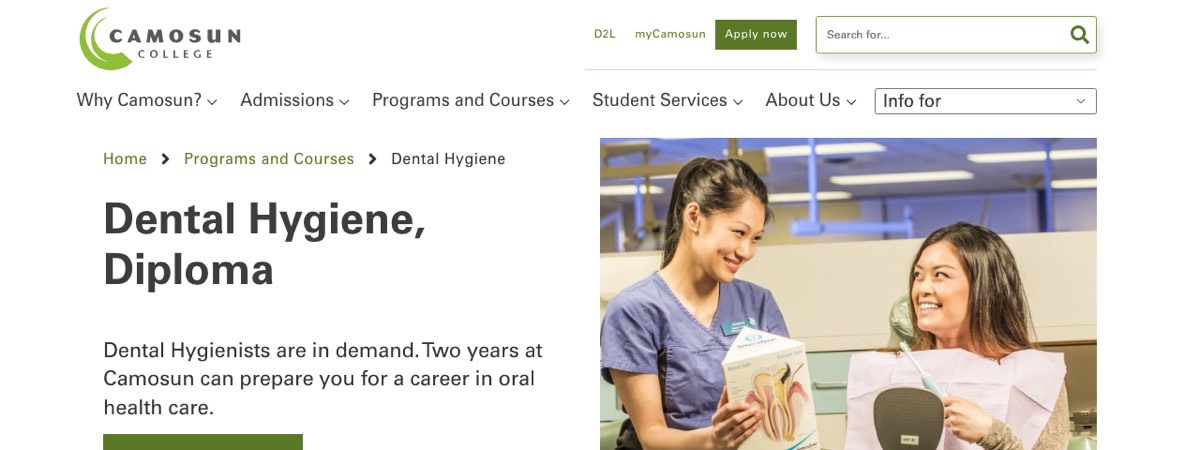
The Dental Hygiene Diploma at Camosun College is a 2-year in-person program from a British Columbia college that costs $19,396 domestic for the entire program.
| Provider | Camosun College |
|---|---|
| Length | 2 years |
| Cost (CAD) | $19,396 (domestic) for entire program |
| Credential | Diploma in Dental Hygiene |
| Format | in person, BC |
Fiona's take: That $19,396 total is the lowest full-program figure among the colleges here that publish costs, and it covers the whole diploma rather than one year. Camosun is 2 years; Ontario timelines in this list range from CNIH's 19 months and CADH's 79 weeks to 3-year advanced diplomas. Confirm accreditation and BCCOHP registration requirements before enrolling.
Skip it if: Skip it if you cannot relocate to BC; Ontario has its own list below.
See Program DetailsDental Hygiene
The Dental Hygiene program at Vancouver Community College is a 2-year blended program from a British Columbia college with tuition of $26,780 and an estimated total of about $34,819 with additional fees.
| Provider | Vancouver Community College |
|---|---|
| Length | 2 years |
| Cost (CAD) | $26,780 tuition (plus additional fees ~$34,819 total estimated) |
| Credential | Diploma |
| Format | class-based (blended elements), BC |
Fiona's take: VCC publishes the most transparent budget here: $26,780 tuition and roughly $34,819 all-in, which is the figure I tell clients to plan around for urban BC. Blended delivery suits students who want some coursework online. Confirm current accreditation and BCCOHP registration requirements before you enrol.
Skip it if: Skip it if the all-in total is out of reach; Camosun lists a lower full-program price.
See Program DetailsDental Hygiene
The Dental Hygiene program at the Canadian National Institute of Health is a 19-month hybrid program from an Ontario institute leading to an Ontario College Advanced Diploma.
| Provider | Canadian National Institute of Health (CNIH) |
|---|---|
| Length | 19 Months |
| Credential | Ontario College Advanced Diploma |
| Format | hybrid (in-person and online), ON |
Fiona's take: Nineteen months is the shortest Ontario timeline in this list, and the hybrid delivery folds some coursework online. Cost is not published in our data, so ask the registrar for the full figure, supplies included, before comparing with other colleges. Confirm current accreditation and CDHO registration requirements before enrolling, and line the schedule up with the NDHCE sittings in January, May and September.
Skip it if: Skip it if you need a published price up front; CNIH does not show one here.
See Program DetailsDental Hygiene
The Dental Hygiene program at Georgian College is a 3-year, six-semester full-time program from an Ontario college leading to an Ontario College Advanced Diploma.
| Provider | Georgian College |
|---|---|
| Length | 3 Years (6 Semesters) |
| Credential | Ontario College Advanced Diploma |
| Format | full-time, ON |
Fiona's take: Georgian follows the standard Ontario advanced diploma shape: three years, six semesters, in person. No tuition figure appears in our data, so request the fee schedule directly. Confirm current accreditation and CDHO registration requirements before enrolling.
Skip it if: Skip it if the 2.5-year delivery at Algonquin or 19 months at CNIH suits your timeline better.
See Program DetailsDental Hygiene Program
The Dental Hygiene Program at Confederation College is a 3-year in-person program from an Ontario college leading to an Ontario College Advanced Diploma, with estimated first-semester domestic fees of $16,378.
| Provider | Confederation College |
|---|---|
| Length | 3 years |
| Cost (CAD) | not shown (estimated fees for first semester domestic $16,378) |
| Credential | Ontario College Advanced Diploma |
| Format | in person, ON |
Fiona's take: Confederation shows estimated first-semester domestic fees of $16,378 and leaves the full program cost unstated, so budget carefully before comparing offers. Confirm current accreditation and CDHO registration requirements before enrolling.
Skip it if: Skip it if you want the whole program price published before applying.
See Program DetailsDental Hygiene Diploma
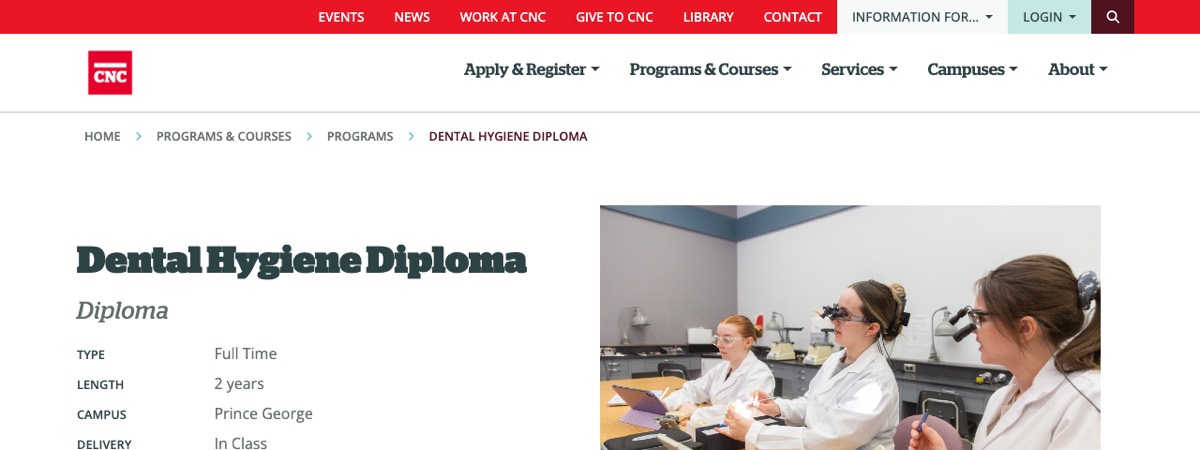
The Dental Hygiene Diploma at the College of New Caledonia is a 2-year in-class program from a British Columbia college costing $27,138.47.
| Provider | College of New Caledonia (CNC) |
|---|---|
| Length | 2 years |
| Cost (CAD) | $27,138.47 |
| Credential | Diploma |
| Format | in class, BC |
Fiona's take: CNC puts a precise total of $27,138.47 on its diploma, which helps you plan in a way vague fee pages do not. Two years in class, then the NDHCE and registration. Confirm accreditation and BCCOHP registration requirements before enrolling.
Skip it if: Skip it if Camosun's $19,396 total leaves more room in your budget.
See Program DetailsDental Hygiene Program in Mississauga
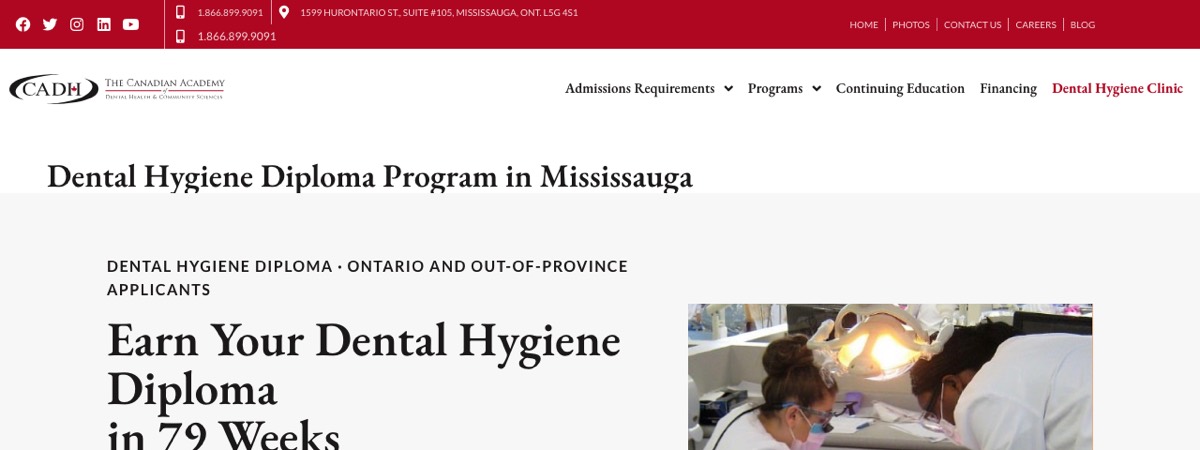
The Dental Hygiene Program at the Canadian Academy of Dental Health and Community Sciences in Mississauga is a 79-week in-person program with clinical learning leading to a Dental Hygiene Diploma.
| Provider | Canadian Academy of Dental Health and Community Sciences (CADH) |
|---|---|
| Length | 79 weeks |
| Cost (CAD) | not shown (government funding available) |
| Credential | Dental Hygiene Diploma |
| Format | in person (clinical learning), ON |
Fiona's take: Seventy-nine weeks is close to a year and a half of clinic-focused training, and CADH lists government funding as available, so have that conversation with the school before ruling it out on price. Tuition itself is not shown in our data. Ask directly how graduates move to the NDHCE and CDHO registration, and confirm eligibility before enrolling.
Skip it if: Skip it if you want an Ontario College Advanced Diploma on your transcript.
See Program DetailsHow Much Does It Cost To Become A Dental Hygienist In Canada?
Becoming a dental hygienist costs between $19,396 and $27,138.47 in published full-program tuition among the BC colleges here, plus exam and registration fees. Most Ontario programs in this list do not publish tuition; Algonquin lists about $11,500 in supplies alone.
| Item | Cost (CAD) | Notes |
|---|---|---|
| Camosun College diploma, domestic | $19,396 | Entire 2-year program, BC |
| College of New Caledonia diploma | $27,138.47 | 2-year program, BC |
| Vancouver Community College | $26,780 tuition | Estimated $34,819 total with additional fees |
| Confederation College, first semester domestic | $16,378 | Estimated; full program cost not shown |
| Algonquin College supplies | About $11,500 | Supplies only; tuition not listed in our data |
| NDHCE registration | $850 + applicable tax | Offered January, May, September |
| CDHO application | $50 | Ontario |
| CDHO General Certificate of Registration | $207.50 | If registered within 12 months of graduation |
| CDHO General Certificate of Registration, standard | $415 | Outside the 12-month window |
| CDHO annual renewal | $415 | General and specialty classes |
| CDHO late renewal fee | $100 | Charged after the renewal deadline |
Two fees hit right after graduation: the NDHCE at $850 plus applicable tax, and CDHO charges of $50 for the application plus $207.50 for the General Certificate if you register within 12 months of finishing. Those are fixed, published numbers, so put them in your budget the day you accept a seat.
The open variable is tuition. Camosun, CNC and VCC publish figures in BC, while Ontario programs like Georgian and CNIH publish nothing in our data and CADH lists government funding as available without a price. Ask every registrar for a total cost sheet, supplies included, before comparing offers. Liability insurance, minimum $1M per occurrence, is one more line to plan for.
How Much Does A Dental Hygienist Earn In Canada?
A dental hygienist earns a median of $45.00 per hour in Canada, according to Job Bank figures for NOC 32111. Alberta leads the provinces at $60.00, while Nova Scotia posts $38.10 at the low end and Ontario sits at $44.00.
| Region | Median Hourly Wage |
|---|---|
| Canada | $45.00 |
| Alberta | $60.00 |
| British Columbia | $55.00 |
| Saskatchewan | $51.00 |
| Newfoundland and Labrador | $50.00 |
| Manitoba | $47.00 |
| Prince Edward Island | $46.00 |
| Ontario | $44.00 |
| New Brunswick | $42.00 |
| Quebec | $39.00 |
| Nova Scotia | $38.10 |
The spread matters more than the median. An Alberta hygienist at $60.00 per hour out-earns a Quebec counterpart at $39.00 by a wide margin, and Ontario's $44.00 sits just under the national $45.00. If you are flexible about where you live, the wage table should shape where you study and register.
Job Bank rates the outlook for NOC 32111 as varying by province, so check the local picture before you pick a school. Each province or territory has its own regulator; Ontario CDHO fees are listed above.
Is Dental Hygiene Worth It In 2026?
Dental hygiene is worth it in 2026 if you finish what you start. The median wage of $45.00 per hour under NOC 32111 rewards a diploma that takes 2 to 3 years, and Alberta's $60.00 median is the strongest provincial figure in the pack. The post-graduation charges, the $850 NDHCE plus CDHO fees, sit nowhere near a second tuition.
Weigh that against entry costs. Published full-program tuition runs $19,396 at Camosun and $27,138.47 at CNC, VCC estimates about $34,819 all-in, and Algonquin lists about $11,500 for supplies before tuition. That spread is real money, and it argues for testing your interest with a Coursera series before you sign anything.
It is not worth it for one group: people who want a fully online path to the job. Registration with a college such as the CDHO is mandatory in every province and territory, and no online certificate replaces the accredited diploma. Use Introduction to Dental Medicine as a 10-hour gut check, then decide.
Dental Hygiene Questions Canadians Ask
How Long Does It Take To Become A Dental Hygienist In Ontario?
Becoming a dental hygienist in Ontario typically takes 2 to 3 years of college plus exam and registration time. Algonquin delivers its three-year Ontario College Advanced Diploma over 2.5 years, CNIH lists 19 months, and CADH in Mississauga lists 79 weeks. After graduating you sit the NDHCE, offered in January, May and September, then complete CDHO registration, which takes weeks to months.
Is The NDHCE Required In All Provinces?
The NDHCE is required in all provinces and territories except Quebec, which regulates through the Ordre des hygiénistes dentaires du Québec. Everywhere else, from Ontario under the CDHO to British Columbia under the BCCOHP, the National Dental Hygiene Certification Examination at $850 plus applicable tax sits between your diploma and registration.
What Is The Median Wage For Dental Hygienists In Canada?
The median wage for dental hygienists in Canada is $45.00 per hour under Job Bank's NOC 32111. Provincially, Alberta posts $60.00, British Columbia $55.00 and Saskatchewan $51.00, while Ontario sits at $44.00 and Nova Scotia at $38.10. Job Bank rates the outlook as varying by province.
Do I Need To Register With A Regulatory Body To Practise?
Registration with a regulatory body is mandatory in every province and territory before you can practise; dental hygienists must be registered or licensed by the appropriate authority. In Ontario that is the College of Dental Hygienists of Ontario, whose General Certificate of Registration costs $207.50 within 12 months of graduation and $415 otherwise.
What Are The Admission Requirements For Dental Hygiene Programs In Ontario?
Admission to dental hygiene programs in Ontario generally requires an Ontario Secondary School Diploma with Grade 12 English, Math, Biology and Chemistry at 65% or higher, as listed at Algonquin, and some colleges add the HPAT. Requirements vary by college, so check each program page before applying and ask admissions about alternatives directly.
How Much Does The NDHCE Cost In 2026?
The NDHCE costs $850 plus applicable tax in 2026. That fee is separate from college tuition and from CDHO charges, which add a $50 application and $207.50 to $415 for registration depending on how soon after graduation you apply. The exam runs in January, May and September, so plan the sitting that follows your final semester.
Can International Graduates Practise In Canada?
International graduates may be able to practise in Canada, but graduates of non-accredited programs must contact the provincial regulator for an equivalency assessment and additional requirements, which the CDHO outlines for Ontario. There is no automatic recognition of a foreign diploma. Start with the regulator in the province where you intend to work before paying for any bridging course.
What Is The CDHO Registration Fee?
The CDHO registration fee is $207.50 for a General Certificate of Registration if you apply within 12 months of graduation, and $415 otherwise. The application itself costs $50, annual renewal is $415, and a late renewal adds $100. Liability insurance with at least $1M per occurrence coverage is also required before you practise.
What's The Bottom Line On Dental Hygiene Courses In Canada?
- The bottom line on dental hygiene courses: the usual route is an accredited dental hygiene diploma, typically 2 to 3 years, followed by the NDHCE and provincial registration. CNIH lists 19 months; confirm eligibility for shorter private programs before enrolling.
- Test the field first with The Integration of Art and Science in Modern Dental Medicine from the University of Pennsylvania: 3 courses, about 4 weeks at 10 hours a week, and no licence attached.
- Budget the fixed post-graduation fees: $850 plus applicable tax for the NDHCE, $50 for the CDHO application, $207.50 to register within 12 months of graduating, $415 after.
- Dental hygienists (NOC 32111) earn a median $45.00 per hour in Canada and $44.00 in Ontario, according to Job Bank.
- Registration is mandatory everywhere: CDHO in Ontario, BCCOHP in British Columbia, ACDH in Alberta, OHDQ in Quebec.