Key Takeaways
- The shortest realistic degree route is a 2-3 year technology diploma, then Camosun's 8-month Electrical & Computer Engineering Bridge to UVic at $6,019 domestic (2026-2027), then 2 years at UVic, roughly 5-6 years end to end.
- A P.Eng licence is mandatory to practise professional engineering in Ontario (PEO), British Columbia (EGBC), Alberta (APEGA) and Quebec (OIQ); a CEAB-accredited degree such as Sheridan's BEng meets the academic requirements.
- Coursera's Master of Science in Electrical and Computer Engineering from University of Colorado Boulder can be finished in 12 months online, but it does not replace a CEAB-accredited undergraduate degree or grant any Canadian licence.
- Job Bank lists NOC 21310 electrical and electronics engineers at a median of $50.67 per hour across Canada, with Saskatchewan at $56.00, Quebec at $53.85 and Prince Edward Island at $46.15 among listed provinces.
- Fiona's verdict: this path suits someone set on hardware, power or embedded systems work who can commit 5-6 years; start with a Coursera specialization first if you are unsure the field fits.
Electrical and Computer Engineering (ECE) combines electrical engineering and computer science to design hardware, software, communications, power and computing systems. In Canada the credential matters: a 4-year CEAB-accredited BEng is the academic ticket to a P.Eng licence, while a college technology diploma can meet the academic requirements for OACETT's C.E.T. credential.
For diploma holders, Camosun's 8-month Bridge to UVic leads into third year of a BEng; from high school, the pack supports a 4-year CEAB-accredited BEng route. Job Bank puts NOC 21310 engineers at a median of $50.67 per hour. Here is how I would map the options.
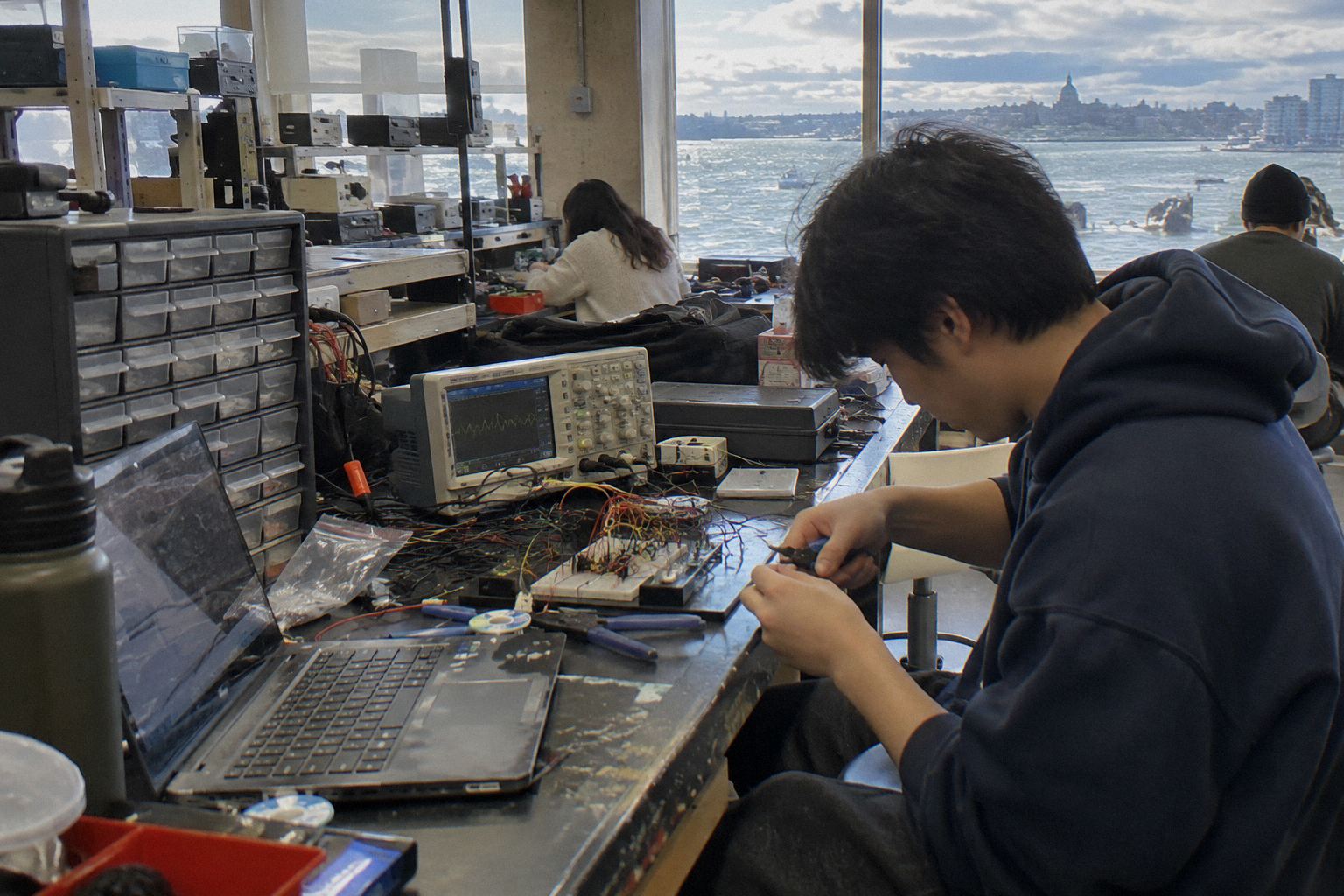
What Are The Ways To Study Electrical And Computer Engineering In Canada?
ECE credentials in Canada split into four broad routes, from a 3-year advanced diploma to CEAB-accredited degrees and online graduate study.
| Route | Time | Cost (CAD) | What You Get | Recognised By | Best For |
|---|---|---|---|---|---|
| Master of Science in Electrical and Computer Engineering | Finish in 12 months | Not listed | Master of Science in Electrical and Computer Engineering, online | University of Colorado Boulder credential; not a route to a Canadian P.Eng on its own | Testing the field or adding graduate theory before committing to a degree |
| Advanced Diploma, Electrical Engineering Technology (Conestoga) | 3 years, optional 16-month co-op | International ~$15,026 per year | Advanced Diploma | OACETT for C.E.T.; pathway to degree | Technologist roles in Ontario |
| Electrical & Computer Engineering Bridge to UVic (Camosun) | 8 months | Domestic $6,019 (2026-2027); international $17,568 | Advanced Diploma | UVic, for direct entry to 3rd year BEng | Diploma holders upgrading to a degree |
| Bachelor of Engineering, Electrical (Sheridan) | 4 years | Varies | BEng | CEAB accredited, meeting P.Eng academic requirements | The full P.Eng track in Ontario |
I recommend the Coursera route for anyone who is not yet sure the field fits, the Camosun bridge for diploma holders chasing the BEng fastest, and a 4-year CEAB degree such as Sheridan's for students starting from high school who want the P.Eng track.
What Is The Fastest Way To Get An ECE Degree In Canada?
The fastest way for diploma holders runs through the Camosun bridge into third year at UVic; from high school, the pack supports a 4-year BEng route.
- Complete a 2-3 year accredited Electrical, Electronics or Computer Engineering Technology diploma at a college such as Conestoga, at roughly $8k-$15k domestic per year.
- Complete the 8-month Electrical & Computer Engineering Bridge program at Camosun College, which costs $6,019 domestic for the entire program (2026-2027) or $17,568 international.
- Enter the third year of the BEng at the University of Victoria and complete the remaining 2 years, with co-op included.
- At the graduate level, Waterloo's Accelerated MEng is for undergraduate engineering students after earning their BASc and can be finished in as little as two terms in person; Alberta's MEng is listed as as little as nine months, hybrid. The pack does not support using either as a substitute for the undergraduate P.Eng academic path.
- For an online-only graduate credential, Coursera's Master of Science in Electrical and Computer Engineering from University of Colorado Boulder can be finished in 12 months.
Is A Licence Required To Practise Electrical And Computer Engineering In Canada?
A licence is mandatory to practise professional engineering and use the P.Eng title, and each province has its own regulator.
| Province | Required? | Regulator | What It Means |
|---|---|---|---|
| Ontario | Yes, for professional practice and the P.Eng title | Professional Engineers Ontario (PEO) | Licence titles: Professional Engineer, Engineer, P.Eng. |
| British Columbia | Yes, for professional practice and the P.Eng title | Engineers and Geoscientists BC (EGBC) | Licence titles: Professional Engineer, Engineer, P.Eng. |
| Alberta | Yes, for professional practice and the P.Eng title | APEGA | Professional Member and Licensee; P.Eng. |
| Quebec | Yes, for professional practice and the ing. title | Ordre des ingénieurs du Québec (OIQ) | Licence title: ingénieur (ing.) |
The degree itself does not make you a professional engineer. Sheridan's Bachelor of Engineering, Electrical is CEAB accredited, which means it satisfies the academic requirements for P.Eng licensure in Canada, but you still apply to your provincial regulator and complete its process. Conestoga's advanced diploma is a different track: it meets the academic requirements to become a Certified Engineering Technologist (C.E.T.) through OACETT, which is a technologist credential, not a P.Eng.
Coursera's Master of Science in Electrical and Computer Engineering does not qualify you for any Canadian licence or registration. It is a way to learn the material and test your interest, not a shortcut around the regulators.
Which Electrical And Computer Engineering Courses Are Worth Taking?
These are the courses and programs I compare most often with clients, from Coursera specializations through Ontario and Alberta graduate programs.
Master of Science in Electrical and Computer Engineering
Master of Science in Electrical and Computer Engineering is a 12-month online degree from University of Colorado Boulder on Coursera.
| Provider | University of Colorado Boulder |
|---|---|
| Length | Finish in 12 months |
| Credential | Master of Science in Electrical and Computer Engineering |
| Format | online |
Fiona's take: This is a full graduate degree delivered online, which makes it the lowest-friction way to test whether you want to commit years to this field. I recommend it for working technologists and career changers who already have an undergraduate credential. It is not a substitute for a CEAB-accredited undergraduate degree if your goal is a Canadian P.Eng.
Skip it if: Skip it if you are starting from high school and need the accredited BEng path to licensure.
Start On CourseraPower Electronics Graduate Certificate
Power Electronics Graduate Certificate is a 9-month online certificate from University of Colorado Boulder on Coursera.
| Provider | University of Colorado Boulder |
|---|---|
| Length | 9 months |
| Credential | Graduate Certificate |
| Format | online |
Fiona's take: A 9-month certificate lets you test the power electronics area without enrolling in a full degree. I suggest this to technologists in utilities or manufacturing who want to explore that specialisation. It does not grant Canadian licensure or certification on its own.
Skip it if: Skip it if you want a broad ECE credential rather than a power-focused one.
Start On CourseraFPGA Design for Embedded Systems Specialization
FPGA Design for Embedded Systems Specialization is a 4-course online series from University of Colorado Boulder on Coursera.
| Provider | University of Colorado Boulder |
|---|---|
| Length | 4 course series |
| Credential | Specialization |
| Format | online |
Fiona's take: Embedded systems and FPGA work is hands-on, and this short series lets you find out whether you enjoy that kind of low-level design before paying for a diploma. I tell clients to pair it with a breadboard and actually build something. It is not a credential for employment on its own.
Skip it if: Skip it if your interest is power systems rather than embedded hardware.
Start On CourseraCrash Course Electronics and PCB Design
Crash Course Electronics and PCB Design is a 33hr 23min online course from Udemy with a 4.7 rating.
| Provider | Udemy |
|---|---|
| Length | 33hr 23min |
| Rating | 4.7 |
| Credential | Course Certificate |
| Format | online |
Fiona's take: This 33hr 23min course has a 4.7 rating in the offer data, and it covers electronics and circuit board design in depth. It suits absolute beginners and technologists who want PCB skills their diploma program may not cover. A Udemy course certificate will not carry weight with PEO or any engineering regulator.
Skip it if: Skip it if you need structured assessment and academic credit rather than self-paced video.
View On UdemyUltimate Electrical Circuits for Electrical Engineering
Ultimate Electrical Circuits for Electrical Engineering is a 25.5-hour online course from Udemy with a 4.5 rating.
| Provider | Udemy |
|---|---|
| Length | 25.5 hours |
| Rating | 4.5 |
| Credential | Course Certificate |
| Format | online |
Fiona's take: Circuit analysis is the gatekeeper skill for every ECE program, and many first-year students struggle with it. I recommend this 25.5-hour course as prep before a diploma or degree starts, not as a replacement for one. The 4.5 rating suggests it lands well with learners.
Skip it if: Skip it if you already passed circuits coursework comfortably.
View On UdemyAccelerated Master of Engineering (MEng) program
Accelerated Master of Engineering (MEng) program is an in-person MEng from University of Waterloo in Ontario, finishable in as little as two terms.
| Provider | University of Waterloo |
|---|---|
| Length | as little as two terms |
| Credential | Master of Engineering (MEng) |
| Format | in person, Ontario |
Fiona's take: Waterloo lists this accelerated format as finishable in as little as two terms, in person, in Ontario. It is aimed at undergraduate engineering students after they earn their BASc. I point that group here when they want a fast graduate credential on their record.
Skip it if: Skip it if you cannot relocate to Ontario or need online delivery.
See Program DetailsElectrical and Computer Engineering (Electric Power Engineering) - Master of Engineering (MEng) (Online)
Electrical and Computer Engineering (Electric Power Engineering) - Master of Engineering (MEng) (Online) is a 36-month online MEng from University of Waterloo in Ontario.
| Provider | University of Waterloo |
|---|---|
| Length | 36 months |
| Credential | Master of Engineering (MEng) |
| Format | online, Ontario |
Fiona's take: This is a fully online Canadian MEng focused on electric power, delivered over 36 months, which suits working engineers who cannot leave their jobs. The length reflects part-time pacing around employment.
Skip it if: Skip it if you want a faster credential than 36 months or a non-power specialisation.
See Program DetailsMaster of Engineering (MEng)
Master of Engineering (MEng) is a hybrid MEng from University of Alberta in Alberta, finishable in as little as nine months.
| Provider | University of Alberta |
|---|---|
| Length | as little as nine months |
| Credential | Master of Engineering (MEng) |
| Format | hybrid, Alberta |
Fiona's take: Nine months to an MEng from University of Alberta, delivered hybrid, is one of the faster graduate credentials listed in this field. It suits recent graduates who already hold an undergraduate credential.
Skip it if: Skip it if you do not already hold an undergraduate degree.
See Program DetailsMaster of Engineering in Electrical and Computer Engineering
Master of Engineering in Electrical and Computer Engineering is an in-person MEng from University of Calgary in Alberta, taking one or two years.

| Provider | University of Calgary |
|---|---|
| Length | one or two years |
| Credential | Master of Engineering |
| Format | in person, Alberta |
Fiona's take: University of Calgary's MEng is a course-based master's that runs one or two years in person and fits students set on Alberta's labour market. I compare it directly with the University of Alberta MEng on delivery and length.
Skip it if: Skip it if you need online or part-time delivery.
See Program DetailsHow Much Does An Electrical And Computer Engineering Degree Cost In Canada?
Costs depend on the route: college diplomas sit around $8k-$15k domestic per year, while the figures I can verify for the bridge route are the clearest.
| Program | Time | Cost (CAD) |
|---|---|---|
| Conestoga Advanced Diploma, Electrical Engineering Technology | 3 years | International ~$15,026 per year |
| Camosun Electrical & Computer Engineering Bridge to UVic | 8 months | $6,019 domestic (2026-2027); $17,568 international |
| Diploma route generally | 2-3 years | ~$8k-$15k domestic per year |
| University degree route | 4 years | ~$20k+ per year, varies |
Camosun's bridge program is $6,019 domestic for the entire 8-month program in 2026-2027. International students pay $17,568 for the same program, and Conestoga's advanced diploma runs about $15,026 per year international. UVic tuition for the final 2 years varies, so budget that portion separately.
For a bachelor's from scratch, university costs run around $20k and up per year depending on the institution, which is why I tell clients to price the diploma-plus-bridge route before assuming a 4-year university start is the only way.
How Much Does An Electrical And Electronics Engineer Earn In Canada?
Job Bank lists NOC 21310, electrical and electronics engineers, at a median of $50.67 per hour across Canada.
| Province | Median Hourly (CAD) |
|---|---|
| Canada (median) | $50.67 |
| Saskatchewan | $56.00 |
| Quebec | $53.85 |
| Ontario | $50.00 |
| Alberta | $50.00 |
| New Brunswick | $50.00 |
| Newfoundland and Labrador | $50.00 |
| British Columbia | $48.08 |
| Manitoba | $48.00 |
| Nova Scotia | $47.18 |
| Prince Edward Island | $46.15 |
Job Bank lists NOC 21310 at a median of $50.67 per hour nationally, with provincial medians shown in the table. Saskatchewan at $56.00 and Quebec at $53.85 lead the listed provinces, while Prince Edward Island at $46.15 is the lowest. Median wages differ by province, and CEAB accreditation supports the academic requirements for P.Eng licensure; applicants still deal with the relevant provincial regulator, such as PEO in Ontario or OIQ in Quebec.
Is An Electrical And Computer Engineering Degree Worth It In 2026?
Job Bank lists NOC 21310 at a median of $50.67 per hour nationally, with provincial medians shown in the table above. Even the slower diploma-plus-bridge route lands you in that occupation in roughly 5-6 years. The cost case depends on route: $6,019 for the Camosun bridge is a small outlay against those wages, while a 4-year university start at $20k+ per year demands more conviction.
CEAB accreditation supports the academic requirements for P.Eng licensure in Canada, and applicants still deal with their provincial regulator. P.Eng is what lets you sign and seal engineering work. If you only want technologist roles, the Conestoga advanced diploma, which meets the academic requirements for OACETT's C.E.T., is a faster credential with its own market.
My honest caveat: this path rewards people who like the material. I tell clients to spend a month on the FPGA Design for Embedded Systems Specialization or the Power Electronics Graduate Certificate on Coursera before committing thousands of dollars, because finding out you dislike circuit design at that stage costs far less than finding out in second year.
Electrical And Computer Engineering Questions Canadians Ask
Diploma Or Degree In Electrical Engineering In Canada?
A diploma takes 2-3 years and can meet the academic requirements for OACETT's C.E.T. credential, while a 4-year CEAB degree such as Sheridan's BEng is required for the P.Eng path. Bridge programs let diploma holders convert to a degree, at roughly 5-6 years total. The right choice depends on whether you want to sign and seal engineering work.
What Is The Fastest Route To An ECE Degree In Canada?
For diploma holders, the fastest verified route is Camosun's 8-month Electrical & Computer Engineering Bridge at $6,019 domestic, then 2 years at the University of Victoria entering third year. From high school, the pack supports a 4-year CEAB-accredited BEng route such as Sheridan's.
Can You Do An Online Bachelor's In Electrical And Computer Engineering In Canada?
The pack includes online graduate options, such as Waterloo's 36-month online MEng in Electric Power and University of Colorado Boulder's 12-month online MSc on Coursera. The pack's research notes that accredited undergraduate programs typically require in-person labs. Plan on campus attendance for the BEng.
Are There 1-Year Options For ECE In Canada?
Yes, in two forms. Camosun's 8-month Advanced Diploma bridge takes diploma holders into university third year. At the graduate level, Alberta's MEng is listed as as little as nine months, hybrid, and Waterloo's Accelerated MEng as as little as two terms in person, aimed at undergraduate engineering students after they earn their BASc.
Is P.Eng Mandatory For Electrical Engineering Jobs In Canada?
P.Eng is mandatory to practise professional engineering, sign and seal documents, and use the P.Eng title, with regulators including PEO in Ontario, EGBC in British Columbia, APEGA in Alberta and OIQ in Quebec. The pack notes many roles allow work under supervision first. Plenty of technologist roles never require it.
What Are Job Bank Wages For Electrical And Electronics Engineers In Canada?
Job Bank lists NOC 21310 at a median of $50.67 per hour across Canada. Provincially, Saskatchewan sits at $56.00, Quebec at $53.85, and Prince Edward Island at $46.15. These are medians, not starting salaries, so budget your early-career expectations accordingly.
Why Does CEAB Accreditation Matter For An ECE Degree?
CEAB accreditation, such as Sheridan's electrical engineering degree carries, ensures graduates meet the academic requirements for P.Eng licensure in Canada. Without it, you may face extra steps from your provincial regulator. If the P.Eng title is your goal, check accreditation before enrolling anywhere.
Which Province Pays The Most For NOC 21310?
Among the provinces Job Bank reports, Saskatchewan leads at a median of $56.00 per hour and Quebec follows at $53.85. Ontario and Alberta both sit at $50.00, just under the national median of $50.67. Prince Edward Island, at $46.15, is the lowest of the listed provinces. These are medians, not starting salaries.
What's The Bottom Line On An Electrical And Computer Engineering Degree?
- The fastest verified degree route for diploma holders is a 2-3 year diploma plus Camosun's 8-month Bridge to UVic at $6,019 domestic, then 2 years at UVic: roughly 5-6 years total.
- A CEAB-accredited degree such as Sheridan's BEng meets the academic requirements for a P.Eng licence from regulators like PEO, EGBC, APEGA and OIQ; Conestoga's diploma can meet the academic requirements for OACETT's C.E.T. instead.
- NOC 21310 pays a median of $50.67 per hour in Canada, with Saskatchewan at $56.00 and Quebec at $53.85, per Job Bank wage figures.
- Before spending thousands, test the field with Master of Science in Electrical and Computer Engineering or the FPGA Design for Embedded Systems Specialization; neither grants a Canadian licence, but both tell you quickly whether this work suits you.
- Online options in the pack sit at the graduate level, such as Waterloo's 36-month online MEng in Electric Power and the University of Colorado Boulder MSc on Coursera; plan on in-person labs for the BEng.






