Key Takeaways
- The fastest realistic route is a prerequisite Standard First Aid with CPR C (about 1-2 days) plus an 80-120 hour Red Cross EMR course (8-12 days), then a provincial licensing exam such as BC's EMALB licence at $450 or the COPR exam at $550 plus applicable taxes.
- Working as an EMR requires provincial registration in regulated provinces: the Emergency Medical Assistants Licensing Board (EMALB) in British Columbia and the Alberta College of Paramedics (ACoP) in Alberta. EMRs in the territories are not yet regulated.
- Before committing thousands of dollars, the Coursera option Become an EMT (2 months at 10 hours a week) teaches the underlying prehospital theory, but it is a US EMT curriculum and does not qualify you for EMALB licensing or ACoP registration.
- Job Bank lists NOC 32102, Paramedical occupations, at a Canada-wide median of $38.00 per hour; that group covers EMRs working in paramedical roles, while non-paramedical EMRs are classified under NOC 33102 with nurse aides, orderlies and patient service associates.
- Fiona's verdict: start with Coursera to test your appetite for the material, then take a provincial-approved EMR course; in BC, apply for EMALB licensing within 1 year of course completion, and check other provincial regulator timelines before you plan around them.
An Emergency Medical Responder (EMR) is an entry-level prehospital provider with basic training in resuscitation, patient assessment and life-saving skills, working alongside other health care providers at events, in remote locations or on ambulances. In the provinces that regulate the role, EMRs cannot simply take a class and start working: they must register with a provincial regulator.
That means the realistic path is prerequisite first aid, an 80-120 hour EMR course from an approved provider, then a provincial exam such as BC's $450 EMALB licence. This page compares the routes, the fees and the wages so you can decide whether the field is worth your money.
What Are The Ways To Become An EMR In Canada?
EMR classes in Canada come in three shapes: short online theory courses, national provider certificates, and provincial regulator-approved programs that lead to licensing exams.
| Route | Time | Cost (CAD) | What You Get | Recognised By | Best For |
|---|---|---|---|---|---|
| Become an EMT (Coursera, University of Colorado) | 2 months at 10 hours a week | Not listed | Shareable career certificate covering EMT theory | No Canadian regulator | Testing your interest before paying for a seat |
| Canadian Red Cross EMR course | 80-120 hours based on jurisdiction | Not listed | 3-year Emergency Medical Responder certificate | Provincial regulators in some jurisdictions, e.g. BC EMALB eligibility | A national certificate with portable recognition |
| St. John Ambulance EMR (BC) | 30 hours online + 70 hours in class | Not listed | SJA Emergency Medical Certificate | EMALB for BC licence application | BC residents who want the licence path |
| Approved Alberta programs (SAIT, NAIT) | Varies | $2,590.00-$2,790.00 at SAIT | Certificate of Achievement plus eligibility for COPR exam and ACoP registration | Alberta College of Paramedics | Albertans who intend to work as licensed EMRs |
I recommend the Coursera route for anyone still deciding, the St. John Ambulance route for BC residents chasing an EMALB licence, and a SAIT or NAIT program for Albertans committed to ACoP registration.
What Is The Fastest Way To Become An EMR In Canada?
The fastest route runs through the Red Cross EMR course and a provincial licensing exam. The course portion can be as short as 8-12 days after prerequisites; licensing timelines vary.
- Complete Standard First Aid with CPR C, usually 1-2 days, since EMR providers require it as a prerequisite.
- Complete the Canadian Red Cross EMR course, typically 80 hours of instruction delivered over 8-12 days.
- Apply to the provincial licensing body: in BC, you apply to the Emergency Medical Assistants Licensing Board within 1 year of course completion; check timelines with other regulators.
- Pay the exam fees: $450 for the EMALB licence if both written and practical examinations are required, or $550 plus applicable taxes for each attempt of the COPR EMR exam used for Alberta College of Paramedics registration.
- Pass the exams and register with the regulator before working in a regulated province.
- Budget for renewal: the Red Cross certificate lasts 3 years, the EMALB renewal fee is $50.00, and Alberta registration fees and dues are pro-rated.
Do You Need A Licence To Work As An EMR In Canada?
EMR licensing in Canada is provincial and split between two models: self-regulation by a college of paramedics and direct government regulation. Not every province grants an EMR-specific licence, and the territories are not yet regulated, so start with the rules where you intend to work.
| Province | Required? | Regulator Or Registry | What It Means |
|---|---|---|---|
| Alberta | Yes | Alberta College of Paramedics | Complete an approved program, then the provincial certification process through ACoP |
| British Columbia | Yes | Emergency Medical Assistants Licensing Board | Approved course, then EMALB exams and licence application within 1 year |
| Saskatchewan | Yes | Saskatchewan College of Paramedics | Registration required to practise |
| Manitoba | Yes | College of Paramedics of Manitoba | Registration required to practise |
| New Brunswick | Yes | Paramedic Association of New Brunswick | Self-regulated model |
| Nova Scotia | Yes | College of Paramedics of Nova Scotia | Self-regulated model |
| Prince Edward Island | Yes | College of Paramedics of PEI | Self-regulated model |
| Ontario | No EMR-specific licence listed | Government regulated | COPR lists government regulation; no EMR-specific registration is listed |
| Quebec | No EMR-specific licence listed | Government regulated | COPR lists government regulation; no EMR-specific registration is listed |
| Newfoundland and Labrador | Yes | Government regulated | Provincial oversight of EMR practice |
| Territories | No | Not regulated | EMRs in the territories are not yet regulated |
The split matters when you pick a course. In Alberta, Saskatchewan, Manitoba, New Brunswick, Nova Scotia and Prince Edward Island, EMRs and paramedics are self-regulated, while British Columbia, Ontario, Quebec and Newfoundland and Labrador are government regulated. Within that second group, British Columbia issues EMR licences through the Emergency Medical Assistants Licensing Board, but Ontario and Quebec do not list EMR-specific registration, so confirm the role and its requirements with the province before you enrol. The Canadian Red Cross certificate is accepted toward eligibility in some jurisdictions, BC's EMALB being one example.
One trap to watch: Canadian Red Cross EMR programs are not approved by the Alberta College of Paramedics and do not on their own qualify you for initial registration in Alberta. If your goal is Alberta work, a SAIT or NAIT program leading to the COPR exam is the route that actually ends in a licence. The Coursera specialization goes nowhere near any of this: it teaches theory only and qualifies you for nothing in Canada.
Which EMR Classes Are Worth Taking In Canada?
I tell clients to sort these into online theory courses, national provider certificates, and provincial-approved programs that lead to registration. Here is my read on each; Coursera and Udemy prices are not listed here.
Become an EMT
Become an EMT is a 2-month (at 10 hours a week) online specialization from the University of Colorado System that covers first responder emergency medical care topics in a shareable career certificate.
| Provider | University of Colorado System |
|---|---|
| Length | 2 months at 10 hours a week |
| Rating | 4.8 (2,654 reviews) |
| Credential | Shareable career certificate |
| Format | online |
Fiona's take: This is the way to find out whether prehospital care grips you before you spend $2,590 to $3,065 on a Canadian seat. Its course list includes EMT Foundations, Medical Emergencies: CPR, Toxicology, and Wilderness, and Trauma Emergencies and Care, so the topic areas sit close to EMR work. It does not qualify you for EMALB licensing or ACoP registration, so treat it as a screening tool, not a credential.
Skip it if: Skip it if you already know you want to work as a licensed EMR in Canada and just need the approved course.
Start On CourseraEMT Foundations
EMT Foundations is a 14-hour online course from the University of Colorado System rated 4.8 across 1,084 ratings.
| Provider | University of Colorado System |
|---|---|
| Length | 14 hours |
| Rating | 4.8 (1,084 ratings) |
| Credential | Shareable certificate |
| Format | online |
Fiona's take: This course is part of the Become an EMT Specialization, and at 14 hours it works as a taste of the material before you commit to the full specialization. It does not qualify you for any Canadian registration, but it tells you quickly whether the subject suits you.
Skip it if: Skip it if you plan to take the full specialization anyway, since it is included.
Start On CourseraMedical Emergencies: CPR, Toxicology, and Wilderness
Medical Emergencies: CPR, Toxicology, and Wilderness is a 13-hour online course from the University of Colorado System rated 4.8 across 797 ratings.
| Provider | University of Colorado System |
|---|---|
| Length | 13 hours |
| Rating | 4.8 (797 ratings) |
| Credential | Shareable certificate |
| Format | online |
Fiona's take: The wilderness and toxicology angle maps neatly onto Canadian practice, since many EMR roles sit in remote locations and industrial sites. Useful context, no Canadian credential attached.
Skip it if: Skip it if toxicology and wilderness medicine are covered by your provincial course and you would rather save the hours.
Start On CourseraTrauma Emergencies and Care
Trauma Emergencies and Care is a 12-hour online course from the University of Colorado System.
| Provider | University of Colorado System |
|---|---|
| Length | 12 hours |
| Credential | Shareable certificate |
| Format | online |
Fiona's take: Trauma is central to EMR work, and this course is part of the Become an EMT Specialization, following EMT Foundations and the medical emergencies course. It may be useful background, but it is not a substitute for a Canadian EMR course or provincial exam process.
Skip it if: Skip it if you are already enrolled in a Red Cross or provincial EMR program that covers trauma in person.
Start On CourseraLearn CPR, AED and First Aid with 7 Steps!
Learn CPR, AED and First Aid with 7 Steps! is an online Udemy course from Advanced Medical Certification rated 4.6 across 2,082 ratings.
| Provider | Advanced Medical Certification |
|---|---|
| Rating | 4.6 (2,082 ratings) |
| Credential | Certificate of completion |
| Format | online |
Fiona's take: A quick refresher on CPR and AED use, the same skills your EMR course will drill in person. Fine as prep, but this certificate of completion does not satisfy EMALB or ACoP licensing requirements.
Skip it if: Skip it if you already hold current CPR C from the prerequisite course.
View On UdemyCivilian Trauma Response
Civilian Trauma Response is a 2h 13m online Udemy course from Matei Florin rated 4.7 across 93 ratings.
| Provider | Matei Florin |
|---|---|
| Length | 2h 13m |
| Rating | 4.7 (93 ratings) |
| Credential | Certificate of completion |
| Format | online |
Fiona's take: A short, civilian-oriented look at bleeding control and trauma response. It will not register you anywhere, and the small review count means the production quality varies, but the bleeding-control content is genuinely useful for laypeople and aspiring EMRs alike.
Skip it if: Skip it if you want a course with a larger review base or any Canadian context.
View On UdemyFirst Aid & Basic Life Support (BLS)
First Aid & Basic Life Support (BLS) is an online Udemy course from Advanced Medical Certification rated 4.5 across 1,312 ratings.
| Provider | Advanced Medical Certification |
|---|---|
| Rating | 4.5 (1,312 ratings) |
| Credential | Certificate of completion |
| Format | online |
Fiona's take: BLS is the language of every EMR course you will later take, so this can front-load the basics. It does not satisfy the Standard First Aid with CPR C prerequisite on its own, so check with your EMR provider before relying on it.
Skip it if: Skip it if your prerequisite first aid is already booked, which makes this redundant.
View On UdemyEmergency Medical Responder (EMR)
Emergency Medical Responder (EMR) is a 5-week (25-day) in-person program at the Justice Institute of British Columbia costing $3,065.04 for domestic students.
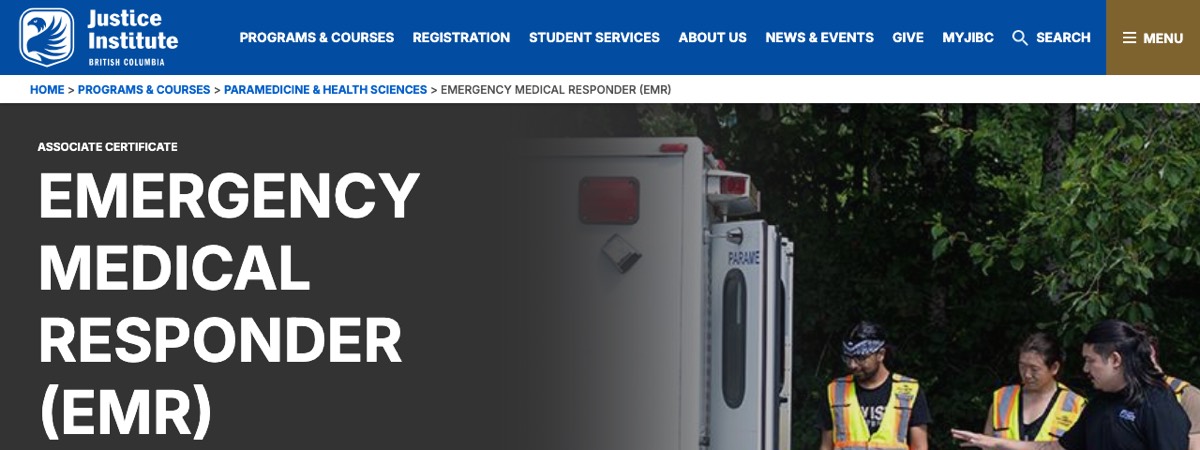
| Provider | Justice Institute of British Columbia (JIBC) |
|---|---|
| Length | 5 weeks (25 days) |
| Cost (CAD) | Domestic $3,065.04 |
| Credential | Associate Certificate in Emergency Medical Responder |
| Format | in person, BC |
Fiona's take: JIBC offers a 5-week in-person Associate Certificate in Emergency Medical Responder for a domestic cost of $3,065.04, and the program serves as a prerequisite course for future paramedics. That makes it the serious-money, serious-intent option on this list. Before you pay, confirm with EMALB how the certificate fits the BC licensing pathway.
Skip it if: Skip it if your province is Alberta, where ACoP-approved programs such as SAIT or NAIT are the ones that end in registration.
See Program DetailsEmergency Medical Responder
Emergency Medical Responder is a hybrid certificate program at Portage College in Alberta running August 30, 2027 to January 21, 2028.
| Provider | Portage College |
|---|---|
| Length | August 30, 2027 to January 21, 2028 |
| Credential | Emergency Medical Responder certificate |
| Format | hybrid, AB |
Fiona's take: A regional Alberta option for students who want a part-time hybrid schedule rather than an intensive 5 weeks. Confirm with Portage that the current offering appears on the Alberta College of Paramedics approved-programs list before you pay, since approval is what makes the COPR exam accessible.
Skip it if: Skip it if you need to start before 2027 or want a compressed full-time format.
See Program DetailsEmergency Medical Responder
Emergency Medical Responder at SAIT is an in-person or hybrid certificate program in Alberta costing $2,590.00-$2,790.00 for the one course.
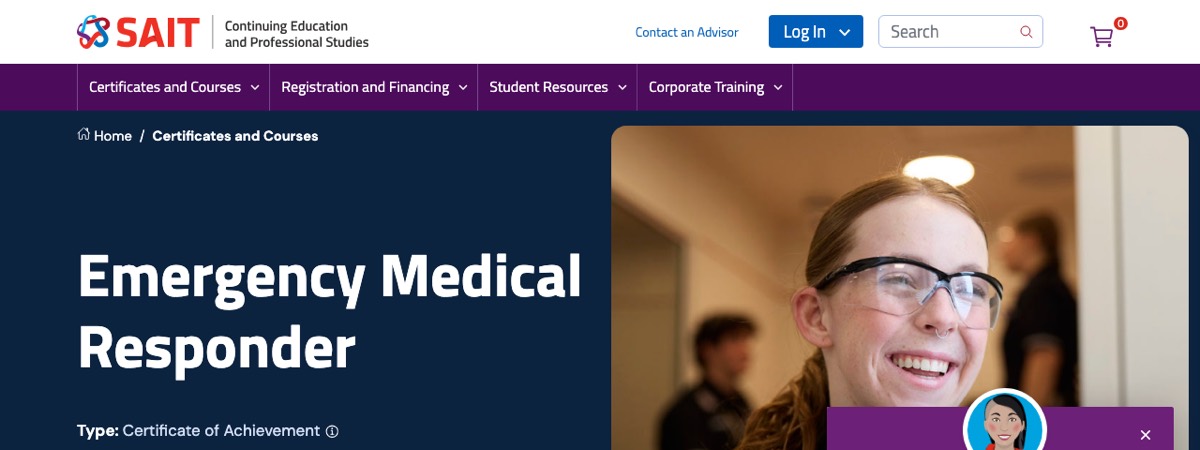
| Provider | SAIT |
|---|---|
| Cost (CAD) | $2590.00 - 2790.00 (one course) |
| Credential | Certificate of Achievement |
| Format | in person/hybrid, AB |
Fiona's take: SAIT is one of the named approved programs in Alberta, so this route ends where it should: with a Certificate of Achievement, eligibility for the COPR exam and a path to ACoP registration. For Albertans who have decided on the career, this is the one I recommend.
Skip it if: Skip it if you are in BC, where the EMALB route runs through providers such as St. John Ambulance or the JIBC.
See Program DetailsEMRE 200 Emergency Medical Responder - Core Medical
EMRE 200 Emergency Medical Responder - Core Medical is an in-person course at NAIT in Alberta.
| Provider | NAIT |
|---|---|
| Format | in person, AB |
Fiona's take: NAIT is one of the named approved Alberta EMR programs, alongside SAIT, so this route can end in the provincial certification process through ACoP. Check NAIT's current schedule, course requirements and fee directly before enrolling.
Skip it if: Skip it if you want a single integrated course rather than split core modules.
See Program DetailsEmergency Medical Responder Course
Emergency Medical Responder Course is an 80-120 hour in-person Canadian Red Cross course delivering a 3-year Emergency Medical Responder certification.
| Provider | Canadian Red Cross |
|---|---|
| Length | 80-120 hours (based on jurisdiction) |
| Credential | 3-year certification in Emergency Medical Responder |
| Format | in person, national (varies) |
Fiona's take: This is the same certificate taught across provinces with jurisdiction-based hour ranges, from 80 to 120 hours. It is recognised toward eligibility in some jurisdictions, including BC EMALB eligibility, but not for initial registration in Alberta, where the Alberta College of Paramedics does not approve Red Cross EMR programs. Pick this route only after you confirm your own province accepts it.
Skip it if: Skip it if your goal is Alberta registration, where you need an ACoP-approved program instead.
See Program DetailsEmergency Medical Responder Training (EMR)
Emergency Medical Responder Training (EMR) at St. John Ambulance is a 30-hour online plus 70-hour (10-day) in-class hybrid in BC leading to the SJA Emergency Medical Certificate, valid for 3 years.
| Provider | St. John Ambulance Canada |
|---|---|
| Length | 30 hours online + 70 hours (10 days) in-class |
| Credential | SJA Emergency Medical Certificate (valid for 3 years) |
| Format | hybrid, BC |
Fiona's take: Successful completion lets you apply to the Emergency Medical Assistants Licensing Board for your licence as an Emergency Medical Responder, which makes this the most direct BC route I know of. The split format also suits people who cannot disappear for five straight weeks.
Skip it if: Skip it if you are outside BC, since the EMALB pathway is provincial.
See Program DetailsEMR
EMR at the Canadian Fire Rescue College is an approximately 80-hour in-person course over 10 weekdays in Alberta delivering Canadian Red Cross Emergency Medical Responder and Basic Life Support certification.
| Provider | Canadian Fire Rescue College |
|---|---|
| Length | 10 weekdays (approx 80 hours) |
| Credential | Canadian Red Cross Emergency Medical Responder & Basic Life Support Certification |
| Format | in person, AB |
Fiona's take: A compressed weekday format that suits shift workers and people between jobs. The Red Cross certificate it issues is recognised toward eligibility in some jurisdictions, but remember it does not on its own qualify you for initial ACoP registration in Alberta.
Skip it if: Skip it if you intend to register in Alberta, where the ACoP-approved programs are the working route.
See Program DetailsEMR Course BC | Emergency Medical Responder
EMR Course BC | Emergency Medical Responder at Alert First Aid is a 120-hour (15-day in-class) in-person BC course rated 4.9 across 14,900+ Google reviews, delivering a Columbia Medical Training program with full EMALB Schedule 1 and 2 endorsements and BLS.
| Provider | Alert First Aid |
|---|---|
| Length | 120-hour (15 days in class) |
| Rating | 4.9 (14,900+ Google Reviews) |
| Credential | Columbia Medical Training program with full EMALB Schedule 1 and 2 endorsements, BLS |
| Format | in person, BC |
Fiona's take: This is the full 120-hour version, and it delivers a Columbia Medical Training program with full EMALB Schedule 1 and 2 endorsements and BLS. The 4.9 rating across 14,900+ Google reviews is the largest review base on this page. If you are set on BC practice, ask EMALB what the Schedule 1 and 2 endorsements cover before you rely on them.
Skip it if: Skip it if 15 consecutive days in class does not fit your schedule, in which case the St. John Ambulance hybrid splits the same goal.
See Program DetailsHow Much Do EMR Classes And Licensing Cost In Canada?
EMR training costs run from the price of a short online course to roughly $3,065 for a college program, and the exams add a few hundred dollars on top.
| Item | Cost (CAD) | Notes |
|---|---|---|
| Red Cross EMR course (typical) | ~$1,000+ | Course fees vary by provider |
| SAIT Emergency Medical Responder | $2,590.00-$2,790.00 | One course, Certificate of Achievement |
| JIBC Emergency Medical Responder (domestic) | $3,065.04 | 5 weeks (25 days), in person |
| EMALB licence exam (BC) | $450.00 | When both written and practical examinations are required |
| EMALB renewal | $50.00 | Renewal fees apply |
| COPR EMR exam | $550.00 per attempt | Plus applicable taxes |
| Alberta College of Paramedics registration | Pro-rated | Registration fees and dues are pro-rated |
Add the pieces before you commit. An Alberta candidate can face $2,590.00 to $2,790.00 at SAIT plus $550.00 plus applicable taxes per COPR exam attempt plus pro-rated ACoP dues. A BC candidate through St. John Ambulance pays the course fee plus $450.00 for the EMALB licence when both written and practical examinations are required, and $50.00 at renewal.
The figure that varies most is the course fee itself. The Canadian Red Cross, St. John Ambulance and the smaller providers each set their own pricing, so confirm the current figure with your provider before registering.
How Much Does An EMR Earn In Canada?
An EMR's pay is benchmarked in Job Bank under NOC 32102, Paramedical occupations, at a Canada-wide median of $38.00 per hour. That group includes paramedics and EMTs as well as EMRs working in paramedical roles, so read the figure as a benchmark for the occupation family rather than a guaranteed starting wage.
| NOC Code | Group | Canada Median ($/hour) |
|---|---|---|
| 32102 | Paramedical occupations (includes EMRs in paramedical roles) | 38.00 |
The classification needs explaining. NOC 32102, Paramedical occupations, covers workers who administer pre-hospital emergency medical care, and the classification explicitly excludes Emergency medical responder (non-paramedical), which sits in NOC 33102 with nurse aides, orderlies and patient service associates. Where a specific EMR job posts its wage depends on which side of that line the role falls, so compare live postings in your own province before you build a budget.
Job Bank lists the outlook as varying, so treat the median as a data point rather than a promise. In some provinces, such as BC, EMR can serve as a prerequisite or stepping stone to PCP training; the Justice Institute of British Columbia describes its EMR program as a prerequisite course for future paramedics. Elsewhere, PCP and ACP paramedicine requires its own training with or without an EMR credential.
Is An EMR Class Worth It In 2026?
For the right person, yes. An 80-120 hour Red Cross course or a 5-week JIBC program is a short, defined commitment compared with additional PCP/ACP paramedicine training, and Job Bank's Canada-wide median of $38.00 per hour for the NOC 32102 paramedical group gives a measurable benchmark to weigh against a roughly $1,000-plus course fee and exam costs.
The honest qualification is that the certificate alone is not the job. In regulated provinces you also pass exams ($450 EMALB in BC, $550 plus taxes per COPR attempt in Alberta), and in Alberta the Red Cross route specifically does not qualify you for initial registration, so the choice of provider decides whether your money ends in a licence.
That is why I like the Coursera-first approach. Two months with the University of Colorado's EMT specialization, whose price is not listed here, tells you whether the material suits you before you commit to an approved program. If it does, you upgrade into the approved program in your province with confidence rather than hope. If it does not, you have learned that without paying for a Canadian EMR seat.
EMR Classes: Questions Canadians Ask
How Long Is The EMR Course In Canada?
The Canadian Red Cross EMR course runs 80-120 hours depending on jurisdiction, typically delivered over 8-12 days. College versions run longer: the JIBC program spans 5 weeks (25 days), and Alert First Aid in BC delivers a 120-hour format over 15 in-class days.
Do I Need To Be Licensed To Work As An EMR In BC?
Yes. You complete an approved EMR course, then pass the EMALB exams and apply for your licence within 1 year of course completion. St. John Ambulance's BC course (30 hours online plus 70 hours in class) is built for exactly this pathway. The licence fee is $450.00 when both written and practical examinations are required.
Can A Red Cross EMR Course Lead To Alberta Registration?
No. Canadian Red Cross EMR programs are not approved by the Alberta College of Paramedics and do not on their own qualify you for initial registration in Alberta. Albertans need an approved program, such as SAIT's Emergency Medical Responder certificate ($2,590.00-$2,790.00), then the provincial certification process through ACoP.
What Exams Are Needed For A BC EMR Licence?
BC licensing through the Emergency Medical Assistants Licensing Board requires a jurisprudence exam, a written knowledge exam, and practical scenarios covering medical and trauma cases. Budget $450.00 for the licence fee when both written and practical examinations are required, and $50.00 at renewal.
What Is The Median Wage For EMRs In Canada?
EMRs working in paramedical roles fall under NOC 32102, Paramedical occupations, where Job Bank's Canada-wide median is $38.00 per hour. That group also includes paramedics and EMTs, so an individual EMR's pay can sit below the group median. The classification files non-paramedical EMRs under NOC 33102 with nurse aides, orderlies and patient service associates, which is why job postings vary.
Is EMR Regulated The Same Across Canada?
No. Alberta, Saskatchewan, Manitoba, New Brunswick, Nova Scotia and Prince Edward Island use self-regulation through colleges of paramedics, while British Columbia, Ontario, Quebec and Newfoundland and Labrador are government regulated. British Columbia issues EMR licences through the Emergency Medical Assistants Licensing Board; Ontario and Quebec do not list EMR-specific registration. EMRs in the territories are not yet regulated.
How Often Does EMR Certification Need Renewal?
The Canadian Red Cross EMR certificate is valid for 3 years, and the St. John Ambulance Emergency Medical Certificate also lasts 3 years. Provincial licences carry their own renewal and continuing competence requirements; the EMALB renewal fee is $50.00, and Alberta College of Paramedics dues are pro-rated.
Is EMR Certification Required To Work As A Paramedic?
EMR certification is the entry-level prehospital credential. Paramedics at the PCP and ACP levels require additional training of their own, and EMR is not a required stepping stone everywhere: in some provinces, such as BC, EMR can serve as a prerequisite or stepping stone to PCP training. The Justice Institute of British Columbia lists its EMR program as a prerequisite course for future paramedics.
What's The Bottom Line On EMR Classes In Canada?
- An EMR credential in Canada is a two-stage purchase: an 80-120 hour course (Red Cross, roughly $1,000+, or SAIT at $2,590.00-$2,790.00) plus a provincial exam ($450.00 EMALB in BC, $550.00 plus taxes per COPR attempt in Alberta).
- The Red Cross certificate is recognised toward BC EMALB eligibility but is not approved by the Alberta College of Paramedics, so your province decides which class is worth your money.
- Job Bank lists the NOC 32102 paramedical group at a Canada-wide median of $38.00 per hour; the group covers EMRs working in paramedical roles, while non-paramedical EMRs sit in NOC 33102.
- Become an EMT is the try-first move: 2 months at 10 hours a week with the University of Colorado System, and it does not qualify you for any Canadian licence or registration.
- My verdict: take Coursera to test the field, then register through an approved provider in the province where you actually intend to work.






