Key Takeaways
- The fastest realistic route to the CFE credential is 6 to 24 months: join the ACFE as an Associate Member, hit the 40-point minimum to sit the exam, pay the $480 USD application fee, pass all three sections at 75%, and show two years of fraud-related experience for certification.
- The CFE is a voluntary credential from the Association of Certified Fraud Examiners, not statutorily required; if your role involves regulated private investigation work, check your provincial rules.
- The try-first option is Forensic Accounting and Fraud Examination from West Virginia University on Coursera, 7 hours, rated 4.7. The pack does not list its price. It does not grant the ACFE CFE credential; it tests your interest before you pay the $480 USD exam fee.
- Pay under NOC 11109 runs $24.04 at the low end, $38.46 at the median and $66.67 at the high end per hour across Canada, with provincial medians of $36.92 in Ontario, $41.03 in Alberta and $41.00 in British Columbia.
- Fiona's verdict: the CFE suits accountants, auditors, analysts and investigators who already work adjacent to fraud files and want a recognised signal to move into forensic roles; it is a poor spend if you have never studied fraud and do not know the field.
A Certified Fraud Examiner (CFE) is a professional credential from the Association of Certified Fraud Examiners (ACFE), earned by members who meet eligibility points, show two years of fraud-related work experience, pass the three-section CFE Exam, and agree to the ACFE Code of Professional Ethics.
The exam costs $480 USD and the whole credential typically takes 6 to 24 months depending on your prior experience and study time. Before you commit to the $480 USD exam fee, I recommend a short Coursera course to confirm the field fits you.

What Are The Ways To Earn The CFE Credential In Canada?
There is one CFE certification route, through the ACFE. The courses and programs listed below are optional preparation or related education, not routes that earn the credential by themselves.
| Route | Time | Cost (CAD) | What You Get | Recognised By | Best For |
|---|---|---|---|---|---|
| Forensic Accounting and Fraud Examination plus self-study | 7 hours for the course, then 6 to 24 months | Exam fee $480 USD (course price not listed) | A shareable Coursera certificate; the CFE credential is separate and requires ACFE membership, eligibility points, two years of fraud-related experience, a passing exam and the ethics code | ACFE (for the CFE) | Anyone testing the field before committing to the $480 USD exam fee |
| ACFE direct path: membership, application, self-study exam prep | 6 to 24 months | Exam fee $480 USD plus membership dues (dues vary) | Certified Fraud Examiner (CFE) credential | ACFE | Working professionals with a degree and fraud-adjacent experience |
| Fraud Examination & Forensic Accounting at Seneca Polytechnic | 2 semesters (8 months) | Not listed | Ontario College Graduate Certificate | Ontario college system | Career changers wanting a classroom credential in Ontario |
| DESS sur la prévention et la détection de la fraude comptable at ESG UQAM | 24 credits (8 courses) | Not listed | Diplôme d'études supérieures spécialisées | Quebec university system | French-speaking professionals in Quebec |
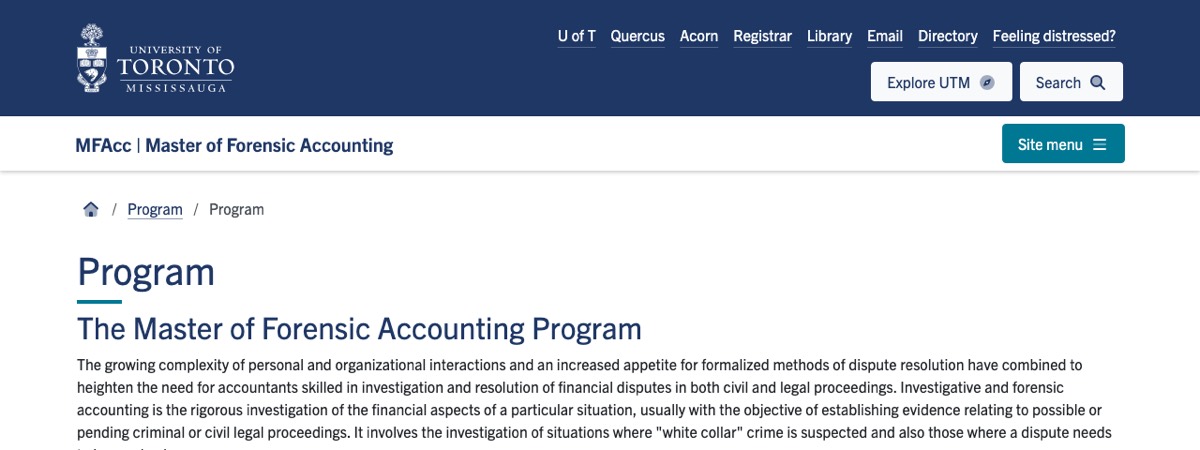
| Master of Forensic Accounting (MFAcc) at the University of Toronto | 10 courses, part-time over two years | Not listed | Master of Forensic Accounting | University of Toronto | Senior professionals targeting forensic leadership roles |
I recommend the Coursera taster for anyone unsure about the field, the ACFE direct path for accountants and auditors who already have the experience points, and Seneca or UQAM for career changers who want structured classroom learning.
What Is The Fastest Way To Become A CFE In Canada?
The fastest way to become a CFE is the ACFE direct path, which typically runs 6 to 24 months and depends mostly on how quickly you prepare for the exam.
- Join the ACFE as an Associate Member. Approval is immediate upon application review, and you must remain a member in good standing throughout; dues vary by country and category, so use the ACFE dues calculator.
- Meet the eligibility points. You need a minimum of 40 points to sit the exam and 50 points plus two years of fraud-related professional experience for certification. A bachelor's degree typically provides 40 points, and two years of fraud-related experience can substitute for each year of academic study.
- Apply for the CFE Exam. The application fee is $480 USD and covers your first attempt at all three sections. ACFE reviews applications in 3 to 5 business days.
- Prepare and pass the three-section exam. Each section requires 75% correct answers. Your application stays valid for two years, extendable once for one additional year for $150 USD, and passing results stay valid for five years.
- Receive certification. Once you pass and the Certification Committee completes its review, you hold the CFE credential at no additional fee.
Do You Need A Licence To Work As A Fraud Examiner In Canada?
The CFE itself is a voluntary professional certification from the Association of Certified Fraud Examiners and is not statutorily required. If your role involves regulated private investigation work, check your provincial rules before you rely on the credential alone.
The credential still carries weight. The CFE is a globally recognized voluntary certification widely held by forensic accountants and fraud investigators in Canada, though it is not statutorily required. Employers in forensic practices often list it in postings because it signals training in fraud schemes, investigation method and legal issues.
Two ACFE requirements function like a licence's gatekeeping. You must be an Associate Member in good standing to take the exam and to earn and maintain the credential, and once certified you must complete at least 20 hours of Continuing Professional Education every 12 months, including 10 fraud-related hours and 2 ethics hours.
No specific degree is required. A bachelor's typically earns 40 points toward the 40-point minimum to sit the exam, and the 50-point minimum plus two years of fraud-related experience applies for full certification. Experience can substitute for education: two years of fraud-related professional experience counts in place of each year of academic study.
Which CFE Exam Prep Courses And Programs Are Worth Taking?
Prep is optional for the CFE Exam, and the ACFE sells its own courses from $899.20 USD at member price, but a range of other courses and Canadian programs can either introduce the field or build depth.
Forensic Accounting and Fraud Examination
Forensic Accounting and Fraud Examination is a 7-hour online course from West Virginia University on Coursera that ends in a shareable certificate and carries a 4.7 rating across 6,354 reviews.
| Provider | West Virginia University |
|---|---|
| Length | 7 hours to complete |
| Rating | 4.7 (6,354 reviews) |
| Credential | Shareable certificate |
| Format | online |
Fiona's take: This is where I tell clients to start. Seven hours tells you whether fraud examination actually holds your interest before you pay a $480 USD exam fee, and the 4.7 rating across thousands of reviews suggests the material lands. The pack lists it as a shareable certificate, not as the ACFE CFE credential.
Skip it if: Skip it if you already work in forensic accounting and only need exam-specific drilling.
Start On CourseraForensic Accounting: Detect, Investigate & Prevent Fraud
Forensic Accounting: Detect, Investigate & Prevent Fraud is an 8-hour online course from EDUCBA on Coursera that ends in a shareable certificate.
| Provider | EDUCBA |
|---|---|
| Length | 8 hours to complete |
| Credential | Shareable certificate |
| Format | online |
Fiona's take: The extra hour over the WVU course buys a detection-and-prevention angle rather than a strictly academic one. I see it as a second taster or an alternative if the WVU course's schedule does not suit. The pack lists it as a shareable certificate, not as the ACFE CFE credential.
Skip it if: Skip it if you have already completed a forensic accounting introduction; the overlap is high.
Start On CourseraCorporate Fraud: Detect, Prevent & Implement Controls
Corporate Fraud: Detect, Prevent & Implement Controls is a 5-hour online course from EDUCBA on Coursera, delivered in 2 modules, that ends in a shareable certificate.
| Provider | EDUCBA |
|---|---|
| Length | 5 hours to complete (2 modules) |
| Credential | Shareable certificate |
| Format | online |
Fiona's take: Five hours on controls makes this the narrowest of the three Coursera options, and the controls angle is genuinely what day-to-day fraud work involves for internal auditors. Pair it with a broader taster if you want full coverage.
Skip it if: Skip it if you want an end-to-end view of fraud examination rather than a controls-focused slice.
Start On CourseraCertified Fraud Examiner: complete course for beginners
Certified Fraud Examiner: complete course for beginners is a 1.5-hour on-demand video course from Usama Musa Khan on Udemy that ends in a certificate of completion and carries a 4.8 rating across 272 ratings.
| Provider | Usama Musa Khan |
|---|---|
| Length | 1.5 hours on-demand video |
| Rating | 4.8 (272 ratings) |
| Credential | Certificate of completion |
| Format | online |
Fiona's take: The beginner framing and 4.8 rating are appealing, but 1.5 hours is an orientation, not exam prep. I treat it as a low-commitment way to map the credential's terrain. The pack lists it as a certificate of completion, not as the ACFE CFE credential.
Skip it if: Skip it if you need section-by-section drilling for the actual exam; the length will not carry you there.
View On Udemy2026 Certified Fraud Examiner (CFE) Test Bank
2026 Certified Fraud Examiner (CFE) Test Bank is an online question-bank course from CFE & Audit Academy on Udemy, rated 3.9 across 18 ratings.
| Provider | CFE & Audit Academy |
|---|---|
| Rating | 3.9 (18 ratings) |
| Format | online |
Fiona's take: A question bank can help you drill toward the 75% per section the exam requires. The 3.9 rating across only 18 ratings gives me pause on quality, so weigh it against the ACFE's own prep materials.
Skip it if: Skip it if you are months away from booking the exam; a question bank this early wastes its value.
View On UdemyFraud Examination & Forensic Accounting
Fraud Examination & Forensic Accounting is a 2-semester (8-month) program at Seneca Polytechnic leading to an Ontario College Graduate Certificate.
| Provider | Seneca Polytechnic |
|---|---|
| Length | 2 Semesters (8 Months) |
| Credential | Ontario College Graduate Certificate |
| Format | Flexible, Ontario |
Fiona's take: Eight months of classroom study in fraud examination and forensic accounting gives career changers structured depth that no short online course matches on length alone. Seneca lists no tuition figure on the page I reviewed, so budget directly with the polytechnic.
Skip it if: Skip it if you already hold an accounting designation and only need the CFE itself; the classroom time is redundant.
See Program DetailsDESS sur la prévention et la détection de la fraude comptable
DESS sur la prévention et la détection de la fraude comptable is a 24-credit (8-course) graduate diploma from ESG UQAM, delivered comodal, simultaneously online and in person.
| Provider | ESG UQAM |
|---|---|
| Length | 24 crédits (8 cours) |
| Credential | Diplôme d'études supérieures spécialisées |
| Format | comodal (simultanément à distance et en présentiel), Quebec |
Fiona's take: It is a 24-credit, 8-course French-language Quebec program delivered comodally and offered in partnership with ACFE and AICPA, which makes it a distinctive academic option for French-speaking professionals in the province.
Skip it if: Skip it if you study in English or want the credential alone without a graduate diploma.
See Program DetailsMaster of Forensic Accounting (MFAcc)
Master of Forensic Accounting (MFAcc) is a 10-course, part-time degree from the University of Toronto delivered by distance learning over two years.
| Provider | University of Toronto |
|---|---|
| Length | 10 courses, part-time over two years |
| Credential | Master of Forensic Accounting |
| Format | distance learning, problem-based learning, Ontario |
Fiona's take: Two years part-time is a serious commitment. The program develops skills for investigating fraud, white-collar crime, money laundering and disputes, and its format is distance learning with problem-based learning spread over two years part-time.
Skip it if: Skip it if your goal is the CFE credential and a move into fraud files; a degree this long is not the shortest route.
See Program DetailsCertificate in Introduction to Forensic Accounting and Fraud
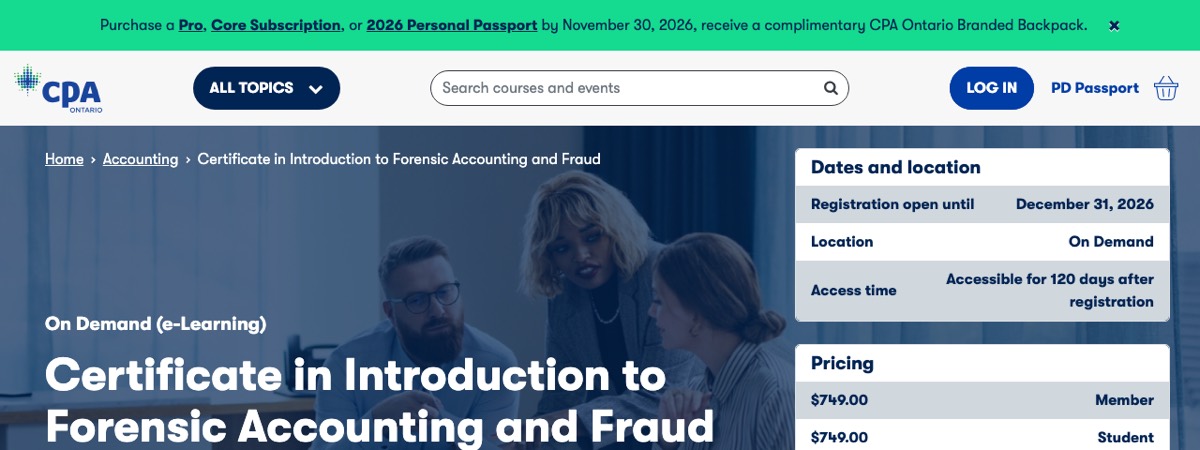
Certificate in Introduction to Forensic Accounting and Fraud is a 9-hour on-demand e-learning certificate from CPA Ontario, priced at $749.00 for members.
| Provider | CPA Ontario |
|---|---|
| Length | 9 hours |
| Cost (CAD) | $749.00 (Member) |
| Credential | Certificate |
| Format | On Demand (e-Learning), Ontario |
Fiona's take: For Ontario chartered professional accountants this is an introduction built by the provincial accounting body and delivered on demand. The $749.00 member price positions it well above the Coursera tasters in listed cost, so I would choose it when the CPA Ontario name matters to your employer.
Skip it if: Skip it if you are not a CPA Ontario member or student; other introductions cover similar ground.
See Program DetailsACFE-GTA Chapter 2025 CPE Training Program
ACFE-GTA Chapter 2025 CPE Training Program is a series of virtual Zoom sessions from the ACFE Greater Toronto Area Chapter, worth between 2.0 and 7.0 CPE credits per session.
| Provider | ACFE-GTA Chapter |
|---|---|
| Length | various sessions (e.g., 2.0 to 7.0 CPE credits) |
| Credential | CPE credits for CFE maintenance |
| Format | Virtual by Zoom, Ontario |
Fiona's take: This one is for after you certify. CFEs must earn at least 20 CPE hours every 12 months, including 10 fraud-related and 2 ethics hours, and the GTA chapter's Zoom sessions are a convenient local way to log them from anywhere in Canada.
Skip it if: Skip it before certification; CPE credits do not advance you toward the exam.
See Program DetailsHow Much Does The CFE Exam And Certification Cost In Canada?
The CFE Exam application fee is $480 USD, which covers your first attempt at each of the three sections. The exam, retake, extension and listed ACFE prep prices are in USD.
| Item | Amount | Notes |
|---|---|---|
| CFE Exam application | $480 USD | Covers the first attempt at each of the three sections |
| Section retake | $110 USD | Charged per failed section |
| ACFE Associate Membership | Varies | Dues vary by country and category; use the ACFE dues calculator |
| Application extension | $150 USD | Extends a two-year application validity by one additional year, once |
| ACFE prep course (optional) | From $899.20 USD | Member price for ACFE's own courses |
| CPA Ontario introductory certificate | $749.00 | Member price for a 9-hour on-demand certificate |
| Annual CPE for renewal | 20 hours per year | 10 fraud-related and 2 ethics hours among them |
Budget for the retake line even if you never use it. The exam requires 75% correct answers in each of its three sections, and a single failed section costs $110 USD to resit. Candidates who prepare with the ACFE's own courses face a bigger number: prep from $899.20 USD at member price, which exceeds the exam fee itself.
Renewal requires continued membership and at least 20 CPE hours annually; the pack does not give a total renewal cost. The 20 hours must include 10 fraud-related hours and 2 ethics hours. The GTA chapter's Zoom sessions, worth 2.0 to 7.0 CPE credits each, are one way to log those hours.
How Much Does A Fraud Examiner Earn In Canada?
Fraud examiners in Canada earn a median of $38.46 per hour under NOC 11109, with a low of $24.04 and a high of $66.67 per hour across the country.
| Region | Median Hourly | Low | High | NOC |
|---|---|---|---|---|
| Canada | $38.46 | $24.04 | $66.67 | 11109 |
| Ontario | $36.92 | Not listed | Not listed | 11109 |
| Alberta | $41.03 | Not listed | Not listed | 11109 |
| British Columbia | $41.00 | Not listed | Not listed | 11109 |
The provincial spread is modest but real. Ontario's median of $36.92 sits slightly below the national figure, while Alberta at $41.03 and British Columbia at $41.00 sit above it.
The $66.67 figure is the high end for NOC 11109 in Canada, and the pack does not present it as a CFE-specific outcome. The same applies to the median: these are wage figures for the occupation group, not a guarantee attached to the credential. I tell clients to treat the CFE as a signal layered on existing accounting or audit skills, not a promise of any particular wage.
Is The CFE Credential Worth It In 2026?
The credential is worth it for a specific reader: someone already working in accounting, audit, compliance or investigations who wants to move into fraud-focused files. The exam's three sections, Fraud Schemes and Financial Crimes, Fraud Investigations and Legal Issues, and Fraud Prevention and Deterrence, map directly onto the work forensic teams hire for, and the CFE is described as a globally recognized voluntary certification widely held by forensic accountants and fraud investigators in Canada.
The economics are reasonable if you pass on the first attempt. A $480 USD exam fee plus membership dues is a modest outlay against a $38.46 median hourly wage under NOC 11109, and the application stays valid for two years with results valid for five, so the timeline bends around your life. Where the math weakens is the prep stack: ACFE courses from $899.20 USD, a $110 USD retake per failed section, and 20 CPE hours every year for renewal.
The credential is not worth it for someone using it to enter accounting from outside. No specific degree is required, but certification demands 50 points plus two years of fraud-related professional experience, so a career changer cannot buy their way in with the exam alone. For that reader, Seneca Polytechnic's 8-month graduate certificate or ESG UQAM's DESS builds the specialty skills first, and the Coursera taster can help you decide while you compare prices.
CFE Exam Questions Canadians Ask
What Is The CFE Exam Format And Passing Score?
The CFE Exam format splits into three sections: Fraud Schemes and Financial Crimes with 120 questions in 2.5 hours, Fraud Investigations and Legal Issues with 120 questions in 2.5 hours, and Fraud Prevention and Deterrence with 70 questions in 1.5 hours. The passing score is 75% correct answers in each section, and a failed section can be retaken for $110 USD.
How Much Does The CFE Exam Cost?
The CFE Exam costs $480 USD to apply, and that single application fee covers your first attempt at each of the three sections. If you fail a section, each retake costs $110 USD. Add ACFE Associate Membership dues, which vary by country and category, plus optional prep such as ACFE courses from $899.20 USD at member price.
Is A Bachelor's Degree Required For The CFE?
A bachelor's degree is not required for the CFE. The ACFE uses a points system: a bachelor's typically earns 40 points, which clears the 40-point minimum to sit the exam. Full certification needs 50 points plus two years of fraud-related professional experience, and two years of that experience can substitute for each year of academic study.
How Long Is The CFE Exam Application Valid?
The CFE Exam application is valid for two years from the date ACFE receives it. If you need more time, you can extend it once for one additional year at a cost of $150 USD. Once you pass, the exam results themselves stay valid for five years, which matters if you are still accumulating the two years of fraud-related experience certification requires.
Do I Need ACFE Membership To Become A CFE?
ACFE membership is required to become a CFE. You must be an Associate Member in good standing to take the exam, and you must maintain that standing to earn and keep the credential. Dues vary by country and category, so the ACFE's dues calculator is the source of the current figure. Membership also continues after certification alongside your annual CPE.
What Continuing Education Is Required For CFE Renewal?
Continuing education for CFE renewal is at least 20 hours of CPE every 12-month period, and the composition is fixed: 10 of those hours must be fraud-related and 2 must cover ethics. Canadian members can log hours through options such as the ACFE-GTA Chapter's virtual Zoom training sessions, which carry between 2.0 and 7.0 CPE credits each.
Is The CFE Recognized In Canada?
The CFE is recognized in Canada as a globally recognized voluntary professional certification, widely held by forensic accountants and fraud investigators. It is not statutorily required. If your role involves regulated private investigation work, check your provincial rules. Employers in forensic and investigative practices treat it as a meaningful signal of specialised training.
Can Experience Substitute For Education In CFE Eligibility?
Experience can substitute for education in CFE eligibility. The ACFE allows two years of fraud-related professional experience to replace each year of academic study when tallying your points. That means a candidate without a degree can still reach the 40-point exam minimum and the 50-point certification minimum through documented fraud-related work, though the burden of proof sits with the applicant.
What's The Bottom Line On The CFE Exam In Canada?
- The CFE Exam costs $480 USD, covers three sections at a 75% passing score, and the route typically takes 6 to 24 months depending on prior experience and study time; certification also requires two years of fraud-related professional experience.
- The CFE is a voluntary credential from the ACFE, not statutorily required; check provincial rules if your work falls under regulated private investigation.
- Pay under NOC 11109 runs from $24.04 to $66.67 per hour with a $38.46 national median, and the credential works best as a multiplier on an existing accounting or audit skill set.
- Start with Forensic Accounting and Fraud Examination: 7 hours from West Virginia University to test the field before the $480 USD fee, with the CFE credential itself earned only through the ACFE.
- Renewal never stops: budget for continuing ACFE membership and at least 20 CPE hours a year, including 10 fraud-related hours and 2 ethics hours.






