Key Takeaways
- A short online option is George Brown College's 32-week online Electronics Technician Certificate at $1,760 domestic; the standard route to technologist jobs is a 2 to 3 year TAC-accredited diploma at $16,000 to $18,000 domestic total.
- In Ontario, Alberta and British Columbia, no licence is required for most technician and technologist roles; professional engineering practice requires a P.Eng. from Professional Engineers Ontario (PEO), APEGA in Alberta or EGBC in British Columbia.
- FPGA Design for Embedded Systems Specialization runs 2 months at 10 hours a week as the try-first option; it grants a Coursera Specialization Certificate, not a licence or the P.Eng.
- Job Bank's median for computer engineers under NOC 21311 is $52.50 an hour Canada-wide, from $45.68 in Alberta to $54.95 in Quebec, in the November 19, 2025 update.
- Fiona's verdict: start with the Coursera specialization if you are unsure, take George Brown's certificate if you need a credential fast, and choose the Camosun or Okanagan diploma for the technologist job market.
Electronics and Computer Engineering is the design, development, testing and integration of computer hardware, embedded systems, communications, microelectronics and related electronic systems, with applications from renewable energy to the Internet of Things. A short online option is George Brown College's 32-week online Electronics Technician Certificate at $1,760 domestic; technician and technologist roles are normally reached through a 2 to 3 year diploma.
A licence is not part of most technician or technologist jobs; the P.Eng. belongs to professional engineering practice and regulators like Professional Engineers Ontario. Below I compare routes, costs and wage figures so you can pick the shortest path to the job you want.
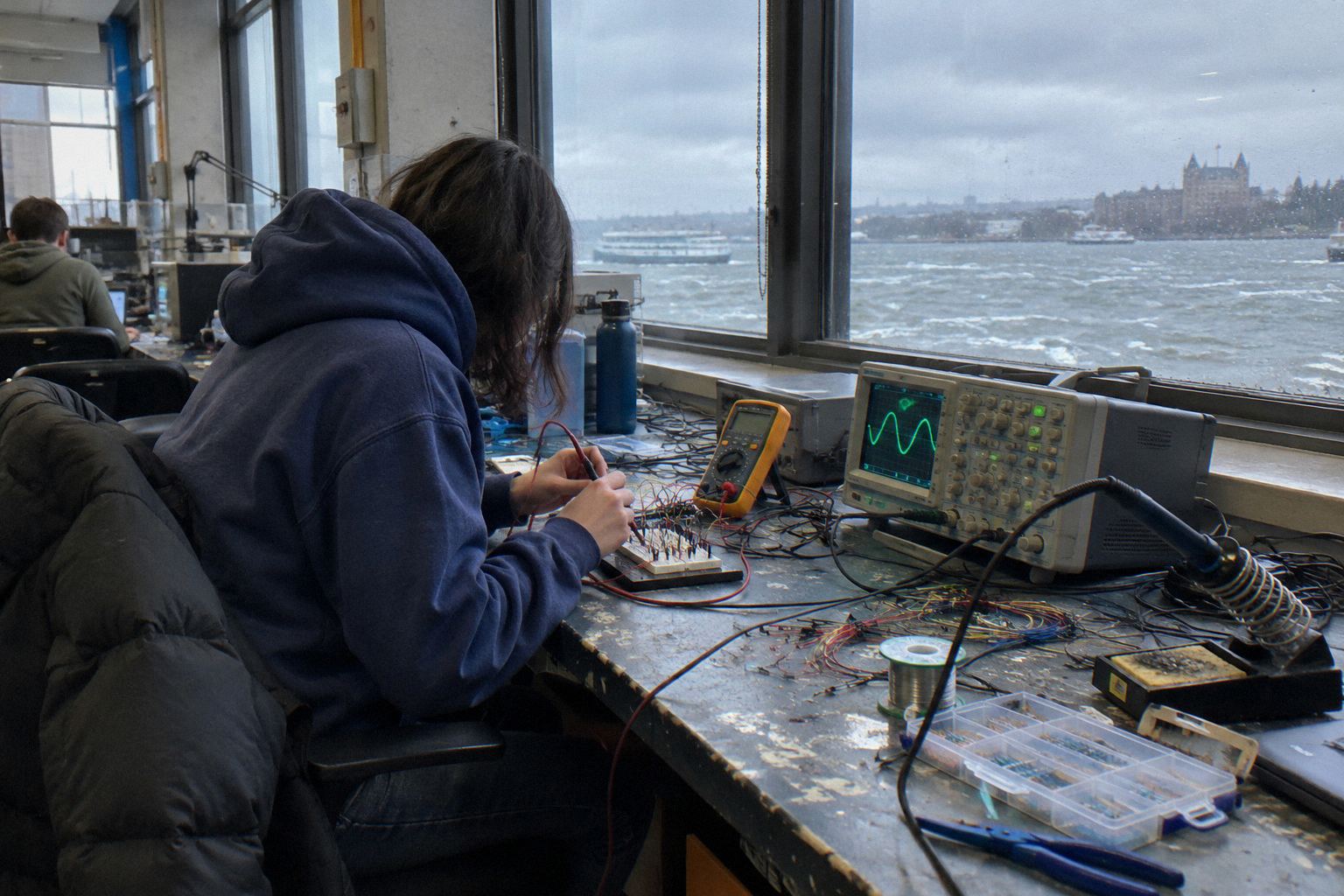
What Are The Ways To Study Electronics And Computer Engineering In Canada?
Common routes in this guide for studying electronics and computer engineering in Canada include a Coursera tester, a 32-week online certificate, a 1-year fast-track diploma, a 2 to 3 year college diploma and a 4-year bachelor's degree. The first row is the try-before-you-buy option; the rest are credentials.
| Route | Time | Cost (CAD) | What You Get | Recognised By | Best For |
|---|---|---|---|---|---|
| FPGA Design for Embedded Systems Specialization | 2 months at 10 hours a week | Not listed | Specialization Certificate | University of Colorado Boulder via Coursera | Testing embedded systems before committing |
| Online/Distance Electronics Technician Certificate (George Brown College) | 32 weeks | $1,760 domestic | Certificate | George Brown College | Fast credential for working adults |
| College Diploma (Electronics & Computer Engineering Technology) | 2 to 3 years | $16,000 to $18,000 domestic total | Diploma or Advanced Diploma | Technology Accreditation Canada (TAC) | Technologist and technician jobs |
| Fast-Track Diploma (Centennial College) | 1 year (2 semesters) | $18,254 international, first year | Ontario College Diploma | Centennial College / TAC | Qualified college or university graduates |
| University Bachelor's Degree (Computer Engineering) | 4 years | $20,000+ per year domestic | Bachelor's Degree | Engineers Canada / provincial regulators for the P.Eng. path | P.Eng. licensure and advanced engineering roles |
I recommend the Coursera row for anyone unsure about the field, George Brown's certificate for people who need a credential this year, and the TAC-accredited diploma for the actual job market; reserve the bachelor's for the P.Eng. track.
What Is The Fastest Way To Study Electronics And Computer Engineering In Canada?
The fastest way to study electronics and computer engineering in Canada varies by starting point; a short online option is George Brown College's 32-week online Electronics Technician Certificate at $1,760 domestic, and the fastest way to the full technologist diploma is Camosun College's guaranteed-seat ladder.
- Test the field with FPGA Design for Embedded Systems Specialization from the University of Colorado Boulder, 2 months at 10 hours a week, before you commit to full college tuition.
- Start the credential ladder with Camosun College's 8-month Electronics & Computer Engineering Access Certificate, $4,240 domestic.
- Move into Camosun's 2.5-year Electronics & Computer Engineering Technology Diploma for $16,524 domestic; finishing the access certificate guarantees a seat in the next intake.
- Skip ahead if you already hold a college or university credential: Centennial's Electronics Engineering Technician Fast-Track grants the Ontario College Diploma in 1 year (2 semesters).
- Optional: convert the diploma into a degree through Camosun's Electronics and Computer Engineering Bridge, with UVic and Lakehead as named destinations; time and cost are additional.
Is Electronics And Computer Engineering A Regulated Profession In Canada?
Electronics and computer engineering is not a regulated profession for most technician and technologist roles in Ontario, Alberta or British Columbia; regulation applies to professional engineering practice, where a P.Eng. licence is required.
| Province | Regulator | Licence Required? | What The Competency Rules Say |
|---|---|---|---|
| Ontario | Professional Engineers Ontario (PEO) | No for most technician roles; yes for professional engineering practice | No fixed period of Canadian work is required for a new first-time P.Eng. application; Canadian knowledge is assessed through competencies |
| Alberta | APEGA | No for most technician roles; yes for professional engineering practice | Since July 18, 2026, eight of APEGA's 22 engineering competencies are mandatory Canadian work environment competencies |
| British Columbia | EGBC | No for most technician roles; yes for professional engineering practice | From July 1, 2025, BC law bans Canadian-work-experience requirements for licensing |
The credential decides this question. A 4-year computer engineering bachelor's is what the P.Eng. path recognises, through Engineers Canada and the provincial regulators, and degrees are required for P.Eng. licensure and the more advanced engineering positions. A TAC-accredited diploma points at technologist work instead, where each regulator above lists most technician roles as unlicensed.
The bridge keeps both doors open. Camosun's Electronics and Computer Engineering Bridge lets diploma graduates move into engineering degrees at UVic or Lakehead, so a technologist who later decides the P.Eng. matters still has a route forward. Time and cost for that bridge are additional, and Camosun lists them as variable.
Which Electronics And Computer Engineering Courses Are Worth Taking?
The electronics and computer engineering courses worth taking depend on the goal: a fast test of interest, a skills boost for interviews, or a credential employers and colleges recognise. I list every option I compare with clients, Coursera first, then Udemy, then the college and provider programs in BC, Alberta and Ontario.
FPGA Design for Embedded Systems Specialization
FPGA Design for Embedded Systems Specialization is a 2-month online specialization from the University of Colorado Boulder, at 10 hours a week, that teaches FPGA design for embedded systems.
| Provider | University of Colorado Boulder |
|---|---|
| Length | 2 months at 10 hours a week |
| Rating | from 1,755 reviews |
| Credential | Specialization Certificate |
| Format | online |
Fiona's take: This is my try-first pick. Two months tells you whether hardware-level work holds your interest before you spend $16,524 on a Camosun diploma or 4 years on a degree. It carries 1,755 reviews and ends in a Specialization Certificate, which belongs in a portfolio, not on a licence application.
Skip it if: Skip it if you need a licence or a Canadian college credential for your next step; this is a Coursera Specialization Certificate.
Start On CourseraPower Electronics Graduate Certificate
Power Electronics Graduate Certificate is a 9-month online graduate certificate from the University of Colorado Boulder, listed at USD $6,003 total, that covers power electronics.
| Provider | University of Colorado Boulder |
|---|---|
| Length | 9 months |
| Cost (CAD) | not shown (USD $6003 total) |
| Credential | Graduate Certificate |
| Format | online |
Fiona's take: Power electronics is the renewable-energy side of this field, the same territory Camosun names in its renewable-energy diploma. Admission requirements are not listed, so I tell clients to confirm them with the provider before treating this as an entry point.
Skip it if: Skip it if you are still testing the field; the $1,760 George Brown certificate is the saner first step.
Start On CourseraIndustrial Internet of Things Graduate Certificate
Industrial Internet of Things Graduate Certificate is a 6 to 12 month online graduate certificate from the University of Colorado Boulder, listed at USD $6,003 total.
| Provider | University of Colorado Boulder |
|---|---|
| Length | 6-12 months |
| Cost (CAD) | not shown (USD $6,003 total) |
| Credential | Graduate Certificate |
| Format | online |
Fiona's take: IIoT is where microelectronics, communications and industrial systems meet, and Canadian programs advertise IoT applications directly. At USD $6,003 total this is a specialist upgrade for working technologists or engineers, not a first credential. Pair it with the FPGA specialization only if your target roles actually list IIoT.
Skip it if: Skip it if you are still testing the field; the breadth will not mean much before the fundamentals.
Start On CourseraMastering Microcontroller and Embedded Driver Development
Mastering Microcontroller and Embedded Driver Development is a 28.5-hour online course from FastBit Embedded Brain Academy, rated 4.6 out of 5 from 13,627 reviews, that builds microcontroller and driver development skills.
| Provider | FastBit Embedded Brain Academy |
|---|---|
| Length | 28.5 total hours |
| Cost (CAD) | not shown (often ~$110 USD) |
| Rating | 4.6 out of 5 (13627 reviews) |
| Credential | Course Certificate |
| Format | online |
Fiona's take: That rating across 13,627 reviews is about as strong a signal as course reviews give. The course covers microcontroller and embedded driver development across 28.5 total hours, the core of the embedded-systems side of this field.
Skip it if: Skip it if you want academic credit; a Udemy Course Certificate does not transfer to any college program.
View On UdemyCrash Course Electronics and PCB Design
Crash Course Electronics and PCB Design is a 112-hour online course from Andre LaMothe, rated 4.7 out of 5 from 19,726 ratings, that runs from electronics fundamentals through PCB design.
| Provider | Andre LaMothe |
|---|---|
| Length | 112 total hours |
| Cost (CAD) | not shown (often ~$15 USD on sale) |
| Rating | 4.7 out of 5 (19726 ratings) |
| Credential | Course Certificate |
| Format | online |
Fiona's take: At 112 total hours this is a serious block of content, often listed around $15 USD on sale, and 19,726 ratings suggest it delivers. The content runs from electronics fundamentals through to PCB design skills.
Skip it if: Skip it if you need structure and deadlines; 112 self-paced hours defeat many students.
View On UdemyEmbedded Systems Bootcamp: RTOS, IoT, AI, Vision and FPGA
Embedded Systems Bootcamp: RTOS, IoT, AI, Vision and FPGA is a 16.5-hour online course from FastBit Embedded Brain Academy, rated 4.6 out of 5 from 993 reviews.
| Provider | FastBit Embedded Brain Academy |
|---|---|
| Length | 16.5 total hours |
| Rating | 4.6 out of 5 (993 reviews) |
| Credential | Course Certificate |
| Format | online |
Fiona's take: Think of this as a sampler across RTOS, IoT, AI, vision and FPGA in 16.5 hours. It helps you pick which specialism to chase next, whether that is the Coursera FPGA specialization or the IIoT graduate certificate. The smaller pool of 993 reviews means the rating carries less weight than FastBit's longer course.
Skip it if: Skip it if you want depth in one area; 16.5 hours spreads thin across five topics.
View On UdemyElectronic Engineering Technology Diploma
Electronic Engineering Technology Diploma is a 2-year in-person diploma from Okanagan College in BC, estimated at $14,094 total for domestic students and $68,959 total for international students.
| Provider | Okanagan College |
|---|---|
| Length | 2 years |
| Cost (CAD) | Domestic: $14,094 total estimated; International: $68,959 total estimated |
| Credential | Diploma |
| Format | in person, BC |
Fiona's take: That $14,094 domestic total is the lowest full-diploma figure on this page, under Camosun's $16,524 for 2.5 years. Two years instead of three also means earning sooner. BC context helps too: Job Bank's BC median for NOC 21311 sits at $54.27 an hour, though that figure covers computer engineers rather than technologists.
Skip it if: Skip it if you want the guaranteed-seat access route or the degree bridge that Camosun runs.
See Program DetailsElectronics Engineering Technology
Electronics Engineering Technology is a 6-semester block-based Advanced Diploma from Humber Polytechnic in Ontario.

| Provider | Humber Polytechnic |
|---|---|
| Length | 6 semesters |
| Credential | Advanced Diploma |
| Format | block-based, ON |
Fiona's take: Six semesters is the standard three-year advanced diploma format, the same shape as Conestoga's program. Delivery is listed as block-based. Humber gives Ontario applicants another advanced diploma option alongside Centennial and Sheridan.
Skip it if: Skip it if speed is the priority; Sheridan's 2-year technician diploma reaches the job market sooner.
See Program DetailsElectronics Engineering Technology (Fast-Track)
Electronics Engineering Technology (Fast-Track) is a 2-year, four-semester Advanced Diploma from Centennial College in Ontario, with international tuition estimated at $18,775 per year.
| Provider | Centennial College |
|---|---|
| Length | 2 years (four semesters) |
| Cost (CAD) | International: $18,775 per year estimate |
| Credential | Advanced Diploma |
| Format | in person/hybrid options noted in related, ON |
Fiona's take: Fast-track means Centennial admits qualified college or university graduates into the later semesters, so the advanced diploma compresses to four semesters. The published figure is international at $18,775 per year, so domestic applicants should ask the registrar for their number before comparing with Camosun's $16,524 total.
Skip it if: Skip it if you have no prior post-secondary credential; the fast-track door presumes one.
See Program DetailsElectronics Engineering Technician
Electronics Engineering Technician is a 2-year in-person Ontario College Diploma from Sheridan College.
| Provider | Sheridan College |
|---|---|
| Length | 2 years |
| Credential | Ontario College Diploma |
| Format | in person, ON |
Fiona's take: Two years to an Ontario College Diploma is the classic technician route, and technician roles sit outside the P.Eng. conversation with Professional Engineers Ontario. Sheridan adds a third Ontario choice beside Humber and Centennial; tuition is not listed, so request it directly.
Skip it if: Skip it if you already hold a credential; Centennial's fast-track versions exist exactly for you.
See Program DetailsElectronics Engineering Technology
Electronics Engineering Technology is a 3-year in-person Advanced Diploma from Conestoga College in Ontario.
| Provider | Conestoga College |
|---|---|
| Length | 3 years |
| Credential | Advanced Diploma |
| Format | in person, ON |
Fiona's take: The 3-year format sits at the top of the 2 to 3 year diploma range that TAC accredits, buying a final year of depth over Okanagan's 2-year version. For Ontario applicants choosing between Conestoga, Humber and Sheridan, delivery format and commute usually decide it faster than curriculum does.
Skip it if: Skip it if you want the shortest path to work; 3 years is the longest college option on this page.
See Program DetailsElectronics Engineering Technology Diploma
Electronics Engineering Technology Diploma is a 2-year in-person diploma from SAIT in Alberta, listed at approximately $16,700 per year.
| Provider | SAIT |
|---|---|
| Length | 2 years |
| Cost (CAD) | $16700 (Annual cost) approx |
| Credential | Diploma |
| Format | in person, AB |
Fiona's take: SAIT is the Alberta anchor here. The figure is annual, roughly $16,700, and the listing does not specify domestic or international, while Okanagan's $14,094 is a domestic total, so the real comparison needs the full two-year SAIT number. Alberta also posts the lowest median on this page, $45.68 an hour for NOC 21311.
Skip it if: Skip it if total cost is your deciding factor before the school confirms the full two-year figure.
See Program DetailsHow Much Does An Electronics And Computer Engineering Program Cost In Canada?
An electronics and computer engineering program in Canada costs anywhere from $1,760 for George Brown's 32-week online certificate to $20,000+ per year domestic for a 4-year computer engineering bachelor's; domestic total examples include $14,094 at Okanagan and $16,524 at Camosun, and other diploma figures may be annual or international.
| Program | Cost (CAD) | Notes |
|---|---|---|
| George Brown Electronics Technician Certificate (online, 32 weeks) | $1,760 domestic | Lowest tuition figure on this page; online delivery listed for Fall 2026 |
| Okanagan College Electronic Engineering Technology Diploma | $14,094 domestic total / $68,959 international total (estimates) | 2 years, in person in BC |
| Camosun Electronics & Computer Engineering Technology Diploma | $16,524 domestic total | 2.5 years; add the $4,240 access certificate first if you need the on-ramp |
| SAIT Electronics Engineering Technology Diploma | $16,700 approx. per year | 2 years; annual figure, not a total, and not specified as domestic or international |
| Centennial Electronics Engineering Technician Fast-Track | $18,254 international, first year | 1 year (2 semesters) for qualified graduates |
| University Computer Engineering Bachelor's | $20,000+ per year domestic | 4 years; the route to the P.Eng. |
Camosun's ladder pricing deserves a note. The 8-month Electronics & Computer Engineering Access Certificate costs $4,240 domestic and guarantees a seat in the next diploma intake, on top of which the diploma itself lists $16,524 at 2026-2027 rates, so budget both lines rather than one.
International pricing behaves differently. Okanagan lists $68,959 total estimated, while Centennial's fast-track programs list $18,254 and $18,775 per year depending on the technician or technology stream. Treat every international number here as an estimate to confirm with the registrar.
How Much Does A Computer Engineer Earn In Canada?
A computer engineer in Canada earns a median of $52.50 per hour, Job Bank's national figure for NOC 21311, and the provincial spread runs from $45.68 in Alberta to $54.95 in Quebec.
| Region | Median Hourly Wage (NOC 21311) |
|---|---|
| Canada | $52.50 |
| Quebec | $54.95 |
| British Columbia | $54.27 |
| Ontario | $52.88 |
| Alberta | $45.68 |
Two caveats keep this honest. NOC 21311 covers computer engineers, the occupation the 4-year bachelor's targets, so diploma graduates working as technicians and technologists fall under a different code with different numbers. The spread is also real: Quebec's $54.95 median sits well above Alberta's $45.68, which matters if you are choosing between SAIT and an Ontario or BC program.
On the demand side, Job Bank rates the outlook positive to excellent in several provinces, and programs like Camosun's advertise renewable energy and IoT applications. Compare the tuition figures in this guide with the NOC 21311 wage benchmark before deciding on any route.
Is An Electronics And Computer Engineering Credential Worth It In 2026?
Whether an electronics and computer engineering credential is worth it in 2026 depends on the licence question and your budget. The spend side is clear: $1,760 for George Brown's certificate, $14,094 to $16,524 domestic total for the diplomas, $20,000+ per year for the bachelor's. The return side uses NOC 21311's $52.50 median, which describes degree-level computer engineers rather than technologists.
The P.Eng. question decides the degree's value. If you want professional engineering practice, the degree is required and the 4-year cost is the entry fee. If you want technician or technologist work, the licence is unnecessary in the provinces covered here and the diploma is the better trade: 2 to 3 years and a fraction of the total cost.
Where I hesitate is with people who enrol without testing the field first. That is why I tell uncertain clients to run FPGA Design for Embedded Systems Specialization for two months before filling in any college application. Two months of evenings protects a $16,524 decision.
Can You Get Funding For An Electronics Program In Canada?
Funding for an electronics program starts with Canada Student Loans and provincial aid, OSAP being the Ontario example, and Camosun's financial aid guidance is blunt that most students need more than one source.
- Canada Student Loans and provincial aid. Federal and provincial loans form the base layer, and in Ontario that means OSAP. Camosun's financial aid pages tell students to combine money you do not need to pay back with sources that must be repaid, and a loan is a loan: it comes out of your pay later.
- Stacking sources. The same Camosun guidance says you may need more than one source of funding, so plan the $16,524 diploma plus the $4,240 access certificate across awards, repayment-free money and loans rather than assuming one application covers both.
Electronics And Computer Engineering Questions Canadians Ask
Is A Diploma Or A Degree Better For Electronics And Computer Engineering Jobs In Canada?
A diploma or a degree serves different goals. Diplomas suit technologist and technician roles with faster entry, 2 to 3 years at a TAC-accredited college like Camosun or Okanagan; degrees are required for P.Eng. licensure and more advanced engineering positions, at 4 years and $20,000+ per year domestic. Decide the licence question first, then the credential follows.
Are There 1-Year Options For Electronics Engineering In Canada?
One-year options exist for qualified graduates. Centennial College's Electronics Engineering Technician Fast-Track grants direct admission into Year 2, so college or university graduates finish the Ontario College Diploma in one year, two semesters. Without prior qualifications, a short online option is George Brown College's 32-week online Electronics Technician Certificate at $1,760 domestic tuition.
Can I Study Electronics And Computer Engineering Online In Canada?
Yes, you can study it online in Canada. George Brown College's Electronics Technician Certificate runs 32 weeks online at $1,760 domestic, with Fall 2026 delivery listed as online, and some hybrid college programs exist as well. For skills rather than a credential, Coursera's FPGA Design for Embedded Systems Specialization from the University of Colorado Boulder takes 2 months at 10 hours a week.
What Is The Median Wage For Computer Engineers In Canada?
The median wage for computer engineers is $52.50 per hour, Job Bank's national figure for NOC 21311. By region, Quebec shows $54.95, British Columbia $54.27, Ontario $52.88 and Alberta $45.68. Technologist and technician roles sit under a different NOC code, so read these numbers as the degree-path benchmark.
Do I Need A P.Eng. Licence For Electronics And Computer Engineering Work?
A P.Eng. licence is not needed for all roles. Technicians and technologists often work without one, while professional engineering practice involving public safety requires the licence in each province. Regulators include Professional Engineers Ontario, APEGA in Alberta and EGBC in British Columbia; PEO assesses Canadian knowledge through competencies rather than a fixed period of Canadian work, and APEGA now counts eight of its 22 competencies as mandatory Canadian work environment competencies.
What Language Tests Are Accepted For Immigration Related To Engineering Professions?
Language tests accepted by IRCC are CELPIP-General, IELTS General Training and PTE Core for English, with TEF and TCF for French. The CLB 7 minimum applies to TEER 0 or 1 occupations like engineers. This matters for immigration files rather than domestic college admission, so confirm which stage you are actually at before booking a test.
How Much Does A Typical Electronics Engineering Technology Diploma Cost In Canada?
A typical electronics engineering technology diploma costs $16,524 domestic for the full 2.5-year program at Camosun College, at 2026-2027 rates. Comparable figures include $14,094 domestic total at Okanagan College and roughly $16,700 per year at SAIT, a rate not specified as domestic or international, so always check whether a school is quoting a total or an annual number before comparing.
Can A Diploma Lead To A Degree In Computer Engineering?
Yes, a diploma can lead to a degree. Bridge programs are the standard route: Camosun diploma graduates can apply to the Electronics and Computer Engineering Bridge and move into engineering degrees at UVic or Lakehead. Camosun also lists co-op work terms.
What's The Bottom Line On Electronics And Computer Engineering?
- A short online option is George Brown College's 32-week online Electronics Technician Certificate at $1,760 domestic; the standard job route is a 2 to 3 year TAC-accredited diploma such as Camosun's $16,524 program.
- In Ontario, Alberta and British Columbia, no licence covers most technician and technologist roles; the P.Eng. from PEO, APEGA or EGBC belongs to professional engineering practice only.
- Test the field first with FPGA Design for Embedded Systems Specialization: 2 months at 10 hours a week, granting a Coursera Specialization Certificate rather than a Canadian licence.
- Job Bank's median for computer engineers under NOC 21311 is $52.50 an hour Canada-wide, from $45.68 in Alberta to $54.95 in Quebec.
- A Camosun diploma can bridge into UVic or Lakehead engineering degrees, so the P.Eng. door stays open even after a $16,524 diploma.