Key Takeaways
- The fastest realistic route is the BCCSA 2-day TCP course in British Columbia: 16 hours over 2 days for $250 to $500, ending in a written exam you must pass at 80% minimum and a practical evaluation at 100%.
- A traffic control certificate is mandatory in British Columbia (WorkSafeBC, through the BCCSA TCP Gateway) and Newfoundland and Labrador (WorkplaceNL TCP Level 1); Ontario and Alberta rely on employer duties under the Ministry of Labour / IHSA and Alberta OHS instead of one central certificate.
- The try-first option is Geometric and Traffic Aspects of Highway from L&T EduTech, 2 weeks at 10 hours a week; it does not qualify you to direct traffic in any province.
- Certificates run on a three-year clock: the BCCSA Record of Completion and the WorkplaceNL TCP Level 1 certificate are each valid for three years, and the BCCSA online renewal costs $65 + GST.
- Fiona's verdict: the BC BCCSA route suits workers who want a two-day path into BC flagging work; take the Coursera intro only if you are still deciding whether the road sector interests you.
A Traffic Control Person (TCP) certificate is the training credential that qualifies a worker to direct vehicles safely through construction and maintenance zones using standard signs, signals and procedures set by provincial occupational health and safety rules.
The answer depends on your province. British Columbia makes training mandatory through a WorkSafeBC-approved BCCSA course, and Newfoundland and Labrador requires WorkplaceNL TCP Level 1. Ontario and Alberta place the duty on employers instead. In BC, the course and evaluations take 2 days; the permanent ROC card follows in 6 to 8 weeks.
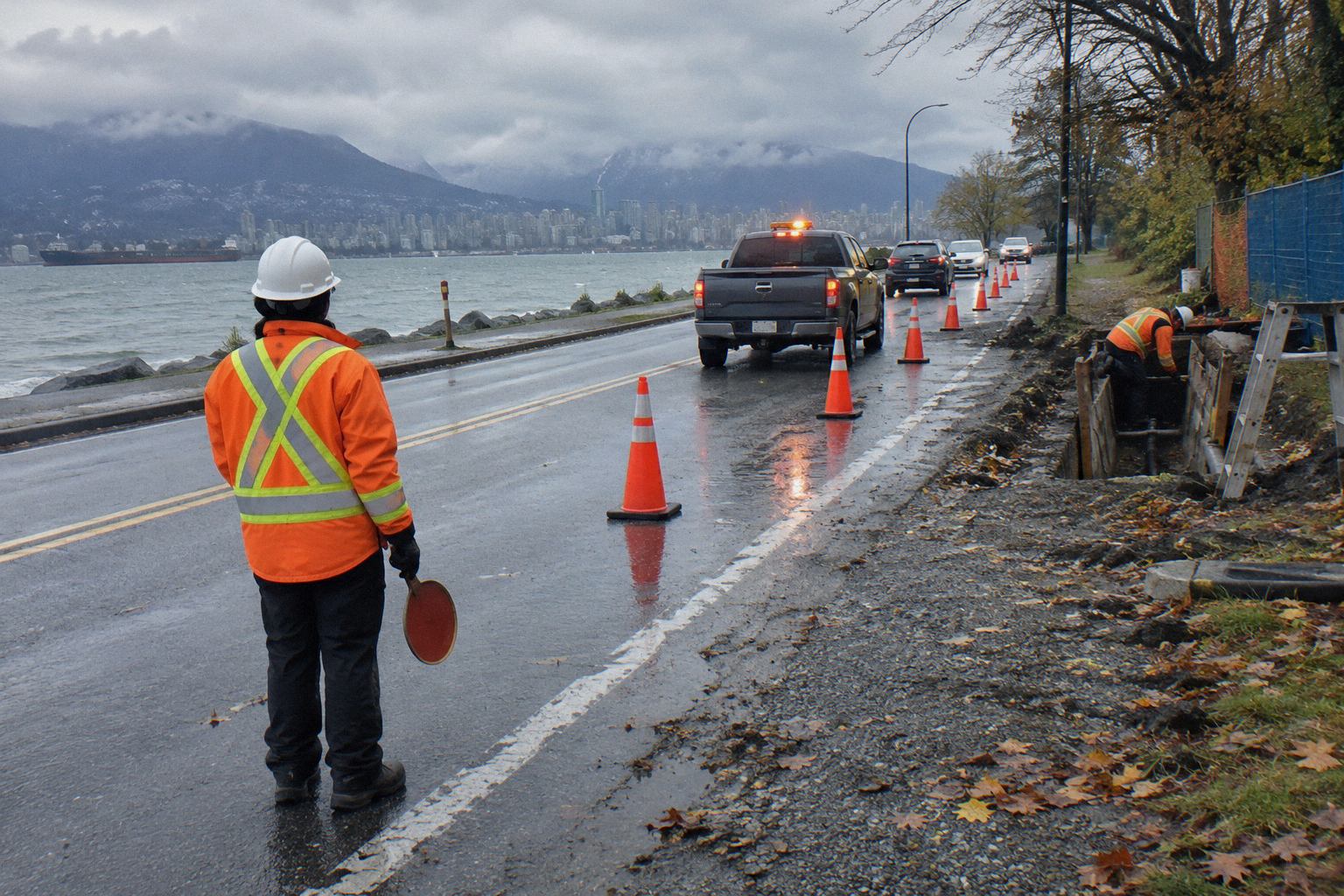
What Are The Ways To Get TCP Certification In Canada?
The ways to get TCP certification in Canada split by province: a short online look at the field first, then the BCCSA course for BC, WorkplaceNL TCP Level 1 for Newfoundland and Labrador, and Book 7 aligned training in Ontario.
| Route | Time | Cost (CAD) | What You Get | Recognised By | Best For |
|---|---|---|---|---|---|
| Coursera: Geometric and Traffic Aspects of Highway | 2 weeks at 10 hours a week | Not listed | Shareable certificate | No provincial regulator | Testing whether road work suits you before paying for TCP training |
| BCCSA 2-Day TCP Course (BC) | 16 hours over 2 days | 250-500 | 3-year BCCSA Record of Completion (ROC) | WorkSafeBC | Anyone who will flag traffic in British Columbia |
| WorkplaceNL TCP Level 1 | Minimum 8 hours | Not listed | 3-year WorkplaceNL TCP Level 1 certificate | WorkplaceNL | Directing traffic in Newfoundland and Labrador |
| Ontario OTM Book 7 aligned training | 1-8 hours | 50-200 | Record of Training | Ontario Ministry of Labour / employers | Ontario workers whose employer documents training |
I recommend the Coursera course for people still choosing the field, and the BCCSA 2-day course for anyone with a BC flagging job lined up.
What Is The Fastest Way To Get TCP Certification In Canada?
The fastest way to get TCP certification in Canada is the BCCSA route in British Columbia: register through the TCP Gateway, train for 2 days, pass both evaluations the same day, and leave with a temporary certificate while the permanent Record of Completion card follows in 6 to 8 weeks.
- Register for a BCCSA-approved 2-day TCP course through the BCCSA TCP Gateway; registration is immediate and courses run within days, with fees of $250 to $500 depending on the provider.
- Attend the 16-hour in-person course over 2 days, classroom plus practical, with the cost included in your registration.
- Pass the written exam with at least 80% and the practical evaluation at 100%, both on the same day at no extra cost.
- Receive a temporary certificate immediately, then the permanent 3-year BCCSA Record of Completion card in 6 to 8 weeks.
Is A Traffic Control Certificate Mandatory In Canada?
A traffic control certificate is mandatory in British Columbia and Newfoundland and Labrador, and there is no single centralized certificate in Ontario or Alberta. That split decides which course you buy and how much you pay.
| Province | Mandatory? | Regulator Or Registry | What It Means |
|---|---|---|---|
| British Columbia | Yes | WorkSafeBC / BCCSA TCP Gateway | A traffic control person must have completed a Board-approved traffic control training program, the 2-day BCCSA course ending in a 3-year Record of Completion. |
| Newfoundland and Labrador | Yes | WorkplaceNL | TCP Level 1 is mandatory for any person responsible for directing traffic movement, and it is valid for three years. |
| Ontario | No | Ministry of Labour / IHSA | A worker directing vehicular traffic must be a competent worker given adequate written and oral instructions, with requirements spelled out in the Ontario Traffic Manual, Book 7, April 2022 edition. |
| Alberta | No | Alberta OHS | When traffic on a public highway is dangerous to workers, the employer must protect them using designated persons directing traffic. |
British Columbia has the strictest rule in this comparison. WorkSafeBC requires that a traffic control person has completed a Board-approved traffic control training program, delivered as the BCCSA two-day standardized course, and only the in-person version counts: online flagger courses are not accepted for BC work. An out-of-province certificate is generally not valid in BC either, though you can apply to WorkSafeBC for recognition.
Newfoundland and Labrador is also mandatory in the provinces covered here: WorkplaceNL requires TCP Level 1 for any person responsible for directing traffic movement, with recertification every three years. Ontario and Alberta place the duty on employers instead. Ontario works from the Ontario Traffic Manual, Book 7, Temporary Conditions, April 2022 edition, while Alberta OHS requires designated persons when highway traffic endangers workers. Neither province names one certificate every flagger must hold.
Which Traffic Control Courses Are Worth Taking In Canada?
Traffic control courses worth taking fall into three groups: online background courses for testing the field, short video introductions including a free one, and the provincial courses that actually certify you. Only province-appropriate training should be used for work requirements; BC and NL require their approved routes.
Geometric and Traffic Aspects of Highway
Geometric and Traffic Aspects of Highway is a 2-week online course from L&T EduTech, 10 hours a week, covering how highway geometry and traffic flow are engineered, with a shareable certificate.
| Provider | L&T EduTech |
|---|---|
| Length | 2 weeks at 10 hours a week |
| Credential | Shareable certificate |
| Format | online |
Fiona's take: I suggest this to clients who are curious about road work but not ready to spend $250 to $500 on a BCCSA seat. It builds the vocabulary of the sector. This course does not qualify you to direct traffic in any province; BC and Newfoundland and Labrador still require their own approved training.
Skip it if: Skip it if you already have a flagging job lined up and just need the provincial certificate.
Not a provincial licence, registration or certificate.
Start On CourseraHighway Planning, Pavement Design and Construction
Highway Planning, Pavement Design and Construction is an online specialization from L&T EduTech, length not listed, covering roads from planning through pavement and construction, with a specialization certificate.
| Provider | L&T EduTech |
|---|---|
| Credential | Specialization certificate |
| Format | online |
Fiona's take: This one aims at the engineering side rather than the paddle side, and it pairs well with the geometric course if you want the full picture. It does not qualify you for any traffic control certificate, and no price is listed.
Skip it if: Skip it if your goal is a TCP card this month.
Not a provincial licence, registration or certificate.
Start On CourseraIngeniería de Tráfico
Ingeniería de Tráfico is a 4-module online course from Pontificia Universidad Católica de Chile, with a shareable certificate.
| Provider | Pontificia Universidad Católica de Chile |
|---|---|
| Length | 4 modules |
| Credential | Shareable certificate |
| Format | online |
Fiona's take: For Spanish-speaking clients this is the same try-the-field idea in a familiar language. The content is traffic engineering, not flagging procedure. It is not a provincial licence, registration or certificate.
Skip it if: Skip it if you need English-language training for a Canadian work site.
Not a provincial licence, registration or certificate.
Start On CourseraSustainable Transportation Networks and Streetscapes
Sustainable Transportation Networks and Streetscapes is a 3-module online course from McKinsey on how transportation networks and street design are planned, with a shareable certificate.
| Provider | McKinsey |
|---|---|
| Length | 3 modules |
| Credential | Shareable certificate |
| Format | online |
Fiona's take: This is big-picture mobility content for anyone weighing traffic control against planning or municipal careers. It does not qualify you for the BCCSA certificate. Treat it as career exploration only.
Skip it if: Skip it if you want hands-on flagging procedure.
Not a provincial licence, registration or certificate.
Start On CourseraFlagging in Temporary Traffic Control
Flagging in Temporary Traffic Control is a 40-minute online course from Steve Wilmes on Udemy that introduces flagging roles in temporary work zones.
| Provider | Steve Wilmes |
|---|---|
| Length | 40m total length |
| Rating | 4.6 |
| Format | online |
Fiona's take: This is the closest topical match among the quick options, rated 4.6 by Udemy learners. It does not meet the BC requirement for in-person BCCSA-approved training, and it does not satisfy WorkplaceNL Level 1. I see it as a preview, not a credential.
Skip it if: Skip it if an employer has asked you for a provincial certificate.
Not a provincial licence, registration or certificate.
View On UdemyOSHA Safety Pro: MUTCD Work Zone Traffic Control
OSHA Safety Pro: MUTCD Work Zone Traffic Control is a free 34-minute on-demand video course from James Neil on Udemy, rated 4.4, covering work zone traffic control under OSHA and the MUTCD.
| Provider | James Neil |
|---|---|
| Length | 34 mins on-demand video |
| Cost (CAD) | Free |
| Rating | 4.4 |
| Format | online |
Fiona's take: Free is the whole argument here. Its references are OSHA and the MUTCD rather than WorkSafeBC rules or Ontario's Book 7, so no Canadian regulator treats it as TCP training. Use it to learn the vocabulary at no cost before you invest anywhere.
Skip it if: Skip it if you need documented training for a job this week.
Not a provincial licence, registration or certificate.
View On UdemyBanksman & Flagman Professional Training - Awareness Course
Banksman & Flagman Professional Training - Awareness Course is a self-paced online awareness course from Professional Training Institute (PTI) on Udemy, with length and price not listed.
| Provider | Professional Training Institute (PTI) |
|---|---|
| Format | online |
Fiona's take: The banksman role covers plant and reversing-vehicle signalling, which overlaps only partly with Canadian road flagging. With no rating, no listed length and no certificate, I would pass unless you work around heavy equipment every day.
Skip it if: Skip it for road work; choose a provincial course instead.
Not a provincial licence, registration or certificate.
View On UdemyTraffic Control Person Training (Flagging)
Traffic Control Person Training (Flagging) is a 2-day in-person course from ProSafe Training in BC that costs $300.00 and awards the BCCSA 3-year certificate.
| Provider | ProSafe Training |
|---|---|
| Length | 2 days |
| Cost (CAD) | $300.00 |
| Credential | BCCSA 3-year certificate |
| Format | in person, BC |
Fiona's take: ProSafe's $300.00 sits mid-range in the $250 to $500 BC market, and the credential is the same BCCSA Record of Completion every provider issues. This is the actual ticket to flagging work in British Columbia. BC entry rules apply: at least 16 years old, good vision and hearing, strong English, and CSA safety boots.
Skip it if: Skip it if you plan to work only in Ontario or Alberta, where no single certificate is mandated.
See Program DetailsTraffic Control Persons for Construction (Flagger)
Traffic Control Persons for Construction (Flagger) is a 1-hour online course from On-Track Safety for Alberta, priced at $59.99 CAD and rated 4.7, with a certificate valid 36 months.
| Provider | On-Track Safety |
|---|---|
| Length | 1h |
| Cost (CAD) | $59.99 CAD |
| Rating | 4.7 |
| Credential | Certificate valid 36 months |
| Format | online, AB |
Fiona's take: Alberta leaves training choice to employers, so an online record like this can serve where your employer accepts it, at a fraction of a BC course fee. It will not get you WorkSafeBC approval, since BC requires in-person BCCSA training with a practical evaluation. Confirm with your employer before buying.
Skip it if: Skip it if your contract is in BC or Newfoundland and Labrador.
See Program DetailsHCSAS Workzone Flagperson Training
HCSAS Workzone Flagperson Training is an online course from the Heavy Construction Safety Association of Saskatchewan, rated 4.7, issuing an HCSAS certificate that covers theory only.
| Provider | Heavy Construction Safety Association of Saskatchewan (HCSAS) |
|---|---|
| Rating | 4.7 |
| Credential | HCSAS certificate (theory only) |
| Format | online, SK |
Fiona's take: A provincial heavy construction association is a credible source for work zone theory in Saskatchewan. The certificate covers theory only. Length and price are not listed.
Skip it if: Skip it if you need a certificate with a practical component.
See Program DetailsFlagperson Certification
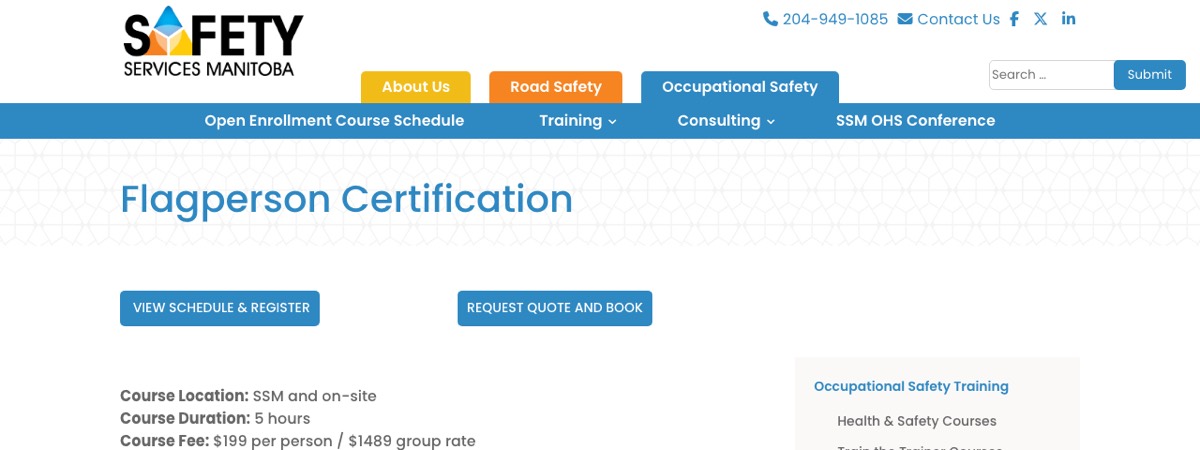
Flagperson Certification is a 5-hour in-person course from Safety Services Manitoba at $199 per person.
| Provider | Safety Services Manitoba |
|---|---|
| Length | 5 hours |
| Cost (CAD) | $199 per person |
| Credential | Flagperson Certification |
| Format | in person, MB |
Fiona's take: Five instructor-led hours at $199 sits below the BC course cost while adding real classroom time to the cheap online options. The per-person pricing matters to employers booking crews. This credential speaks to Manitoba work sites.
Skip it if: Skip it if you are not working in Manitoba.
See Program DetailsTraffic Control Training
Traffic Control Training is a 16-hour, 2-day in-person course from Domcor Health Safety & Security in BC that awards the BCCSA 3-year record of completion.
| Provider | Domcor Health Safety & Security |
|---|---|
| Length | 16 hours (2 days) |
| Credential | BCCSA 3-year record of completion |
| Format | in person, BC |
Fiona's take: Domcor delivers the same 16-hour BCCSA curriculum, so the choice among Domcor, ProSafe and PICS-ETC comes down to dates, location and quoted price within the $250 to $500 range. Its fee is not listed, so ask before booking.
Skip it if: Skip it once you have found a provider with a confirmed seat and price.
See Program DetailsTraffic Control Person (Flagger) - Online Course
Traffic Control Person (Flagger) - Online Course is a self-paced online course from BIS Safety Software Canada for Alberta, ending in a Certificate of Completion.
| Provider | BIS Safety Software Canada |
|---|---|
| Credential | Certificate of Completion |
| Format | online, AB |
Fiona's take: Like the On-Track Alberta course, this is an online record in a province that leaves the choice to employers. No length, price or rating is listed, and it will not satisfy the in-person requirement BC enforces.
Skip it if: Skip it unless your Alberta employer specifically accepts BIS Safety records.
See Program DetailsTraffic Control Person Training (Flagging)
Traffic Control Person Training (Flagging) is a 2-day in-person course from PICS-ETC in BC, running 6 hours each day, that awards the BCCSA 3-year certificate.
| Provider | PICS-ETC |
|---|---|
| Length | 2 days (6 hours both days) |
| Credential | BCCSA 3-year certificate |
| Format | in person, BC |
Fiona's take: PICS-ETC spells out the schedule as 6 hours per day across 2 days, which helps if you are arranging transit or childcare. Its price is not listed, so compare it against ProSafe's $300.00 before committing. The credential is the same BCCSA certificate.
Skip it if: Skip it if a listed price matters to your decision.
See Program DetailsHow Much Does TCP Certification Cost In Canada?
TCP certification costs $250 to $500 for the 2-day BCCSA course in BC, with renewal far cheaper at $65 + GST online. Elsewhere, listed prices include $59.99 in Alberta, $199 in Manitoba, and $50 to $200 for Ontario Book 7 aligned training.
| Item | Cost (CAD) | Notes |
|---|---|---|
| 2-Day BCCSA TCP Course | 250-500 | Varies by provider; ProSafe Training lists $300.00 |
| BCCSA Online Renewal Course | 65 + GST | Online renewal through the TCP Gateway is $65 + GST; the ROC is valid for three years |
| Ontario OTM Book 7 aligned training | 50-200 | 1-8 hours; yields a Record of Training rather than a regulator-issued certificate |
| NLCSA or WorkplaceNL TCP training | Not listed | Minimum 8-hour Level 1 course; recertification every three years |
Outside BC the price spread is wide because the credential varies. On-Track Safety's Alberta online course is $59.99 CAD, Safety Services Manitoba charges $199 per person for 5 hours in person, and Ontario Book 7 aligned training runs $50 to $200 for 1 to 8 hours. Saskatchewan's HCSAS course and the WorkplaceNL route list no price, so request quotes. For BC courses, budget for CSA safety boots as well, since they are required.
Is TCP Certification Worth It In 2026?
TCP certification is worth it in 2026 for two plain reasons. First, it is the gate to flagging work in British Columbia and Newfoundland and Labrador, where WorkSafeBC and WorkplaceNL make training mandatory. Second, the commitment is small: 16 hours over 2 days and $250 to $500 in BC buys a credential that lasts three years.
The case is weaker in Ontario and Alberta, where the Ministry of Labour and Alberta OHS place duties on employers rather than one central certificate. Even there, the NOC profile lists flagperson under NOC 75110, Construction trades helpers and labourers, and notes that flagmen and flagwomen may require a traffic control certificate, so holding one can still set your application apart.
Plan around the three-year clock. The BCCSA Record of Completion and the WorkplaceNL Level 1 certificate each expire after three years, and BC renewal runs through a 1-day course, with an online option at $65 + GST. Anyone treating this as a long-term trade should calendar the expiry the day the card arrives.
TCP Certification Questions Canadians Ask
Is A TCP Certificate From Another Province Valid In BC?
A TCP certificate from another province is generally not valid in BC. Recognition applications go to WorkSafeBC. Workers can apply for recognition through WorkSafeBC or take the BCCSA 2-day course, which costs $250 to $500 over 2 days and is the credential BC employers recognise.
How Long Is The BCCSA TCP Certificate Valid?
The BCCSA TCP certificate, formally the Record of Completion, is valid for three years. Renewal requires a 1-day course, and the online renewal through the TCP Gateway costs $65 + GST. Your permanent card arrives 6 to 8 weeks after the course, so mark the three-year expiry as soon as it lands.
What Are The Requirements For TCP Training In BC?
The requirements for TCP training in BC start with age: participants must be at least 16 years old. You also need good vision and hearing, the physical ability to do the work, and a strong command of English, plus CSA safety boots. The course itself is the 16-hour, 2-day BCCSA program with classroom and practical components.
Is Traffic Control Training Mandatory In Ontario?
Traffic control training in Ontario is not one mandatory certificate. The Ministry of Labour framework, supported by IHSA guidance, requires that a worker directing vehicular traffic be a competent worker who receives adequate written and oral instructions. Further requirements follow the Ontario Traffic Manual, Book 7, Temporary Conditions, April 2022 edition, which is why employers document a Record of Training.
How Much Does The 2-Day BCCSA TCP Course Cost?
The 2-day BCCSA TCP course costs between $250 and $500, set by the individual instructor or provider. ProSafe Training lists $300.00, a useful mid-range marker. Staying current costs less: the Online TCP Renewal Course on the TCP Gateway is $65 + GST. Ask providers directly, since fees vary across that range.
What NOC Code Applies To Traffic Control Persons Or Flaggers?
The NOC code for flaggers is 75110, Construction trades helpers and labourers, which includes flagperson duties and notes that flagmen and flagwomen may require a traffic control certificate. Use 75110 when searching Job Bank postings or comparing labour market data. It is a helper and labourer grouping, not a supervisory or engineering classification.
Can I Take An Online Flagger Course For Work In BC?
An online flagger course will not qualify you for BC work. BC requires the in-person, BCCSA-approved 2-day course with a practical evaluation, and online courses are not accepted. Online options such as the $59.99 CAD Alberta course from On-Track Safety fit a different provincial model where employers choose the training. For BC, register through the BCCSA TCP Gateway.
What's The Bottom Line On TCP Certification In Canada?
- In British Columbia and Newfoundland and Labrador a traffic control certificate is mandatory: WorkSafeBC through the BCCSA, and WorkplaceNL through TCP Level 1, each valid for three years.
- The BC route takes 16 hours over 2 days, costs $250 to $500, and ends with a written exam at 80% minimum plus a practical evaluation at 100%.
- Ontario and Alberta place the duty on employers rather than one central certificate, with Ontario working from OTM Book 7, April 2022 edition.
- Start with Geometric and Traffic Aspects of Highway if you want to test the field first; it does not certify you as a TCP anywhere.
- BC renewal costs $65 + GST online, so the long-run cost of staying certified is modest once the first course is done.






