
Key Takeaways
- The fastest realistic route is Pathway 1: a 4 year CIA-accredited actuarial science degree, 1 to 2 years for ACIA Modules 1 and 2, the ACIA Capstone Exam and the CIA Professionalism Workshop, then 3 or more years for the FCIA. The CIA averages the whole journey at seven to nine years including university; Candidate membership is $75 a year and degree tuition is not listed here, so check each university.
- No province issues an actuary licence. The Canadian Institute of Actuaries (CIA) is the only organization that can qualify actuaries for work in Canada, in every province, through the ACIA and FCIA designations.
- Try the field first with EDUCBA's Complete Insurance Underwriting & Risk Management on Coursera, 4 weeks at 10 hours a week. It does not qualify you for the ACIA or FCIA and does not count toward CIA requirements.
- Job Bank lists a median of $51.00 an hour for NOC 21210 (Mathematicians, statisticians and actuaries), with a range of $31.25 to $77.33. Manitoba is highest among the listed provincial medians at $56.41.
- Fiona's verdict: this path suits students strong in mathematics who can commit to seven to nine years. If you want a fast signal first, the Coursera specialization gives you one in a month.
An actuary assesses and manages financial risk using mathematics, statistics and business knowledge. In Canada one body controls entry: the Canadian Institute of Actuaries (CIA) is the only organization that can qualify actuaries for work in Canada.
The honest answer on time is seven to nine years to the FCIA, including university. Before you sign up for any of that, spend a month testing the field online. Here is the full map: pathways, fees, wages and the courses worth your money.

What Are The Ways To Become An Actuary In Canada?
The ways to become an actuary in Canada are three CIA pathways plus one short online test run. The Canadian Institute of Actuaries (CIA) is the only organization that can qualify actuaries for work in Canada, so every serious route ends at the ACIA or FCIA.
| Route | Time | Cost (CAD) | What You Get | Recognised By | Best For |
|---|---|---|---|---|---|
| Complete Insurance Underwriting & Risk Management | 4 weeks at 10 hours a week | Not listed | Shareable course certificate | Not recognised for CIA purposes | Testing the field before you commit years |
| Pathway 1: CIA-accredited university program | 4 to 8 years post-high school | Not listed | ACIA, then FCIA | Canadian Institute of Actuaries | Students straight out of high school |
| Pathway 2: associate from a recognized organization | 1 to 3 years after associate | Not listed | ACIA | Canadian Institute of Actuaries | Holders of associate-level standing elsewhere |
| Pathway 3: fellow from a recognized organization | 1 to 3 years after fellow | Not listed | FCIA | Canadian Institute of Actuaries | Holders of a fellow designation elsewhere |
I recommend the Coursera run for anyone still deciding, Pathway 1 for students who can start a degree now, and Pathways 2 and 3 for people who already hold associate or fellow standing with another recognized actuarial organization.
What Is The Fastest Way To Become An Actuary In Canada?
The fastest way to become an actuary in Canada is Pathway 1, the CIA-accredited university route: a 4 year degree, then 1 to 2 years for ACIA Modules 1 and 2, the ACIA Capstone Exam and the CIA Professionalism Workshop, then 3 or more years for the FCIA. The CIA averages the full journey at seven to nine years including university education. Anyone promising much faster is selling you something.
- Test the field first with Complete Insurance Underwriting & Risk Management: 4 weeks at 10 hours a week, online, before you commit a multi-year path.
- Enrol in a CIA-accredited actuarial science degree program, such as the University of Waterloo's Bachelor of Mathematics in Actuarial Science (4 to 5 years, co-op available), and complete the mandatory courses: 4 years on the CIA's Pathway 1 timeline.
- Enrol as a CIA Student member: no fee, per the CIA fee schedule.
- Complete ACIA Modules 1 and 2, the ACIA Capstone Exam and the CIA Professionalism Workshop: 1 to 2 years.
- Gain experience and complete the FCIA requirements: 3 or more years.
- Budget the recurring CIA fees along the way: $75 a year as a Candidate, $1,325 a year as an Associate at five years or more, $1,575 a year as a Fellow.
Do You Need A Licence To Work As An Actuary In Canada?
A licence to work as an actuary in Canada is not issued by any province. The Canadian Institute of Actuaries (CIA) is the only organization that can qualify actuaries for work in Canada, and CIA qualification is the only one needed to practice as an actuary in Canada. The designations to chase are the ACIA and then the FCIA.
| Province | Required? | Regulator Or Registry | What It Means |
|---|---|---|---|
| All provinces | No government licence | Canadian Institute of Actuaries (CIA) | The CIA is the only organization that can qualify actuaries for work in Canada; the ACIA and FCIA are the practice designations |
All provinces land in the same row because the CIA operates nationally: there is no provincial actuary licence to chase and no provincial exam board to register with. What the profession recognises is CIA standing, built through the ACIA and FCIA designations on one of the three pathways.
For internationally trained actuaries, Pathways 2 and 3 matter here: if you hold associate or fellow standing with another recognized actuarial organization, you can reach the ACIA or FCIA in 1 to 3 years rather than starting over. The CIA notes the ACIA and FCIA have portability internationally, so the door swings both ways.
Which Actuary Exam And Degree Courses Are Worth Taking?
Actuary exam and degree choices worth making fall into three tiers: a fast Coursera screen, standalone Udemy primers, and university degrees. Waterloo and Regina carry CIA accreditation, which provides credits toward ACIA requirements under Pathway 1; Concordia and UQAM are university routes to verify with the CIA first. I have grouped all eight below, Coursera first.
Complete Insurance Underwriting & Risk Management
Complete Insurance Underwriting & Risk Management is a 4 week online specialization from EDUCBA, a 4 course series at 10 hours a week, that introduces insurance underwriting and risk management.
| Provider | EDUCBA |
|---|---|
| Length | 4 weeks to complete at 10 hours a week (4 course series) |
| Rating | from 44 reviews of courses in this program |
| Credential | Shareable certificate |
| Format | online |
Fiona's take: Coursera shows reviews from 44 learners of courses in this program, and the shareable certificate is a reasonable line on a LinkedIn profile while you decide. I recommend it as a one-month screen: if underwriting and risk material bores you at 10 hours a week, a 4 year actuarial science degree will not go better. This course does not qualify you for the ACIA or FCIA and does not count toward CIA requirements, and I tell clients to treat it strictly as a go or no-go signal.
Skip it if: Skip it if you already know you want the actuarial career and need to focus on CIA modules or SOA and CAS exams instead.
Start On CourseraHow to become an Actuary
How to become an Actuary is an online course from Michael Jordan on Udemy, rated 4.5, described as 'A guide on how to get into the greatest profession'.
| Provider | Michael Jordan |
|---|---|
| Rating | 4.5 |
| Credential | Certificate of completion |
| Format | online |
Fiona's take: This is an online Udemy orientation course described as 'A guide on how to get into the greatest profession', so treat it as a weekend primer on the career itself rather than mathematics training. Its price is not listed here, so check the page before enrolling. The certificate of completion carries no weight with the CIA.
Skip it if: Skip it if you have already mapped your pathway and want technical probability or statistics training.
View On UdemyActuarial Science For Non-Actuaries
Actuarial Science For Non-Actuaries is an online course from Nicholas Jacobi, who lists FSA, MAAA and CERA credentials, on Udemy, rated 4.6.
| Provider | Nicholas Jacobi, FSA, MAAA, CERA |
|---|---|
| Rating | 4.6 |
| Credential | Certificate of completion |
| Format | online |
Fiona's take: The instructor lists industry credentials, which matters in a field where the qualifying body is everything. The course explains actuarial concepts to outsiders, so it pairs well with the Coursera screen if you want a second opinion on whether this work suits you. It is not CIA education and grants no standing.
Skip it if: Skip it if you are already enrolled in an actuarial science degree, since the material will repeat your first year.
View On UdemyThe Actuarial Science Collection
The Actuarial Science Collection is a 12.5 hour on-demand video course from Michael Jordan on Udemy, rated 4.4.
| Provider | Michael Jordan |
|---|---|
| Length | 12.5 hours on-demand video |
| Rating | 4.4 |
| Credential | Certificate of completion |
| Format | online |
Fiona's take: It is listed as 12.5 hours of on-demand video, which makes it a sensible companion to university coursework across actuarial science topics. The 4.4 rating sits a notch below the other two primers, so sample the free preview before you buy. Like the rest of this tier, the certificate of completion is for you, not for the CIA.
Skip it if: Skip it if you need depth on one specific module or exam rather than a broad sweep.
View On UdemyActuarial Science degree (Bachelor of Mathematics in Actuarial Science)
The Actuarial Science degree is a 4 to 5 year in-person program at the University of Waterloo in Ontario leading to a Bachelor of Mathematics, with co-op available.

| Provider | University of Waterloo |
|---|---|
| Length | 4-5 years (co-op available) |
| Credential | Bachelor of Mathematics |
| Format | in person, Ontario |
Fiona's take: This is a Pathway 1 vehicle: the CIA has accredited Waterloo's Actuarial Science program, and CIA-accredited university programs provide credits toward ACIA requirements, which is the practical reason to choose an accredited school over a generic math degree. Co-op availability means you can test work environments while you study rather than after. The 4 to 5 year span against the CIA's 4 year Pathway 1 timeline reflects the co-op option.
Skip it if: Skip it if you cannot relocate to Ontario or need a distance option, since delivery is in person.
See Program DetailsBachelor of Science in Actuarial Science
The Bachelor of Science in Actuarial Science is a 4 to 5 year in-person program at the University of Regina in Saskatchewan.

| Provider | University of Regina |
|---|---|
| Length | 4-5 years |
| Credential | Bachelor of Science |
| Format | in person, Saskatchewan |
Fiona's take: Regina's program is accredited by the Canadian Institute of Actuaries, which gives Saskatchewan students a Pathway 1 route without leaving the province; that accreditation is what does the work on your CIA file. For scale on lengths, Waterloo and Regina are listed as 4 to 5 years, Concordia is listed as 3 to 4 years, and UQAM is listed as 90 credits. Tuition is not listed here, so price it against the Ontario and Quebec options directly.
Skip it if: Skip it if you are outside Saskatchewan and relocation is not on the table.
See Program DetailsActuarial Mathematics/Finance (BA, BSc)
Actuarial Mathematics/Finance at Concordia University is a 3 to 4 year in-person program in Quebec leading to a BA or BSc.

| Provider | Concordia University |
|---|---|
| Length | 3 to 4 years |
| Credential | BA or BSc |
| Format | in person, Quebec |
Fiona's take: Concordia is listed as 3 to 4 years, and the finance pairing fits the risk work the CIA describes in its definition of the profession. The program is provisionally accredited, and the exemptions quoted for it apply to SOA and CAS preliminary exams, so confirm its current CIA standing before you enrol. It sits on the university side of the map as a route toward the ACIA.
Skip it if: Skip it if three to four years in Montreal does not fit your budget or timeline.
See Program DetailsBaccalauréat en actuariat
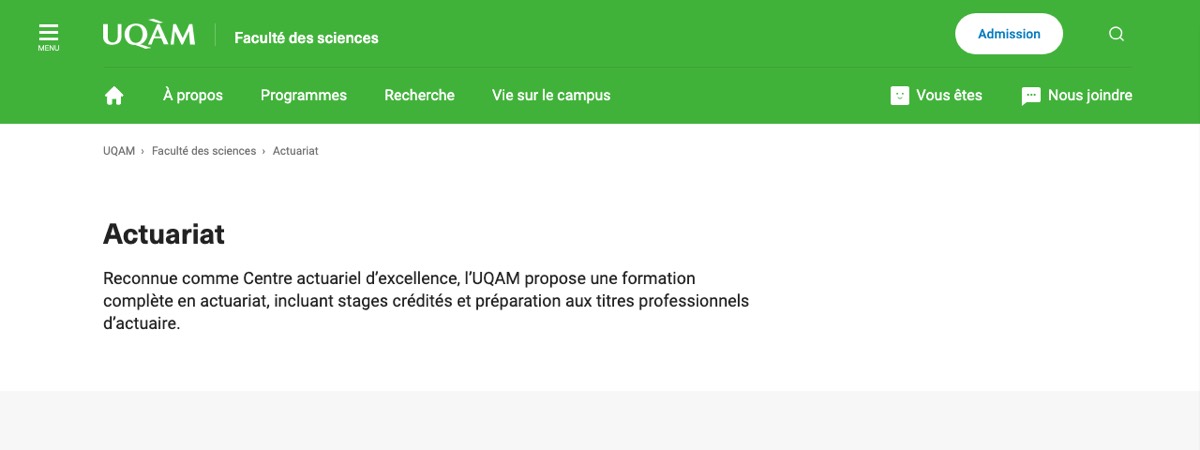
The Baccalauréat en actuariat is a 90 credit in-person program at UQAM in Quebec, offered in profil régulier or honor, leading to a Baccalauréat.
| Provider | UQAM |
|---|---|
| Length | 90 crédits (profil régulier or honor) |
| Credential | Baccalauréat |
| Format | in person, Quebec |
Fiona's take: UQAM is listed as 90 credits with a regular or honour profile, and the program combines actuarial training with credited internships and preparation for professional titles. CIA accreditation is not stated for UQAM here, so verify with the CIA before applying: accreditation is what turns a degree into Pathway 1 credits. It is the dedicated actuariat degree in this set, which suits students who want the specialty in the program name.
Skip it if: Skip it if you already hold associate or fellow standing with a recognized actuarial organization and plan to use Pathway 2 or 3.
See Program DetailsHow Much Does It Cost To Become An Actuary In Canada?
Becoming an actuary in Canada costs $75 a year in CIA Candidate fees while you study, nothing as a Student member, and $1,575 a year once you are a Fellow. Degree tuition is not listed here; check each university, and treat the table below as the fees you can plan around.
| Item | Cost (CAD) | Details |
|---|---|---|
| CIA Student membership | $0 | No fee, per the CIA fee schedule |
| CIA Candidate membership | $75 | Annual |
| CIA Associate membership (five years or more) | $1,325 | Annual |
| CIA Fellow membership | $1,575 | Annual |
| Actuarial science degree tuition | Not listed | Check each university: Waterloo, Regina, Concordia and UQAM |
| Coursera and Udemy courses | Not listed | Cost not listed; check each page |
The CIA fee schedule is the one cost you can pin to the wall: no fee for Student members, $75 a year for Candidates, $1,325 a year for Associates at five years or more, and $1,575 a year for Fellows. Degree tuition is not listed here, so check Waterloo, Regina, Concordia and UQAM directly before comparing them. Note the pattern in the table: the fees rise as you qualify, so the later years of the pathway cost more to maintain, not less.
How Much Does An Actuary Earn In Canada?
An actuary in Canada earns a median of $51.00 an hour, according to Job Bank figures for NOC 21210 (Mathematicians, statisticians and actuaries). The national range runs from $31.25 to $77.33 an hour.
| Province | Median Hourly Wage (CAD) |
|---|---|
| Canada | 51.00 |
| Manitoba | 56.41 |
| Quebec | 51.98 |
| Ontario | 51.28 |
| British Columbia | 50.04 |
| Nova Scotia | 45.84 |
| Saskatchewan | 44.89 |
| Alberta | 44.82 |
| New Brunswick | 44.71 |
| Newfoundland and Labrador | 40.11 |
Manitoba is highest among the listed provincial medians at $56.41 an hour, ahead of Quebec at $51.98 and Ontario at $51.28, both sitting just above the national median of $51.00. British Columbia lands at $50.04, while Saskatchewan ($44.89), Alberta ($44.82) and New Brunswick ($44.71) sit lower among the listed medians. Newfoundland and Labrador is lowest among the listed provincial medians at $40.11.
Read the numbers with the classification in mind: NOC 21210 covers Mathematicians, statisticians and actuaries as a group, so the figures blend related occupations. I do not have a verified outlook rating to quote for this occupation, so weigh the wage range against the seven to nine year qualification path rather than against a growth forecast.
Is Becoming An Actuary Worth It In 2026?
Becoming an actuary in 2026 is worth it if the wage math and the timeline both appeal to you. Job Bank puts NOC 21210 at a median of $51.00 an hour with the top of the range at $77.33. Against that, the CIA's fee schedule takes $75 a year from Candidates and $1,575 a year from Fellows, and the pathway takes seven to nine years including university. That trade is the whole decision.
Portability strengthens the case. The ACIA and FCIA designations prepare actuaries to practice in Canada and have portability internationally, so the credential you build here is not trapped here. CIA qualification is also the only one needed to practice as an actuary in Canada, which means one clear finish line rather than a patchwork of provincial rules.
My verdict: this career suits students who genuinely like statistics and can live with exams for the better part of a decade. If you are unsure, do not start with a degree application. Start with the one-month Coursera screen and a Udemy primer, then decide whether a CIA-accredited Pathway 1 degree at Waterloo or Regina deserves four years of your life, with Concordia and UQAM as routes to verify with the CIA first.
Actuary Exam Questions Canadians Ask
How Long Does It Take To Become An Actuary In Canada?
Becoming an actuary in Canada takes seven to nine years on average to reach the FCIA, including university education. The CIA's Pathway 1 breaks down as a 4 year accredited degree, 1 to 2 years for the ACIA modules, capstone exam and professionalism workshop, then 3 or more years for the FCIA requirements.
Do I Need A Specific Degree To Become An Actuary?
A specific degree is not strictly required. The CIA prefers a bachelor's degree in actuarial science, mathematics or a related field from a CIA-accredited program for Pathway 1. If you hold qualifications from another recognized actuarial organization, Pathways 2 and 3 let you enter with associate or fellow standing instead of starting over.
What Exams Are Required To Become An Actuary In Canada?
The exams required depend on your pathway. The CIA uses its own ACIA Modules 1 and 2, the ACIA Capstone Exam and the CIA Professionalism Workshop, plus exams from the SOA or CAS depending on the pathway. There is no single list of ten exams mandated by the CIA, so map your route before registering for anything.
Is The CIA Designation Mandatory To Work As An Actuary In Canada?
The CIA designation is the only qualification you need to practice as an actuary in Canada. No province issues its own licence, and the CIA is the only organization that can qualify actuaries for work in Canada. The ACIA and FCIA are the designations that define practice standing.
What Is The Median Wage For Actuaries In Canada?
The median wage for actuaries sits at $51.00 an hour, according to Job Bank data for NOC 21210 (Mathematicians, statisticians and actuaries). The range runs from $31.25 to $77.33. Manitoba is highest among the listed provincial medians at $56.41, ahead of Quebec at $51.98 and Ontario at $51.28.
Can I Get Exam Exemptions With A University Degree?
Exam exemptions come through the right school. CIA-accredited university programs provide credits toward ACIA requirements under Pathway 1: Waterloo's Actuarial Science program is accredited by the CIA, and Regina's program is accredited by the Canadian Institute of Actuaries. Concordia is provisionally accredited, with exemptions quoted for SOA and CAS preliminary exams. For UQAM, verify CIA accreditation before applying.
What Membership Fees Apply To CIA Candidates?
CIA candidate fees are the smallest line in your budget: Candidate membership costs $75 annually, and Student membership has no fee at all. The numbers climb once you qualify: $1,325 annually for an Associate at five years or more, and $1,575 annually for a Fellow. Those recurring fees are part of staying in the profession.
Are Canadian Actuarial Credentials Recognised Internationally?
Canadian actuarial credentials travel well. The ACIA and FCIA designations prepare actuaries to practice in Canada and have portability internationally, according to the CIA. If you plan to work across borders, that portability matters more than any single exam choice, and it is one reason the FCIA holds value over a long career.
What's The Bottom Line On Becoming An Actuary?
- The CIA is the only organization that can qualify actuaries for work in Canada, in every province; the ACIA and FCIA are the designations that define practice, and no provincial licence exists.
- Expect seven to nine years to the FCIA including university: a 4 year accredited degree, 1 to 2 years for the ACIA modules, capstone exam and professionalism workshop, then 3 or more years of FCIA requirements.
- Job Bank lists a median of $51.00 an hour for NOC 21210, with a range of $31.25 to $77.33, and Manitoba highest among the listed provincial medians at $56.41.
- Start with Complete Insurance Underwriting & Risk Management to test the field in 4 weeks at 10 hours a week; it does not count toward the ACIA or FCIA, but it tells you whether the work suits you before you spend years on it.
- Budget the recurring CIA fees from day one: nothing as a Student member, $75 a year as a Candidate, $1,575 a year as a Fellow.