Key Takeaways
- The fastest realistic route to a PALS certificate is a Heart & Stroke PALS Renewal at CA$180 to CA$275 over 6 to 8 hours, but it requires a current PALS card; a first-time PALS Provider course runs 14 hours and costs about CA$250 to CA$480.
- PALS is a two-year certificate issued by the Heart & Stroke Foundation of Canada and recognized throughout Canada; no provincial regulator mandates it for nursing licensure, though employers in pediatric settings commonly require it.
- Before committing, Emergency Care: Pregnancy, Infants, and Children from the University of Colorado Boulder is a 16-hour online taste of pediatric emergency care, but it does not qualify you for any PALS certificate.
- Pay for paramedical occupations, NOC 32102, has a Canada-wide median of $38.00 per hour, with Ontario at $42.17 and Manitoba at $40.00 per Job Bank.
- Fiona's verdict: PALS suits nurses, physicians, paramedics and respiratory therapists working with pediatric patients; if you are not yet in one of those roles, take the Coursera preview first and spend on the Heart & Stroke card only when an employer expects it.
Pediatric Advanced Life Support (PALS) is an advanced resuscitation course for healthcare providers who respond to respiratory emergencies, shock and cardiopulmonary arrest in infants and children. In Canada the certificate is issued by the Heart & Stroke Foundation and lasts two years.
A first-time PALS Provider course takes 14 hours, blended or in a classroom, and costs roughly CA$250 to CA$480 depending on the provider. If you already hold a current card, a renewal runs 6 to 8 hours at CA$180 to CA$275. Here is how I tell clients to choose.
What Are The Ways To Get PALS Certification In Canada?
The Heart & Stroke Foundation issues the PALS course completion cards covered in this guide, and there are two main course paths: the full Provider course for first-timers and the shorter Renewal for current card holders.
| Route | Time | Cost (CAD) | What You Get | Recognised By | Best For |
|---|---|---|---|---|---|
| Emergency Care: Pregnancy, Infants, and Children (preview only, no PALS card) | 16 hours | Not listed | Coursera certificate of completion | Coursera and the University of Colorado Boulder; not a Heart and Stroke credential | Testing interest in pediatric emergency care before paying |
| Heart and Stroke PALS Provider course | 14 hours (or blended: online plus 9 hours classroom) | 250-480 | PALS Provider Certificate valid 2 years | Heart & Stroke Foundation of Canada | First-time PALS students |
| Heart and Stroke PALS Renewal course | 6-8 hours (or blended: online plus 5 hours classroom) | 180-275 | PALS Provider Certificate valid 2 years | Heart & Stroke Foundation of Canada | Current card holders before expiry |
I recommend the Coursera preview for anyone not yet working in a pediatric setting, and the Heart & Stroke Renewal, not the full Provider course, for anyone whose card is still within grace.
What Is The Fastest Way To Renew PALS Certification In Canada?
The fastest documented path is the blended PALS Renewal, at 6 to 8 hours total once your prerequisites are in order.
- Confirm a current Heart & Stroke BLS certificate (within 12 months) and a PALS card that is not expired or is within grace; this check is immediate and free.
- Complete the PALS Pre-course Self-Assessment and pass with 70%; it takes 1 to 2 hours and costs nothing.
- Register for the blended PALS Renewal, which pairs online modules with 5 hours in the classroom.
- Complete the in-person classroom/skills session and receive a Heart & Stroke PALS Provider Certificate valid for 2 years; the course costs CA$180 to CA$275.
Do Employers In Canada Require A PALS Certificate?
A PALS certificate is not a licence. No provincial regulator mandates it for general nursing licensure; instead, requirements vary by employer, province and scope of practice, and many employers require it for roles involving pediatric patients.
SickKids describes the PALS audience as healthcare providers who respond to cardiopulmonary emergencies in paediatric settings such as emergency rooms, critical care units and EMS. So the practical rule I give clients: check the specific job posting; requirements vary by employer, province and scope of practice.
The card itself carries real weight when you have it. The Heart & Stroke Foundation issues the PALS Course Completion Card, it is valid for two years from the date of issue, and it is recognized throughout Canada, so a card earned in Ontario holds in British Columbia. Before you can sit the course you need a valid Heart & Stroke BLS completion card from within the past 12 months plus a 70% pass on the PALS Pre-course Self-Assessment.
Which PALS Courses Are Worth Taking In Canada?
The courses below run from a free preview to the full Heart & Stroke credential. Heart & Stroke PALS courses and listed providers that issue Heart & Stroke cards are the route to the Heart & Stroke PALS card; the online previews do not.
Emergency Care: Pregnancy, Infants, and Children
Emergency Care: Pregnancy, Infants, and Children is a 16-hour online course from the University of Colorado Boulder on Coursera.
| Provider | University of Colorado Boulder |
|---|---|
| Length | 16 hours |
| Rating | 4.8 (312 reviews) |
| Credential | Certificate |
| Format | online |
Fiona's take: It covers emergency care for the youngest patients and carries a 4.8 rating from 312 reviews. This course does not qualify you for any PALS certificate, and I say that plainly to every client. What it does well is let a nurse or paramedic student test whether pediatric resuscitation is the specialty they want before spending CA$400 on a seat. Work through it first, then book the Heart & Stroke course with confidence.
Skip it if: Skip it if you already know you want the PALS card; it will not move you toward it.
Not a provincial licence, registration or certificate.
Start On CourseraPsychological First Aid
Psychological First Aid is a 6-hour online course from Johns Hopkins University on Coursera.
| Provider | Johns Hopkins University |
|---|---|
| Length | 6 hours to complete |
| Rating | 4.8 (20,007 reviews) |
| Credential | Shareable certificate |
| Format | online |
Fiona's take: It rates 4.8 from 20,007 reviews and fits a different need: supporting people in an emergency by using the RAPID model. Like the Colorado course, it is not a licence, registration or certificate of any regulated kind. I suggest it to clients who want the human side of emergency care, not the algorithms.
Skip it if: Skip it if your goal is strictly the resuscitation credential; it is a psychological first aid course, not a PALS Provider course.
Not a provincial licence, registration or certificate.
Start On CourseraPediatric Advanced Life Support (PALS)
Pediatric Advanced Life Support (PALS) is a 1.5-hour on-demand video course from Advanced Medical Certification on Udemy.
| Provider | Advanced Medical Certification |
|---|---|
| Length | 1.5 hours on-demand video |
| Cost (CAD) | Free |
| Rating | 4.6 (1,150 ratings) |
| Format | online |
Fiona's take: It is free and rated 4.6 from 1,150 ratings, which makes it a decent screen for the rhythm of PALS material. It is not a provincial licence, registration or certificate, and it will not get you a Heart & Stroke card. Treat it as a study aid before the real course, not a substitute for it.
Skip it if: Skip it if you already hold the current PALS manual and pre-course materials; it adds little.
Not a provincial licence, registration or certificate.
View On UdemyPALS Provider
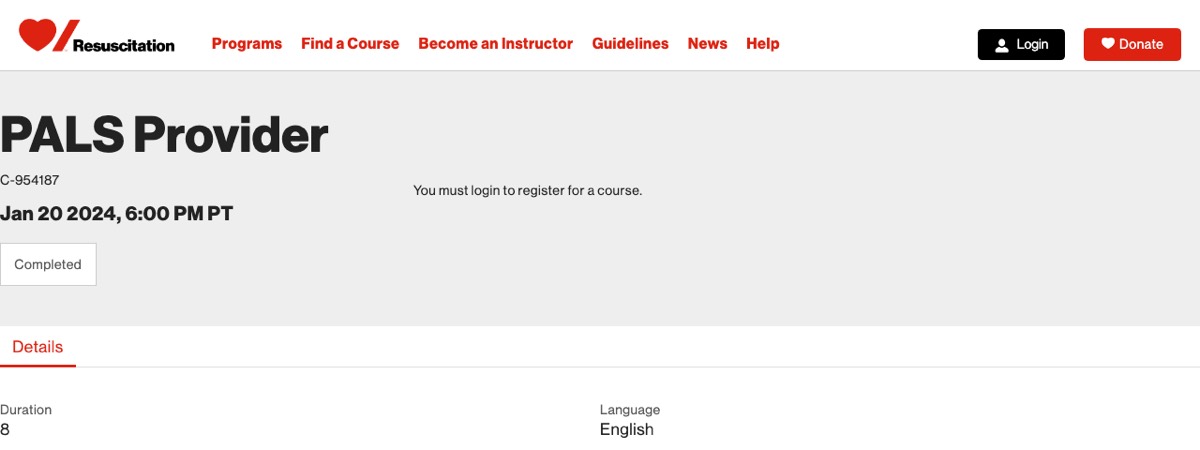
PALS Provider is the Heart & Stroke Foundation's 14-hour course, delivered as 14 classroom hours or blended online learning plus 9 hours in the classroom, for CA$480.00 in Ontario.
| Provider | Heart & Stroke Foundation |
|---|---|
| Length | Blended Learning: Mix of self-paced, online learning and 9 hrs in classroom setting OR Traditional Learning: 14 hrs in classroom setting |
| Cost (CAD) | CA$480.00 |
| Credential | PALS Provider Certificate Valid for 2 yrs |
| Format | hybrid, Ontario |
Fiona's take: This is the credential employers mean when they write PALS in a posting. The certificate is valid for 2 years and recognized throughout Canada. The blended format suits working nurses because the theory happens on your own schedule and only the 9 classroom hours pull you off the roster.
Skip it if: Skip it if your card is still current; the renewal is shorter and cheaper.
See Program DetailsPALS – Pediatric Advanced Life Support
PALS - Pediatric Advanced Life Support is an in-person course from Sunnybrook Education & Training in Ontario, run over one weekend.
| Provider | Sunnybrook Education & Training |
|---|---|
| Length | Saturday: 8:00 a.m. to 4:00 p.m. (BLS, 8:00 a.m. – 9:00 a.m., PALS, 9:00 a.m. – 4:00 p.m.) Sunday: 9:00 a.m. to 4:00 p.m. (PALS, 9:00 a.m. – 4:00 p.m.) |
| Credential | PALS Course Completion Cards issued by the Heart & Stroke Foundation. Certification is valid for two years |
| Format | in person, Ontario |
Fiona's take: Sunnybrook runs BLS from 8:00 a.m. to 9:00 a.m. on the Saturday, then PALS from 9:00 a.m. to 4:00 p.m., and again Sunday 9:00 a.m. to 4:00 p.m. Completion cards are issued by the Heart & Stroke Foundation and are valid for two years. The weekend block suits clinicians who cannot spread a course across weekday evenings, and Sunnybrook lists a BLS hour before PALS on Saturday; confirm with Sunnybrook whether this satisfies your prerequisite before registering.
Skip it if: Skip it if you cannot commit to a full weekend in Ontario; blended options exist.
See Program DetailsPediatric Advanced Life Support (PALS) Courses
Pediatric Advanced Life Support (PALS) Courses from VIVICPR in Ontario offer 14 hours blended or 14 hours in the classroom.
| Provider | VIVICPR |
|---|---|
| Length | 14 hrs blended · 14 hrs classroom |
| Credential | 2-year PALS Provider card |
| Format | hybrid, Ontario |
Fiona's take: VIVICPR issues the 2-year PALS Provider card recognized throughout Canada. Two format choices at the same length let you pick by schedule rather than content, which is the right way to choose once the credential is identical. I tell clients to compare their calendar, not the certificate.
Skip it if: Skip it if you are outside Ontario; there are providers in other provinces.
See Program DetailsPALS Provider
PALS Provider from SkillStat is an in-person course in British Columbia that awards the Heart and Stroke Foundation PALS Provider certificate, good for 2 years.
| Provider | SkillStat |
|---|---|
| Credential | Heart and Stroke Foundation PALS Provider certificate (good for 2 years) |
| Format | in person, British Columbia |
Fiona's take: For clients in British Columbia, SkillStat gives a local route to the same two-year card, so nobody needs to fly to Ontario for the credential. The certificate is the Heart & Stroke one employers ask for. Confirm the next sitting dates directly before planning around them.
Skip it if: Skip it if you want the blended format; this listing is in person.
See Program DetailsPALS Certification & Renewal
PALS Certification & Renewal from the Canadian Heart Association offers hybrid delivery across Canada and issues a PALS Provider Certificate valid for two years.
| Provider | Canadian Heart Association |
|---|---|
| Credential | PALS Provider Certificate, valid for two years |
| Format | hybrid, National (Canada) |
Fiona's take: The national hybrid format helps rural and northern clinicians who cannot reach a major centre easily. The certificate is the two-year PALS Provider credential. As with any renewal, check that your BLS is current within 12 months and your self-assessment pass is in hand before you register.
Skip it if: Skip it if a Heart & Stroke or hospital program like Sunnybrook is closer to you.
See Program DetailsHow Much Does PALS Certification Cost In Canada?
PALS certification costs between CA$180 and CA$480 depending on whether you take a renewal or the full Provider course, and the manual can add CA$80.
| Item | Cost (CAD) | What It Includes |
|---|---|---|
| PALS Provider course (Sunnybrook, Ontario) | 400 | Course for Resident, Fellow, RN, NP, PA, RT and Paramedic; the 2020 PALS Manual is extra at $80 |
| PALS Provider (Heart & Stroke, Ontario) | 480 | Blended or 14-hour classroom course |
| PALS Renewal (Heart & Stroke) | 199-275 | Renewal course |
| PALS Recertification (First Aid Plus) | 225 | Recertification course |
| Coursera preview: Emergency Care: Pregnancy, Infants, and Children | Not listed | 16 hours of pediatric emergency content, no PALS card |
| Udemy: Pediatric Advanced Life Support (PALS) | Free | 1.5 hours of on-demand video, no PALS card |
Two figures matter most in my advising: Sunnybrook charges CA$400 for the full Provider course for Residents, Fellows, RNs, NPs, PAs, RTs and Paramedics, and the Heart & Stroke renewal starts at CA$199. If your employer covers continuing education, ask before you pay; the renewal alone is the difference between CA$199 and CA$400 plus an $80 manual.
The free Udemy video and the Coursera course with no listed CAD price are where I tell clients to start only when they are undecided. They settle whether pediatric resuscitation is worth the several hundred dollars the real credential takes.
Is PALS Certification Worth It In 2026?
PALS is worth it in 2026 if a pediatric role is on your horizon. Employers in emergency rooms, critical care units and EMS ask for the card in postings, the Heart & Stroke credential is recognized throughout Canada, and Job Bank lists a $38.00 national median hourly wage for NOC 32102 paramedical occupations; compare that with the course cost.
Timing decides the price. Renew on schedule and the credential costs CA$180 to CA$275 over 6 to 8 hours; let the card lapse and you are back to the full 14-hour Provider course at CA$250 to CA$480. I tell clients to put the two-year expiry date in their calendar the day they receive the card.
If you are a student or career changer who has not yet been hired into a pediatric setting, the card can wait. Start with the free 1.5-hour Udemy video and the 16-hour Emergency Care: Pregnancy, Infants, and Children course, confirm the specialty suits you, then pay for the Heart & Stroke course when a posting asks for it.
PALS Certification Questions Canadians Ask
How Long Is PALS Certification Valid In Canada?
PALS certification is valid for two years from the date of issue. Sunnybrook states it plainly: cards are issued by the Heart & Stroke Foundation and certification is valid for two years from the date of issue. Mark the date and book a renewal while you are still within grace.
What Is Required Before Taking A PALS Course?
Two prerequisites stand between you and the classroom: a valid Heart & Stroke BLS completion card held within the past 12 months, and a pass of at least 70% on the PALS Pre-course Self-Assessment. The self-assessment takes roughly 1 to 2 hours and costs nothing, so clear it early.
Who Needs PALS Certification?
PALS is for healthcare providers who respond to cardiopulmonary emergencies in paediatric settings, including emergency rooms, critical care units and EMS. SickKids names nurses, physicians, paramedics and respiratory therapists as the audience. If your unit treats children in crisis, your employer likely expects the card.
Is PALS Mandatory For Nurses In Canada?
PALS is not mandated by provincial regulators for general nursing licensure. Requirements vary by employer, province and scope of practice, and many employers require it for roles involving pediatric patients. Read your target job postings; they tell you what the licence alone does not.
What Is The Cost Of PALS Renewal In Canada?
PALS renewal courses cost CA$180 to CA$275 depending on provider and format, and the Heart & Stroke lists its renewal at CA$199.00. First Aid Plus charges CA$225.00 for recertification. That is far below the CA$400 to CA$480 full Provider price, so renewing on time saves real money.
Can PALS Be Taken Online In Canada?
Heart & Stroke PALS certification is not fully online; it uses classroom or blended learning with in-person skills. Heart & Stroke offers two formats, traditional classroom teaching or blended learning, and fully online without skills is not offered by Heart & Stroke, which is why the free Udemy video is only a study aid.
Which Organization Issues PALS Certification In Canada?
The Heart & Stroke Foundation of Canada issues the PALS course completion card, whether you take the course at Sunnybrook, VIVICPR or SkillStat. The card is valid for 2 years throughout Canada. Compare format, dates and price across providers rather than hunting for a different issuer.
Is PALS Recognized Across Canada?
PALS recognition across Canada is complete for the Heart & Stroke card: the Provider certification is valid for 2 years and recognized throughout Canada, from Ontario to British Columbia. Heart & Stroke PALS is recognized throughout Canada; confirm any employer-specific requirements in the job posting.
What's The Bottom Line On PALS Certification In Canada?
- The Heart & Stroke PALS Provider Certificate is the credential Canadian employers mean by PALS: valid 2 years, recognized throughout Canada, 14 hours and roughly CA$250 to CA$480 for the full course.
- The least expensive legitimate route is the Renewal at CA$180 to CA$275 over 6 to 8 hours, but only if your current card has not lapsed and your BLS is within 12 months.
- No provincial regulator mandates PALS for general nursing licensure; requirements vary by employer, province and scope of practice, so the job posting is your rulebook.
- Before paying, Emergency Care: Pregnancy, Infants, and Children is a 16-hour, 4.8-rated way to test the field, with the honest caveat that it grants no PALS card of any kind.
- Pay for the real card when a pediatric role is in sight; Job Bank lists a $38.00 national median hourly wage for NOC 32102 paramedical occupations; compare that with the course cost.