Key Takeaways
- The fastest full credential among programs listed in this guide is the Police Foundations Diploma from Canadian Career Education College (CCEC): 42 weeks, 1,025 hours, $11,900, in class or online in Ontario. The fastest degree listed is Athabasca University's online Bachelor of Professional Arts, Criminal Justice major, at as little as 2 years of full-time study.
- No regulator or licensing body is listed for the criminal justice degree itself, so the career you want afterward, policing included, has its own hiring or licensing requirements: check them with the employer or body before you choose a program.
- The try-first option is Hot Topics in Criminal Justice from Vanderbilt University on Coursera: 2 weeks at 10 hours a week, with a shareable certificate. It does not grant a diploma, a degree or any professional standing.
- Correctional service officers (NOC 43201) show a listed median of $36.15 an hour Canada-wide, $39.00 in Ontario and $36.00 in Alberta; police officers sit under a separate grouping, NOC 42100, and Job Bank rates the Ontario outlook for NOC 43201 as Moderate for 2025-2027.
- Fiona's verdict: spend the two weeks on Coursera first, then take a 2-year college diploma such as Okanagan College's ($5,152 estimated first-year domestic cost) to work sooner, or Athabasca's online major if the bachelor's itself is the goal.
Criminal justice study in Canada spans several program names: criminal justice, criminology and policing, justice studies, and justice administration, at colleges and universities in BC, Alberta and Ontario. The fastest degree route listed is Athabasca University's online Bachelor of Professional Arts, Criminal Justice major, at as little as 2 years of full-time study, while Wilfrid Laurier University's online Criminology and Policing BA runs approx. four to five years.
Before committing tuition to any of them, I tell clients to spend 2 weeks on Hot Topics in Criminal Justice from Vanderbilt University. It shows you how the subject feels day to day before you commit anywhere.
What Are The Ways To Get A Criminal Justice Degree In Canada?
The ways into criminal justice in Canada run from a 2-week Coursera course to an online BA that takes approx. four to five years. The right pick depends on whether you want a taste of the field, a diploma or the full degree.
| Route | Time | Cost (CAD) | What You Get | Provider / Province | Best For |
|---|---|---|---|---|---|
| Hot Topics in Criminal Justice | 2 weeks at 10 hours a week | Not listed | Shareable certificate | Vanderbilt University (Coursera) | Testing the field before committing |
| Police Foundations Diploma | 42 weeks (1,025 hours) | $11,900 | Diploma | Canadian Career Education College (CCEC), ON | The fastest classroom credential |
| Diploma in Criminal and Social Justice | 2 years | $5,152 estimated first-year cost (domestic) | Diploma | Okanagan College, BC | Classroom study in the Okanagan |
| Justice Administration Services | 4 semesters (2 years) | Not listed | Ontario College Diploma | Seneca Polytechnic, ON | Ontario students who need online delivery |
| Bachelor of Professional Arts, Criminal Justice Major | As little as 2 years full-time | Not listed | Degree | Athabasca University, AB | Degree seekers studying online |
| Criminology and Policing (BA) | Approx. four to five years | Tuition $6,180 (domestic) | BA | Wilfrid Laurier University, ON | A full bachelor's with a policing focus |
For readers still deciding I recommend the Coursera route; for a Canadian campus at a listed price, Okanagan College's $5,152 first-year estimate; and for anyone whose goal needs the bachelor's, Athabasca's online major.
What Is The Fastest Way To Get A Criminal Justice Credential In Canada?
The fastest criminal justice credential among programs listed in this guide is the 42-week Police Foundations Diploma from Canadian Career Education College. The fastest degree listed is Athabasca University's online Criminal Justice major at as little as 2 years of full-time study.
- Start with Hot Topics in Criminal Justice from Vanderbilt University, 2 weeks at 10 hours a week, to confirm the field holds your interest before you spend anything larger.
- If speed is the whole point, apply to the Police Foundations Diploma at Canadian Career Education College: 42 weeks, 1,025 hours, $11,900, in class or online in Ontario.
- If the degree itself is the goal, apply to Athabasca University's Bachelor of Professional Arts, Criminal Justice major, an Alberta program you can finish in as little as 2 years of full-time online study.
- Compare the two-year college options on price before you commit: Okanagan College lists an estimated $5,152 first-year domestic cost, Red Deer Polytechnic lists $6,080 for Year 1 and $4,864 for Year 2, and Camosun College lists $8,212 domestic.
- Study the listed wage data for correctional service officers (NOC 43201), a Canada-wide median of $36.15 an hour, and note that police officers sit under a separate grouping, NOC 42100, before you map a program to a paycheque.
- If you want the bachelor's with a policing angle and can go the distance, Wilfrid Laurier's online Criminology and Policing BA takes approx. four to five years at $6,180 domestic tuition.
Does A Criminal Justice Degree Lead To A Regulated Profession?
A criminal justice degree has no regulator listed for the credential itself. That means the role you want afterward, policing included, carries its own hiring or licensing requirements, set by the employer or body rather than by your transcript. Check those requirements before you choose a program, not after.
A diploma from Camosun College or Seneca Polytechnic proves you finished a program of study. No regulator is listed for the criminal justice degree or diploma itself, so whether your target is policing or an administrative role, the requirements that matter are the ones the employer or body publishes. Ask for them before you enroll, not after you graduate.
This is also why I like the Coursera-first approach here. A shareable certificate from Hot Topics in Criminal Justice makes no claim on professional standing, so nothing about it confuses the credential question while you decide between a 42-week diploma and a four-to-five-year BA.
Which Criminal Justice Courses And Programs Are Worth Taking?
Criminal justice options worth your money in 2026 span three tiers: Coursera courses for testing the water, an $11.99 Udemy survey, and 2-year diplomas and online degrees from BC, Alberta and Ontario schools. Here is my read on each.
Hot Topics in Criminal Justice
Hot Topics in Criminal Justice is a 2-week online course from Vanderbilt University, at 10 hours a week, that surveys current debates in the field and ends with a shareable certificate.
| Provider | Vanderbilt University |
|---|---|
| Length | 2 weeks at 10 hours a week |
| Rating | 4.6 (199 reviews) |
| Credential | Shareable certificate |
| Format | online |
Fiona's take: This is the course I put in front of every client who asks about the field. The 4.6 rating across 199 reviews suggests it lands for most people. Treat it as reconnaissance for the Okanagan or Athabasca decision, not as a credential that moves your resume.
Skip it if: Skip it if you already hold a justice diploma or degree and want advanced material, because this is an entry-level survey.
Start On CourseraForensic Science: DNA Analysis
Forensic Science: DNA Analysis is a 4-week online course from the University of Cambridge, at 10 hours a week, that teaches DNA analysis methods used in forensic work, with a shareable certificate.
| Provider | University of Cambridge |
|---|---|
| Length | 4 weeks at 10 hours a week |
| Rating | 20 reviews |
| Credential | Shareable certificate |
| Format | online |
Fiona's take: Twenty reviews is a small base, but the University of Cambridge name carries weight and the topic is specific enough to test a forensic interest rather than a general justice one. I suggest it for clients torn between a justice diploma and a science path. Four weeks at 10 hours a week is a real commitment, so schedule it deliberately.
Skip it if: Skip it if your interest is policing or law rather than lab-based forensic work.
Start On CourseraRights, Liberties, & Criminal Law
Rights, Liberties, & Criminal Law is an online course from the University of Illinois Urbana-Champaign that examines individual rights against criminal law, with a shareable certificate.
| Provider | University of Illinois Urbana-Champaign |
|---|---|
| Credential | Shareable certificate |
| Format | online |
Fiona's take: No length or rating is listed for this course, so I treat it as a deeper dive to schedule after the Vanderbilt survey rather than a first stop. The rights angle suits readers who enjoy the legal reasoning side of the Laurier BA more than the operational side. Confirm the workload on the course page before you block out weeks for it.
Skip it if: Skip it if you specifically want Canadian law, because this course comes from a US university.
Start On CourseraIntroduction to Criminal Justice
Introduction to Criminal Justice is an 11h 10m online course from Kevin W. Jennings, Ph.D. on Udemy that surveys the field end to end, with a certificate of completion.
| Provider | Kevin W. Jennings, Ph.D. |
|---|---|
| Length | 11h 10m |
| Cost (CAD) | $11.99 (current price) |
| Rating | 4.7 (307 ratings) |
| Credential | Certificate of completion |
| Format | online |
Fiona's take: At $11.99 (current price) for 11h 10m, this is the lowest listed price among the priced short courses in this guide, and the 4.7 rating across 307 ratings is the largest review base of any course listed here. I recommend it for readers who want a self-paced video survey between the Vanderbilt course and a diploma application. I tell clients not to expect admissions readers to weigh it like university coursework.
Skip it if: Skip it if you want graded university work, since this is a video course with a completion certificate.
View On UdemyComparative Criminal Justice
Comparative Criminal Justice is an online course from Kevin W. Jennings, Ph.D. on Udemy that compares justice systems across countries, with a certificate of completion.
| Provider | Kevin W. Jennings, Ph.D. |
|---|---|
| Rating | 4.6 (9 ratings) |
| Credential | Certificate of completion |
| Format | online |
Fiona's take: The same instructor as the introduction course, with a 4.6 rating from 9 ratings, so the feedback base is thin. Comparative material suits readers planning the Laurier BA, where system-level thinking gets rewarded. No length or current price is listed, so check both on Udemy before enrolling.
Skip it if: Skip it if you are still deciding on the field, because the introduction course covers that job better.
View On UdemyDiploma in Criminal and Social Justice
Diploma in Criminal and Social Justice is a 2-year in-person diploma from Okanagan College that combines criminal justice study with a social justice focus at its Kelowna, Penticton and Salmon Arm campuses.
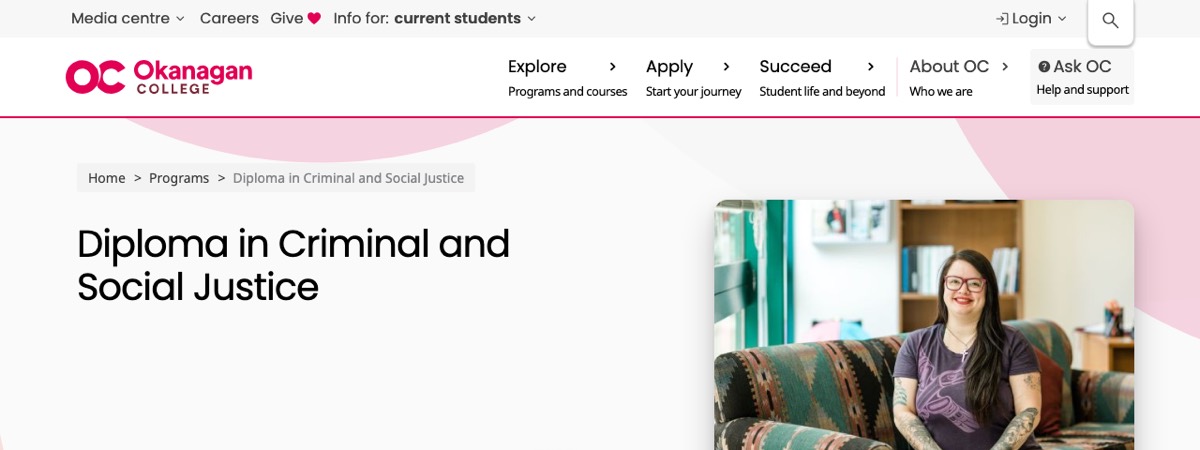
| Provider | Okanagan College |
|---|---|
| Length | 2 years |
| Cost (CAD) | $5,152 estimated first-year cost (domestic, Kelowna/Penticton/Salmon Arm) |
| Credential | Diploma |
| Format | in-person, BC |
Fiona's take: The estimated $5,152 first-year domestic cost is the lowest entry price of the diplomas listed here, and the three-campus spread across the Okanagan gives you location choice. The social justice half of the curriculum suits readers aiming at community-facing roles rather than enforcement. That figure covers first year only, so confirm second-year costs with the college.
Skip it if: Skip it if you need online delivery, because this program is in person.
See Program DetailsJustice Studies Diploma
Justice Studies Diploma is a 2-year on-campus diploma from Red Deer Polytechnic that studies the justice system over two years in Alberta.
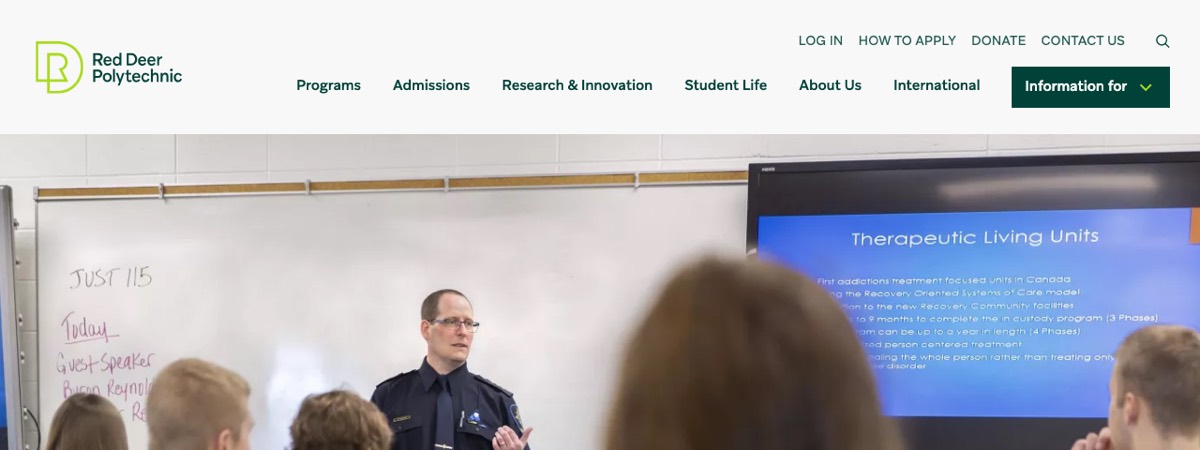
| Provider | Red Deer Polytechnic |
|---|---|
| Length | 2 Years |
| Cost (CAD) | Year 1 $6,080.00; Year 2 $4,864.00 (domestic estimate) |
| Credential | Diploma |
| Format | on campus, AB |
Fiona's take: The domestic estimate breaks out as $6,080 for Year 1 and $4,864 for Year 2, and the Year 2 drop is worth asking the polytechnic about when you budget. I point Alberta clients here before the CCEC route, since those figures sit well under CCEC's $11,900. Delivery is on campus in Red Deer, so plan for relocation or a commute.
Skip it if: Skip it if you need online study, since delivery is on campus.
See Program DetailsBachelor of Professional Arts, Criminal Justice Major
Bachelor of Professional Arts, Criminal Justice Major is an online degree from Athabasca University that can be completed in as little as 2 years of full-time study.
| Provider | Athabasca University |
|---|---|
| Length | as little as 2 years of full-time study |
| Credential | degree |
| Format | online, AB |
Fiona's take: This is the shortest degree route in this guide, and as an Alberta online program it fits readers who are working or parenting while they study. No tuition figure is listed, so request the current fee schedule from Athabasca before you build a budget. The 2-year pace assumes full-time study, so plan realistically around your hours.
Skip it if: Skip it if you want a campus cohort experience, because this degree is fully online.
See Program DetailsCriminal Justice, Diploma
Criminal Justice, Diploma is a 2-year diploma from Camosun College in British Columbia, offered full-time or part-time, at $8,212 domestic.
| Provider | Camosun College |
|---|---|
| Length | 2 years |
| Cost (CAD) | $8,212 (domestic) |
| Credential | Diploma |
| Format | full-time/part-time, BC |
Fiona's take: The part-time option is the differentiator here: most 2-year diplomas in this guide assume full-time attendance, and Camosun's flexibility suits working students in BC. At $8,212 domestic it sits above Okanagan's estimated first-year cost, so weigh the part-time access against the price. I raise it with clients whose shifts rule out a fixed timetable.
Skip it if: Skip it if the lowest possible price is the goal and full-time study works, since Okanagan's estimated first-year cost of $5,152 is lower.
See Program DetailsJustice Administration Services
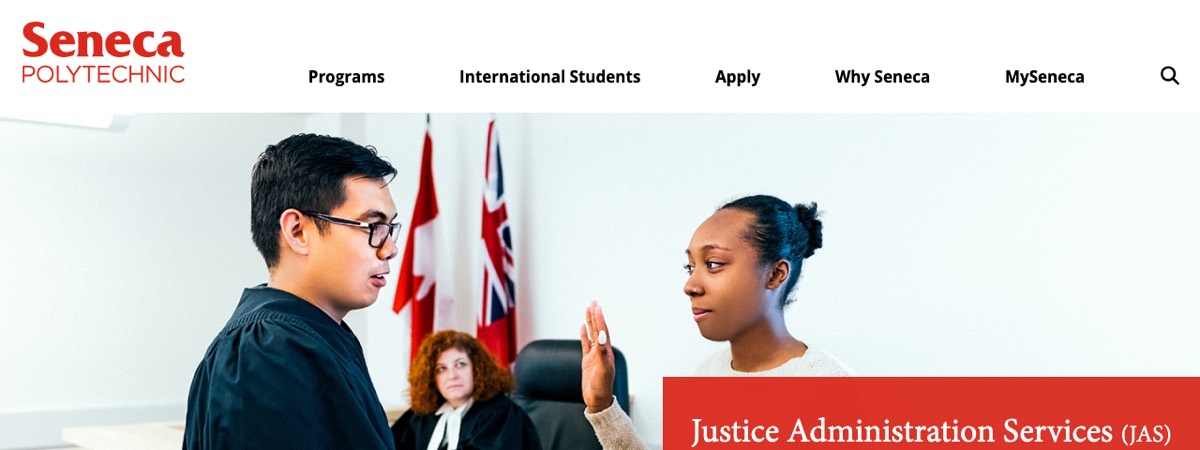
Justice Administration Services is a 4-semester, 2-year online program from Seneca Polytechnic that leads to an Ontario College Diploma.
| Provider | Seneca Polytechnic |
|---|---|
| Length | 4 Semesters (2 Years) |
| Credential | Ontario College Diploma |
| Format | online, ON |
Fiona's take: For Ontario readers without a campus nearby, an online Ontario College Diploma from Seneca Polytechnic is a practical middle path between CCEC's 42-week diploma and a four-year BA. No tuition figure is listed, so confirm domestic fees with Seneca before applying. The administration angle suits readers who prefer the paperwork side of the justice system to front-line work.
Skip it if: Skip it if you are in BC or Alberta, since in-person diploma options closer to you are listed here.
See Program DetailsCriminology and Policing (BA)
Criminology and Policing (BA) is an online bachelor's program from Wilfrid Laurier University that takes approx. four to five years, with domestic tuition listed at $6,180.

| Provider | Wilfrid Laurier University |
|---|---|
| Length | approx. four to five years |
| Cost (CAD) | Tuition $6,180 (domestic) |
| Credential | BA |
| Format | online, ON |
Fiona's take: This is the full-degree option for readers set on a bachelor's with a policing focus. The $6,180 domestic tuition figure sits near Red Deer Polytechnic's $6,080 Year 1, though it is not stated whether Laurier's number is annual or program-wide, so ask before you budget. The four-to-five-year timeline is roughly double the Athabasca minimum, so choose it for the curriculum, not for speed.
Skip it if: Skip it if 2 years is your ceiling, because this BA runs approx. four to five years.
See Program DetailsPolice Foundations Diploma
Police Foundations Diploma is a 42-week, 1,025-hour full-time program from Canadian Career Education College (CCEC), delivered in class or online, at $11,900.
| Provider | Canadian Career Education College (CCEC) |
|---|---|
| Length | 42 weeks, 1,025 hours, full time |
| Cost (CAD) | CAD $11,900 |
| Credential | Diploma |
| Format | in class or online, ON |
Fiona's take: At 42 weeks this is the fastest full credential in this guide, and the $11,900 price is stated plainly, which I appreciate. Weigh it against Red Deer Polytechnic's 2-year Justice Studies Diploma at $6,080 for Year 1 and $4,864 for Year 2 if Alberta works for you. As with any program, confirm how your target employer views the credential before you enroll.
Skip it if: Skip it if 42 weeks of full-time study is not realistic alongside work, since the schedule is full time.
See Program DetailsHow Much Does A Criminal Justice Degree Cost In Canada?
A criminal justice degree at Wilfrid Laurier University shows tuition of $6,180 (domestic), though it is not stated whether that figure is annual or program-wide, and no tuition figure is listed for Athabasca University. Listed diploma figures include Okanagan's $5,152 estimated first-year domestic cost, Red Deer's $6,080 Year 1 and $4,864 Year 2 domestic estimate, Camosun's $8,212 domestic figure, and CCEC's $11,900 price. The short courses sit far below all of it.
| Program | Provider | Length | Cost (CAD) |
|---|---|---|---|
| Hot Topics in Criminal Justice | Vanderbilt University (Coursera) | 2 weeks at 10 hours a week | Not listed |
| Introduction to Criminal Justice | Kevin W. Jennings, Ph.D. (Udemy) | 11h 10m | $11.99 (current price) |
| Police Foundations Diploma | Canadian Career Education College (CCEC) | 42 weeks (1,025 hours) | $11,900 |
| Diploma in Criminal and Social Justice | Okanagan College | 2 years | $5,152 estimated first-year cost (domestic) |
| Justice Studies Diploma | Red Deer Polytechnic | 2 years | Year 1 $6,080; Year 2 $4,864 (domestic estimate) |
| Criminal Justice, Diploma | Camosun College | 2 years | $8,212 (domestic) |
| Justice Administration Services | Seneca Polytechnic | 4 semesters (2 years) | Not listed |
| Criminology and Policing (BA) | Wilfrid Laurier University | Approx. four to five years | Tuition $6,180 (domestic) |
| Bachelor of Professional Arts, Criminal Justice Major | Athabasca University | As little as 2 years full-time | Not listed |
Two gaps to notice: no program fee is listed for Athabasca University or Seneca Polytechnic, so request current fees from both before you compare them on price. Among the priced diplomas, Okanagan's estimated $5,152 first-year domestic cost and Red Deer's $6,080 Year 1 sit below CCEC's $11,900, though CCEC's program runs 42 weeks rather than 2 years.
One comparison I make with clients: Laurier's $6,180 domestic tuition figure against a 2-year diploma depends entirely on whether that figure repeats each year. That breakdown is not given, so ask the university directly before you build a four-to-five-year budget around it.
How Much Do Correctional Service Officers (NOC 43201) Earn In Canada?
Correctional service officers (NOC 43201) earn a listed median of $36.15 an hour Canada-wide, $39.00 in Ontario and $36.00 in Alberta. The full ranges run from $27.00 at the Alberta low end to $48.08 at the Ontario high end.
| Region | Low ($/hour) | Median ($/hour) | High ($/hour) |
|---|---|---|---|
| Canada | $28.85 | $36.15 | $46.15 |
| Ontario | $29.43 | $39.00 | $48.08 |
| Alberta | $27.00 | $36.00 | $46.15 |
One caution before you map programs to these numbers: NOC 43201 covers correctional service officers, not the whole justice field. Police officers sit under a separate grouping, NOC 42100, and this guide carries no wage figures for it, so the pay behind a Police Foundations Diploma from CCEC or Laurier's Criminology and Policing BA follows that other grouping, not the table above. Read the NOC description for your target role before you budget years around it.
On outlook, Job Bank rates correctional service officers (NOC 43201) as Moderate in Ontario for the 2025-2027 period, which I read as steady hiring with real competition for spots. No verified Canada-wide or Alberta outlook appears in the data behind this page, so open Job Bank before planning around one. A related NOC 41409 entry lists a $40.00 median hourly wage in Canada, above the $36.15 median listed for NOC 43201.
Is A Criminal Justice Degree Worth It In 2026?
A criminal justice degree is worth it in 2026 if three things line up: the field genuinely interests you, the credential level matches your target role, and the price makes sense against wage data you can verify. Compare the listed tuition figures with the correctional service officer (NOC 43201) Canada-wide median of $36.15 an hour yourself before deciding anything, and remember that police pay sits under NOC 42100, a grouping this guide carries no figures for.
The test-first logic matters more in this field than most, because the programs differ sharply. $11,900 and 42 weeks at CCEC is a different bet than four to five years at $6,180 tuition at Laurier, and 2 weeks with Hot Topics in Criminal Justice settles the interest question before any of those commitments begins.
My verdict: the degree is the better fit for readers who want roles that expect university credentials or who plan further study, while the 2-year diploma suits readers who want to be working sooner, at Okanagan's estimated $5,152 first-year domestic cost or Red Deer's $6,080 Year 1. Either way, spend the two weeks testing first.
Criminal Justice Degree Questions Canadians Ask
How Long Does A Criminal Justice Degree Take In Canada?
A criminal justice degree takes as little as 2 years of full-time study through Athabasca University's online Criminal Justice major, or approx. four to five years through Wilfrid Laurier's online Criminology and Policing BA. Two-year diplomas sit between: Okanagan College, Camosun College and Red Deer Polytechnic each list 2 years, Seneca Polytechnic's online diploma runs 4 semesters, and CCEC's Police Foundations Diploma takes 42 weeks.
What Is The Fastest Criminal Justice Credential In Canada?
The fastest criminal justice credential in this guide is the Police Foundations Diploma from Canadian Career Education College: 42 weeks, 1,025 hours, full time, at $11,900, in class or online. The fastest degree listed is Athabasca University's Bachelor of Professional Arts, Criminal Justice major, listed at as little as 2 years of full-time online study. Red Deer Polytechnic's diploma costs less but takes the full 2 years.
Can You Complete A Criminal Justice Degree Online In Canada?
Completing a criminal justice degree online in Canada is possible through several listed options: Athabasca University's Criminal Justice major, Wilfrid Laurier's Criminology and Policing BA over approx. four to five years, and Seneca Polytechnic's online Justice Administration Services diploma in Ontario. CCEC offers its Police Foundations Diploma in class or online, and the Coursera and Udemy courses are online by default.
How Much Does A Criminal Justice Diploma Cost In BC?
Criminal justice diplomas in BC list two clear prices: Okanagan College's Diploma in Criminal and Social Justice at an estimated $5,152 first-year domestic cost across its Kelowna, Penticton and Salmon Arm campuses, and Camosun College's Criminal Justice Diploma at $8,212 domestic over 2 years. Both are classroom programs, so confirm current fees with each college before you budget.
Does A Criminal Justice Degree Guarantee A Police Job?
A criminal justice degree guarantees no police job at any school listed here. No regulator is listed for the credential itself, and police hiring runs on its own process, so ask your target service what it looks for before choosing between a 42-week diploma and a four-to-five-year BA.
What Do Correctional Service Officers (NOC 43201) Earn In Ontario?
Correctional service officers (NOC 43201) in Ontario earn $29.43 an hour at the low end, a $39.00 median and $48.08 at the high end, against a Canada-wide median of $36.15. Alberta shows $27.00 to $46.15 with a $36.00 median. Police officers sit under NOC 42100, not 43201, and Job Bank rates the Ontario outlook for 43201 as Moderate for 2025-2027.
Is A Coursera Certificate Enough To Work In Criminal Justice?
A Coursera certificate on its own is not enough for roles that require a diploma or degree. Hot Topics in Criminal Justice from Vanderbilt University takes 2 weeks at 10 hours a week and awards a shareable certificate: strong for testing the field and showing initiative, but no substitute for the 2-year diplomas or the Athabasca degree when employers screen for credentials.
Which Program Suits Alberta Criminal Justice Students?
Alberta students have two strong in-province options: Red Deer Polytechnic's Justice Studies Diploma, 2 years on campus at $6,080 for Year 1 and $4,864 for Year 2 in domestic estimates, and Athabasca University's online Bachelor of Professional Arts, Criminal Justice major, listed at as little as 2 years of full-time study with no tuition figure listed. Red Deer for the classroom, Athabasca for the degree.
What's The Bottom Line On Criminal Justice Degrees In Canada?
- Test the field first: Hot Topics in Criminal Justice takes 2 weeks at 10 hours a week and tells you whether the subject holds you before you pay tuition anywhere.
- Among programs listed here, the fastest degree is Athabasca University's online Criminal Justice major at as little as 2 years full-time, and the fastest full credential is CCEC's 42-week, $11,900 Police Foundations Diploma.
- Okanagan College lists an estimated $5,152 first-year domestic cost, Red Deer Polytechnic lists $6,080 for Year 1 and $4,864 for Year 2, Camosun College lists $8,212 domestic, and CCEC's 42-week diploma is $11,900.
- Correctional service officers (NOC 43201) show a listed median of $36.15 an hour Canada-wide, $39.00 in Ontario and $36.00 in Alberta; police officers sit under NOC 42100, and Job Bank rates the Ontario outlook for 43201 as Moderate for 2025-2027.
- Match the credential to the goal: a diploma to work sooner, Laurier's four-to-five-year BA or Athabasca's degree if the bachelor's itself is the target.