Key Takeaways
- The fastest realistic route is the Ontario Lawyer Licensing Process: a 3-year JD, a $160 application, the $865 barrister exam with $100 materials, 10-month articling or the Law Practice Program at $2,800, then a $165 or $250 call to the bar.
- The barrister exam is mandatory in Ontario: the Law Society of Ontario requires both the barrister and the solicitor exams for licensing, while many other provinces use skills-based programs such as PREP or CPLED instead of traditional exams.
- The try-first option is Corporate & Commercial Law I: Contracts & Employment Law from the University of Toronto, 2 weeks at 10 hours a week on Coursera: it covers business-law topics such as agency, contracts, debtor-creditor relationships, government regulation of business and business organizations, but it does not count toward LSO licensing or replace either exam.
- Job Bank puts lawyers (NOC 41101) at a median of $59.76 per hour in Canada, $65.21 in Ontario and $78.85 in Alberta, with a national low of $30.22 and high of $107.14.
- Fiona's verdict: commit if an Ontario litigation career is the goal, since both exams are unavoidable once you are in the process; test the field first with a short Coursera series if you are still deciding.
A barrister exam is one of two self-study, multiple-choice, open-book licensing exams the Law Society of Ontario requires in its lawyer licensing process, testing entry-level competencies from ethical responsibilities and Ontario and federal law to issue identification and the litigation process.
The route to it is long: a 3-year JD, LSO registration, both exams, and 10-month articling or the Law Practice Program. The sitting itself costs $865 plus $100 in materials. Test your interest with a short Coursera series before you commit years and fees.
What Are The Ways To Become A Barrister In Canada?
In Canada, the barrister exam is an Ontario requirement: it belongs to the Law Society of Ontario's lawyer licensing process, while many other provinces use skills-based programs such as PREP or CPLED instead of traditional exams. These are the routes I compare with clients.
| Route | Time | Cost (CAD) | What You Get | Recognised By | Best For |
|---|---|---|---|---|---|
| Corporate & Commercial Law I: Contracts & Employment Law first, to test the field | 2 weeks at 10 hours a week | Not listed | Shareable certificate | Coursera, not the Law Society of Ontario | Testing whether law study suits you before a JD |
| Ontario Lawyer Licensing Process (JD + articling or LPP + exams) | 3 years JD, then 10-month articling or LPP | $160 application + $865 barrister exam + $100 materials + $2,800 experiential; JD tuition not listed | Lawyer licence (called to the bar) | Law Society of Ontario | Becoming a licensed lawyer in Ontario |
| Emond Barrister Exam Preparation Course (support, not a licence) | Five days each spring, live webinar | Not listed | Exam preparation, no licence | Emond Exam Prep, not the LSO | Candidates who want structured lectures on the topics tested plus exam-preparation strategy |
I recommend the licensing process for anyone set on an Ontario legal career, the University of Toronto Coursera course first for people still deciding, and Emond for candidates who want substantive lectures on the topics tested plus an exam-preparation strategy component.
What Is The Fastest Way To Become A Barrister In Canada?
In Ontario, the barrister exam belongs to the Law Society of Ontario's lawyer licensing process, and the fastest way through is to move between stages with no gaps: a 3-year JD, registration with the LSO, both licensing exams, 10-month articling or the Law Practice Program, then the call to the bar. LSO candidates must meet the LSO licensing requirements.
- Complete a Canadian common law JD approved by the Law Society, or a Certificate of Qualification from the National Committee on Accreditation if you qualified abroad: the JD takes 3 years, tuition not listed.
- Apply and register in the LSO lawyer licensing process before the exam deadlines: $160 application fee.
- Register for the barrister exam: $865 plus $100 for study materials; the fall 2026 sitting is November 3, 2026.
- Pass both exams by self-study: the barrister and solicitor exams are multiple-choice and open book, with official materials provided.
- Complete 10-month articling or the Law Practice Program: $2,800.
- Take the call to the bar after all requirements: $165 or $250.
Is The Barrister Exam Required In Every Province?
The barrister exam is required in Ontario and not in every province: the Law Society of Ontario lists two lawyer licensing exams, the barrister and the solicitor, as a required part of licensing, while many other provinces use skills-based programs such as PREP or CPLED instead of traditional exams.
| Province | Barrister Exam Required? | Regulator Or Registry | What It Means |
|---|---|---|---|
| Ontario | Yes | Law Society of Ontario (LSO) | Two required licensing exams, barrister and solicitor, both multiple-choice and open book |
| Other provinces | Varies by province; many use skills-based programs such as PREP or CPLED | Varies by province | Many provinces use skills-based programs instead of traditional exams; confirm with the province where you will become licensed |
Eligibility matters more than geography at the start. To write a licensing exam, the LSO requires that you have completed a common law program at a university in Canada approved by the Law Society, or that you hold a Certificate of Qualification from the National Committee on Accreditation, and that you have applied to and registered in the lawyer licensing process. No Coursera or Udemy course on this page changes that gate.
The exam format also comes from the LSO: both the barrister and solicitor exams are self-study, multiple-choice and open book, with official study materials provided. The barrister exam tests ethical responsibilities, knowledge of Ontario and federal law, the barrister-client relationship, issue identification and the litigation process.
Which Barrister Exam Prep Courses Are Worth Taking?
Barrister exam prep courses worth taking split into three groups: Coursera series that build legal foundations, a Udemy orientation to the Canadian pathway, and the Emond course aimed at the Ontario exam itself. Only the last targets the LSO exams, and none registers you with the Law Society.
Corporate & Commercial Law I: Contracts & Employment Law
Corporate & Commercial Law I: Contracts & Employment Law is a 2-week online course from the University of Toronto, run at 10 hours a week across 5 modules, covering business-law topics such as agency, contracts, debtor-creditor relationships, government regulation of business and business organizations.
| Provider | University of Toronto |
|---|---|
| Length | 2 weeks at 10 hours a week (5 modules) |
| Rating | 4.8 (1,338 reviews) |
| Credential | Shareable certificate |
| Format | online |
Fiona's take: This is my pick for testing the field before you commit to a JD. The syllabus covers Agency, Contracts, Debtor-Creditor Relationships, Government Regulation of Business, and Business Organizations, the 4.8 rating from 1,338 reviews signals consistent delivery, and its cost is not listed. It does not count toward the LSO licensing process.
Skip it if: Skip it if you are already in the licensing process and only want exam review, because Emond is the closer fit.
Start On CourseraAI in Law: Research, Risk, and Legal Drafting
AI in Law: Research, Risk, and Legal Drafting is a 4-week online course series from Coursera, run at 10 hours a week across 9 courses, training legal research, risk analysis and drafting.
| Provider | Coursera |
|---|---|
| Length | 4 weeks at 10 hours a week (9 course series) |
| Cost (CAD) | not shown (Coursera Plus subscription) |
| Rating | from 108 reviews of courses in this program |
| Credential | Shareable certificate |
| Format | online |
Fiona's take: Research and drafting sit close to core barrister competencies, so this series is a sensible warm-up before law school. The 108 reviews across courses in this program are modest next to the University of Toronto numbers. It is skills training, not LSO barrister-exam preparation.
Skip it if: Skip it if you need doctrine for the sitting, since this series is about skills and tools rather than the exam syllabus.
Start On CourseraAI & Law
AI & Law is a 2-week online course from Lund University, run at 10 hours a week across 4 modules, surveying how artificial intelligence intersects with law.
| Provider | Lund University |
|---|---|
| Length | 2 weeks at 10 hours a week (4 modules) |
| Rating | 4.7 (839 reviews) |
| Credential | Shareable certificate |
| Format | online |
Fiona's take: Lund is a serious university and the course rates 4.7 from 839 reviews, so it is a low-risk way to explore a growing area. It is not identified as Ontario barrister-exam preparation, though the exam itself tests Ontario and federal law. Treat it as breadth for a tech-curious future litigator.
Skip it if: Skip it if the November 3, 2026 sitting is your only concern, because it adds breadth, not exam readiness.
Start On CourseraAnti Money Laundering: Canada
Anti Money Laundering: Canada is a 4-week online course series from SkillUp, run at 4 hours a week across 5 courses, covering Canadian anti-money-laundering rules.
| Provider | SkillUp |
|---|---|
| Length | 4 weeks at 4 hours a week (5 course series) |
| Cost (CAD) | not shown (Coursera Plus subscription) |
| Credential | career certificate from SkillUp |
| Format | online |
Fiona's take: Canadian content matters here: the series builds AML and ATF skills aligned with Canada's regulatory framework and FINTRAC reporting requirements. It carries no rating in our data, and a career certificate from SkillUp carries no weight with the LSO. I see it as a niche add-on after the basics.
Skip it if: Skip it if you are still deciding on law as a career; start with the University of Toronto course instead.
Start On CourseraHow to become a Lawyer in Canada
How to become a Lawyer in Canada is a 6h 41m online course from Daniel amar on Udemy, laid out in 5 sections, walking through accreditation as a lawyer in Canada.
| Provider | Daniel amar |
|---|---|
| Length | 6h 41m total length (5 sections • 5 lectures) |
| Cost (CAD) | not shown (starts at $13.00 per month subscription) |
| Rating | 4.7 out of 5 (7 ratings) |
| Format | online |
Fiona's take: At 6 hours 41 minutes it is a brief overview of how to get your law credentials recognized in Canada, and it rates 4.7 out of 5 from only 7 ratings, so treat that score lightly. Pricing starts at $13.00 per month on the Udemy subscription. Use it as orientation rather than licensing-exam preparation.
Skip it if: Skip it if you already hold a Canadian JD, because you know this material.
View On UdemyBarrister Exam Preparation Course
The Barrister Exam Preparation Course is a five-day live webinar course from Emond Exam Prep in Ontario, offered each spring, preparing candidates for the LSO barrister exam.
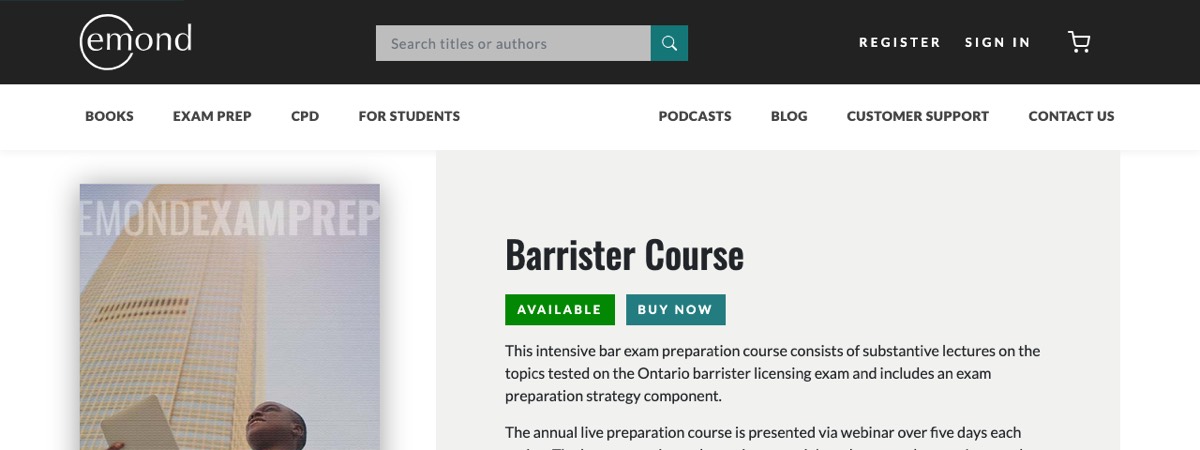
| Provider | Emond Exam Prep | Emond Publishing |
|---|---|
| Length | five days each spring (live webinar) |
| Format | hybrid, Ontario |
Fiona's take: Emond is the one offer on this page aimed at the exam itself, and its five-day spring format delivers substantive lectures on the topics tested plus an exam-preparation strategy component. The price is not listed, so ask before enrolling. Completing it does not register you with the LSO or replace the $865 sitting.
Skip it if: Skip it if self-study with the $100 official materials already works for you.
See Program DetailsHow Much Does The Barrister Exam Cost In Ontario?
The barrister exam costs $865 per sitting, plus $100 for study materials, under the 2026-2027 fee schedule published by the Law Society of Ontario. The wider licensing chain adds a $160 application, $2,800 for articling or the Law Practice Program, and $165 or $250 for the call to the bar.
| Fee | Amount (CAD) | Who Charges It |
|---|---|---|
| Barrister licensing exam | $865 per sitting | Law Society of Ontario |
| Barrister exam study materials | $100 | Law Society of Ontario |
| Licensing application fee | $160 | Law Society of Ontario |
| Articling or LPP experiential training | $2,800 | Law Society of Ontario |
| Call to the bar | $165 or $250 | Law Society of Ontario |
These fees sit inside a longer financial picture. The JD tuition that precedes everything is not listed on the LSO pages, and the $2,800 experiential fee applies whether you article or join the Law Practice Program. The exam fees recur per sitting, so a failed attempt means paying $865 again to rewrite.
Results arrive about eight weeks after you sit, and a rewrite means registering again and paying fees, so I tell clients to budget for the possibility of two sittings before they register for one. The $100 materials fee attaches to each attempt as well.
How Much Does A Barrister Earn In Canada?
Barristers in Ontario are licensed lawyers, and Job Bank tracks the occupation as NOC 41101: the median is $59.76 per hour in Canada, with a low of $30.22 and a high of $107.14.
| Province | Median Hourly (CAD) |
|---|---|
| Canada | 59.76 |
| Alberta | 78.85 |
| Newfoundland and Labrador | 66.85 |
| Ontario | 65.21 |
| British Columbia | 65.00 |
| New Brunswick | 59.94 |
| Quebec | 51.28 |
| Manitoba | 47.18 |
The spread between provinces is wide: Alberta's $78.85 median is far above Manitoba's $47.18, and Ontario sits at $65.21. Job Bank grades the outlook as moderate to good depending on province, moderate in some regions per Job Bank and COPS. The median is for the whole NOC 41101 occupation; starting wages for newly called lawyers are not provided.
For exam candidates the pay question is really a debt question: the licensing fees are fixed, at $865 and $100 for the barrister sitting, while earning power builds once the 10-month articling stage or the Law Practice Program ends and the call to the bar lands. Ontario's $65.21 median is the number I quote to clients weighing the province.
Is The Barrister Exam Worth It In 2026?
The barrister exam is worth it in 2026 for anyone committed to practising law in Ontario, because it is not optional: the LSO requires both licensing exams before the call to the bar. The listed sitting cost is $865 plus $100 in materials; JD tuition is not listed, so weigh that longer investment separately.
It is not worth rushing. The exam is self-study and open book, results take about eight weeks, and a failed attempt means registering and paying again. The competencies cover Ontario and federal law, ethics, the barrister-client relationship, issue identification and the litigation process, which is a lot of material to compress into a few weeks.
If you are pre-JD and unsure, run the 2-week University of Toronto course on Coursera before you apply anywhere. If it holds your attention, the licensing path, the fees and the $59.76 national median for NOC 41101 start to look reasonable.
Can You Get Funding For Barrister Exam Fees?
Funding for barrister exam fees comes down to the LSO's own supports: the Law Society's licensing fees page notes that financial help may be available, and it offers a monthly payment plan.
- LSO Financial Assistance / Monthly Payment Plan. The Law Society of Ontario says financial help may be available for licensing candidates, and its monthly payment plan can spread fees such as the $865 barrister exam and the $100 materials. Contact the LSO directly to confirm what you qualify for; the exam fee is still due for each sitting you write.
Barrister Exam Questions Canadians Ask
What Is The Barrister Exam In Ontario?
The barrister exam in Ontario is a required, self-study, multiple-choice, open-book licensing exam administered by the Law Society of Ontario. It tests entry-level barrister competencies: ethical responsibilities, knowledge of Ontario and federal law, the barrister-client relationship, issue identification and the litigation process. The LSO requires two lawyer licensing exams, the barrister and the solicitor, so candidates write both before they are called to the bar.
When Are The 2026 Barrister Exam Dates In Ontario?
The 2026 barrister exam dates give you the fall sitting on November 3, 2026. The LSO also lists a winter sitting on February 25, 2027, and a summer sitting on June 8, 2027. Registration closes before each exam date, so I tell clients to choose a sitting and plan backwards, keeping the roughly eight-week wait for results in mind in case a rewrite is needed.
How Much Does The Ontario Barrister Exam Cost?
The Ontario barrister exam costs $865 per sitting under the 2026-2027 fee schedule, plus $100 for the official study materials. The Law Society of Ontario also charges a $160 licensing application fee before you can register. Articling or the Law Practice Program adds $2,800, and the call to the bar adds $165 or $250.
Do All Canadian Provinces Require A Barrister Exam?
Not all provinces require a barrister exam. Ontario requires separate barrister and solicitor exams through the Law Society of Ontario, while many other provinces use skills-based programs such as PREP or CPLED instead of traditional exams. If you will become licensed in another province, confirm the pathway with that province's law society, because the two-exam structure is the Ontario model.
Are Ontario Bar Exams Open Book?
Ontario's licensing exams are open book. Both the barrister and the solicitor exams are self-study, multiple-choice and open-book, with official study materials provided by the Law Society of Ontario, paid through the $100 materials fee attached to the barrister sitting. Open book does not mean easy: the competencies cover Ontario and federal law, ethics, the barrister-client relationship, issue identification and the litigation process.
What Happens If I Fail The Barrister Exam?
Failing the barrister exam is not a dead end. Candidates may rewrite after registering again and paying fees, and results arrive about eight weeks after you sit. Because the exam costs $865 per sitting plus $100 for materials, a rewrite carries real cost, so I tell clients to treat the first attempt seriously with the official materials and a set study schedule.
How Long Is Articling In Ontario?
Articling in Ontario typically runs 10 months, as part of the experiential training requirement in the Law Society of Ontario's licensing process. The Law Practice Program is the alternative to articling, and either path costs $2,800. You complete your experiential training after the JD or a National Committee on Accreditation Certificate of Qualification, alongside passing the barrister and solicitor exams, before the call to the bar.
What Is The Median Wage For Lawyers In Canada?
Lawyers under NOC 41101 earn a median of $59.76 per hour in Canada according to Job Bank, with a low of $30.22 and a high of $107.14. Ontario sits at $65.21 per hour and Alberta at $78.85. The median covers the whole NOC 41101 occupation, and starting wages for newly called lawyers are not provided, so do not read it as a starting salary.
What's The Bottom Line On The Barrister Exam?
- The barrister exam is the Ontario model: the Law Society of Ontario requires both a barrister and a solicitor exam before the call to the bar, while many other provinces use skills-based programs such as PREP or CPLED instead.
- Budget $865 for the exam and $100 for materials per sitting, on top of the $160 application, the $2,800 articling or LPP fee, and the $165 or $250 call to the bar.
- Start with Corporate & Commercial Law I: Contracts & Employment Law if you are still testing the field: 2 weeks, University of Toronto, and no bearing on LSO licensing.
- The fall 2026 barrister exam sits November 3, 2026, and results arrive about eight weeks after the sitting.
- Lawyers (NOC 41101) earn a median of $59.76 an hour in Canada and $65.21 in Ontario, per Job Bank.