
Key Takeaways
- One of the shorter provider options is an online Use of Force course at $149.99 plus tax, completed in about 8 self-paced hours, with a Use of Force Competency Certificate issued immediately upon completion. Providers state it meets employer expectations for guards authorised to carry equipment in Ontario; confirm with your provincial regulator or employer before enrolling.
- Ontario's Ministry syllabus includes use-of-force theory within the mandatory 40-hour basic training, and employers may require additional practical training for equipment authorisation; police officers and Niagara Parks constables must complete Use of Force Requalification every 12 months under O. Reg. 87/24. Alberta requires certification and recertification for peace officers, and baton authorisation under the Security Services and Investigators Act requires a full 40-hour approved course.
- A Coursera option like Understanding and Managing the Stresses of Police Work from the University of Toronto takes 3 hours, but it is a shareable course certificate and does not qualify you for any provincial use of force licence, registration or certificate.
- Security guards fall under NOC 64410, with a Job Bank median wage of $21.00 per hour in Canada, $20.00 in Ontario and $22.75 in British Columbia.
- Fiona's verdict: if an employer requires the certificate, take the approved course your province or employer recognises; use Coursera only to test the field and build de-escalation theory first.
A Use of Force certificate is a training credential for security guards, peace officers and police that covers legal authority, de-escalation and control techniques for carrying batons, handcuffs or similar equipment. In Ontario the Ministry training syllabus includes use-of-force theory within the mandatory 40-hour basic security guard training, and police officers must requalify every 12 months.
A short provider option is the online course: $149.99 plus tax, about 8 self-paced hours, and a digital Use of Force Competency Certificate on completion. In-person training runs $199 plus HST in Ontario; the Alberta blended option is $245. Providers state these courses meet employer expectations for guards authorised to carry equipment, so confirm with your regulator or employer before enrolling. Before you spend anything, I recommend starting with a Coursera course to test the field, since no Coursera certificate replaces the provincial one.
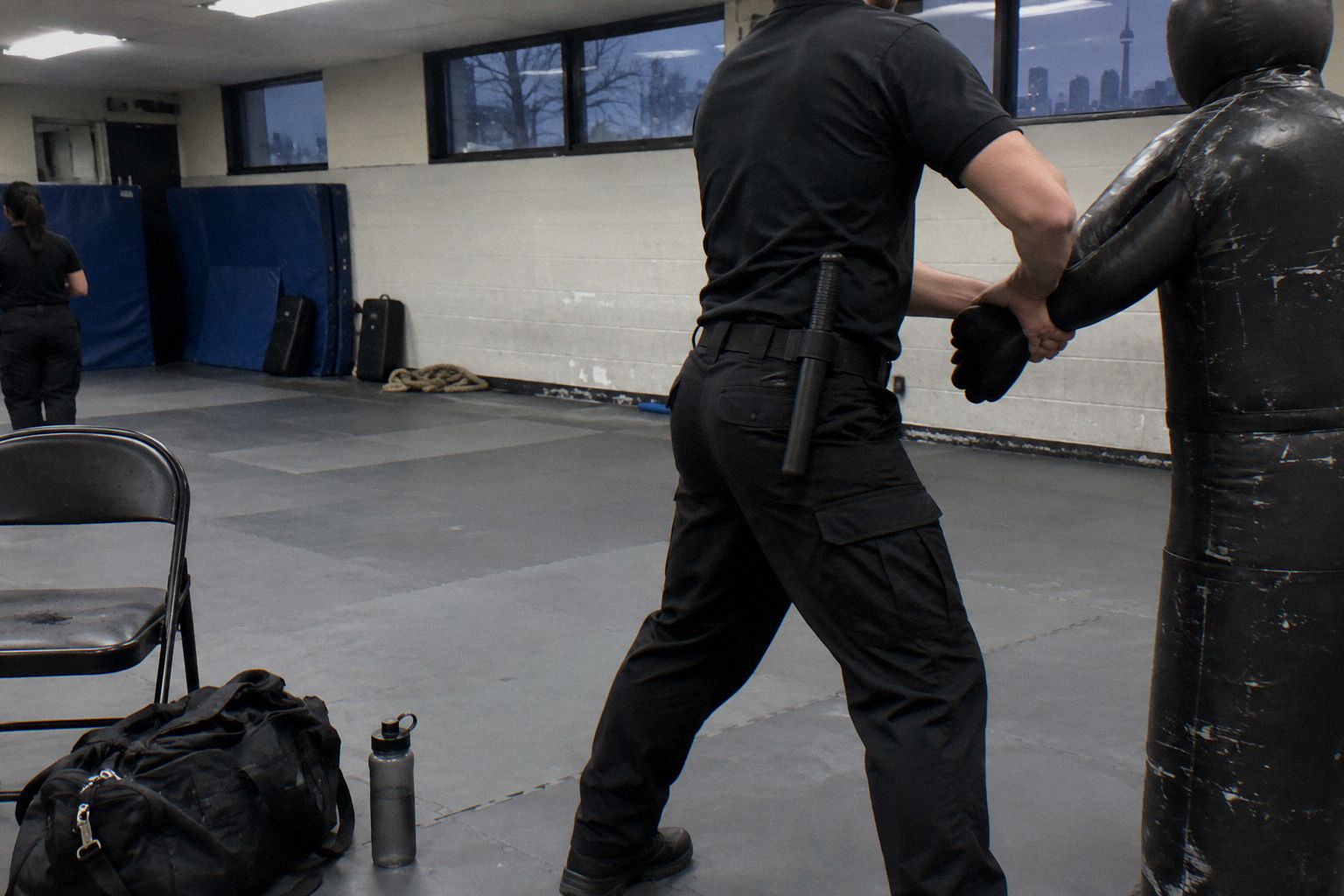
What Are The Ways To Get Use Of Force Certification In Canada?
Use of Force certification comes through three main routes: an online course, in-person training, or blended delivery, and recognition rules vary by province and role, with examples from Ontario, Alberta and BC below.
| Route | Time | Cost (CAD) | What You Get | Recognised By | Best For |
|---|---|---|---|---|---|
| Understanding and Managing the Stresses of Police Work plus an approved course later | 3 hours (Coursera intro) | Coursera cost not listed | Shareable course certificate; theory only | Coursera; no provincial recognition | Testing the field before committing to paid certification |
| Online Use of Force course (security guards) | 8 hours self-paced | $149.99 + tax | Use of Force Competency Certificate | Some providers state their certificate is accepted by employers across Canada; confirm with your provincial regulator or employer before enrolling | Security guards whose employer accepts an online certificate |
| In-person Use of Force (handcuffing and baton) | 1 day | $199.00 + HST | Digital Use of Force certificate | Ontario security employers | Ontario guards who want hands-on baton and handcuffing practice |
| Alberta Peace Officer Use of Force Legislation (blended) | 8 hours online + in-person review/exam | $245 | Course completion certificate | Accredited by Alberta Security Programs / approved providers under the Security Services and Investigators Act | Alberta peace officers |
For Ontario security guards I recommend starting with the online route at $149.99 plus tax if your employer accepts it, since it takes 8 self-paced hours. Alberta peace officers should take the $245 blended course accredited under the Security Services and Investigators Act; security guards seeking Alberta baton authorisation need the full 40-hour approved course, so confirm the approved provider before enrolling.
What Is The Shortest Way To Get A Use Of Force Certificate In Canada?
One of the shorter provider options is the online course, which can be finished in a single day; many roles still require in-person components or the 40-hour basic training.
- Enrol in an online Use of Force course, such as the one from Training Centre Canada at $149.99 plus tax. Enrolment is immediate.
- Complete the 8 hours of self-paced modules. This is the full course length, so a focused day is enough.
- Complete the course requirements and receive your digital Use of Force Competency Certificate immediately upon completion.
- Check what your employer or regulator actually requires: Ontario's Ministry syllabus includes use-of-force theory within the mandatory 40-hour basic training, and employers may require additional practical training for equipment authorisation.
- Book your recertification: providers list recertification fees of $89 for handcuffing or $99 for handcuffing and baton, and Ontario police must requalify every 12 months under O. Reg. 87/24.
Is Use Of Force Certification Mandatory In Canada?
Use of Force training requirements depend on your province and your role; the table below gives examples from Ontario, Alberta and BC, and other provinces such as New Brunswick also have rules for equipment authorisation, so check your specific provincial regulator.
| Province | Required? | Regulator Or Standard | What It Means |
|---|---|---|---|
| Ontario | Use-of-force theory is part of the mandatory 40-hour basic training; employers may require additional practical training for equipment authorisation; annual requalification for police and special constables | Ministry of the Solicitor General's Private Security and Investigative Services Branch; Ontario Police College and certified trainers | Guards may carry employer-issued batons for defensive purposes and handcuffs; police officers and Niagara Parks constables must complete Use of Force Requalification within every 12 months under O. Reg. 87/24 |
| Alberta | Yes, for peace officers as a condition of certification and recertification; baton authorisation for security requires the full 40-hour approved course | Alberta Security Programs / approved providers under the Security Services and Investigators Act | Actively employed peace officers must certify and recertify; to carry a baton, guards must complete an approved 40-hour baton use-of-force training course |
| British Columbia | Yes, for police use of force instructors | Province of British Columbia policing standards | Instructors must complete BC's Standardized Use of Force Instructor Course (SUFIC) or other provincially approved training |
The Coursera options on this page do not satisfy any of these requirements. A shareable course certificate from Coursera is not a provincial licence, registration or use of force certificate, so treat it as preparation, not qualification. If your employer or regulator expects a certificate, only an approved provider's course counts.
Recertification timing matters as much as the initial course. Ontario's regulation states every police officer and Niagara Parks constable must complete Use of Force Requalification within every 12 months, and providers list recertification fees of $89 to $99 for handcuffing and baton courses. In Alberta, baton authorisation is tied to the full 40-hour approved training course, so guards seeking baton authorisation should confirm the requirement and the approved provider before enrolling in a shorter course. New Brunswick also requires guards who carry batons or handcuffs to complete a training program approved by the Minister, which is a reminder that the examples above are not the full list.
Which Use Of Force Courses Are Worth Taking?
Start with a Coursera course to test the field, then move to an approved provider when you need the actual certificate.
Understanding and Managing the Stresses of Police Work
Understanding and Managing the Stresses of Police Work is a 3-hour online course from the University of Toronto that ends with a shareable certificate and rates 4.8 from 453 reviews.
| Provider | University of Toronto |
|---|---|
| Length | 3 hours to complete |
| Rating | 4.8 (453 reviews) |
| Credential | Shareable certificate |
| Format | online |
Fiona's take: I recommend this as the first stop for anyone considering security or policing work. It covers the stress side of the job, which is the part career changers underestimate most, and 3 hours is a small investment to find out if the field fits. This course does not qualify you for any provincial use of force licence, registration or certificate, so plan on an approved course afterwards.
Skip it if: Skip it if you already hold a Use of Force certificate and need continuing training hours, since it is not a regulated credential.
Not a provincial licence, registration or certificate.
Start On CourseraConflict Management Specialization
Conflict Management Specialization is a 4-week online specialization from the University of California, Irvine at about 10 hours a week, rated 4.6 from 1,322 reviews.
| Provider | University of California, Irvine |
|---|---|
| Length | 4 weeks to complete at 10 hours a week |
| Rating | 4.6 (1,322 reviews) |
| Credential | Shareable certificate |
| Format | online |
Fiona's take: De-escalation is one part of Use of Force training, alongside legal authority and control techniques, and this specialization goes deeper on the verbal side than most one-day certifications will. Four weeks at 10 hours a week is a serious commitment, so I suggest it for people already working in security who want to strengthen the verbal skills that keep force from being needed. It is a shareable course certificate, not a provincial credential.
Skip it if: Skip it if you only need the Ontario certificate for an employer, since the Ministry will not recognise it.
Not a provincial licence, registration or certificate.
Start On CourseraConflict Resolution Skills
Conflict Resolution Skills is a 6-hour online course from the University of California, Irvine ending in a shareable certificate.
| Provider | University of California, Irvine |
|---|---|
| Length | 6 hours |
| Credential | Shareable certificate |
| Format | online |
Fiona's take: Six hours is close to the length of the actual online certification course, which makes this a useful dry run. I tell clients to treat it as the theory half of the job: negotiation, de-escalation and resolution, all taught by a university. It does not qualify you for any provincial licence or certificate.
Skip it if: Skip it if you need the handcuffing and baton hands-on component, which no online Coursera course provides.
Not a provincial licence, registration or certificate.
Start On CourseraProfessional Security Officer/Security Guard Training
Professional Security Officer/Security Guard Training is a 1 hour 15 minute online course from Fox Bravo on Udemy, rated 4.5 from 561 ratings.
| Provider | Fox Bravo |
|---|---|
| Length | 1h 15m total length |
| Rating | 4.5 (561 ratings) |
| Credential | Certificate of completion |
| Format | online |
Fiona's take: This is a broad security guard orientation rather than use of force training specifically, and its 1 hour 15 minutes make it the quickest overview on this page. It is useful for understanding the guard role before committing to the $149.99 certification course. It gives a Udemy certificate of completion, not a provincial credential.
Skip it if: Skip it if your employer is asking for a Use of Force Competency Certificate, which this does not provide.
Not a provincial licence, registration or certificate.
View On UdemyStudiGuide 20: Use of Force in California
StudiGuide 20: Use of Force in California is a 54-minute online course from Michael Rubacha on Udemy, rated 4.8 from 135 ratings.
| Provider | Michael Rubacha |
|---|---|
| Length | 54m total length |
| Rating | 4.8 (135 ratings) |
| Credential | Certificate of completion |
| Format | online |
Fiona's take: Despite the title, this covers California law, not Canadian law, so its use here is limited to the general concepts of legal authority and reasonable force. I would only point someone at it for exam-style review of the theory. It is not a Canadian credential of any kind.
Skip it if: Skip it if you are certifying in Canada, because the legal standards it teaches are not the ones in O. Reg. 87/24 or the Security Services and Investigators Act.
Not a provincial licence, registration or certificate.
View On UdemyUse of Force & Baton Training
Use of Force & Baton Training is an in-person course from Columbia College in Alberta that costs $500 and ends in a training certificate.
| Provider | Columbia College |
|---|---|
| Length | TBD |
| Cost (CAD) | $500 |
| Credential | Training Certificate |
| Format | in person, AB |
Fiona's take: At $500 this is the most expensive route on the page, and it is in-person baton and control training in Alberta. Confirm with your employer whether this in-person Alberta training is required for your role. Confirm the current course length with the college before booking, since it is listed as TBD.
Skip it if: Skip it if you only need the entry certificate, since cheaper routes listed here cover certification requirements for less.
See Program DetailsIn-Person Use of Force Training in Ontario
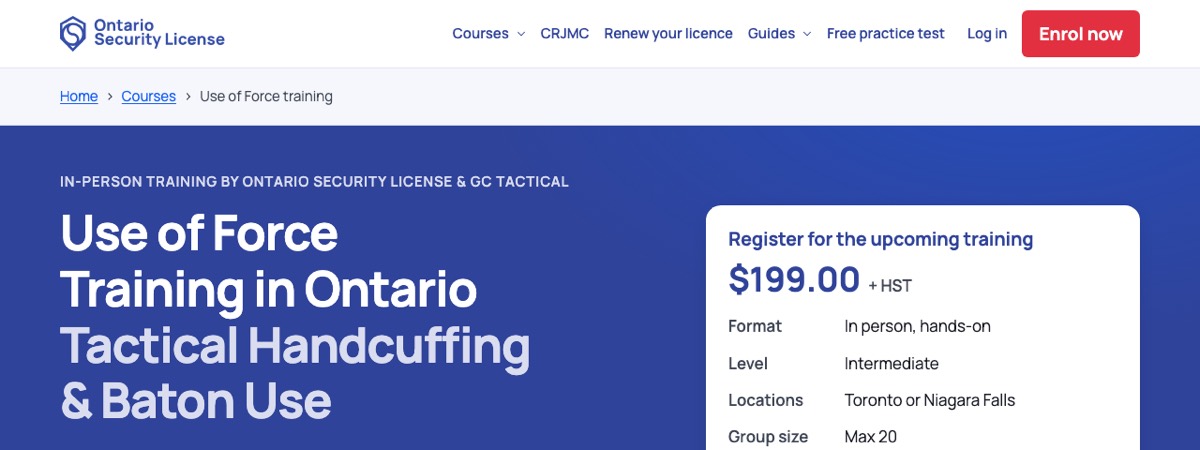
In-Person Use of Force Training in Ontario is a 1-day course from Ontario Security License & GC Tactical costing $199.00 plus HST, ending in a digital certificate.
| Provider | Ontario Security License & GC Tactical |
|---|---|
| Cost (CAD) | $199.00 + HST |
| Credential | Digital certificate |
| Format | in person, ON |
Fiona's take: This is an Ontario in-person route for guards whose employer wants baton and handcuffing practice, not just the online theory. One day of in-person Ontario training and you leave with the digital certificate Ontario security employers recognise. I recommend pairing it with the online course if your role needs both depth and speed.
Skip it if: Skip it if you can complete the $149.99 online course and your employer accepts it, since it saves you a full day and about $50.
See Program DetailsTactical Handcuffing and Baton
Tactical Handcuffing and Baton is a 40-hour course over 5 days from Control Concepts Canada in Alberta, costing $435 plus GST, with a certificate valid for 1 year.
| Provider | CONTROL CONCEPTS CANADA |
|---|---|
| Length | 40 hour course over 5 days |
| Cost (CAD) | $435 + GST |
| Credential | Issued by Control Concepts Canada, valid for 1 year |
| Format | in person, AB |
Fiona's take: Five days and 40 hours is the deep end, aimed at people who use these techniques daily, such as peace officers under the Security Services and Investigators Act framework. The certificate is issued by Control Concepts Canada and is valid for 1 year, so recertification is part of the deal from day one. At $435 plus GST it is a serious investment in physical skills.
Skip it if: Skip it if your employer accepts the 8-hour online route; if you need Alberta baton approval, the 40-hour approved course is the requirement to confirm first.
See Program DetailsHow Much Does Use Of Force Certification Cost In Canada?
Use of Force certification costs between $149.99 plus tax for an online course and $500 for in-person baton training, with recertification running lower at some providers.
| Fee | Amount (CAD) | Notes |
|---|---|---|
| Online course fee | $149.99 + tax | Training Centre Canada, 8 hours self-paced; providers state it meets employer expectations for guards authorised to carry equipment in Ontario |
| In-person training fee | $199.00 + HST | Ontario Security License & GC Tactical, 1 day |
| Alberta blended course tuition | $245 | Tip of Spear & Control Concepts Canada, 8 hours online plus in-person review and exam |
| Tactical handcuffing and baton (Alberta) | $435 + GST | Control Concepts Canada, 40 hours over 5 days, certificate valid 1 year |
| Columbia College Use of Force & Baton Training | $500 | In person, Alberta |
| Recertification | $89 to $99 | Handcuffing $89, handcuffing and baton $99 at one listed provider; some recerts cost the same as or less than the initial course |
Budget for annual recertification; some providers list recertification at $89 to $99, while others may charge the initial-course price. Remember that Ontario's mandatory 40-hour basic training, which includes use-of-force theory in the Ministry syllabus, is a separate requirement from any provider certificate. The Coursera courses have no price listed in the pack, but they never replace the paid certificate, so I treat them as pre-training rather than a substitute.
Is Use Of Force Certification Worth It In 2026?
If your employer requires it, the certificate is not optional, so the question is only which route. Providers state the $149.99 online course meets employer expectations for guards authorised to carry equipment in Ontario, where the Ministry syllabus includes use-of-force theory within the mandatory 40-hour basic training, and 8 self-paced hours is a small cost for work tied to NOC 64410 at a median of $21.00 per hour nationally.
Employers may require additional practical training for equipment authorisation, and Job Bank lists NOC 64410 wages from $16.55 to $31.45 nationally, with a BC median of $22.75 and an Alberta high of $38.00.
My honest caveat: if you are unsure about the field, do not start with $149.99 or a $435 five-day course. Spend 3 hours on the University of Toronto's Coursera course about the stresses of police work first. It will not certify you for anything, but it will tell you whether this career deserves your money.
Use Of Force Certification Questions Canadians Ask
Is Use Of Force Training Mandatory For Security Guards In Ontario?
Use of Force training for Ontario security guards works in two layers: the Ministry syllabus includes use-of-force theory within the mandatory 40-hour basic training, and employers may require additional practical training for equipment authorisation. Guards may carry employer-issued batons for defensive purposes and handcuffs. Providers of the 8-hour courses state they meet employer expectations; confirm with your employer before enrolling.
How Long Is Use Of Force Certification Valid?
Use of Force certification is typically valid for 12 months for security guards in Ontario, matching the annual recertification cycle providers describe. Some Alberta and BC programs run 2 to 3 years before renewal. The Control Concepts Canada tactical handcuffing and baton certificate in Alberta is valid for 1 year.
What Is The Cost Of Use Of Force Certification In Canada?
The cost of Use of Force certification depends on format: online courses start at $149.99 plus tax, the one-day in-person Ontario course runs $199.00 plus HST, and the Alberta blended peace officer course is $245. Deeper in-person training runs $435 plus GST over 5 days, or $500 at Columbia College.
Who Requires Use Of Force Certification In Alberta?
Use of Force certification is required in Alberta for peace officers as a condition of certification and recertification, with approved providers listed under the Security Services and Investigators Act. Guards who want to carry a baton must complete a full 40-hour approved baton use-of-force training course, so shorter courses will not authorise baton use.
Can I Take Use Of Force Training Online?
Online Use of Force training is available, most commonly as an 8-hour self-paced course costing $149.99 plus tax. Some providers state their certificate is accepted by employers across Canada; confirm with your provincial regulator or employer before enrolling. Hands-on components like baton technique still call for in-person training such as the $199 Ontario day course.
What NOC Code Applies To Security Guards Needing Use Of Force Training?
Security guards fall under NOC 64410, security guards and related security service occupations. Job Bank data shows a national median of $21.00 per hour, with a low of $16.55 and a high of $31.45. British Columbia's median sits at $22.75.
How Often Do Police Officers Need Use Of Force Requalification In Ontario?
Police officers in Ontario need Use of Force requalification annually. Under O. Reg. 87/24, every police officer and Niagara Parks constable must successfully complete the Use of Force Requalification course, delivered by a certified trainer, within every 12 months.
Are There Approved Provider Lists For Use Of Force Training By Province?
Approved provider lists do exist by province. Alberta publishes approved baton and use of force training providers under the Security Services and Investigators Act, Ontario relies on Ministry-approved security trainers, and BC requires use of force instructors to complete the Standardized Use of Force Instructor Course or other provincially approved training. New Brunswick also approves training programs for guards carrying batons or handcuffs, so check your own provincial regulator.
What's The Bottom Line On Use Of Force Certification?
- Ontario's Ministry syllabus includes use-of-force theory within the mandatory 40-hour basic training, and employers may require additional practical training for equipment authorisation; police must requalify every 12 months under O. Reg. 87/24. Alberta peace officers must certify and recertify under the Security Services and Investigators Act, and baton authorisation requires the full 40-hour approved course.
- A short provider option is the $149.99 plus tax online course, done in 8 self-paced hours, with the digital certificate issued immediately upon completion; confirm with your employer or regulator before enrolling.
- Coursera's theory option, Understanding and Managing the Stresses of Police Work, does not qualify you for any provincial use of force licence or certificate, but it is a low-commitment way to test the field first.
- Security guards under NOC 64410 earn a median of $21.00 per hour nationally, with BC at $22.75 and highs reaching $31.45; compare annual recertification costs with NOC 64410 wage data when budgeting.
- If you need the certificate for a job, take the approved course your province or employer recognises, and add in-person baton and handcuffing training only if the role demands it.