Key Takeaways
- The fastest realistic route to teaching art in a Canadian public school is a 4-year bachelor's degree with visual arts credits, then a 1-2 year after-degree BEd, then certification: roughly 5-6 years total, with tuition costs varying by university.
- Yes, certification is mandatory for K-12 public schools. In Ontario the regulator is the Ontario College of Teachers; in British Columbia it is the Teacher Regulation Branch of the Ministry of Education and Child Care.
- Test the field first with the Coursera series Teaching with Art from the Museum of Modern Art, a flexible 3-course series that does not qualify you for any provincial teaching certificate.
- Secondary school teachers in Canada earn a median of $45.67 per hour under NOC 41220. Among the listed provincial medians, Quebec is $44.23 and Ontario is $48.08; the Canada-wide Job Bank range is $28.85 to $59.76.
- Fiona's verdict: if you already hold a fine arts degree or sufficient visual arts credits, the after-degree BEd is your fastest path; if you are starting from zero, budget the full 5-6 years or consider community and private art instruction, which may not require a BEd.
An art teacher in Canada is an educator who teaches visual arts in K-12 schools, and the job normally requires a Bachelor of Education with visual arts as a teachable subject plus provincial certification. Community and private art instruction may not require a BEd and is generally not regulated, though requirements can vary by employer and setting.
The short answer: there is no shortcut credential called an art teacher diploma for public schools. The routes are a concurrent BEd with a visual arts teachable, or a bachelor's degree with enough art credits followed by an after-degree BEd, then registration with your province's regulator, typically 4-6 years of study. A Coursera series from MoMA lets you test the field online before you commit the years.
What Are The Ways To Become An Art Teacher In Canada?
There is no single art teacher diploma: Canadian public school art teaching runs through a BEd recognized by a provincial certification body, while community and private instruction may not require a BEd and is generally not regulated, though requirements can vary by employer or setting.
| Route | Time | Cost (CAD) | What You Get | Recognised By | Best For |
|---|---|---|---|---|---|
| Teaching with Art: Using Inquiry, Activities, and Themes (try the field first) | 3-course series, flexible schedule | Not listed | Specialization Certificate in inquiry-based art teaching | Not a teaching credential; no regulator accepts it for certification | Testing whether teaching art suits you before committing to a degree |
| Concurrent BEd with visual arts teachable | 4-5 years | Not listed | BEd | Provincial teacher certification body (e.g., Ontario College of Teachers, BC Teacher Regulation Branch) | Students starting from zero who know they want to teach |
| After-degree BEd (prior fine arts degree) | 1-2 years | Not listed | BEd | Provincial teacher certification body | Fine arts graduates changing to teaching |
| Private or community art instruction | Varies | Not listed | No standard credential | Generally not regulated | Teaching outside the school system, where requirements vary by employer or setting |
I recommend the after-degree BEd for anyone who already holds a fine arts degree or sufficient visual arts credits, and the Coursera series for anyone still deciding whether the classroom is the right fit.
What Is The Fastest Way To Become An Art Teacher In Canada?
The fastest route for someone with a completed degree and sufficient visual arts credits, such as a prior fine arts degree, is the after-degree BEd followed by certification, roughly 1-2 years plus processing time.
- Complete a 4-year bachelor's degree with sufficient visual arts credits. BC requires at least 24 credits in art or related fine arts subjects within 120 post-secondary credits for a secondary teachable.
- Complete an approved after-degree teacher education program (BEd) including practicum. Queen's University offers a 12-month Artist in Community Education track; the University of Alberta's after-degree art route typically runs 2 years.
- Apply for provincial certification with your regulator, such as the Ontario College of Teachers or the BC Teacher Regulation Branch, including a background check and fees.
- Pay the annual membership and registration fees, which vary by province, to stay certified.
Do You Need A Licence To Teach Art In Canada?
Certification is mandatory for K-12 public school art teaching in the provinces covered here, and each province has its own regulator.
| Province | Required? | Regulator | What It Means |
|---|---|---|---|
| Ontario | Yes | Ontario College of Teachers | To teach in Ontario's publicly funded schools, a teacher must be certified by the Ontario College of Teachers. |
| British Columbia | Yes | Teacher Regulation Branch, Ministry of Education and Child Care | To teach in the public and independent school system in BC, educators need a BC teaching certificate. |
| Outside schools | Generally not | No single regulator listed | Non-school art instruction is generally not regulated; requirements can vary by employer or setting. |
The Ontario College of Teachers sets out a minimum 3-year postsecondary degree plus a 4-semester teacher education program, with visual arts as a teachable subject. In BC, the Teacher Regulation Branch issues the teaching certificate, and the secondary art teachable requires at least 24 credits in art or related fine arts subjects within 120 post-secondary credits.
If you want to teach art in community centres, private studios or your own business, the picture loosens. Community or private art instruction may not require a BEd and is generally not regulated, but requirements can vary by employer or setting.
Which Art Teaching Courses Are Worth Taking?
The Coursera offerings from the Museum of Modern Art are online courses on flexible schedules; some university BEd and art education programs below can form part of a provincial certification route, and the CSEA item is a directory.
Teaching with Art: Using Inquiry, Activities, and Themes
Teaching with Art: Using Inquiry, Activities, and Themes is a flexible 3-course series from the Museum of Modern Art covering inquiry-based art teaching.
| Provider | The Museum of Modern Art |
|---|---|
| Length | 3 course series, flexible schedule |
| Credential | Specialization Certificate |
| Format | online |
Fiona's take: This is my recommended first step for anyone weighing the career. The title names what you get: inquiry, activities and themes, delivered online on a flexible schedule. The Specialization Certificate is a course credential, not a teaching qualification, so treat it as exploration and preparation.
Skip it if: Skip it if you need a provincially recognised qualification, because no regulator accepts it for certification.
Start On CourseraArt & Inquiry: Museum Teaching Strategies For Your Classroom
Art & Inquiry: Museum Teaching Strategies For Your Classroom is a 1-week, 10-hours-per-week course from the Museum of Modern Art.
| Provider | The Museum of Modern Art |
|---|---|
| Length | 1 week at 10 hours a week |
| Credential | Course Certificate |
| Format | online |
Fiona's take: This single course runs 1 week at about 10 hours a week, the shortest MoMA option here. It suits someone who wants a fast taste of the field before taking on the full series.
Skip it if: Skip it if you would rather earn the full specialization certificate.
Start On CourseraArt & Ideas: Teaching with Themes
Art & Ideas: Teaching with Themes is a 6-module self-paced course from the Museum of Modern Art.
| Provider | The Museum of Modern Art |
|---|---|
| Length | 6 modules, learn at your own pace |
| Credential | Course Certificate |
| Format | online |
Fiona's take: The course spans 6 modules at your own pace, so it fits around a job or a degree. Its focus on teaching with themes, per the title, works as preparation before a BEd interview or practicum.
Skip it if: Skip it if you want business skills rather than classroom pedagogy.
Start On CourseraStart & Run An Art Teaching Business
Start & Run An Art Teaching Business is a 5.5-hour Udemy course from Rod Moore rated 4.5 from 290 ratings.
| Provider | Udemy (Rod Moore) |
|---|---|
| Length | 5.5 hours |
| Rating | 4.5 (290 ratings) |
| Credential | Course Certificate |
| Format | online |
Fiona's take: If your goal is a private studio rather than a school, this 5.5-hour course targets that side of the field, as its title states. It carries a 4.5 rating from 290 ratings.
Skip it if: Skip it if you are aiming at public school certification, since a course certificate does not count toward it.
View On UdemyLearn to Teach Art to Kids
Learn to Teach Art to Kids is a Udemy course from Jacqui Grantford rated 5.0 from 12 ratings.
| Provider | Udemy (Jacqui Grantford) |
|---|---|
| Rating | 5.0 (12 ratings) |
| Credential | Course Certificate |
| Format | online |
Fiona's take: This course from Jacqui Grantford is aimed at teaching art to kids, per its title, which suits community programs and private lessons. It is rated 5.0 from 12 ratings, a small sample to weigh.
Skip it if: Skip it if your learners are teens or adults rather than kids.
View On UdemyBFA Specialization in Art Education
BFA Specialization in Art Education is a 120-credit in-person program at Concordia University leading to teacher certification in Quebec.
| Provider | Concordia University |
|---|---|
| Length | 120 credits |
| Credential | BFA leading to teacher certification in Quebec |
| Format | in person, QC |
Fiona's take: Concordia's BFA Specialization in Art Education is a Quebec option here: 120 credits, in person, listed as leading to teacher certification in Quebec. It suits a student set on teaching in that province.
Skip it if: Skip it if you are outside Quebec, since its certification pathway is Quebec-specific.
See Program DetailsBachelor of Education in Secondary Education - After Degree Art
Bachelor of Education in Secondary Education, After Degree Art at the University of Alberta is a typically 2-year in-person BEd for degree holders.
| Provider | University of Alberta |
|---|---|
| Length | varies, typically 2 years |
| Credential | BEd |
| Format | in person, AB |
Fiona's take: This is the Alberta after-degree route: typically 2 years, in person, for holders of a first degree with art credits. You leave with a BEd and then apply to the provincial regulator.
Skip it if: Skip it if you have not yet completed a first degree with sufficient art credits.
See Program DetailsArts Education Program
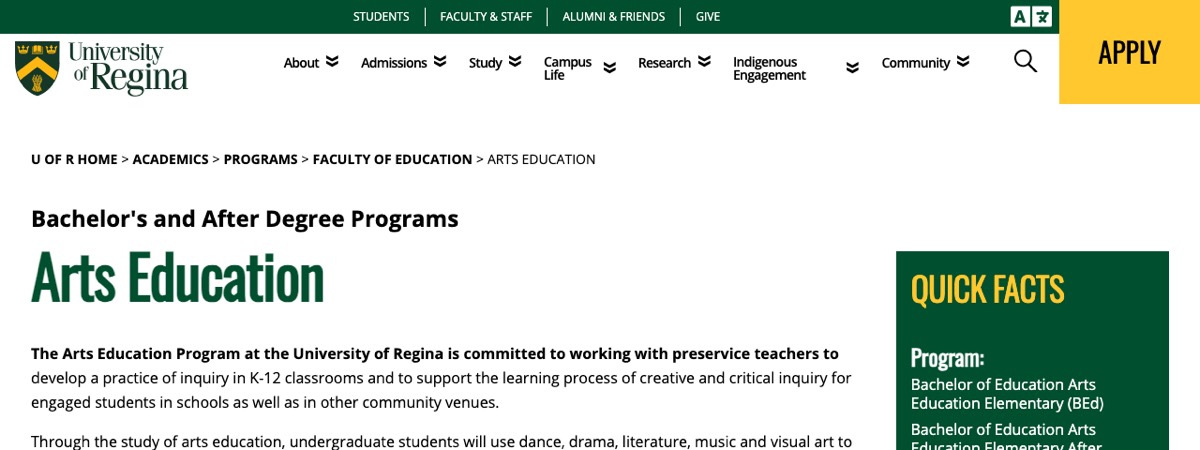
Arts Education Program at the University of Regina is an in-person BEd program in Saskatchewan.
| Provider | University of Regina |
|---|---|
| Credential | BEd |
| Format | in person, SK |
Fiona's take: The University of Regina's Arts Education Program is a Saskatchewan BEd option, delivered in person, for students who want an education program built around the arts.
Skip it if: Skip it if you want the flexibility of starting from a general fine arts degree first.
See Program DetailsArtist in Community Education
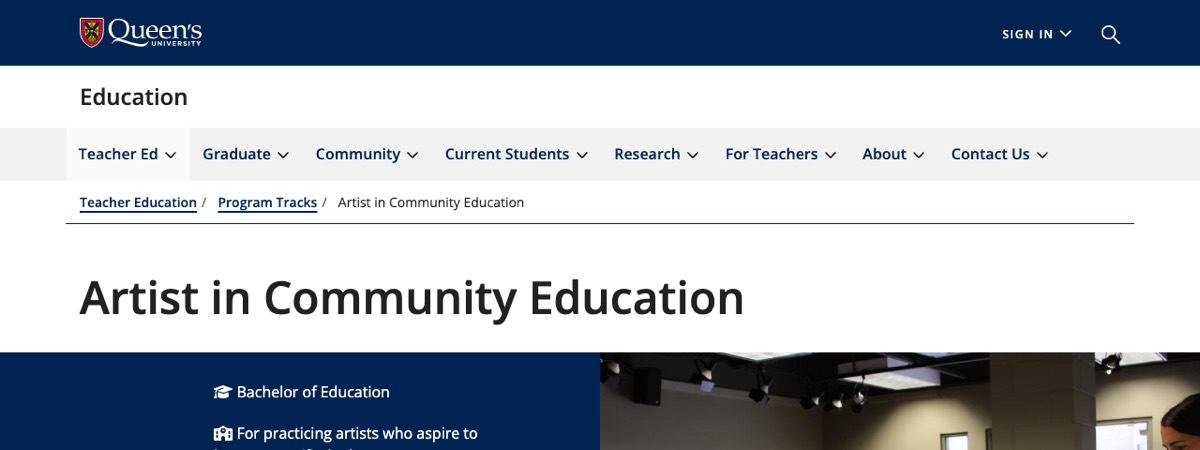
Artist in Community Education at Queen's University is a 12-month hybrid BEd track with in-person class blocks and practicum.
| Provider | Queen's University |
|---|---|
| Length | 12-month program |
| Credential | BEd |
| Format | hybrid (in-person class blocks and practicum), ON |
Fiona's take: Queen's compresses the BEd into 12 months, the shortest program in this list, and its program page says you earn a second bachelor's degree in education qualifying you to apply for teaching certification in Ontario and beyond.
Skip it if: Skip it if you cannot attend the in-person class blocks and practicum.
See Program DetailsArt Education
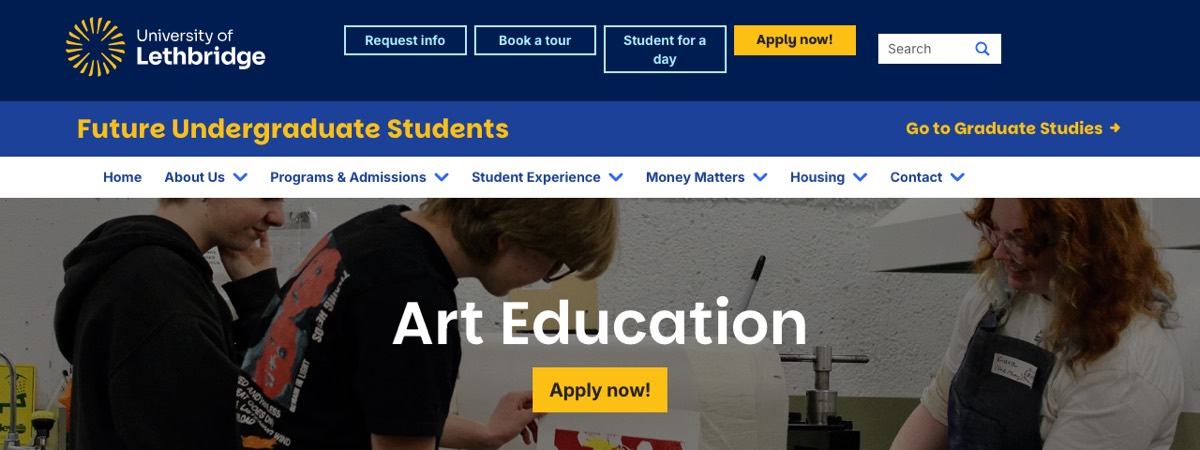
Art Education at the University of Lethbridge is a 5-year combined degrees program leading to a BA/BEd or BFA/BEd.
| Provider | University of Lethbridge |
|---|---|
| Length | 5 years combined degrees |
| Credential | BA/BEd or BFA/BEd |
| Format | in person, AB |
Fiona's take: Lethbridge pairs the degree and the BEd over 5 years, which suits a student starting from zero who wants both credentials without applying twice.
Skip it if: Skip it if you already hold a degree, because the after-degree route is faster.
See Program DetailsWhere to Study Art Education – CSEA Directory
Where to Study Art Education is a directory of programs published by the Canadian Society for Education through Art (CSEA).
| Provider | Canadian Society for Education through Art (CSEA) |
|---|---|
| Length | directory of programs |
| Credential | N/A (directory) |
| Format | various |
Fiona's take: Before applying anywhere, scan this directory. It lists art education programs across the country so you can compare credentials province by province.
Skip it if: Skip it if you have already settled on a province and program.
See Program DetailsHow Much Does It Cost To Become An Art Teacher In Canada?
Tuition figures for these programs are not listed, and the regulator costs that appear in the pack are the annual membership and registration fees.
| Cost Item | Amount | Notes |
|---|---|---|
| Bachelor's degree tuition | Not listed | Varies by university and province |
| After-degree BEd tuition | Not listed | Varies by university; Queen's 12-month ACE track and UAlberta's 2-year after-degree are examples |
| Certification application, background check and fees | Not listed | May be required; amounts and process vary by province |
| Annual membership and registration fees | Not listed | Ongoing fees to remain certified; amounts vary by province |
The one cost the pack confirms is the certification cycle itself: the Ontario College of Teachers tells applicants to apply to the College for certification and pay the annual membership and registration fees, and those fees vary by province. Budget for them on top of tuition.
The Coursera route's cost is not listed here, so compare prices yourself before enrolling. What it offers is a flexible online way to test the field before a multi-year degree commitment.
How Much Does An Art Teacher Earn In Canada?
Secondary school teachers, the NOC 41220 category that includes art teachers, earn a median of $45.67 per hour across Canada according to Job Bank.
| Region | Median Hourly Wage (Job Bank) |
|---|---|
| Canada | $45.67 |
| Ontario | $48.08 |
| Alberta | $47.12 |
| British Columbia | $44.33 |
| Quebec | $44.23 |
The Canada-wide range for NOC 41220 runs from $28.85 at the low end to $59.76 at the high end, with Ontario paying the highest median among the provinces listed.
Outlook varies by province, so check Job Bank for your region before committing to a BEd.
Is Becoming An Art Teacher Worth It In 2026?
If you already hold a fine arts degree or sufficient visual arts credits, the after-degree BEd is the efficient move: 1-2 years of study positions you for an occupation with a Job Bank median of $45.67 per hour under NOC 41220. Queen's 12-month Artist in Community Education track is the shortest program in this list.
If you are starting from zero, the honest picture is 4-6 years of post-secondary education, and you should test the field first. The Coursera MoMA series runs online on a flexible schedule and will tell you whether teaching with art actually interests you.
If your real interest is making and teaching art rather than school curriculum, community and private instruction may not require a BEd and is generally not regulated, though requirements vary by employer and setting. That route does not lead to public school certification.
Art Teacher Questions Canadians Ask
How Long Does It Take To Become An Art Teacher In Canada?
Becoming an art teacher takes typically 4-6 years of post-secondary education including a bachelor's degree and a BEd program. Fine arts graduates shortcut this with a 1-2 year after-degree BEd, and Queen's offers a 12-month track. Certification processing adds weeks to months on top.
Is Art Teaching Regulated In Canada?
Art teaching is regulated for K-12 public schools, where certification is required by provincial bodies like the Ontario College of Teachers or BC's Teacher Regulation Branch. Non-school art instruction is generally not regulated, though requirements can vary by employer or setting.
What Degree Do I Need To Teach Art In Ontario Schools?
Ontario requires a minimum 3-year postsecondary degree plus a 4-semester teacher education program, with visual arts as a teachable subject. You then certify with the Ontario College of Teachers before entering a publicly funded school.
What Are The Teachable Subject Requirements For Art In BC?
For BC secondary teaching, you need at least 24 credits in art or related fine arts subjects within 120 post-secondary credits. The Teacher Regulation Branch reviews your credentials when you apply for a BC teaching certificate, so count your credits before you apply.
Can I Teach Art Without A BEd In Canada?
For public K-12 schools, no, a BEd and certification are required. Community or private art instruction may not require it, though requirements can vary by employer or setting. Studios, camps and community centres set their own expectations, so ask before you plan around this route.
What NOC Code Applies To Art Teachers In Schools?
The NOC code for art teachers in schools is 41220, covering secondary school teachers. Job Bank reports a Canada-wide median of $45.67 per hour for this occupation, with a range from $28.85 to $59.76.
Do I Need A Portfolio To Become An Art Teacher?
A portfolio demonstrating artistic ability is often recommended or required for admission to art education programs or specialist qualifications. Requirements differ from program to program, so check each one's admission details before you apply, and start building a portfolio early.
Can A Coursera Course Certify Me As An Art Teacher?
No Coursera course can certify you. The MoMA courses issue course certificates, not teaching credentials, and no provincial regulator such as the Ontario College of Teachers or BC's Teacher Regulation Branch accepts them for certification. Use them for preparation and exploration, not qualification.
What's The Bottom Line On Becoming An Art Teacher In Canada?
- Public-school routes generally include either a concurrent BEd with a visual arts teachable or a bachelor's degree with visual arts credits followed by a 1-2 year after-degree BEd, plus certification with a body like the Ontario College of Teachers or BC's Teacher Regulation Branch.
- A fine arts graduate's fastest route is Queen's 12-month Artist in Community Education track or another after-degree BEd.
- Median pay for secondary school teachers under NOC 41220 is $45.67 per hour across Canada; the Job Bank range is $28.85 to $59.76, and among the listed provincial medians Quebec is $44.23 and Ontario is $48.08.
- Test the field first with Teaching with Art: Using Inquiry, Activities, and Themes from the Museum of Modern Art, a 3-course series that does not qualify you for any teaching certificate.
- Teaching art privately or in community programs may not require a BEd and is generally not regulated, though requirements can vary by employer or setting.