Key Takeaways
- The fastest realistic route into by-law work is an online core competency course, roughly 20 to 36 hours for about $299 through a provider such as Ontario Guard Training, followed by applying to municipalities for appointment.
- Ontario, BC and Alberta do not legally require an MLEO certificate: Ontario's MLEOA certification is voluntary but has become a standard requirement for many municipal employers, and BC and Alberta have no legislated certification.
- Coursera's Hot Topics in Criminal Justice from Vanderbilt University is an 18 hour course on U.S. criminal justice issues for general interest, but it does not qualify you as a by-law officer or count toward MLEOA certification.
- By-law enforcement and other regulatory officers (NOC 43202) earn a median of $36.92 per hour in Canada, with provincial medians of $41.89 in Ontario, $36.90 in BC, $36.13 in Alberta and $31.60 in Quebec.
- Fiona's verdict: this path suits patient, detail-oriented communicators who want public-facing enforcement work without policing. Ontario applicants may start with a private online course; BC applicants should compare that with JIBC Level 1; Ontario candidates pursuing certification should consider MLEOA Part I.
A Municipal Law Enforcement Officer (MLEO) is a by-law enforcement officer who enforces municipal by-laws and provincial statutes, appointed under the Community Safety and Policing Act in Ontario or equivalent municipal authority elsewhere. The fastest way in is a short online course: roughly 20 to 36 hours of core competency training for about $299, then applying to municipalities.
Ontario, BC and Alberta do not legally require a certificate, but training is what gets you interviews. In Ontario, the MLEOA Certified designation has become a standard requirement for many municipal employers. In BC, JIBC's Level 1 course is the recognized standard. I walk through each route, the costs and the pay below.
What Are The Ways To Become A Municipal Law Enforcement Officer In Canada?
There are four realistic routes: an online core competency course, the MLEOA certification pathway in Ontario, JIBC training in BC, or a college diploma for postings that ask for one.
| Route | Time | Cost (CAD) | What You Get | Recognised By | Best For |
|---|---|---|---|---|---|
| Hot Topics in Criminal Justice and other intro courses first | 18 hours | Not listed | A Coursera course certificate on U.S. criminal justice issues | General interest only | Testing interest in the field before committing money |
| Online core competency course (e.g. Burgess and Associates, Ontario Guard Training) | Approximately 36 hours | $299 | Printable accreditation certificate | Vendors of Record for Ontario government (Burgess) | Ontario applicants on a budget |
| MLEOA Part I Municipal Law Enforcement Foundations (Ontario) | Several weeks virtual or hybrid | Not listed | 10 points toward MLEO certification | MLEOA | Ontario candidates targeting the MLEOA Certified designation |
| JIBC Bylaw Compliance, Enforcement & Investigative Skills Level 1 (BC) | 42 hours online and virtual | $1,493.88 | Course completion | Municipalities across BC; LGCEA | BC applicants |
| College diploma (e.g. Niagara College Policing and Community Safety) | 1 year advanced standing or longer | Not listed | 2 year diploma | Employers preferring post-secondary education | Postings that require or prefer a diploma |
I recommend the online core competency route for Ontarians who want the fastest entry, JIBC Level 1 for anyone in BC, and a diploma for postings that require or prefer post-secondary law-enforcement education.
What Is The Fastest Way To Get An MLEO Certificate In Canada?
The quickest route is an online course, because Ontario, BC and Alberta do not legally require the specific certificate routes listed here; Ontario MLEOs are still appointed under provincial legislation.
- Complete an online MLEO or parking by-law course, for example the Burgess and Associates core competency program or a private course at $299. Budget roughly 20 to 36 hours of study.
- Print your accreditation certificate from the provider once you pass, which for Burgess is a printable certificate on completion.
- Apply to municipal by-law jobs with the certificate on your resume. This step costs nothing and the timeline varies with each municipality's hiring cycle.
- Get hired and appointed. Employers, meaning municipalities, hold the enforcement authority and individual appointment follows hiring, along with any required local training.
- If you land in Ontario and want to advance, enrol in the MLEOA Part I Municipal Law Enforcement Foundations course, which provides 10 points toward MLEO certification.
Is An MLEO Certificate Legally Required In Canada?
Ontario, BC and Alberta do not legally require the specific certificate routes listed here; Ontario MLEOs are still appointed under provincial legislation. Training is voluntary in all three, but market expectations vary sharply by province.
| Province | Required? | Regulator Or Registry | What It Means |
|---|---|---|---|
| Ontario | No | Municipal Law Enforcement Officers' Association of Ontario (MLEOA) | The MLEOA Certified designation, authorized through Bill Pr83 in 1997, is recognized by municipalities across Ontario and has become a standard requirement for many employers |
| British Columbia | No | None (JIBC training recommended) | No single legislated certification exists, but professional training such as JIBC Level 1 is widely expected |
| Alberta | No | None | No provincial legislation regulates the occupation; training is often on-the-job |
Of the provinces covered here, Ontario has the formal MLEOA certification body. The MLEOA describes itself as the only organization authorized to issue certification to Municipal Law Enforcement Officers in Ontario, and its Certified designation carries weight in municipal hiring there.
BC has no legislated equivalent, but the Justice Institute of British Columbia's Level 1 course is recognized by municipalities across the province and by the LGCEA, so skipping it in BC is a mistake. Alberta leaves training largely to employers, so Albertans can sometimes get hired first and trained on the job.
Which By-Law Enforcement Courses Are Worth Taking?
I group these into try-first courses, provincial credentials, and diplomas. Start with an online course, then pay for the credential your province actually recognizes. Coursera pricing is not listed in the pack.
Hot Topics in Criminal Justice
Hot Topics in Criminal Justice is an 18 hour online course from Vanderbilt University on Coursera that examines current issues in the U.S. criminal justice system.
| Provider | Vanderbilt University |
|---|---|
| Length | 18 hours |
| Credential | Certificate |
| Format | online |
Fiona's take: This is my pick for testing your interest. The course covers mass incarceration, the death penalty, risk assessment, the insanity defense, police use of force, and surveillance technology. It is a course certificate, not a credential anyone in municipal hiring counts, so treat it purely as an interest test before spending $299 or more on provincial training.
Skip it if: Skip it if you have already worked in security, policing or any enforcement role and know you like the work.
Start On CourseraIntroduction to International Criminal Law
Introduction to International Criminal Law is an online course from Case Western Reserve University on Coursera that covers the fundamentals of international criminal law.
| Provider | Case Western Reserve University |
|---|---|
| Credential | Certificate |
| Format | online |
Fiona's take: Interesting law, wrong jurisdiction. International criminal law has almost nothing to do with municipal by-laws in Canada, so I would treat it as general interest rather than career preparation.
Skip it if: Skip it if your goal is an MLEO certificate, because none of this content applies to by-law enforcement work.
Start On CourseraDe-escalation for Law Enforcement
De-escalation for Law Enforcement is a 3 hour online course from Udemy with a 4.4 rating from 400 ratings.
| Provider | Udemy |
|---|---|
| Length | 3 hours |
| Rating | 4.4 (400 ratings) |
| Credential | Certificate of completion |
| Format | online |
Fiona's take: The course presents techniques and communication skills for de-escalation, which is relevant to enforcement work. Three hours is short, but it can serve as a primer before a provincial course.
Skip it if: Skip it if your provincial program already covers similar material.
View On UdemyStudiGuide 20: Use of Force in California
StudiGuide 20: Use of Force in California is a 1 hour online course from Udemy with a 4.8 rating from 134 ratings.
| Provider | Udemy |
|---|---|
| Length | 1 hour |
| Rating | 4.8 (134 ratings) |
| Credential | Certificate of completion |
| Format | online |
Fiona's take: This one is built for California law exams, so the legal content does not transfer to Canadian enforcement. I include it only because the underlying concept of understanding force frameworks shows up in interviews.
Skip it if: Skip it if you are training in Canada, because the California legal standards are irrelevant here.
View On UdemyBylaw Compliance, Enforcement, & Investigative Skills
Bylaw Compliance, Enforcement, & Investigative Skills is an 8 week blended program from the Justice Institute of British Columbia.
| Provider | Justice Institute of British Columbia (JIBC) |
|---|---|
| Length | 8 Weeks |
| Format | blended, British Columbia |
Fiona's take: This is the industry standard in BC, recognized by municipalities across the province and by the LGCEA. If you are serious about by-law work in BC, this is the course employers expect to see. Domestic tuition for the Level 1 course is $1,493.88.
Skip it if: Skip it if you live outside BC, since the Ontario market looks to MLEOA and Burgess instead.
See Program DetailsPolicing and Community Safety - Advanced Standing Program
Policing and Community Safety - Advanced Standing Program is a 1 year in person program at Niagara College in Ontario leading to a 2 year diploma.
| Provider | Niagara College |
|---|---|
| Length | 1 Year |
| Credential | 2 Year Diploma |
| Format | in person, Ontario |
Fiona's take: This is the long route. It makes sense when a posting you want lists a 2 year college diploma in law enforcement as a requirement, which many do. It costs you a year in person, so I only recommend it for people committing to the field long term.
Skip it if: Skip it if you already have enforcement experience or hold a related diploma.
See Program DetailsOLCD-LGOV0015 Municipal Law
OLCD-LGOV0015 Municipal Law is an online course from Dalhousie University with live sessions, delivered over 18 learning hours across six weeks.
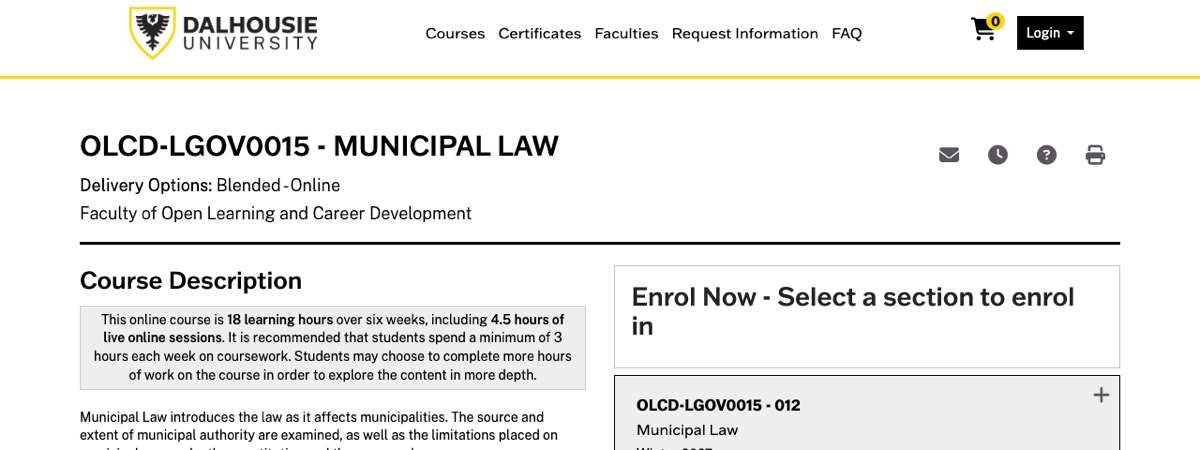
| Provider | Dalhousie University |
|---|---|
| Length | 18 learning hours over six weeks |
| Format | online (with live sessions), Nova Scotia |
Fiona's take: Dalhousie's course covers where municipal powers actually come from, which is genuinely useful context for understanding why you can enforce what you enforce. I suggest it as a deeper academic supplement after the core competency course, not as a substitute for one.
Skip it if: Skip it if you only need job-ready practical training now.
See Program DetailsPart I - Municipal Law Enforcement Foundations
Part I - Municipal Law Enforcement Foundations is a virtual and hybrid course from the Municipal Law Enforcement Officers' Association of Ontario.
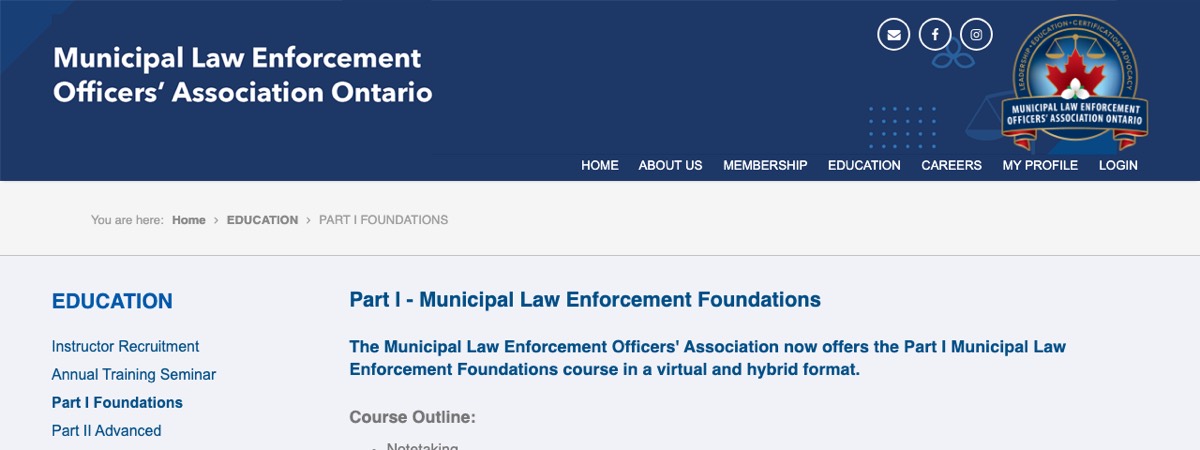
| Provider | Municipal Law Enforcement Officers' Association of Ontario (MLEOA) |
|---|---|
| Length | not shown (independent learning + webinars) |
| Credential | 10 points towards MLEO certification |
| Format | virtual and hybrid, Ontario |
Fiona's take: This is the entry point to the designation that matters in Ontario. Completion provides 10 points toward MLEO certification, and since the MLEOA is the only body authorized to issue certification to Ontario MLEOs, this is the path for Ontarians who want the credential employers there treat as a standard requirement.
Skip it if: Skip it if you are in BC or Alberta, where employers look to JIBC or on-the-job training.
See Program DetailsBylaw Officer Core Competency Program (Ontario P.O.O./M.L.E.O)
Bylaw Officer Core Competency Program (Ontario P.O.O./M.L.E.O) is an approximately 36 hour online stand-alone course from Burgess And Associates with a printable accreditation certificate.
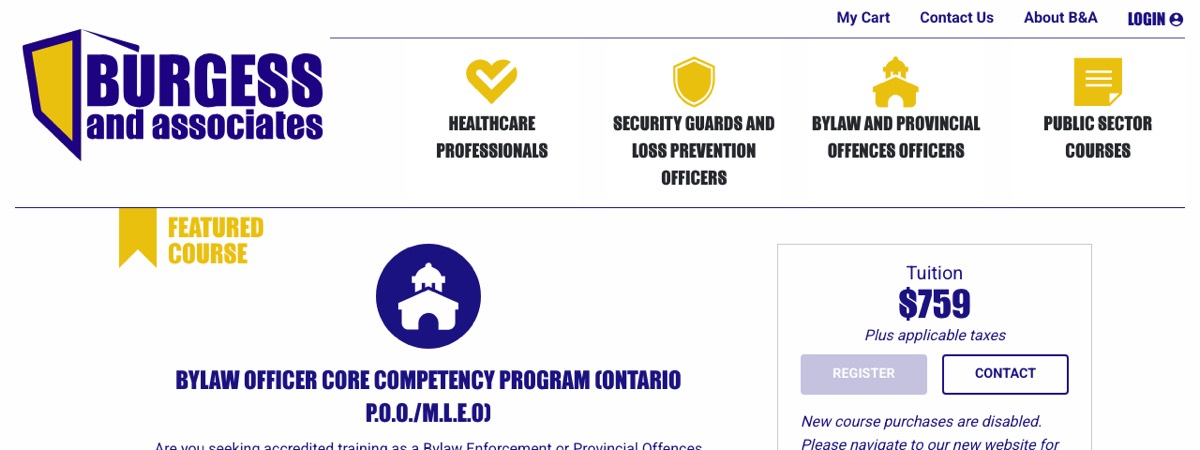
| Provider | Burgess And Associates |
|---|---|
| Length | Approximately 36 hours |
| Credential | Printable accreditation certificate |
| Format | online, Ontario |
Fiona's take: Burgess is a Vendor of Record for the Ontario government, and the course is designed for anyone seeking employment as a by-law enforcement or municipal law enforcement officer in Ontario. At roughly 36 hours, it covers the core material in a fraction of the time a diploma takes, and I consider it a strong first credential for Ontarians.
Skip it if: Skip it if you plan to work in BC, where JIBC is the recognized standard.
See Program DetailsBylaw Enforcement Officer Course: Level 1
Bylaw Enforcement Officer Course: Level 1 is a 40 hour in person course over 2 weeks at Focus College in British Columbia.
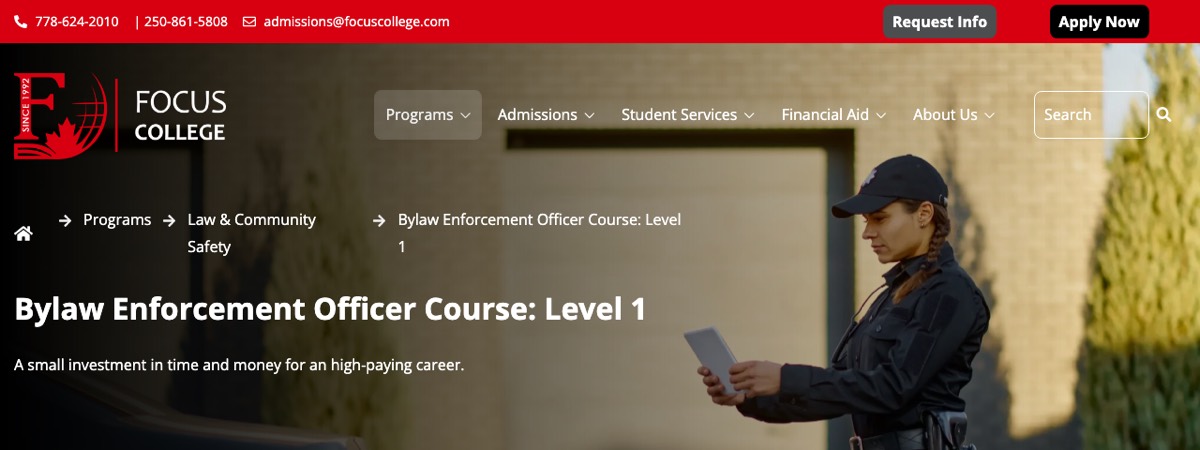
| Provider | Focus College |
|---|---|
| Length | 40 Hours (2 Weeks) |
| Format | in person, British Columbia |
Fiona's take: An in person alternative for British Columbians who learn better in a classroom than online. The course teaches about the court system in BC and Canada, which is core background for by-law work.
Skip it if: Skip it if the JIBC blended format fits your schedule, since JIBC carries the wider municipal recognition in BC.
See Program DetailsCommunity Peace Officer Induction Program (CPOIP)
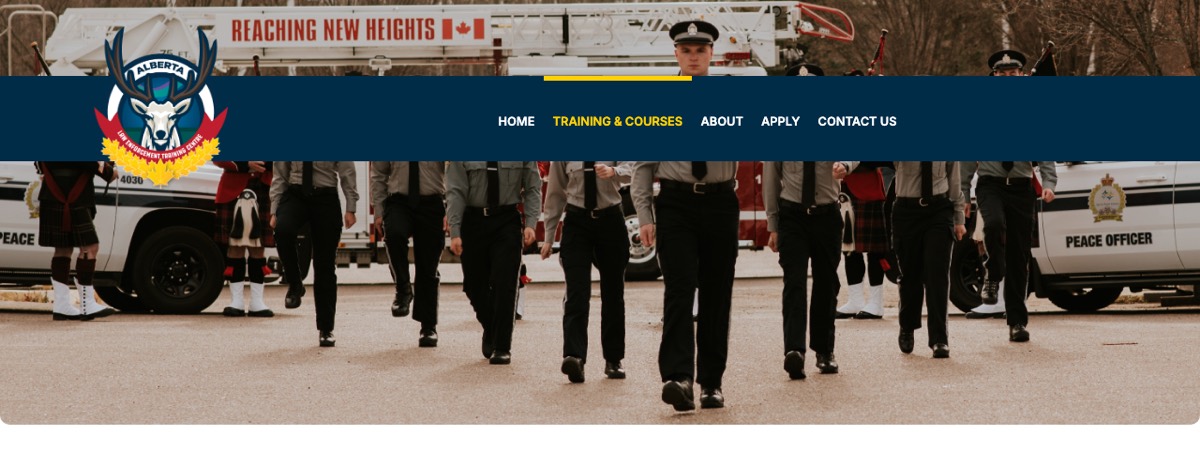
Community Peace Officer Induction Program (CPOIP) is a 12 week in person program from ALETC in partnership with Portage College in Alberta, costing $9,759 plus GST with no accommodation included.
| Provider | ALETC (in partnership with Portage College) |
|---|---|
| Length | 12 weeks |
| Cost (CAD) | $9,759 + GST (no accommodation) |
| Credential | Level 1 Community Peace Officer appointment |
| Format | in person, Alberta |
Fiona's take: This is the heavyweight option. It offers the required training for students seeking a Level 1 Community Peace Officer appointment and designation in Alberta. It is aimed at peace officer roles more broadly than by-law work, and at nearly ten thousand dollars it is a serious investment.
Skip it if: Skip it if your goal is a municipal by-law officer role, which in Alberta does not require this level of training.
See Program DetailsHow Much Does MLEO Training Cost In Canada?
Costs run from $299 for a private online MLEO course to $1,493.88 for JIBC's Level 1 domestic tuition, and up to $9,759 plus GST for Alberta's peace officer program.
| Item | Cost (CAD) |
|---|---|
| Private online MLEO course (e.g. Ontario Guard Training) | $299 |
| JIBC Bylaw Level 1 domestic tuition | $1,493.88 |
| MLEOA Part I Foundations | Not listed |
| Burgess core competency course | Not listed |
| Community Peace Officer Induction Program (CPOIP), Alberta | $9,759 + GST, no accommodation |
The two clear price anchors are the $299 private online MLEO course and the $1,493.88 JIBC Level 1 domestic tuition, which is recognized by municipalities across BC and the LGCEA. Coursera pricing is not listed in the pack, so check the platform directly for current rates.
The CPOIP in Alberta is a different product altogether. At $9,759 plus GST without accommodation, it targets peace officer training, so by-law applicants in Alberta do not need to spend anywhere near that.
How Much Does A By-Law Enforcement Officer Earn In Canada?
By-law enforcement and other regulatory officers (NOC 43202) earn a median of $36.92 per hour in Canada, according to Job Bank.
| Region | Median Hourly Wage (CAD) |
|---|---|
| Canada | $36.92 |
| Ontario | $41.89 |
| British Columbia | $36.90 |
| Alberta | $36.13 |
| Quebec | $31.60 |
Ontario is highest among the listed provincial medians at $41.89 per hour, with Quebec lowest of the four at $31.60, so location matters as much as training. Job Bank rates the outlook as varying by province, so check your local municipality's posting volume before committing to a training route.
Is An MLEO Certificate Worth It In 2026?
An MLEO certificate is worth it when it matches the province you want to work in. In Ontario, the MLEOA Certified designation has become a standard requirement for many municipal employers, so the points pathway pays off. In BC, the JIBC Level 1 course at $1,493.88 is what municipalities expect. In Alberta, there is no provincial legislation regulating the occupation, and training is often on-the-job.
The pay supports the investment. At a Canadian median of $36.92 per hour under NOC 43202, a $299 course is earned back within the first couple of shifts, and even the JIBC tuition is a few weeks of full time pay. The catch is that appointment comes only through a municipality, so no certificate guarantees a job by itself.
I tell clients to treat this as a two step plan: test your interest with an 18 hour Coursera course like Vanderbilt's Hot Topics in Criminal Justice, then buy the provincial credential only once you are sure. Your target postings tell you exactly which training they want.
MLEO Certificate Questions Canadians Ask
What Is An MLEO?
An MLEO is a Municipal Law Enforcement Officer, a term unique to Ontario referring to by-law enforcement officers appointed under provincial legislation. Elsewhere in Canada the same role is usually called a by-law enforcement officer, but the work, enforcing municipal by-laws, is the same.
Is MLEO Certification Mandatory In Ontario?
No, MLEO certification is not mandatory in Ontario, but the MLEOA Certified designation, issued by the Municipal Law Enforcement Officers' Association of Ontario, is recognized by municipalities across the province and has become a standard requirement for many employers. In practice, skipping it narrows your options.
How Long Does MLEO Training Take?
MLEO training in its basic form is short. Online core competency programs, such as the Burgess and Associates course, can be completed in approximately 20 to 36 hours. JIBC's BC Level 1 course runs 42 hours, while diploma routes take a year or more.
What Training Is Recommended In BC For Bylaw Officers?
Training in BC centres on the Justice Institute of British Columbia's Bylaw Compliance, Enforcement and Investigative Skills Level 1 course, which is the industry standard recognized by municipalities across the province and by the LGCEA. There is no single legislated certification in BC, but this course is widely expected.
Is There Regulation For Bylaw Officers In Alberta?
Regulation for bylaw officers in Alberta does not exist at the provincial level. ALIS states there is currently no provincial legislation regulating this occupation in Alberta, and training is often on-the-job.
What Is The Median Wage For By-Law Enforcement Officers In Canada?
The median wage for by-law enforcement and other regulatory officers, NOC 43202, is $36.92 per hour in Canada according to Job Bank. Ontario sits highest of the provinces listed at $41.89, with British Columbia at $36.90, Alberta at $36.13 and Quebec at $31.60.
Do I Need A College Diploma To Become An MLEO?
A college diploma is not always required, but many job postings require or prefer a 2-year college diploma in law enforcement or a related field plus experience. A posting from the Town of Stouffville for an MLEO III is one example. Start with a short course and add the diploma if your target postings demand it.
How Do I Get Appointed As An MLEO?
Appointment as an MLEO works through the employer. Municipalities obtain the enforcement authority, and your individual appointment follows hiring along with any required local training. You cannot appoint yourself or buy an appointment, which is why the certificate alone never finishes the process.
What's The Bottom Line On The MLEO Certificate?
- Ontario, BC and Alberta do not legally require an MLEO certificate, but in Ontario the MLEOA Certified designation has become a standard requirement for many municipal employers.
- The fastest entry is an online core competency course of roughly 20 to 36 hours at about $299, then applying for municipal appointment.
- In BC, JIBC's 42 hour Level 1 course at $1,493.88 domestic tuition is the recognized standard; in Alberta, training is often on-the-job.
- Pay is solid: NOC 43202 shows a Canadian median of $36.92 per hour, and $41.89 in Ontario.
- Test your interest first with Hot Topics in Criminal Justice, an 18 hour Vanderbilt University course on Coursera covering U.S. criminal justice issues, before spending on provincial training.