Key Takeaways
- The fastest realistic route to RPN registration in Ontario is a 2-year approved practical nursing diploma at about $10,000, then the CNO eligibility assessment, the $350 REx-PN exam plus GST, about $100 for the jurisprudence step and registration; CNO application and registration fees vary and sit in the hundreds, so check CNO for current fees.
- Registration is mandatory: the College of Nurses of Ontario (CNO) regulates RPNs, the BCCNM regulates LPNs in British Columbia, and regulators such as CLPNS and CLPNM cover the other provinces and territories. Quebec has a separate practical-nursing pathway not covered here.
- Healthcare Career Explorer: Nursing Professions on Coursera is a 3-course series you can finish in about 4 weeks at 10 hours per week; it does not qualify you for registration with any regulator.
- Practical nurses (NOC 32101) earn a median of $31.32 per hour in Canada according to Job Bank, ranging from $29.58 in Newfoundland and Labrador to $44.15 in the Northwest Territories.
- Fiona's verdict: this path suits career changers who want a regulated health title in 2 years; if you are unsure nursing fits, test it with the Coursera explorer before spending $10,000 on a diploma.
A Registered Practical Nurse (RPN) is a regulated health professional who provides safe nursing care to clients across the lifespan under the direction of physicians or registered nurses. Ontario uses the RPN title; the same role is a Licensed Practical Nurse elsewhere in Canada.
The direct answer: you need a 2-year approved practical nursing diploma, then registration with your provincial regulator. Ontario and BC applicants write the REx-PN at $350 plus GST per attempt, and the other provinces and territories except Quebec use the CPNRE at $610.
What Are The Ways To Become An RPN In Canada?
The ways to become an RPN in Canada fall into three routes: test the field online first, complete an approved 2-year diploma, or bridge from PSW status. Here is how they stack up.
| Route | Time | Cost (CAD) | What You Get | Recognised By | Best For |
|---|---|---|---|---|---|
| Healthcare Career Explorer: Nursing Professions | 3 courses, about 4 weeks at 10 hours per week | Not listed | Career certificate from Coursera | No regulator; exploration only | Testing whether nursing fits before a diploma |
| Practical Nursing Diploma Program | 2 years (4-5 semesters) | $10,000 typical | Ontario College Diploma or equivalent | CNO and other provincial regulators | New entrants ready for full-time study |
| PSW to PN Bridging Pathway | 1-2 semesters bridging, then a 2-year PN program with advanced standing | $5,000 | Advanced entry to a 4-semester PN program; Ontario College Diploma | CNO | Ontario PSWs seeking credit for experience |
I recommend the Coursera explorer for anyone still deciding, the 2-year diploma for anyone ready to commit, and the PSW bridge for Ontario PSWs who want advanced standing for work they have already done.
What Is The Fastest Way To Become An RPN In Canada?
The fastest way to become an RPN in Canada is a 2-year approved diploma followed by a registration chain that runs several weeks to a few months. These are the steps in order, with the fees attached.
- Complete an approved practical nursing diploma at an Ontario public college such as Algonquin College: 2 years, about $10,000.
- Apply to the College of Nurses of Ontario for a registration eligibility assessment: several weeks; application fees vary and sit in the hundreds, so check CNO for current fees.
- Pass the REx-PN if you are in Ontario or BC, or the CPNRE in the other provinces and territories except Quebec: exams run in multiple windows per year; the REx-PN costs $350 plus GST per attempt, the CPNRE $610.
- Complete the jurisprudence exam plus language and criminal record check requirements: 1-3 months, about $100.
- Register with your provincial regulator and start work: immediate upon approval; registration fees vary and sit in the hundreds, so check CNO for current fees.
Do You Need A Licence To Work As An RPN In Canada?
A licence, in the form of registration with a provincial regulator, is required before you can work as an RPN or LPN in Ontario, British Columbia and the other provinces and territories. Quebec has a separate practical-nursing pathway not covered here; the REx-PN and CPNRE statements in this guide exclude Quebec.
| Province | Required? | Regulator Or Registry | What It Means |
|---|---|---|---|
| Ontario | Yes, mandatory | College of Nurses of Ontario (CNO) | Complete a CNO-approved program, pass the REx-PN and finish the jurisprudence exam before registering as an RPN |
| British Columbia | Yes, mandatory | British Columbia College of Nurses and Midwives (BCCNM) | New graduates of a BC practical nursing program take the REx-PN to practise as LPNs |
| Other provinces and territories (except Quebec) | Yes, mandatory | Provincial or territorial regulatory authority, e.g., CLPNS, CLPNM | The CPNRE is the mandatory computer-based examination for LPN applicants |
One exam-name trap catches people every year, especially anyone searching for CPNRE prep. Ontario stopped accepting the CPNRE for its applicants after 2021 and now uses the REx-PN, which BC also uses. The CPNRE remains the LPN exam in the other provinces and territories, except Quebec. Buy the right prep for your province.
None of the online certificates on this page change that picture. A Coursera series from Duke or MedCerts, or a Udemy prep course, does not grant registration with the CNO, BCCNM or any provincial regulator. Registration requires approved practical-nursing education, your province's exam and the regulator's other requirements, including the jurisprudence exam and language and criminal record checks.
Which Practical Nursing Courses Are Worth Taking In Canada?
Practical nursing courses come in three tiers: Coursera series for testing the field, short online prep for skills and exams, and college diplomas that lead to registration. The listed college practical-nursing diplomas are the options here that lead toward regulator eligibility, and the reviews below are ordered that way.
Healthcare Career Explorer: Nursing Professions
Healthcare Career Explorer: Nursing Professions is a 3-course online series from Coursera, about 4 weeks at 10 hours per week, that surveys nursing roles so you can compare them before applying anywhere.
| Provider | Coursera |
|---|---|
| Length | 3 course series (4 weeks at 10 hours/week) |
| Credential | Career certificate from Coursera |
| Format | online |
Fiona's take: I recommend this to every client who is curious but not yet committed. It lays out what practical nurses do against other nursing professions, which is the decision that matters before you spend two years and about $10,000 on a diploma. It does not qualify you for registration with any regulator; treat it as reconnaissance.
Skip it if: Skip it if you are already admitted to a diploma program; your first term covers this ground.
Start On CourseraNursing Assistant Fundamentals
Nursing Assistant Fundamentals is a 3-course online series from MedCerts, 25 hours total, that covers the basics of assisting patients with daily care, including communication, hygiene and safety, and mobility and comfort.
| Provider | MedCerts |
|---|---|
| Length | 3 course series (25 hours total) |
| Credential | Career certificate from MedCerts |
| Format | online |
Fiona's take: It is a nursing-assistant career certificate, not practical-nursing registration, and no step on this page counts it toward becoming an RPN. I suggest it as a way to build bedside vocabulary and comfort with care routines before a diploma, never as a substitute for one.
Skip it if: Skip it if you are set on the RPN path and want to put every hour toward diploma prerequisites.
Start On CourseraAI in Nursing Practice: Foundations for Quality and Safety
AI in Nursing Practice: Foundations for Quality and Safety is a 3-course online specialization from Duke University School of Nursing, roughly one month at 3-4 hours per course.
| Provider | Duke University School of Nursing |
|---|---|
| Length | 3 courses (approximately one month, 3-4 hours per course) |
| Credential | Coursera Specialization certificate |
| Format | online |
Fiona's take: This is a forward-looking add-on about how AI touches nursing quality and safety, best taken late in a diploma or as a working nurse. It has nothing to do with passing the REx-PN or CPNRE, so do not treat it as exam prep.
Skip it if: Skip it if your goal is registration; it forms no part of any regulator's requirements.
Start On CourseraREx-PN Nursing Exam Prep Preparation
REx-PN Nursing Exam Prep Preparation is a 2-hour on-demand video course from Udemy instructor Ausaaf Ansari aimed at REx-PN candidates.
| Provider | Ausaaf Ansari |
|---|---|
| Length | 2 hours on-demand video |
| Rating | 1.6 (2 ratings) |
| Credential | Certificate of completion |
| Format | online |
Fiona's take: I cannot recommend this one. It carries a 1.6 rating from 2 ratings on Udemy, which is both a tiny sample and a poor score, and 2 hours is thin coverage for an exam this consequential. A failed attempt costs another $350 plus GST, so prep quality matters more than prep price.
Skip it if: Skip it; the rating alone is the warning.
View On UdemyPractical Nursing Skills: ECG, ABG, IV Infusion,Life Support
Practical Nursing Skills: ECG, ABG, IV Infusion, Life Support is a 12-hour on-demand video course from HeartbeatsZ Academy, a UK provider.
| Provider | HeartbeatsZ Academy, UK |
|---|---|
| Length | 12 hours on-demand video |
| Credential | Certificate of completion |
| Format | online |
Fiona's take: Useful for drilling skills content such as ECG interpretation and IV infusion basics alongside a diploma, not instead of one. The provider is UK-based, so scope of practice differs from Canadian rules; confirm what RPNs may do with your own regulator before repeating anything clinically. The certificate of completion has no regulatory standing.
Skip it if: Skip it if you need REx-PN or CPNRE prep; this is skills content, not exam prep.
View On UdemyPractical Nursing Diploma
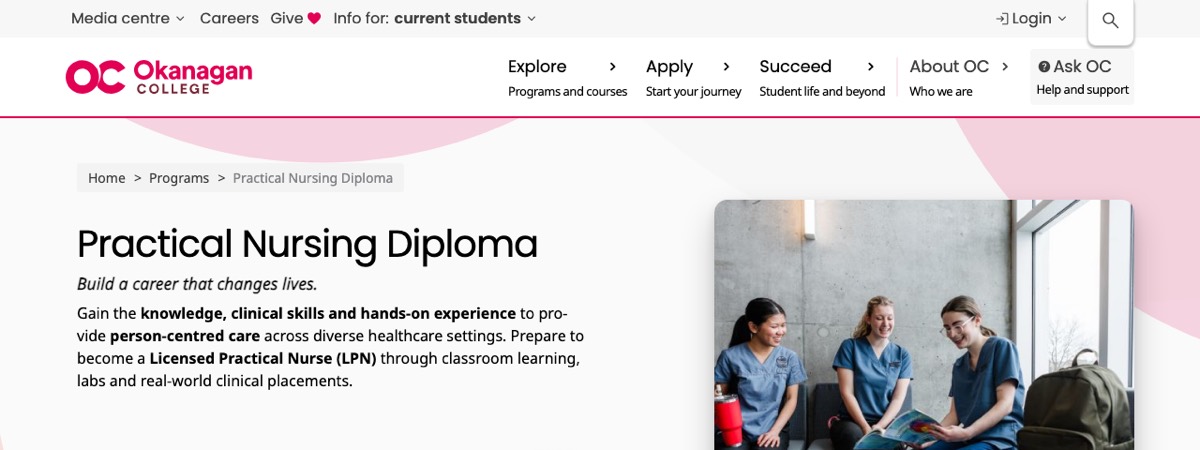
Practical Nursing Diploma is a 70-week in-person diploma at Okanagan College in British Columbia, with 62 weeks of instruction plus built-in program breaks.
| Provider | Okanagan College |
|---|---|
| Length | 70 weeks including built in program breaks; 62 weeks instruction |
| Cost (CAD) | $13,898 (2025-26, Kelowna, Penticton and Salmon Arm) |
| Credential | Diploma |
| Format | in person, British Columbia |
Fiona's take: A solid BC option with a published price of $13,898 for 2025-26 at the Kelowna, Penticton and Salmon Arm campuses. Graduates then move toward BCCNM registration and the REx-PN. That tuition sits above the $10,000 typical for the diploma route, so weigh campus location against budget before committing.
Skip it if: Skip it if you cannot relocate to the Okanagan or attend in person.
See Program DetailsAccess to Practical Nursing Diploma
Access to Practical Nursing Diploma is a 14-16 month in-person diploma at Northern Lights College in British Columbia.
| Provider | Northern Lights College |
|---|---|
| Length | 14-16 months |
| Credential | Diploma |
| Format | in person, British Columbia |
Fiona's take: This BC access diploma runs 14 to 16 months and is designed for applicants building on a Health Care Assistant (HCA) certificate, so it is not a direct-entry route for newcomers to the field. No tuition figure is listed here; check the college for current fees before comparing it with Okanagan's $13,898 or Keyano's $7,917 per year.
Skip it if: Skip it if you need a firm tuition number before applying.
See Program DetailsPractical Nurse Diploma
Practical Nurse Diploma is a 2-year, 5-term in-person diploma at Keyano College in Alberta, delivered through classroom instruction, simulation labs and clinical placements.
| Provider | Keyano College |
|---|---|
| Length | 2 years (5 terms) |
| Cost (CAD) | $7,917.00 annual (domestic, 2025–26) |
| Credential | Diploma |
| Format | in-person with classroom instruction, simulation labs, and clinical placements, Alberta |
Fiona's take: Keyano publishes $7,917 per year for domestic students in 2025-26, which makes it one of the clearest prices among the Alberta colleges here. Labs and clinical placements are face-to-face, which matters when you are building hands-on skills for practice.
Skip it if: Skip it if you want hybrid theory options; this program is in person.
See Program DetailsPractical Nurse - Diploma
Practical Nurse - Diploma is a 5-term in-person diploma at Bow Valley College in Alberta.
| Provider | Bow Valley College |
|---|---|
| Length | 5 terms |
| Credential | Diploma |
| Format | in person, Alberta |
Fiona's take: At 5 terms it matches Keyano's structure. No tuition figure is listed here; check Bow Valley College for current fees before you compare it against Keyano's $7,917 per year.
Skip it if: Skip it if you need a firm tuition figure before applying.
See Program DetailsPractical Nursing Diploma
Practical Nursing Diploma is a 2-year or 3-year hybrid diploma at Red Deer Polytechnic in Alberta, with theory online or in person and labs and clinicals face-to-face.
| Provider | Red Deer Polytechnic |
|---|---|
| Length | 2 Years OR 3 Years |
| Credential | Diploma |
| Format | hybrid (theory online or in-person, labs and clinicals face-to-face), Alberta |
Fiona's take: Red Deer Polytechnic offers a 2-year or 3-year format, with theory online or in person and labs and clinicals face-to-face. Confirm with the polytechnic which track fits your timeline before you apply. Labs and clinical placements stay in person on either track, so you still get the hands-on practice the role depends on.
Skip it if: Skip it if speed is everything; even the 2-year track requires in-person labs and clinicals.
See Program DetailsHow Much Does RPN Training Cost In Canada?
RPN training costs about $10,000 in typical diploma tuition before exam and registration fees, which add several hundred dollars at each step of the CNO chain.
| Item | Cost (CAD) | Notes |
|---|---|---|
| Practical nursing diploma (typical) | $10,000 | 2 years, 4-5 semesters, Ontario public colleges |
| PSW to PN bridging pathway | $5,000 | 1-2 semesters before advanced entry |
| CNO registration eligibility assessment | Varies (hundreds) | Several weeks; check CNO for current fees |
| REx-PN exam (Ontario and BC) | $350 + GST per attempt | Multiple exam windows per year |
| CPNRE exam | $610 | LPN exam outside Ontario and BC, except Quebec |
| Jurisprudence exam and other requirements | $100 | 1-3 months |
| Provincial registration | Varies (hundreds) | Immediate upon approval; check CNO for current fees |
| Okanagan College diploma | $13,898 | 2025-26, Kelowna, Penticton and Salmon Arm |
| Keyano College diploma | $7,917 per year | Domestic, 2025-26, 2 years (5 terms) |
Exam fees deserve their own line in your budget. The REx-PN costs $350 plus GST per attempt in Ontario and BC, and every retake is charged again, while the CPNRE outside those provinces costs $610. On top sit the CNO eligibility assessment, about $100 for the jurisprudence exam and related checks, and registration itself; CNO application and registration fees vary and sit in the hundreds, so check CNO for current figures.
College prices spread widely. Okanagan College charges $13,898 for its 70-week diploma in 2025-26, Keyano College publishes $7,917 per year for domestic students, and $10,000 is the typical figure for the two-year route. Where you study changes the bill by thousands, so get the current fee sheet before you apply anywhere.
How Much Does An RPN Earn In Canada?
An RPN, classified under NOC 32101, earns a median of $31.32 per hour in Canada according to Job Bank, with wide provincial spread.
| Region | Median Hourly Wage (CAD) |
|---|---|
| Canada | $31.32 |
| Ontario | $31.00 |
| British Columbia | $34.57 |
| Alberta | $32.00 |
| Saskatchewan | $38.09 |
| Manitoba | $33.57 |
| Quebec | $30.00 |
| New Brunswick | $31.50 |
| Nova Scotia | $30.42 |
| Prince Edward Island | $31.00 |
| Newfoundland and Labrador | $29.58 |
| Northwest Territories | $44.15 |
| Yukon | $43.50 |
Geography matters more than most clients expect. Saskatchewan pays $38.09, the highest provincial median in Job Bank's table, while Newfoundland and Labrador sits at $29.58. The North pays a premium: $44.15 in the Northwest Territories and $43.50 in Yukon.
The demand side is just as strong. Job Bank rates the outlook good to very good across most provinces, and the COPS projection for 2026-2035 counts 24,300 job openings with a strong risk of shortage nationally. A regulated title plus shortage risk is why practical nursing keeps coming up in my advising conversations.
Is Becoming An RPN Worth It In 2026?
Becoming an RPN in 2026 is worth it if you want a regulated health career without a degree-length commitment. Job Bank rates the outlook good to very good across most provinces, COPS projects 24,300 openings between 2026 and 2035 with a strong risk of shortage, and a $31.32 median hourly wage against roughly $10,000 in diploma tuition is a strong return on two years of study.
The honest caveats: registration adds fees on top of tuition, including the CNO eligibility assessment, $350 plus GST per REx-PN attempt and final registration, all of which vary and sit in the hundreds at the CNO, plus about $100 for the jurisprudence exam and related checks. The final steps take 1-3 months after graduation, and retaking the REx-PN means paying the exam fee again. Budget for the whole chain, not just tuition.
If you are unsure whether bedside nursing suits you, run the test first: the Healthcare Career Explorer series on Coursera takes about 4 weeks at 10 hours per week. It will not qualify you for registration, and that is the point. It is a decision tool, not a credential, and using it first can save you two years if the answer is no.
Can You Get Funding For RPN Training In Canada?
Funding for RPN training exists, though the support program I can point to by name here is Ontario-based.
- Ontario Learn & Stay Grant. Ontario's Learn & Stay Grant appears on Northern College's Practical Nursing program page as support for nursing students in the province. Grant terms and eligible programs change, so confirm current eligibility with the college's financial aid office before you build a budget around it.
RPN And CPNRE Exam Questions Canadians Ask
What Exam Do I Need To Pass To Become An RPN In Ontario?
The exam you need in Ontario is the REx-PN. The College of Nurses of Ontario stopped accepting the CPNRE for Ontario applicants after 2021, so new graduates register by passing the REx-PN at $350 plus GST per attempt. The CPNRE, at $610, still applies to LPN applicants in provinces and territories outside Ontario and BC; Quebec has a separate pathway not covered here.
How Long Is A Practical Nursing Diploma Program In Ontario?
A practical nursing diploma in Ontario typically takes 2 years, or 4 semesters, of full-time study at an approved college such as Seneca Polytechnic; some approved programs run 4 to 5 semesters. That education is the requirement the College of Nurses of Ontario expects before you can apply to register as an RPN.
What Is The Median Wage For Practical Nurses In Canada?
The median wage for practical nurses (NOC 32101) in Canada is $31.32 per hour, according to Job Bank. Provincially it ranges from $29.58 in Newfoundland and Labrador to $44.15 in the Northwest Territories, with Saskatchewan at $38.09 and British Columbia at $34.57 among the stronger markets.
Is Registration Mandatory To Work As An RPN?
Registration is mandatory. In Ontario you register with the College of Nurses of Ontario; in British Columbia the regulator is BCCNM; elsewhere provincial and territorial authorities such as CLPNS and CLPNM register LPNs. Graduates also pass the REx-PN or CPNRE and complete a jurisprudence exam. Quebec has a separate pathway not covered here.
Can PSWs Bridge To Practical Nursing In Ontario?
PSWs can bridge to practical nursing in Ontario. After completing seven pathway courses, PSWs become eligible for advanced entry into a public college's four-semester Practical Nursing program, and graduates earn an Ontario College Diploma and can apply to the CNO. Budget 1-2 extra semesters of bridging before the diploma begins.
What Are The Job Prospects For Practical Nurses?
Job prospects for practical nurses are rated good to very good across most provinces, and the COPS projection for 2026-2035 counts 24,300 job openings nationally with a strong risk of shortage. Paired with a $31.32 median hourly wage, that demand is why practical nursing stays on my short list for career changers seeking stability.
Where Can I Find Approved Practical Nursing Programs?
Approved programs are listed by the College of Nurses of Ontario on its website, which names the practical nursing programs reviewed and approved by CNO Council. Most Ontario public colleges appear there, and graduating from an approved program means you meet CNO's education requirement for registration as an RPN.
What Costs Are Involved In Writing The REx-PN?
The costs involved in writing the REx-PN start with the exam fee of $350 plus GST per attempt, charged in both Ontario and BC. Add regulator steps such as the CNO eligibility assessment, about $100 for the jurisprudence exam and related checks, plus final registration; CNO application and registration fees vary and sit in the hundreds, so check CNO for current figures.
What's The Bottom Line On Becoming An RPN In Canada?
- The fastest realistic route is a 2-year approved practical nursing diploma at about $10,000, then the REx-PN at $350 plus GST per attempt; CNO application and registration fees vary and sit in the hundreds, so check CNO for current fees.
- No licence-free path exists: the RPN and LPN titles require registration with the CNO in Ontario, BCCNM in BC, or regulators such as CLPNS and CLPNM elsewhere. Quebec has a separate pathway not covered here.
- Pay runs to a $31.32 national median hourly wage (NOC 32101) with 24,300 projected openings between 2026 and 2035.
- Not sure about nursing yet? Healthcare Career Explorer: Nursing Professions is a 4-week, 3-course way to find out before committing; it does not qualify you for registration.