Key Takeaways
- The fastest realistic route to practising audiology in Canada is a 4-year bachelor's degree ($20,000 to $40,000) plus a 2-3 year accredited master's in audiology ($20,000 to $60,000 tuition), followed by the CETP exam at $1,325 per attempt, effective April 1, 2026.
- Audiology is a regulated profession: registration with a provincial college such as CASLPO in Ontario, ACSLPA in Alberta or OOAQ in Quebec is required to practise.
- Hearing Loss in Children is a 2-week Coursera course from the University of Michigan rated 4.9 (60 ratings). It is a shareable certificate, not an entry-to-practice credential, and it does not qualify you for audiologist registration.
- Audiologists fall under NOC 31112 with a Canada median wage of $46.15 per hour, from $41.00 in Quebec to $55.00 in Alberta, per Job Bank's November 2025 update.
- Fiona's verdict: this path suits patient-focused graduates with strong science prerequisites who can commit 2-3 in-person years after a bachelor's; the Coursera courses suit anyone testing interest first.
Canada does not offer Au.D. degrees, and entry-to-practice here sits at the master's level: a 2-3 year accredited M.Sc. or M.Aud. in audiology, followed by registration with a provincial college. Ontario requires the Canadian Entry-to-Practice (CETP) exam for CASLPO registration, while Quebec's Laval program gives access to the OOAQ permit.
If you searched for an Au.D. because you want to practise as an audiologist here, this page maps the real Canadian route, what it costs, what it pays, and where short online courses fit.
What Are The Ways To Become An Audiologist In Canada?
There is no Au.D. in Canada, so the routes run through a master's degree, a related diploma, or short online courses for testing the field.
| Route | Time | Cost (CAD) | What You Get | Recognised By | Best For |
|---|---|---|---|---|---|
| Hearing Loss in Children and other short online courses | 2 weeks at 10 hours a week (this course) | Not listed | Shareable course certificate | No regulator; for interest only | Testing whether audiology suits you |
| Master's in Audiology (entry-to-practice), e.g. Dalhousie M.Sc. or UBC M.Sc. | 2-3 years full-time | 20,000-60,000 total tuition | M.Sc. or M.Aud. in Audiology | Provincial regulators via CACUP-ASLP accreditation and the CETP exam | Anyone who wants to practise as an audiologist |
| Hearing Aid Practitioner Diploma, e.g. MacEwan University | 2 years full-time; up to 7 years part-time | 14,000-20,000 | Diploma in Hearing Aid Practitioner or Hearing Instrument Specialist | Provincial hearing aid practitioner colleges, not for full audiologist practice | Fitting hearing aids without full audiologist practice |
For future audiologists I recommend the accredited master's route, and I tell anyone still deciding to start with the Coursera courses before spending tuition dollars.
What Is The Fastest Way To Become An Audiologist In Canada?
The fastest realistic route runs through a bachelor's degree and then the shortest accredited master's available, because the master's is the minimum entry-to-practice credential.
- Complete a 4-year bachelor's degree with relevant prerequisites, roughly $20,000 to $40,000.
- Apply to and complete a CACUP-ASLP accredited master's in audiology, such as UBC's 2-year M.Sc. or Dalhousie's 3-year M.Sc.; tuition runs $20,000 to $60,000 total.
- Pass the Canadian Entry-to-Practice (CETP) Exam for Audiology, administered by SAC; it is a non-exemptible requirement for CASLPO registration in Ontario. It costs $1,325 per attempt effective April 1, 2026, with up to 3 attempts.
- Register with your provincial regulator, such as CASLPO in Ontario or ACSLPA in Alberta; this takes weeks to months and costs $500 to $1,500 initially, plus annual renewal of $400 to $650.
Is A Licence Or Registration Required To Practise Audiology In Canada?
Audiology is a regulated profession: you must register with the provincial college wherever you practise, and the specifics vary by province. Ontario makes the CETP exam a non-exemptible requirement for CASLPO registration; Alberta requires an approved exam for applicants trained outside a Canadian accredited program; Quebec's Laval program gives access to the OOAQ permit.
| Province | Required? | Regulator | What It Means |
|---|---|---|---|
| Ontario | Yes | College of Audiologists and Speech-Language Pathologists of Ontario (CASLPO) | The CETP Exam is a non-exemptible requirement for CASLPO registration |
| Alberta | Yes | Alberta College of Speech-Language Pathologists and Audiologists (ACSLPA) | Applicants trained outside a Canadian accredited program must pass an approved entry-to-practice examination to become a Registered Audiologist (R.Aud) |
| Quebec | Yes | Ordre des orthophonistes et audiologistes du Québec (OOAQ) | Université Laval's maîtrise en audiologie leads to the OOAQ practice permit |
Ontario makes the CETP exam a non-exemptible requirement for CASLPO registration, Alberta requires an approved entry-to-practice examination for applicants trained outside a Canadian accredited program, and Université Laval's Quebec program gives access to the OOAQ permit. Treat short courses as interest exploration, not a step toward registration.
The registration fee range of $500 to $1,500 is an initial cost, and annual renewal runs $400 to $650. Budget these alongside the $1,325 CETP attempt fee effective April 1, 2026.
Which Audiology And Hearing Courses Are Worth Taking?
Short courses cannot make you an audiologist, but they show you the clinical subject matter before you commit to a master's application.
Hearing Loss in Children
Hearing Loss in Children is a 2-week online course from the University of Michigan, at 10 hours a week, rated 4.9 (60 ratings).
| Provider | University of Michigan |
|---|---|
| Length | 2 weeks at 10 hours a week |
| Rating | 4.9 (60 ratings) |
| Credential | Shareable certificate |
| Format | online |
Fiona's take: It covers paediatric hearing loss, including ear anatomy, audiograms and interventions, with a shareable certificate at the end. I recommend it as the first stop for anyone weighing the field, because it is one of the listed short courses with a published rating, and it has the highest listed rating at 4.9. It does not qualify you for audiologist registration.
Skip it if: Skip it if you already work in hearing healthcare and want an advanced clinical topic instead.
Start On CourseraIntroduction to Hearing Loss
Introduction to Hearing Loss is a 4-hour online course from the Icahn School of Medicine at Mount Sinai.
| Provider | Icahn School of Medicine at Mount Sinai |
|---|---|
| Length | 4 hours to complete |
| Credential | Shareable certificate |
| Format | online |
Fiona's take: Four hours is the smallest commitment on this list, and it covers the basics of hearing loss as a health condition. I suggest it to clients who want a single evening to confirm their interest before moving to longer material. The shareable certificate is for your own record, not for registration.
Skip it if: Skip it if you need depth on assessment or treatment rather than an overview.
Start On CourseraIntroduction to Ear, Nose, and Throat Disorders
Introduction to Ear, Nose, and Throat Disorders is a 4-week online specialization from the Icahn School of Medicine at Mount Sinai, at 10 hours a week.
| Provider | Icahn School of Medicine at Mount Sinai |
|---|---|
| Length | 4 weeks to complete at 10 hours a week |
| Credential | Specialization certificate |
| Format | online |
Fiona's take: ENT disorders sit next to audiology in clinical practice, so this specialization widens your view of the medical context audiologists work in. The commitment is closer to a real course, 4 weeks at 10 hours a week. It suits pre-application students building a picture of the field.
Skip it if: Skip it if you are set on audiology and would rather spend those 4 weeks on paediatric or public health hearing content.
Start On CourseraA Public Health Approach to Hearing Loss and Aging
A Public Health Approach to Hearing Loss and Aging is a 3-module online course from Johns Hopkins University, with each module about 1 hour.
| Provider | Johns Hopkins University |
|---|---|
| Length | 3 modules, 1 hour each |
| Credential | Shareable certificate |
| Format | online |
Fiona's take: The course introduces a public health approach to hearing loss and aging in roughly 3 hours. It is a good pairing with the clinical courses above for anyone wanting a population-level view of the subject. The shareable certificate does not carry regulatory weight.
Skip it if: Skip it if you want hands-on clinical content rather than population-level perspective.
Start On CourseraHow to become a Hearing Instrument Specialist (HIS)
How to become a Hearing Instrument Specialist (HIS) is an online Udemy course from Adib Eddy Geadah, rated 4.2 (71 ratings).
| Provider | Adib Eddy Geadah |
|---|---|
| Rating | 4.2 (71 ratings) |
| Credential | Certificate of completion |
| Format | online |
Fiona's take: It profiles the hearing instrument specialist career, the role that fits and dispenses hearing aids without full audiologist practice. MacEwan's diploma is two years full-time, while George Brown's program is three years. It is a certificate of completion only.
Skip it if: Skip it if you are committed to the master's route, since it covers a separate role.
View On UdemyEarly childhood and Special education for Hearing disability
Early childhood and Special education for Hearing disability is a 3-hour on-demand video course from Arpita Roy on Udemy, rated 4.7 (18 ratings).
| Provider | Arpita Roy |
|---|---|
| Length | 3 hours on-demand video |
| Rating | 4.7 (18 ratings) |
| Credential | Certificate of completion |
| Format | online |
Fiona's take: With 18 ratings the sample is small, but the topic, hearing disability in early childhood education, is genuinely useful for teachers and early childhood workers who refer children to audiology services. It is not audiology training itself. The certificate of completion suits professional development folders.
Skip it if: Skip it if you are the aspiring audiologist rather than the educator referring families.
View On UdemyHearing Aid Sciences (Diploma)
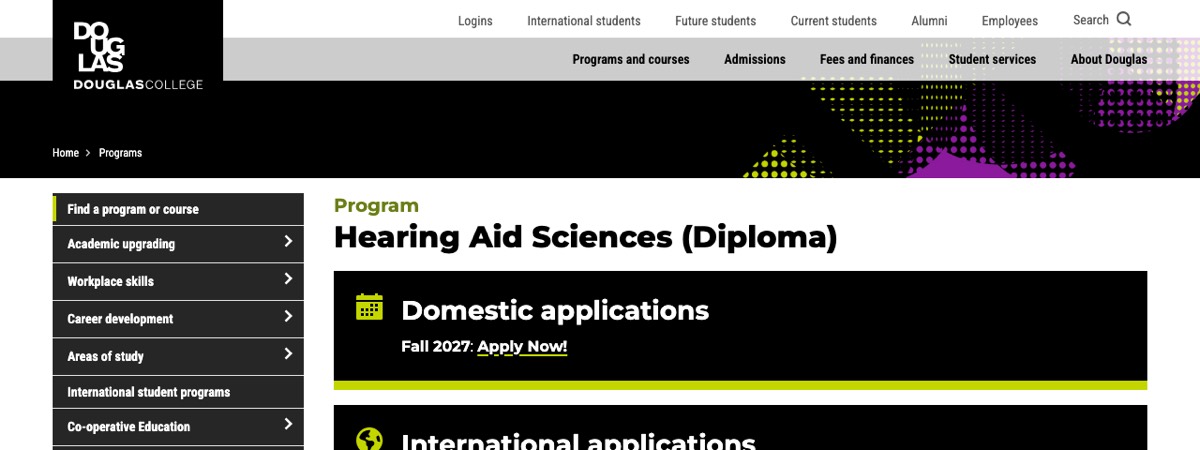
Hearing Aid Sciences (Diploma) is a 2-year in-person diploma from Douglas College in British Columbia.
| Provider | Douglas College |
|---|---|
| Length | Two years |
| Credential | Diploma |
| Format | in person, BC |
Fiona's take: Douglas College delivers this diploma in person in BC, preparing students for hearing instrument practice rather than audiologist registration. It suits BC residents who want a local, structured path into hearing aid dispensing. It is not a route to the CETP exam.
Skip it if: Skip it if you want audiologist practice, which requires the master's degree.
See Program DetailsHearing Instrument Specialist Program S117
Hearing Instrument Specialist Program S117 is a 3-year, 6-semester hybrid advanced diploma from George Brown College in Ontario, with domestic tuition of $5,083.
| Provider | George Brown College |
|---|---|
| Length | 3 years (6 semesters) |
| Cost (CAD) | Domestic Tuition: $5,083.00 * |
| Credential | Ontario College Advanced Diploma |
| Format | hybrid, ON |
Fiona's take: George Brown's S117 leads to an Ontario College Advanced Diploma in a hybrid format, which helps students who need some schedule flexibility. The stated domestic tuition figure of $5,083 makes it one of the few programs here with a published price. It trains hearing instrument specialists, not audiologists.
Skip it if: Skip it if the 3-year timeline is too long for a diploma-level outcome.
See Program DetailsHearing Instrument Specialist
Hearing Instrument Specialist is a 4-semester in-person diploma from Humber Polytechnic in Ontario.
| Provider | Humber Polytechnic |
|---|---|
| Length | 4 semesters |
| Credential | Diploma |
| Format | in person, ON |
Fiona's take: Humber's program is a 4-semester in-person Ontario diploma. It targets the same hearing instrument specialist role as the George Brown and MacEwan programs. Confirm intake details with the college directly before applying.
Skip it if: Skip it if you cannot attend in person in Ontario.
See Program DetailsHearing Aid Practitioner (Diploma)
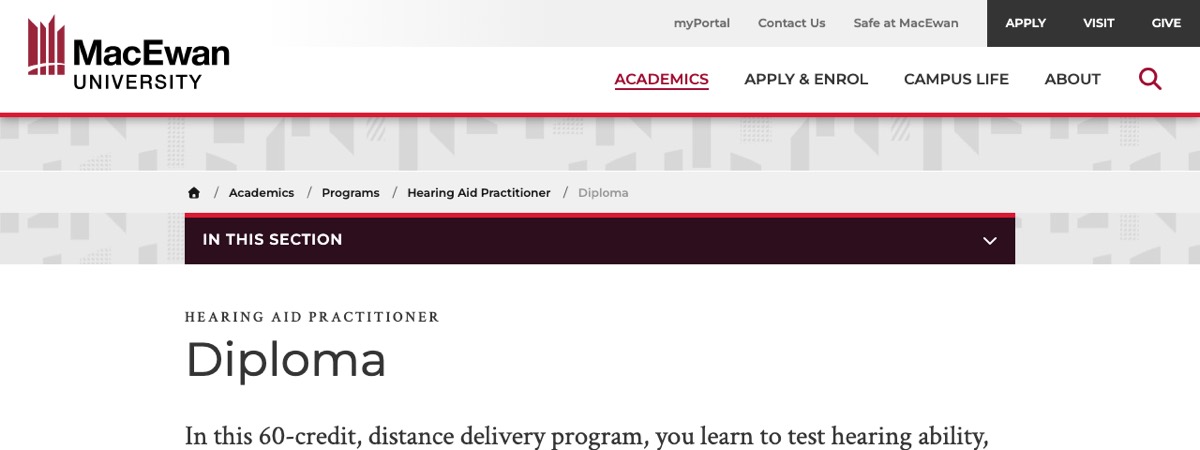
Hearing Aid Practitioner (Diploma) is a 2-year online diploma from MacEwan University in Alberta, with labs and placement, extendable to 7 years part-time.
| Provider | MacEwan University |
|---|---|
| Length | Two years full-time; up to seven years part-time |
| Credential | Diploma |
| Format | online (with labs and placement), AB |
Fiona's take: MacEwan's diploma is online with labs and placement, two years full-time or up to seven years part-time. The route costs $14,000 to $20,000 in total. Graduates register with provincial hearing aid practitioner colleges, not audiology regulators.
Skip it if: Skip it if you want the full audiologist scope of practice, which stays behind the master's degree.
See Program DetailsAudiology (MSc)
Audiology (MSc) is a 3-year in-person master's program from Dalhousie University in Nova Scotia.
| Provider | Dalhousie University |
|---|---|
| Length | 3 years |
| Credential | MSc |
| Format | in person, NS |
Fiona's take: Dalhousie offers the only 3-year audiology program in Canada, with hands-on clinical learning, and it is accredited by the Council for Accreditation of Canadian University Programs in Audiology and Speech-Language Pathology (CACUP-ASLP). The 3-year format is the longest listed master's. It is a full entry-to-practice route.
Skip it if: Skip it if you want a shorter accredited path, such as a 2-year master's.
See Program DetailsMaster of Science in Audiology
Master of Science in Audiology is a 2-year in-person master's program from the University of British Columbia.
| Provider | University of British Columbia |
|---|---|
| Length | 2 years |
| Credential | MSc |
| Format | in person, BC |
Fiona's take: UBC's in-person MSc in BC spans 2 years; an MSc degree is required for registration and/or certification to practise in Canada. For applicants with strong prerequisites, it is one of the shorter routes toward registration. Tuition across accredited master's programs runs $20,000 to $60,000 total.
Skip it if: Skip it if you are outside BC and want a program closer to home, such as Dalhousie or Ottawa.
See Program DetailsMaîtrise ès sciences de la santé en audiologie
Maîtrise ès sciences de la santé en audiologie is a 2-year in-person master's program from the University of Ottawa, studied over six consecutive trimesters.
| Provider | University of Ottawa |
|---|---|
| Length | six trimestres consécutifs, soit deux années d'études à temps plein |
| Credential | MHSc |
| Format | in person, ON |
Fiona's take: Ottawa's MHSc runs six consecutive trimesters, or two full-time years, and sits in a bilingual city. It is a master's-level audiology program, the level entry-to-practice sits at in Canada. Check language of instruction details with the university before applying.
Skip it if: Skip it if you want the extra year that Dalhousie's 3-year format provides.
See Program DetailsHow Much Does An Audiology Degree Cost In Canada?
The master's tuition is only part of the bill: the CETP exam and provincial registration add costs on top, and the fee schedule changed in 2026.
| Item | Cost (CAD) |
|---|---|
| Bachelor's degree (prerequisites) | 20,000-40,000 |
| Master's in Audiology tuition (2-3 years) | 20,000-60,000 |
| CETP Exam per attempt | 1,325 effective April 1, 2026 (1,135 before) |
| Provincial registration, initial | 500-1,500 |
| Annual registration renewal | 400-650 |
| Hearing Aid Practitioner Diploma route (alternative) | 14,000-20,000 |
The exam fee alone is worth flagging: $1,325 per attempt effective April 1, 2026, with up to 3 attempts. Retake risk is a real budget item, not a hypothetical one.
The $14,000 to $20,000 diploma figure belongs to the hearing aid practitioner route. It does not lead to audiologist practice, so do not compare it directly with the master's tuition range.
How Much Does An Audiologist Earn In Canada?
Audiologists, classified under NOC 31112, earn a Canada median of $46.15 per hour, with the provincial spread running from $41.00 to $55.00, per Job Bank's November 19, 2025 update.
| Province | Median Hourly (CAD) |
|---|---|
| Alberta | 55.00 |
| Saskatchewan | 53.00 |
| Manitoba | 47.50 |
| New Brunswick | 47.14 |
| British Columbia | 47.00 |
| Nova Scotia | 46.93 |
| Prince Edward Island | 46.79 |
| Ontario | 46.70 |
| Newfoundland and Labrador | 45.00 |
| Canada median | 46.15 |
| Quebec | 41.00 |
Alberta at $55.00 and Saskatchewan at $53.00 sit well above the national median of $46.15, while Quebec at $41.00 sits below it. For relocation decisions, the spread is large enough to matter over a career.
The outlook supports the investment: projections show a strong risk of labour shortage for audiologists nationally over 2026-2035, though it varies by province. That is the demand picture behind the tuition and exam fees.
Is An Audiology Degree Worth It In 2026?
The economics lean positive: $20,000 to $60,000 in master's tuition buys entry to a regulated profession with a $46.15 national median wage, at $55.00 in Alberta, and a strong risk of labour shortage through 2026-2035. The data show a $46.15 national median wage and a strong national shortage-risk outlook for audiologists.
The trade-offs are time and rigidity. There is no online or 1-year entry-to-practice option; programs run 2 to 3 years in person with clinical components, and the full sequence includes a 4-year bachelor's, the master's itself, the CETP exam and provincial registration. You also carry exam and registration costs, $1,325 per CETP attempt effective April 1, 2026 plus $500 to $1,500 to register initially.
My verdict: worth it for patient-focused graduates with the prerequisites and the flexibility to study in person for 2 to 3 years. Not worth it for anyone who mainly wants to fit hearing aids, where the 2-year hearing aid practitioner diploma at $14,000 to $20,000 is the better-fit credential.
Audiology Degree Questions Canadians Ask
What Is The Minimum Education To Become An Audiologist In Canada?
Is There A Doctor Of Audiology (Au.D.) Program In Canada?
Are There Online Or 1-Year Audiology Degree Options In Canada?
What Exam Is Required For Audiologist Registration?
How Much Does An Audiologist Make In Canada?
Is Audiology A Regulated Profession In Canada?
What Is The Job Outlook For Audiologists?
Can I Become An Audiologist With A Diploma Instead Of A Degree?
What's The Bottom Line On The Audiology Route In Canada?
- Canada has no Au.D. The entry-to-practice credential is an accredited 2-3 year master's in audiology, at $20,000 to $60,000 in tuition, followed by the CETP exam.
- Audiologists under NOC 31112 earn a $46.15 national median hourly wage, from $41.00 in Quebec to $55.00 in Alberta, with a strong risk of labour shortage projected through 2026-2035.
- Registration with a provincial college such as CASLPO, ACSLPA or the OOAQ is mandatory: budget $500 to $1,500 initially, $400 to $650 in annual renewal, and $1,325 per CETP attempt effective April 1, 2026.
- Before committing tuition, test the field with Hearing Loss in Children, the 2-week University of Michigan course rated 4.9 (60 ratings).
- If you want to fit hearing aids rather than diagnose hearing and balance disorders, the 2-year hearing aid practitioner diploma at $14,000 to $20,000 is the more direct credential.