
Key Takeaways
- The fastest realistic route is a 2-year accredited diploma program such as Mohawk's Ultrasonography Medical Radiation Sciences advanced diploma, which costs $20,000 to $50,000, followed by 3 to 6 months for Sonography Canada exams and 1 to 2 months for provincial registration.
- A licence is required in Ontario (CMRITO), Quebec (l'Ordre des technologues en imagerie médicale), Saskatchewan, Nova Scotia, and Alberta from July 6, 2026 through ACMDTT; British Columbia and Manitoba do not regulate sonography.
- Visualizing the Living Body: Diagnostic Imaging from Yale is a 1-3 month online course to test your interest in diagnostic imaging, but it does not qualify you for Sonography Canada exams or CMRITO registration.
- Job Bank lists a median wage of $42.00 per hour for medical sonographers (NOC 32122), ranging from $36.80 in New Brunswick to $46.11 in Alberta.
- Fiona's verdict: this path suits people with science prerequisites who want a two-year, hands-on diagnostic imaging career with outlook varying by province, not anyone hoping to licence through online study alone.
A diagnostic medical sonographer, often called an ultrasound technician, operates ultrasound equipment to produce and record images of the body so physicians can diagnose and treat patients. In Canada the real path is a 2-year accredited diploma, then Sonography Canada certification exams, then registration with a provincial regulator where one exists.
If you are searching for an ultrasound technician course in Ontario, the credential that matters is an Accreditation Canada EQual accredited program such as Mohawk, followed by CMRITO registration. Georgian and Conestoga also offer Ontario College Advanced Diploma programs; confirm current accreditation and exam eligibility before enrolling. An online course such as Yale's diagnostic imaging offering is a smart first test of interest, but it will never replace the diploma.
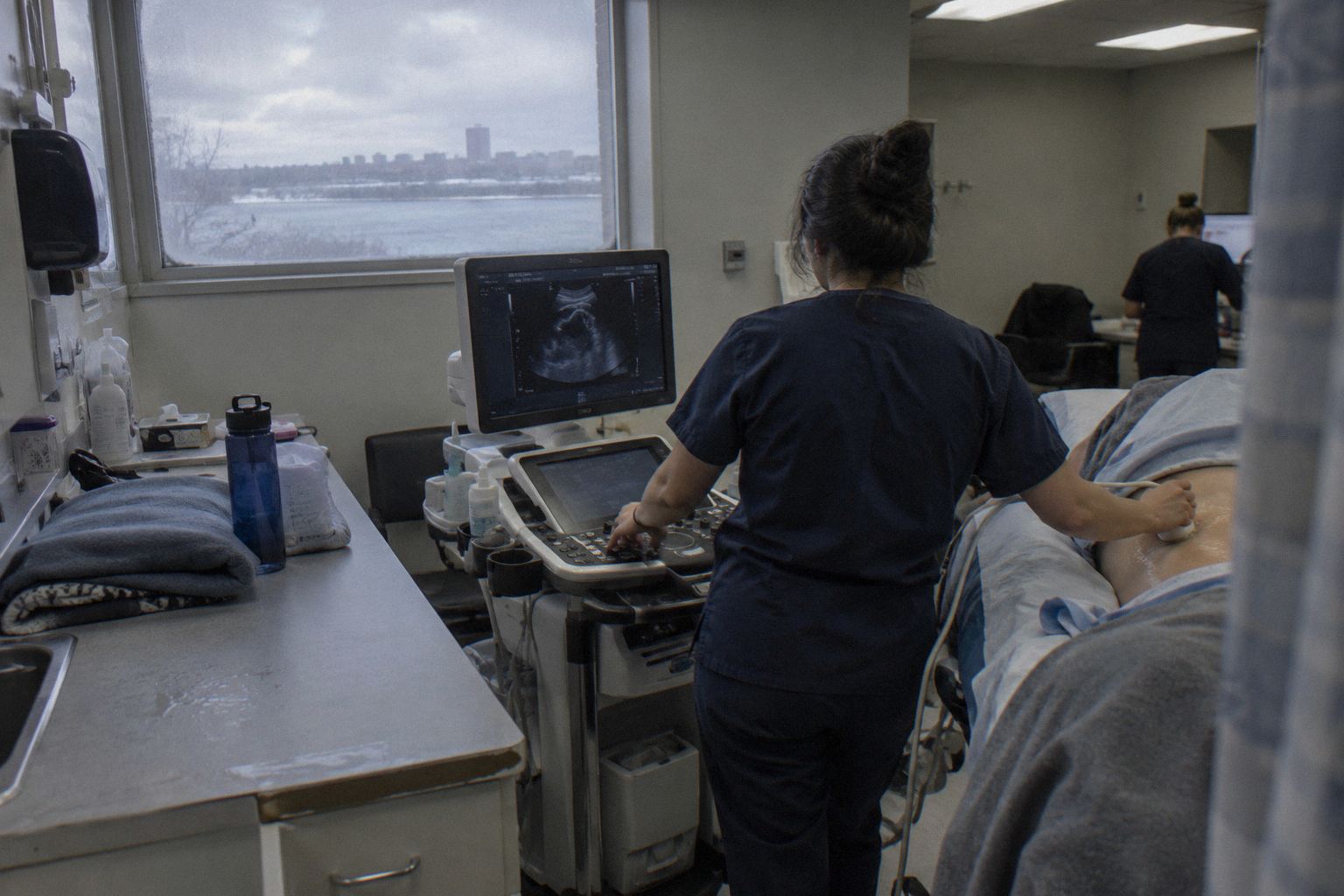
What Are The Ways To Become An Ultrasound Technician In Canada?
There are two career routes, plus optional online courses to test interest before committing to diploma tuition.
| Route | Time | Cost (CAD) | What You Get | Recognised By | Best For |
|---|---|---|---|---|---|
| Visualizing the Living Body: Diagnostic Imaging (test the field first) | 1-3 months | Not listed | A Yale certificate in diagnostic imaging fundamentals | No regulator; interest and theory only | Anyone unsure whether imaging suits them |
| Accredited college diploma program (generalist), e.g. Mohawk, NAIT, BCIT | 2 years | 20000-50000 | Ontario College Advanced Diploma + Sonography Canada CRGS eligibility | CMRITO, employers, Sonography Canada | New entrants with science prerequisites |
| Post-diploma sonography after an allied health program | 1 year post-diploma | 15000-30000 | Sonography Canada credential | Provincial regulators where applicable | Registered nurses, radiological technologists and other allied health professionals |
I recommend the 2-year accredited diploma for newcomers, the 1-year post-diploma route for allied health professionals who want to pivot, and the Yale course for anyone who has never stepped inside an imaging department.
What Is The Fastest Way To Become An Ultrasound Technician In Canada?
The fastest full route is usually 2 years plus 3 to 6 months for exams, and another 1 to 2 months for registration where required.
- Complete high school with sciences and math prerequisites, since accredited diploma programs screen on them.
- Enrol in and finish a 2-year accredited DMS diploma, for example Mohawk's Ultrasonography program, NAIT or BCIT, at a cost of $20,000 to $50,000.
- Complete the clinical practicum during the program; budget separately for the CCSA, listed at $2,000 plus the application fee.
- Pass the Sonography Canada exams, Core plus Generalist, at roughly $800 plus the application fee, over 3 to 6 months post-graduation.
- Register with your provincial regulator, for example CMRITO in Ontario, which takes 1 to 2 months plus application and annual fees.
- If you have already completed a two- to three-year program in a related allied health field, the 1-year post-diploma route in diagnostic medical sonography is the shortcut, at $15,000 to $30,000.
Do You Need A Licence To Work As An Ultrasound Technician In Canada?
Registration is mandatory in Ontario, Quebec, Saskatchewan and Nova Scotia today, and in Alberta from July 6, 2026, while British Columbia and Manitoba leave hiring requirements to employers.
| Province | Required? | Regulator Or Registry | What It Means |
|---|---|---|---|
| Ontario | Yes | College of Medical Radiation and Imaging Technologists of Ontario (CMRITO) | You must be registered with CMRITO to practise medical radiation and imaging technology |
| Quebec | Yes | Ordre des technologues en imagerie médicale, en radio-oncologie et en électrophysiologie médicale du Québec | Registration with l'Ordre is required to practise |
| Saskatchewan | Yes | Saskatchewan Association of Medical Radiation Technologists or equivalent | Registration required before practising |
| Nova Scotia | Yes | Nova Scotia College of Medical Imaging and Radiation Therapy Professionals (NSCMIRTP) | Registration required before practising |
| Alberta | Yes, effective July 6, 2026 | Alberta College of Medical Diagnostic and Therapeutic Technologists (ACMDTT) | All DMS practitioners must register and hold a valid practice permit |
| British Columbia | No | None; employers typically require a Sonography Canada credential | Each employer sets its own hiring requirements |
| Manitoba | No | None | Hiring requirements are set by employers |
In the four provinces that currently regulate, the licence and the Sonography Canada credential work together: the diploma makes you exam-eligible, the exams earn the credential, and the credential supports registration. British Columbia's WorkBC profile is blunt that each employer determines hiring requirements there, which in practice means a Sonography Canada credential.
Alberta's July 6, 2026 deadline matters for planning. If you start a 2-year diploma in fall 2026, you will graduate after regulation begins, so budget for ACMDTT registration on top of your exam fees.
Which Ultrasound Courses Are Worth Taking In Canada?
Only accredited diploma programs lead to registration, so treat short online courses as preparation or interest testing, not credentials. These are the ones I compare for clients.
Visualizing the Living Body: Diagnostic Imaging
Visualizing the Living Body: Diagnostic Imaging is a 1-3 month online course from Yale University that introduces how diagnostic imaging works across modalities.
| Provider | Yale University |
|---|---|
| Length | 1-3 months |
| Rating | 4.8 (391 reviews) |
| Credential | Certificate |
| Format | online |
Fiona's take: This is the course I put in front of clients who like the idea of imaging but have never seen an MRI or ultrasound study. At 4.8 with 391 reviews, it is the strongest low-commitment entry point in the pack. It does not qualify you for Sonography Canada exams, CMRITO registration or any provincial licence, and I never present it as a shortcut. Its job is to tell you, before tuition season, whether the physics and anatomy genuinely hold your attention.
Skip it if: Skip it if you are already enrolled in a diploma program or working in imaging, since it covers fundamentals you already have.
Start On CourseraUltrasound Physics + Instrumentation Review for SPI or RMSK
Ultrasound Physics + Instrumentation Review for SPI or RMSK is an online Udemy course from Brandon Ramakko that reviews the physics core of sonography credentialing exams.
| Provider | Brandon Ramakko |
|---|---|
| Rating | 4.8 (3 ratings) |
| Format | online |
Fiona's take: Rated 4.8 with 3 ratings, this is a narrow, targeted review tool. I recommend it to diploma students in the term before physics-heavy exams, because ultrasound physics is where strong students stall. It is exam prep, not education from scratch.
Skip it if: Skip it if you have not yet started a sonography program, since it assumes baseline imaging vocabulary.
View On UdemyDiagnostic Medical Sonographer (RDMS) Practice Tests
Diagnostic Medical Sonographer (RDMS) Practice Tests is an online Udemy course from Edu Viking with practice questions for the RDMS credentialing exam.
| Provider | Edu Viking |
|---|---|
| Format | online |
Fiona's take: Practice questions are the most direct form of exam drilling I know, and this is a full bank of them. The RDMS is an American credential, so Canadian students should pair it with Sonography Canada Core and Generalist materials rather than treat it as a syllabus.
Skip it if: Skip it if you want teaching rather than drill, since it assumes you have already learned the content.
View On UdemyEchocardiography for the non Cardiologist
Echocardiography for the non Cardiologist is a 2.5-hour online Udemy course from Mohamed El Wazir that explains cardiac ultrasound reading for clinicians outside cardiology.
| Provider | Mohamed El Wazir |
|---|---|
| Length | 2.5 hours |
| Rating | 4.6 (408 ratings) |
| Credential | Certificate of completion |
| Format | online |
Fiona's take: At 4.6 with 408 ratings, this suits physicians, nurses and allied health readers. It is a short 2.5-hour course on basic echocardiography and common cardiac conditions; it is not a sonography diploma or registration route.
Skip it if: Skip it if you are a generalist sonography student rather than someone interpreting echo studies.
View On UdemyDiagnostic Medical Sonography Diploma
Diagnostic Medical Sonography Diploma is a 2-year on-campus program from Red Deer Polytechnic in Alberta leading to a diploma.
| Provider | Red Deer Polytechnic |
|---|---|
| Length | 2 Years |
| Credential | Diploma |
| Format | on campus, AB |
Fiona's take: Red Deer Polytechnic positions you in a province where ACMDTT registration becomes mandatory on July 6, 2026, so graduating into a regulated market is a planning advantage. It is a full diploma route, not a test-the-water option.
Skip it if: Skip it if you are outside Alberta and want a program with local practicum placements in your own province.
See Program DetailsDiagnostic Medical Ultrasound Technology
Diagnostic Medical Ultrasound Technology is a 4-year in-person program at Dalhousie University in Nova Scotia leading to a Bachelor of Health Sciences, with a diploma option after Year 3.
| Provider | Dalhousie University |
|---|---|
| Length | 4 years (BHSc) or diploma after Year 3 |
| Credential | Bachelor of Health Sciences or Diploma |
| Format | in person, NS |
Fiona's take: Dalhousie is the academic heavyweight here: a BHSc for students who want a BHSc option rather than only the diploma route, and a diploma exit after Year 3 for those who want to get working. I recommend it for Atlantic Canada clients who want the degree kept open.
Skip it if: Skip it if speed is your priority, since the diploma routes finish a year sooner.
See Program DetailsDiagnostic Medical Sonography
Diagnostic Medical Sonography is a 2-year in-person Ontario College Advanced Diploma at Georgian College.
| Provider | Georgian College |
|---|---|
| Length | 2 Years |
| Credential | Ontario College Advanced Diploma |
| Format | in person, ON |
Fiona's take: Georgian and Conestoga offer Ontario College Advanced Diploma programs; confirm current accreditation and exam eligibility before enrolling. For clients in the Barrie area, staying local for the advanced diploma can beat relocating, provided accreditation and practicum placements line up.
Skip it if: Skip it if you need hybrid delivery, since this program is fully in person.
See Program DetailsDiagnostic Medical Sonography
Diagnostic Medical Sonography is a 2-year hybrid advanced diploma program at the Michener Institute in Ontario.
| Provider | Michener Institute |
|---|---|
| Length | 2 Years |
| Credential | Advanced Diploma |
| Format | hybrid, ON |
Fiona's take: Michener is a 2-year hybrid advanced diploma in Ontario and its quote says it is accredited. For clients balancing work or family, hybrid delivery can make a 2-year commitment more workable.
Skip it if: Skip it if you learn best hands-on in a lab from week one, since part of the theory is delivered online.
See Program DetailsDiagnostic Medical Sonography
Diagnostic Medical Sonography is a 2-year, 5-term Ontario College Advanced Diploma at Conestoga College delivered in person.

| Provider | Conestoga College |
|---|---|
| Length | 2 years (5 terms) |
| Credential | Ontario College Advanced Diploma |
| Format | in person, ON |
Fiona's take: Conestoga compresses the credential into five terms over two years in Kitchener. Georgian and Conestoga offer Ontario College Advanced Diploma programs; confirm current accreditation and exam eligibility before enrolling, since eligibility for the credentialing exams depends on it.
Skip it if: Skip it if you cannot commit to five consecutive terms of in-person study.
See Program DetailsDiagnostic Medical Sonographer
Diagnostic Medical Sonographer is a 19-20 month Ontario College Advanced Diploma at CNIH, delivered hybrid or in person.
| Provider | CNIH |
|---|---|
| Length | 19-20 Months |
| Credential | Ontario College Advanced Diploma |
| Format | hybrid or in-person, ON |
Fiona's take: CNIH is the shortest diploma on this list at 19 to 20 months, which matters if you want to reach the exam stage a term early. Confirm current accreditation status directly before enrolling, since accreditation is what unlocks Sonography Canada exam eligibility.
Skip it if: Skip it if accreditation confirmation does not come back clean, since a non-accredited path blocks the credential.
See Program DetailsHow Much Does An Ultrasound Course Cost In Canada?
An accredited 2-year sonography diploma costs $20,000 to $50,000 all-in, and the credentialing stack on top runs over $3,000 when you add exams and the skills assessment.
| Item | Cost (CAD) |
|---|---|
| Accredited 2-year diploma program (e.g. Mohawk) | 20000-50000 |
| Post-diploma program after an allied health credential | 15000-30000 |
| Sonography Canada exam application fee | 200 |
| Generalist exam (NCP 6.1) | 600 plus the application fee |
| Canadian Clinical Skills Assessment (CCSA) | 2000 plus the application fee |
| CMRITO annual registration (Ontario example) | Varies, in the hundreds |
The diploma dominates the bill, but the exam layer is not trivial. The $200 application fee is non-refundable, the Generalist exam is $600 on top of it, and the CCSA costs $2,000 plus the application fee. Budget for all of it before you graduate, not after.
Ontario clients should apply to OSAP, since Mohawk's Ultrasonography program is OSAP eligible. A diploma funded by OSAP is still debt: it must be repaid, so weigh a $20,000 to $50,000 program against a median wage of $42.00 per hour when deciding.
How Much Does An Ultrasound Technician Earn In Canada?
Medical sonographers, NOC 32122, have a Job Bank median of $42.00 per hour nationally, with Alberta the highest listed province at $46.11.
| Province | Median Hourly (NOC 32122) |
|---|---|
| Alberta | 46.11 |
| British Columbia | 44.19 |
| Saskatchewan | 43.95 |
| Newfoundland and Labrador | 42.57 |
| Canada median | 42.00 |
| Manitoba | 40.93 |
| Ontario | 40.16 |
| Nova Scotia | 39.17 |
| Quebec | 38.73 |
| New Brunswick | 36.80 |
The provincial spread is real: $46.11 in Alberta against $36.80 in New Brunswick is nearly a $10 gap per hour. Ontario's $40.16 median is near the national line, which is why Ontario clients should weigh program cost against local wages rather than national averages.
Outlook is reported as good to moderate depending on province, with high demand noted in some sources.
Is Becoming An Ultrasound Technician Worth It In 2026?
On the numbers, yes for the right person. The pack lists a $42.00 national median wage and $20,000 to $50,000 typical diploma cost; compare this with your province's wages and program costs. This is a hands-on diagnostic imaging career with a defined licence path, and outlook varies by province.
The honest caveat is the entry bar. There is no online shortcut to CMRITO registration or Sonography Canada certification, so this path demands two years of full-time study, clinical placements and physics exams. If that commitment is not realistic, the allied health route in, followed by a 1-year post-diploma program at $15,000 to $30,000, is the smarter sequencing.
Test the interest before the tuition. Yale's Visualizing the Living Body is a 1-3 month online certificate that shows you whether imaging anatomy and physics genuinely hold your attention before you commit $20,000 to $50,000 to a diploma. I would never let a client spend that on a guess a short course could have tested first.
Can You Get Funding For An Ultrasound Program In Canada?
Ontario has one confirmed funding channel in this pack, and it applies to the diploma route, not to short courses.
- OSAP (Ontario Student Assistance Program). Mohawk's Ultrasonography Medical Radiation Sciences advanced diploma is listed as OSAP eligible, so Ontario students can apply for provincial assistance against the $20,000 to $50,000 program cost. Check OSAP directly for grant and loan amounts and repayment terms.
Ultrasound Technician Questions Canadians Ask
How Long Does It Take To Become An Ultrasound Technician In Canada?
Becoming an ultrasound technician typically takes 2 years through an accredited diploma program, plus 3 to 6 months for Sonography Canada certification exams. Add 1 to 2 months for provincial registration where a regulator exists, for example CMRITO in Ontario. If you have already completed a two- to three-year program in a related allied health field, a 1-year post-diploma program is the faster entry.
What Is The Salary For A Diagnostic Medical Sonographer In Canada?
The Job Bank median for medical sonographers, NOC 32122, is $42.00 per hour nationally. Provincially, the listed medians range from $36.80 in New Brunswick to $46.11 in Alberta, with Ontario at $40.16, British Columbia at $44.19 and Saskatchewan at $43.95. Demand is reported as good to moderate depending on province.
Is Sonography Regulated In Ontario?
Sonography in Ontario is regulated through the College of Medical Radiation and Imaging Technologists of Ontario (CMRITO). You must be registered with CMRITO to practise medical radiation and imaging technology in the province, which means completing an accredited program, passing Sonography Canada exams and applying to the College.
Do I Need Sonography Canada Certification?
Sonography Canada certification is usually required by employers across Canada and is mandatory for registration in the regulated provinces: Ontario, Quebec, Saskatchewan and Nova Scotia, plus Alberta from July 6, 2026. In British Columbia and Manitoba each employer sets hiring requirements, and a Sonography Canada credential is the standard benchmark.
What Programs Are Accredited For Sonography In Canada?
Accreditation Canada EQual accredited programs at colleges like Mohawk, NAIT and BCIT prepare graduates for Sonography Canada exams. In Ontario, Michener, Georgian and Conestoga also offer the Ontario College Advanced Diploma route. Always confirm current accreditation status with the program before you enrol, since eligibility for the credentialing exams depends on it.
How Much Does A Sonography Program Cost In Ontario?
A sonography program in Ontario typically costs $20,000 to $51,000 in total, including tuition, books and fees, for a 2-year diploma. On top of that, budget roughly $800 for the Sonography Canada Core plus Generalist exams, $200 for the non-refundable application fee, and $2,000 plus the application fee for the Canadian Clinical Skills Assessment.
When Does Regulation Start In Alberta?
Regulation of diagnostic medical sonographers in Alberta starts effective July 6, 2026. From that date, all individuals practising as a DMS in any specialty must be registered with the Alberta College of Medical Diagnostic and Therapeutic Technologists (ACMDTT) and hold a valid practice permit.
Can I Become An Ultrasound Technician Online?
You cannot become a registered ultrasound technician in Canada through online study alone. Accredited diploma programs such as Michener's hybrid delivery blend online theory with in-person clinical training, and the Canadian Clinical Skills Assessment requires demonstrated scanning competence. Online courses like Yale's diagnostic imaging offering are for interest and theory, not registration.
What's The Bottom Line On Ultrasound Courses In Canada?
- For newcomers, the main route is a 2-year accredited diploma: $20,000 to $50,000 at programs like Mohawk, NAIT or BCIT, followed by Sonography Canada exams at about $800 plus fees. Allied health graduates may use a 1-year post-diploma route at $15,000 to $30,000.
- Ontario requires CMRITO registration to practise; Quebec, Saskatchewan and Nova Scotia also regulate, and Alberta joins through ACMDTT on July 6, 2026. British Columbia and Manitoba do not regulate.
- Visualizing the Living Body: Diagnostic Imaging from Yale is the 1-3 month first step to test your interest in imaging, but it does not qualify you for any exam or licence.
- Job Bank puts medical sonographers, NOC 32122, at a $42.00 per hour median nationally, from $36.80 in New Brunswick to $46.11 in Alberta.
- Fiona's verdict: this career suits science-prerequisite students ready for two years of full-time, hands-on study, and it does not suit anyone hoping to licence through online courses.